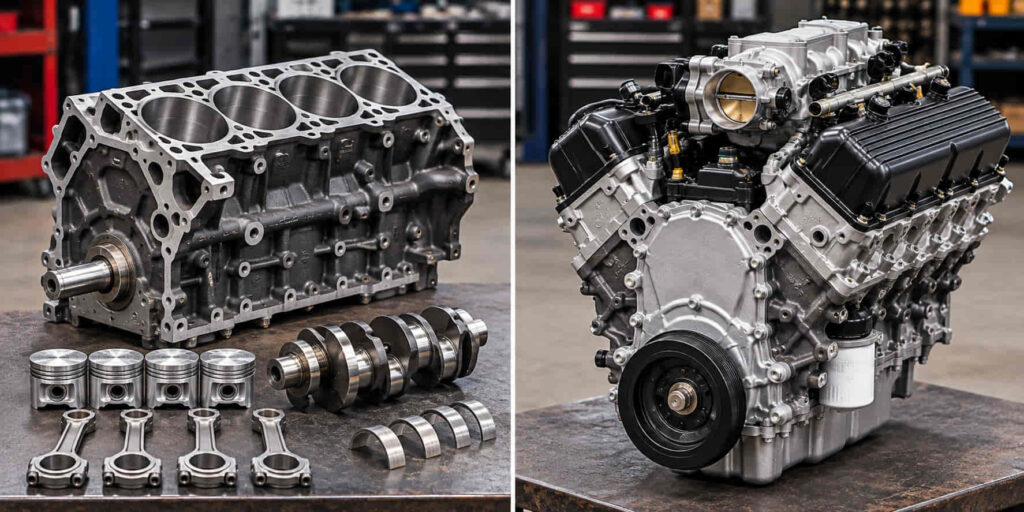
The main difference between a short block vs long block engine is the number of assembled components included with the replacement engine. A short block contains the engine block and its lower rotating assembly, including the crankshaft, connecting rods, pistons, piston rings, and bearings. A long block includes these same components plus the cylinder head or heads and assembled valvetrain, with camshafts and related timing components included according to the engine design and supplier specifications.
A short block is generally less expensive to purchase but requires more assembly work. A long block costs more initially but usually reduces installation complexity because the cylinder heads and valvetrain are already assembled. For most standard engine replacements, a compatible long block is the more convenient choice, while a short block can provide better value when the original cylinder heads are in excellent condition or when building a customized performance engine.
However, neither term describes whether an engine is new, rebuilt, remanufactured, or used. A short block and a long block can be sold in any of these conditions. The terms refer to how much of the mechanical engine assembly is included, not the quality of the restoration or the engine’s physical length.
Understanding the differences in included components, installation labor, total replacement cost, reliability, and compatibility is essential before selecting an engine for a car, pickup truck, diesel vehicle, or performance project.
What Is the Difference Between a Short Block and Long Block?
A short block includes the engine’s lower assembly, while a long block adds the cylinder heads and valvetrain needed to complete the core mechanical engine. This is the fundamental distinction used by engine manufacturers, rebuilders, and replacement parts suppliers.
The short block serves as the engine’s mechanical foundation. It contains the cylinder block, crankshaft, connecting rods, pistons, piston rings, and the bearings supporting the rotating assembly. Some short blocks also include additional components, depending on the manufacturer’s package.
A long block begins with the same lower assembly and adds the upper engine components. These generally include the cylinder heads, intake and exhaust valves, valve springs, and the components needed to operate the valves.
Camshaft inclusion depends partly on engine architecture. On an overhead-cam engine, the camshafts are located in the cylinder heads and are normally part of an assembled long block. On a traditional pushrod engine, the camshaft sits inside the block and may already be included with certain short block assemblies.
The distinction matters because the additional components represent substantial parts and labor costs.
When purchasing a short block, the customer must provide, inspect, and install the cylinder heads and related components. With a long block, much of this work has already been completed by the engine supplier.
However, a long block is not necessarily ready to install and start. Intake manifolds, fuel injectors, turbochargers, sensors, and other external components may still need to be transferred or purchased separately.
The exact included components must always be confirmed with the supplier.
What Is a Short Block Engine?
A short block engine is an assembled lower engine unit containing the cylinder block and the principal rotating components responsible for converting combustion pressure into crankshaft rotation.
The engine block provides the main structure. It contains the cylinder bores, crankshaft bearing supports, coolant passages, and oil galleries.
The crankshaft rotates inside the block and converts the pistons’ reciprocating movement into usable rotational power. Connecting rods transfer force between the pistons and crankshaft.
Pistons move inside the cylinder bores, while piston rings help seal combustion pressure and control oil movement.
Main bearings and connecting rod bearings allow the crankshaft and connecting rods to operate with appropriate oil-film clearance.
In a typical short block, these components are already assembled. The buyer does not normally need to install individual pistons or assemble the crankshaft from separate parts.
However, the package does not generally include cylinder heads or a complete valvetrain.
This means the short block cannot operate as a complete internal combustion engine until the upper engine components are installed.
The exact scope varies.
Ford Performance, for example, markets a 5.0-liter Gen 3 Coyote Aluminator short block with forged pistons, upgraded connecting rods, and a forged crankshaft.
That particular product is supplied ready for the installation of cylinder heads, camshafts, timing components, and the oil system. Its oil pump and oil pan are not included.
Other short block suppliers may include a camshaft, timing set, or oil pump.
A short block is therefore best understood as a partially assembled engine rather than a standardized package with identical contents across all manufacturers.
What Is a Long Block Engine?
A long block engine is a more complete mechanical engine assembly containing the short block, cylinder heads, and assembled valvetrain. It is designed to reduce the amount of internal engine assembly required during replacement.
The cylinder heads seal the upper ends of the cylinders and contain the passages through which intake air and exhaust gases enter and leave the combustion chambers.
They also support components responsible for controlling valve operation.
Depending on the engine, these components can include camshafts, rocker arms, valve springs, hydraulic lifters, pushrods, and timing mechanisms.
The long block therefore includes substantially more of the engine’s functional mechanical structure than a short block.
For a modern overhead-cam engine, an assembled long block typically includes the camshafts installed in the cylinder heads.
For a pushrod engine, it generally includes the internal camshaft and the remaining valvetrain components required by the design.
However, the amount of external equipment supplied varies considerably.
Some long blocks include valve covers, an oil pump, oil pan, timing cover, or other finishing components.
Others omit these parts.
JASPER, for example, defines a conventional long block as including the block, cylinder heads, camshaft, and valvetrain. Its more complete remanufactured gasoline engine format adds components such as the oil pan, timing cover, and finishing gasket set.
This distinction demonstrates that a long block is not always the most complete engine replacement offered by a supplier.
The long block is particularly useful when the original engine has damage affecting both the lower rotating assembly and cylinder heads.
It is also attractive when the condition of the original cylinder heads is unknown or when the owner wants to avoid paying for separate cylinder head restoration.
What Parts Are Included in a Short Block vs Long Block?
Both assemblies normally include the engine block, crankshaft, connecting rods, pistons, piston rings, and bearings. The cylinder heads and assembled valvetrain are the major additional components found in a long block.
These lower engine components are responsible for containing combustion forces and transmitting power to the crankshaft.
They must be manufactured and assembled within precise dimensional tolerances.
Crankshaft bearing clearances affect lubrication and durability. Piston-to-cylinder clearances influence friction, thermal expansion, and cylinder sealing.
These dimensions must be correct regardless of whether the engine is sold as a short block or long block.
The long block adds components that control airflow into and out of the cylinders.
Cylinder heads contain the valves, combustion chamber features, and associated passages.
The valvetrain operates the valves at the correct points in the four-stroke cycle.
Depending on the design, this may involve overhead camshafts or a block-mounted camshaft operating the valves through pushrods.
Head gaskets and fasteners are also necessary to assemble the upper and lower engine sections.
However, they may not be supplied separately with a short block.
A long block generally arrives with its cylinder heads already installed, meaning the corresponding head gaskets and fasteners have been used during assembly.
External equipment is a separate consideration.
The intake manifold, exhaust manifold, fuel injectors, engine sensors, alternator, starter, air-conditioning compressor, and turbocharger are not automatically included with either configuration.
Certain long block packages include more equipment than others.
Therefore, the manufacturer’s actual bill of materials is more important than assuming every long block or short block contains the same components.
Does a Long Block Include the Oil Pan, Timing Cover, and Water Pump?
A long block may include an oil pan, timing cover, oil pump, or water pump, but these components are not universally included. Their presence depends on the engine manufacturer, replacement package, and product specification.
This is one of the most common sources of confusion during engine replacement.
A buyer may assume that a long block includes every mechanical component except the external accessories.
However, the term only establishes that the upper engine components are assembled with the lower block.
The oil pan is important because it stores the engine’s lubricant.
The oil pump draws oil from the sump and distributes it through internal passages to protect the crankshaft bearings, camshaft components, and other moving surfaces.
The timing cover protects the timing mechanism and provides sealing around the front of the engine.
The water pump circulates coolant through the engine and cooling system.
These components may be installed on some long blocks but omitted from others.
For example, a supplier may offer a conventional long block without an oil pan so the installer can transfer the correct vehicle-specific sump.
Another supplier may sell a more complete engine with the oil pan and front cover already attached.
The distinction can affect installation labor and parts compatibility.
Two vehicles using the same basic engine may require different oil pans because of chassis clearance or engine mounting arrangements.
A replacement water pump may also differ according to accessory drive configuration.
Before ordering, the buyer should confirm the exact components included and identify which original parts must be reused.
A photograph of a product should not be treated as a definitive list of included components.
The written product description and part number should determine what is supplied.
Short Block vs Long Block vs Complete Engine
A short block contains the lower engine assembly, a long block includes the assembled upper and lower mechanical components, and a complete engine generally adds more external systems required for installation and operation.
A complete engine is sometimes called a dressed engine or running-complete engine.
However, these terms also require careful interpretation.
A running-complete diesel engine may include major fuel injection components, turbocharging equipment, an intake manifold, and other systems needed for controlled factory testing.
JASPER’s running-complete diesel engine program provides an example.
Its typical configuration includes the block, cylinder heads, valve covers, oil pump, oil pan, timing cover, fuel injection pump, injectors, turbocharger when applicable, intake manifold, water pump, and oil cooler.
However, JASPER explicitly notes that component inclusion varies by engine application.
Some components may remain excluded even from a running-complete package.
A complete gasoline engine may also be supplied with additional equipment, but it does not necessarily include the alternator, starter, exhaust system, wiring harness, or every sensor.
The term turnkey is usually associated with a more comprehensive package intended to simplify operation or installation.
However, even a turnkey engine may require compatible vehicle wiring, cooling components, fuel supply, and exhaust connections.
The distinction is especially important for engine swaps.
A long block from a compatible production vehicle may provide the correct internal engine but still require extensive parts transfer.
A crate engine sold with additional components may reduce some of that work.
When comparing quotations, the buyer should determine whether the products are short blocks, conventional long blocks, complete engines, or specialized crate engine packages.
Different levels of assembly should not be compared solely by their advertised purchase prices.
How Does Engine Design Affect Short Block and Long Block Components?
The contents of a short block or long block depend partly on whether the engine uses an overhead-valve, single-overhead-cam, or dual-overhead-cam design.
A conventional pushrod V8 provides a useful example.
Many Chevrolet small block V8 engines use a camshaft located inside the cylinder block.
The camshaft operates valves in the cylinder heads through lifters, pushrods, and rocker arms.
Because the camshaft sits in the block, certain short block packages include it.
However, a complete pushrod valvetrain still requires the cylinder heads and additional components.
An overhead-cam engine is arranged differently.
Its camshafts are mounted in the cylinder heads rather than within the lower block.
A short block for this engine normally contains the lower rotating assembly without the camshafts.
When purchasing a long block, the assembled cylinder heads typically include the relevant camshafts and valve components.
A dual-overhead-cam V6 or V8 may have several camshafts, multiple timing chains, tensioners, and variable valve timing components.
The complete valvetrain can represent substantial manufacturing and assembly expense.
This is one reason why the difference between a short block and a long block can be especially significant for modern multivalve engines.
Engine-specific compatibility also matters.
Cylinder head designs may change during the production life of an engine family.
Ford’s Coyote V8, for example, has undergone several generations of cylinder head, camshaft, and timing system development.
Components from different generations are not always interchangeable without specific matching parts or adjustments.
When selecting a replacement short block, the existing cylinder heads and timing components must be compatible with the new lower engine assembly.
Short Block vs Long Block Cost: Which Is Cheaper?
A short block generally has a lower initial purchase price because it includes fewer components, while a long block usually costs more because it adds assembled cylinder heads and valvetrain equipment.
However, the lower purchase price does not guarantee a lower final repair bill.
The short block buyer must still provide the upper engine components.
If the original cylinder heads are reusable, they must be inspected and prepared for installation.
This may involve cleaning, checking for cracks, measuring surface flatness, inspecting valve guides, testing valve sealing, and replacing worn components.
Cylinder head resurfacing or valve work can increase the cost substantially.
The engine also requires head gaskets, fasteners, and other necessary assembly components.
Additional labor is needed to install and correctly time the upper engine assembly.
A long block incorporates much of this work into the supplier’s production process.
Its purchase price is higher because the cylinder heads and valvetrain have already been restored or assembled.
However, the installer generally spends less time performing internal engine assembly.
The exact cost difference depends on the engine.
A simple pushrod four-cylinder may have relatively inexpensive cylinder head components.
A modern dual-overhead-cam V8 with variable valve timing may require substantial additional labor and parts when assembled from a short block.
The condition of the original engine also matters.
If the cylinder heads are damaged or severely worn, the cost of restoring them can eliminate much of the apparent savings from purchasing a short block.
The correct financial comparison is the complete installed cost, including parts, machining, labor, shipping, core charges, and necessary supporting repairs.
Why Can a Short Block Cost More to Install?
A short block can require more installation labor because the cylinder heads, valvetrain, timing system, and additional components must be inspected, assembled, and adjusted before the engine is ready for operation.
Installing a short block is not simply a matter of replacing one assembled engine with another.
The technician must establish the condition of the original upper engine components.
Cylinder heads may require cleaning and pressure testing.
Valve guides and valve seats must be inspected for excessive wear or damage.
The head gasket surfaces must meet the required specifications.
After inspection, the cylinder heads must be installed using the appropriate sealing components and fastening procedures.
Certain engines require new torque-to-yield cylinder head bolts.
Others use different fastener arrangements or specialized tightening procedures.
The camshaft timing must also be established correctly.
An error in mechanical timing can cause poor performance, a no-start condition, or internal engine damage.
On interference engines, incorrect valve timing may allow contact between the pistons and valves.
Modern variable valve timing systems introduce additional complexity.
Camshaft phasers, timing chains, tensioners, and associated components may require specific installation procedures.
A long block generally arrives with the main mechanical upper and lower engine sections assembled.
This reduces the amount of precision assembly performed during vehicle installation.
However, it does not remove the need to install or inspect external components.
The labor advantage therefore depends on the replacement engine package and the condition of the original accessories.
For routine engine replacement, a long block can reduce assembly time and some installation risks.
When Should You Choose a Short Block Engine?
A short block is often the better choice when the engine’s lower rotating assembly is damaged but the cylinder heads and valvetrain remain in good condition and are economical to reuse.
Consider an engine that develops a damaged crankshaft bearing while the cylinder heads remain mechanically sound.
If the failure has not contaminated or damaged the upper engine components, replacing the lower assembly may be practical.
However, the cause of the bearing failure must be identified first.
Oil starvation or severe metal contamination may affect components throughout the engine.
A short block is also useful for specialized engine rebuilding projects.
An experienced engine builder may want to select particular cylinder heads, camshafts, valve springs, or other performance components.
Purchasing an assembled short block allows the builder to focus on developing the upper engine combination.
Performance short blocks may contain upgraded pistons, connecting rods, crankshafts, or other internal components.
These assemblies can support higher performance targets when combined with suitable cylinder heads, fuel delivery, and engine management.
Short blocks can also be appropriate for restoration work.
A classic vehicle owner may want to retain the original cylinder heads or maintain a particular historical engine configuration.
However, this approach requires a qualified technician or engine builder.
The condition of reused parts must be verified rather than assumed.
A short block is less attractive when the original engine has severe overheating damage, widespread contamination, or extensive upper engine wear.
In those situations, a long block may provide greater value and reduce the risk of reusing damaged components.
When Is a Long Block the Better Choice?
A long block is generally the better choice when the original engine has damage affecting the cylinder heads or valvetrain, when the condition of the upper engine is uncertain, or when reducing installation complexity is a priority.
Severe overheating provides a common example.
Excessive engine temperature can distort cylinder head sealing surfaces or damage internal components.
If the lower engine also requires restoration, purchasing a short block and reusing the original heads may create unnecessary risk.
A long block provides an assembled replacement with the upper and lower engine components restored or manufactured together.
Timing system failures can create similar problems.
When a timing belt or chain fails on certain interference engines, valves may contact pistons.
This can damage cylinder head components and the lower rotating assembly.
A short block does not solve damaged valve or cylinder head problems.
A long block can be more appropriate when both assemblies require replacement.
The same principle applies to engines with substantial mileage and unknown maintenance history.
Even if the cylinder heads appear usable, their valves, guides, springs, and other components may have significant wear.
Reconditioning them adds cost and labor.
A remanufactured long block may reduce this uncertainty by supplying already assembled components that have undergone the supplier’s inspection process.
However, the buyer must still evaluate the quality of that process.
A long block is often especially attractive for professional repair facilities performing standard engine replacements.
It allows the shop to concentrate on vehicle installation, accessory transfer, electronic compatibility, and final testing rather than rebuilding the internal engine.
Read more: Best Remanufactured Engines
Can You Reuse Cylinder Heads With a New Short Block?
Yes, existing cylinder heads can be reused with a new short block when they are structurally sound, dimensionally within specification, and compatible with the replacement engine.
However, reuse should be based on inspection rather than appearance alone.
Cylinder heads operate under substantial thermal and mechanical stress.
They contain the valves and, in overhead-cam engines, the camshafts and associated valvetrain components.
Over time, cylinder heads can develop wear involving valve seats, valve guides, sealing surfaces, and other components.
Overheating may also cause distortion or cracking.
Before installation, the heads should be cleaned and examined for damage.
Pressure testing may be appropriate when internal cracks or coolant leakage are suspected.
The sealing surfaces must be checked for flatness and surface condition.
The valves should seal correctly, and valve springs must remain within acceptable specifications.
The technician should also inspect the camshafts, bearings, lifters, rocker arms, or other applicable components.
Compatibility is equally important.
A cylinder head from a different engine generation may not have the same oil passages, coolant passages, combustion chamber dimensions, or mounting features.
Even when the head physically attaches to the block, the combination may require different gaskets, timing components, or calibration.
The cost of inspection and restoration should be included when comparing short block and long block prices.
If the cylinder heads need extensive machining or replacement parts, purchasing a long block may be more economical.
A short block delivers the greatest value when the reusable upper components are already known to be in good condition.
Which Is Better After Engine Overheating or Bearing Failure?
The appropriate replacement depends on which parts were damaged, not simply on whether the engine overheated or suffered a bearing failure.
Overheating can affect several engine systems.
Cylinder heads may distort, head gaskets may lose sealing integrity, and pistons or cylinder walls may experience abnormal temperatures.
Severe overheating can also damage the lower engine.
If the failure is limited to a head gasket and the block and cylinder heads remain serviceable, replacing the entire engine may not be necessary.
A correct diagnosis may support a smaller repair.
However, if overheating causes substantial cylinder head and lower-engine damage, a long block may be the more practical replacement.
Bearing failure presents a different situation.
Crankshaft bearings depend on a continuous lubricating oil film.
When lubrication fails, the bearings and crankshaft journals can become damaged.
The resulting metal particles may circulate through the oil system.
A replacement short block may restore the damaged lower assembly, but it does not automatically eliminate contamination remaining in the cylinder heads, oil cooler, turbocharger, or external oil passages.
These components must be inspected and addressed according to the cause of failure.
In some cases, a long block is appropriate because damage or contamination has affected multiple engine sections.
In other cases, a short block can provide a suitable repair when the upper components remain serviceable.
A catastrophic connecting rod failure may also damage the block and other components.
The essential requirement is a complete failure diagnosis.
Choosing a larger replacement assembly without correcting the original cause can result in another engine failure.
Is a Short Block or Long Block More Reliable?
Neither a short block nor a long block is inherently more reliable. Reliability depends on manufacturing quality, component condition, assembly accuracy, installation, and the supporting engine systems.
A professionally assembled short block can provide excellent durability.
Its crankshaft, connecting rods, pistons, and bearings may be restored or manufactured to the same specifications used in a complete engine assembly.
However, the finished engine’s reliability also depends on the cylinder heads and valvetrain installed afterward.
If reused cylinder heads contain worn valve guides or damaged sealing surfaces, the completed engine may develop problems even though the short block is properly manufactured.
A long block reduces some of this uncertainty by supplying the upper and lower engine components as an assembled unit.
This may provide better consistency when the supplier uses documented machining, assembly, and quality-control procedures.
However, a long block can still fail if its components are defective or its manufacturing process is inadequate.
External components are another important factor.
A defective fuel injector can cause poor combustion.
A damaged cooling system can overheat the replacement engine.
A contaminated oil cooler may introduce debris into new bearings.
These problems affect either engine configuration.
The label also does not establish the quality category.
A new short block may contain entirely new components.
A remanufactured long block may contain selected restored components.
Both can be dependable when correctly manufactured.
Reliability should therefore be evaluated through mechanical specifications, quality-control documentation, supplier reputation, installation procedures, and warranty coverage.
Does a Long Block Last Longer Than a Short Block?
A long block does not automatically last longer than a short block because the terms describe assembly completeness rather than engine lifespan.
Both configurations can form the foundation of a dependable engine.
The difference lies in the components supplied and the amount of additional assembly required.
A short block paired with correctly restored cylinder heads and high-quality timing components can provide longevity comparable to a professionally assembled long block.
However, using worn or improperly inspected components may shorten the completed engine’s service life.
A long block offers the advantage of receiving major upper and lower engine components from the same supplier.
When the manufacturer follows a controlled assembly process, this may reduce the risk of compatibility and assembly errors.
Nevertheless, the longevity of the complete engine depends on more than its internal construction.
Oil quality, maintenance intervals, operating temperature, fuel delivery, cooling system performance, and driver behavior all influence durability.
Turbocharged engines also require reliable oil supply and temperature management.
A well-manufactured engine can experience premature failure when exposed to insufficient lubrication or repeated overheating.
Conversely, a carefully assembled engine maintained under suitable operating conditions may provide extensive additional service.
The warranty period should not be interpreted as a direct prediction of lifespan.
A three-year warranty does not mean an engine is expected to fail after three years.
The most meaningful measures of quality are the restoration standards, component condition, correct installation, and ongoing maintenance.
Short Block vs Long Block for Performance Builds
A short block is often attractive for performance builds because it allows the engine builder to choose cylinder heads, camshafts, and valvetrain components separately. A long block is useful when the supplier already offers a complete mechanical combination matching the desired performance level.
Performance engines operate under different requirements from ordinary replacement engines.
Higher horsepower may increase combustion pressure, thermal loading, and mechanical stress.
The lower rotating assembly must be capable of handling these conditions.
A performance short block may include forged pistons, stronger connecting rods, upgraded bearings, and a crankshaft selected for the intended power range.
Ford Performance’s Aluminator short blocks illustrate this approach.
They are designed to provide upgraded lower-engine components while allowing customers to select compatible upper-engine parts.
The cylinder heads and camshafts then influence the engine’s airflow and operating characteristics.
An engine intended for high-RPM naturally aspirated use may require a different valvetrain than a turbocharged street engine.
However, customization requires engineering knowledge.
Compression ratio, piston-to-valve clearance, cylinder head compatibility, camshaft timing, and fuel calibration must work together.
An incorrectly matched combination may produce poor performance or mechanical failure despite using expensive components.
A performance long block can simplify the process.
It may arrive with cylinder heads, camshafts, and other internal components already selected and assembled as a coordinated package.
This can reduce the need for separate machining and valvetrain setup.
However, performance long blocks still require suitable external components and engine management.
For experienced builders seeking maximum customization, a short block provides flexibility. For buyers who prefer an integrated mechanical assembly, a long block may offer a simpler path.
Short Block vs Long Block for Diesel Engines
The difference between diesel short blocks and long blocks is fundamentally the same as for gasoline engines, but diesel applications often require additional attention to fuel injection systems, turbochargers, oil coolers, and other external components.
A diesel short block contains the cylinder block and lower rotating assembly.
These components are designed to withstand substantial combustion pressures.
Depending on the engine, the assembly may include heavy-duty pistons, connecting rods, crankshaft components, and other lower-end parts.
A diesel long block adds the cylinder heads and valvetrain.
However, it may not include the fuel injection pump, injectors, turbocharger, or external lubrication components.
This matters because modern diesel engines depend on sophisticated high-pressure fuel delivery systems.
A failed fuel injection pump can release metal particles into the fuel system.
A long block replacement does not automatically correct that contamination.
Similarly, a turbocharger failure can introduce debris into the intake or lubrication system.
Reusing damaged components may compromise the replacement engine.
Some diesel suppliers offer more complete assemblies to reduce this risk.
JASPER’s running-complete diesel engine format, for example, may include fuel injection equipment, a turbocharger, intake components, water pump, and oil cooler, depending on the application.
Such products are different from conventional long blocks.
For a Ford Power Stroke, GM Duramax, or Cummins diesel, the exact engine generation and failure cause should guide the choice.
A short block may be suitable for isolated lower-end damage when the cylinder heads and external systems remain serviceable.
A long block or more complete assembly may be preferable when damage affects several systems or when extensive parts transfer creates unacceptable risk.
Is a Long Block the Same as a Rebuilt or Remanufactured Engine?
No. Long block describes how much of the engine is assembled, while rebuilt and remanufactured describe the engine’s condition and restoration process.
A long block can be new.
It can also be rebuilt or remanufactured.
The same applies to a short block.
A new short block is assembled using new components according to the manufacturer’s specifications.
A rebuilt short block generally begins with a previously used engine block and other reusable components that have been inspected and restored.
A remanufactured short block typically undergoes a factory-based restoration process.
A new long block contains an assembled upper and lower engine built using new components.
A remanufactured long block contains restored components assembled according to the remanufacturer’s process.
The distinction is important because buyers sometimes assume that a long block is automatically rebuilt while a short block is automatically new.
Neither assumption is correct.
The U.S. Federal Trade Commission addresses rebuilt and remanufactured automotive parts through its Guides for the Rebuilt, Reconditioned, and Other Used Automobile Parts Industry.
Under 16 CFR Section 20.3, a product represented as remanufactured or factory rebuilt must satisfy the relevant rebuilding requirements and be processed at a factory generally engaged in that work.
This is separate from whether the product includes cylinder heads.
Therefore, a buyer should establish both the engine’s assembly format and its manufacturing or restoration condition.
For example, a remanufactured long block and a new short block are different products in both completeness and component condition.
Comparing them solely by price would not provide an accurate picture of their value.
Do Short Blocks and Long Blocks Have Different Warranties?
Warranty coverage can differ between short blocks and long blocks because the supplied components, installation procedures, and supplier responsibilities are not identical.
A short block warranty generally applies to the components included in the lower engine assembly, subject to the supplier’s written terms.
Problems involving reused cylinder heads, valves, camshafts, or timing equipment may not be covered when those components were not supplied.
The installation process can also affect warranty eligibility.
If the original cylinder heads are damaged or incompatible, the short block manufacturer may not be responsible for the resulting failure.
A long block warranty typically covers a more complete mechanical assembly.
Because the supplier provides the cylinder heads and valvetrain, qualifying defects in those components may fall within the engine warranty.
However, this does not mean every external component is covered.
Fuel injectors, turbochargers, sensors, cooling components, and other accessories may be excluded when they are transferred from the original engine.
Some manufacturers offer parts-and-labor coverage.
Others provide replacement parts only.
Labor reimbursement may be subject to flat-rate time allowances or a specified hourly rate.
Warranty duration also varies.
A new short block can have different coverage from a remanufactured long block supplied by the same company.
Commercial applications and performance engines may have additional restrictions.
The buyer should confirm the coverage period, mileage limits, labor reimbursement, exclusions, and claims procedure before ordering.
The most valuable warranty is one that clearly covers the purchased components and provides practical protection if a defect develops.
How Do You Confirm Short Block or Long Block Compatibility?
Engine compatibility should be confirmed using the vehicle identification number, original engine code, model year, production details, and the replacement supplier’s application information.
Displacement alone does not establish compatibility.
Two engines may both have a displacement of 5.0 liters or 6.2 liters while belonging to different generations.
Cylinder bore dimensions, crankshafts, pistons, cylinder heads, timing components, and electronic controls may differ.
A short block requires particular attention to the existing cylinder heads.
The combustion chamber design must be compatible with the piston configuration and compression ratio.
Oil and coolant passages must align correctly with the intended head gaskets.
Cylinder head fastener requirements must also match the block and head design.
The timing system presents another consideration.
Some engine families undergo revisions that change camshaft phasers, chain arrangements, or related components.
These parts cannot always be combined across generations.
A long block reduces certain compatibility concerns because the cylinder heads and lower engine are supplied together.
However, external compatibility remains important.
The engine must work with the original transmission, mounts, intake system, exhaust system, sensors, and engine management.
Certain replacement engines require electronic programming or calibration procedures after installation.
GM Genuine Parts, for example, identifies programming requirements for selected remanufactured engine assemblies.
The installer should confirm the exact replacement part number and included components before removing the original engine.
Written fitment confirmation can prevent expensive delays, freight charges, and unnecessary returns.
Can a Short Block or Long Block Fix Every Engine Problem?
No. Replacing a short block or long block is appropriate only when the engine has internal damage that justifies replacing those assemblies. Many engine problems can be repaired without replacing the entire mechanical engine.
A head gasket leak may be repairable when the cylinder block and cylinder head remain structurally sound.
A failed water pump, thermostat, or radiator does not automatically require a new engine.
Likewise, a misfire may result from an ignition coil, spark plug, fuel injector, sensor, or electrical fault.
These problems should be diagnosed before purchasing a replacement engine.
A short block becomes relevant when the lower engine assembly has substantial damage.
Examples include severe cylinder wall wear, a damaged crankshaft, failed connecting rod bearings, or certain piston failures.
A long block becomes more attractive when both the lower assembly and upper engine require extensive restoration.
However, replacing an engine assembly does not eliminate unrelated vehicle problems.
A failing transmission, damaged cooling system, or defective fuel system may remain after installation.
This is especially important when the original engine failed because of a supporting component.
For example, installing a long block without correcting a cooling system fault can expose the replacement to the same overheating conditions.
Similarly, installing a new short block without identifying the cause of oil starvation may result in another bearing failure.
The correct repair should be based on diagnostic evidence, including mechanical inspection, compression testing, oil pressure evaluation, cooling system checks, and other procedures appropriate to the engine.
Replacing only what is necessary can reduce cost while maintaining reliability.
What Should Be Checked Before Installing a Short Block or Long Block?
Before installing either engine assembly, the technician should identify the original failure cause, inspect all reused components, verify compatibility, and follow the replacement supplier’s installation and lubrication procedures.
The first concern is contamination.
A previous engine failure may have produced metal particles that entered the oil system.
These particles can remain inside oil coolers, lines, and other components.
If contaminated parts are reused, debris may enter the replacement engine and damage its bearings.
Fuel system contamination can create similar problems.
A defective injector or high-pressure fuel pump must be addressed before the replacement engine returns to service.
The cooling system should also be inspected.
Radiator restrictions, damaged hoses, thermostat problems, and water pump failures can cause overheating.
These problems must be corrected rather than relying on the replacement engine to operate with a defective cooling system.
For a short block, the cylinder heads and timing system require additional attention.
The cylinder heads must be correctly prepared, installed, and timed according to the engine’s service procedures.
For a long block, the installer must verify that all external components are compatible and serviceable.
The engine may require oil priming before startup.
The appropriate oil and coolant specifications must be used.
Initial oil pressure should be confirmed according to the manufacturer’s procedure.
The engine should then be inspected for leaks, abnormal noise, and diagnostic trouble codes.
Some replacement engines require a specific break-in process or early oil change.
Following the supplier’s written instructions helps protect both engine reliability and warranty eligibility.
Is It Better to Buy a Short Block, Long Block, or Used Engine?
A short block is suitable when the original upper engine is reusable, a long block is often better for extensive internal engine damage, and a used engine may offer lower initial cost when the vehicle’s overall value is limited.
Used engines differ from rebuilt and remanufactured products.
They are typically removed from another vehicle without complete internal restoration.
A used engine may be sold as a long block or a more complete assembly.
However, its internal components can still contain wear accumulated during previous operation.
The engine’s maintenance history may also be incomplete.
A used engine with verified low mileage can be an economical replacement in certain circumstances.
However, mileage alone does not guarantee condition.
An engine that was overheated or poorly maintained may contain problems that are not immediately visible.
A remanufactured long block provides a different proposition.
Its internal components are inspected and restored according to the supplier’s procedures.
This can reduce uncertainty compared with an ordinary used engine, although quality and warranty support vary.
A short block may be more cost-effective when the original cylinder heads are in excellent condition and a qualified shop can assemble the remaining engine correctly.
The vehicle’s market value is another factor.
A costly long block replacement may be reasonable for a truck or car expected to remain in service for many years.
For a vehicle with serious transmission problems, extensive corrosion, or other major defects, even an inexpensive engine replacement may not be economical.
The correct decision should consider the total installed cost, expected reliability, warranty protection, and remaining service life of the complete vehicle.
How Do You Choose Between a Short Block and Long Block?
The best choice depends on the extent of engine damage, the condition of reusable components, the skill of the installer, and the total cost required to return the vehicle to dependable operation.
A short block is attractive when the engine’s lower assembly requires replacement but the existing cylinder heads and valvetrain are known to be serviceable.
It is also a flexible option for performance builders who want to select specific upper engine components.
However, the savings depend on the condition of the reused parts.
Cylinder head testing, resurfacing, valve repairs, gaskets, fasteners, and assembly labor must all be included in the final estimate.
A long block is attractive when the upper and lower engine sections need restoration or when avoiding extensive assembly work is important.
It can simplify the replacement process because the major mechanical components are already assembled.
However, the product must still be matched correctly to the vehicle.
A long block should not be purchased without confirming its included components.
A supplier may include an oil pan and timing cover, while another may require these parts to be transferred.
Warranty coverage and testing procedures should also be evaluated.
For a remanufactured engine, the buyer should understand the manufacturer’s machining, inspection, and quality-control process.
The final decision should compare complete installed prices rather than engine purchase prices alone.
A cheaper short block can become the more expensive option if substantial cylinder head work is required.
A more expensive long block may offer better overall value when it eliminates extensive labor and reduces the risk associated with reusing worn components.
Final Verdict: Short Block vs Long Block — Which Is Better?
A short block contains the engine block and lower rotating assembly, while a long block includes the same lower components plus the cylinder heads and valvetrain. This is the essential difference between the two engine replacement formats.
A short block generally costs less to purchase and allows greater customization.
It can be a practical choice when the original cylinder heads are serviceable or when an experienced engine builder wants to select specific performance components.
However, installing a short block requires additional inspection, parts, machining, and assembly labor.
A long block generally costs more upfront but supplies a more complete mechanical engine.
It is often the better choice when the original engine has extensive internal damage, uncertain cylinder head condition, or significant valvetrain wear.
The supplier’s definition of a long block also matters.
Oil pans, timing covers, water pumps, intake manifolds, and other external components may or may not be included.
Neither engine type is automatically more reliable.
Durability depends on manufacturing quality, component compatibility, correct installation, and maintenance.
Likewise, short block and long block do not describe whether the engine is new, rebuilt, or remanufactured.
For most standard engine replacements, a compatible remanufactured or new long block is generally the more convenient choice because it reduces internal assembly work. For custom engine builds or repairs involving a healthy upper engine, a short block can provide better value and flexibility.
Ultimately, the right choice between a short block vs long block should be based on the actual engine failure, the parts included, the final installed cost, and the quality of the replacement assembly rather than the advertised purchase price alone.