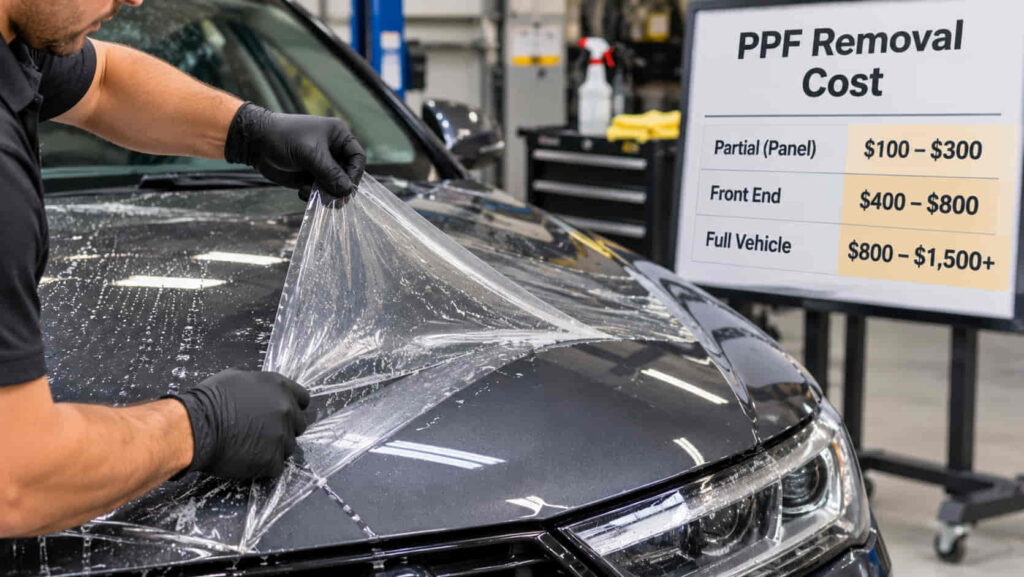
Professional paint protection film removal cost in 2026 typically ranges from about $150–$250 for a single car panel to $800–$2,500 or more for an entire vehicle in the United States. Removing PPF from the front end generally costs around $200–$700, although severely deteriorated film can push the price higher. These figures are published market estimates rather than fixed national rates, and the final quote depends on the vehicle, film condition, and work required.
The biggest factor affecting PPF removal cost is the amount of labor needed to separate the film from the paint safely. Newer film in good condition may peel away in large sections, while older paint protection film can become brittle, crack into smaller pieces, or leave stubborn adhesive residue. Removing damaged PPF therefore requires additional time and careful surface cleaning, increasing the total service cost.
Vehicle size, coverage area, local labor rates, and the condition of the underlying paint also influence pricing. A front bumper removal is different from stripping full-body PPF, and previously repainted panels may require additional precautions.
This guide explains paint protection film removal prices in 2026, including full-car and individual-panel costs, labor charges, adhesive removal, and potential additional fees. It also compares DIY removal with professional services to help vehicle owners understand their options and budget accurately.
How Much Does Paint Protection Film Removal Cost in 2026?
Paint protection film removal cost in 2026 ranges from approximately $100–$300 for a single panel, $200–$1,000 for full-front coverage, and $800–$2,500 or more for a full vehicle in the United States. These are broad budgeting estimates drawn from published pricing guides, not standardized national rates. The final price depends on how much film must be removed, whether the adhesive releases cleanly, and how much labor the job requires.
The difference between the lowest and highest removal prices reflects the condition of the paint protection film as much as the size of the covered area. Film that remains flexible and properly bonded can often be lifted in relatively large sections after controlled heating. This allows a technician to remove the material without repeatedly working on small fragments. In contrast, aged film that has become brittle or cracked may break apart during removal, increasing the time required to clear the surface and its remaining adhesive.
For a more specific comparison, one published 2026 pricing guide places single-panel removal at approximately $100–$200 for newer film and $150–$300 for deteriorated film. The same guide estimates $200–$500 for full-front removal when the film is in good condition, compared with $400–$1,000 when it is old, yellowed, or cracking. These differences demonstrate why two vehicles with identical PPF coverage can receive substantially different quotes.
Professional PPF removal is primarily a labor-based service rather than a material-based purchase. Unlike installing new paint protection film, removal does not require purchasing large sheets of protective material. Instead, the cost reflects the technician’s time, equipment, experience, and responsibility for working around the vehicle’s painted surfaces. Controlled heat, careful peeling, and adhesive cleanup are essential parts of the process, particularly when the underlying finish must be preserved.
Labor pricing also varies between automotive detailing businesses and geographic markets. A shop operating in a higher-cost metropolitan area may charge more per hour than a comparable business in a smaller city. Some providers quote a fixed price after inspecting the vehicle, while others calculate charges according to estimated labor hours. A fixed quote may be easier to budget for, but its value depends on which services are included and how the shop handles unexpected adhesive residue.
The quoted price should therefore identify the coverage area and clarify whether adhesive cleanup is included. Removing the visible film does not always leave the surface ready for a new protective coating or PPF installation. If substantial adhesive remains, additional cleaning may be necessary. Paint polishing or correction, when requested or required, may also be priced separately from the removal itself.
The most accurate way to estimate PPF removal cost is to compare quotes for the same coverage area, film condition, and included services. A low initial price is not necessarily the least expensive option if adhesive cleanup or additional labor is excluded. For vehicle owners budgeting in 2026, published price ranges provide a starting point, while an inspection-based estimate offers a more reliable picture of the actual expense.
How Much Does Full-Car PPF Removal Cost?
Full-car PPF removal generally requires a budget of approximately $800–$2,500 or more, with published 2026 estimates reaching $3,500 or higher for large SUVs, exotic vehicles, or severely deteriorated film. The total expense depends on the vehicle’s size, the number of covered panels, and the condition of the film and adhesive. Removing full-body paint protection film is considerably more labor-intensive than removing a front-end package because the technician must work across nearly every protected exterior panel.
Published estimates differ in their assumptions. One 2026 pricing guide lists approximately $500–$2,000 for full-vehicle removal under relatively manageable conditions, while another places full-body sedan removal at $1,200–$2,500 and larger SUVs or exotic vehicles at $1,500–$3,500 or more. These figures should not be combined into a single national average because the sources do not use an identical pricing methodology. They instead illustrate the range of budgets owners may encounter when requesting professional removal.
Vehicle size affects full-car removal pricing because larger vehicles generally have more covered surface area. A compact sedan usually requires less total film removal than a three-row SUV, assuming similar coverage and film condition. However, surface area alone does not determine the final cost. Complex bumpers, recessed sections, tight edges, and difficult-to-access areas can require additional attention. A smaller vehicle with intricate bodywork may therefore demand more labor than its dimensions initially suggest.
The condition of the existing PPF can have an even greater effect on the total price. When a technician can remove film in long, continuous sections, the process is generally more efficient. Older film exposed to years of sunlight and environmental conditions may become brittle, lose flexibility, or separate from its adhesive layer. Instead of peeling away as a single sheet, it may break into small fragments that require repeated heating and careful removal.
For example, consider two midsize sedans with full-body PPF coverage. The first has relatively recent film that remains flexible and releases cleanly. The second has aging film with cracked sections on the hood and roof, along with adhesive residue on several panels. Although both vehicles have similar dimensions and coverage, the second requires more individual removal work and surface cleaning. Its labor cost can therefore be substantially higher.
Full-car removal also requires careful evaluation of the underlying paint before work begins. Factory-applied paint in sound condition may respond differently from a panel that has been repainted after collision repairs. If the existing finish has poor adhesion, peeling away the film can expose weaknesses in the paint system. A professional shop should inspect questionable areas and explain the risks before proceeding rather than assuming that every painted surface can tolerate the same removal process.
The final quote may also depend on what happens after the film is removed. Some owners want the original paint exposed and cleaned, while others plan to install new PPF or apply a ceramic coating. These services involve different preparation requirements. Removing the old film does not automatically include polishing, paint correction, or installation of replacement protection, so each service should be identified separately in the estimate.
For full-car PPF removal, the most reliable quote comes from an inspection that considers both vehicle coverage and film condition. Owners should confirm whether the price includes adhesive removal, surface cleaning, and any additional labor required for difficult panels. This approach provides a clearer estimate than calculating the total solely from vehicle size or multiplying a single-panel removal price by the number of panels.
Read more: rusty frame repair cost
How Much Does It Cost to Remove PPF From Individual Car Panels?
Removing paint protection film from a single car panel generally costs $100–$300 in the United States, depending on the panel’s shape, the film’s condition, and the labor required. Published 2026 pricing estimates place removal from a hood or roof at approximately $100–$200 when the film is relatively new, increasing to $150–$300 when it is old or deteriorated. These figures are useful for budgeting, but they are not fixed prices for every vehicle or detailing shop.
The hood is one of the most straightforward areas to evaluate because it usually has a large, accessible surface. When the existing PPF remains flexible and its adhesive releases properly, a technician can often lift the film in broad sections. This reduces the amount of repeated peeling and surface cleaning. However, a hood exposed to years of sunlight may have film that has become brittle or cracked, turning an otherwise manageable removal into a more labor-intensive job.
Front bumper PPF removal can cost as much as removing a larger panel because bumper design increases the complexity of the work. Modern bumpers contain curved surfaces, recessed sections, sharp transitions, and openings around grilles or sensors. Film installed across these shapes may have multiple edges and tightly fitted sections that require careful handling. One US removal service publishes a general single-panel price of $150–$250 for a hood, door, fender, or bumper, illustrating why the bumper is not necessarily cheaper simply because it has less surface area than the hood.
Front fenders present a similar pricing consideration. Although a fender is generally smaller than a hood, its contours around the wheel arch, headlights, and adjacent panels can complicate film removal. A technician must control the peeling process around these features to avoid leaving fragments along edges or placing unnecessary stress on the underlying finish. The condition of the film and the accessibility of its edges can therefore matter more than the panel’s dimensions.
Doors and roof panels are also priced according to their specific removal requirements. A door may have relatively accessible flat sections but additional film around handles, trim, or folded edges. A roof has a larger uninterrupted surface, yet its position can make the work less convenient, particularly on taller vehicles. Published single-panel estimates provide a reasonable starting point for these areas, but an inspection is needed to determine whether the job involves straightforward peeling or extensive adhesive cleanup.
Small PPF-covered components, including side mirrors and narrow protective strips, do not always receive proportionally lower removal prices. A mirror may contain little film, but its curved housing can make removal delicate. A detailing business may also apply a minimum service charge to cover preparation, equipment, and technician time. Consequently, removing one small piece of film may cost more per square foot than removing several panels during the same appointment.
For owners removing PPF from multiple front-end components, a package quote may be more useful than adding individual-panel estimates. A US service provider lists approximately $200–$400 for partial-front removal covering areas such as the bumper, partial hood, mirror backs, and fender edges. This example shows how a shop can price several related areas as one service rather than treating each protected surface as a separate appointment.
The distinction between partial-front and full-front coverage is important when comparing estimates. Partial-front protection generally covers selected high-impact areas, while full-front coverage extends across larger portions of the hood, bumper, and fenders. Two vehicles described as having front-end PPF may therefore have substantially different amounts of material to remove. A quote that does not specify the protected panels cannot be compared reliably with another provider’s price.
The most accurate individual-panel PPF removal estimate identifies the exact panel, the film’s condition, and whether adhesive cleanup is included. A photograph may help a shop provide an initial estimate, but visible cracking, peeling edges, or suspected repainting can justify an in-person inspection. Comparing quotes based on these details is more reliable than choosing a service solely because it advertises the lowest single-panel price.
What Factors Affect Paint Protection Film Removal Cost?
The main factors affecting paint protection film removal cost are film age, adhesive condition, coverage area, panel complexity, paint condition, and local labor rates. Each factor changes either the time required to complete the work or the precautions needed to protect the vehicle’s finish. Their combined effect explains why two cars with similar PPF coverage can receive very different removal estimates.
Film age is an important pricing factor because paint protection film changes as it is exposed to sunlight, temperature fluctuations, and environmental conditions. Film that remains flexible can often be removed in relatively large sections, allowing the technician to work efficiently. Older film may become harder to separate from the surface, especially when its top layer cracks or loses flexibility. However, age alone does not determine removal difficulty; film quality, maintenance, environmental exposure, and installation conditions also influence how it behaves.
Adhesive condition directly affects labor costs because removing the film does not always remove the adhesive beneath it. When the adhesive releases with the film, the surface may require relatively limited cleanup. If adhesive remains attached to the paint, the technician must remove that residue using suitable products and controlled techniques. This creates a separate cleaning stage that can extend the appointment. Published 2026 pricing guidance identifies adhesive cleanup as a potential additional expense, particularly when the film is heavily deteriorated.
Coverage area determines how much of the vehicle must be processed, but it does not provide a complete measure of the work involved. Removing PPF from a large, relatively flat hood can be more straightforward than working around a smaller bumper with numerous contours and recessed sections. Film wrapped around panel edges may also require additional attention because the technician must access and release material that is not immediately visible on the main painted surface.
The original installation can influence removal difficulty as well. Film edges may be tucked beneath accessible trim or wrapped around the back of a panel, depending on the installation method. Some sections can be removed without disturbing nearby components, while others require more careful access. A shop should assess the actual installation before assuming that every piece of PPF can be lifted from an exposed edge.
The condition of the underlying paint affects removal pricing because compromised finishes require additional precautions. Factory paint that is properly bonded to the vehicle generally presents a different risk profile from a panel that has been repainted or repaired. If a repainted panel has poor adhesion or an existing clear-coat problem, peeling the film can place stress on an already vulnerable finish. The technician may need to proceed more slowly, modify the removal approach, or recommend further assessment before continuing.
Local labor rates are another source of price variation. Automotive detailing businesses operate with different labor costs, overhead expenses, and service models. A shop in a high-cost metropolitan area may charge more for the same number of labor hours than a business in a lower-cost market. Published US pricing guidance for 2026 describes hourly rates that vary substantially by region, reinforcing why national price ranges should be treated as budgeting references rather than guaranteed local quotes.
For example, consider two vehicles that each need PPF removed from the hood and front bumper. The first vehicle has relatively recent film that remains flexible, with accessible edges and little adhesive residue. The second has cracked film on the hood, tightly fitted bumper sections, and a previously repainted panel. Although both jobs cover the same vehicle areas, the second requires more careful inspection, slower removal, and potentially additional adhesive cleaning. Its higher price would reflect the extra work rather than a difference in the amount of film alone.
Professional experience also affects the quality of the removal process, although a higher hourly rate does not automatically mean a higher total bill. An experienced technician may be able to assess film condition, select an appropriate removal method, and complete manageable sections efficiently. A less expensive hourly rate can still produce a higher final charge if the work takes substantially longer. Comparing the total estimated labor, included services, and treatment of unexpected complications is therefore more useful than comparing hourly rates in isolation.
The final removal estimate should reflect the vehicle’s actual condition rather than a generic price based only on its model or size. A clear quote identifies the covered areas, the expected removal work, adhesive cleanup, and any circumstances that could require additional labor. Understanding these pricing factors allows vehicle owners to evaluate whether a higher PPF removal quote reflects genuine complexity or simply a difference in how the service is priced.
Why Does Old or Damaged PPF Cost More to Remove?
Old or damaged paint protection film costs more to remove because deteriorated material can break into small pieces, resist peeling, and leave adhesive residue that requires additional cleaning. A technician may need substantially more time to remove a damaged film than an intact sheet covering the same area. The additional expense comes from the difficulty of separating the film from the vehicle’s surface, not simply from how long the film has been installed.
Paint protection film is designed to withstand environmental exposure, but its physical properties can change over time. Ultraviolet radiation, temperature fluctuations, road contaminants, and prolonged outdoor exposure contribute to material aging. As the film deteriorates, it may lose flexibility or develop cracks that interrupt its structural integrity. Instead of lifting in a continuous section, the material can tear repeatedly, forcing the technician to remove smaller fragments while controlling the stress applied to the paint.
Cracked PPF is particularly labor-intensive because each broken section creates another removal point. When a film has extensive surface cracking, the technician cannot necessarily maintain a continuous peeling motion across the panel. Heat or steam may help soften the material and adhesive, but neither method guarantees that severely degraded film will release cleanly. A hood covered in brittle, fragmented PPF can therefore require considerably more work than a similarly sized hood with flexible film that peels away in large sections.
Yellowing requires a different assessment. Discoloration can result from changes in the film or its exposure history, but yellowed PPF is not automatically difficult to remove. A discolored film that remains flexible and structurally intact may still release without extensive fragmentation. By contrast, yellowing accompanied by cracking, separation, or adhesive deterioration indicates a more complicated condition. Professional removal estimates should account for the film’s actual physical state rather than using its color alone to predict labor requirements.
Adhesive deterioration can further increase the removal cost. In a relatively straightforward removal, much of the adhesive may separate from the painted surface along with the film. With some aged or damaged installations, adhesive remains on the panel after the protective layer is lifted. The technician must then remove the residue using products and methods appropriate for automotive finishes. Stubborn adhesive can require repeated treatment, particularly around wrapped edges, recessed areas, and sections where the film has separated from its adhesive layer.
For example, consider two vehicles with PPF covering the front bumper and hood. The first has intact film that releases in broad sections and leaves limited residue. The second has extensive cracking across the hood and adhesive remaining around the bumper’s contours. Although both vehicles have the same protected areas, the second job involves more peeling operations and a longer cleaning process. Its higher removal quote reflects the additional labor rather than a larger amount of protective film.
Removing deteriorated PPF before it becomes severely fragmented can help avoid the labor associated with difficult removal, although early removal does not guarantee a lower price. The condition of the adhesive, the original installation, and the underlying paint still determine how the material responds. When a film is visibly cracking, lifting, or separating into layers, a professional inspection provides a more reliable estimate than assuming the removal will follow the same process as an intact film.
How Much Do Professional PPF Removal Labor Rates Affect the Price?
Professional labor rates directly affect paint protection film removal cost because technician time is one of the primary expenses involved in the service. Unlike PPF installation, which includes the cost of new film, removal pricing largely reflects the time spent preparing the surface, separating the existing material, and cleaning any remaining adhesive. A higher hourly rate increases the cost of a job when the number of billable hours remains the same, but the final price also depends on how efficiently the work is completed.
Automotive detailing shops generally use either hourly pricing or a fixed project quote for PPF removal. Under hourly pricing, the total labor charge is calculated by multiplying the billable time by the shop’s hourly rate. A fixed quote instead provides an agreed price for a defined scope of work, subject to any conditions stated in the estimate. Both approaches can be appropriate, but they distribute the uncertainty of difficult film removal differently between the customer and the service provider.
For illustration, a shop charging $125 per labor hour would bill $500 for four hours of removal work or $1,000 for eight hours, before any separately charged services or applicable taxes. These figures are hypothetical calculations, not verified national average rates for 2026. They demonstrate why the number of hours required can have a substantial effect on the final bill. A job that takes twice as long may cost twice as much under a straightforward hourly pricing arrangement.
The estimated number of labor hours depends on the amount of PPF, the complexity of the protected surfaces, and the condition of the material being removed. A technician working on intact film may complete the peeling stage efficiently, while another technician handling cracked film and stubborn adhesive may need additional time on the same panels. Preparation, controlled heating, edge removal, and surface cleaning all contribute to the labor requirement. Consequently, an hourly quote cannot be evaluated accurately without understanding the work involved.
Labor rates also reflect differences in operating costs and service specialization. Businesses in different US markets face different expenses for facilities, staffing, equipment, and insurance. A specialist experienced in removing deteriorated PPF may charge a higher hourly rate than a general detailing provider. However, the higher rate does not automatically result in a higher final bill. A technician who completes the job efficiently may generate a lower total labor charge than a less expensive provider who requires substantially more time.
Fixed-price estimates offer a different budgeting advantage. When a shop inspects the vehicle and agrees to remove PPF from specified panels for a stated amount, the owner has a clearer understanding of the expected expense. However, the estimate should explain whether the price includes adhesive removal and how unexpected conditions will be handled. A fixed price that excludes difficult adhesive cleanup is not directly comparable to an estimate that includes the complete removal and cleaning process.
Some shops may also apply a minimum service charge, particularly when removing small sections of film. This means a short appointment involving a mirror or protective strip may not be priced strictly according to the minutes spent peeling the material. Preparation, inspection, equipment use, and administrative costs can make a minimum charge necessary. For owners removing PPF from several small areas, combining the work into one appointment may reduce repeated minimum charges, depending on the provider’s pricing policy.
The best way to evaluate professional PPF removal labor costs is to compare the estimated total price, expected work, and included services rather than hourly rates alone. Before authorizing the job, vehicle owners should understand whether the quote is fixed or time-based, whether adhesive cleanup is included, and how additional labor will be approved. These details make it easier to distinguish a reasonable charge for complex removal work from an estimate that leaves important costs undefined.
Does PPF Removal Cost Include Adhesive Removal?
Professional PPF removal cost may include adhesive removal, but the service is not automatically included in every shop’s quoted price. Some automotive detailing businesses provide a complete removal service that covers peeling off the protective film and cleaning the remaining adhesive. Others charge separately when stubborn residue requires additional labor or specialized cleaning products. Vehicle owners should confirm exactly what the quoted service includes before authorizing the work.
Paint protection film consists of a protective polymer layer and an adhesive system designed to bond the film to the vehicle’s painted surface. During removal, the adhesive ideally separates from the paint along with the film. However, the adhesive does not always release uniformly. Portions may remain attached to the clear coat, particularly where the film has deteriorated, separated into layers, or experienced prolonged environmental exposure. The technician must remove this residue before the surface can be considered clean.
Adhesive removal becomes an additional cost when the cleaning process requires labor beyond the shop’s original estimate. A small amount of residue along a panel edge may be addressed during routine cleanup, while widespread adhesive remaining across a hood or roof can require repeated treatment. Technicians may use appropriate adhesive-removal products, controlled heat, and careful cleaning methods to separate the residue from the painted surface. The process must account for the paint’s condition and the compatibility of the cleaning products used.
The distinction between adhesive removal and paint correction is important when evaluating a PPF removal quote. Adhesive removal focuses on eliminating bonding material left behind by the film. Paint correction involves working on the painted finish to address defects such as light scratches, oxidation, or surface imperfections, typically through machine polishing. Removing adhesive does not automatically correct existing paint defects, and polishing should not be assumed to be part of a standard PPF removal service.
For example, a vehicle owner may receive a quote to remove paint protection film from the hood. If the film releases cleanly and leaves minimal residue, the quoted service may cover the complete job. If the film separates from its adhesive layer and leaves widespread residue, the shop may need additional cleaning time. Whether that extra work increases the final bill depends on the original estimate and the provider’s pricing policy.
A complete PPF removal estimate should state whether adhesive cleanup is included, what level of cleaning is covered, and how additional work will be priced. This distinction helps vehicle owners compare services accurately and avoid assuming that every quoted price includes the same amount of surface preparation. It is especially relevant when the vehicle will receive replacement PPF, since remaining adhesive must be addressed before a new installation can proceed.
What Additional Charges Can Increase a PPF Removal Quote?
The most common additional PPF removal charges involve extensive adhesive cleanup, unexpected labor, paint correction, and preparation for a new protective film installation. These expenses are not necessarily part of the original removal price because they involve work beyond separating the existing film from the vehicle. The final bill depends on the services included in the estimate and the condition discovered during removal.
Extensive adhesive cleanup is one potential source of additional expense. A technician may initially expect the protective film to release with limited residue, only to discover that adhesive remains across several panels. Removing this material can require additional cleaning cycles and more labor than originally anticipated. If the shop’s estimate covers only routine adhesive removal, unusually difficult residue may result in a supplemental charge. The provider should explain the additional work and obtain approval before exceeding the agreed scope.
Unexpected labor charges can also arise when the film’s actual condition is worse than it appeared during the initial inspection. Surface discoloration or minor edge lifting does not always reveal how the material will behave during removal. Once the technician begins peeling, the film may fragment or separate into layers, requiring a slower process. Under an hourly billing arrangement, this additional time can increase the total charge. A fixed-price estimate may handle the situation differently, depending on its stated terms and exclusions.
Paint correction represents another potential expense, but it should be treated as a separate detailing service rather than an unavoidable part of PPF removal. After the film is removed, previously concealed scratches, water spots, or paint imperfections may become visible. A vehicle owner preparing to install new PPF or a ceramic coating may choose to have those defects corrected. The additional price depends on the paint’s condition, the extent of correction requested, and the labor required. Removing the old film does not automatically mean that machine polishing is necessary.
Previously repaired or repainted panels can introduce a different category of expense. If the underlying paint has poor adhesion, removing PPF may reveal or worsen an existing weakness in the finish. Repairing damaged paint is not the same service as removing protective film, and the cost of repainting a panel should not be included in a general PPF removal estimate without a specific reason. A professional provider should identify visible concerns before beginning work and explain how potential paint damage will be handled.
Replacement PPF installation and related surface preparation can substantially increase the overall project budget without increasing the removal service itself. For example, an owner replacing full-front PPF may pay for removal of the existing material, adhesive cleanup, any necessary paint preparation, and installation of the new film. These are distinct stages of the project. A bundled quote may combine them into one total, but the owner should still understand which services are included.
Consider a vehicle scheduled for front-end PPF removal. The original estimate covers removing the film from the hood, bumper, and fenders, along with standard adhesive cleanup. During the work, the technician discovers unusually stubborn adhesive on the hood and existing paint defects that the owner wants polished before replacement film is installed. The final project price may increase because of the extra cleaning and requested paint correction, even though the original coverage area has not changed.
The most reliable way to avoid unexpected PPF removal charges is to request an itemized estimate that defines the removal scope, adhesive cleanup, additional labor policy, and optional detailing services. Vehicle owners should also establish whether the shop will request approval before performing work that exceeds the quoted amount. A clearly defined estimate makes the total expense easier to predict and helps distinguish necessary removal work from optional improvements to the vehicle’s finish.
Is It Cheaper to Remove PPF Yourself or Hire a Professional?
Removing paint protection film yourself generally costs less upfront than hiring a professional because you avoid paying for specialized labor. However, DIY PPF removal is not always the least expensive option when equipment, time, adhesive cleanup, and potential paint damage are considered. The financial advantage depends on the film’s condition, the size of the protected area, and the owner’s ability to remove the material without damaging the vehicle’s finish.
DIY removal expenses primarily involve equipment and cleaning supplies rather than labor charges. A vehicle owner may need a suitable heat source, automotive-safe adhesive remover, microfiber towels, and other surface-cleaning materials. The total cost depends on which tools are already available and whether additional products are required. Although these purchases may be less expensive than a professional removal appointment, they do not eliminate the time needed to complete the work or the risk of damaging the paint.
DIY removal is most practical when the PPF covers a small, accessible area and remains flexible enough to peel away without breaking. For example, removing an intact protective strip from a relatively flat panel presents a different challenge from stripping deteriorated film across an entire hood. When the film releases in continuous sections, the process is easier to control. If it repeatedly tears or leaves widespread adhesive residue, the amount of work increases and the likelihood of removal mistakes becomes greater.
Temperature control is one of the most important considerations during DIY removal. Controlled warming can help soften the adhesive and improve the film’s flexibility, but excessive heat can damage the protective film, surrounding trim, or painted finish. Pulling the film aggressively can also place unnecessary stress on the clear coat, especially when the panel has been repainted or repaired. A method that works on factory paint in good condition may not be appropriate for a compromised surface.
Professional PPF removal costs more upfront because the customer pays for trained labor, equipment, and the technician’s experience handling different film conditions. A qualified specialist can assess whether the film is likely to release cleanly, identify areas requiring additional precautions, and select an appropriate removal approach. Professional service does not eliminate every risk, but it reduces the need for an inexperienced owner to make technical decisions about adhesive behavior, heating, and paint condition.
Consider two owners removing PPF from their vehicles. The first has a small section of relatively recent film on an undamaged factory-painted panel. The second has extensive cracking across the hood and bumper, with evidence of previous bodywork. The first owner may be able to complete a manageable DIY removal with suitable precautions. The second faces a more complicated job in which professional assessment is the safer financial decision, since damage to a repainted panel could create repair expenses far greater than the original removal quote.
Professional removal is generally the better choice for full-car coverage, severely deteriorated film, or vehicles with uncertain paint history. DIY removal is more reasonable for limited, intact coverage when the owner understands the process and can stop if the film resists removal. The correct cost comparison therefore includes not only the price of labor but also the condition of the film, the time required, and the potential expense of correcting an unsuccessful removal.
Can Removing Paint Protection Film Damage Car Paint?
Removing paint protection film can damage automotive paint, particularly when the underlying finish has poor adhesion, the film is severely deteriorated, or improper removal techniques are used. However, PPF removal does not automatically damage a vehicle’s paint. When the finish is sound and the film is removed using appropriate methods, the protective material can often be separated without lifting the underlying coating.
Paint protection film attaches to the vehicle through an adhesive layer that bonds to the painted surface. During removal, the technician must overcome that adhesive bond without applying excessive stress to the clear coat or underlying paint layers. The outcome depends on the strength of the adhesive, the condition of the paint system, and how the film is pulled away. Controlled removal helps manage these forces, while abrupt pulling or excessive heating can increase the risk of damage.
Factory paint and repainted panels can respond differently to PPF removal because their coating systems may have different adhesion characteristics. Original automotive paint is applied under controlled manufacturing conditions, while a repaired panel may have been refinished using different materials and curing procedures. A properly prepared and fully cured repaint can perform well, but poor surface preparation, inadequate curing, or existing coating defects can make the finish more vulnerable when the film is removed.
For example, a hood with sound factory paint and flexible PPF may allow the film to release without visible coating damage. A bumper that has been repainted after a collision presents a different situation if the replacement finish was not properly bonded to the substrate. When the adhesive film is lifted, weakly attached paint may separate along with it. The resulting damage reflects the interaction between the film’s adhesive bond and the underlying coating condition, rather than proving that PPF removal always damages paint.
Existing clear-coat deterioration is another concern. A surface with peeling, cracking, or delaminating clear coat may not withstand the forces involved in removing bonded film. Heat and pulling pressure can worsen these defects, even when the technician uses a careful approach. For this reason, a professional should inspect visible paint problems before removal and explain when the condition of the finish makes a damage-free result uncertain.
Adhesive cleanup also requires attention to paint safety. Strong solvents, unsuitable chemicals, abrasive tools, and excessive rubbing can affect the painted surface if used incorrectly. Products should be compatible with the vehicle’s finish and applied according to their intended use. The goal is to remove adhesive residue without unnecessarily disturbing the clear coat or surrounding trim.
Paint damage caused or revealed during PPF removal can create expenses that are separate from the original removal cost. Minor surface defects may be suitable for professional polishing, while paint that has lifted or peeled may require refinishing. Polishing cannot restore a missing layer of paint or clear coat. The appropriate repair depends on the type and extent of the damage, which is why a low removal quote should not be evaluated without considering the vehicle’s paint condition.
The safest approach is to inspect the vehicle before removal, disclose any previous repainting or body repairs, and select a provider experienced with paint protection film. Owners should also understand how the shop assesses removal risks and handles unexpected paint problems. A careful inspection and appropriate removal technique reduce the likelihood of paint damage, but no professional can guarantee that compromised paint will remain intact when bonded PPF is removed.
How Long Does Paint Protection Film Removal Take?
Paint protection film removal can take a few hours for limited coverage or considerably longer for an entire vehicle, depending on the film’s condition and the amount of adhesive cleanup required. Removing intact PPF from a single panel is generally faster than stripping full-body protection, but surface area alone does not determine the duration. A technician must also account for how easily the film separates, whether it breaks during removal, and the condition of the underlying paint.
The removal process begins with an assessment of the protected surfaces. A technician identifies the film’s edges, checks for cracking or separation, and evaluates visible paint concerns before applying an appropriate removal technique. Controlled warming may help the adhesive release while maintaining the film’s flexibility. When the material remains intact, larger sections can be lifted with fewer interruptions, reducing the time spent separating the film from the vehicle.
The condition of the existing PPF is one of the strongest indicators of removal time. Flexible film that peels away in continuous sections allows the technician to progress across a panel efficiently. Brittle or cracked film behaves differently because it can break into smaller pieces during removal. Each fragment must be separated individually, and adhesive may remain on the surface after the protective layer is removed. This additional work can extend the appointment even when the covered area is relatively small.
Panel design also influences the schedule. A broad, accessible hood generally offers a more straightforward working surface than a front bumper with recessed sections, curved edges, and openings around exterior components. Film wrapped around difficult-to-access edges requires careful handling, which adds time without necessarily increasing the visible area of protection. Full-car removal combines these challenges across multiple panels, making the overall duration harder to predict from vehicle size alone.
Labor hours and total appointment time are not always the same. A shop may need to inspect the vehicle, prepare the work area, complete the removal, clean the surface, and perform a final inspection. The vehicle may remain at the facility longer than the technician’s directly billable removal time, particularly when the appointment includes additional detailing or preparation for new PPF. Owners should distinguish the estimated labor charge from the expected vehicle pickup time.
For example, removing intact film from a hood may involve relatively little adhesive cleanup, allowing the technician to complete the work without extensive additional treatment. A similar hood with fragmented film and stubborn residue requires a different workflow. The technician must remove smaller sections, address the remaining adhesive, and inspect the finish before considering the job complete. The second vehicle can therefore require substantially more time despite having the same protected surface area.
When requesting a PPF removal quote, vehicle owners should ask how long the shop expects the work to take and whether the estimate includes adhesive cleaning and final surface inspection. An accurate removal schedule should reflect the film’s actual condition rather than a fixed time allowance based only on the number of panels. This is especially important when the vehicle must be ready for a scheduled PPF replacement appointment.
How Much Does It Cost to Remove and Replace PPF?
The total cost to remove and replace paint protection film includes the removal of the existing PPF, preparation of the painted surface, and installation of new protective film. These are separate services with different pricing requirements. Removal is primarily a labor expense, while replacement installation also includes new film material, cutting or pattern preparation, installation labor, and finishing work. The final project cost depends on the coverage area, the condition of the old film, and the type of replacement protection selected.
The first expense is removing the existing PPF. As discussed in the removal pricing sections, this cost varies according to the number of covered panels and how easily the film releases. A vehicle with flexible, intact PPF may require less removal labor than one with cracked material and extensive adhesive residue. Because removal must be completed before the new film can be installed, unexpected complications during this stage can affect the total project budget and schedule.
Surface preparation is the connection between PPF removal and replacement installation. After the old film has been removed, the painted panels must be inspected and cleaned to ensure that adhesive residue and other contaminants do not interfere with the new installation. Depending on the vehicle’s condition, the shop may recommend additional decontamination or paint correction. These services should be evaluated separately because a clean, sound painted surface does not automatically require machine polishing.
New PPF installation represents another major part of the project cost. The price depends on whether the owner wants protection on a single panel, the full front end, or the entire vehicle. Film selection, vehicle design, installation complexity, and the provider’s pricing structure also influence the amount charged. A full-body replacement involves substantially more material and installation work than replacing film on a hood or bumper, so removal pricing alone cannot establish the total replacement budget.
For example, an owner replacing PPF on the hood should request a quote covering removal of the old film, adhesive cleanup, any necessary surface preparation, and installation of the new hood protection. If the owner instead wants to expand coverage to the bumper and fenders, the installation portion of the project will change even though the original removal requirement remains limited to the hood. Separating these services makes it easier to identify which decisions increase the total expense.
Some PPF installers offer combined removal and replacement quotes, but a bundled price does not automatically guarantee a discount. A provider may simplify scheduling or combine certain preparation steps when both services are completed during the same appointment. Whether this reduces the final cost depends on the shop’s pricing policy and the condition of the existing film. Owners should compare the total scope of work rather than assuming that one combined figure is always less expensive than separate services.
Replacement projects may also involve warranty considerations. If the existing film is being removed because of a product defect, the original manufacturer’s warranty or installer’s workmanship policy may affect the owner’s out-of-pocket expense. Coverage depends on the specific warranty terms, the cause of failure, and any applicable exclusions. Normal aging, physical damage, and installation defects should not be treated as interchangeable warranty claims.
The most reliable removal-and-replacement estimate separates the cost of removing the old film from surface preparation and new PPF installation. Vehicle owners should confirm the replacement coverage, film product, included preparation work, and applicable warranty terms before approving the project. This provides a more accurate budget and prevents the removal fee from being confused with the substantially broader cost of installing new paint protection film.
How Can You Reduce Paint Protection Film Removal Costs?
The most effective way to reduce paint protection film removal costs is to address deteriorating film before removal becomes labor-intensive, compare quotes with identical service scopes, and avoid paying for unnecessary detailing services. These measures target the main expenses involved in PPF removal: technician time, adhesive cleanup, and additional surface preparation. The goal is to reduce avoidable work without compromising the condition of the vehicle’s paint.
Removing PPF before it becomes severely cracked or fragmented can make the process more manageable. Flexible film that remains structurally intact is generally easier to peel away than material that breaks into small pieces. Once the film deteriorates, a technician may need to remove individual fragments and spend additional time cleaning adhesive residue. However, there is no universal age at which PPF must be removed. Film condition, manufacturer guidance, environmental exposure, and the vehicle’s maintenance history should determine when replacement or removal is appropriate.
Comparing estimates from qualified PPF removal providers can prevent overpaying, but the quotes must cover the same work. A shop advertising a low removal price may exclude extensive adhesive cleanup, while another may include surface cleaning in its standard service. Comparing these figures without checking their inclusions can create a misleading impression of savings. Vehicle owners should request estimates for the exact protected panels and confirm how each provider handles deteriorated film, remaining adhesive, and additional labor.
Accurate information about the vehicle can also improve the reliability of an initial estimate. Providing photographs of the protected panels, identifying visible cracking or peeling, and disclosing previous paint repairs allows a shop to assess potential complications before the appointment. Although photographs cannot reveal every adhesive or paint problem, they help the provider understand the expected work. An in-person inspection remains appropriate when the film is severely damaged or the underlying finish is uncertain.
Combining several PPF removal tasks into one appointment may reduce total service costs when a shop applies minimum charges or offers package pricing. For example, an owner who needs film removed from the hood, bumper, and mirrors can request a single front-end removal quote rather than scheduling three separate visits. This approach may reduce repeated preparation or minimum service charges. Actual savings depend on the provider’s pricing policy, so a combined appointment should not automatically be assumed to qualify for a discount.
Owners planning to install replacement PPF can also ask whether removal and installation can be scheduled as one project. Coordinating the services may simplify preparation and reduce vehicle downtime. However, replacement installation remains a separate expense, and bundled pricing is not necessarily cheaper. A detailed estimate should identify removal, adhesive cleanup, surface preparation, and new film installation so that the total can be evaluated accurately.
Avoiding unnecessary services is another practical way to control the budget. Paint correction may be beneficial when the exposed finish has visible defects or requires preparation for a particular treatment, but it is not automatically necessary after every PPF removal. If the paint is clean and in suitable condition, additional polishing may provide little value for an owner who simply wants the protective film removed. Any proposed correction should address an identified condition rather than being added automatically to the service.
The lowest removal quote is not always the least expensive outcome. A poorly performed removal can leave adhesive residue, damage trim, or place excessive stress on vulnerable paint. Choosing a qualified provider with a clearly defined price helps reduce the likelihood of unexpected work and subsequent repair expenses. Cost savings are most meaningful when the vehicle is returned with the agreed film removed and its painted surfaces properly cared for.
How Do You Choose a Professional PPF Removal Service?
Choose a professional PPF removal service based on the provider’s removal experience, inspection process, pricing transparency, and approach to protecting automotive paint. A shop that regularly installs PPF may also offer removal, but installation experience alone does not establish expertise in handling severely deteriorated film. The provider should be able to explain how it evaluates the existing material, manages adhesive residue, and addresses concerns involving repainted or damaged panels.
Experience with different film conditions is particularly important. Removing flexible, intact PPF presents a different challenge from working with brittle material that breaks apart during peeling. A qualified technician should understand how film condition affects removal methods and labor requirements. When discussing a difficult job, the shop should be able to explain the likely complications without guaranteeing that every film will release cleanly.
A professional inspection should evaluate both the PPF and the underlying paint before removal begins. Visible cracking, lifted edges, adhesive separation, and previous body repairs can influence the removal process. Repainted panels deserve particular attention because the condition and adhesion of the refinished coating may differ from factory paint. A provider who identifies these risks before starting gives the owner an opportunity to understand the potential consequences and make an informed decision.
Pricing transparency is equally important. A useful estimate identifies the protected panels being serviced, the expected removal work, and whether adhesive cleanup is included. It should also explain how unexpected labor or additional detailing services will be handled. For example, a quote covering hood and bumper removal should clarify whether stubborn adhesive residue would trigger an additional charge and whether the owner must approve that charge before work continues.
The shop’s approach to paint safety should be part of the selection process, not an afterthought. Appropriate removal techniques involve controlling the forces applied to the film and using cleaning products compatible with the painted finish. Excessive heat, aggressive pulling, or unsuitable chemicals can create avoidable risks. A reliable provider should explain its general approach to protecting paint and surrounding trim without claiming that damage is impossible under every condition.
Customer reviews and examples of completed work can provide additional context, particularly when they describe removal rather than installation alone. Reviews discussing communication, unexpected charges, adhesive cleanup, and the condition of the vehicle after service are more relevant than general statements about appearance. Photographs of completed jobs may also help demonstrate experience, although they cannot independently verify the quality of every removal procedure.
Owners should also understand how the business handles pre-existing paint defects and unexpected damage. A reputable provider should distinguish between a problem already present beneath the film and damage resulting from the removal process. Written service terms, inspection records, and clear communication can help establish expectations. No shop should promise that compromised paint will remain intact regardless of its condition.
For example, an owner requesting full-front PPF removal from a vehicle with a previously repainted bumper should expect the provider to examine the bumper, explain the additional risk, and describe how the work will proceed. A detailed estimate that addresses these concerns provides more useful information than a lower price offered without inspecting the vehicle.
The best professional PPF removal service is one that combines appropriate technical experience with a clear scope of work and a realistic assessment of paint-related risks. Before booking, vehicle owners should understand the total estimated cost, the services included, the expected completion time, and the procedure for approving additional work. These details make it easier to select a provider based on the complete value of the service rather than the advertised removal price alone.