The Mini Cooper is widely known for its compact design, sporty handling, and enjoyable driving experience. However, many owners eventually encounter a frustrating warning message on the dashboard: “Engine Malfunction – Reduced Power.”
When this warning appears, the vehicle often enters a safety state commonly known as “limp mode,” where engine performance is intentionally limited. Acceleration becomes weak, throttle response feels delayed, and the car may struggle to maintain normal driving speed. While the vehicle is still drivable, this condition can be alarming and inconvenient, especially in traffic or long-distance travel.
Understanding the meaning behind Mini Cooper Engine Malfunction Reduced Power is essential for preventing further damage and avoiding costly repairs. In many cases, the issue is not a catastrophic engine failure but rather a protective response triggered by sensors, fuel system irregularities, or electronic faults.
In this guide, you will learn what causes this warning, the most common symptoms, how to diagnose the problem properly, and practical steps to fix it. Whether you are a new Mini Cooper owner or have driven one for years, this article will help you respond correctly and restore your vehicle’s performance safely and efficiently.
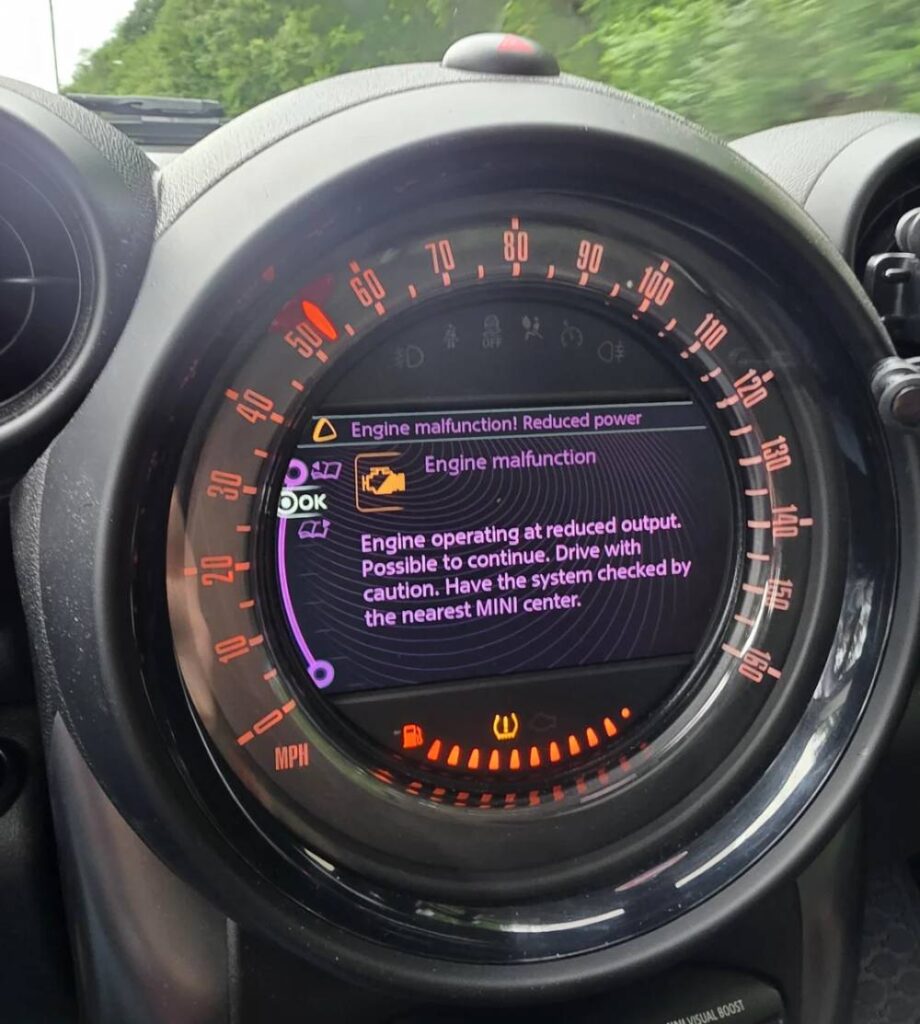
What Does “Engine Malfunction Reduced Power” Mean?
When this warning appears, your Mini Cooper is signaling that the engine control system has detected an abnormal condition. To prevent damage, the ECU (Engine Control Unit) reduces engine output.
This safety feature is known as limp mode, and it is designed to:
- Protect the engine from severe damage
- Limit throttle response and power output
- Allow the driver to reach a safe location or repair shop
In this state, the ECU restricts performance by adjusting fuel delivery, turbo boost (if equipped), and ignition timing. The car is not broken completely, but it is operating under controlled limitations.
Common Symptoms of Reduced Power Mode
When your Mini Cooper enters reduced power mode, you may notice several clear symptoms:
1. Weak acceleration
The car feels sluggish, and pressing the accelerator does not produce normal power.
2. Check engine light
The dashboard warning light often appears alongside the message.
3. Rough engine performance
You may feel vibration, uneven idling, or inconsistent engine behavior.
4. Limited speed
The vehicle may struggle to exceed certain speeds, especially on highways.
5. Increased fuel consumption
Because the engine is not operating efficiently, fuel usage may rise.
Many drivers initially mistake these symptoms for poor fuel quality or transmission issues, but they are often related to engine management faults.
Main Causes of Mini Cooper Engine Malfunction Reduced Power
There are several potential reasons why this warning appears.
1. Faulty engine sensors
Modern vehicles rely heavily on sensors. If one fails, the ECU may activate limp mode.
Common sensors include:
- Mass Air Flow (MAF) sensor
- Throttle position sensor
- Oxygen sensor
2. Fuel system issues
If the engine does not receive proper fuel supply, performance drops significantly.
Possible problems:
- Weak fuel pump
- Clogged fuel injectors
- Dirty fuel filter
3. Ignition system problems
Misfires can trigger reduced power mode.
Typical causes:
- Worn spark plugs
- Faulty ignition coils
4. Turbocharger system faults
In turbocharged models, boost pressure issues are common.
Possible issues include:
- Boost leaks
- Wastegate malfunction
- Turbo failure
Sometimes the problem is not mechanical but electronic.
Examples:
- Weak battery voltage
- ECU software glitches
- Wiring faults
How to Diagnose the Problem Correctly
To identify the exact cause, proper diagnosis is required.
Step 1: Use an OBD2 scanner
Read diagnostic trouble codes to locate the issue.
Step 2: Check common fault codes
Examples include:
- P0300 (random misfire)
- P0171 (lean mixture)
- P0299 (turbo underboost)
Step 3: Inspect air intake system
Look for leaks or blocked airflow.
Step 4: Test fuel pressure
Ensure the fuel pump is delivering adequate pressure.
Step 5: Review ECU data
Advanced diagnostics can show sensor readings in real time.
Fix Guide: How to Resolve Reduced Engine Power
Depending on the root cause, different solutions may apply.
1. Reset the system
Disconnecting the battery for a few minutes may reset temporary faults.
2. Clean key components
- Clean the MAF sensor
- Clean throttle body
3. Replace worn ignition parts
- Spark plugs
- Ignition coils
4. Repair air or boost leaks
Fix cracked hoses or intake leaks immediately.
5. Replace faulty sensors
If diagnostics confirm sensor failure, replacement is necessary.
6. Update ECU software
In some cases, a software update resolves false warnings.
When You Should Visit a Mechanic
You should seek professional help if:
- The warning returns after reset
- Multiple fault codes appear
- The engine vibrates heavily or stalls
- You cannot identify the cause with basic tools
Driving for long periods in limp mode may worsen engine damage, so timely inspection is important.
How to Prevent Engine Malfunction Reduced Power Issues
Preventive maintenance can significantly reduce the risk:
- Follow regular servicing schedules
- Use high-quality fuel
- Replace filters and spark plugs on time
- Keep sensors clean and functional
- Check battery health regularly
A well-maintained Mini Cooper is far less likely to trigger emergency engine protection mode.
Conclusion
The Mini Cooper Engine Malfunction Reduced Power warning is not always a sign of severe engine failure. In most cases, it is a protective response triggered by the ECU to prevent further damage.
By understanding the symptoms, identifying common causes, and applying correct diagnostic steps, you can quickly determine whether the issue is minor or requires professional repair.
Ignoring this warning can lead to reduced performance and potentially expensive repairs. However, with proper maintenance and timely attention, your Mini Cooper can continue delivering the driving experience it is known for.