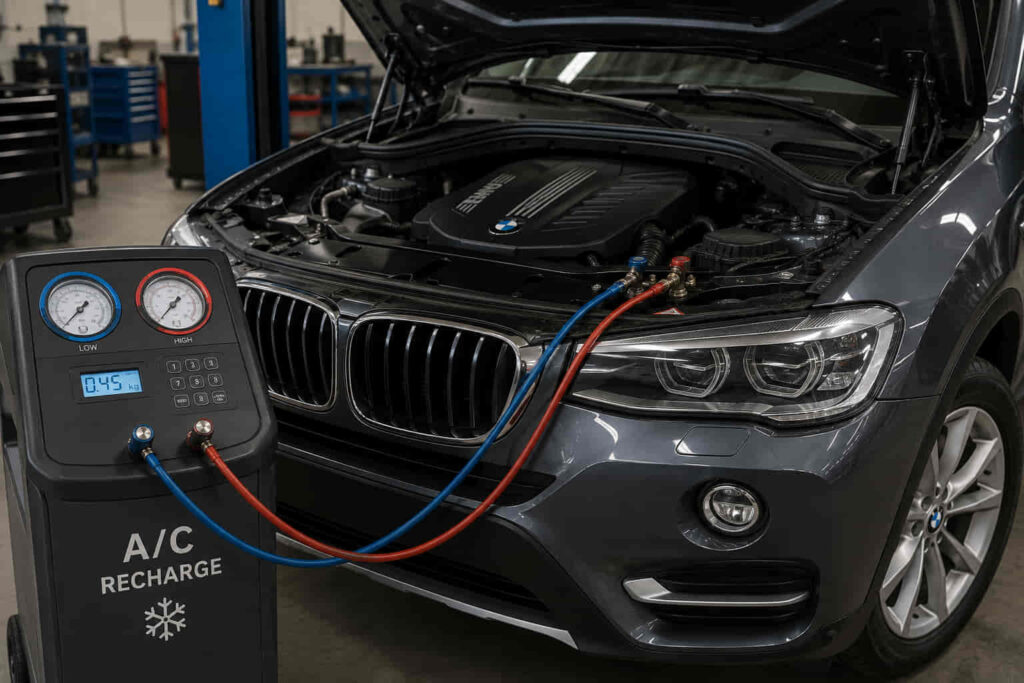
A BMW X3 AC recharge restores the air conditioning system to its specified refrigerant charge when the refrigerant condition is incorrect, but recharging is not a universal solution for an X3 that does not blow cold air. Warm vent air can make refrigerant condition relevant to diagnosis, yet similar cooling symptoms can also result from compressor operation, inadequate condenser heat rejection, electrical controls, sensors, or other HVAC problems. The symptom alone therefore does not confirm that additional refrigerant is required.
The BMW X3 air conditioning system relies on a closed refrigerant circuit to transfer heat from the cabin to the outside environment. If refrigerant has escaped, restoring the specified charge can allow the refrigeration cycle to operate correctly again, but the reason for the refrigerant loss still matters. A recharge corrects the charge condition; it does not seal a leak or repair another component that prevents the AC system from cooling.
The correct refrigerant specification also depends on the specific BMW X3 and its AC-system configuration. Refrigerant type, required charge quantity, and operating pressure describe different attributes and should not be treated as interchangeable values. For that reason, a proper BMW X3 AC recharge should be based on vehicle-specific specifications and the actual condition of the system rather than adding refrigerant until the vents simply feel colder. Understanding when recharge is appropriate, what happens during service, and what recurring cooling loss indicates helps separate refrigerant service from the diagnosis and repair of an underlying AC fault.
How can you tell if a BMW X3 may need an AC recharge?
A BMW X3 may need an AC recharge when diagnosis shows that the refrigerant charge is below the specified condition, but weak or warm air from the vents does not by itself confirm that refrigerant is low. The most useful starting point is therefore the cooling symptom combined with the actual condition of the refrigerant system, not cabin temperature alone.
When refrigerant conditions are incorrect, the refrigeration cycle may lose some of its ability to transfer heat from the passenger compartment to the outside air. The blower can continue moving air through the vents, but that air may not become as cold as expected because the evaporator is no longer operating under the intended refrigeration conditions. This creates the common complaint that the BMW X3 AC is “working” mechanically from the driver’s perspective but is not cooling the cabin effectively.
Reduced cooling can make refrigerant charge relevant, but the same symptom can originate elsewhere. A compressor that is not operating correctly can reduce cooling even when refrigerant quantity is appropriate. Inadequate heat rejection at the condenser can also make vent air warmer, particularly when operating conditions change. Electrical, sensor, or HVAC control problems can interfere with AC operation without requiring additional refrigerant.
This is why the symptom should lead to diagnosis rather than directly to recharge. If the vents produce strong but warm air, the cooling side of the system deserves investigation. If the vents produce little or no airflow, the problem is more closely associated with air delivery and a refrigerant recharge will not restore the missing airflow. Distinguishing these two conditions prevents unrelated HVAC faults from being treated as low refrigerant.
A history of cooling performance can provide additional context. If the BMW X3 previously cooled correctly, refrigerant service restored performance, and the same cooling problem later returned, refrigerant loss becomes more relevant to investigate. However, temporary improvement after service is still diagnostic evidence rather than proof of a particular leak or failed component.
The correct relationship is poor cooling → establish the refrigerant and AC-system condition → determine whether the charge is incorrect → recharge only when the system requires it. A BMW X3 should not receive additional refrigerant simply because the vents feel warm, since recharge is appropriate only when it addresses an identified refrigerant-charge condition.
Which refrigerant does a BMW X3 AC system use?
The correct refrigerant for a BMW X3 depends on the specific model year and air-conditioning system specification, so one refrigerant type should not be assumed to apply to every X3 generation. BMW has produced the X3 across different generations and production periods, and AC service requirements must correspond to the specific vehicle being serviced.
Refrigerant type identifies the refrigerant specified for the system, while refrigerant charge quantity defines how much of that refrigerant the particular AC system requires. These are separate specifications. Identifying the correct refrigerant without determining the required charge does not establish how much should be introduced into the system.
Operating pressure represents another different attribute. Pressure changes with refrigeration-system conditions and can provide diagnostic information, but it is not interchangeable with refrigerant quantity. A pressure reading should therefore not be treated as a universal substitute for restoring the specified refrigerant charge. The relationship between charge, pressure, temperature, compressor operation, and heat rejection is more complex than simply adding refrigerant until a generic pressure value is reached.
Vehicle-specific information is especially important for the BMW X3 because applying specifications from another model year or configuration can lead to incorrect service. The applicable refrigerant labeling and reliable service information for the specific vehicle should be used to establish refrigerant type and required charge rather than relying on a generic “BMW X3 refrigerant amount.”
This distinction also explains why adding more refrigerant does not automatically make the AC colder. The system is designed to operate with its specified refrigerant condition. Moving away from that condition does not improve the underlying refrigeration process and can produce operating conditions different from those intended by the system design.
The semantic distinction is refrigerant type → what refrigerant the system specifies; charge quantity → how much the system requires; operating pressure → a condition observed while the refrigeration system operates. Correct BMW X3 AC recharge service requires these attributes to remain separate rather than using one value as a substitute for another.
Should you check for leaks before recharging a BMW X3 AC?
Yes, refrigerant loss should be investigated before treating a BMW X3 AC recharge as the complete repair because an air-conditioning system is designed to retain its refrigerant within a closed circuit. If the system has an insufficient charge because refrigerant escaped, adding the specified amount can restore the charge condition without correcting the location or mechanism responsible for the loss.
A refrigerant leak affects cooling by changing the conditions under which the refrigeration cycle operates. The system relies on refrigerant circulating between components such as the evaporator, compressor, and condenser to transfer heat from the cabin to the outside environment. When enough refrigerant is lost, heat transfer can become less effective and the driver may notice that the vents no longer produce the expected cold air even though cabin airflow remains normal.
The important diagnostic question is therefore not simply whether the BMW X3 has a low refrigerant condition, but why that condition exists. Refrigerant can escape through different parts of the circuit, including sealing points, connections, lines, or AC components. The actual loss source must be identified from the specific vehicle rather than assuming that one component is responsible for every BMW X3 refrigerant leak.
Recurring cooling loss provides useful diagnostic context. If the AC cools properly after the specified refrigerant charge is restored but later becomes warm again, refrigerant loss becomes relevant to investigate. The time between service and symptom recurrence can help describe the problem, but it does not identify the leak location by itself. The refrigerant circuit still needs to be evaluated to determine whether a leak exists and where the loss occurs.
A recharge and a leak repair consequently perform two different functions. Recharge restores the specified refrigerant charge, while leak repair corrects a confirmed point or mechanism of refrigerant loss. Repeatedly adding refrigerant can temporarily change cooling performance while leaving the underlying loss mechanism unchanged. If refrigerant continues escaping, the same cooling complaint can return.
This distinction also prevents low refrigerant from being treated as normal refrigerant consumption without diagnosis. When the BMW X3 requires refrigerant because its charge has decreased, the condition of the closed AC circuit deserves investigation. The objective is not merely to make the vents cold again but to establish whether the system can maintain the specified refrigerant condition after service.
What happens during a proper BMW X3 AC recharge?
A proper BMW X3 AC recharge involves servicing the refrigerant system according to the specification and actual condition of the specific vehicle, then restoring the required refrigerant charge with appropriate AC service equipment. It is not simply a process of adding refrigerant until the air from the vents feels cold.
The starting condition matters because refrigerant may already remain inside the system. Proper service must account for the existing refrigerant and the condition of the circuit rather than assuming the system is empty. Depending on the required service, refrigerant handling, system preparation, and evacuation procedures are performed with suitable equipment before the specified charge is restored. This creates a controlled service condition instead of adding an unknown amount on top of an unknown existing charge.
Evacuation and refrigerant charging also perform different functions. Preparing an AC circuit for service is not the same as adding refrigerant, and neither action by itself proves that a refrigerant leak has been repaired. These stages need to be understood as parts of refrigerant-system service rather than interchangeable solutions for every cooling complaint.
The BMW X3 should then receive the refrigerant type and charge specified for that particular AC configuration. This is why vehicle-specific service information matters. A quantity from another X3 generation or a generic pressure target cannot replace the applicable charge specification. The objective is to restore the system to its intended refrigerant condition, not to maximize the amount of refrigerant inside it.
Vent temperature becomes more useful after the refrigerant system has been serviced correctly. Cooling behavior can then be evaluated under appropriate operating conditions to determine whether the AC is performing as expected. If the refrigerant charge is correct but the BMW X3 still blows warm air, adding more refrigerant is not the logical next step. Compressor operation, condenser heat rejection, electrical controls, sensors, and other AC conditions become relevant diagnostic areas.
The correct service relationship is establish system condition → use the applicable vehicle specification → service the refrigerant circuit appropriately → restore the specified charge → verify AC performance. A BMW X3 AC recharge is therefore specification-based rather than sensation-based. Cold vent air is an outcome used in evaluating performance, not a substitute for determining how much refrigerant belongs in the system.
Read more: BMW X1 Air Conditioning Not Working
Why is the correct refrigerant charge important in a BMW X3?
The correct refrigerant charge is important in a BMW X3 because the air conditioning system is designed to operate with a specified refrigerant condition, and moving away from that specification can reduce cooling performance rather than improve it. Refrigerant quantity therefore needs to match the requirements of the specific X3 AC system instead of being adjusted according to the assumption that more refrigerant will always produce colder air.
The refrigeration cycle depends on coordinated heat absorption and heat rejection. At the evaporator, the system removes heat from cabin air, while the condenser releases that heat outside the vehicle. Compressor operation supports the pressure conditions required for this cycle. The refrigerant charge forms part of the operating conditions that allow these components to perform their respective functions effectively.
An insufficient refrigerant charge can interfere with effective heat transfer and result in poor cabin cooling. However, adding refrigerant beyond the specified requirement is not the correct response. The system is not designed to become progressively colder as refrigerant quantity increases. Its components need to operate within the conditions intended for the particular AC configuration.
This is also why pressure and refrigerant quantity should not be treated as equivalent measurements. System pressure changes according to several operating variables, including temperature and refrigeration-cycle behavior. A pressure observation can provide diagnostic information, but it does not change the vehicle-specific refrigerant charge specification into a generic pressure target.
The applicable BMW X3 specification matters because the X3 has been produced across multiple generations and configurations. A refrigerant amount associated with one vehicle should not automatically be applied to another X3 simply because both share the same model name. Correct service requires identification of the actual AC-system requirements for the vehicle being serviced.
The functional relationship is specified refrigerant charge → intended refrigeration-cycle conditions → effective heat absorption and rejection → expected cabin cooling. The goal of a BMW X3 AC recharge is therefore to restore the specified charge, not to maximize refrigerant quantity. This distinction prevents both poor cooling and abnormal system behavior from being addressed by repeatedly adding refrigerant.
How do you know whether a BMW X3 AC recharge worked?
A BMW X3 AC recharge has achieved its intended purpose when the system has been restored to the specified refrigerant condition and the air conditioning subsequently produces the expected cooling behavior under appropriate operating conditions. Simply confirming that refrigerant entered the system is not enough because recharge is a service action, while restored AC performance is the result that needs to be verified.
Cooling behavior provides one part of that verification. After correct refrigerant service, the system should be evaluated to determine whether it can remove cabin heat effectively. Vent temperature can contribute useful information when considered under appropriate conditions, but it should not be treated as the only measure of success. Ambient conditions, airflow, compressor behavior, and heat rejection can all influence the cooling result.
The stability of cooling is equally important. An X3 that becomes cold immediately after recharge but loses cooling again later has produced a different result from one that maintains normal performance. If refrigerant is being lost, the charge condition can change again after service. Temporary cold air therefore does not prove that the entire AC problem has been permanently repaired.
If the BMW X3 still blows warm air after the correct refrigerant charge has been restored, the diagnostic direction should change. Adding additional refrigerant is not justified simply because cooling remains inadequate. Compressor operation, condenser heat rejection, electrical or control conditions, sensor information, and other HVAC faults can prevent effective cooling even when the refrigerant charge itself is correct.
This distinction is important because correct charge + poor cooling indicates that refrigerant quantity alone does not explain the symptom. The next objective is to determine which part of the refrigeration or control process is preventing the system from removing cabin heat. Continuing to recharge the system without establishing that it has lost refrigerant would treat the symptom rather than identify the malfunction.
The post-service relationship is restore the specified refrigerant charge → operate the AC under appropriate conditions → verify cooling performance → determine whether performance remains stable. If the BMW X3 cools correctly and maintains that performance, the recharge has addressed the identified charge condition. If cooling remains poor or disappears again, further diagnosis is required instead of assuming that the system simply needs more refrigerant.
Why does a BMW X3 lose cooling again after an AC recharge?
A BMW X3 can lose cooling again after an AC recharge when the refrigerant charge changes again or when another AC-system fault prevents effective cooling despite the refrigerant service. If cold air returns after recharge and later becomes warm, the pattern provides useful diagnostic evidence, but it does not prove by itself that the vehicle has one specific refrigerant leak or failed component.
Recurring refrigerant loss is an important possibility when the system was found to have an incorrect charge before service. The AC refrigerant circuit is intended to retain refrigerant, so a charge that decreases again requires investigation into how refrigerant is leaving the system. Restoring the specified charge can return the refrigeration cycle to more favorable operating conditions, but any confirmed leak that remains in the circuit can allow the same condition to develop again.
The time between recharge and the return of poor cooling can help describe the failure pattern, but it does not identify where refrigerant is escaping. A leak can occur at different sealing points, connections, lines, or AC components, and the actual source must be established through diagnosis. The correct question after recurring refrigerant loss is therefore not simply “Does the BMW X3 need another recharge?” but “Why is the system unable to maintain its specified refrigerant condition?”
Cooling can also disappear again without refrigerant loss being the root cause. If the BMW X3 retains the correct refrigerant condition but later produces warm air, the diagnostic direction needs to expand beyond recharge. Compressor operation, condenser heat rejection, electrical supply, control commands, sensor information, and other HVAC conditions can influence whether the system removes heat effectively. Adding more refrigerant in this situation does not correct the malfunction and can move the system away from its intended charge.
Intermittent cooling is particularly important to evaluate according to operating conditions. An X3 that becomes warmer while stationary but cools better at road speed presents a different diagnostic pattern from one that gradually loses cooling over days or weeks. Likewise, a system that begins a drive with cold air and later becomes warm may require investigation of operating behavior rather than an assumption that refrigerant is continuously disappearing. The circumstances under which cooling fails help separate refrigerant-loss symptoms from heat-rejection, compressor, electrical, or control problems.
This is why temporary improvement after an AC recharge should be interpreted carefully. If restoring the correct refrigerant charge immediately restores cooling, refrigerant condition was relevant to the original symptom. It does not automatically establish why that condition occurred. If cooling deteriorates again, the next diagnostic step is to determine whether the charge has changed or whether another part of the AC system is now preventing effective refrigeration.
The complete relationship is cooling loss → establish refrigerant condition → restore the specified charge when required → verify cooling → monitor whether the condition remains stable → diagnose refrigerant loss or another AC fault if the symptom returns. A BMW X3 AC recharge corrects a refrigerant-charge condition; diagnosis identifies why that condition or cooling problem occurred; and repair addresses the confirmed failure mechanism. Keeping these functions separate prevents repeated recharge from becoming a substitute for resolving an underlying air-conditioning problem.