Reducing road noise in your car requires addressing tire noise, vibration transmission, and insufficient sound insulation throughout the vehicle cabin. Road noise commonly enters through the tires, wheel wells, floor panels, doors, and windows as tires make contact with the road surface. These sounds become more noticeable when driving at highway speeds, traveling over rough pavement, or using tires with aggressive tread patterns. Worn suspension components, damaged wheel bearings, and poorly sealed doors can also contribute to excessive noise inside the vehicle.
The most effective way to make a car quieter is to identify where the noise originates before choosing a soundproofing solution. Replacing noisy tires, maintaining proper tire pressure, installing sound deadening mats, and improving insulation around doors and floor panels can reduce unwanted sound transmission. However, mechanical problems such as failing wheel bearings or damaged suspension components require proper repairs rather than additional insulation.
Learning how to reduce road noise in a car helps improve cabin comfort, reduce driving fatigue, and create a quieter environment for passengers. This guide explains the main causes of road noise, compares effective soundproofing methods, and explores practical ways to make your vehicle quieter without unnecessary modifications.
What Causes Road Noise Inside a Car?
Road noise inside a car primarily comes from tire-road contact, vibration transmission through the vehicle body, and external sounds entering through doors, windows, and other openings. When tires roll across pavement, friction and surface irregularities generate vibrations and airborne sound waves. These vibrations travel through the suspension, wheel hubs, wheel wells, and floor panels before reaching the passenger cabin. The amount of noise passengers hear depends on tire design, road conditions, vehicle construction, and the effectiveness of the factory sound insulation.
Tire-road contact is one of the most common sources of road noise because tires continuously interact with pavement while the vehicle moves. As tread blocks contact and separate from the road surface, they generate vibrations and air-pressure changes that produce audible sounds. Rough asphalt, concrete joints, and uneven pavement can increase these vibrations, making the cabin louder at higher driving speeds. Tires with aggressive tread patterns or uneven wear may also produce more noise than tires designed for quiet highway driving. For example, an all-terrain tire generally produces a different sound profile from a touring tire because its larger tread blocks and open grooves interact differently with pavement.
Vehicle body construction also determines how much external noise reaches the cabin. Thin floor panels, insufficient insulation, and large untreated metal surfaces can transmit and amplify vibrations generated around the wheels. Wheel wells are particularly exposed because they sit close to the tire-road contact area. When tires generate sound and vibration, these forces can travel through wheel well liners and surrounding body panels into the passenger compartment. Doors, windows, and weatherstripping create additional sound transmission pathways when their seals deteriorate or fail to close properly.
Wind noise and mechanical noise can further increase perceived cabin noise, although they have different causes from ordinary tire-road noise. Wind noise commonly develops when air moves around mirrors, windows, door frames, and damaged weatherstripping at highway speeds. Mechanical noises may originate from worn wheel bearings, suspension components, drivetrain parts, or exhaust system problems. A failing wheel bearing, for instance, can produce a humming or growling sound that increases with vehicle speed. Identifying whether the noise comes from tires, wind, or mechanical components is essential because each source requires a different solution. Adding sound insulation will not repair a damaged bearing or eliminate an underlying mechanical fault.
How Do You Reduce Road Noise in a Car?
You can reduce road noise in a car by using quieter tires, maintaining proper tire pressure, installing sound deadening materials, improving wheel well insulation, and sealing gaps around doors and windows. These methods address different stages of sound generation and transmission. Tire maintenance reduces noise at its source, while acoustic insulation limits how much vibration and airborne sound enter the passenger cabin. Combining several appropriate methods generally provides better results than relying on a single soundproofing product.
Choosing low-noise tires is one of the most effective ways to reduce tire-generated road noise. Touring tires and grand touring tires are designed to prioritize comfort, predictable handling, and relatively quiet operation on paved roads. Their tread patterns and rubber compounds can reduce the vibrations and sound generated during normal driving. Drivers who frequently travel on highways may benefit from tires specifically designed with noise-reduction technology, such as optimized tread block sequencing or internal acoustic foam. However, tire selection should also account for vehicle compatibility, load requirements, weather conditions, and driving needs rather than focusing on noise ratings alone.
Maintaining the correct tire pressure helps preserve the intended tire contact patch and reduce irregular wear that can contribute to excessive road noise. Underinflated tires may flex more than intended, generate additional heat, and wear unevenly across their tread surfaces. Overinflated tires can also change the contact characteristics and affect ride comfort. Drivers should check tire pressure when the tires are cold and follow the manufacturer’s recommended pressure displayed on the driver’s door placard or in the owner’s manual. Increasing tire pressure beyond the recommended specification is not a safe or reliable method of reducing road noise.
Installing sound deadening mats can reduce vibration transmitted through large metal body panels. These materials are commonly applied to vehicle doors, floor pans, trunk panels, and selected interior metal surfaces. Many sound deadening mats use a constrained-layer damping design that converts some vibration energy into small amounts of heat, reducing panel resonance. For example, applying damping material to a vibrating door panel can reduce the metallic resonance produced by external road and speaker vibrations. However, damping materials do not block every sound frequency, so they are most effective when combined with appropriate acoustic insulation.
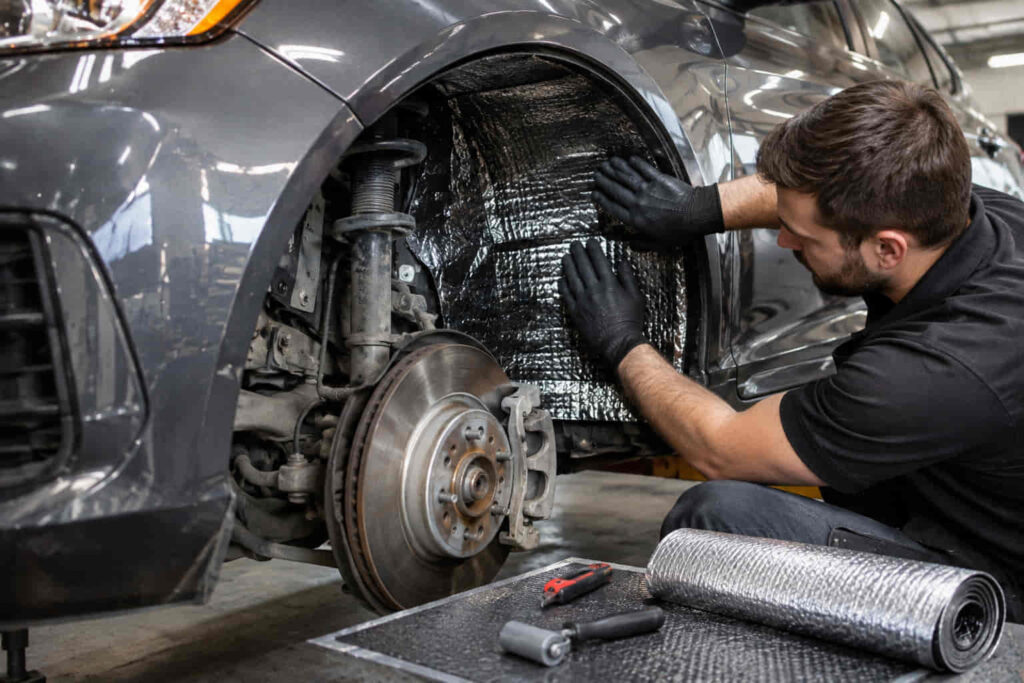
Improving wheel well insulation helps reduce sound entering the cabin from the tires. Wheel wells are directly exposed to tire-generated noise, water spray, gravel, and road debris. Factory wheel well liners provide some protection, but their acoustic performance varies between vehicles. Adding suitable automotive acoustic insulation or replacing damaged liners can help reduce the transmission of tire noise through surrounding body panels. Any aftermarket material installed in this area must be designed for exposure to moisture, temperature changes, dirt, and road debris. Materials that absorb water or interfere with drainage can create additional problems.
Door and window sealing can also improve cabin noise levels, particularly when wind noise contributes to the overall sound. Weatherstripping creates a flexible barrier between moving doors, windows, and the vehicle body. When these seals become cracked, compressed, or detached, outside air can pass through small gaps and generate whistling or rushing sounds. Replacing deteriorated weatherstripping and adjusting improperly aligned doors can restore the intended seal. However, excessive tire noise transmitted through the floor and wheel wells will require additional treatment because door seals cannot eliminate sound entering through other vehicle structures.
Maintaining wheel bearings and suspension components is essential when road noise originates from mechanical deterioration rather than ordinary tire-road contact. Worn wheel bearings can generate continuous humming, growling, or grinding sounds that become more noticeable as driving speed increases. Damaged suspension components can produce knocking, rattling, and vibration over uneven surfaces. These problems require mechanical inspection and repair before soundproofing modifications are considered. Covering up a mechanical warning sound with additional insulation can delay necessary repairs and potentially create safety risks.
The best approach to reducing road noise is to combine source control with targeted sound insulation. Drivers should first inspect tire condition, pressure, wheel bearings, suspension components, and door seals to identify unnecessary noise sources. Once mechanical problems have been ruled out or repaired, sound deadening mats, wheel well insulation, and acoustic materials can improve cabin comfort. This approach reduces unwanted sound without adding unnecessary weight or spending money on insulation that does not address the actual problem.
Do Tires Cause Most of the Road Noise Inside a Car?
Yes, tires are one of the primary sources of road noise inside a car because they continuously generate sound and vibration through contact with the road surface. As a vehicle moves, tire tread blocks repeatedly compress and release against pavement, creating vibrations and pressure changes that produce audible noise. These sounds travel through the wheel assemblies, suspension components, wheel wells, and vehicle floor before reaching the passenger cabin. The amount of noise depends on tire design, tread condition, road texture, vehicle insulation, and driving speed.
Tire tread pattern plays an important role in determining how much noise a tire generates. Large tread blocks, aggressive patterns, and widely spaced grooves can create more noticeable sound when they repeatedly contact paved surfaces. All-terrain and mud-terrain tires are designed to provide traction on loose surfaces, so their tread designs may generate more road noise on highways than conventional touring tires. By comparison, grand touring tires generally prioritize ride comfort, predictable handling, and lower noise levels on paved roads. Drivers who spend most of their time on highways may benefit from tires specifically engineered for quiet operation.
Tire wear can also increase road noise, particularly when the tread develops uneven patterns. Cupping, feathering, and irregular shoulder wear can create repeated variations in tire-road contact, producing humming, roaring, or rhythmic sounds. These conditions may result from improper wheel alignment, worn suspension components, incorrect tire pressure, or inadequate tire maintenance. For example, a tire with scalloped tread wear may produce a repetitive humming sound that becomes louder as vehicle speed increases. Rotating tires according to the manufacturer’s maintenance schedule and correcting alignment problems can help prevent further irregular wear.
Tire pressure influences road noise by changing how the tire interacts with the pavement. Underinflated tires experience greater sidewall flex, which can increase heat generation, alter tread contact, and accelerate uneven wear. Overinflated tires may produce a harsher ride because their contact characteristics differ from the manufacturer’s intended specifications. Both conditions can negatively affect driving comfort and tire performance. Drivers should use the recommended cold tire pressure listed on the driver’s door placard rather than relying on the maximum pressure printed on the tire sidewall.
Choosing tires with low-noise characteristics is often more effective than attempting to eliminate tire noise through cabin insulation alone. Some premium touring tires use optimized tread block sequencing, specialized rubber compounds, and noise-reduction technologies to reduce the sound generated during road contact. Certain models also incorporate internal acoustic foam designed to reduce resonance inside the tire cavity. However, tire noise ratings should be considered alongside wet traction, braking performance, load capacity, and weather suitability. A quieter tire is beneficial only when it also meets the vehicle’s safety and performance requirements.
Do Sound Deadening Mats Reduce Road Noise?
Yes, sound deadening mats can reduce road noise by controlling vibrations in metal vehicle panels, particularly the doors, floor pans, trunk panels, and other large body surfaces. These materials help prevent thin metal panels from resonating when exposed to tire-generated vibrations and external sound energy. When properly installed, sound deadening mats can make the cabin quieter by reducing panel vibration and limiting the transmission of certain low-frequency noises. However, their effectiveness depends on the material design, installation location, coverage, and original acoustic characteristics of the vehicle.
Most automotive sound deadening mats use a constrained-layer damping structure consisting of a viscoelastic layer attached to a metal surface, often with an aluminum facing. When a vehicle panel vibrates, the damping layer deforms and converts some mechanical vibration energy into small amounts of heat. This process reduces the amplitude of panel vibration and limits the metallic resonance that passengers may hear inside the cabin. For example, applying damping material to the interior metal surface of a door can reduce panel resonance caused by road vibrations and improve the acoustic environment for passengers.
Sound deadening mats differ from acoustic insulation materials because they primarily target structural vibration rather than absorbing airborne sound. Mass loaded vinyl, for example, adds mass to a barrier and helps reduce sound transmission through vehicle panels. Acoustic foam and fibrous insulation materials absorb sound energy within enclosed spaces, reducing reflections and certain airborne noise frequencies. These materials serve different functions, so combining them can produce better results than relying on one product. A damping mat may control vibration in the floor panel, while a separate acoustic barrier helps prevent tire noise from entering the passenger compartment.
Installation location significantly influences how much road noise sound deadening mats can reduce. Floor pans and trunk areas often transmit noise from tires and road surfaces, making them useful locations for vibration-control materials. Door panels can also benefit from damping because large metal surfaces may resonate when exposed to external sound. Wheel wells and selected firewall areas may require specialized materials designed to withstand moisture, heat, and environmental exposure. Installing material without identifying the dominant noise source can increase vehicle weight without producing a meaningful improvement in cabin comfort.
Sound deadening mats are most effective when they form part of a complete automotive noise reduction system rather than being treated as a universal soundproofing solution. Drivers should first identify whether excessive noise originates from tires, wheel bearings, suspension components, wind leakage, or vibrating body panels. Mechanical problems must be repaired before additional insulation is installed. The correct combination of vibration damping, acoustic barriers, insulation, and properly maintained tires can reduce unwanted cabin noise more effectively than covering every accessible surface with damping material.
Read more: car ac making hissing noise
How Can You Reduce Road Noise Through Car Doors and Floor?
You can reduce road noise through car doors and floors by installing appropriate sound deadening materials, improving acoustic insulation, and replacing damaged weatherstripping. Doors and floor panels are important sound transmission pathways because they contain large metal surfaces exposed to external vibrations. Tire noise travels through the suspension and vehicle structure, while airborne sound can enter through gaps around doors and windows. Treating these areas with suitable automotive insulation helps reduce unwanted noise and improve cabin comfort.
Car doors can transmit road noise because their metal panels vibrate when exposed to external sound and mechanical energy. The space inside a door also contains openings for window mechanisms, wiring, and drainage. Applying automotive sound deadening mats to suitable interior metal surfaces helps reduce panel resonance and vibration. Acoustic insulation can provide additional sound absorption within the door cavity when installed without interfering with window regulators, electrical wiring, side-impact protection, or drainage pathways. Combining vibration damping with appropriate acoustic materials generally provides better results than using either material alone.
Door weatherstripping also plays an important role in controlling outside noise. Rubber seals around the door frame create a barrier that limits wind and airborne sound from entering the cabin. Over time, these seals can become compressed, cracked, hardened, or detached, allowing air and noise to pass through small gaps. Drivers may notice whistling or rushing sounds that become louder at highway speeds. Replacing deteriorated weatherstripping and correcting door alignment can restore the original sealing performance and reduce wind noise. However, door seals primarily address air leakage and external sound transmission rather than vibrations originating from the tires and floor structure.
The vehicle floor is another important area for reducing road noise because it sits close to the tires, suspension, and underbody. Tire-generated vibrations can travel through the suspension mounting points and vehicle structure before reaching the floor panels. Installing damping materials on suitable floor surfaces can reduce metal panel resonance, while dense acoustic barriers and insulation help limit sound transmission into the cabin. The factory carpet and underlayment also contribute to acoustic comfort, but their performance varies depending on vehicle design and insulation thickness.
Effective floor soundproofing requires selecting materials that provide the correct balance of vibration control, acoustic insulation, moisture resistance, and weight. Automotive damping mats can reduce floor panel vibration, while mass loaded vinyl or specialized acoustic barriers can help block airborne sound. Installation must account for wiring harnesses, seat mounting points, airbags, and factory drainage channels. Covering essential electrical connections or obstructing water drainage can create problems that outweigh the acoustic benefits. Professional installation is worth considering when extensive floor disassembly is required.
How Do You Reduce Tire Noise From Wheel Wells?
You can reduce tire noise from wheel wells by maintaining the factory wheel well liners, installing suitable automotive acoustic materials, and addressing vibrations transmitted through surrounding body panels. Wheel wells are particularly exposed to tire-road contact noise because they surround the tires and sit close to the main source of road-generated sound. As tires roll over pavement, vibrations and airborne sound travel through the wheel well structure and adjacent floor panels. Improving the acoustic protection in this area can reduce the amount of tire noise reaching the passenger cabin.
Wheel well liners provide the first layer of protection against road debris, water, and some tire-generated noise. These liners are commonly made from molded plastic, textile-based materials, or other automotive-grade composites. Their design helps protect the vehicle body while reducing direct exposure to debris thrown from the tires. Damaged, loose, or missing liners can allow additional vibration and sound to reach surrounding body panels. Replacing damaged liners with manufacturer-compatible components helps restore the intended protection and acoustic characteristics.
Additional acoustic insulation can improve wheel well noise reduction when the selected materials are designed for automotive use. Specialized wheel well liners and acoustic barriers can help absorb or block certain sound frequencies generated by tire-road contact. Unlike interior sound deadening mats, materials installed near the wheels must withstand water, road salt, mud, gravel, temperature changes, and repeated exposure to environmental contaminants. Materials that absorb excessive moisture or deteriorate under road conditions can create maintenance problems and should not be used in exposed wheel well areas.
The inner body panels surrounding the wheel wells can also contribute to cabin noise. When these metal surfaces vibrate in response to tire-generated sound, they can transfer additional noise into the floor and passenger compartment. Applying suitable vibration-damping material to accessible interior-side panels can reduce resonance. This approach is different from applying insulation directly inside the exposed wheel well because the materials have different environmental requirements. Interior-side damping materials should be selected according to the manufacturer’s temperature and installation specifications.
Wheel well soundproofing works best when combined with quiet tires, properly maintained suspension components, and effective floor insulation. Installing thicker liners or acoustic materials will not eliminate excessive noise caused by uneven tire wear, damaged wheel bearings, or deteriorated suspension components. Drivers should inspect these mechanical components before investing in additional insulation. Addressing the original noise source and improving the surrounding acoustic barriers provides a more effective and durable reduction in cabin road noise.
How Can You Identify the Source of Excessive Road Noise?
You can identify the source of excessive road noise by observing when the sound occurs, how it changes with driving speed, and whether it responds to road conditions, steering inputs, or vehicle operation. Tire noise, wind noise, wheel bearing problems, and suspension defects can produce similar sounds inside the cabin, but their patterns often differ. Identifying these differences helps determine whether the vehicle needs soundproofing, tire maintenance, or mechanical repairs.
Tire-related road noise generally changes with vehicle speed and pavement texture. A humming or roaring sound that becomes louder as the car accelerates may originate from tire-road contact, especially when the tires have aggressive tread patterns or uneven wear. The same vehicle may sound quieter on smooth asphalt and noticeably louder on coarse concrete because different road surfaces produce different vibration and sound characteristics. If the noise changes significantly between pavement types, tire-related noise is a reasonable possibility. However, worn wheel bearings can also produce speed-dependent humming, so further inspection may be necessary.
Wheel bearing noise often resembles a continuous humming, growling, or grinding sound that increases with vehicle speed. In some cases, the sound changes when the vehicle turns because cornering forces alter the load placed on the wheel bearings. A damaged bearing may become louder when more weight transfers onto the affected side. Unlike ordinary tire noise, bearing noise may remain noticeable across different road surfaces. Because a failing wheel bearing can affect vehicle safety, persistent humming or grinding should be inspected by a qualified technician rather than treated with additional sound insulation.
Wind noise typically becomes more noticeable at highway speeds and often resembles whistling, rushing, or air escaping around the windows. Damaged door seals, poorly aligned windows, deteriorated weatherstripping, and gaps around exterior trim can allow air to enter the cabin. Drivers may notice that the noise becomes louder when driving into a headwind or when air moves around a particular side of the vehicle. Inspecting the door seals and window alignment can help identify these problems. Replacing damaged weatherstripping is generally more appropriate than installing floor soundproofing when the primary source is air leakage.
Suspension and drivetrain problems can also produce excessive noise that should not be confused with ordinary road noise. Worn suspension bushings, damaged struts, loose components, and drivetrain defects may create knocking, rattling, clunking, or vibration during driving. These sounds may become more pronounced when traveling over bumps, accelerating, or changing direction. For example, a repeated clunk over uneven pavement may indicate a suspension component problem rather than inadequate cabin insulation. If the noise is accompanied by steering changes, unusual vibration, grinding, or unstable handling, mechanical inspection should take priority over soundproofing modifications.
Does Tire Pressure Affect Road Noise?
Yes, tire pressure affects road noise because it changes how the tire contacts the pavement, flexes during driving, and transfers vibrations into the vehicle. Incorrect inflation can alter the tire’s contact patch, affect tread wear, and reduce ride comfort. Both underinflated and overinflated tires can contribute to undesirable driving characteristics, although the resulting noise depends on tire construction, vehicle weight, road conditions, and driving speed.
Underinflated tires generally experience greater sidewall flex because they do not maintain their intended operating shape. This additional flex generates heat and can accelerate uneven tread wear, potentially increasing road noise over time. The tire may also develop irregular contact characteristics that affect how vibrations travel through the suspension and vehicle body. Drivers who frequently operate vehicles with insufficient tire pressure may notice a harsher or less consistent driving experience as tire wear progresses.
Overinflated tires can also affect cabin comfort by changing the tire’s contact characteristics and reducing its ability to absorb certain road irregularities. Because an overinflated tire may become less compliant, passengers can experience a firmer ride over rough pavement, expansion joints, and small road imperfections. This can make certain road sounds and vibrations more noticeable inside the cabin. However, increasing tire pressure does not provide a reliable method of reducing road noise and may compromise handling and tire performance.
The correct way to manage tire pressure is to follow the vehicle manufacturer’s recommended cold inflation pressure rather than adjusting it to achieve a quieter ride. Drivers can find this specification on the tire information placard, commonly located inside the driver’s door frame, or in the owner’s manual. Tire pressure should be checked when the tires are cold because driving increases internal air temperature and pressure. Maintaining the specified pressure helps preserve the intended tire contact characteristics, reduce irregular wear, and support consistent vehicle handling.
Tire pressure maintenance should also be combined with regular tread inspections and tire rotation. Uneven wear, cupping, feathering, and damaged tread blocks can produce persistent humming or roaring sounds even when inflation pressure is correct. If excessive road noise continues after correcting tire pressure, a technician should inspect wheel alignment, suspension components, and wheel bearings. Replacing worn tires with quieter touring tires may also provide a more noticeable improvement than repeatedly adjusting inflation pressure.
How Much Does It Cost to Reduce Road Noise in a Car?
Reducing road noise in a car can cost approximately $100 to $2,000 or more, depending on the soundproofing materials, installation areas, vehicle size, and labor requirements. Basic upgrades, such as treating individual door panels or installing limited sound deadening materials, cost less than comprehensive treatments covering the floor, doors, trunk, roof, and wheel wells. The final price also depends on whether owners install the materials themselves or hire an automotive soundproofing specialist.
DIY sound deadening is generally the most affordable option because vehicle owners pay primarily for materials and installation tools. Automotive butyl-based damping sheets typically cost around $1.50–$4 per square foot, while mass loaded vinyl generally costs approximately $2.50–$6 per square foot through aftermarket retail channels. Closed-cell acoustic foam and insulation materials have different price ranges depending on their density, thickness, and intended application. These materials serve different acoustic functions, so purchasing the cheapest product without considering its purpose may produce disappointing results. Prices, Size, Forecast, and Companies+2
Targeted soundproofing is a practical option when road noise enters primarily through one or two areas. For example, treating the front doors may reduce panel resonance and improve overall cabin acoustics without requiring extensive interior disassembly. A floor treatment can be more useful when tire and underbody noise dominate the driving experience. Specialist product pricing also varies by vehicle application. Second Skin Audio lists several application-specific kits, including door kits priced around $250–$540 and wheel well spray kits around $220, illustrating how material coverage and product design influence the budget. Second Skin Audio
Professional installation costs more because technicians must remove interior panels, prepare metal surfaces, apply damping materials, install acoustic barriers, and reinstall vehicle components. A professional treatment covering selected doors, the floor, or trunk can cost several hundred dollars, while comprehensive soundproofing may reach $1,500–$2,000 or more. For example, a Philadelphia automotive soundproofing service lists doors-only treatment at approximately $200–$400, floor and trunk treatment at $400–$800, and full-vehicle treatment at $900–$1,800 or more. These are local service estimates rather than nationwide fixed prices. Top Pros+2
The vehicle’s size and interior design also affect installation costs. A compact sedan generally requires less material than a full-size SUV, pickup truck, or minivan. Vehicles with complex dashboards, integrated electrical systems, extensive interior trim, and difficult-to-access floor panels require additional labor. Premium acoustic materials may also increase the budget because they offer different combinations of density, damping performance, heat resistance, and durability. Owners should request an itemized estimate that separates material costs, labor, installation areas, and any additional repairs.
The most cost-effective approach is to treat the areas responsible for the greatest amount of unwanted noise rather than soundproofing the entire vehicle immediately. If tire noise enters mainly through the floor and wheel wells, treating those areas may provide better results than spending money on door insulation alone. If wind noise dominates, replacing damaged weatherstripping may be more effective than installing expensive damping mats. Identifying the primary noise source before purchasing materials helps prevent unnecessary expenses.
Is It Worth Soundproofing Your Car?
Soundproofing your car is worth considering when excessive road noise affects driving comfort, creates cabin fatigue, or makes conversations and audio playback difficult. Automotive soundproofing can reduce vibrations, panel resonance, and external sound transmission, creating a quieter passenger compartment. The improvement depends on the original vehicle construction, the source of noise, the quality of materials, and the installation method. Vehicles with limited factory insulation may benefit more noticeably from targeted acoustic upgrades than vehicles that already have extensive factory soundproofing.
One major benefit of soundproofing is improved comfort during highway driving. At higher speeds, tire noise, road vibrations, and wind noise can become more noticeable, particularly in vehicles with thin body panels or limited acoustic insulation. Applying damping materials to floor panels and doors can reduce structural vibration, while acoustic barriers help limit airborne sound entering the cabin. A quieter environment can make long-distance driving more comfortable and improve communication between passengers without requiring them to speak over excessive background noise.
Soundproofing can also improve the listening experience inside the vehicle. Road noise competes with music, navigation instructions, phone calls, and conversations, particularly when driving on coarse pavement. Reducing panel resonance and unwanted background noise allows passengers to hear audio more clearly at lower volume levels. Door damping can also reduce vibrations from speakers, improving the overall acoustic performance of an aftermarket car audio system. However, soundproofing does not replace proper speaker installation, acoustic tuning, or repair of defective audio equipment.
The main disadvantages of car soundproofing are additional vehicle weight, installation costs, and the possibility of limited improvement when materials are applied to the wrong locations. Butyl damping mats and mass loaded vinyl add weight to the vehicle, particularly when large areas of the floor, doors, and trunk receive multiple layers of material. Excessive or poorly selected insulation can also interfere with wiring, drainage channels, window mechanisms, and interior trim. Owners should choose automotive-rated materials and avoid covering essential safety components or ventilation pathways.
Soundproofing is not always the best solution when excessive noise comes from damaged mechanical components. A failing wheel bearing, unevenly worn tires, loose suspension parts, or deteriorated exhaust components should be diagnosed and repaired before additional acoustic insulation is installed. These problems can produce humming, grinding, knocking, or vibration that soundproofing materials cannot properly resolve. Treating the cabin without fixing the underlying mechanical fault may conceal warning signs and delay necessary maintenance.
Car soundproofing provides the greatest value when it addresses a clearly identified noise source and uses materials designed for the specific application. Drivers experiencing ordinary tire-road noise may benefit from quieter touring tires, targeted floor insulation, or wheel well treatment. Vehicles with noticeable door resonance may benefit from damping materials applied to suitable metal surfaces. Choosing targeted improvements instead of automatically purchasing a full-vehicle soundproofing package helps balance acoustic performance, installation cost, and additional vehicle weight.