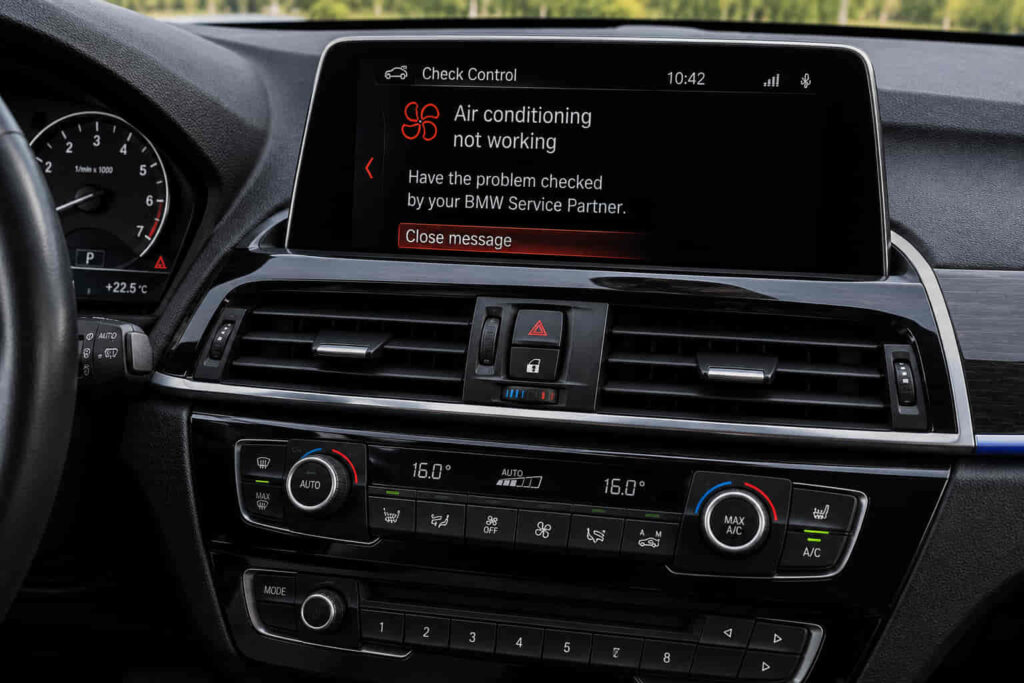
A BMW X1 air conditioning system can stop working because of refrigerant loss or incorrect refrigerant conditions, compressor problems, inadequate condenser cooling, restricted cabin airflow, electrical faults, or HVAC sensor and control issues. The exact symptom provides the first diagnostic clue because a BMW X1 that produces strong airflow but does not blow cold air has a different problem from one that delivers little or no air through the vents.
When airflow remains normal but the cabin does not cool, the refrigeration side of the AC system becomes more relevant. Refrigerant condition, compressor operation, condenser heat rejection, and the electronic controls that manage cooling all influence whether heat can be removed from the cabin. When airflow itself is weak or absent, diagnosis should shift toward the blower and air-delivery path rather than assuming the refrigerant circuit is responsible. Intermittent cooling also requires attention to the operating conditions under which the problem appears because electrical, control, and heat-rejection issues can change AC performance without producing a constant symptom.
Adding refrigerant is therefore not a universal fix when a BMW X1 air conditioning system is not working. A recharge restores the specified refrigerant charge when the system requires it, but it does not repair a leak that allowed refrigerant to escape. It also cannot correct a failed blower, inadequate condenser airflow, an electrical problem, or incorrect HVAC sensor information. Identifying whether the BMW X1 has a cooling, airflow, or control problem provides the diagnostic direction needed to find the actual failure mechanism instead of replacing parts based only on warm cabin air.
Can low refrigerant or a leak stop the BMW X1 AC from cooling?
Yes, refrigerant loss or an incorrect refrigerant charge can prevent a BMW X1 air conditioning system from cooling properly because the refrigeration cycle requires specific operating conditions to transfer heat out of the cabin. The typical symptom is airflow that remains present at the vents while the air itself is warmer than expected. This separates a refrigeration-side problem from a blower problem in which the volume of airflow is reduced or absent.
The refrigerant circuit transfers heat rather than simply producing cold air. Inside the HVAC system, the evaporator allows heat to be removed from air before that air enters the cabin. The refrigerant carries the absorbed heat through the circuit, and the condenser allows that heat to be released outside the vehicle. If refrigerant conditions move outside the system’s intended operating range, this heat-transfer process can become less effective and cabin cooling can deteriorate.
Low refrigerant is therefore a system condition, not a complete diagnosis. The AC circuit is designed to contain its refrigerant, so a loss of charge can indicate leakage from a component, connection, seal, or another point in the circuit. The source must be identified before assuming that restoring refrigerant alone constitutes a complete repair.
This distinction becomes especially important when cooling returns after an AC recharge and later deteriorates again. Recharge restores the specified refrigerant charge, but it does not seal the location from which refrigerant is escaping. If the BMW X1 repeatedly loses cooling after the charge has been restored, recurring refrigerant loss provides evidence that the system should be evaluated for a leak rather than simply recharged again.
The correct refrigerant condition also depends on the specific vehicle. BMW X1 generations and configurations can use different AC specifications, so a generic refrigerant quantity should not be applied across every model. More refrigerant does not mean more cooling; the system needs to operate according to its specified requirements.
The causal chain is refrigerant loss → incorrect refrigeration-system conditions → reduced heat transfer → insufficient cabin cooling. A recharge addresses the charge condition, while diagnosis and repair of a confirmed leak address why refrigerant was lost. Keeping those two actions separate prevents a temporary return of cold air from being mistaken for a permanent repair.
Can a bad AC compressor make the BMW X1 blow warm air?
Yes, an AC compressor problem can make a BMW X1 blow warm air because the compressor supports the pressure conditions required for the refrigeration cycle to remove heat from the cabin. The cabin blower can remain fully operational during this type of failure, which means strong airflow from the vents does not necessarily indicate that the cooling side of the AC system is working correctly.
The compressor operates within the refrigerant circuit rather than the cabin air-delivery circuit. When the refrigeration system operates correctly, compressor function contributes to the pressure and refrigerant conditions that allow heat to be absorbed at the evaporator and rejected at the condenser. If this process is disrupted, air can continue moving through the HVAC system without being cooled sufficiently before reaching the cabin.
However, a compressor that is not operating should not automatically be diagnosed as a failed compressor. Its behavior can depend on refrigerant-system conditions, electrical supply, control commands, sensor information, and operating protections. The AC control system may alter compressor operation when another condition prevents normal refrigeration-cycle operation. Replacing the compressor without determining why it is inactive can therefore leave the underlying BMW X1 AC problem unresolved.
Intermittent cooling makes this distinction particularly important. If the AC produces cold air under one operating condition but becomes warm under another, compressor behavior should be evaluated together with the conditions present when cooling disappears. An electrical or control problem can influence operation differently from an internal compressor failure even though both eventually produce warm air at the vents.
Diagnosis should therefore connect compressor behavior with the rest of the system. Refrigerant conditions, relevant electrical inputs and commands, and actual cooling performance provide more diagnostic value together than any single symptom. Strong airflow combined with warm air establishes that the cooling side deserves investigation, but it does not identify the compressor as the failed component by itself.
The diagnostic relationship is normal airflow + warm air → evaluate refrigeration-cycle conditions → assess compressor operation → determine why operation is abnormal → repair the confirmed failure. A defective compressor can prevent BMW X1 air conditioning from cooling, but compressor replacement should follow diagnosis rather than be inferred from warm vent air alone.
Read more: BMW 1 Series Air Conditioning Not Working
Can condenser or cooling-airflow problems reduce BMW X1 AC performance?
Yes, condenser or cooling-airflow problems can reduce BMW X1 AC performance because the air conditioning system must release the heat removed from the cabin to the outside air. The condenser performs this heat-rejection function. If heat cannot leave the refrigerant circuit efficiently, the AC may produce warmer vent air even though the cabin blower continues operating normally.
The condenser works on a different side of the cooling process from the evaporator. The evaporator supports heat absorption from cabin air, while the condenser allows the refrigerant to release that absorbed heat outside the vehicle. Effective air conditioning therefore depends on both processes. Cooling can deteriorate when the system can absorb heat but cannot reject it efficiently enough to maintain the required refrigeration-cycle conditions.
Airflow across the condenser directly affects this heat-transfer process. When the BMW X1 is moving, vehicle speed increases external airflow through the front heat-exchanger area. When the vehicle is stationary or moving slowly, cooling airflow depends more heavily on the conditions and systems designed to maintain adequate heat rejection without significant road speed. This relationship makes changes in AC performance between moving and stationary operation diagnostically useful.
For example, a BMW X1 that produces colder air while driving but becomes noticeably warmer while idling presents a different symptom pattern from an X1 that blows warm air continuously. The first pattern makes condenser heat rejection and cooling airflow more relevant to investigate. However, it does not by itself prove that the condenser or a particular cooling component has failed because refrigerant conditions, compressor operation, electrical control, and other AC variables can influence the same symptom.
Condenser airflow should also not be confused with airflow from the cabin vents. The condenser requires outside airflow to reject heat, whereas the HVAC blower moves conditioned air through the passenger compartment. A BMW X1 can therefore have strong airflow at the vents while the AC cools poorly because the refrigeration system cannot reject heat effectively.
The causal relationship is inadequate condenser heat rejection → unfavorable refrigeration-cycle conditions → reduced cooling capacity → warmer cabin air. If BMW X1 AC performance changes significantly with vehicle speed or stationary operation, condenser heat rejection and its supporting airflow should be evaluated as part of the cooling-side diagnosis rather than assuming the system simply needs more refrigerant.
Can a blower motor or cabin air filter cause weak airflow?
Yes, a blower motor problem or restricted cabin air filter can cause weak airflow from the BMW X1 vents even when the refrigeration system is capable of cooling the air. This is primarily an air-delivery problem, which means adding refrigerant will not correct the symptom if the actual failure is insufficient airflow through the HVAC system.
The blower creates the airflow required to move conditioned air through the HVAC housing and into the passenger compartment. When blower operation becomes weak, intermittent, or unavailable, the amount of air reaching the vents decreases. Cabin cooling can then feel inadequate because the HVAC system cannot distribute enough conditioned air, even if the refrigeration side remains capable of lowering air temperature.
A restricted cabin air filter affects the same airflow path through a different mechanism. As restriction increases, air encounters greater resistance before reaching the cabin. The blower may still operate, but the volume of air delivered through the vents can decrease. This creates a useful distinction between a blower that cannot move air effectively and an air path that restricts the air a functioning blower is attempting to move.
Vent temperature helps separate airflow faults from refrigeration faults. If the BMW X1 produces a small amount of noticeably cold air but airflow remains weak, the blower and air-delivery path deserve greater attention. If airflow is strong but consistently warm, refrigerant condition, compressor operation, condenser heat rejection, and AC controls become more relevant instead.
The way airflow responds to requested blower-speed changes provides additional diagnostic context. Airflow that fails to change normally can point diagnosis toward blower operation or its control environment, while consistently restricted airflow despite apparent blower operation can make the air path more relevant. Neither pattern should be used as proof of a specific failed component without confirming the mechanism responsible for the symptom.
The functional distinction is refrigeration system → removes heat from the cabin air, while blower and air-delivery path → move that conditioned air into the passenger compartment. A BMW X1 with weak or absent vent airflow therefore requires airflow-side diagnosis, whereas strong but warm airflow directs attention toward the cooling side of the AC system.
Can an electrical fault stop the BMW X1 air conditioning from working?
Yes, an electrical fault can stop the BMW X1 air conditioning from working when an AC or HVAC component does not receive the power, control command, or electrical communication required for normal operation. The BMW X1 AC system combines a physical refrigeration circuit with electronic control, so a component that stops operating should not automatically be considered mechanically defective.
The symptom depends on which electrical function is affected. A fault associated with the cabin blower can reduce or eliminate airflow from the vents, while an electrical problem affecting refrigeration control can allow the blower to continue working even though the air remains warm. An intermittent electrical condition can also cause the AC to work normally during one drive and lose cooling or airflow during another. Classifying the symptom therefore helps identify which electrical path deserves investigation.
Power supply and control command are separate parts of this process. A component can have an available power supply but remain inactive because the control system is not requesting operation under the current conditions. Conversely, the system can request operation while a circuit or connection problem prevents the component from responding. This is why checking only whether a compressor, blower, or another AC component is active does not establish why it is active or inactive.
Circuit protection can become relevant when an AC component receives no power, but there is no single fuse number that should be applied universally to every BMW X1. Electrical architecture can differ by generation, model year, powertrain, and equipment. A failed protective device can also indicate another circuit problem, so replacing it without identifying why the electrical interruption occurred can result in the same fault returning.
Electrical diagnosis becomes especially important before replacing an expensive component. If a compressor or blower is not operating, the diagnostic process should determine whether the component has the required supply and receives the expected command before concluding that the component itself has failed. A functional component cannot perform correctly when the electrical conditions required for its operation are missing.
The diagnostic relationship is component inactive → identify required operating conditions → verify control request → verify electrical path → evaluate component response. Following this sequence helps distinguish an electrical or control problem from an actual component failure and prevents the BMW X1 AC malfunction from being diagnosed solely from what a component appears to be doing.
Can an AC pressure or temperature sensor cause BMW X1 cooling problems?
Yes, an AC pressure or temperature sensor problem can contribute to BMW X1 cooling problems because the HVAC control system uses sensor information to determine operating conditions and manage air-conditioning functions. If relevant information is incorrect or unavailable, the system can respond differently from what the actual cabin or refrigerant conditions require.
Pressure information is important because AC operation depends on conditions within the refrigerant circuit. The control system can use relevant pressure data when determining how the refrigeration system should operate. If the information reaching the control system is incorrect because of a sensor or circuit fault, component operation can be affected even though the driver continues requesting maximum cooling.
An abnormal pressure value does not, however, prove that the pressure sensor has failed. The sensor may be accurately reporting a real refrigeration-system condition. Incorrect refrigerant charge, poor condenser heat rejection, or another physical problem can create abnormal operating conditions that appear in diagnostic data. Replacing the sensor in this situation would remove neither the physical fault nor the reason the value became abnormal.
Temperature-related information follows the same diagnostic principle. HVAC controls use temperature inputs to determine how the system should respond to the selected cabin setting. Incorrect information can contribute to unexpected cooling behavior, but a cabin that remains too warm can also result from inadequate refrigeration, weak airflow, or excessive heat that the AC system cannot remove effectively.
The useful distinction is therefore between a sensor producing incorrect information and a sensor correctly reporting an abnormal condition. Diagnostic values need to be compared with actual system behavior and relevant physical conditions. When the reported information does not correspond with those conditions, the sensor or its circuit becomes more relevant. When the data accurately represents a real AC problem, diagnosis should follow that underlying physical condition.
The causal chain is sensor input → HVAC control decision → component response → cabin cooling performance. A faulty input can disrupt that chain, but BMW X1 AC diagnosis should establish whether the sensor information is incorrect before the sensor is identified as the root cause. This prevents an abnormal reading from being treated as automatic evidence of a failed sensor.
What should you check if the BMW X1 AC still does not work?
If the BMW X1 AC still does not work, diagnosis should begin by determining whether the malfunction affects cooling, airflow, or both, then tracing that symptom through the refrigeration, air-delivery, electrical, and HVAC control systems. This symptom-first approach helps identify the relevant fault domain before refrigerant is added or individual components are replaced.
Airflow provides the first distinction. If the vents produce a normal volume of air but that air remains warm, the blower is performing its basic air-delivery function and diagnosis should focus more closely on the cooling side. Refrigerant conditions, compressor behavior, condenser heat rejection, sensor information, and system controls become relevant because each can affect the refrigeration cycle without stopping cabin airflow.
Weak or absent airflow requires a different diagnostic direction. In this condition, the blower and air-delivery path deserve greater attention because the HVAC system cannot distribute conditioned air effectively if sufficient air is not reaching the vents. Even if the refrigeration circuit is capable of cooling, inadequate airflow can make cabin temperature remain uncomfortable. Refrigerant service does not correct this type of failure mechanism.
The conditions under which cooling changes also provide diagnostic evidence. A BMW X1 that cools better while driving than while stationary presents a different pattern from one that continuously blows warm air. Likewise, an AC system that starts cold and later loses cooling should not automatically receive the same diagnosis as a system that never becomes cold. Identifying when the symptom appears helps determine whether heat rejection, electrical control, compressor operation, or another system condition needs closer evaluation.
Refrigerant condition should be measured or otherwise evaluated appropriately rather than inferred from cabin temperature alone. If refrigerant has been lost, restoring the specified charge addresses the resulting refrigerant condition but does not explain why the loss occurred. When cooling improves after service and later deteriorates again, recurring refrigerant loss becomes an important diagnostic clue and the source of that loss needs to be identified.
Compressor operation requires the same cause-based reasoning. A compressor that is not operating may have an internal fault, but electrical supply, control commands, refrigerant conditions, and sensor information can also influence whether the system allows or requests compressor operation. Diagnosis should establish why the compressor is inactive before compressor replacement is considered the repair.
Sensor and diagnostic information should also be interpreted in relation to actual system conditions. An abnormal pressure or temperature value may result from incorrect sensor information, but it may also accurately describe a physical AC problem. Comparing reported values with refrigeration-system behavior prevents a sensor from being replaced when it is correctly identifying another failure.
When these individual checks do not isolate the problem, system-level HVAC diagnosis becomes necessary. The objective is to connect the observed BMW X1 AC symptom with the component, circuit, or physical condition responsible for it. Refrigerant conditions, compressor behavior, condenser heat rejection, cabin airflow, electrical supply, control commands, and sensor information provide related evidence that should be evaluated together rather than as independent possible failures.
The correct troubleshooting sequence is BMW X1 AC symptom → identify cooling or airflow failure → isolate the relevant fault domain → confirm the failure mechanism → perform the required repair → verify cooling and airflow performance. Recharge restores the specified refrigerant charge, diagnosis identifies why the air conditioning is not working, and repair corrects the confirmed cause. This distinction prevents temporary symptom improvement from being mistaken for a completed BMW X1 air conditioning repair.