Seeing the “Service StabiliTrak” warning appear on your GMC Sierra’s dashboard can be unsettling, especially if it happens while you’re driving at highway speeds or towing a heavy load. The message often appears without warning, leaving many drivers wondering whether the truck is still safe to operate or if an expensive repair is just around the corner. Since the StabiliTrak system is closely connected to your vehicle’s traction control, anti-lock braking system (ABS), and electronic stability control, ignoring the warning may reduce your truck’s ability to maintain stability during sudden maneuvers or on slippery roads.
Fortunately, a GMC Sierra Service StabiliTrak warning does not always indicate a major mechanical failure. In many cases, the issue can be traced to a faulty wheel speed sensor, steering angle sensor, low battery voltage, damaged wiring, or another component that can be diagnosed and repaired without replacing costly parts. However, because multiple systems communicate with each other, identifying the exact cause requires a systematic approach rather than simply clearing the warning message.
This comprehensive guide explains everything you need to know about the GMC Sierra Service StabiliTrak warning. You’ll learn what the system does, why the warning appears, the ten most common causes, how to diagnose the problem using professional methods, estimated repair costs, whether it’s safe to continue driving, and the most effective ways to prevent the issue from returning. Whether you’re a DIY enthusiast or planning to visit a repair shop, this guide will help you understand the problem and make informed decisions that keep your GMC Sierra safe, reliable, and performing at its best.
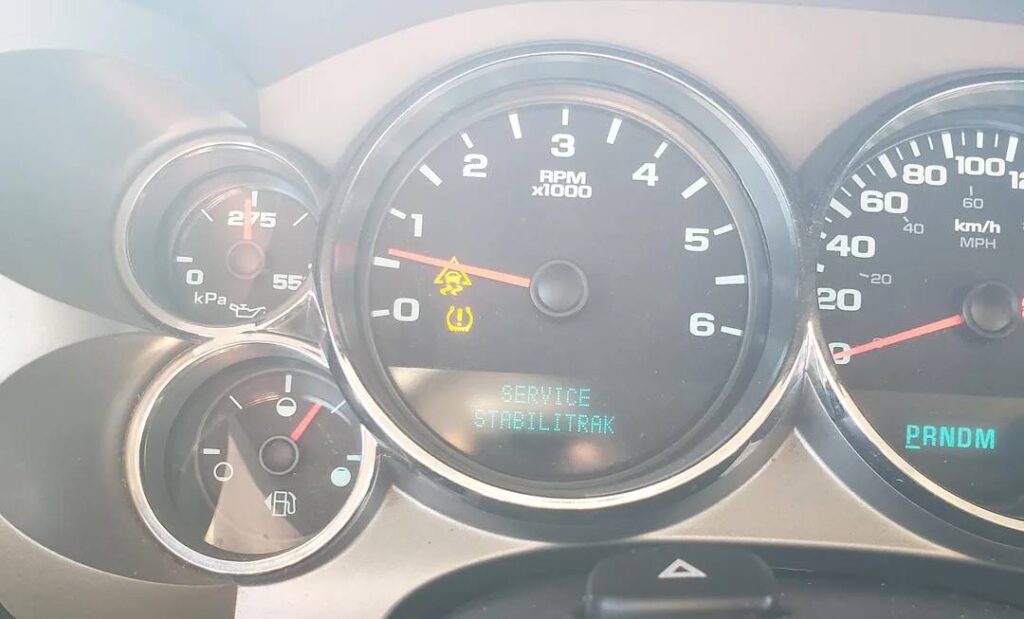
What Does “Service StabiliTrak” Mean on a GMC Sierra?
The Service StabiliTrak warning on a GMC Sierra indicates that the truck’s Electronic Stability Control (ESC) system has detected a fault that requires attention. Rather than identifying a specific failed component, the message serves as a general alert that one or more systems responsible for maintaining vehicle stability are not functioning correctly. When this warning appears, the truck may temporarily disable or limit certain safety features until the underlying issue is diagnosed and repaired.
StabiliTrak is General Motors’ electronic stability control technology, designed to help drivers maintain control during emergency maneuvers, sharp turns, or slippery driving conditions. It continuously monitors the truck’s movement using multiple sensors and compares the driver’s intended direction with the vehicle’s actual path. If the system detects understeer, oversteer, or wheel slip, it automatically applies braking force to individual wheels and, in some cases, reduces engine power to restore stability.
Unlike a traditional traction control system that mainly prevents wheel spin during acceleration, StabiliTrak provides more comprehensive control by working together with several critical vehicle systems. It relies on the Anti-lock Braking System (ABS), Traction Control System (TCS), steering angle sensor, wheel speed sensors, yaw rate sensor, brake pressure sensors, and the Engine Control Module (ECM). Because these components constantly exchange data, a malfunction in any one of them can trigger the Service StabiliTrak warning.
For example, if one wheel speed sensor begins transmitting inaccurate information, the control module may incorrectly assume that a wheel has lost traction. To prevent unsafe intervention, the system disables itself and alerts the driver. Similarly, electrical issues, communication errors between control modules, or even engine performance problems such as ignition misfires can interfere with StabiliTrak operation.
Drivers often notice additional warning lights alongside the Service StabiliTrak message. The traction control indicator may illuminate, the ABS warning light may appear, or the Check Engine Light may turn on if the fault originates from the engine management system. Some GMC Sierra models may also enter Reduced Engine Power mode, limiting acceleration to protect the vehicle from further damage. Cruise control may become unavailable until the problem has been resolved.
Although the warning does not always mean the truck is unsafe to drive, it should never be ignored. Electronic stability control significantly improves vehicle handling during adverse weather, emergency lane changes, and sudden obstacle avoidance. Without it, the risk of losing control increases, particularly on wet, icy, or uneven roads. If the warning is accompanied by unusual braking behavior, steering issues, or reduced engine performance, the vehicle should be inspected as soon as possible.
Understanding what the Service StabiliTrak warning represents is the first step toward identifying the root cause. Since the message only indicates that a fault exists somewhere within the stability control network, proper diagnosis using an OBD-II scanner and a systematic inspection of related components is essential before replacing any parts.
Top 10 Causes of GMC Sierra Service StabiliTrak Warning
A Service StabiliTrak warning can be triggered by a wide range of mechanical, electrical, or electronic issues. While some causes are relatively minor and inexpensive to repair, others require advanced diagnostics and professional service. Understanding the most common sources of the problem can save both time and money by preventing unnecessary parts replacement.
1. Faulty Wheel Speed Sensor
A defective wheel speed sensor is the most common cause of the Service StabiliTrak warning on a GMC Sierra. Each wheel is equipped with a sensor that continuously measures rotational speed and sends data to the ABS and stability control modules. If one sensor fails or produces inconsistent readings, the system can no longer accurately determine whether a wheel is slipping.
Common symptoms include an illuminated ABS light, disabled traction control, intermittent warning messages, and abnormal ABS operation during braking. Dirt, road salt, corrosion, damaged wiring, or physical impact can all contribute to sensor failure.
Fortunately, diagnosing this issue is relatively straightforward. A diagnostic scanner will usually identify the affected wheel, allowing technicians to inspect the sensor, wiring, and connector before replacing the component if necessary.
2. Bad Steering Angle Sensor
The steering angle sensor measures the position and direction of the steering wheel. This information helps the StabiliTrak system determine whether the vehicle is following the driver’s intended path.
Over time, the sensor may lose calibration after a wheel alignment, suspension repair, steering component replacement, or battery disconnection. Internal electronic failure is also possible, especially on higher-mileage trucks.
A malfunctioning steering angle sensor can cause the Service StabiliTrak warning even if all other systems are functioning normally. Drivers may notice that the warning appears immediately after starting the vehicle or during low-speed turns. In many cases, recalibrating the sensor with a professional scan tool resolves the issue without requiring replacement.
3. ABS Control Module Problems
The ABS control module serves as the communication hub for several safety systems, including StabiliTrak and traction control. It processes data received from multiple sensors and determines when corrective braking intervention is required.
If the module develops internal electronic faults, software corruption, or communication errors with other control units, the Service StabiliTrak message may appear alongside ABS and traction control warnings.
Symptoms often include multiple dashboard warning lights, intermittent brake system faults, and diagnostic trouble codes related to module communication. Because the ABS module plays a critical role in vehicle safety, accurate diagnosis is essential before considering repair or replacement. In some cases, a software update can restore proper operation, while more severe failures may require a replacement module followed by programming to match the vehicle’s configuration.
4. Worn or Damaged Wheel Bearing
A worn wheel bearing is another common but often overlooked cause of the GMC Sierra Service StabiliTrak warning. While many drivers associate wheel bearings only with unusual noises, these components also play a critical role in the vehicle’s stability control system. On many GMC Sierra models, the wheel speed sensor works together with an encoder ring built into the wheel bearing assembly. As the bearing begins to wear, excessive movement or vibration can interfere with the sensor’s ability to generate accurate wheel speed data.
When the Electronic Brake Control Module receives inconsistent information from a single wheel, it may interpret the data as wheel slip or loss of traction. As a protective measure, the StabiliTrak system disables itself and displays the warning message on the dashboard.
Common symptoms of a failing wheel bearing include a humming or growling noise that becomes louder as vehicle speed increases, vibration through the steering wheel, uneven tire wear, and intermittent ABS or traction control warnings. In severe cases, drivers may notice excessive wheel play during inspection.
Diagnosing a faulty wheel bearing usually involves lifting the vehicle and checking for looseness by rocking the wheel from side to side. A technician may also monitor live wheel speed data during a road test to determine whether one wheel reports inconsistent readings.
Replacing the complete wheel bearing assembly typically resolves both the bearing noise and the Service StabiliTrak warning. Because wheel bearing replacement requires specialized tools and proper torque specifications, many owners choose to have the repair performed by a qualified technician.
5. Brake Pedal Position Sensor Failure
The brake pedal position sensor is responsible for informing several electronic systems whenever the driver applies the brakes. In addition to activating the brake lights, this sensor provides valuable information to the ABS, traction control, cruise control, and StabiliTrak systems.
If the brake pedal position sensor begins sending incorrect signals or fails completely, the stability control module may not accurately determine when braking occurs. As a result, the system may disable electronic stability control and display the Service StabiliTrak warning.
Drivers experiencing a faulty brake pedal position sensor may notice cruise control no longer functions properly, brake lights remain illuminated or fail to activate, or warning messages appear intermittently during normal driving.
Diagnosis generally involves scanning for manufacturer-specific diagnostic trouble codes and verifying sensor operation through live data monitoring. Technicians may also inspect the electrical connector for corrosion or loose terminals.
Replacing the brake pedal position sensor is usually a relatively straightforward repair that restores communication between multiple vehicle systems. After installation, recalibration may be necessary depending on the GMC Sierra model year.
6. Weak Battery or Low System Voltage
Many drivers are surprised to learn that a weak battery can trigger the GMC Sierra Service StabiliTrak warning even when no sensors have actually failed. Modern GMC Sierra trucks rely on dozens of electronic control modules that constantly exchange information across the vehicle’s communication network. Stable electrical voltage is essential for accurate communication between these modules.
As a battery ages, its voltage output gradually decreases, especially during engine startup or under heavy electrical loads. Low voltage may interrupt communication between the Engine Control Module, ABS module, Body Control Module, and StabiliTrak system, causing one or more warning messages to appear.
A failing alternator can create similar symptoms by preventing the battery from maintaining proper charge while the engine is running.
Common warning signs include slow engine cranking, dim headlights, intermittent dashboard warnings, random electrical glitches, or multiple warning lights appearing simultaneously. In some cases, the Service StabiliTrak message disappears after restarting the engine, only to return later as battery voltage drops again.
Battery testing should always be part of the diagnostic process whenever unexplained electronic faults occur. Measuring battery voltage, performing a load test, and checking alternator output can quickly determine whether the electrical system is operating correctly.
Replacing a weak battery or repairing the charging system often eliminates recurring StabiliTrak warnings without requiring replacement of expensive electronic components.
7. Damaged Wiring Harness or Corroded Electrical Connectors
Electrical wiring problems are another frequent cause of intermittent Service StabiliTrak warnings. The wiring harnesses connected to wheel speed sensors, ABS components, steering sensors, and other electronic modules are constantly exposed to harsh environmental conditions including rain, snow, mud, road salt, heat, and vibration.
Over time, insulation may crack, connectors may loosen, and corrosion can develop inside electrical terminals. Rodent damage is another surprisingly common source of wiring failures, particularly in vehicles that remain parked outdoors for extended periods.
Because electrical faults often occur intermittently, they can be among the most difficult problems to diagnose. The Service StabiliTrak warning may appear only while driving over bumps, during wet weather, or after the vehicle reaches operating temperature.
Technicians typically perform a thorough visual inspection of all accessible wiring before using a digital multimeter to verify circuit continuity and resistance. Wiggle testing individual wiring harnesses while monitoring live sensor data can help identify broken conductors hidden beneath intact insulation.
Minor wiring damage can usually be repaired by replacing the affected section of wire and sealing the repair with heat-shrink tubing. Severely corroded connectors or damaged harnesses may require complete replacement to restore long-term reliability.
8. Faulty Yaw Rate Sensor
The yaw rate sensor is one of the most important components within the StabiliTrak system because it measures how quickly the vehicle rotates around its vertical axis during cornering. This information allows the stability control module to determine whether the truck is following the driver’s intended direction or beginning to skid.
When functioning properly, the yaw rate sensor continuously compares vehicle movement with steering input and wheel speed data. If the truck starts to oversteer or understeer, StabiliTrak automatically applies braking force to individual wheels to help restore control.
If the yaw rate sensor becomes defective or loses calibration, the control module receives inaccurate information about vehicle movement. As a precaution, the system disables electronic stability control and activates the Service StabiliTrak warning.
Symptoms may include the warning light appearing during turns, unexpected traction control activation, or reduced confidence while cornering on slippery roads. Diagnosis typically requires an advanced scan tool capable of monitoring real-time yaw sensor values and verifying sensor calibration.
Because yaw rate sensors are sensitive electronic devices, replacement should be followed by proper calibration according to manufacturer specifications.
9. Engine Performance Problems
Many GMC Sierra owners are surprised when an engine-related issue causes the Service StabiliTrak warning to appear. Although the stability control system primarily manages traction and braking, it also communicates extensively with the Engine Control Module.
Engine misfires, failing ignition coils, worn spark plugs, dirty throttle bodies, malfunctioning mass airflow sensors, manifold absolute pressure sensors, or fuel delivery problems can all reduce engine performance. When the control module detects abnormal engine operation, it may temporarily disable traction control and stability control because it can no longer accurately manage engine torque during emergency situations.
Drivers often notice the Check Engine Light appearing together with the Service StabiliTrak warning. Other symptoms may include rough idling, hesitation during acceleration, poor fuel economy, reduced engine power, or noticeable vibration while driving.
Diagnosis begins by scanning for engine-related diagnostic trouble codes before inspecting ignition, fuel, and air intake components. Resolving the engine fault frequently causes the Service StabiliTrak warning to disappear without requiring repairs to the stability control system itself.
10. Outdated Software or PCM Problems
Not every Service StabiliTrak warning is caused by a mechanical failure. Occasionally, outdated software, corrupted control module programming, or communication errors within the Powertrain Control Module can trigger false warning messages.
General Motors periodically releases software updates that improve communication between vehicle modules, correct programming bugs, and enhance overall system reliability. If your GMC Sierra experiences intermittent Service StabiliTrak warnings with no obvious mechanical faults, checking for available software updates should be part of the diagnostic process.
In rare situations, the PCM or another electronic control module may develop internal hardware failures that prevent proper communication with the ABS or stability control systems. These issues often generate multiple communication-related diagnostic trouble codes and require advanced diagnostic equipment to confirm.
Software updates can usually be completed at a dealership or qualified repair facility using factory-approved programming equipment. If a control module has failed internally, replacement must be followed by programming and system initialization to ensure proper operation.
Although PCM failures are far less common than sensor or wiring problems, they should not be overlooked after all other potential causes have been eliminated through systematic diagnosis.
How to Diagnose a GMC Sierra Service StabiliTrak Warning
Successfully repairing a Service StabiliTrak warning begins with an accurate diagnosis. Because the warning can be triggered by dozens of different components, replacing parts without confirming the root cause often leads to unnecessary expenses and recurring problems. Following a structured diagnostic process allows technicians and experienced DIY owners to identify the fault efficiently.
The first step is to connect a professional OBD-II scanner capable of reading manufacturer-specific diagnostic trouble codes. Basic code readers may only display engine-related faults, while advanced scan tools can access ABS, traction control, and stability control modules. These stored codes provide valuable clues about which system detected the malfunction and help narrow the list of possible causes.
After retrieving the diagnostic codes, examine the freeze-frame data and live sensor readings. Compare wheel speed sensor values while driving at low speeds to ensure all four sensors report consistent information. Sudden fluctuations or missing data often indicate a failing sensor, damaged wiring, or a worn wheel bearing affecting sensor accuracy.
Next, perform a visual inspection of the braking and suspension components. Check each wheel speed sensor for dirt buildup, corrosion, loose connectors, or damaged cables. Inspect wiring harnesses near the wheel wells, as these areas are frequently exposed to moisture, road debris, and vibration that can cause electrical faults over time.
If the sensors appear to function normally, evaluate the steering angle sensor using a diagnostic scanner. Confirm that its reported steering angle changes smoothly as the steering wheel turns. Any irregular readings, sudden jumps, or calibration errors may indicate the need for recalibration or replacement.
Battery voltage should also be tested during diagnosis. A weak battery or unstable charging system can create communication errors between electronic control modules, sometimes triggering the Service StabiliTrak warning even when no individual component has failed. Verifying charging system performance helps eliminate unnecessary repairs.
Finally, complete a controlled road test after clearing any diagnostic codes. Monitor live data while accelerating, braking, and making gradual turns. If the warning returns, the newly stored diagnostic codes will provide additional information to confirm the root cause before repairs begin.
How to Fix GMC Sierra Service StabiliTrak
Once you’ve identified the root cause of the GMC Sierra Service StabiliTrak warning, the next step is performing the appropriate repair. Since the warning can originate from several different components, repairs should always begin with the simplest and least expensive solutions before moving on to more complex procedures. This approach minimizes unnecessary costs and helps ensure the problem is resolved correctly the first time.
Clean or Replace the Wheel Speed Sensor
Wheel speed sensors are among the most common sources of StabiliTrak problems. Before replacing a sensor, inspect it for dirt, rust, road debris, or metallic particles that may interfere with its magnetic signal. Cleaning the sensor and tone ring with a soft brush and brake cleaner can sometimes restore normal operation.
If the sensor is physically damaged or diagnostic data shows inconsistent readings, replacement is the best option. Most wheel speed sensors can be replaced in less than an hour using basic hand tools. After installation, clear the diagnostic trouble codes and perform a road test to verify that the warning does not return.
Difficulty: Easy to Moderate
Estimated Labor Time: 0.5 to 1.5 hours
Recalibrate or Replace the Steering Angle Sensor
If the steering angle sensor loses calibration after an alignment, battery replacement, or steering repair, the StabiliTrak system may misinterpret the driver’s steering input.
Many calibration procedures require a professional scan tool capable of communicating with the Body Control Module or Electronic Brake Control Module. If recalibration fails or the sensor has internally failed, replacement may be necessary.
Difficulty: Moderate
Estimated Labor Time: 1 to 2 hours
Repair Damaged Wiring
Electrical wiring near the wheel wells is constantly exposed to water, mud, road salt, and vibration. Over time, insulation may crack, connectors may corrode, or wires may break internally.
Inspect all wiring connected to the wheel speed sensors, ABS module, and steering angle sensor. Damaged wires should be repaired using automotive-grade connectors and heat-shrink tubing rather than household electrical connectors. Proper repairs reduce the likelihood of recurring electrical faults.
Difficulty: Moderate
Estimated Labor Time: 1 to 3 hours
Replace a Worn Wheel Bearing
Many GMC Sierra wheel bearings include an integrated encoder ring used by the wheel speed sensor. Excessive bearing wear can create inaccurate sensor readings even when the sensor itself is functioning correctly.
Common symptoms include humming noises while driving, wheel play, vibration, and intermittent ABS or StabiliTrak warnings. Replacing the wheel bearing restores proper sensor alignment and improves overall driving safety.
Difficulty: Moderate to Advanced
Estimated Labor Time: 2 to 4 hours
Update or Reprogram the PCM
Occasionally, software bugs or outdated calibration files can trigger false StabiliTrak warnings. General Motors periodically releases software updates that improve communication between electronic control modules.
Programming should only be performed using factory-approved diagnostic equipment or by an authorized repair facility. Disconnecting the battery or interrupting programming can damage the control module.
Difficulty: Advanced
Estimated Labor Time: 1 to 2 hours
Replace the ABS Control Module
If diagnostic testing confirms an internal ABS module failure, replacement is usually required. Because the module controls several critical safety systems, installation must be followed by programming, brake system initialization, and a complete diagnostic verification.
Replacing the ABS module should generally be considered only after sensors, wiring, and software issues have been ruled out.
Difficulty: Advanced
Estimated Labor Time: 2 to 4 hours
After completing any repair, clear all stored diagnostic codes and perform a thorough road test under various driving conditions. Verify that the Service StabiliTrak warning remains off and confirm that the ABS and traction control systems operate normally before considering the repair complete.
How Much Does It Cost to Fix GMC Sierra Service StabiliTrak?
The cost of repairing a GMC Sierra Service StabiliTrak problem varies widely because the warning itself is not a diagnosis. A simple sensor cleaning may cost almost nothing, while replacing an ABS control module or repairing complex electrical issues can be significantly more expensive. Labor rates, vehicle model year, geographic location, and whether original equipment or aftermarket parts are used all influence the final repair bill.
The table below provides a general comparison of the most common repairs associated with the Service StabiliTrak warning.
| Problem | Typical Repair | Estimated Cost |
|---|---|---|
| Dirty Wheel Speed Sensor | Cleaning | $0 to $50 |
| Faulty Wheel Speed Sensor | Replace Sensor | $120 to $300 |
| Steering Angle Sensor | Replace and Calibrate | $250 to $600 |
| Damaged Wiring Harness | Electrical Repair | $100 to $500+ |
| Wheel Bearing Failure | Replace Bearing Assembly | $350 to $800 |
| Weak Battery | Replace Battery | $180 to $400 |
| PCM Software Update | Reprogram Control Module | $100 to $250 |
| ABS Control Module | Replace and Program | $700 to $1,500+ |
Before authorizing major repairs, it is always wise to request a complete diagnostic report. Some repair shops may recommend replacing expensive components before confirming the actual source of the problem. Obtaining a second opinion can help prevent unnecessary expenses, especially when the diagnosis involves the ABS module or electronic control units.
Vehicle owners who perform their own maintenance can often reduce repair costs by replacing accessible components such as wheel speed sensors or batteries. However, repairs involving programming, brake electronics, or advanced diagnostics should generally be left to qualified technicians to ensure the vehicle’s safety systems continue operating as designed.
Can You Drive with the Service StabiliTrak Warning?
One of the first questions most drivers ask after seeing the Service StabiliTrak warning is whether it is safe to continue driving. The answer depends on what caused the warning and whether additional symptoms are present.
If the warning appears by itself and the truck continues to drive normally without unusual noises, steering problems, or braking issues, it may be possible to drive a short distance to your home or a repair facility. However, the electronic stability control system may no longer be available to assist during emergency maneuvers or slippery road conditions. This means the truck may be more difficult to control if traction is suddenly lost.
Extra caution is especially important during rain, snow, ice, gravel roads, or while towing heavy trailers. Under these conditions, StabiliTrak plays a significant role in maintaining directional stability. Without it, the risk of skidding or losing control increases considerably.
If the Service StabiliTrak warning appears together with the Check Engine Light, ABS warning light, Reduced Engine Power message, or brake system warning, the situation becomes more serious. Reduced engine performance, poor braking response, abnormal steering feel, or unusual transmission behavior may indicate a larger mechanical or electronic issue that requires immediate attention.
Drivers should avoid continuing their trip if any of the following symptoms occur:
- The vehicle enters Reduced Engine Power mode.
- ABS braking performance is noticeably affected.
- Steering becomes unusually heavy or inconsistent.
- Multiple warning lights appear simultaneously.
- The truck vibrates excessively or produces grinding noises.
- Brake pedal response changes unexpectedly.
Ignoring these symptoms may increase the risk of an accident and could lead to more extensive damage if the underlying problem worsens.
In general, the safest approach is to schedule a diagnostic inspection as soon as possible after the warning first appears. Prompt diagnosis not only restores the truck’s electronic safety features but may also prevent a relatively inexpensive repair from developing into a much more costly one.
How to Reset the Service StabiliTrak Warning
Many GMC Sierra owners search for a quick way to clear the Service StabiliTrak warning after it appears on the dashboard. While several reset methods are available, it’s important to understand that the warning is a symptom rather than the actual problem. Resetting the message without fixing the underlying fault will usually result in the warning returning within a short period of time.
Perform an Ignition Cycle
The simplest reset method is to turn the engine off, remove the key, and allow the vehicle to remain powered down for several minutes. Restart the truck and check whether the warning has disappeared.
This method only works if the warning was triggered by a temporary communication error or a brief electrical interruption. It will not resolve mechanical or sensor-related faults.
Disconnect the Battery
Some owners disconnect the negative battery cable for approximately 15 to 30 minutes to reset various electronic control modules. While this may temporarily clear stored codes on certain models, it can also erase adaptive memory settings and may require the steering angle sensor to be recalibrated afterward.
Always disconnect the negative terminal first and follow the manufacturer’s recommended battery procedures. If the warning returns after reconnecting the battery, additional diagnosis is required.
Use an OBD-II Scan Tool
The most reliable way to clear the Service StabiliTrak warning is with a professional OBD-II scanner that supports ABS and stability control systems. After repairing the faulty component, erase all stored diagnostic trouble codes and perform a road test.
If the repair was successful, the warning should remain off. If the same code immediately returns, another issue is still present within the system.
Recalibrate the Steering Angle Sensor
Following a wheel alignment, steering rack replacement, suspension repair, or battery replacement, the steering angle sensor may require recalibration. Many modern scan tools include a dedicated calibration function that restores proper communication between the steering system and the StabiliTrak module.
Without recalibration, the system may continue displaying the warning despite having no mechanical faults.
Complete a Drive Cycle
Certain diagnostic codes automatically clear after the vehicle completes several normal driving cycles without detecting additional faults. This process allows the control modules to verify that the repaired component is operating correctly.
Drive the vehicle under varying speeds while making gradual left and right turns and applying the brakes several times. If no new faults are detected, the warning may disappear without manually clearing the codes.
Keep in mind that repeatedly clearing codes without addressing the root cause is not recommended. Doing so can hide valuable diagnostic information and delay repairs that may affect the truck’s safety and performance.
How to Prevent Future Service StabiliTrak Problems
Although some electronic failures occur unexpectedly, many Service StabiliTrak warnings can be prevented through routine maintenance and periodic inspections. Taking a proactive approach helps reduce repair costs while ensuring that the vehicle’s electronic safety systems remain fully functional.
One of the most effective preventive measures is maintaining the braking system. Worn brake components, damaged wheel bearings, and contaminated ABS sensors can all interfere with accurate wheel speed readings. During every brake service, inspect the sensors and wiring for corrosion, dirt, or physical damage.
Battery health is equally important. Modern GMC Sierra trucks rely heavily on stable electrical voltage for communication between control modules. A weak battery or failing alternator can create voltage fluctuations that trigger warning messages even when no individual sensor has failed. Testing the battery annually and replacing it when necessary can prevent many electrical problems.
Wheel alignments should also be performed whenever suspension or steering components are replaced. Incorrect alignment may affect steering angle sensor calibration, leading to false StabiliTrak warnings. After major suspension repairs, verify that all related sensors have been properly recalibrated.
Regular tire maintenance also contributes to proper system operation. Tires should always be inflated to the recommended pressure, rotated at scheduled intervals, and replaced as a complete set whenever possible. Significant differences in tire size or tread depth may confuse the wheel speed monitoring system.
Avoid directing high-pressure water at electrical connectors around the wheel wells, ABS sensors, or underbody wiring harnesses. Moisture intrusion is a common cause of corrosion and intermittent electrical faults that can be difficult to diagnose.
Scheduling a periodic diagnostic scan, even when no warning lights are present, allows technicians to identify pending trouble codes before they develop into more serious issues. Many repair shops include electronic system inspections as part of routine maintenance, helping owners detect potential problems early.
Finally, keep your GMC Sierra’s software up to date. Manufacturers occasionally release control module updates that improve system reliability, correct software bugs, and enhance communication between electronic components.
Frequently Asked Questions
What does Service StabiliTrak mean on a GMC Sierra?
The Service StabiliTrak warning indicates that the vehicle’s electronic stability control system has detected a malfunction. The warning itself does not identify the exact cause but signals that one or more components within the stability control network require inspection or repair.
Can a bad wheel speed sensor trigger the Service StabiliTrak warning?
Yes. A faulty wheel speed sensor is one of the most common causes of this warning. Because the StabiliTrak system depends on accurate wheel speed information, incorrect sensor data can disable traction and stability control functions.
Can a weak battery cause the Service StabiliTrak warning?
Yes. Low battery voltage or charging system problems can interrupt communication between electronic control modules, leading to temporary or persistent Service StabiliTrak warnings.
Will replacing the battery clear the warning?
Not necessarily. If low voltage was the only cause, replacing the battery may resolve the issue. However, if another component has failed, the warning will return even after installing a new battery.
Is it safe to drive with the Service StabiliTrak warning?
If the truck drives normally and no additional warning lights appear, you may be able to drive carefully to a repair facility. However, electronic stability control may be disabled, reducing vehicle stability on wet, icy, or uneven roads. If the warning appears with Reduced Engine Power, ABS faults, or brake system warnings, driving should be minimized until the problem has been diagnosed.
Can an engine problem activate the Service StabiliTrak warning?
Yes. Engine misfires, throttle body issues, faulty ignition coils, malfunctioning MAF or MAP sensors, and other engine management problems can indirectly trigger the Service StabiliTrak warning because these systems share information through the vehicle’s electronic control network.
How long does it take to diagnose a Service StabiliTrak problem?
A basic diagnostic scan usually takes 30 to 60 minutes. More complex electrical faults, intermittent sensor failures, or communication issues between control modules may require several hours of testing.
How much does it cost to diagnose the problem?
Most repair facilities charge between $100 and $200 for a comprehensive diagnostic inspection, although the exact amount varies depending on location, labor rates, and the level of testing required. Some shops may apply the diagnostic fee toward the final repair if you choose to have the work completed there.
Conclusion
The GMC Sierra Service StabiliTrak warning should never be ignored because it indicates that one of the truck’s most important safety systems is no longer operating as intended. While the message can be alarming, it does not automatically mean that an expensive repair is necessary. In many cases, the problem can be traced to relatively common issues such as a faulty wheel speed sensor, steering angle sensor, damaged wiring, low battery voltage, or a worn wheel bearing.
Accurate diagnosis is the key to resolving the issue efficiently. Using a professional OBD-II scanner, inspecting related sensors, and verifying electrical connections can prevent unnecessary parts replacement and reduce repair costs. Addressing the problem promptly also helps restore the full functionality of the electronic stability control system, improving safety during emergency maneuvers, adverse weather conditions, and towing.
Routine maintenance plays an equally important role in preventing future Service StabiliTrak warnings. Regular brake inspections, battery testing, tire maintenance, suspension checks, software updates, and periodic diagnostic scans can significantly reduce the likelihood of recurring faults while extending the lifespan of critical vehicle systems.
If your GMC Sierra displays the Service StabiliTrak warning, don’t rely on simply clearing the message. Identify the underlying cause, complete the necessary repairs, and verify that the system operates correctly before returning to normal driving. Taking action early not only protects your investment but also ensures that your truck continues to deliver the stability, safety, and confidence expected from every GMC Sierra.