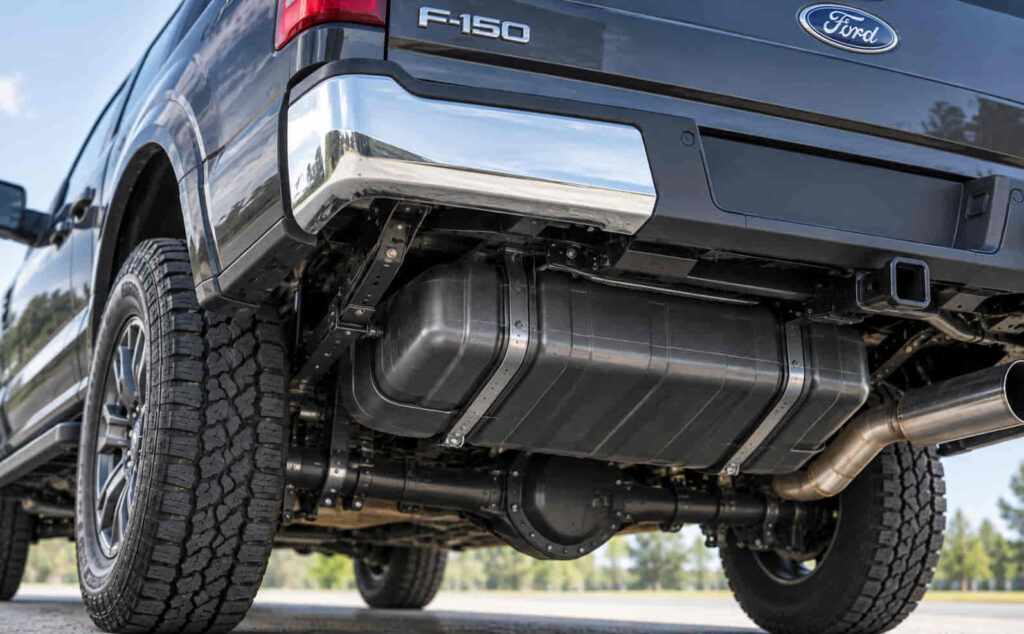
The Ford F-150 fuel tank size varies by model year, powertrain, body configuration, and available fuel tank option rather than following one capacity across every truck. Depending on the specific F-150, the amount of fuel it can hold can therefore differ even between trucks sold within the same model year. Identifying the correct capacity requires matching the fuel tank specification to the actual vehicle configuration instead of relying on a single F-150-wide figure.
Fuel tank capacity matters for more than determining how many gallons are required to fill the truck. It also affects the potential distance between fuel stops and becomes especially relevant for owners who drive long distances or tow regularly. Tank size should not, however, be confused with fuel economy. Capacity determines how much fuel the F-150 can carry, while fuel economy determines how efficiently that fuel is used; together, the two values help determine potential driving range.
This Ford F-150 fuel tank size guide explains how capacity varies by model year and configuration, why different F-150s can use different tank sizes, and how to identify the capacity installed in a specific truck. It also explains fuel capacity in gallons and liters and how tank size relates to driving and towing range.
What Is the Ford F-150 Fuel Tank Size?
The Ford F-150 does not have one universal fuel tank size because fuel capacity varies by model year and vehicle configuration. A specific truck must therefore be matched with its applicable fuel tank specification before its capacity can be stated accurately. Differences in powertrain, cab and bed configuration, and available fuel tank options can result in two F-150s carrying different amounts of fuel even when both belong to the same model line.
Fuel tank size is measured by the volume of fuel the tank is designed to hold, normally expressed in U.S. gallons in Ford specifications. This capacity is a vehicle specification rather than a measurement of how much fuel an owner will necessarily add during a normal fill-up. A truck arriving at a fuel station with fuel remaining in the tank will accept less than its total rated capacity, so the number of gallons shown on a fuel receipt should not automatically be treated as the truck’s tank size.
Model year is the first attribute to identify when determining Ford F-150 fuel capacity. Ford changes vehicle specifications between product generations and model years, while available configurations can also change within a generation. A fuel tank capacity associated with an older F-150 should therefore not be transferred to a newer truck solely because both vehicles use the F-150 name.
Vehicle configuration provides the next level of specification. The correct fuel tank must be associated with the applicable combination of equipment rather than with the model name alone. When more than one tank capacity is available for a model year, identifying the truck’s configuration explains why different specification sources or F-150 owners may report different capacities without either figure necessarily being incorrect.
Fuel tank capacity should also be separated from fuel economy and driving range. Tank capacity describes how much fuel the F-150 can carry, while fuel economy describes the distance the truck travels per unit of fuel. A larger tank can increase the potential distance between refueling stops when fuel consumption remains comparable, but it does not make the engine more fuel-efficient. This distinction becomes important when comparing F-150 configurations designed for everyday driving, long-distance use, or towing.
For an exact Ford F-150 fuel tank size, match the truck’s model year and configuration with the corresponding Ford specification or vehicle-specific documentation. This approach provides a more reliable answer than choosing a capacity based on the F-150 badge, engine displacement alone, or the amount of fuel added during a previous fill-up.
Read more: ford f150 brush guard install
What Is the Ford F-150 Fuel Tank Size by Model Year?
The Ford F-150 fuel tank size varies by model year and configuration, with recent models using 23-gallon, 30.6-gallon, or 36-gallon tanks in specified applications. The correct capacity cannot be determined from the F-150 name alone because cab style, box configuration, and PowerBoost hybrid equipment can change the fuel tank specification.
For the 2026 Ford F-150, the standard-range fuel tank holds 23 gallons and is associated with Regular Cab configurations, while the extended-range tank holds 36 gallons and is available across applicable Regular Cab, SuperCab, and SuperCrew configurations. The 3.5-liter PowerBoost full-hybrid configuration uses a 30.6-gallon fuel tank. This means a 2026 F-150 owner may encounter three different capacity figures in specifications without those figures conflicting with one another; each number describes a different vehicle or powertrain configuration.
The 2025 Ford F-150 follows the same basic capacity pattern in Ford’s published information. Ford lists a 23-gallon standard-range tank for the Regular Cab with the 6.5-foot box and a 36-gallon extended-range tank for other specified Regular Cab, SuperCab, and SuperCrew applications. Ford also identifies the 36-gallon tank as available equipment on the F-150 XL and lists it for applicable SuperCab and SuperCrew configurations. The relevant cab and box combination must therefore be checked before assigning either 23 or 36 gallons to an individual 2025 truck.
The 2024 Ford F-150 technical specifications show a different way of presenting the same relationship between capacity and configuration. Ford lists a 36-gallon fuel capacity for the 2.7-liter EcoBoost, 3.5-liter EcoBoost, and 5.0-liter V8 applications covered by the specification, with availability dependent on cab and box configuration. The 3.5-liter PowerBoost uses a 30.6-gallon tank. Ford also notes an availability restriction for the 36-gallon configuration with the 122-inch wheelbase, reinforcing that engine type alone is not enough to identify the tank installed in every truck.
The 30.6-gallon PowerBoost tank is an important distinction when comparing recent F-150 specifications. A buyer may see a conventional gasoline F-150 listed with a 36-gallon tank and assume that the hybrid version carries the same amount of gasoline. Ford’s published specifications instead identify a 30.6-gallon fuel tank for the PowerBoost hybrid in the applicable recent model years. The difference illustrates why fuel capacity should be matched to the complete powertrain and vehicle configuration rather than inferred from trim level or exterior appearance.
Cab and box configuration also explain why the 23-gallon and 36-gallon figures can appear for the same model year. For example, Ford identifies a 23-gallon tank for the 2026 F-150 XL Regular Cab while listing a 36-gallon tank for applicable SuperCab and SuperCrew configurations. The larger figure therefore does not mean that every 2026 F-150 has a 36-gallon tank, just as the presence of a 23-gallon specification does not establish 23 gallons as the capacity for the entire model year.
The model-year specification should be treated as the first filter rather than the final answer when identifying an F-150 fuel tank size. After locating the correct year, match the truck’s cab, box, engine or hybrid powertrain, and applicable fuel-tank option with Ford’s vehicle-specific information. This process separates the general capacity figures published for the F-150 lineup from the actual fuel tank installed in an individual truck.
Why Do Ford F-150 Fuel Tank Sizes Vary?
Ford F-150 fuel tank sizes vary because Ford matches fuel capacity to specific model years, cab and box configurations, powertrains, and available fuel tank options. Fuel capacity is therefore a configuration-dependent specification rather than a fixed characteristic of the F-150 nameplate. This is why two F-150 trucks from the same model year can have different fuel capacities without either truck having a nonstandard tank.
Cab configuration is one of the clearest examples in recent F-150 models. For the 2025 and 2026 F-150, Ford identifies a 23-gallon standard-range tank for applicable Regular Cab configurations while listing a 36-gallon extended-range tank for applicable configurations, including SuperCab and SuperCrew models. The relationship between cab configuration and tank size means that identifying only the model year is not always sufficient to determine how many gallons an F-150 holds.
Powertrain creates another important distinction. Recent F-150 models equipped with the 3.5-liter PowerBoost full-hybrid V6 use a 30.6-gallon fuel tank in the configurations specified by Ford. This capacity differs from the 36-gallon tank used in applicable non-hybrid configurations. As a result, an F-150 owner should not infer fuel capacity from exterior dimensions or trim appearance when the truck’s powertrain changes the applicable tank specification.
Box length and wheelbase can also affect tank availability. Ford’s 2024 technical specifications state that fuel capacity depends on cab and box configuration and identify restrictions associated with the 122-inch wheelbase. This demonstrates that fuel tank size is connected to the physical configuration of the truck, not simply to engine displacement. The space available for the tank and the vehicle configuration supported by a particular tank option determine which capacity can be installed.
Tank availability also changes across model years. Ford’s 2015 and 2016 technical specifications, for example, identify 23 gallons as the standard fuel capacity while listing a 36-gallon extended-range tank as an option, with a restriction for the 122-inch wheelbase. Recent F-150 specifications still contain 23- and 36-gallon capacities, but the way those capacities correspond with cab, box, and powertrain configurations has evolved. A tank size associated with one model year should therefore not be automatically assigned to another model year.
The correct Ford F-150 fuel tank size is ultimately determined by the combination of vehicle year and configuration. Model year establishes the relevant specification set, while cab, box, wheelbase, powertrain, and available tank equipment narrow that specification to the individual truck. This configuration-based approach explains why a single answer to “How many gallons does an F-150 hold?” can be inaccurate without additional vehicle information.
Does the Ford F-150 Have a 36-Gallon Fuel Tank?
Yes, the Ford F-150 is available with a 36-gallon fuel tank in specified configurations and model years. Ford describes this capacity as an extended-range fuel tank in multiple F-150 specifications, including current models, but the 36-gallon tank should not be interpreted as the standard capacity of every F-150.
For the 2026 F-150 XL, Ford lists a 23-gallon fuel tank for the Regular Cab and a 36-gallon tank for SuperCab and SuperCrew configurations. The 2026 STX and XLT pages also identify a 36-gallon tank for their applicable SuperCab and SuperCrew configurations. This makes 36 gallons a major current F-150 fuel capacity, but its availability remains connected to vehicle configuration.
The 2025 F-150 follows a similar pattern. Ford lists 23 gallons as the standard-range capacity for applicable Regular Cab configurations and 36 gallons as the extended-range capacity for applicable Regular Cab, SuperCab, and SuperCrew configurations. The distinction between standard-range and extended-range tanks is important because the presence of a smaller standard tank does not mean a 36-gallon tank is unavailable for that model year.
The 36-gallon tank also has a longer history within the F-150 lineup. Ford’s 2015 and 2016 technical specifications identify a 36-gallon extended-range tank as optional while listing a 23-gallon standard tank. Ford’s 2018 F-150 documentation also identifies a 36-gallon extended-range tank, and the 2019 F-150 Limited specification lists a 36-gallon extended-range tank as equipment. The 36-gallon capacity is therefore not exclusive to the newest generation of the truck.
A 36-gallon fuel tank holds approximately 136.3 liters because one U.S. gallon equals approximately 3.785 liters. This capacity can extend the distance between refueling stops compared with a smaller tank when fuel consumption remains equal. It does not increase the F-150’s miles per gallon because fuel capacity and fuel efficiency measure different vehicle attributes.
Owners should verify the installed tank before treating 36 gallons as the capacity of their truck. An F-150 may instead have a 23-gallon tank or, in applicable recent PowerBoost configurations, a 30.6-gallon tank. Matching the model year, cab, box, powertrain, and vehicle-specific equipment provides a more accurate answer than assuming that every F-150 with an extended driving range uses the same fuel tank.
What Is the Largest Fuel Tank Available on a Ford F-150?
A 36-gallon tank is the largest factory fuel tank capacity listed for the conventional gasoline Ford F-150 configurations covered by the recent Ford specifications discussed in this guide. Ford identifies this tank as an extended-range option or configuration, while other recent F-150 applications use smaller capacities such as 23 gallons or 30.6 gallons for applicable PowerBoost models. The 36-gallon figure should therefore be understood within its model-year and configuration context rather than applied to every F-150.
A 36-gallon fuel tank equals approximately 136.3 liters. Compared with a 23-gallon tank, which holds approximately 87.1 liters, the 36-gallon tank carries 13 additional gallons, or about 49.2 additional liters, when both are filled to their rated capacities. That represents approximately 56.5% more nominal fuel capacity. The difference primarily affects how much fuel the truck can carry between refueling stops; it does not by itself change the amount of fuel the engine consumes per mile.
The extended-range designation describes the practical purpose of the larger tank. Increasing stored fuel can increase potential driving distance before refueling when two trucks have comparable fuel consumption. This is particularly relevant to long-distance driving and towing, where access to fuel stations or the frequency of stops can matter. Actual range still depends on fuel economy, so a truck consuming fuel at a higher rate will not obtain the same distance from 36 gallons as a more efficient configuration.
PowerBoost models illustrate why the largest available F-150 tank should not be confused with the tank installed in every high-range configuration. Recent Ford specifications identify a 30.6-gallon tank for applicable 3.5-liter PowerBoost full-hybrid models rather than the 36-gallon capacity found in specified conventional configurations. The hybrid powertrain changes both the applicable tank specification and the way fuel contributes to overall vehicle range.
Model year remains an essential qualification when discussing the largest F-150 fuel tank. Ford has offered the 36-gallon extended-range tank across multiple F-150 model years, but availability rules and vehicle configurations have changed. The correct question for an individual truck is therefore not simply whether Ford has offered a 36-gallon F-150 tank, but whether the specific model year and configuration were built with that capacity.
How Do You Find the Fuel Tank Size of Your Ford F-150?
Find the fuel tank size of a Ford F-150 by identifying the truck’s model year and exact configuration and matching that information with the applicable Ford specifications or vehicle-specific documentation. This method is more reliable than estimating capacity from the amount of gasoline added at a fuel station because a normal fill-up does not begin with a completely empty fuel tank.
Start with the model year because it establishes which set of F-150 specifications applies to the truck. Next, identify the configuration information relevant to fuel capacity, including the powertrain, cab style, box configuration, and other equipment distinctions specified by Ford for that year. For example, recent F-150 specifications distinguish between applicable 23-gallon standard-range configurations, 36-gallon extended-range configurations, and 30.6-gallon PowerBoost applications. Knowing only that the vehicle is an F-150 is therefore insufficient when multiple capacities exist within the same model year.
The original vehicle documentation and Ford’s model-year specifications provide the strongest reference points for identifying factory capacity. Match the truck’s configuration to the capacity stated for that application rather than selecting the largest tank listed on a general specification page. When a model year offers both standard-range and extended-range tanks, the existence of the larger option does not establish that an individual truck was equipped with it.
Fuel receipts provide supporting information but are not a precise tank-identification method. A driver who adds 20 gallons to a truck does not necessarily have a 20-gallon tank because fuel remained in the tank before refueling. The fuel gauge and low-fuel warning also do not establish total capacity by themselves. A reserve amount may remain when the gauge approaches empty, which prevents the number of gallons added during a fill-up from directly representing rated tank volume.
Aftermarket modifications create another distinction between factory specification and current vehicle condition. If a previous owner replaced the original fuel tank with an aftermarket or auxiliary system, the model-year specification describes how the truck was factory-equipped rather than necessarily describing its present fuel storage capacity. Physical tank identification and documentation for the installed system become necessary when there is evidence that the original fuel system has been modified.
The most accurate identification process therefore moves from the specific truck to the specification, not from a general F-150 capacity figure back to the vehicle. Establish the model year, confirm the relevant configuration, check the applicable factory documentation, and account for known fuel-system modifications. This prevents a 23-, 30.6-, or 36-gallon specification from being assigned to the wrong Ford F-150.
How Many Liters Does a Ford F-150 Fuel Tank Hold?
A Ford F-150 fuel tank can hold approximately 87.1, 115.8, or 136.3 liters when converting the 23-, 30.6-, and 36-gallon capacities found in the recent configurations covered by this guide. These figures use the conversion of one U.S. gallon to approximately 3.785 liters. The correct liter capacity therefore depends on which fuel tank is installed in the specific F-150 rather than on a separate metric specification.
A 23-gallon F-150 fuel tank converts to approximately 87.1 liters because 23 multiplied by 3.785 equals about 87.1. This capacity applies to specified standard-range configurations discussed earlier in this guide. The metric conversion changes only the unit used to describe the tank; a 23-gallon and an approximately 87.1-liter specification describe essentially the same nominal fuel volume.
The 30.6-gallon tank used in applicable recent PowerBoost configurations converts to approximately 115.8 liters. This capacity sits between the 23-gallon standard-range tank and the 36-gallon extended-range tank. Identifying the PowerBoost powertrain is therefore important when an owner encounters a specification near 116 liters and expects the larger capacity associated with some conventional gasoline F-150 configurations.
A 36-gallon F-150 fuel tank converts to approximately 136.3 liters. Compared with the 23-gallon tank, it stores approximately 49.2 additional liters at nominal capacity. That difference explains why the 36-gallon tank is associated with extended-range applications: more stored fuel can increase the distance available between refueling stops when fuel consumption remains comparable.
Gallons and liters should not be treated as different fuel tank specifications when they are simply conversions of the same rated capacity. An F-150 described as having a 36-gallon tank and one described as having approximately a 136-liter tank may therefore refer to the same capacity. Small differences between converted values can result from rounding rather than from a different physical tank.
How Far Can a Ford F-150 Go on a Full Tank?
The distance a Ford F-150 can travel on a full tank depends on both fuel tank capacity and actual fuel economy, so tank size alone cannot determine driving range. The basic relationship is fuel capacity multiplied by miles per gallon. A larger tank provides more fuel for the truck to use, while MPG determines how far each gallon carries the vehicle.
For example, an F-150 averaging 20 mpg with a 23-gallon tank has a simple theoretical range of 460 miles because 23 multiplied by 20 equals 460. At the same 20 mpg, a 36-gallon tank produces a theoretical calculation of 720 miles. The 13-gallon increase in capacity creates a 260-mile difference in this simplified example even though fuel efficiency remains exactly the same.
These calculations illustrate the effect of tank capacity rather than guaranteeing real-world range. An F-150 does not maintain one fixed MPG under every operating condition. Vehicle speed, acceleration, traffic, temperature, terrain, payload, towing, tire condition, idling, and other operating factors can change fuel consumption and therefore alter the distance obtained from the same amount of gasoline.
Usable driving range can also differ from a calculation that multiplies the entire rated tank capacity by an MPG figure. Drivers normally refuel before consuming every gallon in the tank, and the vehicle’s estimated distance-to-empty system is intended to provide a practical estimate rather than prove the physical capacity of the tank. A calculated 720-mile theoretical range should therefore not be interpreted as a guarantee that a 36-gallon F-150 will travel exactly 720 miles before refueling.
Tank capacity and fuel economy should be evaluated separately when comparing F-150 configurations. A truck with a larger tank can travel farther between fuel stops without achieving better MPG, while a more efficient F-150 can obtain greater range from each gallon without having the largest available tank. Driving range is the resulting relationship between these two attributes rather than an alternative measurement of fuel tank size.
For a more realistic F-150 range estimate, multiply the truck’s actual average MPG by its verified fuel tank capacity. An owner averaging 17 mpg while towing should use 17 mpg for the calculation rather than an unrelated highway fuel-economy figure. Matching real fuel consumption with the correct 23-, 30.6-, or 36-gallon capacity produces a range estimate that better reflects how that particular F-150 is being used.
Does a Larger F-150 Fuel Tank Increase Driving Range?
A larger Ford F-150 fuel tank can increase driving range between refueling stops because it allows the truck to carry more fuel, but it does not increase fuel economy. When two F-150 configurations achieve the same MPG, the truck with the larger usable fuel capacity can theoretically travel farther before requiring additional fuel.
The difference between a 23-gallon and 36-gallon tank illustrates this relationship. The 36-gallon tank carries 13 more gallons at rated capacity, representing approximately 56.5% more nominal fuel volume than a 23-gallon tank. If both trucks average 20 mpg, the simple theoretical calculations are 460 miles for 23 gallons and 720 miles for 36 gallons. The additional 260 theoretical miles come from carrying more fuel, not from improving the number of miles traveled per gallon.
Fuel economy remains an independent vehicle attribute. Installing or selecting a larger-capacity tank does not make the engine burn less gasoline while producing the same work. An F-150 averaging 18 mpg remains an 18-mpg truck for the purpose of a simple range calculation regardless of whether it carries 23 or 36 gallons. What changes is the quantity of fuel available before another refueling stop becomes necessary.
A larger tank can therefore provide practical value even without an MPG improvement. Long-distance drivers can reduce the frequency of fuel stops, while drivers operating in areas with fewer fuel stations have a larger fuel reserve available between stops. The same principle applies to work and recreational use where the truck spends extended periods away from convenient refueling locations.
The range advantage is not fixed because actual fuel consumption changes with operating conditions. A 36-gallon F-150 driven under heavy load or in conditions that increase fuel consumption can have a shorter real-world range than a smaller-tank truck operating much more efficiently. Tank capacity establishes how much fuel is available; driving conditions determine how quickly that supply is consumed.
For this reason, fuel tank size, fuel economy, and driving range should be treated as three connected but distinct specifications. Tank size measures stored fuel volume, MPG measures fuel efficiency, and range describes the distance that can be obtained from the available fuel under a given level of consumption. A larger F-150 tank directly changes the first value and can increase the third, but it does not directly improve the second.
Does Fuel Tank Size Affect Ford F-150 Towing Range?
Ford F-150 fuel tank size affects the potential distance between fuel stops while towing because a larger tank provides more fuel to use as towing increases fuel consumption. Tank capacity does not determine how much weight the F-150 can tow, and it does not prevent the reduction in fuel economy that can occur when pulling a trailer. Its direct role is to determine how much fuel is available before refueling becomes necessary.
Towing range follows the same basic relationship as normal driving range: fuel capacity multiplied by actual fuel economy provides a simple theoretical distance. The difference is that towing can substantially change the MPG value used in that calculation. Trailer weight, aerodynamic drag, speed, road grade, weather, and driving conditions can increase the amount of fuel required to travel the same distance.
For example, consider a 36-gallon F-150 that averages 20 mpg without a trailer but 12 mpg under a particular towing condition. The simplified theoretical range changes from 720 miles at 20 mpg to 432 miles at 12 mpg. The fuel tank remains exactly the same size; the 288-mile difference results from higher fuel consumption. These numbers are an example of the capacity-and-efficiency relationship rather than a claimed fuel-economy specification for a particular F-150 or trailer combination.
A 23-gallon tank at the same example towing efficiency of 12 mpg produces a theoretical calculation of 276 miles. Compared with 432 theoretical miles from a 36-gallon tank at the same 12 mpg, the larger tank provides 156 additional calculated miles between full and empty. Again, the advantage comes from the additional 13 gallons of nominal capacity rather than from improved towing efficiency.
This distinction is particularly important when comparing fuel tank size with towing capacity. Towing capacity describes the maximum trailer weight permitted for a specified truck configuration under the applicable ratings and conditions, while fuel tank capacity describes stored fuel volume. A 36-gallon tank does not give an F-150 a higher tow rating than an otherwise equivalent truck simply because it carries more gasoline.
Real towing-range planning should use the verified fuel tank capacity of the specific F-150 and fuel-consumption data that reflects actual towing conditions. Drivers should also plan refueling before reaching the theoretical maximum range rather than treating every gallon of rated capacity as guaranteed usable driving distance. The practical benefit of a larger F-150 fuel tank during towing is therefore longer potential distance between fuel stops, not increased towing capacity or better MPG.