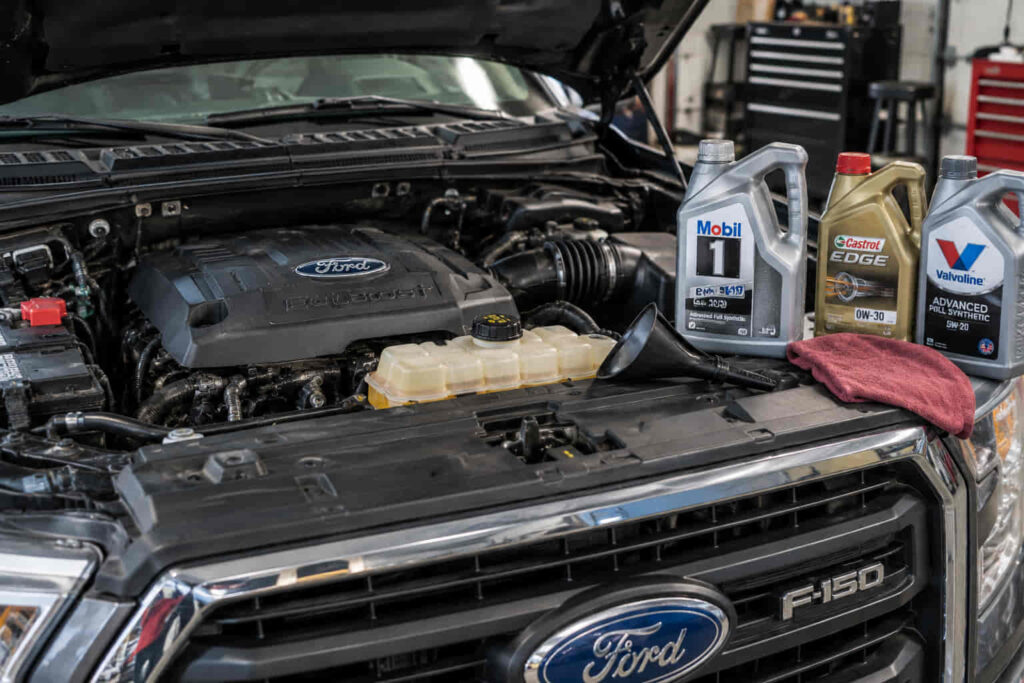
When searching for Ford F150 engine oil weights, the term “oil weight” usually refers to engine oil viscosity rather than the physical weight of the oil. Viscosity describes how engine oil flows at different temperatures, which is why specifications such as 5W-30, 5W-20, or another SAE grade are commonly called oil weights. The correct oil weight for a Ford F-150 depends on the engine, model year, operating requirements, and the specific specification listed for that vehicle.
The F-150 has been offered with multiple engine families and configurations, so there is no single oil weight that applies to every Ford F-150. Ford’s current F-150 range includes engines such as the 2.7L EcoBoost V6, 3.5L EcoBoost V6, 3.5L PowerBoost hybrid, 5.0L V8, and specialized Raptor engines. This makes engine-specific oil selection more important than choosing an oil simply because it is marketed for trucks.
What Does Ford F150 Engine Oil Weight Mean?
Ford F150 engine oil weight is another way of referring to the SAE viscosity grade printed on an engine oil container. A designation such as 5W-30 contains two viscosity characteristics. The number before the “W” describes how the oil behaves at lower temperatures, while the second number represents its viscosity at operating temperature.
The “W” stands for winter rather than weight. Therefore, a 5W-30 oil should not be interpreted as oil with a particular physical weight. Instead, the designation describes how the lubricant flows during cold starts and when the engine reaches normal operating temperature.
This distinction matters because engine oil must provide adequate flow during startup while maintaining an appropriate lubricating film when the engine is hot. The viscosity grade selected by Ford is therefore part of the engine’s lubrication requirements rather than simply a consumer preference.
What Oil Weights Does the Ford F150 Use?
The correct Ford F150 oil weight varies by engine and model year. Ford’s own motor-oil catalog for the F-150 includes different SAE grades, including 5W-30 and 5W-20 applications, which reinforces why the engine and vehicle-specific specification should be checked before an oil change.
A newer F-150 with an EcoBoost, PowerBoost, V8, or Raptor powertrain should not automatically be assigned the same oil viscosity as an older F-150 simply because both vehicles are F-150 models. The engine design, lubrication system, emissions requirements, operating temperature range, and Ford’s service specification can change between applications.
The most reliable source for the correct oil weight is the owner’s manual or Ford’s vehicle-specific maintenance information. Ford provides owner manuals by vehicle and model year, allowing the required specification to be identified for the particular F-150 rather than relying on a generic F-150 oil chart.
Why Does Oil Viscosity Matter on a Ford F150?
Oil viscosity affects how quickly lubricant reaches engine components during startup and how well the oil maintains its protective film when the engine is hot. The correct viscosity helps the engine maintain lubrication across the temperature range for which it was designed.
Using an oil that is substantially different from the specified viscosity can affect cold-start flow, lubrication characteristics, fuel economy, and engine operation. Modern F-150 engines also use tightly controlled oil passages, variable valve timing, turbocharger systems, and other components that depend on the correct lubrication characteristics.
For EcoBoost engines, oil quality and viscosity are particularly relevant because turbocharged operation places additional thermal and mechanical demands on the lubricant. For the PowerBoost hybrid, the engine can also experience operating patterns that differ from a conventional gasoline-only powertrain. The correct Ford specification therefore matters alongside the SAE viscosity grade.
Ford F150 Oil Weight vs Oil Capacity
Oil weight and oil capacity are two different specifications. Oil weight identifies the viscosity grade, such as a particular SAE classification, while oil capacity describes how much oil the engine requires during an oil change.
A vehicle can therefore have a specified viscosity and a separate oil-fill quantity. Knowing that an F-150 requires a certain oil weight does not tell you how many quarts should be added.
Oil capacity can also vary between engines and model years. The oil filter, engine configuration, oil pan design, and service procedure can affect the amount required. The correct approach is to use the vehicle-specific capacity specification and then verify the level with the engine oil level-check procedure.
Overfilling the engine can be just as undesirable as operating with insufficient oil. For this reason, oil capacity should always be treated as a separate specification from viscosity.
How to Choose the Correct Ford F150 Engine Oil
Choosing the correct engine oil begins with identifying the F-150’s model year and engine. The engine designation alone may not always be sufficient when different applications or production years use different specifications.
The next step is to identify the SAE viscosity and Ford-required oil specification listed for that vehicle. The oil container may display multiple industry certifications, but matching the Ford requirement is more important than choosing an oil based solely on the viscosity number.
Ford’s parts catalog includes Motorcraft engine oils in different SAE grades, demonstrating that Ford’s oil selection is application-dependent rather than based on one universal F-150 viscosity.
When the vehicle is used in unusually hot, cold, severe, or demanding conditions, the owner’s manual should still be the reference for whether an alternative viscosity or service requirement is permitted. The goal is not simply to select a thicker or thinner oil but to use the grade and specification engineered for that particular engine.
Ford F150 5W-20 vs 5W-30
The difference between 5W-20 and 5W-30 is primarily their viscosity at operating temperature. Both have the same “5W” cold-temperature classification, while the second number differs.
A 5W-30 oil is more viscous at operating temperature than a 5W-20 oil. That does not make 5W-30 universally better for an F-150. If Ford specifies 5W-20 for a particular engine, changing to 5W-30 simply because it is thicker can move the engine away from its intended lubrication specification.
Likewise, an F-150 that specifies 5W-30 should not automatically be filled with 5W-20 because both oils are common automotive viscosities. The correct grade is determined by the engine and Ford’s service requirements.
Does Ford F150 Engine Oil Weight Change by Engine?
Yes. Engine oil requirements can change between F-150 powertrains. The F-150 has used multiple naturally aspirated, turbocharged, hybrid, and high-performance engines, and each engine application can have its own lubrication requirements.
Ford’s current F-150 lineup illustrates the scale of this variation, with multiple engine families available across different trims and configurations. Older model years add additional engine generations and specifications, making a single universal oil-weight recommendation unreliable.
For this reason, an article about Ford F150 engine oil weights should treat viscosity as an engine-specific attribute rather than a property shared by every F-150.
Read more: Ford F150 Trailer Hitch Weight Limits
How Model Year Affects Ford F150 Oil Weight
Model year is another important part of determining the correct engine oil. Even when two F-150 trucks appear to have the same engine displacement, the underlying engine generation, calibration, emissions equipment, or lubrication requirements can differ.
Ford maintains owner-manual information by vehicle and year, which is the appropriate reference when verifying maintenance specifications for a particular truck.
This is also why an oil chart copied from an older F-150 should not automatically be applied to a newer truck. A technically correct viscosity for one model year may not represent the current specification for another.
Synthetic Oil and Ford F150 Engine Oil Weight
Synthetic and synthetic-blend oils can be available in the viscosity grades used by Ford F-150 engines. However, the word “synthetic” does not replace the need to match the required viscosity and specification.
The correct oil must satisfy the vehicle’s specified SAE grade and applicable Ford or industry requirements. A premium oil with the wrong viscosity is not automatically a better choice than an oil that correctly matches the engine specification.
Ford’s own Motorcraft catalog includes synthetic-blend and other engine-oil products in F-150-relevant viscosity grades.
What Happens If the Wrong Oil Weight Is Used?
Using the wrong oil viscosity can change the engine’s lubrication behavior. A viscosity that is too high for the application can affect cold-start flow and other operating characteristics, while a viscosity that is too low can alter the oil film and lubrication behavior under operating conditions.
The consequences depend on how far the oil differs from the required specification, how long the vehicle is operated with it, engine temperature, driving conditions, and the particular engine design.
If an incorrect viscosity has been added, the appropriate response depends on the amount used and the vehicle-specific specification. When there is uncertainty, the owner’s manual and qualified service information should take priority over a generic oil recommendation.
Ford F150 Engine Oil Weight and Oil Change Service
Selecting the correct oil weight is only one part of an oil change. The service also involves the correct oil capacity, compatible oil filter, proper drain-plug installation, correct oil-level checking procedure, and the maintenance interval specified for the vehicle.
After adding oil, the level should be checked using Ford’s prescribed procedure rather than assuming that the engine is correctly filled because a certain number of quarts were added. The vehicle should also be inspected for leaks around the oil filter and drain area.
The oil-change interval is a separate maintenance specification from oil viscosity. Changing to a different SAE grade does not automatically change the manufacturer’s recommended service interval.
How to Find the Correct Oil Weight for Your Ford F150
The safest method is to identify the exact F-150 model year and engine and then consult the corresponding Ford owner’s manual or maintenance information. Ford provides an official owner-manual system for locating documentation by vehicle and year.
The oil specification should then be matched against the information printed on the oil container. This creates a complete relationship between the vehicle, engine, SAE viscosity, oil specification, and service requirement.
For an older F-150, it is especially important to verify the model year because the same F-150 nameplate has used many different engines and lubrication specifications over its production history.
Ford F150 Engine Oil Weights FAQ
What does “oil weight” mean on a Ford F150?
Oil weight normally refers to the SAE viscosity grade, such as 5W-20 or 5W-30. The term describes viscosity characteristics rather than the physical weight of the oil.
Is 5W-30 the correct oil weight for every Ford F150?
No. The correct viscosity depends on the F-150’s engine, model year, and Ford specification. Ford’s oil catalog includes multiple viscosity grades for F-150 applications.
Can I use 5W-30 instead of 5W-20 in a Ford F150?
You should not assume that these viscosities are interchangeable. Use the viscosity and oil specification listed for the exact engine and model year.
Does engine oil capacity mean the same thing as oil weight?
No. Oil weight refers to viscosity, while oil capacity refers to the amount of oil required by the engine.
Does a Ford F150 EcoBoost require a specific oil weight?
EcoBoost engines have engine-specific lubrication requirements. The exact SAE viscosity and specification should be verified against the owner’s manual for the model year and engine.
Where can I find the correct Ford F150 oil weight?
The owner’s manual and Ford-specific maintenance information are the best sources. Ford provides owner manuals organized by vehicle and model year.