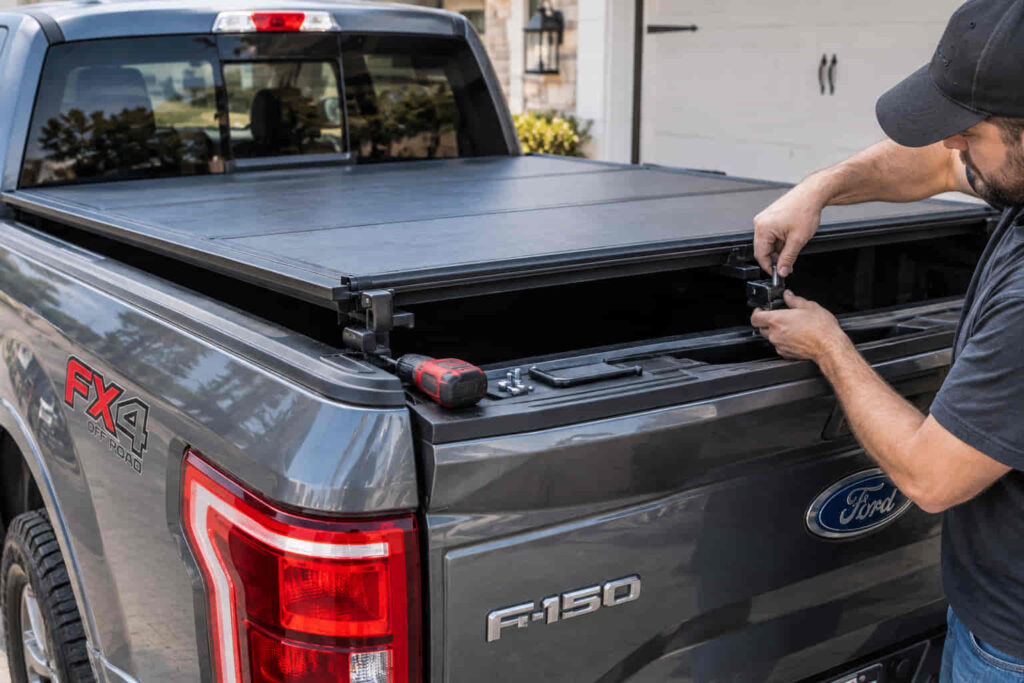
Installing a Ford F150 bed cover is generally straightforward when the cover is correctly matched to the truck, but the actual installation method depends on the cover design, bed length, mounting position, and hardware supplied with the kit. A soft roll-up cover, hard folding cover, retractable cover, and over-the-bedrail cover can use different mounting systems even though they all serve the same basic purpose of protecting the truck bed and its cargo.
Ford offers F-150 bed covers in several configurations, including folding, rolling, and retractable designs. Some current Ford accessories use clamp-on or no-drill mounting, while others are designed around specific bed lengths and rail configurations. Because of these differences, installation should always begin with fitment rather than assuming that every F-150 bed cover follows the same procedure.
What Is a Ford F150 Bed Cover?
A Ford F150 bed cover is a removable or permanently mounted cover designed to protect cargo stored inside the pickup bed. It is commonly called a tonneau cover and can use a soft, hard, folding, rolling, retractable, or other construction.
The cover attaches to the bed using rails, clamps, brackets, hinges, latches, or another mounting system. Its installation determines how well the cover aligns with the bed, how securely it stays in position, how the tailgate operates, and how effectively the seals manage water and debris.
A properly installed cover should sit squarely on the truck bed without excessive movement, uneven gaps, or interference with the tailgate. Installation is therefore not only about attaching the cover but also about establishing the correct relationship between the cover, bed rails, tailgate, and weather seals.
Check Ford F150 Bed Fitment Before Installation
The most important part of Ford F150 bed cover installation happens before the first clamp or bracket is installed. The cover must match the truck’s bed configuration.
F-150 beds are available in different lengths, and bed-cover manufacturers can produce separate versions for those dimensions. Ford accessory listings, for example, identify covers specifically for 5.5-foot, 6.5-foot, and 8-foot beds depending on the product.
Model year can also affect compatibility because bed construction, tailgate design, rail configuration, and factory accessories can change. A cover designed for one generation should not be assumed to fit another simply because both vehicles are F-150s.
The presence of bedliners, bed rails, tie-down equipment, bed extenders, racks, or other accessories can also affect installation. Some covers are designed to work with these accessories, while others require specific mounting space around the bed rails.
Prepare the Ford F150 Bed for Installation
The bed should be clean before mounting the cover. Dirt, mud, debris, or accumulated material around the bed rails can prevent mounting components from sitting correctly and can create uneven pressure against the cover.
The bed rails should be inspected for damage, deformation, or accessories that could interfere with the mounting system. If the cover uses an inside-the-rail design, the available space along the inside edge of the bed becomes especially important.
The mounting surfaces should also be dry and free from unnecessary contamination when the installation instructions require a clean surface for seals or adhesive components. Some products use seals to improve weather resistance, so installation should not compress or displace those seals incorrectly.
Ford F150 Bed Cover Installation Process
The basic installation process begins by positioning the primary cover components on the truck bed and establishing their relationship to the front bed wall and side rails. The exact sequence depends on whether the cover is folding, rolling, retractable, or another design.
For a clamp-mounted cover, the mounting rails or brackets are positioned against the bed structure before the clamps are tightened. The cover should remain loose enough during the initial installation to allow alignment adjustments.
Once the mounting components are positioned, the cover is centered from side to side. The front edge should be positioned according to the manufacturer’s specified relationship with the front bed wall, while the rear portion should remain properly aligned with the tailgate.
The mounting hardware can then be progressively tightened according to the manufacturer’s instructions. Tightening one side completely before the opposite side is aligned can pull the cover out of square, so alignment should be checked throughout the installation.
Many Ford-compatible bed covers use clamp-on or no-drill mounting. Ford currently lists several F-150 covers with no-drill or clamp-in installation, reducing the need for permanent modification of the truck bed.
Align the Bed Cover With the F150 Bed
Alignment is one of the most important parts of a successful F150 bed cover installation. A cover that is technically attached but positioned unevenly can create problems with sealing, latching, folding, rolling, or tailgate operation.
The side-to-side gap should be reasonably consistent, and the cover should remain parallel with the bed rails. The front and rear sections should also remain square relative to the truck bed.
On folding covers, each panel should move through its operating range without binding against the bed rails. On roll-up covers, the cover should travel smoothly along its rails and remain centered as it is opened or closed.
Retractable covers require additional attention to the rail alignment because the cover depends on those rails for controlled movement. Ford-listed retractable F-150 covers can use integrated rails and drainage components, making correct rail positioning important for both operation and water management.
Check Tailgate Clearance
The tailgate is an important reference point during Ford F150 bed cover installation. The cover should allow the tailgate to open and close without excessive interference unless the specific design is intentionally integrated with the tailgate.
After the cover has been positioned, operate the tailgate and inspect the rear edge of the cover. Look for contact, excessive pressure, uneven gaps, or a latch that cannot operate normally.
Some newer covers are specifically designed around Ford tailgate features. For example, Ford lists certain F-150 hard rolling covers with a rear tailgate slat optimized for operation with the Ford Automatic Tailgate Release.
This illustrates why compatibility should be established before installation rather than assuming that every bed cover will interact with the tailgate in the same way.
Read more: Ford F150 Engine Oil Weights
Install and Adjust Bed Cover Clamps
Clamps are responsible for transferring the cover’s mounting force into the truck bed structure. Their position and adjustment can therefore affect both security and alignment.
A clamp should engage the intended mounting surface rather than simply gripping a convenient section of the bedliner or plastic trim. If a clamp is positioned incorrectly, tightening it can create an unstable installation or damage a component.
Spring-loaded speed clamps are used on some Ford-listed hard folding covers, while other products use different clamp or bracket systems. The manufacturer’s installation instructions should determine the correct clamp position and tightening method for the specific cover.
After the clamps are installed, the cover should be tested through its normal operating range. If the cover shifts significantly when opened or closed, the mounting system should be inspected and realigned rather than simply tightened further.
Ford F150 Bed Cover Installation With a Bedliner
A bedliner does not automatically prevent installation of a bed cover, but its design can affect the available mounting surfaces. Spray-in, drop-in, and molded bedliners can have different relationships with the bed rails.
Ford’s factory bedliner is designed around the contours and features of the F-150 bed, but aftermarket bedliners may introduce additional thickness or coverage around mounting areas.
A cover that mounts inside the bed rails may therefore require more attention to clearance than a cover that mounts over the bed rails. The cover’s instructions should specify whether the particular bedliner configuration is supported.
Do not trim or permanently modify the bedliner simply to make a cover fit unless the manufacturer explicitly provides that procedure for the product.
Folding, Roll-Up, and Retractable Bed Cover Installation
The installation method changes with the operating design of the bed cover.
A folding cover typically uses hinges or folding panels connected to a mounting frame or rail system. Its most important installation characteristics are panel alignment, clamp position, tailgate clearance, and correct operation through each folding position.
A roll-up cover generally depends on rails or side mounting components that keep the cover aligned as it rolls toward the front of the bed. The rails must remain parallel so that the cover does not bind or develop uneven tension.
A retractable cover can use a more complex rail and roller system. Some Ford-listed retractable covers incorporate drainage tubes and integrated rail systems, so installation involves both mechanical alignment and correct routing of the water-management components.
These differences mean that “bed cover installation” should be treated as an installation category rather than a single universal procedure.
Check Weather Seals After Installation
Weather sealing depends heavily on correct positioning. A seal that is folded, compressed unevenly, or displaced during installation can allow water to enter the bed even when the cover itself is correctly mounted.
The perimeter of the cover should be inspected after the mounting hardware has been tightened. Seals should sit continuously against their intended surfaces without obvious gaps or areas where the material has rolled underneath itself.
Hard folding F-150 covers listed by Ford use padded seals to help protect the vehicle finish while limiting exposure to weather.
A weather-resistant tonneau cover should not automatically be interpreted as completely waterproof under every condition. Water can enter through tailgate gaps, seams, drain paths, or areas where the bed configuration differs from the cover’s intended design.
Common Ford F150 Bed Cover Installation Problems
A bed cover that sits too far forward or backward can interfere with the tailgate or produce uneven sealing. A cover that is not centered can create inconsistent gaps along the side rails.
If a folding cover is difficult to close, the problem may be related to rail alignment, panel positioning, or excessive mounting tension. If a roll-up cover binds during operation, the rails should be checked for parallel alignment and obstruction.
A retractable cover that moves unevenly can indicate a rail alignment problem or an installation issue involving the roller or drainage system. A cover that shifts after driving can indicate improperly positioned or insufficiently secured mounting hardware.
These problems should be corrected at the mounting and alignment level rather than solved by simply applying additional force to the clamps.
Does Ford F150 Bed Cover Installation Require Drilling?
Many F-150 bed covers are designed for no-drill installation. Ford currently lists several bed-cover products using clamp-on or clamp-in mounting systems.
However, no-drill installation is not universal across every aftermarket bed cover. Some products may use brackets, rails, electrical components, or other hardware that requires a different installation method.
The product-specific instructions should therefore determine whether drilling, trimming, adhesive installation, or other modification is permitted. A cover should not be drilled into the truck bed simply because the installer cannot find a suitable mounting position.
How to Know the Ford F150 Bed Cover Is Installed Correctly
A correctly installed bed cover should remain securely positioned while the truck is stationary and during normal driving. The cover should open and close according to its design without binding, excessive force, or abnormal movement.
The tailgate should operate normally, the cover should remain aligned with the bed, and the seals should remain properly positioned. Mounting clamps or brackets should remain secure rather than shifting after repeated operation.
The final inspection should also include any straps, latches, drain tubes, rails, or support components supplied with the cover. These components are part of the installation system and can affect how the cover performs after installation.
Ford F150 Bed Cover Installation FAQ
Can I install a bed cover on my Ford F150 myself?
Many F-150 bed covers are designed for DIY installation, particularly products using clamp-on or no-drill mounting. The difficulty depends on the cover design, bed configuration, and installation hardware.
Do all Ford F150 bed covers install the same way?
No. Folding, roll-up, retractable, and other bed-cover designs can use different mounting systems and adjustment procedures.
Does an F150 bedliner affect bed cover installation?
It can. The type and thickness of the bedliner may affect mounting clearance, especially for covers that install inside the bed rails.
Do I need to drill into my Ford F150 bed?
Not necessarily. Many current F-150 bed covers use clamp-on or clamp-in installation without drilling, but the specific product instructions determine the required mounting method.
Why is my F150 bed cover not closing correctly?
An incorrectly positioned cover, uneven rails, improperly adjusted clamps, seal interference, or tailgate clearance issue can prevent normal closing. The mounting alignment should be checked before applying additional force.
Should the bed cover be installed before bed rails or other accessories?
It depends on the cover and accessory combination. Some Ford bed covers are specifically designed to preserve access to stake pockets or work with certain bed accessories, while other mounting systems can interfere with rails or racks.
How long does Ford F150 bed cover installation take?
Installation time varies significantly by cover design and mounting system. A simple clamp-on cover can be relatively quick to install, while a retractable system with rails and drainage components can require more adjustment.