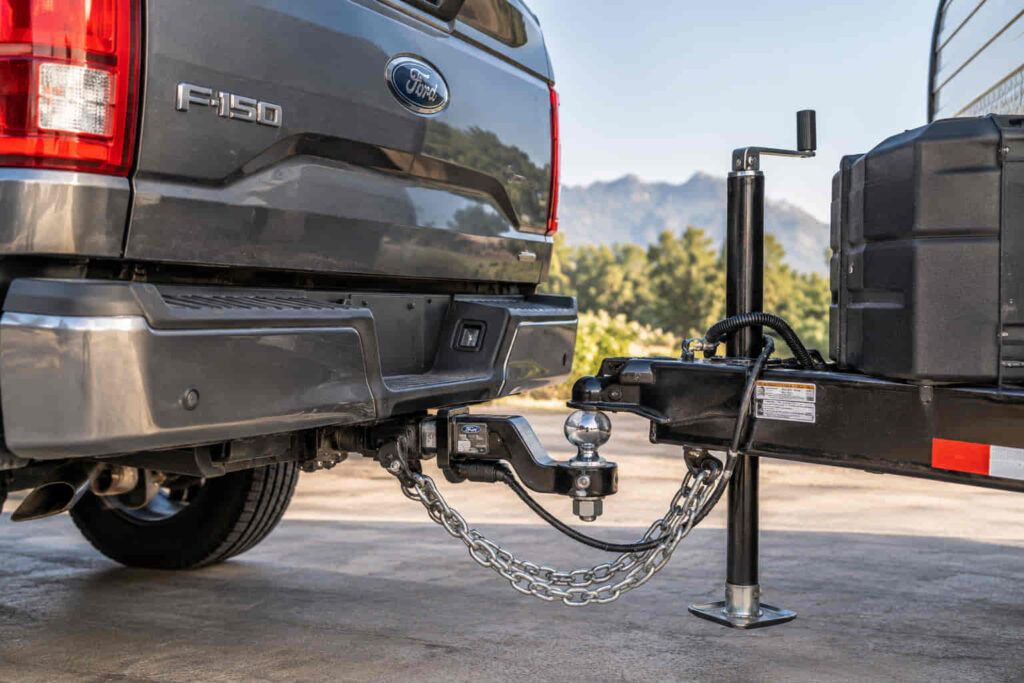
Ford F150 trailer hitch weight limits determine how much trailer weight and tongue load the hitch system can safely support. However, the hitch receiver rating is only one part of the towing equation. The actual limit for a Ford F-150 can also depend on the vehicle’s model year, engine, axle ratio, cab and bed configuration, towing package, payload, passengers, cargo, trailer equipment, and the specific hitch receiver installed on the truck.
This distinction is important because the maximum capacity printed on a hitch receiver does not automatically mean that the truck can tow a trailer of that weight in every configuration. Ford’s towing information explicitly separates hitch receiver capacity from the maximum loaded trailer weight for the vehicle.
What Are Ford F150 Trailer Hitch Weight Limits?
A Ford F150 trailer hitch weight limit describes the maximum load associated with the hitch receiver and trailer connection. The term can refer to more than one measurement, including maximum trailer capacity and maximum tongue load.
Trailer weight is the total loaded weight being pulled by the truck, while tongue weight is the portion of that trailer weight transferred downward onto the hitch connection. These two values work together but represent different loads.
The correct limit is therefore not determined by the hitch receiver alone. The complete towing combination must remain within the lowest applicable limit established by the truck, hitch, trailer equipment, and towing configuration.
Ford F150 Hitch Receiver Capacity vs Towing Capacity
Hitch receiver capacity and vehicle towing capacity are related but different specifications. A hitch receiver can have a specific maximum rating, while the F-150 itself may have a lower maximum loaded trailer weight for a particular configuration.
For example, Ford’s 2026 F-150 towing guide lists a standard 2-inch receiver rated at 11,600 pounds, while the available Max Tow Axle configuration uses a reinforced receiver rated at 14,000 pounds. Ford also states that these receiver capacities can exceed the maximum loaded trailer weight for the vehicle, so the vehicle-specific towing selector must still be consulted.
This distinction prevents a common towing mistake: assuming that the number stamped on the hitch receiver is automatically the maximum trailer weight the truck can tow.
Ford F150 Maximum Tongue Weight
Tongue weight is the downward load applied by the trailer to the hitch connection. Ford generally recommends that conventional trailer tongue weight be approximately 10–15% of the trailer’s total loaded weight, while the actual maximum tongue load must remain within the vehicle and hitch ratings.
The correct tongue weight is influenced by trailer design and load distribution. A trailer that is too lightly loaded at the tongue can become unstable, while excessive tongue weight can overload the hitch, rear axle, suspension, tires, or vehicle payload capacity.
The practical target is therefore not simply a percentage. The tongue load must satisfy both the trailer’s stability requirements and the F-150’s specific maximum tongue-load limitation.
Ford F150 Weight-Carrying Hitch Limits
A weight-carrying hitch supports the trailer through the conventional hitch connection without using a weight-distributing system to transfer part of the tongue load toward the front axle.
Ford’s current F-150 towing guide lists a 5,000-pound maximum trailer capacity and 500-pound maximum tongue load for the weight-carrying configuration of the applicable hitch receiver. These figures are receiver ratings and do not override the lower vehicle-specific towing limit when one applies.
The weight-carrying rating should therefore be treated as one constraint within the overall towing system rather than as the universal towing capacity of every F-150.
Ford F150 Weight-Distributing Hitch Limits
A weight-distributing hitch uses additional hardware to distribute part of the trailer’s tongue load across the towing vehicle’s axles. This allows certain properly equipped F-150 configurations to support higher trailer loads than the weight-carrying configuration.
For 2026, Ford lists a maximum weight-distributing receiver capacity of 13,500 pounds and a maximum tongue load of 1,400 pounds for the applicable F-150 receiver configuration. Ford notes that achieving the corresponding vehicle towing capability requires the appropriate towing equipment and vehicle configuration.
These numbers should not be interpreted as a universal 13,500-pound towing limit for every F-150. Ford’s vehicle specifications show that maximum available towing varies substantially by engine and configuration. For example, the 2026 F-150 is listed with maximum available towing ratings ranging from different engine-specific limits up to 13,500 pounds for the properly equipped 3.5L EcoBoost configuration.
Ford F150 Trailer Hitch Weight Limits by Model Year
Trailer hitch ratings can change between F-150 generations and model years. Ford has offered different receiver designs, towing packages, axle configurations, and maximum towing combinations over time.
For example, Ford’s 2024 towing guide lists a 2-inch F-150 receiver rated at 11,600 pounds, with the Tow/Haul Package including a reinforced receiver rated at 14,000 pounds. Its receiver chart lists 5,000 pounds and 500 pounds for weight-carrying use and 13,500 pounds with a 1,350-pound tongue load for weight-distributing use.
The 2026 guide uses a 1,400-pound maximum tongue load for its 13,500-pound weight-distributing receiver rating. This illustrates why a generic hitch-weight number should not be applied across every F-150 model year.
Read more: Ford F150 Leveling Spacer Installation
What Determines the Ford F150 Trailer Weight Limit?
The actual trailer weight limit is determined by the complete vehicle configuration. Engine output, transmission, axle ratio, drivetrain, cab configuration, bed length, trailer package, rear axle configuration, tires, payload, passengers, cargo, and available towing equipment can all influence the final rating.
Ford’s current F-150 specifications demonstrate this variation. The 2026 model is available with multiple engines, including the 2.7L EcoBoost V6, 3.5L PowerBoost Full Hybrid V6, 3.5L EcoBoost V6, and 5.0L V8, with different maximum available towing ratings.
This means two F-150 trucks from the same model year can have significantly different towing capabilities.
Ford F150 Payload and Trailer Hitch Limits
Payload capacity is another limit that must be considered when calculating a safe trailer combination. Tongue weight is carried by the truck, so it becomes part of the vehicle’s payload along with passengers, cargo, accessories, and other loads.
A trailer may be within the hitch receiver’s rated trailer capacity while the truck is still overloaded because of excessive tongue weight or other payload.
This is why hitch rating, towing rating, payload rating, rear axle rating, and tire capacity should be considered together rather than using a single number as the entire towing limit.
Ford F150 Rear Axle and Tongue Weight
The rear axle carries a significant portion of the trailer-related load because tongue weight is transferred through the hitch to the truck. As tongue weight increases, the load on the rear axle and rear suspension also increases.
The rear axle ratio can also affect the F-150’s available towing rating. Ford identifies axle ratio codes and corresponding ratios in its towing documentation, allowing the exact truck configuration to be matched to the applicable towing chart.
A truck with a higher-rated hitch does not necessarily have the same maximum towing capability as another truck simply because the receiver looks identical.
How to Calculate Ford F150 Tongue Weight
Tongue weight is based on the loaded trailer rather than the trailer’s empty or unloaded weight. Cargo, fuel, water, equipment, and other items carried by the trailer all contribute to its loaded weight.
For conventional towing, Ford generally recommends approximately 10–15% tongue weight while also requiring the actual tongue load to remain below the applicable maximum rating.
The trailer should be loaded so that its weight distribution supports stable towing without exceeding the F-150’s maximum tongue load or vehicle payload capacity.
For F-150 models equipped with onboard scales, Ford provides a method for measuring trailer tongue load through the vehicle’s weighing system. Vehicles without onboard scales can use an appropriate vehicle or trailer scale to determine the load.
Ford F150 Trailer Hitch Weight Limits and Tow Packages
Trailer tow packages can add equipment necessary to achieve higher towing ratings. Depending on the model year and configuration, this can include an upgraded hitch receiver, trailer brake controller, wiring, cooling equipment, axle ratio, or other towing-related components.
Ford’s 2026 towing guide, for example, specifies required towing equipment for higher trailer weights and identifies the Max Tow Axle as part of the configuration needed for certain maximum ratings.
The presence of a trailer hitch alone therefore does not establish the truck’s maximum towing capability.
Ford F150 Hitch Receiver Classes and Ratings
The hitch receiver’s physical size and class can help identify its general capacity category, but the vehicle-specific rating remains essential.
A 2-inch receiver, for example, can be used with different receiver constructions and towing configurations. Ford offers factory receivers with different ratings depending on the F-150 application and towing equipment.
The receiver label is therefore an important source of information. Its rating should be compared with the vehicle’s towing documentation rather than treated as an independent authorization to tow the maximum number printed on the receiver.
Ford F150 Trailer Hitch Weight Limits and Hitch Ball
The hitch receiver is only one part of the trailer connection. The ball mount, hitch ball, safety chains, electrical connection, trailer brakes, and other towing equipment must also be suitable for the loaded trailer.
Ford notes that its hitch receiver capacities do not include the hitch ball or ball mounting and places responsibility on the owner to use appropriate equipment for the trailer and cargo load.
The hitch ball must also match the trailer coupler size and the required load rating. Using an undersized or improperly rated component can create a separate limitation within the towing system.
What Happens If You Exceed the F150 Hitch Weight Limit?
Exceeding a hitch or vehicle towing limit can increase mechanical stress and reduce braking, acceleration, handling, and stability. Ford warns that exceeding specified towing limitations may significantly reduce towing vehicle performance.
Excessive tongue weight can also overload the rear axle, suspension, tires, or vehicle payload capacity. An overloaded trailer can create additional stopping and stability challenges even when the hitch itself appears physically capable of carrying the load.
The safest towing combination is therefore one that remains within all applicable limits rather than only the largest number associated with the hitch receiver.
How to Find the Correct Ford F150 Trailer Hitch Weight Limit
The correct limit should be established by identifying the exact F-150 model year and configuration, then checking the vehicle’s towing information and the rating label on the hitch receiver.
The owner’s documentation and Ford’s model-specific towing guide provide the vehicle-level limits. The receiver label provides information about the hitch itself. The trailer manufacturer’s specifications establish the requirements for the trailer and its components.
The final allowable trailer weight is constrained by the applicable limit in this complete system. When ratings differ, the lower applicable limit should control.
Ford F150 Trailer Hitch Weight Limits and Trailer Brakes
Trailer brakes become increasingly important as trailer weight increases. Depending on the trailer and vehicle configuration, an integrated trailer brake controller or other compatible braking equipment may be required.
A trailer’s ability to stop is part of the overall towing system. Maximum trailer weight should therefore never be evaluated only from the perspective of whether the hitch can physically support the trailer.
The appropriate brake equipment, electrical connection, trailer configuration, and F-150 towing package should all be considered when determining whether a particular trailer is suitable.
Ford F150 Trailer Hitch Weight Limits and Safe Towing
Safe towing requires matching the trailer to the complete F-150 configuration rather than relying on the advertised maximum towing number alone.
The truck must remain within its maximum loaded trailer weight, tongue weight, payload, axle, tire, hitch, and equipment limits. Trailer loading also needs to maintain appropriate tongue weight and stable weight distribution.
For this reason, the correct answer to “How much can my F-150 hitch tow?” is always configuration-specific. The hitch receiver rating, vehicle towing rating, and actual loaded trailer conditions must all be considered together.
FAQ About Ford F150 Trailer Hitch Weight Limits
How much weight can a Ford F150 trailer hitch hold?
The answer depends on the hitch receiver and F-150 configuration. Current Ford towing information lists different weight-carrying and weight-distributing receiver capacities, while the vehicle itself can have a lower maximum loaded trailer weight.
What is the maximum tongue weight for a Ford F150?
The maximum tongue weight varies by hitch and vehicle configuration. For example, Ford’s 2026 F-150 receiver chart lists 500 pounds for weight-carrying use and up to 1,400 pounds for the applicable weight-distributing configuration.
Is hitch capacity the same as F150 towing capacity?
No. Hitch receiver capacity and vehicle towing capacity are separate ratings. Ford specifically notes that receiver capacity may exceed the maximum loaded trailer weight for the vehicle.
How much tongue weight should an F150 trailer have?
For conventional trailers, Ford generally recommends approximately 10–15% of the trailer’s total loaded weight as tongue weight, while staying within the truck and hitch’s maximum tongue-load rating.
Does the F150 tow package increase hitch weight capacity?
A towing package can provide equipment required for higher towing ratings, but the actual increase depends on the model year and configuration. It should not be assumed that every F-150 with a tow package has the same capacity.
Can an F150 tow more than the number printed on the hitch?
No. The receiver rating is a maximum for that hitch component, not permission to exceed the vehicle’s own towing or payload limits. The lowest applicable rating controls.
Does tongue weight count toward F150 payload?
Yes. Trailer tongue weight is carried by the truck and therefore contributes to the load placed on the vehicle. Passengers, cargo, accessories, and other payload must also be considered when evaluating the complete combination.