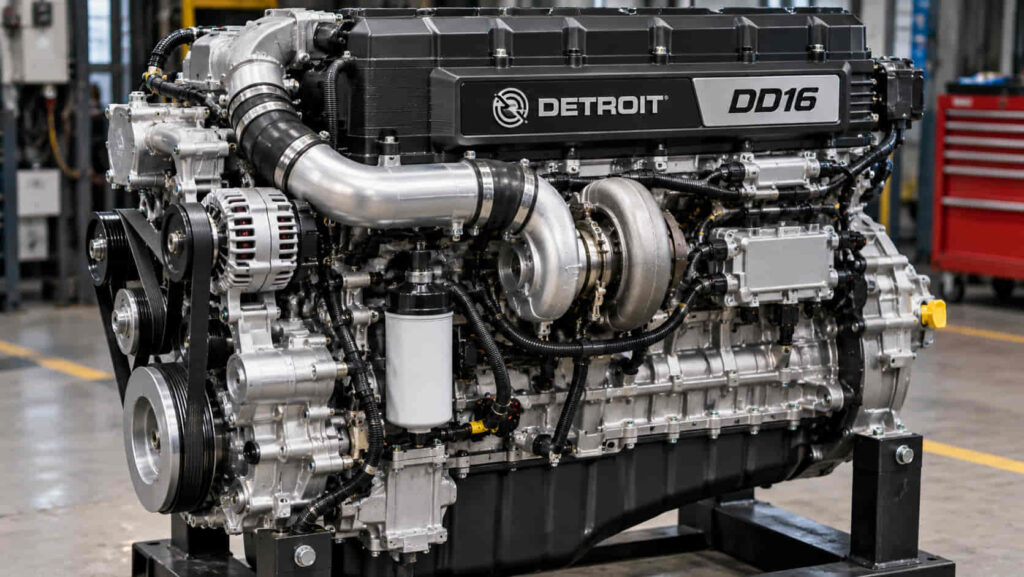
The Detroit DD16 is a 15.6-liter, turbocharged inline-six diesel engine producing 500–600 horsepower and 1,850–2,050 lb-ft of torque, depending on its factory rating. It is Detroit’s largest on-highway engine and is designed primarily for heavy hauling, demanding vocational work, and commercial truck applications requiring exceptional low-speed pulling power.
The DD16 has a displacement of 952 cubic inches, a cylinder bore of 139 mm (5.47 inches), and a piston stroke of 171 mm (6.73 inches). Its published compression ratio is approximately 17:1.
According to Detroit’s official technical specifications, the engine has a dry weight of approximately 2,837 pounds (1,287 kg) and requires about 45 US quarts (43 liters) of engine oil during a standard oil and filter change.
Unlike older mechanically controlled diesel engines, the DD16 uses Detroit Diesel Electronic Controls (DDEC) and an advanced Amplified Common Rail System (ACRS) for precise fuel injection management.
Another defining feature is its turbo-compounding system, which recovers energy from exhaust gases and transfers additional mechanical power to the engine. This helps improve efficiency while supporting the high torque required for demanding heavy-duty operation.
The Detroit DD16 is particularly attractive for heavy-haul trucks because certain factory calibrations deliver 2,050 lb-ft of torque at approximately 975 RPM. This low-speed torque allows the engine to pull heavy loads without constantly operating at high RPM.
However, DD16 specifications depend on the production generation, emissions certification, and vehicle configuration. Detroit has also announced a sixth-generation DD16 with planned production beginning in January 2028. That future engine is rated for 560–605 horsepower and should not be confused with the current 500–600-horsepower version.
This guide explains Detroit DD16 engine specs, including displacement, horsepower, torque, bore and stroke, compression ratio, oil capacity, engine weight, injection technology, turbo-compounding, maintenance intervals, reliability, common problems, and comparisons with the Detroit DD15 and Cummins X15.
What Is the Detroit DD16 Engine?
The Detroit DD16 is a large-displacement, electronically controlled diesel engine developed by Detroit Diesel Corporation for demanding on-highway and vocational truck applications.
Detroit is a powertrain brand of Daimler Truck North America.
Its engine portfolio includes the DD13, DD15, and DD16 heavy-duty engine families.
The DD16 occupies the upper end of this range.
Its 15.6-liter displacement gives it greater swept volume than the 12.8-liter DD13 and the 14.8-liter DD15.
The engine is designed for applications in which high torque and sustained power are particularly important.
These include heavy-haul tractors, construction-related trucks, and specialized vocational vehicles.
The DD16 uses six cylinders arranged in a straight line.
This configuration is common among heavy-duty diesel engines because it supports substantial displacement and favorable mechanical balance.
The engine also incorporates a double-overhead-camshaft valvetrain, four valves per cylinder, common-rail fuel injection, and electronically controlled combustion.
Compared with older diesel designs, these technologies allow more precise control of fuel delivery and emissions.
However, the additional complexity requires appropriate diagnostic equipment and maintenance.
The DD16 is best understood as a heavy-duty powertrain designed to operate as part of an integrated commercial truck system.
Its real-world performance depends on the transmission, axle ratios, cooling system, emissions equipment, and vehicle configuration.
Detroit DD16 Engine Displacement and Configuration
The Detroit DD16 has a displacement of 15.6 liters, equivalent to approximately 952 cubic inches, and uses a six-cylinder inline configuration.
Each cylinder contributes to the engine’s total displacement.
The combination of cylinder bore and crankshaft stroke determines the volume swept by the pistons.
The DD16 uses a large bore and a relatively long stroke.
This configuration is appropriate for a diesel engine intended to produce substantial torque.
However, displacement alone does not determine engine performance.
The amount of fuel injected, turbocharger airflow, combustion efficiency, and electronic calibration also influence output.
The engine uses a four-stroke diesel combustion cycle.
Air enters the cylinders during the intake stroke.
The pistons compress the air, increasing its temperature.
Fuel is then injected directly into the combustion chamber.
Combustion forces the pistons downward and turns the crankshaft.
The exhaust stroke removes combustion gases.
The DD16’s engine management system coordinates these processes across all six cylinders.
Its relatively large displacement helps it produce useful power at lower engine speeds.
This characteristic is especially valuable when pulling heavy trailers or operating on steep grades.
The engine’s rated operating range and torque curve are therefore important specifications alongside displacement.
Detroit DD16 Bore and Stroke
The Detroit DD16 has a cylinder bore of 139 mm (5.47 inches) and a piston stroke of 171 mm (6.73 inches).
These dimensions are confirmed by Detroit’s official technical specification sheets.
The bore represents the nominal diameter of the cylinder.
The stroke measures the distance the piston travels between top dead center and bottom dead center.
The DD16 has a longer stroke than bore.
This arrangement is commonly associated with diesel engines designed for substantial low-speed torque.
However, a long stroke does not automatically guarantee durability or towing capability.
The rotating assembly must also be designed to withstand the corresponding mechanical loads.
The crankshaft, connecting rods, pistons, and bearings must operate within their intended specifications.
The relationship between bore and stroke is also important during engine rebuilding.
The cylinder bores must be measured for wear, taper, and out-of-round conditions.
The crankshaft journals and connecting rods require dimensional inspection.
A replacement piston must match the engine’s actual cylinder and production configuration.
Components from the DD15 should not automatically be installed in a DD16 simply because both engines belong to Detroit’s heavy-duty platform.
Their stroke and certain internal dimensions differ.
Correct parts selection requires engine identification and the appropriate Detroit service information.
Detroit DD16 Horsepower Specifications
The established Detroit DD16 engine is available with factory horsepower ratings ranging from 500 to 600 HP, depending on the engine calibration and application.
Detroit’s official product literature identifies several performance configurations.
These include 500, 530, 560, and 600-horsepower versions in certain markets.
The published ratings are associated with an engine speed of approximately 1,800 RPM.
However, not every truck is offered with every rating.
Available calibrations depend on the vehicle manufacturer, emissions requirements, transmission, and application.
A highway tractor may be configured differently from a heavy vocational truck.
A lower horsepower rating does not necessarily mean that the engine has an entirely different internal architecture.
In many commercial diesel families, electronic calibration and application-specific hardware influence the final output.
However, it would be incorrect to assume that every rating can be changed through software alone.
The engine and vehicle must be approved for the intended configuration.
Cooling capacity, drivetrain limits, and emissions certification also matter.
For buyers, the important distinction is between advertised maximum capability and the rating of the actual engine.
A Detroit DD16 badge does not automatically mean the truck produces 600 horsepower.
The engine identification and factory rating information should be checked before comparing trucks.
Detroit DD16 Torque Specifications
The Detroit DD16 produces approximately 1,850–2,050 lb-ft of torque, with certain configurations reaching peak torque at just 975 RPM.
The maximum published torque figure is equivalent to approximately 2,780 Nm.
This substantial pulling force is one of the engine’s main advantages.
Heavy trucks require torque to accelerate large loads and maintain speed on demanding grades.
The DD16 is designed to provide a broad, relatively flat torque curve.
This allows useful pulling performance across a wide range of engine speeds.
Detroit’s Western Star technical specification sheet identifies several combinations of horsepower and torque.
A 500-horsepower version is listed with 1,850 lb-ft.
Certain 560-horsepower versions are available with either 1,850 or 2,050 lb-ft.
A 600-horsepower version is also documented with different torque configurations.
This demonstrates that horsepower and peak torque are not always tied to one fixed combination.
A truck buyer should therefore check both specifications.
Two DD16 engines with similar rated horsepower may have different torque calibrations.
The appropriate configuration depends on vehicle gearing and intended operating load.
The highest torque rating is not necessarily required for every commercial application.
For certain highway operations, a lower output configuration may provide the desired performance while supporting the fleet’s operating requirements.
Detroit DD16 600 HP and 2,050 lb-ft Performance
The 600-horsepower Detroit DD16 is the highest-rated configuration in the established DD16 product range and can deliver up to 2,050 lb-ft of torque.
Detroit’s published performance chart identifies a 600 HP rating at approximately 1,800 RPM.
The corresponding maximum torque reaches 2,050 lb-ft at approximately 975 RPM.
These figures illustrate the difference between peak power and peak torque.
Peak torque occurs at a relatively low engine speed.
Peak horsepower occurs at a higher speed.
The DD16 can therefore produce substantial pulling force before reaching its rated horsepower RPM.
This is useful during heavy hauling.
A truck climbing a long grade may need sustained torque to maintain movement without excessive downshifting.
However, actual gradeability depends on the complete vehicle.
Transmission ratios, axle gearing, tire size, gross combined weight, and other factors influence performance.
The engine’s 600-horsepower rating should not be interpreted as proof that every truck equipped with it can tow a particular trailer weight.
Vehicle ratings remain essential.
The maximum engine output is also a factory-controlled specification.
Unapproved modifications that increase power may impose additional stress on the drivetrain and emissions equipment.
For reliable operation, the truck should remain within its approved mechanical and load limits.
Detroit DD16 Compression Ratio
The Detroit DD16 has a published compression ratio of approximately 17:1 in the manufacturer’s technical specification sheets.
The compression ratio describes the relationship between the cylinder’s maximum and minimum volumes.
Diesel engines use high compression to heat the intake air before fuel injection.
This allows the fuel to ignite without the spark ignition system used by gasoline engines.
The DD16’s combustion chamber and piston design are engineered for its compression and injection requirements.
The high compression ratio contributes to the engine’s operating characteristics.
However, compression ratio alone does not determine combustion pressure.
Turbocharger boost, injection timing, fuel quantity, and engine load also influence cylinder pressure.
Detroit’s earlier technical service documentation identifies a 17.1:1 figure for one historical DD16 platform specification.
The more commonly cited product brochure rounds the specification to 17:1.
This difference illustrates why production generation and technical document revision matter.
When rebuilding an engine, the correct piston and cylinder head components must be selected.
Using an incompatible piston can alter compression characteristics.
The engine should therefore be serviced using its actual serial-number-specific specifications.
A generalized compression ratio is useful for understanding the engine but is not a substitute for component measurements or rebuild instructions.
How Many Valves Does the Detroit DD16 Have?
The Detroit DD16 has four valves per cylinder, giving the inline-six engine a total of 24 valves.
Detroit’s technical service documentation identifies two intake valves and two exhaust valves for each cylinder.
The intake valves control airflow entering the combustion chamber.
The exhaust valves allow combustion gases to leave the cylinder.
Using multiple valves per cylinder can improve airflow management.
This supports efficient combustion in a large turbocharged diesel engine.
The DD16 also uses dual overhead camshafts.
This arrangement differs from older diesel engines that use one camshaft inside the engine block and long pushrods.
The overhead camshafts operate the valve train according to the engine’s timing requirements.
Precise valve operation is important because the engine must control airflow during high-load combustion.
However, the valve train also requires periodic maintenance.
Incorrect valve clearance can affect noise, engine performance, and component wear.
Detroit publishes valve adjustment intervals and procedures for the relevant engine configurations.
The correct specifications should be obtained from the service manual for the installed engine.
A general DD16 valve count does not provide enough information to perform a valve adjustment or timing repair.
Detroit DD16 Firing Order
The Detroit DD16 uses a firing order of 1-5-3-6-2-4, as shown in Detroit’s heavy-duty platform service information.
The firing order describes the sequence of combustion events across the engine’s six cylinders.
An inline-six four-stroke engine completes its combustion cycle over two crankshaft revolutions.
The firing sequence helps distribute combustion forces and contributes to smooth operation.
The DD16 uses electronically controlled common-rail fuel injection.
Therefore, fuel injection timing is managed through the engine control system rather than a mechanical distributor.
However, the crankshaft and camshafts must remain correctly synchronized.
This is particularly important during engine assembly.
Incorrect mechanical timing can affect valve operation and engine performance.
The firing order is also useful during diagnostic testing.
A technician investigating a cylinder-specific misfire or injector fault must identify the correct cylinder.
However, cylinder identification and firing order should be verified against the applicable Detroit service documentation.
The engine’s electronic control module uses sensor information to coordinate injection timing.
A mechanical or electronic fault can therefore affect combustion even when the basic firing order remains unchanged.
The correct diagnosis should evaluate both engine timing and fuel injection operation.
Detroit DD16 Engine Weight
The Detroit DD16 has a published dry weight of approximately 2,837 pounds, equivalent to about 1,287 kilograms.
This figure appears in Detroit’s technical specifications for the relevant engine configuration.
The weight reflects the engine’s large-displacement heavy-duty construction.
However, dry weight is not necessarily the complete installed weight.
Engine oil, coolant, additional accessories, and application-specific equipment can increase the actual mass.
The complete powertrain also includes the transmission and other components.
Therefore, a vehicle’s installed engine assembly may weigh substantially more than the published dry engine figure.
Engine weight matters when selecting equipment for removal or installation.
The appropriate lifting devices must be rated for the assembly.
Correct lifting points and manufacturer-approved procedures are essential.
Engine mounts and chassis structures must also support the powertrain.
The DD16 is intended for vehicles designed to accommodate a large heavy-duty engine.
Installing it into another truck platform may require substantial modification.
Weight also influences vehicle configuration.
A larger engine can affect front axle loading and available payload.
However, the final vehicle rating depends on the complete chassis and equipment specification.
The engine’s weight should therefore be considered alongside power and torque when comparing the DD16 with smaller alternatives.
Read more: Caterpillar C7 Engine Specs
Detroit DD16 Oil Capacity
The Detroit DD16 requires approximately 43 liters, or 45 US quarts, of engine oil during a standard oil and filter change for the documented on-highway configurations.
This specification appears in Detroit’s technical brochures and operator documentation.
It is equivalent to approximately 11.4 US gallons.
However, the oil-and-filter refill capacity is not identical to the engine’s total dry oil volume.
Detroit’s service documentation identifies approximately 49 liters, or 51.8 quarts, for the total dry lubrication system in certain earlier DD16 applications.
The difference is important.
During an ordinary oil change, some lubricant remains inside the engine.
Detroit identifies approximately 6 liters of residual oil after a normal drain in the documented configuration.
Therefore, adding the complete dry-fill amount during routine service can result in overfilling.
The oil pan’s operating range also differs from its total capacity.
Detroit identifies approximately 5 liters between the low and full marks on the dipstick.
This provides a useful reference when topping up oil.
However, the final amount added should be determined by the actual oil level.
The engine must be checked according to Detroit’s specified dipstick procedure.
The correct oil specification and filter are also important.
Using the right quantity of an unsuitable oil does not provide proper lubrication.
Detroit DD16 Oil Capacity in Quarts and Gallons
The standard Detroit DD16 oil and filter service fill is approximately 45 US quarts, 11.25 US gallons, or 43 liters in the manufacturer’s rounded technical specifications.
The small difference between conversions reflects rounding.
Forty-three liters is approximately 45.4 US quarts.
That equals approximately 11.36 US gallons.
Detroit’s specification sheets generally round the refill amount to 45 quarts.
The operator’s manual may provide a more precise equivalent for certain engine generations.
For a normal oil change, the 43-liter figure is the correct general reference for the documented DD16 truck applications.
However, this should not be confused with the engine’s total dry lubrication capacity.
That larger figure is approximately 49 liters in the applicable older documentation.
The distinction becomes especially important after engine rebuilding.
A completely dry engine may require more initial lubricant than an engine undergoing routine maintenance.
The correct initial fill and priming procedure should come from the appropriate service manual.
Oil container sizes can also vary by market.
Technicians purchasing oil in gallons or liters should ensure that enough approved lubricant is available.
However, they should not force the entire purchased quantity into the engine.
The final level must remain within the acceptable dipstick range.
What Type of Oil Does the Detroit DD16 Use?
The Detroit DD16 requires a heavy-duty diesel engine oil meeting the applicable Detroit Fluids Specification, with the correct viscosity selected according to operating temperature and engine generation.
Detroit maintains approved lubricant standards for its engines.
Two important specifications are DFS 93K222 and DFS 93K223.
DFS 93K222 is associated with API CK-4 heavy-duty diesel oils.
DFS 93K223 is associated with API FA-4 lubricants intended for approved applications.
However, the specifications are not universally interchangeable across all Detroit engines and generations.
The correct choice depends on the particular engine and its operating requirements.
Detroit identifies DFS 93K222 oils as suitable for a broad range of heavy-duty applications.
The company also identifies DFS 93K223 oils as an option for compatible modern engines using ultra-low-sulfur diesel fuel.
Oil viscosity is another consideration.
Heavy-duty diesel oils are available in several multigrade formulations.
The appropriate viscosity depends on climate and the manufacturer’s recommendations.
A truck operating in extreme cold may require different oil characteristics from one operating in a hot climate.
However, selecting a thicker oil is not automatically beneficial.
The engine’s lubrication system is designed for approved viscosity and performance standards.
The oil should also be changed at the appropriate maintenance interval.
Detroit warns that synthetic oil alone does not justify extending the service interval beyond the manufacturer’s approved limit.
How Often Should You Change Detroit DD16 Oil?
Detroit DD16 oil change intervals depend on duty cycle, fuel economy, engine generation, oil specification, and operating hours rather than one fixed mileage requirement.
Detroit’s heavy-duty platform maintenance documentation identifies several intervals for DD16 engines using the approved oil specifications.
For qualifying long-haul operation averaging approximately 6.0–6.9 mpg, the published interval can reach 55,000 miles.
For short-haul operation averaging approximately 5.1–5.9 mpg, the interval is approximately 40,000 miles or 1,000 hours.
For severe operation averaging up to approximately 5.0 mpg, the interval is approximately 35,000 miles or 750 hours.
However, these figures apply to the specified engine generations, fuel, and approved oil program.
Older CJ-4 oil applications may have shorter intervals.
The documented maintenance schedule also includes other operating conditions and service restrictions.
The interval should therefore be obtained from the engine’s exact maintenance documentation.
A truck operating under demanding conditions may require more frequent oil changes.
Examples include repeated heavy hauling, frequent idling, and stop-and-go vocational service.
Operating hours can become especially important when the truck travels relatively few miles.
Fleet operators should monitor maintenance data and engine operating conditions.
An extended interval is appropriate only when the manufacturer authorizes it.
Detroit DD16 Fuel Injection System
The Detroit DD16 uses an Amplified Common Rail System, commonly abbreviated ACRS, to provide electronically controlled high-pressure diesel fuel injection.
This system is different from older mechanically controlled diesel injection arrangements.
A fuel pump supplies diesel fuel to the common-rail system.
The engine management electronics coordinate the timing and quantity of injection.
Detroit’s second-generation ACRS design uses pressure amplification within the injector.
This allows high injection pressure while limiting the maximum pressure required throughout the entire fuel rail.
The manufacturer identifies precise fuel delivery as a major benefit.
The system supports multiple injection events and advanced combustion control.
These capabilities help manage engine noise, fuel consumption, and emissions.
However, high-pressure diesel injection components are sensitive to contamination.
Water or debris in the fuel can damage precision internal surfaces.
Proper fuel filtration is therefore essential.
A fuel system problem may cause hard starting, rough running, reduced power, or diagnostic trouble codes.
However, these symptoms do not prove that every injector requires replacement.
The fuel supply, electronic control, pressure system, and individual injectors must be tested using the correct procedure.
The high-pressure fuel system should never be opened while pressurized.
A qualified technician should follow the appropriate Detroit safety and service instructions.
How Does Detroit DD16 Turbo Compounding Work?
Detroit DD16 turbo compounding recovers energy from the exhaust stream and converts part of that energy into additional mechanical power.
A conventional turbocharger uses exhaust gas energy to drive a compressor.
The compressor increases the amount of air entering the engine.
This allows the diesel engine to burn fuel more effectively under load.
However, some exhaust energy remains after the turbocharger has performed its primary function.
The DD16 uses a turbo-compounding arrangement to recover additional energy.
A downstream power turbine can extract energy from the exhaust flow.
That recovered energy is transferred mechanically into the engine’s powertrain system.
The purpose is to improve overall thermal efficiency.
Detroit promotes turbo compounding as one of the DD16’s important technologies.
It contributes to useful engine output without relying solely on increasing fuel consumption.
However, the system also adds mechanical components that require correct operation.
Problems involving the exhaust system, turbocharger, or power turbine can affect performance.
The exact configuration depends on engine generation.
A technician should therefore use the correct service documentation when diagnosing the turbo-compounding system.
It should not be treated as identical to the turbocharger arrangement used in every smaller Detroit diesel engine.
Does the Detroit DD16 Use a Variable Geometry Turbocharger?
The DD16 incorporates advanced turbocharging and turbo-compounding technologies, but the exact air-management hardware should be identified by engine generation before selecting replacement components.
The purpose of the turbocharging system is to increase intake airflow.
The engine requires sufficient air to support combustion under heavy load.
Electronic controls manage the relationship between engine operating conditions, fuel injection, and available air.
The DD16’s turbo-compounding system also recovers additional exhaust energy.
However, not every engine generation uses identical turbocharger or exhaust hardware.
A replacement turbocharger must match the intended calibration and physical installation.
The engine’s aftertreatment components must also remain compatible.
Low power or poor boost response can have several possible causes.
A restricted air filter can reduce intake airflow.
Charge-air leaks can prevent the engine from maintaining the required pressure.
Exhaust leaks or sensor faults can also influence performance.
A damaged turbocharger is another possibility.
However, replacing the turbocharger without verifying the actual fault may lead to unnecessary expense.
A professional diagnosis should evaluate boost pressure, electronic control data, and the condition of the intake and exhaust systems.
The complete air-management system must function correctly to deliver the engine’s rated performance.
Detroit DD16 Engine Brake Specifications
The Detroit DD16 features an integrated Jacobs engine brake with three selectable braking stages in the documented engine configuration.
An engine brake provides additional deceleration without relying solely on the vehicle’s service brakes.
This is especially useful in heavy trucks.
A loaded truck descending a long grade can place substantial heat into its foundation brakes.
Engine braking helps reduce the braking workload.
The DD16’s integrated Jacobs system provides multiple levels of braking performance.
The driver can select the appropriate setting according to road and operating conditions.
However, engine braking effectiveness depends on engine speed, transmission gear, vehicle load, and the selected braking stage.
The system does not replace the service brakes.
It should be used according to the truck manufacturer’s instructions.
Road surface conditions also matter.
Aggressive engine braking may not be suitable on slippery surfaces.
The engine brake is integrated with the vehicle’s electronic control system.
Faults involving the controls or valve train can affect operation.
However, diagnosing an engine brake problem requires the specific engine service information.
The system’s adjustment and repair procedures should not be confused with those of older Detroit Series 60 engines.
Detroit DD16 Cooling System Specifications
The Detroit DD16 uses a liquid cooling system designed to manage the substantial heat generated during heavy-duty diesel operation.
The engine relies on coolant circulation through its internal passages.
Heat is transferred from the engine to the vehicle’s radiator and related cooling equipment.
However, the complete cooling system capacity varies by truck configuration.
A Freightliner Cascadia may use a different radiator, hose arrangement, or accessory package from a Western Star vocational truck.
Therefore, one universal DD16 coolant capacity should not be assumed.
Detroit identifies several approved coolant options.
These include extended-life coolant using Organic Acid Technology and conventional coolant systems where approved.
The manufacturer’s coolant requirements must be followed.
Using an incompatible coolant formulation can affect corrosion protection and cooling system durability.
The appropriate antifreeze concentration is also important.
An excessively concentrated mixture may reduce heat transfer performance.
Too little antifreeze can reduce corrosion and freeze protection.
The cooling system should be inspected for leakage, restriction, and abnormal pressure.
A persistent coolant loss complaint requires diagnosis.
Repeated overheating can damage engine components.
A properly functioning cooling system is essential for preserving DD16 reliability during heavy hauling.
Detroit DD16 Emissions System
Modern Detroit DD16 engines use electronically managed diesel emissions systems to comply with applicable regulations, including EGR, diesel particulate filtration, and selective catalytic reduction technologies where required.
Diesel combustion produces several types of emissions.
The exhaust gas recirculation system can help manage nitrogen oxide formation under certain operating conditions.
The diesel particulate filter captures soot from the exhaust stream.
The filter requires periodic regeneration to remove accumulated combustible soot.
Selective catalytic reduction uses diesel exhaust fluid to reduce nitrogen oxide emissions.
However, the exact equipment arrangement depends on engine generation and emissions certification.
Detroit has produced DD16 engines for different markets and regulatory requirements.
The systems should therefore be identified by the engine’s actual configuration.
A malfunction may produce warning lights, fault codes, or reduced engine power.
However, a warning related to the aftertreatment system does not automatically indicate internal engine damage.
The correct diagnosis should identify the affected sensor or component.
The fuel and lubrication systems must also meet the requirements of the emissions equipment.
Unauthorized removal or modification of emissions controls can violate regulations.
For dependable operation, the complete system should be maintained according to Detroit’s official service procedures.
Detroit DD16 Engine Applications
The Detroit DD16 is primarily intended for heavy-duty commercial trucks requiring high torque, substantial power, and dependable performance under demanding operating conditions.
Its applications include heavy-haul and specialized vocational trucks.
Detroit identifies construction, dump truck, oil and gas, refuse, and other commercial categories within its broader engine application information.
However, actual availability depends on the vehicle model and market.
The Western Star 49X is an important DD16 application.
Western Star markets the engine as a high-output option for demanding vocational and heavy-haul work.
The Freightliner Cascadia has also been offered with the DD16 in appropriate configurations.
Detroit’s current product information lists the fourth-generation Cascadia among relevant model options.
However, an engine may not be offered in every cab, axle, or emissions configuration.
The final vehicle specification must be checked with the truck manufacturer.
The DD16 is particularly suitable for heavy trailers and challenging grades.
However, engine torque alone does not determine the vehicle’s towing capacity.
Transmission rating, axle configuration, chassis strength, brakes, and regulatory gross weight limits must also be considered.
The correct engine selection should match the actual workload rather than simply choosing the highest available horsepower.
Detroit DD16 in Freightliner Cascadia Trucks
The Freightliner Cascadia has been offered with the Detroit DD16 engine in selected configurations intended for demanding highway transportation.
The Cascadia is a Class 8 highway truck platform.
Its available powertrains vary according to production generation and configuration.
The DD16 provides a higher-displacement alternative to the DD13 and DD15.
It can be useful for operators transporting heavy loads through mountainous terrain.
The engine’s low-speed torque supports pulling performance.
However, real-world fuel consumption and road speed depend on the complete truck.
The transmission and axle ratio must be selected appropriately.
A truck with an unsuitable gear ratio may not use the engine’s power efficiently.
The Cascadia also integrates electronic controls and diagnostic systems with the Detroit engine.
This can support maintenance planning and fault identification.
However, parts and service requirements still depend on the installed engine generation.
Owners should verify the engine serial number before ordering filters or internal components.
A used Cascadia advertised as having a Detroit engine may contain a DD13, DD15, or DD16.
The correct model must be identified.
The engine’s rated horsepower should also be checked because not every DD16 is calibrated for the 600-horsepower maximum.
Detroit DD16 in Western Star Trucks
The Detroit DD16 is an important powertrain option for the Western Star 49X, a vocational truck designed for demanding work environments.
Western Star emphasizes durability, heavy loads, and specialized vehicle configurations.
The 49X can be used in applications such as construction and heavy hauling.
Its available engines include Detroit diesel options as well as selected Cummins powertrains.
The DD16 provides up to 600 horsepower and 2,050 lb-ft of torque in the established generation.
This makes it suitable for applications where low-speed pulling performance is important.
However, the truck must also be configured with the appropriate transmission and axles.
The 49X offers several drivetrain options depending on application.
These include automated manual and other heavy-duty transmission configurations.
The correct components must support the engine’s torque rating.
A 2,050-lb-ft engine cannot simply be combined with any transmission.
The complete drivetrain must be approved for the intended output and vehicle load.
Western Star’s published specifications also confirm that the next-generation DD16 is planned for 2028.
Until that production change takes place, buyers should distinguish existing DD16 specifications from future Gen 6 ratings.
For vocational owners, the engine’s torque curve, service accessibility, and dealer support are important considerations.
Detroit DD16 vs DD15 Engine Specs
The Detroit DD16 is larger and offers higher maximum factory output than the DD15, making it better suited to certain heavy-haul applications, while the DD15 is commonly chosen for general long-haul efficiency.
The DD15 has a displacement of approximately 14.8 liters.
The DD16 displaces 15.6 liters.
Both use six-cylinder inline configurations.
They also belong to Detroit’s heavy-duty engine platform and share certain engineering principles.
However, their internal components are not universally interchangeable.
The DD15 uses a shorter crankshaft stroke in the relevant earlier generation.
Detroit’s service information identifies 163 mm for the DD15 compared with 171 mm for the DD16.
The DD16 also has a different maximum output range.
The established DD16 reaches 600 horsepower and 2,050 lb-ft.
The appropriate DD15 rating depends on model year and generation.
The best choice depends on vehicle duty.
For regular long-haul transportation, the DD15 may provide an attractive balance of performance and operating efficiency.
For maximum heavy hauling, the additional displacement and torque of the DD16 can be beneficial.
However, the DD16 is not automatically the better engine for every truck.
Purchase price, vehicle weight, maintenance costs, and fuel consumption must be evaluated.
The correct comparison should use the actual vehicle configurations rather than displacement alone.
Detroit DD16 vs DD13 Engine Specs
The Detroit DD16 offers substantially greater displacement and available torque than the DD13, while the DD13 is designed for applications where lower engine weight and more moderate output are appropriate.
The DD13 has a displacement of approximately 12.8 liters.
The DD16 uses 15.6 liters.
Both engines have six cylinders.
However, their bore and stroke dimensions differ.
Detroit’s earlier service documentation identifies a bore of approximately 132 mm and a stroke of 156 mm for the DD13.
The DD16 has a bore of 139 mm and a stroke of 171 mm.
These differences influence engine size and output potential.
The DD13 is commonly associated with regional transportation and vocational work.
The DD16 occupies the upper end of the heavy-duty range.
It offers greater pulling capability when high torque is required.
However, more displacement is not automatically advantageous.
A truck that operates under moderate loads may not need a 600-horsepower engine.
The additional cost and weight may not provide sufficient benefit.
The correct choice depends on the vehicle’s intended service.
A distribution truck, dump truck, and heavy-haul tractor can have different powertrain requirements.
The engine should be selected according to load, operating speed, fuel economy goals, and the complete vehicle specification.
Detroit DD16 vs Cummins X15
The Detroit DD16 and Cummins X15 are competing large-displacement inline-six diesel engines used in heavy-duty commercial trucks.
The Detroit DD16 has a displacement of 15.6 liters.
The Cummins X15 has a nominal displacement of approximately 14.9 liters in the established engine family.
Both offer high-output configurations designed for demanding trucking applications.
However, engine performance varies by generation and calibration.
The established Detroit DD16 produces up to 600 horsepower and 2,050 lb-ft.
Certain Cummins X15 configurations also reach comparable torque levels.
The engines use different fuel injection and electronic control systems.
Their service procedures and parts are not interchangeable.
The DD16 incorporates Detroit’s ACRS injection system and turbo-compounding technology.
The Cummins X15 uses its own high-pressure fuel system, engine electronics, and air-management arrangements.
Fuel economy comparisons should consider the complete vehicle.
A truck’s gearing, aerodynamics, weight, route, and driving habits can strongly influence consumption.
Maintenance networks also matter.
Detroit provides service through its authorized dealer and distributor network.
Cummins has an extensive independent engine and service network.
For a fleet, access to qualified service facilities may be as important as a small difference in rated torque.
The best engine depends on the application and total cost of ownership.
Is the Detroit DD16 Engine Reliable?
The Detroit DD16 is engineered for heavy-duty durability, but actual reliability depends on correct maintenance, operating conditions, fuel quality, and the condition of its mechanical and electronic systems.
Detroit’s technical literature identifies a B50 life of approximately 1.2 million miles for a documented DD16 generation.
This is a manufacturer durability statistic.
It should not be interpreted as a guarantee that every individual engine will run 1.2 million miles without repairs.
B50 life is associated with a statistical overhaul-life benchmark under defined conditions.
Individual engines may require major service earlier or continue operating longer.
The engine’s internal construction is designed for substantial mechanical loads.
However, the modern DD16 also uses sophisticated fuel injection, turbocharging, and emissions components.
These systems require proper maintenance.
Fuel contamination can damage precision injection equipment.
Incorrect oil can affect engine lubrication.
Cooling problems can lead to overheating.
An emissions-system fault may cause reduced engine power even when the main rotating assembly remains healthy.
For a used truck, the engine’s operating history is especially important.
High mileage alone does not establish poor condition.
A highway truck with documented maintenance may be healthier than a lower-mileage truck subjected to severe neglect.
A proper inspection should evaluate engine hours, oil consumption, diagnostic data, maintenance records, and previous repairs.
Common Detroit DD16 Engine Problems
Potential Detroit DD16 service concerns include fuel injection faults, turbocharging problems, oil or coolant leakage, emissions-system faults, and maintenance-related wear.
However, these should be treated as possible diagnostic categories rather than proof of universal manufacturing defects.
The fuel injection system is one important area.
The DD16 uses high-pressure electronic injection equipment.
Contaminated diesel fuel can damage precision components.
The engine may then develop hard starting, rough operation, or reduced power.
However, these symptoms can also result from fuel supply restrictions or electronic control faults.
The turbocharger and turbo-compounding arrangement are another consideration.
Abnormal exhaust conditions or mechanical wear can affect performance.
However, low boost pressure does not automatically mean the turbocharger has failed.
Charge-air leaks and sensor problems may produce similar symptoms.
Oil leaks can develop as seals and gaskets age.
Cooling problems may arise from damaged hoses, restricted radiators, or other components.
Modern emissions equipment can also create diagnostic trouble codes.
Diesel particulate filter and SCR problems require system-specific diagnosis.
The correct approach is to determine which component has failed before replacing expensive parts.
A detailed inspection by a qualified Detroit technician is often the most efficient route to a reliable repair.
How Long Does a Detroit DD16 Engine Last?
Detroit has advertised a B50 engine life of approximately 1.2 million miles for a documented DD16 generation, but individual engine life depends on maintenance and operating conditions.
This is one of the most frequently cited DD16 durability figures.
However, the meaning should be understood correctly.
It is not a comprehensive warranty lasting 1.2 million miles.
It also does not mean every engine will avoid injector, turbocharger, or emissions-system repairs throughout that period.
The engine’s major components are designed for demanding commercial use.
However, long-term durability depends on several factors.
Clean engine oil protects the bearings and rotating assembly.
Appropriate fuel filtration helps protect the injection system.
The cooling system must maintain suitable operating temperatures.
A truck used for heavy hauling may experience substantial engine loads.
However, highway miles and severe vocational hours are not directly equivalent.
Operating hours provide useful additional information.
An engine that spends long periods idling may accumulate relatively little mileage while still operating for thousands of hours.
For used-truck buyers, maintenance records and diagnostic information are more useful than a single mileage figure.
The best assessment should consider oil pressure, oil consumption, coolant condition, fuel system performance, and overall engine operation.
Detroit DD16 Engine Maintenance Requirements
Reliable Detroit DD16 operation depends on following the applicable oil, fuel filter, coolant, valve adjustment, and exhaust aftertreatment maintenance schedules.
The correct maintenance intervals depend on engine generation and duty cycle.
Oil changes are particularly important.
The lubricant must meet the relevant Detroit Fluids Specification.
The oil filter should also match the engine’s approved service requirements.
Fuel filtration protects the precision common-rail injection equipment.
Water contamination is a major concern in modern diesel fuel systems.
The appropriate water separator and fuel filters should therefore be serviced according to the vehicle’s instructions.
Valve lash adjustment is another maintenance item.
Detroit’s technical literature identifies specific intervals that vary by engine and market.
The proper adjustment procedure should follow the exact engine service manual.
Cooling system maintenance is equally important.
The correct coolant type and concentration should be maintained.
Exhaust aftertreatment components require attention when the vehicle indicates a service condition.
However, replacing a DPF or SCR component without diagnosis is not appropriate.
The engine’s electronic controls provide useful maintenance and fault information.
Detroit Connect and compatible service diagnostic systems can support maintenance planning.
A fleet should also keep records of operating hours, mileage, fuel consumption, and previous repairs.
These records help determine the appropriate service schedule.
Detroit DD16 Engine Warranty
Detroit’s published standard engine service warranty for qualifying DD16 applications includes two years of unlimited-mileage engine coverage, with separate terms for injectors and major components.
The manufacturer’s current warranty information identifies two years of engine coverage with parts and labor included under the applicable conditions.
Injector coverage is identified as two years or 200,000 miles.
Major engine components receive additional coverage extending to five years or 500,000 miles under the stated terms.
However, warranty details depend on the exact engine, purchase arrangement, application, and market.
An extended warranty may provide different coverage.
Used engines and remanufactured components may also have separate warranty terms.
The owner should not assume that every component is covered for the same period.
For example, an emissions-system component may be subject to a different coverage program.
Maintenance records can also be important for evaluating warranty claims.
Using unsuitable fluids or performing unauthorized modifications may affect eligibility.
The written warranty should therefore be reviewed before purchase.
The engine serial number and original in-service date are important details.
A published warranty period is not equivalent to a predicted engine lifespan.
The DD16’s durability expectations and formal warranty obligations should be considered separately.
Detroit DD16 Gen 6 Engine Specs for 2028
Detroit has announced a sixth-generation DD16 engine with a planned production start in January 2028 and preliminary published ratings of 560–605 horsepower and 1,850–2,050 lb-ft of torque.
The announcement was made in February 2026 as part of Daimler Truck North America’s updated heavy-duty engine portfolio.
The new generation is intended to comply with the EPA’s 2027 heavy-duty emissions requirements.
However, the production timing differs across engine families.
Detroit plans to begin production of the Gen 6 DD13 and DD15 in January 2027.
The Gen 6 DD16 is scheduled to follow in January 2028.
The planned DD16 retains a 15.6-liter displacement.
Its published horsepower range increases to 560–605 horsepower.
The torque range remains 1,850–2,050 lb-ft.
Detroit also identifies improvements involving fuel efficiency, emissions performance, and engine technology across the Gen 6 lineup.
However, detailed component and maintenance specifications may be updated before production.
Therefore, the future engine’s oil capacity, service requirements, and internal details should not automatically be assumed identical to those of the established DD16.
As of November 2026, the Gen 6 DD16 is an announced future engine rather than a production engine with years of established field service.
Buyers should distinguish its preliminary specifications from those of currently operating trucks.
How to Identify Detroit DD16 Specifications by Engine Serial Number
The most accurate way to determine Detroit DD16 specifications for a specific truck is to use its engine serial number and the matching Detroit service documentation.
The DD16 has been produced in several generations.
Its emissions equipment, electronic calibration, and service requirements can vary.
The engine serial number helps identify the production configuration.
It also supports correct parts selection.
For example, a replacement injector must match the engine’s fuel system.
A turbocharger must correspond to the correct application.
Oil and fuel filter specifications should also be verified.
A truck’s model year alone may not provide enough information.
The engine may have been replaced during the vehicle’s service life.
It may also have an application-specific calibration.
The engine identification information should therefore be checked directly.
Authorized Detroit service locations can use this information to access the appropriate technical documentation.
Detroit’s official product and service resources also provide general operating information.
However, detailed repair procedures require the correct engine-specific references.
This is especially important for major repairs.
Cylinder head fasteners, bearings, pistons, and valve train components may have particular installation requirements.
Using a generic specification can create serious mechanical problems.
For routine owners, the engine serial number is also useful when ordering filters and confirming maintenance requirements.
Final Verdict: What Are the Detroit DD16 Engine Specs?
The Detroit DD16 is a 15.6-liter inline-six diesel engine producing 500–600 horsepower and 1,850–2,050 lb-ft of torque in its established factory configurations. It is designed for heavy hauling and other demanding commercial truck applications.
The engine has a nominal displacement of 952 cubic inches.
Its cylinder bore measures 139 mm, while its crankshaft stroke measures 171 mm.
Detroit’s published technical specifications identify a compression ratio of approximately 17:1.
The engine uses dual overhead camshafts and four valves per cylinder, for a total of 24 valves.
Its firing order is 1-5-3-6-2-4.
The DD16’s published dry weight is approximately 2,837 pounds, or 1,287 kg.
Its standard oil and filter service fill is approximately 43 liters, equivalent to about 45 US quarts.
The engine uses electronically controlled fuel injection through Detroit’s Amplified Common Rail System.
Its turbo-compounding arrangement recovers additional energy from exhaust gases.
Certain configurations produce maximum torque of 2,050 lb-ft at approximately 975 RPM.
An integrated Jacobs engine brake provides additional deceleration for heavy trucks.
The DD16 is used in selected Freightliner and Western Star applications, including heavy-haul and vocational configurations.
Long-term reliability depends on correct oil, fuel filtration, cooling system maintenance, and timely diagnosis of electronic and emissions faults.
Detroit has also announced a new Gen 6 DD16 rated at 560–605 horsepower, with production planned for January 2028.
However, those future specifications should not be confused with the established engine.
For buyers who need maximum low-speed torque and substantial pulling power, the Detroit DD16 remains one of the strongest engines in Detroit’s heavy-duty portfolio.
The correct powertrain should be selected according to the complete truck’s load rating, transmission, axle configuration, operating conditions, and maintenance requirements.
Before servicing or purchasing a particular engine, its serial number should be used to confirm the applicable Detroit specifications.