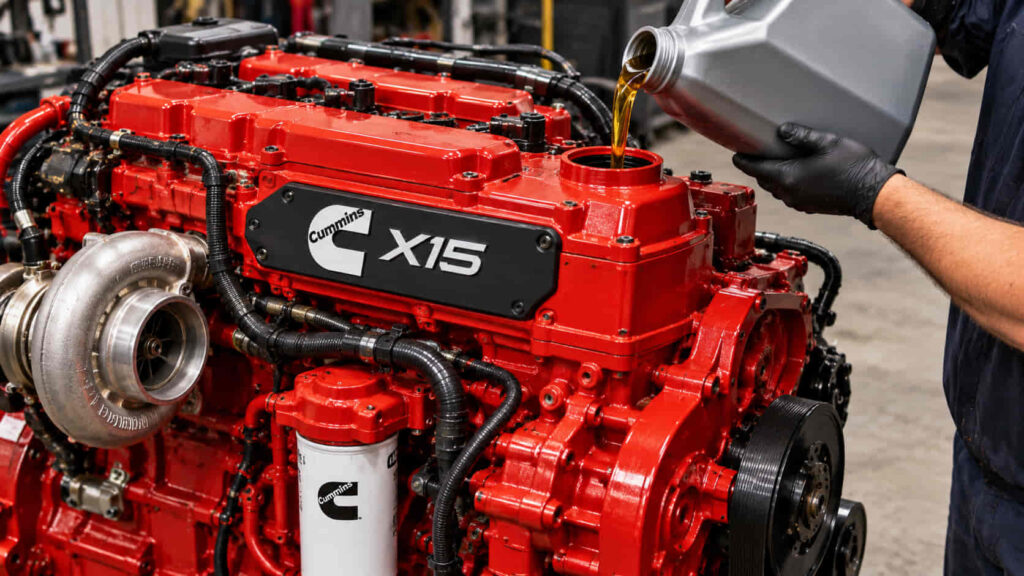
The Cummins X15 oil capacity typically ranges from 9.6 to 12 US gallons (approximately 36.3–45.4 liters) for many on-highway truck applications, depending on engine generation and oil pan configuration. However, certain specialized X15 applications require more oil, making it essential to verify the exact engine before performing an oil change.
For the EPA 2017 Cummins X15, the manufacturer’s official maintenance guide identifies an oil and filter change capacity of 11.5 gallons for the standard stamped-steel oil pan, 12 gallons for the wedge-type cast aluminum pan, and 11 gallons for the rear-center-sump aluminum pan.
The specifications changed for later engine configurations. Cummins’ 2024 X15 maintenance guide lists a typical oil and filter change capacity ranging from 9.6 to 11.6 gallons. This corresponds to approximately 38.4–46.4 US quarts.
The correct amount of oil depends on the installed oil pan, engine generation, and application—not simply the X15 engine name or truck model year.
Cummins also publishes a 50–52-quart lubricant capacity for certain X15 engines designed for fire and emergency vehicles. This demonstrates why applying one universal refill quantity across every X15 installation can lead to incorrect servicing.
The X15 is a heavy-duty inline-six diesel engine widely used in Class 8 commercial trucks and specialized vehicles. It has been offered in Efficiency, Performance, and other application-specific configurations, with differences in hardware, calibration, and maintenance requirements.
Most on-highway X15 engines require an approved heavy-duty diesel engine oil meeting the applicable Cummins Engineering Standard. SAE 15W-40 and 10W-30 are common viscosity options, depending on engine specifications and operating conditions.
Oil filter selection and oil change intervals also vary. Cummins identifies the Fleetguard LF14000NN for certain earlier X15 applications and the LF14001NN for more recent configurations.
This guide explains Cummins X15 oil capacity by engine generation, oil pan design, and application, along with recommended oil types, oil filters, oil change intervals, proper filling procedures, and common lubrication mistakes.
How Much Oil Does a Cummins X15 Take?
A Cummins X15 commonly requires approximately 9.6–12 US gallons of engine oil during a normal oil and filter change, although the precise quantity varies by configuration.
The X15 engine family includes several generations.
Cummins introduced the X15 name for its EPA 2017 heavy-duty engine lineup.
The engine was developed from the manufacturer’s established ISX15 platform and introduced significant improvements in efficiency, emissions control, and operating performance.
However, the X15 designation does not describe one fixed oil sump design.
Different truck manufacturers may install engines with different oil pans.
The same engine family may also be used in long-haul tractors, vocational trucks, or specialized emergency vehicles.
These applications can require different lubrication arrangements.
Cummins’ EPA 2017 maintenance guide identifies several distinct refill quantities.
The standard stamped-steel oil pan requires approximately 11.5 gallons during an oil and filter change.
The optional wedge-type aluminum oil pan requires approximately 12 gallons.
The aluminum rear-center-sump configuration requires approximately 11 gallons.
Later Cummins maintenance documentation lists a broader typical range of 9.6–11.6 gallons.
These values should not be combined into one universal specification.
The correct amount must be determined from the engine serial number, applicable service documentation, and installed oil pan.
After filling, the final level should always be checked with the engine’s dipstick.
Cummins X15 Oil Capacity in Gallons, Quarts, and Liters
Cummins X15 oil capacity is often expressed in US gallons, but converting the amount into quarts or liters makes it easier to purchase the correct quantity of engine oil.
The EPA 2017 stamped-steel-pan configuration has a refill specification of 11.5 US gallons.
That equals 46 US quarts or approximately 43.5 liters.
The wedge-type aluminum oil pan requires 12 US gallons.
This equals 48 quarts or approximately 45.4 liters.
The rear-center-sump aluminum configuration requires 11 US gallons.
This equals 44 quarts or approximately 41.6 liters.
For the later X15 configurations covered by the 2024 Cummins quick reference guide, the typical range is 9.6–11.6 gallons.
This corresponds to approximately 38.4–46.4 quarts or 36.3–43.8 liters.
However, the 2024 guide does not establish one exact refill quantity for every oil pan.
Specialized X15 applications may also use larger quantities.
For example, the 2025 Cummins fire and emergency vehicle literature identifies a lubricant capacity of 50–52 quarts, equivalent to approximately 12.5–13 gallons.
When purchasing oil, the technician should use the verified specification rather than simply selecting the largest number associated with the engine family.
The final fill quantity must also account for the amount of oil actually drained.
The dipstick remains the final reference for the correct operating level.
Cummins X15 EPA 2017 Oil Capacity
The EPA 2017 Cummins X15 has a documented oil and filter change capacity of 11, 11.5, or 12 gallons, depending on oil pan configuration.
Cummins published these specifications in Quick Reference Guide Bulletin 5410641, revised November 2017.
The guide covers the X15 Efficiency and Performance Series engines associated with the EPA 2017 platform.
It identifies the stamped-steel oil pan as the standard configuration.
With this pan, the oil and filter change capacity is approximately 43.5 liters, or 11.5 gallons.
The optional wedge-type cast aluminum pan requires approximately 45.4 liters, or 12 gallons.
The rear-center-sump aluminum pan has a lower published refill capacity of approximately 41.6 liters, or 11 gallons.
These differences result from oil sump geometry and the lubrication system’s service configuration.
The guide also distinguishes oil pan capacity from complete lubricating system capacity.
That distinction is important because not all oil drains during routine service.
Oil remains in some internal galleries and components after the drain plug is removed.
Therefore, an engine’s total lubricating system volume is not necessarily the amount required during a normal oil change.
The EPA 2017 specifications should not automatically be applied to engines with later hardware or different oil pans.
Cummins X15 2020 and 2021 Oil Capacity
Cummins identifies a typical oil and filter change capacity of 9.6–11.6 gallons for its 2020 and 2021 X15 Efficiency hardware.
This information appears in Cummins Quick Reference Guide Bulletin 5600512, revised October 2024.
The document identifies the engine platform as X15 CM2450 X124B.
The lower end of the refill range is 36.3 liters, or 9.6 US gallons.
The upper end is 43.8 liters, or 11.6 US gallons.
These values are different from the 11–12-gallon range described in the earlier EPA 2017 guide.
This demonstrates why identifying the correct engine generation is essential.
A technician servicing a 2021 X15 should not automatically use the refill quantity for a 2017 engine with a stamped-steel pan.
Even if both engines belong to the X15 family, their oil pan arrangements may differ.
The 2020–2021 guide also identifies the Fleetguard LF14001NN as its preferred oil filter.
It specifies a minimum hot-idle oil pressure of 10 psi for the documented configuration.
However, the actual refill amount and maintenance requirements should still be confirmed for the individual engine.
Cummins QuickServe Online provides service information linked to the engine serial number.
That is the appropriate source for resolving differences between general published guides and a specific engine installation.
Cummins X15 EPA 2024 Oil Capacity
The EPA 2024 Cummins X15 maintenance guide lists a typical oil and filter change capacity ranging from 9.6 to 11.6 US gallons.
The specifications appear in Cummins Bulletin 6553662, revised November 2024.
The document covers X15 engines intended for relevant on-highway truck applications.
It includes Efficiency, productivity, and performance-oriented configurations.
The lower typical refill quantity is 36.3 liters.
The maximum typical quantity listed is 43.8 liters.
The guide identifies the Fleetguard LF14001NN as the preferred oil filter.
It also provides oil pressure and drain fitting information.
However, the published capacity is a range rather than a single number assigned to every truck.
Therefore, it would be incorrect to claim that every 2024 X15 requires exactly 11.6 gallons.
The oil pan and engine configuration must be identified.
The same precaution applies when servicing later trucks equipped with related X15 hardware.
A truck’s registration year may not match the production or certification generation of its engine.
The exact Cummins engine serial number is therefore more dependable than truck model year alone.
For an accurate refill, the technician should use the corresponding engine-specific service instructions.
The quantity should then be verified using the dipstick after the oil and filter have been replaced.
Cummins X15 2025 and 2026 Oil Capacity
The oil capacity of a 2025 or 2026 Cummins X15 should be determined from the specific engine serial number rather than assuming that every newer X15 uses the same refill quantity.
Cummins continues developing the X15 engine family.
The manufacturer’s maintenance literature covers several engine generations and specialized applications.
For example, the EPA 2024 truck maintenance guide lists a typical refill range of 9.6–11.6 gallons.
However, a separate Cummins publication for X15 fire and emergency vehicles, revised in March 2025, lists a lubricant capacity of 50–52 quarts.
That equals approximately 12.5–13 gallons.
The difference is significant.
It means an X15 used in an emergency vehicle may have different lubricant requirements from an X15 installed in a conventional highway tractor.
Cummins has also introduced a redesigned X15 engine platform intended for future emissions requirements.
Its EPA 2027 fire and emergency vehicle literature identifies a 14.5-liter engine with a 50–52-quart lubricant capacity.
That document describes a different engine generation and should not be used as the default oil specification for an earlier 14.9-liter X15.
Therefore, the correct approach for a truck identified as a 2025 or 2026 model is to locate the engine serial number.
The matching Cummins service manual will establish the correct oil pan configuration, refill quantity, and filter.
The year on the vehicle’s registration is not sufficient to determine those details.
Cummins X15 Efficiency Series Oil Capacity
The Cummins X15 Efficiency Series oil capacity depends on the engine generation and sump arrangement, with official service guides identifying different refill ranges for earlier and later versions.
The Efficiency Series was developed for fuel-conscious heavy-duty truck applications.
It is commonly associated with long-haul and regional transportation.
The engine uses a turbocharged inline-six configuration.
Electronic engine management helps control fuel injection, combustion, and emissions systems.
However, the Efficiency designation does not identify a single oil pan size.
Earlier EPA 2017 engines use the published oil pan-specific refill quantities.
Later Efficiency hardware has a different documented typical range.
For 2020 and 2021, Cummins identifies 9.6–11.6 gallons.
The EPA 2024 guide provides the same typical range for the covered configurations.
These specifications should not be interpreted as interchangeable with the earlier 11–12-gallon values.
The installed oil pan must be verified.
The lubricant itself should also meet the relevant Cummins engineering standard.
An engine operating in long-haul service may qualify for extended oil change intervals under appropriate conditions.
However, extended intervals depend on duty cycle and the manufacturer’s program.
Using a larger oil quantity or synthetic oil does not automatically authorize additional mileage between services.
The exact maintenance requirements should be checked in QuickServe Online.
Cummins X15 Performance Series Oil Capacity
The Cummins X15 Performance Series requires an oil quantity determined by its actual engine configuration and oil pan, rather than by its higher horsepower or torque rating.
The Performance Series is intended for applications that require substantial engine output.
These can include demanding highway operations and certain vocational uses.
Higher engine torque does not automatically mean a larger oil reservoir.
Oil capacity is determined by the lubrication system and sump arrangement.
The EPA 2017 Cummins guide covers Efficiency and Performance engines and lists refill quantities according to oil pan type.
A standard stamped-steel-pan application uses approximately 11.5 gallons.
The optional aluminum arrangements use different amounts.
Later Performance Series engines must be checked against their corresponding service documentation.
The published EPA 2024 quick reference guide identifies a typical range of 9.6–11.6 gallons for the engine configurations it covers.
However, an X15 Performance engine installed in specialized equipment may have a different approved configuration.
The technician should therefore confirm the engine serial number and oil pan before servicing.
The correct oil specification is equally important.
Higher performance does not justify using an arbitrary thicker oil or exceeding the published refill level.
The engine’s intended lubrication characteristics depend on using approved oil and maintaining the correct quantity.
Cummins X15 Oil Capacity With a Stamped-Steel Pan
The standard stamped-steel oil pan used in the EPA 2017 Cummins X15 has a published oil and filter change capacity of approximately 11.5 gallons, or 46 quarts.
Cummins identifies this arrangement in Bulletin 5410641.
The corresponding metric quantity is approximately 43.5 liters.
The oil pan is positioned beneath the engine block.
It serves as the primary oil reservoir when the engine is not running.
During operation, the oil pump draws lubricant from the sump and distributes it throughout the engine.
The oil eventually drains back into the pan.
A stamped-steel oil pan has a particular shape and internal capacity.
However, not every stamped-steel pan used across Cummins engines is identical.
The 11.5-gallon figure applies to the specified EPA 2017 X15 arrangement.
The engine’s service documentation should be checked before using this quantity on another generation.
The technician should also distinguish normal refill quantity from total system capacity.
Cummins’ earlier guide provides a separate total lubrication-system figure that includes residual oil.
That larger amount is not the quantity to add during a standard oil change.
For routine service, the correct published oil-and-filter refill value should be used.
The final operating level should then be verified with the dipstick.
Cummins X15 Aluminum Oil Pan Capacity
The EPA 2017 Cummins X15 uses different oil refill quantities depending on which optional aluminum oil pan is installed.
Cummins identifies a wedge-type cast aluminum oil pan.
For that configuration, the oil and filter change capacity is approximately 12 gallons, or 48 quarts.
This equals approximately 45.4 liters.
Another available arrangement uses an aluminum rear-center-sump pan.
Cummins lists its oil and filter refill capacity at approximately 11 gallons, or 44 quarts.
This equals approximately 41.6 liters.
The difference is associated with the shape and location of the oil sump.
The oil pan must provide sufficient lubricant storage while accommodating chassis packaging and other vehicle design requirements.
A rear-center sump may be selected for a particular installation.
However, a pan’s external material or appearance should not be the only basis for determining capacity.
The complete part configuration must be verified.
An owner should not assume that every aluminum X15 oil pan holds 12 gallons.
Likewise, the 11-gallon quantity applies specifically to the documented rear-center-sump configuration.
Other engines and applications may use different oil pans.
The correct service information must match the engine’s actual hardware.
Cummins X15 Oil Capacity With and Without Filter
Cummins commonly publishes X15 oil change capacities as the quantity required for an oil pan and filter service, while the no-filter quantity is not represented by one universal specification.
The distinction matters during maintenance.
When the oil filter is removed, the oil inside it is discarded.
A replacement filter must then be filled during the subsequent lubrication process.
For the EPA 2017 X15, Cummins identifies a standard combination full-flow and bypass filter capacity of approximately 2.2 liters.
That is roughly 0.58 US gallon.
However, this filter volume should not be added on top of the published oil-and-filter refill quantity.
The service capacity already accounts for the intended filter replacement.
Similarly, the difference between the engine’s total system volume and routine refill quantity should not be interpreted as a separate filter capacity.
Oil remains in internal passages and other components after draining.
A partial oil change without replacing the filter may require a different amount.
However, the final quantity should be determined by the actual oil level and the applicable service procedure.
For routine maintenance, the oil filter should be replaced according to Cummins’ instructions.
The published oil-and-filter quantity is the appropriate starting reference.
What Type of Oil Does a Cummins X15 Use?
The Cummins X15 requires a heavy-duty diesel engine oil meeting the applicable Cummins Engineering Standard, with SAE 15W-40 and SAE 10W-30 among the commonly approved viscosity grades.
Cummins’ EPA 2017 maintenance guide explicitly identifies 10W-30 and 15W-40 oils meeting the appropriate Cummins requirements as usable in the engine.
However, viscosity alone is not sufficient.
Modern heavy-duty diesel engines require lubricant formulations designed to protect internal engine components and operate correctly with emissions aftertreatment systems.
Cummins uses its own engineering standards to identify compatible oil.
CES 20086 is associated with API CK-4 lubricants.
CES 20087 is associated with API FA-4 lubricants.
However, the two categories should not be treated as universally interchangeable.
FA-4 oils have different high-temperature, high-shear viscosity characteristics and are intended for specifically approved engine applications.
The correct standard must therefore be confirmed in the engine’s service documentation.
Cummins has also approved certain Valvoline Premium Blue formulations meeting applicable specifications.
However, a particular brand name does not replace the need for an approved performance classification.
Owners should select oil according to the actual X15 generation, ambient temperature, and operating requirements.
The oil container should identify the applicable specification.
Can You Use 15W-40 in a Cummins X15?
SAE 15W-40 is a common heavy-duty diesel oil viscosity and is suitable for Cummins X15 engines when the oil meets the applicable manufacturer specifications and operating temperature requirements.
The designation 15W-40 describes a multigrade lubricant.
The first part relates to cold-temperature viscosity performance.
The second number identifies the oil’s viscosity grade at higher operating temperatures.
The oil must also satisfy the correct diesel engine performance standard.
For many X15 applications, Cummins CES 20086 and API CK-4 are relevant.
However, the exact requirement depends on engine generation.
A conventional 15W-40 diesel oil may be suitable for many highway operations.
Nevertheless, very low ambient temperatures can influence viscosity selection.
An engine operating in extremely cold conditions may require an approved lower winter-grade lubricant.
This should be determined from the manufacturer’s viscosity chart.
Using a thicker oil does not automatically provide better engine protection.
The lubrication system is designed around specified oil flow and pressure characteristics.
Likewise, 15W-40 does not require a larger sump capacity than an approved 10W-30.
The published refill quantity remains determined by the engine and oil pan.
Oil selection and oil capacity are separate maintenance requirements.
Read more: 5.3 Lifter Replacement Without Removing Head
Can You Use 10W-30 in a Cummins X15?
SAE 10W-30 is an approved viscosity option for various Cummins X15 applications when the lubricant meets the correct Cummins Engineering Standard.
Cummins’ EPA 2017 service guide specifically identifies 10W-30 alongside 15W-40.
The manufacturer has also published information supporting approved lower-viscosity lubricants for certain modern X-Series engines.
These oils may contribute to improved fuel efficiency under appropriate operating conditions.
However, not every 10W-30 diesel oil has the same approval.
Some formulations are associated with API CK-4.
Others may belong to a different performance category.
The correct Cummins standard matters more than the viscosity number alone.
The owner’s manual should identify which products are appropriate.
The engine’s operating climate also influences lubricant selection.
A 10W-30 product may have different cold-start characteristics from a 15W-40.
However, the actual benefits depend on its formulation and operating conditions.
Fleet operators should consider the engine’s approved oil program rather than changing viscosity solely for fuel economy.
A properly approved 10W-30 does not reduce the required refill quantity.
The same oil pan still requires its specified volume.
Maintenance intervals should also remain within the Cummins-approved schedule.
What Is the Difference Between CK-4 and FA-4 Oil?
API CK-4 and API FA-4 are heavy-duty diesel engine oil categories, but they have different viscosity-related requirements and should not be assumed interchangeable for every Cummins X15.
API CK-4 oils are designed for a broad range of modern four-stroke diesel engines.
They provide protection against wear, oxidation, soot-related viscosity changes, and other operating challenges.
Cummins CES 20086 is associated with the CK-4 category.
API FA-4 oils are formulated for certain newer diesel applications requiring specific lower high-temperature, high-shear viscosity characteristics.
Cummins CES 20087 is associated with FA-4.
Cummins’ OilGuard documentation identifies both CES 20086 and CES 20087 oils as eligible for the program in approved X-Series applications.
However, eligibility for an oil analysis program does not mean every X15 engine can use every FA-4 formulation.
The actual engine and service manual determine compatibility.
This distinction is especially important when servicing mixed fleets.
A shop may maintain older ISX15 engines and newer X15 engines at the same location.
The oil approved for one engine may not be appropriate for another.
The lubricant should be selected according to the applicable Cummins specification.
Owners should never assume that all heavy-duty diesel oil categories are interchangeable merely because their containers show similar SAE viscosity grades.
What Oil Filter Does a Cummins X15 Use?
Fleetguard LF14000NN and LF14001NN are official oil filter recommendations associated with different Cummins X15 service documentation and engine generations.
The EPA 2017 X15 quick reference guide identifies the Fleetguard LF14000NN or an approved equivalent.
The later 2020–2021 X15 Efficiency guide identifies LF14001NN as its preferred filter.
The EPA 2024 X15 guide also recommends LF14001NN.
This difference is important.
A filter may be physically similar to another product but have different filtration or service characteristics.
The correct part number should be determined using the engine serial number.
The oil filter performs an essential function.
It captures contaminants circulating through the lubrication system.
The filter may also incorporate full-flow and bypass filtration arrangements, depending on the design.
Using an unsuitable filter can affect lubrication performance.
Likewise, a filter with insufficient service capability may not support the engine’s approved extended maintenance interval.
Cummins specifically recommends LF14001NN for certain oil drain intervals exceeding 60,000 miles in its later guides.
Owners should not assume that every aftermarket filter supports the same service interval.
The appropriate replacement filter must meet the engine’s technical and maintenance requirements.
Cummins X15 LF14000NN vs LF14001NN Oil Filter
The correct choice between Fleetguard LF14000NN and LF14001NN depends on the X15 engine’s service information rather than simply choosing the newer-looking part number.
The LF14000NN appears in Cummins’ EPA 2017 maintenance documentation.
It is also listed for X15 applications in certain motorhome maintenance references.
The LF14001NN appears in later truck maintenance guides.
Cummins identifies it as the preferred filter for the documented EPA 2024 configuration.
The manufacturer also recommends LF14001NN when using certain extended drain intervals.
However, this does not prove that every older LF14000NN application has been universally superseded.
The exact engine configuration matters.
The filter mounting arrangement and bypass requirements should be checked.
A parts catalog lookup using the Cummins engine serial number is the appropriate method.
Owners should also distinguish the oil filter from the fuel filter.
Fleetguard FF5825NN and FF5971NN are associated with fuel filtration in certain X15 service guides.
They are not engine oil filters.
Using a fuel filter part number when purchasing oil service components would be a serious mistake.
The correct filter should be confirmed before the engine is drained.
This helps prevent delays and avoids installing an incompatible component.
How Often Should You Change Cummins X15 Oil?
Cummins X15 oil change intervals depend on engine generation, vehicle duty cycle, fuel economy, operating hours, approved lubricant, and maintenance program.
The EPA 2024 X15 quick reference guide provides several examples.
For severe duty averaging approximately 3–4.9 miles per gallon, the listed interval is 25,000 miles or 12 months.
For short-haul operation averaging 5–5.9 mpg, the interval is 50,000 miles or 12 months.
For normal duty averaging 6–6.9 mpg, the interval is 60,000 miles or 12 months.
For light-duty operation averaging at least 7 mpg, the interval can reach 75,000 miles or 12 months.
However, these figures apply to the documented engine and operating categories.
The same guide identifies shorter requirements for vocational applications.
It also includes special guidance for extremely severe operation.
Cummins notes that idle time and power take-off operation can affect the appropriate maintenance category.
Therefore, fuel economy alone should not determine service timing.
An engine used for frequent low-speed work may require different maintenance from one operating continuously on highways.
The manufacturer’s maintenance monitor or approved oil analysis program may provide additional guidance.
The exact requirements should be verified using QuickServe Online.
Cummins X15 EPA 2017 Oil Change Interval
The EPA 2017 Cummins X15 service guide uses oil change intervals of 25,000, 35,000, or 50,000 miles, depending on operating duty cycle.
The intervals differ from those published for later engine generations.
For severe-duty operation averaging below approximately 5.5 mpg, Cummins identifies 25,000 miles.
For normal-duty operation averaging approximately 5.5–6.5 mpg, the guide identifies 35,000 miles.
For light-duty operation averaging above 6.5 mpg, the interval increases to 50,000 miles.
However, the guide also provides operating-hour and calendar limits.
The standard examples include 500 hours and six months.
The applicable service point depends on whichever limit is reached first.
This means a truck operating for many hours at low speed may require an oil change before it reaches the mileage limit.
Likewise, a vehicle that accumulates very few miles may still reach its calendar-based maintenance requirement.
Later X15 guides use different intervals.
Therefore, a 2017 engine should not automatically follow the 2024 maintenance schedule.
The selected lubricant must also meet the appropriate Cummins requirements.
Any extended interval program should be approved for the engine and operating conditions.
Can a Cummins X15 Go 75,000 Miles Between Oil Changes?
Certain Cummins X15 configurations can qualify for oil change intervals of up to 75,000 miles under the light-duty conditions identified in the manufacturer’s later maintenance guides.
However, this is not a universal interval.
Cummins’ EPA 2024 guide associates the 75,000-mile interval with light-duty operation averaging at least 7 mpg.
The guide also includes a 12-month limit.
Operating conditions can reduce the allowable interval.
Higher idle time, power take-off use, or severe duty may require more frequent service.
The manufacturer also recommends the LF14001NN oil filter for intervals exceeding 60,000 miles.
This is important because an extended oil change program involves both lubricant performance and filtration.
An engine that operates under heavy load or frequent stop-and-go conditions may not qualify for the maximum interval.
Likewise, a truck achieving good fuel economy on one trip does not automatically meet the required duty cycle over its maintenance period.
The relevant operating data must be evaluated.
Cummins’ Maintenance Monitor can provide additional guidance for supported applications.
However, any extended interval must remain within the manufacturer-approved framework.
Changing oil less frequently can reduce service costs, but extending the interval beyond the approved limit may increase mechanical risk.
Can Cummins OilGuard Extend X15 Oil Change Intervals?
Cummins OilGuard can support extended oil change intervals for eligible X-Series engines through oil analysis and engine operating data.
The program is designed for fleets seeking to optimize maintenance.
Cummins evaluates information collected from the engine control module.
The program may also use oil samples to monitor lubricant condition.
The objective is to determine whether the engine can safely operate beyond its standard service interval.
Cummins identifies X15 Efficiency, Productivity, and Performance engines among the eligible categories.
The program requires an approved CK-4 oil meeting CES 20086 or an eligible FA-4 oil meeting CES 20087.
However, the actual lubricant must be approved for the specific engine application.
Cummins has published OilGuard documentation describing possible intervals of up to 100,000 miles.
This does not mean every X15 is automatically eligible.
The manufacturer evaluates the fleet’s operating data and oil analysis results.
Once an extended interval is approved, it becomes part of the applicable maintenance requirements.
A fleet should not claim OilGuard eligibility merely because it uses a premium synthetic oil.
Proper enrollment and manufacturer approval are necessary.
The program may reduce downtime for suitable long-haul fleets.
However, its usefulness depends on the actual engine and duty cycle.
Does Synthetic Oil Change Cummins X15 Oil Capacity?
No. Using synthetic or semi-synthetic oil does not change the published Cummins X15 oil capacity.
Oil capacity is determined primarily by the physical lubrication system.
The sump, oil filter, internal passages, and service configuration establish the amount of lubricant required.
A synthetic 10W-30 does not require a different fill volume from an approved conventional 10W-30 solely because of its base-oil formulation.
The same applies when comparing suitable synthetic and conventional 15W-40 products.
However, synthetic oils may offer benefits under particular temperature conditions.
Cummins’ maintenance guides identify potential advantages in extremely hot or extremely cold environments.
Nevertheless, the manufacturer explicitly warns against extending oil change intervals simply because synthetic or semi-synthetic oil is used.
The approved maintenance schedule still applies.
An extended interval may be available through a qualified Cummins maintenance program.
However, that requires the specified conditions and approval.
The final oil quantity must always match the engine’s actual configuration.
Adding more synthetic oil than the approved capacity does not increase lubrication protection.
Overfilling can introduce additional mechanical problems.
The correct approach is to select approved oil and fill the crankcase to the specified dipstick level.
How to Change the Oil in a Cummins X15 Engine
Changing the oil in a Cummins X15 requires identifying the correct engine capacity, safely draining the used lubricant, replacing the oil filter, and verifying the final operating level.
The truck should be parked on a suitable level surface.
The parking brake must be applied, and the engine should be shut off.
The equipment should be secured according to the vehicle manufacturer’s safety instructions.
The engine oil should be warm enough to drain effectively but not so hot that it creates an unnecessary burn risk.
A drain container must have sufficient capacity for the oil quantity.
An X15 may discharge more than ten gallons during a routine service.
Therefore, a small passenger-car drain pan is not appropriate.
The oil filler and drain areas should be cleaned to reduce contamination.
The drain fitting is removed according to the applicable engine procedure.
Used oil should be allowed to drain thoroughly.
The oil filter is also removed and replaced with the correct approved component.
The replacement filter must be installed according to Cummins’ instructions.
The drain fitting and its seal should be inspected before reinstallation.
The engine is then refilled using the approved oil.
The technician should initially add slightly less than the verified refill capacity and check the level before completing the fill.
After the engine has circulated the new oil, the oil pressure and possible leaks should be checked.
The engine is then shut down, allowed the specified drain-back period, and checked again using the dipstick.
What Is the Cummins X15 Oil Drain Plug Torque?
Cummins’ EPA 2024 X15 service guide specifies 35 lb-ft of torque for the documented M27x2 STOR oil pan drain fitting.
The corresponding torque is approximately 47.5 Nm.
The same specification appears in the revised 2020–2021 X15 Efficiency guide.
However, this value must not automatically be applied to every X15 engine generation or aftermarket drain arrangement.
The EPA 2017 guide identifies the M27x2 STOR drain fitting but does not provide the same drain torque value in its quick reference specification section.
Other Cummins engines may also use different drain hardware.
Therefore, the exact engine-specific procedure should be checked before tightening.
The drain fitting provides an oil-tight seal at the sump.
Insufficient tightening can allow leakage.
Excessive tightening can damage threads or sealing components.
The technician should inspect the fitting and its sealing surface.
If the threads are damaged, the problem must be corrected before service is completed.
A torque wrench should be used when specified.
The drain area should also be checked after filling and starting the engine.
The correct oil quantity will not protect the engine if lubricant escapes through an improperly installed drain fitting.
How to Check Cummins X15 Oil Level Correctly
The Cummins X15 oil level should be checked with the truck parked on level ground and the engine allowed the appropriate oil drain-back period described in its service manual.
The dipstick indicates the amount of oil available in the sump.
It should be used both after an oil change and during routine engine inspections.
The engine must be checked according to the manufacturer’s specified conditions.
Oil level readings can vary depending on whether the engine has just been operated and how long the oil has had to return to the pan.
The dipstick should be removed and cleaned.
It is then fully inserted and removed again.
The reading should fall within the designated operating range.
If the oil is below the acceptable level, the appropriate lubricant should be added gradually.
However, the crankcase should not be overfilled.
The published refill capacity is a useful reference, but it does not replace the dipstick.
This is especially important when the exact amount of old oil drained is uncertain.
Operators should also monitor changes in oil level between services.
Unusual oil consumption or an increasing oil level may indicate a developing problem.
A rising level can sometimes be associated with contamination or dilution.
Any unexplained change should be investigated rather than ignored.
What Happens if You Overfill a Cummins X15?
Overfilling a Cummins X15 can interfere with normal crankcase operation and may contribute to oil aeration, abnormal crankcase pressure behavior, oil consumption, or other mechanical problems.
The engine’s oil sump is designed for a specified operating range.
Excessive oil can be disturbed by moving internal components.
Under certain conditions, this can introduce air into the lubricant.
Aerated oil does not provide the same consistent lubrication characteristics as a stable supply of liquid oil.
Excess oil may also affect crankcase ventilation.
A large diesel engine has substantial internal components and airflow requirements.
The lubrication system must function within its designed limits.
However, overfilling severity depends on the amount of excess oil.
A small measurement discrepancy is different from adding several unnecessary gallons.
The correct response is to verify the level using the specified procedure.
If the oil level is above the approved range, the excess should be removed.
The technician should not continue adding oil simply to reach a generalized capacity figure found online.
An X15 with a 9.6-gallon refill specification should not receive 12 gallons merely because another X15 configuration uses that amount.
The installed sump and engine documentation determine the correct fill.
What Happens if the Cummins X15 Runs Low on Oil?
Operating a Cummins X15 with insufficient engine oil can compromise lubrication of the crankshaft bearings, camshaft components, pistons, and turbocharger.
The X15 is a heavy-duty diesel engine that produces substantial torque.
Its internal components operate under considerable mechanical loads.
A pressurized oil system distributes lubricant throughout the engine.
The oil helps maintain protective films between moving surfaces.
If the oil level becomes too low, the oil supply may become inconsistent under certain operating conditions.
This can contribute to abnormal friction and wear.
The turbocharger is especially sensitive to lubrication problems because its rotating assembly operates at very high speed.
Insufficient oil pressure can damage turbocharger bearings.
However, low oil pressure does not always result from low oil level.
A worn pump, restricted passage, defective pressure sensor, or internal bearing problem may also be responsible.
A genuine low oil pressure warning requires immediate attention.
The engine should be shut down as soon as safely possible.
Continuing to operate a large diesel engine with inadequate oil pressure can result in severe damage.
The oil level should be checked, but adding oil will not correct every lubrication fault.
The underlying cause must be identified before normal service resumes.
What Is Normal Cummins X15 Oil Pressure?
Cummins publishes different oil pressure specifications for different X15 engine generations, so the appropriate value must be matched to the engine’s service documentation.
The EPA 2017 X15 quick reference guide identifies a minimum allowable hot-idle oil pressure of approximately 15 psi at an oil temperature of 200°F.
It also identifies approximately 35–40 psi at no-load governed speed.
However, the later EPA 2024 guide uses a different specification.
It identifies a minimum hot-idle oil pressure of 10 psi.
The no-load governed-speed range is approximately 35–47 psi.
These differences show why a single oil pressure number should not be applied to every X15.
Actual pressure also depends on operating temperature and engine speed.
Cold engine oil may produce higher pressure than warm oil.
The correct interpretation requires comparing the reading with the conditions specified by Cummins.
An engine displaying unusually low pressure should be evaluated using the appropriate procedure.
A faulty sensor can create an inaccurate warning.
However, genuine lubrication problems can also cause low readings.
The technician should verify actual pressure before replacing major components.
Low oil pressure should never be dismissed simply because the engine appears to run normally.
Why Is My Cummins X15 Losing Oil?
Cummins X15 oil loss can result from external leakage, internal consumption, crankcase ventilation problems, or other lubrication-system conditions.
External oil leaks are often the first area to inspect.
Potential sources include gaskets, seals, oil filter connections, and oil pan sealing surfaces.
The engine’s operating history may help identify the problem.
A small leak may become more noticeable after extended highway operation.
However, an engine that consumes oil internally may show no obvious external leakage.
Piston ring condition and cylinder wear can influence oil consumption.
Turbocharger problems may also allow abnormal oil movement.
Crankcase ventilation faults are another consideration.
However, not every oil loss complaint indicates a major internal engine failure.
The oil level may have been measured incorrectly.
The wrong refill quantity may also have been used during a previous service.
Therefore, the technician should begin by confirming the correct dipstick procedure and documenting oil consumption.
External leaks should be inspected.
If the engine continues using excessive oil, further diagnosis may be required.
Oil consumption should be evaluated against the applicable Cummins specifications rather than relying on a universal limit found online.
The actual cause must be corrected to protect long-term engine reliability.
How Does Excessive Idling Affect Cummins X15 Oil Changes?
Excessive idling can influence Cummins X15 oil maintenance requirements because the engine continues accumulating operating hours even when the truck travels little distance.
Mileage is one measure of use.
However, a commercial diesel engine may spend substantial time running while parked.
Examples include vocational equipment, certain delivery operations, and vehicles operating auxiliary machinery through power take-off systems.
During these conditions, the engine continues circulating oil.
Combustion byproducts and operating conditions can affect lubricant quality.
Cummins accounts for this through duty-cycle and operating-hour guidance.
The EPA 2024 X15 maintenance guide specifically states that high combined idle and PTO time can require using a shorter oil drain interval.
For certain duty categories, the guide instructs operators to move to the next lower interval when combined idle and PTO time exceeds 40%.
However, that threshold belongs to the documented maintenance program.
Other X15 generations may use different rules.
The engine control system can provide useful operating data.
Fleet operators should consider both mileage and engine hours.
A truck traveling relatively few miles but accumulating many operating hours may need oil service sooner than its odometer suggests.
The correct schedule should follow the applicable Cummins manual and maintenance monitoring program.
Is Cummins X15 Oil Capacity the Same as ISX15?
The Cummins X15 and ISX15 belong to a related heavy-duty engine lineage, but their oil capacity specifications should not automatically be treated as identical.
Cummins developed the X15 from its established ISX15 engine platform.
Both engines use large inline-six diesel architectures.
However, the engines belong to different generations.
Their electronic controls, emissions equipment, lubrication systems, and other components have evolved.
The ISX15 was used in numerous highway and vocational applications before the X15 designation.
Its oil capacity can also vary according to sump configuration.
However, an ISX15 service manual may identify different capacities from those used in later X15 documentation.
For example, the EPA 2017 X15 quick reference guide identifies 11–12 gallons depending on the installed pan.
The EPA 2024 X15 guide identifies a typical range of 9.6–11.6 gallons.
These figures should not automatically be transferred to a pre-2017 ISX15.
Likewise, information for the industrial QSX15 engine may not apply to an on-highway X15.
The QSX15 can use specialized oil pan configurations with substantially different volumes.
The correct engine identification and service manual are therefore essential.
A vehicle advertised as having a 15-liter Cummins engine does not provide enough information to determine the oil quantity.
Cummins X15 Oil Capacity by Truck Brand
Cummins X15 oil capacity is determined by the installed engine and oil pan configuration rather than the badge on the truck’s grille.
The X15 is used in various heavy-duty commercial vehicle applications.
These include trucks from manufacturers such as Kenworth, Peterbilt, Freightliner, Western Star, and International, depending on model year and available engine options.
However, a truck manufacturer may specify different engine mounting and chassis arrangements.
Oil pan selection can depend on available clearance, axle configuration, and other installation requirements.
Therefore, two trucks using the X15 engine family may not have identical refill capacities.
A Kenworth X15 should not automatically be assigned the same capacity as an International X15.
Even trucks from the same manufacturer may use different oil pans.
A Peterbilt configured for long-haul transportation may have different equipment from one built for vocational work.
The correct identification process begins with the Cummins engine serial number.
The engine-specific documentation should then be checked for the installed sump.
The truck’s owner’s manual may also provide application-specific information.
When the documents disagree, the engine serial number and actual hardware should be verified through Cummins or an authorized service facility.
This is more dependable than selecting a refill volume from a generic truck brand comparison.
How to Find the Correct Cummins X15 Oil Capacity by Engine Serial Number
The most accurate way to verify Cummins X15 oil capacity is to use the engine serial number in Cummins QuickServe Online.
Cummins identifies the engine serial number, or ESN, as a key reference for engine-specific technical information.
The ESN generally consists of eight digits.
The number can be found on the engine dataplate.
For the related ISX engine family, Cummins identifies the dataplate location near the top of the rocker lever cover.
However, exact locations can vary by engine.
If the dataplate is missing or damaged, the engine block may also contain identifying information.
QuickServe Online allows users to access documentation associated with the engine serial number.
Available information can include the owner’s manual, parts catalog, and engine dataplate details.
This is particularly useful for the X15 because the same general engine name covers multiple production generations.
The ESN can help identify the correct service model.
It can also support selection of the appropriate oil filter and other maintenance parts.
The actual oil pan configuration should be confirmed where necessary.
The technician can then use the correct refill quantity and oil specification.
This reduces the risk of overfilling, underfilling, or installing an incompatible filter.
How Much Does a Cummins X15 Oil Change Cost?
The cost of a Cummins X15 oil change depends on the oil capacity, lubricant specification, filter price, labor rate, and maintenance services included.
A typical X15 oil change may require approximately ten to twelve gallons of oil.
This is substantially more than a passenger car engine.
Therefore, lubricant quantity is a major factor in the total cost.
Heavy-duty diesel oil prices vary according to brand, formulation, packaging, and supplier.
A fleet purchasing oil in bulk may have different costs from an owner-operator buying gallon containers at retail prices.
The oil filter is another expense.
The selected filter should match the engine’s approved service requirements.
Labor and shop charges also vary.
Some maintenance facilities offer complete service packages.
Others charge separately for oil, filtration, disposal, and inspection.
The engine’s installed oil pan affects material cost.
An engine requiring 9.6 gallons uses less lubricant than one requiring 12 gallons.
However, the correct quantity must not be reduced merely to save money.
A fleet should also consider how often the oil must be changed.
A manufacturer-approved extended drain interval may reduce annual maintenance events.
However, eligibility depends on operating conditions and approved procedures.
The most accurate estimate is an itemized quote based on the engine’s serial number and required service package.
What Are the Most Common Cummins X15 Oil Change Mistakes?
Common Cummins X15 oil service mistakes include using the wrong refill quantity, selecting an unsuitable oil filter, confusing oil pan capacity with total system capacity, and extending service intervals without approval.
The first mistake is treating every X15 as identical.
Cummins publishes different refill values across engine generations and applications.
A technician using the wrong capacity may substantially overfill or underfill the crankcase.
Another mistake involves confusing quarts and gallons.
For example, 12 gallons equals 48 US quarts.
It does not equal 12 quarts.
This type of unit error can create serious lubrication problems.
Using an incorrect oil filter is another risk.
The LF14000NN and LF14001NN appear in different Cummins service documents.
The correct component should be identified using the engine serial number.
Oil specification errors can also occur.
An engine approved for a particular CK-4 lubricant should not automatically receive an unrelated FA-4 product.
Likewise, selecting synthetic oil does not automatically permit longer drain intervals.
Incorrect drain plug tightening can cause leakage or thread damage.
The applicable service torque must be followed.
Finally, the technician should check the oil level after service.
The published refill capacity is a reference, but the final operating level must be confirmed by the dipstick.
How to Prevent Cummins X15 Lubrication Problems
Proper lubrication maintenance requires approved engine oil, correct fill quantity, compatible filtration, regular oil level checks, and timely investigation of abnormal pressure or consumption.
The engine’s oil specification should be confirmed before service.
The appropriate Cummins Engineering Standard is essential.
The oil filter should be selected according to the actual engine configuration.
The correct quantity must then be added.
However, maintenance does not end after the oil change.
Oil pressure and temperature should be monitored during operation.
The driver should respond promptly to warning messages.
Cummins also recommends daily checks of important engine operating indicators.
Oil consumption should be documented.
A sudden increase may indicate a leak or developing mechanical problem.
The engine’s duty cycle should also be considered.
Long-haul operation and vocational use can have different maintenance requirements.
The appropriate oil drain interval should follow Cummins’ published schedule or an approved maintenance monitoring program.
Owners should also preserve records of oil changes and filter replacements.
These records help establish maintenance history and support future troubleshooting.
A large engine oil capacity provides an appropriate lubrication reservoir, but it does not eliminate the need for correct maintenance.
Reliability depends on the complete lubrication system operating as designed.
Final Verdict: What Is the Cummins X15 Oil Capacity?
Cummins X15 oil capacity varies by engine generation, oil pan design, and application, so there is no single gallon or quart figure that applies to every X15.
For the EPA 2017 X15, Cummins publishes several oil-and-filter refill quantities.
The standard stamped-steel oil pan uses approximately 11.5 gallons, or 46 quarts.
The wedge-type aluminum pan uses approximately 12 gallons, or 48 quarts.
The aluminum rear-center-sump configuration uses approximately 11 gallons, or 44 quarts.
For the 2020–2021 X15 Efficiency hardware and the configurations covered by the EPA 2024 quick reference guide, Cummins lists a typical capacity of 9.6–11.6 gallons.
That equals approximately 38.4–46.4 quarts.
Specialized applications may require more oil.
Cummins’ 2025 X15 fire and emergency vehicle publication identifies 50–52 quarts.
Therefore, a general X15 oil capacity chart should be treated as a starting reference, not as an engine-specific service instruction.
The recommended lubricant must also meet the applicable Cummins specification.
SAE 15W-40 and SAE 10W-30 are common options.
Cummins CES 20086 is associated with API CK-4, while CES 20087 is associated with API FA-4 for approved applications.
The correct standard depends on the engine.
The oil filter also varies.
Earlier X15 service literature identifies Fleetguard LF14000NN.
Later truck guides recommend LF14001NN.
Oil change intervals vary according to duty cycle and engine generation, with certain EPA 2024 applications qualifying for intervals up to 75,000 miles under appropriate conditions.
However, severe operation and extended idling may require shorter intervals.
The most reliable way to determine Cummins X15 oil capacity is to look up the engine serial number in Cummins QuickServe Online, verify the installed oil pan and service procedure, and confirm the final oil level using the dipstick.
This approach helps prevent incorrect filling, supports proper lubrication, and reduces the risk of avoidable engine damage.