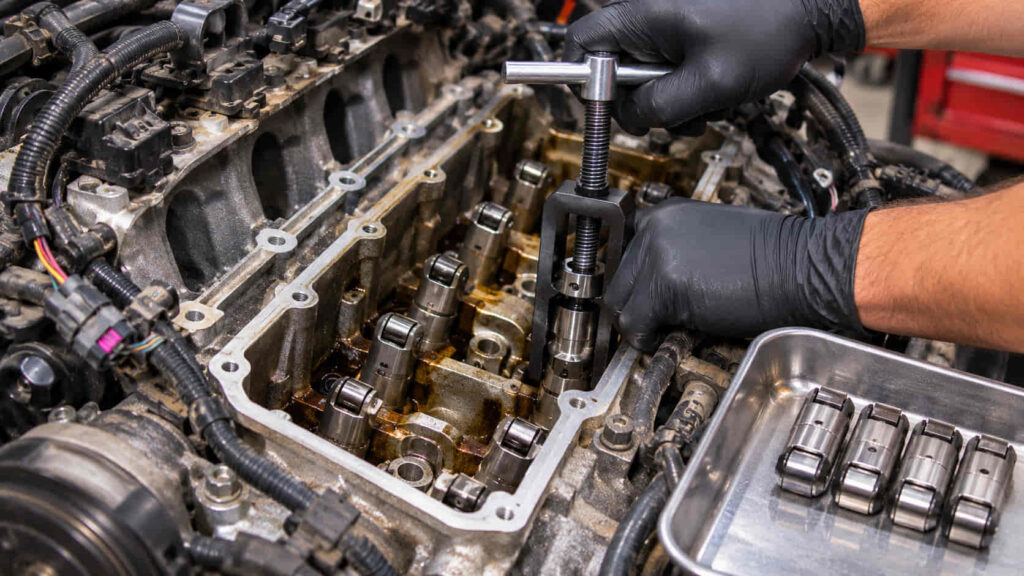
Replacing the lifters in a Chevy 5.3L V8 without removing the cylinder heads is generally not possible using the standard GM-approved repair procedure. Although certain inspection methods, valvetrain adjustments, and limited troubleshooting techniques can be performed with the cylinder heads installed, replacing a damaged lifter and its guide normally requires cylinder head removal.
This applies to popular General Motors 5.3-liter V8 engines, including many LS-based engines and later EcoTec3 engines equipped with Active Fuel Management (AFM) or Dynamic Fuel Management (DFM).
The difficulty comes from the engine’s internal construction. GM pushrod V8 engines position their hydraulic roller lifters inside the engine block beneath the cylinder heads. Plastic lifter guides maintain the alignment of the lifters with the camshaft lobes.
General Motors Service Bulletin 15-06-01-002M specifically states that lifter guides must be replaced whenever the corresponding lifters are replaced. The bulletin also describes approved methods for extracting a lifter stuck in its bore, but those procedures require access to the exposed lifter assembly after disassembly.
Some owners attempt to release a collapsed AFM lifter through the pushrod opening without removing the cylinder head. Although this may occasionally produce a temporary change in engine operation, it does not replace a damaged lifter, inspect its roller, or restore its guide.
Furthermore, a collapsed lifter may be accompanied by camshaft wear, a bent pushrod, or damage to the lifter bore. These conditions require proper mechanical inspection.
For owners trying to reduce repair costs, the most important step is determining whether the ticking or misfire actually comes from a failed lifter. An exhaust leak, low oil level, faulty ignition component, or other valvetrain problem may produce similar symptoms without requiring complete lifter replacement.
This guide explains whether 5.3 lifter replacement without removing the head is possible, why GM requires cylinder head removal, which diagnostic procedures can be performed first, and how to approach an AFM or DFM lifter failure correctly.
Can You Replace 5.3 Lifters Without Removing the Heads?
A complete lifter replacement on a conventional GM 5.3L pushrod V8 normally requires removing the relevant cylinder head because the lifter guides and lifter assemblies cannot be properly serviced through the pushrod openings alone.
The GM 5.3L V8 uses a cam-in-block design.
The camshaft sits inside the engine block, and hydraulic roller lifters transfer its motion through pushrods to the rocker arms.
The lifters are positioned below the cylinder heads.
On these engines, the lifters are also retained and aligned by dedicated guide assemblies.
The lifter guides prevent the roller lifters from rotating incorrectly inside their bores.
Maintaining that alignment is essential because each lifter roller must contact its corresponding camshaft lobe in the intended orientation.
A lifter that rotates out of position can damage both the roller and camshaft.
Removing the intake manifold or valve covers does not provide complete access to the lifter guide assemblies.
Likewise, removing the pushrods does not create a service opening large enough to perform a normal lifter and guide replacement.
Some methods described online involve attempting to manipulate a stuck lifter through the pushrod passage.
However, this is fundamentally different from removing and replacing the lifter assembly.
The proper repair procedure requires enough access to remove the lifter, replace its guide, and inspect the related camshaft components.
Therefore, the cylinder head should be removed when a confirmed lifter failure requires mechanical replacement.
Why Do Chevy 5.3 Lifters Require Cylinder Head Removal?
The need for cylinder head removal comes from the physical position of the lifters and the design of the plastic lifter guides used in GM pushrod V8 engines.
Each lifter operates inside a machined bore in the engine block.
A pushrod extends upward from the lifter to a rocker arm mounted on the cylinder head.
The cylinder head overlaps the area where the lifter assemblies must be removed.
Although the pushrod itself can be withdrawn after releasing the rocker arm, the lifter remains inside the block.
The plastic guide assembly also surrounds and aligns the lifters.
This guide must be accessible for replacement.
GM’s 2023 service bulletin explicitly requires replacement of the lifter guides whenever a lifter is replaced.
The requirement is important because a worn or damaged guide may allow the replacement lifter to operate incorrectly.
A new lifter installed into a damaged guide may experience abnormal roller alignment.
The result can be additional camshaft wear or another lifter failure.
The cylinder head removal process creates access to the lifter and guide assemblies.
It also allows the technician to inspect the lifter bores and related components.
Without this access, it is difficult to confirm that the replacement parts have been installed correctly.
This explains why a seemingly small failed lifter can require substantial labor.
The expense comes primarily from the disassembly necessary to reach the component rather than from the lifter itself.
Which Chevy 5.3 Engines Have Lifter Problems?
Lifter problems can occur in several GM 5.3L V8 generations, but the failure mechanisms and replacement parts vary according to the engine’s design and cylinder deactivation system.
Older 5.3L LS-based engines use hydraulic roller lifters.
Some versions do not have cylinder deactivation.
Other versions introduced Active Fuel Management.
AFM uses specialized lifters on selected cylinders.
These lifters can change their operating state when the engine management system activates cylinder deactivation.
The 2014–2018 EcoTec3 L83 engine also uses AFM.
General Motors documented collapsed or stuck AFM lifters on certain affected vehicles.
Later 5.3L L84 engines introduced Dynamic Fuel Management.
DFM uses a more extensive cylinder deactivation strategy.
These engines use lifters designed for the newer operating system.
Although AFM and DFM lifters share certain design principles, the components are not universally interchangeable.
Melling’s technical bulletin on deactivation lifter JB-8011 specifically distinguishes replacement lifter compatibility between AFM and DFM applications.
This is important because a part that physically fits an older 5.3L engine may not have the correct internal operating characteristics for a newer DFM engine.
Before ordering replacement parts, the technician should identify the exact engine RPO code, production year, and original component arrangement.
The vehicle identification number can help determine the proper application.
What Are the Symptoms of a Bad 5.3 Lifter?
A failing Chevy 5.3 lifter may cause persistent ticking, engine misfires, rough idle, reduced power, and abnormal rocker arm movement.
One of the most recognizable symptoms is a repetitive ticking sound.
The noise may come from the upper engine area.
However, a ticking noise alone does not prove that a lifter has failed.
Exhaust manifold leakage can create a similar sound.
Fuel injector operation also produces normal mechanical clicking.
A collapsed lifter may cause more severe symptoms.
If the lifter cannot transfer the proper camshaft motion to the pushrod, the corresponding valve may not open as intended.
This can affect cylinder breathing and combustion.
The engine may develop a misfire.
GM’s service bulletin identifies diagnostic trouble code P0300 as a possible finding.
A cylinder-specific misfire code may also appear during diagnosis.
The technician may discover that one rocker arm is not moving normally.
A bent pushrod can provide another clue.
However, these findings should be interpreted together.
A defective ignition coil, damaged spark plug, or fuel injector problem can also create a misfire.
The correct diagnosis should establish whether the valve train is operating abnormally before the cylinder head is removed.
Can a Collapsed AFM Lifter Be Fixed Without Removing the Head?
Some owners attempt to release a collapsed AFM lifter without removing the cylinder head, but this should not be confused with a manufacturer-approved lifter replacement or a dependable permanent repair.
An AFM lifter contains internal locking mechanisms that allow it to operate in different states.
When the mechanism becomes stuck, the lifter may remain collapsed.
The affected valve may then stop opening normally.
Some informal repair methods attempt to free the mechanism by applying a mechanical impact through the pushrod opening.
However, this approach has significant limitations.
A lifter may collapse because of broken internal components.
It may also have damaged locking pins or other mechanical defects.
An impact cannot reliably restore fractured or worn internal parts.
There is also a risk of damaging the lifter cup, pushrod seat, or surrounding components.
A sudden release may not mean the underlying problem has been corrected.
The lifter may collapse again after the engine returns to operation.
More importantly, the camshaft and lifter roller remain difficult to inspect properly while the assembly is installed.
If the roller has been damaged, continued operation can destroy the camshaft lobe.
For these reasons, a confirmed mechanically failed lifter should be replaced through the appropriate service procedure.
Attempting to avoid cylinder head removal can increase the final repair expense if the engine sustains additional damage.
Does GM Approve the Lifter Unsticking Method?
GM documents approved methods for removing a lifter stuck in its bore, but those methods should not be confused with attempting to repair a collapsed lifter through the pushrod hole while the cylinder head remains installed.
General Motors Service Bulletin 15-06-01-002M addresses misfire and ticking complaints involving certain engines with AFM.
The bulletin identifies several possible causes.
These include a mechanically collapsed lifter, damaged internal locking pins, a lifter stuck in its bore, and a bent pushrod.
When a lifter becomes stuck in the bore during removal, GM describes two approved extraction techniques.
One uses locking pliers with a slide hammer.
The other uses locking pliers with a small pry bar.
However, the accompanying illustrations show the lifter exposed after the necessary engine disassembly.
GM also warns technicians not to pry against the block’s sealing surface.
Damage to that surface could create serious problems during cylinder head reinstallation.
These procedures are intended to extract a lifter that cannot be removed normally.
They are not instructions for repairing a damaged internal locking mechanism while the cylinder head remains in place.
The bulletin further states that lifter guides must be replaced whenever lifters are replaced.
Therefore, the documented GM procedure supports proper mechanical replacement rather than an improvised heads-on repair.
Can You Remove a 5.3 Camshaft Without Removing the Heads?
On certain GM LS-based 5.3L engines, a camshaft can be removed with the cylinder heads installed if the existing lifters are safely retained above the camshaft during removal.
This procedure is often confused with replacing lifters.
The two operations are different.
During a camshaft replacement, the existing lifters may sometimes remain installed.
Technicians may use the friction provided by the lifter trays to temporarily hold the lifters away from the camshaft.
Specialized retaining tools can also be used in some applications.
However, the procedure must be performed carefully.
If a lifter falls into the lower engine area, additional disassembly may be necessary to retrieve it.
The engine may also require front-cover and timing-system disassembly to remove the camshaft.
Speedway Motors documents a heads-on LS camshaft replacement procedure using retaining dowels.
However, the guide specifically explains that an AFM delete involving lifter replacement requires cylinder head removal.
The distinction is straightforward.
A camshaft may be removable while the lifters remain inside the engine.
Replacing lifters requires access to the lifter assemblies and their guides.
Therefore, a successful heads-on camshaft replacement does not establish that a complete lifter replacement can be performed using the same procedure.
What Is the Difference Between a Cam Swap and Lifter Replacement?
A cam swap changes the camshaft, while lifter replacement involves removing and installing the hydraulic roller lifters that contact its lobes.
The camshaft controls when the engine’s valves open and close.
Its lobes push against the lifters.
The lifters transfer motion through the pushrods to the rocker arms.
During certain performance camshaft installations, the existing lifters can remain inside the engine if they are undamaged and safely retained.
However, this approach is not suitable when the lifters themselves need replacement.
A collapsed or damaged lifter must be removed from its bore.
Its guide must also be serviced according to the applicable GM instructions.
Cylinder head removal is therefore normally required.
Another distinction involves camshaft damage.
If a lifter roller has failed and damaged the camshaft lobe, installing a new camshaft without correcting the lifter failure would be inappropriate.
Likewise, replacing the lifter while leaving a severely worn camshaft in service can produce another failure.
GM’s bulletin instructs technicians to inspect the lifters and camshaft for excessive wear.
When damage is found, both affected components may require replacement.
The correct repair depends on the actual condition of the complete valvetrain.
How Do You Diagnose a 5.3 Lifter Without Removing the Head?
A Chevy 5.3 lifter problem can often be investigated without removing the cylinder head by checking diagnostic trouble codes, engine oil condition, ignition operation, compression, and rocker arm movement.
The diagnosis should begin with the symptoms.
A persistent ticking sound may indicate a valvetrain problem, but its location and operating pattern matter.
An exhaust leak can become quieter as components warm and expand.
A lifter problem may continue producing noise after the engine reaches normal temperature.
However, sound alone is not definitive.
The engine should be scanned for diagnostic codes.
A misfire code can identify the cylinder or operating conditions associated with the problem.
Ignition and fuel delivery faults should be considered.
The oil level and condition should also be checked.
Certain hydraulic lifter problems are influenced by lubrication.
If the evidence points toward the valve train, the valve cover can be removed for inspection.
The technician can then examine rocker arm operation using a safe, engine-specific procedure.
An affected rocker arm that does not move through its expected range may indicate a collapsed lifter, bent pushrod, damaged camshaft, or another mechanical problem.
However, the exact cause may still require disassembly.
The objective is to confirm a mechanical valvetrain problem before committing to an expensive cylinder head removal.
Can a Bad Pushrod Cause the Same Symptoms as a Failed Lifter?
Yes. A bent or damaged pushrod can produce abnormal valve movement, engine ticking, and misfire symptoms similar to those associated with a collapsed lifter.
The pushrod connects the lifter to the rocker arm.
If it bends, the motion transferred from the camshaft may be reduced or distorted.
The corresponding valve may not open properly.
This can affect combustion and engine performance.
However, a bent pushrod may be a consequence of an underlying lifter failure.
GM’s service bulletins identify bent pushrods among the findings associated with certain collapsed lifter conditions.
Therefore, replacing a bent pushrod without investigating its cause may result in another failure.
A technician can inspect the pushrod after removing the appropriate rocker arm components.
The rod should be checked for straightness and damage.
However, discovering a bent pushrod does not establish that the lifter itself remains healthy.
The lifter may have collapsed internally or become stuck.
The camshaft must also be considered.
If the lifter roller has damaged a camshaft lobe, replacing only the pushrod will not restore normal engine operation.
The correct diagnosis should identify the complete chain of mechanical problems.
This avoids unnecessary replacement while reducing the risk of repeated failure.
How Does AFM Cause 5.3 Lifter Failure?
Active Fuel Management introduces specialized deactivation lifters that contain internal locking mechanisms, creating additional potential failure points compared with conventional hydraulic roller lifters.
AFM allows the engine to deactivate selected cylinders during certain operating conditions.
The system is designed to reduce fuel consumption when full engine power is unnecessary.
On the relevant GM 5.3L engines, oil pressure is used to control special lifters.
These lifters can temporarily prevent normal valve operation on selected cylinders.
However, their internal locking mechanisms must operate correctly.
If a locking pin becomes damaged or stuck, the lifter may remain in an unintended position.
GM documents mechanically collapsed AFM lifters as a possible cause of ticking and misfire complaints.
Oil aeration is another condition identified in the manufacturer’s service information.
The lifter can also become stuck inside its bore.
However, not all 5.3L lifter failures involve the AFM mechanism.
Conventional lifters can experience roller wear, lubrication problems, or mechanical damage.
The correct repair therefore requires identifying the actual failed component.
Disabling the AFM system electronically does not repair a lifter that has already been physically damaged.
The internal components remain installed even when cylinder deactivation is disabled.
A mechanical failure requires an appropriate mechanical repair.
Read more: Best Years for 6.7 Powerstroke
Is DFM Lifter Replacement Different From AFM?
Dynamic Fuel Management uses a different deactivation strategy from traditional AFM, and replacement lifters must be compatible with the specific DFM engine.
GM introduced DFM in newer 5.3L and 6.2L V8 applications.
The 5.3L L84 engine is one of the most recognizable examples.
Traditional AFM deactivates a defined group of cylinders under appropriate conditions.
DFM supports more flexible cylinder deactivation patterns.
This requires lifters capable of operating under the newer control strategy.
The internal switching characteristics of the lifters are therefore important.
Melling’s technical bulletin identifies JB-8011 as a deactivation lifter compatible with specified GM AFM and DFM applications.
It also states that the older JB-7011 AFM-only lifter must not be used in newer DFM engines.
Although the two components can appear similar externally, their internal operating characteristics differ.
This demonstrates why physical appearance alone is insufficient for selecting replacement parts.
DFM engines also have their own diagnostic and service information.
GM TechLink documented collapsed lifter concerns involving certain 2020–2021 Silverado, Sierra, Tahoe, Suburban, Yukon, and Escalade applications equipped with the L84 or L87 engines.
However, the repair procedure and replacement scope depend on the applicable bulletin and vehicle information.
A DFM lifter repair should not automatically follow instructions intended for an older AFM engine.
Can You Replace Just One Bad 5.3 Lifter?
The appropriate replacement scope depends on the engine, failure mode, and applicable GM service information, rather than a universal rule requiring either one lifter or all sixteen.
For certain AFM-related misfire conditions, GM’s service instructions direct replacement of the affected bank of lifters and associated components.
The precise replacement scope should follow the vehicle’s service information.
Newer DFM engines can have different instructions.
GM TechLink’s guidance for certain 2020–2021 L84 and L87 engines identifies replacement of the damaged lifter’s guide and associated lifters.
Other GM service campaigns or defined production populations require replacement on both cylinder banks.
The difference matters.
Replacing every lifter increases parts and labor costs.
However, replacing too few components may leave known damaged or affected parts in service.
A technician should also evaluate the age and condition of the remaining lifters.
The camshaft must be inspected for abnormal wear.
If the roller or camshaft lobe has been damaged, additional components require replacement.
A repair estimate should explain why a particular number of lifters is recommended.
The explanation should be supported by the vehicle’s symptoms, inspection findings, and applicable manufacturer instructions.
The correct approach is neither automatically replacing one lifter nor automatically replacing the entire set without considering the evidence.
Do You Need New Lifter Guides When Replacing 5.3 Lifters?
Yes. GM Service Bulletin 15-06-01-002M explicitly requires replacement of the lifter guides whenever lifters are replaced in the covered applications.
The lifter guides perform an important mechanical function.
They prevent the roller lifters from rotating incorrectly inside their bores.
The camshaft is designed to contact the lifter roller in a specific orientation.
If a lifter rotates, its roller may no longer align correctly with the camshaft lobe.
This can cause rapid mechanical damage.
The guide is therefore not simply a plastic spacer.
It is a critical alignment component.
A worn or broken guide may contribute to abnormal lifter movement.
Replacing only the lifter while retaining a damaged guide can undermine the repair.
GM’s instruction is particularly relevant to attempts to replace lifters without removing the heads.
Even if someone could manipulate a lifter through a restricted opening, that would not provide the access required for normal guide replacement.
This is one reason the manufacturer-approved procedure requires substantial engine disassembly.
The replacement guide should match the exact engine application.
Different engine generations may use different guide designs and associated lifters.
Correct alignment must be verified during assembly.
Can a Failed Lifter Damage the Camshaft?
Yes. A failed hydraulic roller lifter can damage its corresponding camshaft lobe, particularly when the lifter roller stops operating correctly.
The roller is designed to follow the shape of the camshaft lobe.
As the camshaft rotates, the lifter rises and falls.
This movement is transferred through the pushrod and rocker arm to the valve.
If the roller becomes damaged or stops rotating properly, friction and abnormal contact can increase.
The camshaft lobe may develop scoring or severe wear.
Metal particles can then enter the engine oil.
This creates an additional contamination risk for bearings and other internal components.
GM’s service information specifically instructs technicians to inspect the camshaft and lifters.
If excessive wear is found on the roller or camshaft lobe, replacement of the damaged components is required.
However, not every collapsed AFM lifter causes catastrophic camshaft wear.
The actual failure mode matters.
A lifter with a malfunctioning locking mechanism may behave differently from one with a seized roller.
Therefore, a mechanic should not assume that the camshaft is damaged without inspection.
Likewise, a new lifter should not be installed onto an obviously damaged camshaft.
Correct diagnosis helps determine whether a head removal repair is sufficient or whether more extensive engine disassembly is necessary.
What Tools Are Needed for 5.3 Lifter Replacement?
A complete 5.3L lifter replacement requires ordinary engine service tools along with equipment for accurate timing, fastener tightening, component inspection, and safe access to the cylinder heads.
The exact tools depend on engine generation and vehicle layout.
Common requirements include appropriately sized sockets, torque wrenches, fastener removal equipment, and tools for handling the intake and valvetrain components.
Some engines use direct injection.
Those applications can require additional precautions and tools for the high-pressure fuel system.
The fuel system must be depressurized according to GM’s service procedure before relevant connections are opened.
The cylinder heads must be removed using the prescribed method.
The required gaskets and fasteners should be available before reassembly.
Many GM cylinder head fasteners are torque-to-yield designs that require replacement after removal.
However, the exact requirement depends on the engine and hardware.
A technician may need specialized equipment if a lifter is stuck in its bore.
GM documents a slide hammer arrangement and a carefully controlled pry technique for particular exposed-lifter situations.
The correct tools for cleaning and inspecting sealing surfaces are also important.
A repair should not rely on uncontrolled impact methods or improvised components that could damage the lifter bore.
The appropriate service manual should determine the complete tool and fastener requirements.
How to Replace Chevy 5.3 Lifters Correctly
The correct procedure involves confirming the failure, gaining access to the affected cylinder head, removing the lifter and guide assemblies, inspecting the camshaft, and installing compatible replacement components.
The technician should begin by identifying the engine and reviewing the applicable GM service instructions.
The cooling and fuel systems must be handled safely.
The battery should be disconnected according to the service procedure.
Intake and related components are removed as necessary.
On certain engines, high-pressure fuel lines require special handling and replacement instructions.
The valve cover and rocker arm components are then accessed.
Pushrods must be identified and inspected.
The cylinder head is removed to expose the lifter assemblies.
The damaged lifter and guide are removed.
If a lifter is stuck, the technician should use the appropriate GM-approved extraction procedure for the exposed component.
The lifter bore should be inspected for damage.
The camshaft lobe and lifter roller must also be evaluated.
New compatible lifters and guides are then installed.
The engine is reassembled using the correct gaskets, seals, and fasteners.
Cylinder head bolt tightening requires the proper sequence and specifications.
The valvetrain must be assembled correctly.
Finally, the lubrication system is prepared according to the service information.
The engine is tested for abnormal noise, misfires, and fluid leakage after reassembly.
A successful repair requires correcting the underlying failure rather than merely restoring temporary valve movement.
How Much Does 5.3 Lifter Replacement Cost?
Professional Chevy 5.3 lifter replacement often costs several thousand dollars because the repair requires substantial engine disassembly and may involve additional camshaft or valvetrain damage.
For 2026 budgeting, an affected-bank lifter repair may cost approximately $2,500–$4,500 at an independent repair facility in the United States.
However, the actual cost varies by engine generation, location, and repair scope.
A repair involving the full lifter set can cost more.
If the camshaft has been damaged, the total may increase to approximately $4,000–$7,500 or higher depending on the work required.
These are broad market estimates, not guaranteed quotations.
GM’s own service bulletin demonstrates the labor involved.
For specified Silverado and Sierra applications, its warranty labor information identifies approximately 9.4 hours for left-bank lifter and oil manifold work and approximately 10.9 hours for right-bank work.
However, warranty labor times are not identical to customer-pay labor estimates.
The repair may also require new cylinder head gaskets, bolts, lifter guides, fluids, and additional components.
Direct-injection engine configurations may have further fuel system service requirements.
A shop should provide an itemized estimate.
The estimate should identify how many lifters will be replaced, whether the camshaft is damaged, and which associated components are included.
A low initial quotation can become much more expensive if significant internal wear is discovered after disassembly.
Is Replacing Lifters Without Removing the Heads Cheaper?
A heads-on procedure may appear cheaper because it avoids cylinder head removal, but an incomplete or unsuccessful repair can ultimately cost more than following the correct service procedure.
Cylinder head removal accounts for a substantial part of the labor expense.
It may also require new gaskets and fasteners.
This creates an incentive to search for alternative methods.
However, the price difference must be considered alongside the repair’s reliability.
If a collapsed lifter is merely released temporarily, its internal locking mechanism may remain damaged.
The lifter may fail again after the vehicle returns to service.
If the roller has already developed wear, further engine operation can damage the camshaft.
An improvised tool can also damage the lifter cup or pushrod seating area.
The resulting repair may become more extensive.
By comparison, proper disassembly allows the mechanic to inspect the lifter, guide, bore, and related camshaft surfaces.
This is especially important on AFM and DFM engines because the internal deactivation mechanism can fail mechanically.
A cost-saving technique is only beneficial if it restores the component to a dependable condition.
For a confirmed failed lifter, the correct repair usually remains cylinder head removal and replacement of the affected components.
Can Oil Additives Fix a Collapsed 5.3 Lifter?
An oil additive cannot reliably repair a physically broken, collapsed, or internally damaged AFM or DFM lifter.
Hydraulic lifters depend on clean engine oil.
Certain ticking noises can be related to lubrication conditions.
A low oil level, contaminated oil, or an incorrect lubricant may affect valvetrain operation.
Correcting these conditions can sometimes improve noise when no mechanical component has failed.
However, a physically damaged lifter is different.
Broken locking pins, failed internal mechanisms, damaged rollers, and worn camshaft lobes require mechanical repair.
An additive cannot restore a fractured component.
It also cannot replace a worn lifter guide.
Some products are marketed as remedies for lifter ticking or sticking.
However, these claims should not be treated as proof that a collapsed AFM or DFM lifter can be repaired chemically.
GM’s documented repair procedures focus on diagnosis and replacement of failed components.
The manufacturer also identifies camshaft inspection as an important part of the process.
Owners should first verify that the correct oil type and level are being used.
If the engine continues to misfire or the valve train is not moving normally, mechanical diagnosis is necessary.
Continuing to operate the engine while hoping an additive will correct a confirmed failure can increase the risk of additional damage.
Can an AFM Disabler Fix a Bad Lifter?
An electronic AFM disabler does not repair an already damaged lifter because it changes the operation of cylinder deactivation rather than replacing the lifter’s internal mechanical components.
AFM disablers are marketed as devices that keep an engine operating on all cylinders under certain conditions.
However, a lifter that has already collapsed may remain mechanically defective.
Disabling cylinder deactivation does not restore a broken internal locking pin.
It also does not repair roller wear, camshaft damage, or a damaged guide.
The engine may continue to misfire even if AFM operation is disabled electronically.
Another important distinction concerns DFM systems.
Their control strategies differ from conventional AFM.
A device designed for one engine generation may not be compatible with another.
Owners should not assume that an electronic disabler intended for an older 5.3L will function correctly with the L84 DFM engine.
Warranty and emissions compliance considerations also apply to modifications of factory engine controls.
The appropriate response to a confirmed failed lifter is mechanical inspection and repair.
Preventing future cylinder deactivation commands and repairing an existing failed component are separate issues.
An electronic device should never be presented as a substitute for replacing a damaged lifter.
Is an AFM Delete Better Than Lifter Replacement?
An AFM delete is a more extensive mechanical modification than replacing failed AFM lifters with factory-style components.
A complete AFM delete generally replaces the specialized deactivation lifters with compatible conventional lifters.
It may also require a different camshaft, related valvetrain parts, and changes to the engine’s oil control components.
Some kits include replacement lifter guides, head bolts, and other required parts.
The correct configuration depends on the engine.
A mechanical delete also requires appropriate engine control calibration.
However, an AFM delete does not avoid cylinder head removal.
The lifters still need to be accessed and replaced.
Speedway Motors and other engine parts suppliers explicitly distinguish a heads-on camshaft swap from an AFM delete that involves replacing lifters.
An AFM delete also changes the factory engine configuration.
Such modifications can affect emissions compliance, inspections, warranty coverage, and fuel economy.
The legal requirements depend on the vehicle’s jurisdiction and intended use.
For a stock road vehicle, replacing failed components with the correct factory-compatible parts is generally the most straightforward compliant repair approach.
A performance engine project may have different objectives.
However, the mechanical work must still be performed correctly.
An AFM delete kit is not a shortcut for repairing a failed lifter without cylinder head removal.
What Happens if You Keep Driving With a Bad 5.3 Lifter?
Continuing to drive with a confirmed failed 5.3 lifter can increase the risk of camshaft damage, abnormal valve operation, and additional engine wear.
The severity depends on the type of failure.
A collapsed lifter may prevent a valve from opening correctly.
This can cause a misfire and reduced engine performance.
A misfire can also affect exhaust temperatures and catalytic converter operation.
If the lifter roller is damaged, continued camshaft rotation may create severe wear.
Metal debris may enter the lubrication system.
This can threaten other engine components.
A bent pushrod may also create additional mechanical problems.
However, not every ticking engine has a failed lifter.
An exhaust leak or normal injector noise may be mistaken for valvetrain damage.
The correct diagnosis should therefore be performed before recommending extensive repair.
If the vehicle has a persistent misfire, severe mechanical noise, or abnormal oil pressure, continued operation is not advisable.
The engine should be inspected as soon as practical.
A confirmed failed roller lifter deserves particularly urgent attention because additional camshaft damage may increase the repair scope.
Stopping operation early can reduce the likelihood of turning a localized lifter failure into a more expensive internal engine repair.
Does a 5.3 Lifter Failure Mean You Need a New Engine?
No. A failed lifter does not automatically mean the entire GM 5.3L engine must be replaced.
GM’s service bulletin specifically distinguishes lifter and camshaft damage from conditions requiring complete engine replacement.
If the damaged components can be removed and the remaining engine structure is serviceable, the appropriate repair may involve replacing the lifters, guides, and camshaft.
The actual repair depends on inspection findings.
A failed lifter roller may damage one camshaft lobe.
If the block and other internal components remain healthy, a localized valvetrain repair may still be appropriate.
However, severe contamination or additional damage can complicate the repair.
The lifter bore must be inspected.
A lifter that is stuck in the bore may require the approved extraction procedures described by GM.
If it cannot be removed using the specified methods, GM’s bulletin indicates that engine replacement may be necessary.
The extent of metal debris in the engine also matters.
The technician should evaluate the oiling system and related components.
An engine with severe bearing damage or other major internal wear may require rebuilding or replacement.
However, engine replacement should be supported by evidence of damage beyond the normal scope of a lifter repair.
How Can You Prevent Chevy 5.3 Lifter Problems?
The best maintenance strategy is to use the correct engine oil, maintain proper oil level, follow the specified service schedule, and investigate abnormal ticking or misfire symptoms promptly.
Hydraulic lifters depend on engine oil.
The correct viscosity and performance specification should therefore be used.
GM’s oil requirements vary between engine generations and model years.
An older LS-based 5.3L may use different lubricant guidance from a newer direct-injection EcoTec3 engine.
The owner’s manual should determine the correct oil.
The oil level should also be checked regularly.
Operating with insufficient oil can compromise lubrication.
Oil aeration is another concern because hydraulic lifters rely on consistent oil pressure and internal fluid control.
GM identifies oil aeration as a possible contributor to certain AFM lifter locking-pin problems.
However, normal maintenance cannot guarantee that a mechanically defective lifter will never fail.
Material defects and internal component damage can occur despite proper care.
The most practical protection is early diagnosis.
A persistent tick, misfire, or unusual rocker arm movement should not be ignored.
The vehicle should be inspected before a failed roller damages the camshaft.
Maintaining service records is also useful when requesting warranty or repair assistance.
The exact engine model and applicable GM service information should guide maintenance decisions.
Is 5.3 Lifter Replacement a DIY Job?
Replacing the lifters in a GM 5.3L V8 is a substantial repair that is generally better suited to an experienced mechanic with the correct service information and tools.
The job involves more than removing a valve cover.
Cylinder head removal is normally required.
The technician must also manage intake, exhaust, cooling, and other components.
Later direct-injection engines introduce additional fuel system precautions.
The replacement parts must match the exact engine.
AFM and DFM lifters are not universally interchangeable.
Cylinder head fasteners and gaskets must be installed correctly.
The engine also requires the specified tightening sequence and torque procedures.
Improper assembly can create fluid leakage or mechanical damage.
The lifter guides must be installed correctly to maintain roller alignment.
The camshaft and lifter bores must be inspected.
If internal wear is discovered, the repair can become more complicated.
A DIY owner should also consider how to handle a lifter stuck in its bore.
Improper prying can damage the block’s sealing surface.
A professional repair facility may have better access to specialized extraction and inspection equipment.
An experienced DIY mechanic can perform the work with the correct preparation.
However, the repair should not be approached as a simple one-hour lifter swap.
The engine’s mechanical condition should be confirmed before disassembly begins.
Final Verdict: Can You Replace 5.3 Lifters Without Removing the Heads?
A complete 5.3 lifter replacement without removing the cylinder heads is generally not supported by the standard GM service procedure. The lifters are located inside the engine block beneath the cylinder heads, and their plastic guides must be accessed and serviced during replacement.
Although some diagnostic procedures can be performed with the heads installed, replacing a failed lifter requires more extensive access.
GM Service Bulletin 15-06-01-002M explicitly states that lifter guides must be replaced when lifters are replaced.
The same bulletin describes approved methods for removing a lifter stuck in its bore after the lifter has been exposed during disassembly.
These procedures do not establish a factory-approved heads-on replacement technique.
The distinction between camshaft replacement and lifter replacement is also important.
Some LS-based engines allow a camshaft swap without cylinder head removal if the existing lifters remain safely retained.
However, an AFM or DFM lifter replacement requires access to the lifters and guides.
A collapsed lifter should also be evaluated for related damage.
Bent pushrods, worn rollers, damaged camshaft lobes, and lifter bore problems can change the repair requirements.
Not every ticking 5.3L V8 has a failed lifter.
Ignition faults, exhaust leaks, oil-related concerns, and other mechanical problems should be ruled out through proper diagnosis.
For a confirmed lifter failure, the repair may cost several thousand dollars, particularly if the camshaft is damaged.
However, replacing a lifter does not automatically require replacing the entire engine.
The most reliable approach is to diagnose the failure correctly, remove the necessary cylinder head, replace the appropriate lifters and guides, inspect the camshaft, and follow the exact GM service procedure for the engine.
Attempting to avoid cylinder head removal may appear to save labor, but it does not provide the access required for a complete manufacturer-compliant repair and can increase the risk of repeated failure or additional damage.