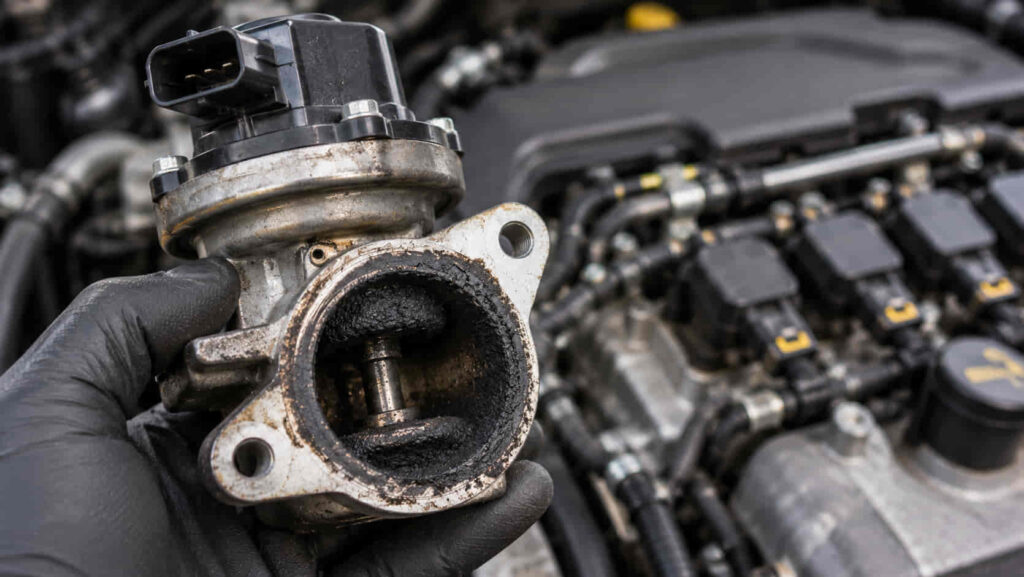
Yes, a bad EGR valve can cause an engine misfire, especially when the valve becomes stuck open or fails to close completely during idle. Excessive exhaust gas recirculation can disrupt the combustion process, producing rough idling, engine shaking, hesitation, stalling, and diagnostic trouble code P0300.
The exhaust gas recirculation (EGR) system is designed to reduce nitrogen oxide emissions by directing a controlled amount of exhaust gas back into the engine’s intake system. This changes combustion conditions and helps limit peak combustion temperatures.
However, EGR flow must be carefully controlled.
In many conventional gasoline engines, the EGR valve remains closed or allows very little flow during idle because the engine needs a stable supply of fresh air for consistent combustion.
When the valve becomes stuck open, too much exhaust gas can enter the intake manifold. This displaces part of the fresh intake charge and can make combustion unstable.
The result may be an intermittent or continuous engine misfire.
The connection between EGR failure and misfires is documented in manufacturer service information. Mazda Technical Service Bulletin 01-001/21 identifies rough idle and P0300 misfires caused by EGR valves that do not close properly in certain Mazda6 and CX-9 vehicles.
An earlier Mazda bulletin, 01-028/05, describes a similar problem on 2001–2003 Protegé models, where a sticking EGR valve causes rough idle and random misfires.
However, not every EGR malfunction causes the same symptoms.
A valve stuck closed generally reduces exhaust gas recirculation rather than introducing excessive exhaust gas. This can increase combustion temperatures and nitrogen oxide emissions, sometimes contributing to spark knock under load.
Misfires can also originate from worn spark plugs, failing ignition coils, fuel injector problems, intake leaks, or low engine compression.
Therefore, replacing the EGR valve without confirming the cause may not resolve the problem.
This guide explains how a bad EGR valve causes misfires, seven warning signs, related diagnostic trouble codes, testing procedures, repair costs, and the differences between gasoline and diesel engine EGR problems.
How Does an EGR Valve Work?
An EGR valve controls the amount of exhaust gas recirculated into the engine’s intake system to help reduce nitrogen oxide emissions.
During combustion, high temperatures encourage nitrogen and oxygen in the intake air to react and form nitrogen oxides.
These pollutants contribute to air quality problems.
The EGR system reduces their formation by introducing a controlled portion of exhaust gas into the incoming charge.
Because recirculated exhaust gas contains less available oxygen than fresh air, it changes the combustion process and helps limit peak temperatures.
However, the amount of EGR flow must match the engine’s operating conditions.
Under many conventional gasoline-engine operating strategies, EGR flow is restricted during idle and other conditions where stable combustion is especially important.
During suitable part-load operation, the engine management system may command additional EGR flow.
The valve can be vacuum-operated or electronically controlled, depending on the engine.
Modern systems may also use sensors to monitor valve position or exhaust flow.
However, not every gasoline engine uses a separate external EGR valve. Some engines achieve a related effect through internal valve-timing strategies.
The appropriate diagnosis therefore begins by confirming the actual engine’s EGR system design.
Why Can a Bad EGR Valve Cause a Misfire?
A bad EGR valve causes misfires primarily when excessive exhaust gas enters the intake system at a time when the engine cannot maintain stable combustion.
A gasoline engine requires the correct mixture of air and fuel, adequate compression, and a properly timed spark.
These conditions allow each cylinder to produce combustion pressure consistently.
However, exhaust gas is not equivalent to fresh intake air.
It contains combustion products that do not contribute oxygen in the same way.
When an EGR valve leaks or remains open during idle, excessive exhaust gas can dilute the fresh intake charge.
The mixture may become difficult to ignite or burn consistently.
Combustion can become slower or incomplete.
The engine then produces uneven power from one or more cylinders.
The engine control module detects these irregularities through its misfire monitoring system.
In many vehicles, the result is diagnostic trouble code P0300.
However, the severity depends on the amount of unwanted EGR flow.
A slightly leaking valve may create an occasional rough idle.
A severely stuck-open valve can cause repeated stalling or difficulty starting.
The same mechanical problem can therefore produce different symptoms depending on engine operating conditions.
1. Rough Idle and Engine Shaking
Rough idle is one of the strongest clues that an EGR valve may be stuck open, particularly when the engine runs more smoothly at higher speeds.
At idle, the engine operates with relatively small amounts of air and fuel.
A stable combustion process is important because the engine must maintain a low rotational speed without producing large amounts of torque.
When unwanted exhaust gas enters the intake system, the fresh charge becomes diluted.
Individual cylinders may begin producing inconsistent combustion pressure.
The engine can then shake or vibrate.
The driver may notice the steering wheel, seats, or dashboard vibrating more than usual.
Engine speed may also fluctuate.
However, these symptoms are not specific to EGR problems.
Worn spark plugs, damaged ignition coils, vacuum leaks, and fuel injection faults can also cause rough idle.
The operating pattern is useful.
An engine that runs poorly at idle but becomes smoother after acceleration may have an EGR valve that is leaking when it should be closed.
However, the actual fault should be confirmed through diagnostic testing.
2. Random or Multiple-Cylinder Misfires
A stuck-open EGR valve can cause random or multiple-cylinder misfires, frequently resulting in diagnostic trouble code P0300.
Unlike a failing ignition coil that may affect one cylinder, excessive exhaust recirculation can disturb combustion across several cylinders.
This occurs because the EGR system introduces exhaust gas into the intake arrangement used by multiple cylinders.
When the flow becomes excessive, combustion quality can deteriorate throughout the engine.
However, the distribution of exhaust gas is not always uniform.
Intake manifold design can cause some cylinders to receive a greater share of the unwanted exhaust flow.
Consequently, a defective EGR valve may produce more pronounced symptoms in particular cylinders.
This means a cylinder-specific misfire does not completely rule out an EGR problem.
Nevertheless, individual cylinder misfires are often more directly associated with spark plugs, ignition coils, fuel injectors, or mechanical compression problems.
The technician should therefore examine misfire counters and operating conditions.
P0300 becomes more meaningful when accompanied by evidence that the EGR valve is not closing properly.
3. Engine Stalling at Idle or When Stopping
A severely stuck-open EGR valve can cause the engine to stall, especially when the vehicle slows down or stops at a traffic light.
During deceleration, engine speed decreases toward idle.
The engine management system must maintain combustion while the available airflow and fuel delivery change.
However, an EGR valve that remains open can introduce more exhaust gas than the engine can tolerate.
Combustion becomes unstable.
Engine speed may drop sharply.
The vehicle may then stall.
An earlier Mazda technical bulletin describes this exact operating pattern on affected Protegé vehicles.
The bulletin identifies an EGR valve that can become stuck open because moisture causes corrosion on the valve shaft.
The resulting unwanted exhaust flow produces rough idle and random misfires.
However, stalling has many possible causes.
An electronic throttle problem, fuel pressure fault, or major intake leak can produce similar behavior.
A vehicle that stalls repeatedly should be diagnosed promptly because unexpected engine shutdown can create a driving hazard.
4. Hesitation During Acceleration
A malfunctioning EGR valve can cause hesitation or stumbling when the driver begins accelerating, particularly if exhaust flow remains excessive during the transition from idle.
When the accelerator is pressed, the engine needs to increase torque.
Fuel delivery and airflow must respond to the new operating demand.
However, excessive EGR flow can interfere with stable combustion.
The driver may feel a brief delay, stumble, or loss of responsiveness.
The symptom can be more noticeable during initial throttle application.
However, acceleration hesitation is not unique to EGR problems.
A restricted fuel filter, weak fuel pump, faulty mass airflow sensor, or ignition fault may also cause the engine to hesitate.
Turbocharged engines introduce additional possibilities involving boost control and charge-air leakage.
Therefore, an EGR valve should not be replaced solely because the vehicle hesitates.
The diagnostic process should determine whether EGR flow is actually outside the commanded range.
5. Check Engine Light With P0300 or EGR Codes
A defective EGR valve can illuminate the check engine light and may be associated with P0300, P0401, P0402, P0403, or P0404, depending on the specific malfunction and diagnostic strategy.
However, these codes describe different conditions.
P0300 indicates random or multiple-cylinder misfires.
P0401 identifies insufficient EGR flow.
P0402 identifies excessive EGR flow.
P0403 indicates an EGR control circuit problem.
P0404 describes an EGR control range or performance problem.
The distinction is important.
P0402 may support a diagnosis involving excessive EGR flow or a valve that fails to close properly.
However, P0401 can sometimes occur with a sticking EGR valve under certain manufacturer-specific diagnostic strategies.
The Mazda Protegé service bulletin provides an example in which a sticking-open valve can be associated with P0300 or P0401.
Therefore, diagnostic trouble codes must be interpreted using the relevant service information.
A code identifies a detected condition rather than proving one particular component has failed.
6. Hard Starting or Extended Cranking
An EGR valve that remains open can contribute to difficult starting because excessive exhaust gas in the intake system can interfere with stable combustion during cranking.
Starting requires the engine to develop consistent combustion across the cylinders.
However, an EGR valve that does not close properly can alter the intake charge.
The engine may crank longer than normal.
It may start and then immediately stall.
In some cases, the engine starts but runs roughly for several seconds.
However, this symptom has many possible explanations.
A weak battery can reduce cranking speed.
A fuel pressure problem can delay fuel delivery.
A damaged crankshaft or camshaft position sensor can interfere with ignition and injection timing.
Therefore, hard starting should be investigated systematically.
The technician should evaluate battery condition, fuel delivery, ignition operation, and stored diagnostic codes.
An EGR fault becomes more likely when testing confirms that the valve is allowing unwanted flow during starting or idle.
Read more: 3.0 Duramax Problems
7. Reduced Engine Power and Poor Fuel Economy
A bad EGR valve can reduce engine performance and contribute to increased fuel consumption, although the actual effect varies with the fault and engine operating conditions.
Excessive EGR flow can reduce combustion stability.
The engine may produce less useful torque.
The driver may compensate by pressing the accelerator farther.
However, reduced fuel economy does not automatically indicate a bad EGR valve.
Tire pressure, driving conditions, vehicle load, ignition quality, and fuel system condition also influence fuel consumption.
A valve that remains closed can cause a different problem.
The engine may experience higher combustion temperatures and increased nitrogen oxide formation.
In certain gasoline engines, this can contribute to spark knock under load.
Modern engine controls may respond to abnormal conditions by adjusting operation or limiting power.
Therefore, poor performance must be interpreted alongside diagnostic data.
The correct repair depends on whether the system has excessive flow, insufficient flow, or an electrical control problem.
Can an EGR Valve Stuck Open Cause a Misfire?
Yes. An EGR valve stuck open is one of the clearest EGR-related causes of misfire because it can introduce excessive exhaust gas when the engine requires a stable fresh-air charge.
The condition is especially noticeable at idle.
Many conventional gasoline EGR systems command little or no recirculation under these conditions.
A valve that remains partially open can therefore cause an immediate change in combustion quality.
Carbon deposits are one possible cause.
Deposits may accumulate around the valve seat and prevent the valve from sealing.
Corrosion can also affect the valve’s movement.
Electronic actuator problems may interfere with proper control.
In some engines, a valve-position learning problem can create an incorrect closing condition.
Mazda bulletin 01-001/21 specifically documents carbon deposits preventing the valve from closing and an incorrect learned closed position contributing to idle misfires.
The manufacturer provides a combination of mechanical inspection and software-related service procedures for affected vehicles.
Therefore, the correct repair may involve more than simply replacing the valve.
Can an EGR Valve Stuck Closed Cause a Misfire?
An EGR valve stuck closed is less likely to cause the classic EGR-related idle misfire than a valve stuck open.
When the valve remains closed, exhaust gas does not enter the intake system as intended.
This generally results in insufficient EGR flow.
The engine may store P0401.
In gasoline engines, a lack of EGR can increase combustion temperatures under operating conditions where recirculation is normally required.
This can increase nitrogen oxide emissions.
It may also contribute to detonation or spark knock under load.
However, spark knock and engine misfire are different conditions.
Spark knock involves abnormal combustion pressure behavior.
A misfire occurs when a cylinder fails to produce its expected combustion event.
A stuck-closed EGR valve may affect engine operation in some applications.
However, it is not the typical explanation for severe idle shaking caused by excessive exhaust dilution.
The correct diagnosis should distinguish insufficient-flow problems from a valve that leaks when commanded closed.
Can a Bad EGR Valve Cause P0300?
Yes. P0300 can be triggered by a bad EGR valve when excessive exhaust recirculation creates irregular combustion across multiple cylinders.
P0300 means random or multiple-cylinder misfire detected.
It does not identify the exact failed part.
The engine control module usually recognizes misfires by analyzing variations in crankshaft rotational speed.
When combustion becomes inconsistent, the crankshaft does not accelerate as expected after a firing event.
The module may then identify a misfire.
A stuck-open EGR valve is one possible cause.
However, many other conditions can produce P0300.
These include ignition problems, incorrect fuel delivery, intake leaks, and low compression.
Ross-Tech’s Volkswagen and Audi diagnostic information specifically lists a stuck-open EGR valve among possible causes of random misfires.
Ford service information also identifies stuck-open EGR valves and restricted EGR passages as potential P0300 causes in certain applications.
Therefore, EGR should be included in the diagnostic process when the symptoms support it.
However, a P0300 code alone is not a sufficient reason to replace the valve.
What Does P0401 Mean With a Misfire?
P0401 indicates that the engine control system has detected insufficient exhaust gas recirculation flow under the conditions being monitored.
Common causes include restricted EGR passages, a valve that fails to open properly, or incorrect sensor information.
However, the code must be interpreted according to the manufacturer’s diagnostic strategy.
The presence of P0401 does not guarantee that the EGR valve is stuck closed.
Mazda’s earlier Protegé bulletin identifies situations where a sticking-open EGR valve can be associated with both P0300 and P0401.
This demonstrates why generic code descriptions can be misleading.
A vehicle may have one fault affecting more than one operating condition.
The technician should inspect EGR valve operation and the relevant flow-control system.
An EGR flow code accompanied by misfires should also prompt evaluation of the engine’s other possible combustion problems.
The correct repair should address the confirmed malfunction.
What Does P0402 Mean With a Misfire?
P0402 indicates excessive EGR flow and can strengthen suspicion of a valve that remains open or leaks exhaust gas when it should be closed.
However, the code does not automatically prove that the valve is mechanically damaged.
The engine computer may infer EGR flow using pressure, temperature, airflow, or position information.
A faulty sensor can therefore affect the diagnostic result.
Carbon deposits may prevent the valve from closing completely.
An electrical control problem may also cause incorrect operation.
The technician should compare the commanded EGR behavior with the actual response using the appropriate diagnostic equipment.
In many vehicles, a bi-directional scan tool can help evaluate electronic EGR valve operation.
However, not every vehicle supports the same tests.
A P0402 code accompanied by rough idle and random misfires makes excessive EGR flow an important diagnostic possibility.
The valve and supporting components should be checked before replacement.
Can a Bad EGR Valve Cause a Single-Cylinder Misfire?
Yes, a bad EGR valve can contribute to a cylinder-specific misfire in certain engines, although a single-cylinder misfire more often directs diagnosis toward ignition, fuel injection, or mechanical problems affecting that cylinder.
The distribution of EGR gas depends on intake manifold design.
Some manifolds distribute recirculated gas more evenly than others.
If excessive flow reaches one intake runner more strongly, combustion quality may deteriorate in that cylinder.
However, this is not the most common explanation for every P0301, P0302, or similar diagnostic code.
A worn spark plug may affect only one cylinder.
A damaged ignition coil can also produce an isolated misfire.
A leaking or restricted fuel injector is another possibility.
Low compression may indicate a mechanical concern.
Therefore, the technician should examine the affected cylinder first.
If the usual ignition and fuel checks do not identify the problem, EGR flow distribution may deserve further investigation.
The diagnosis should follow the specific engine’s service information.
Can a Bad EGR Valve Cause a Misfire Without a Check Engine Light?
Yes. An EGR-related misfire can occur before the engine computer stores a confirmed diagnostic trouble code or illuminates the check engine light.
The onboard diagnostic system monitors misfire activity using defined thresholds.
A brief or intermittent combustion problem may not always satisfy the conditions needed to illuminate the warning light.
The symptom may occur only when the engine is cold.
It may also appear at idle after a particular driving pattern.
If the EGR valve occasionally sticks, the engine may run normally during other operating conditions.
A technician may therefore need to examine pending codes, stored history, live data, and misfire counters.
However, the absence of a check engine light should not be treated as proof that the EGR system is healthy.
Likewise, a rough idle without a warning light does not establish that EGR is responsible.
Other mechanical and electrical faults remain possible.
The appropriate diagnosis should reproduce the condition and evaluate the relevant systems.
Can a Bad EGR Valve Cause a Diesel Engine to Misfire?
Yes. A malfunctioning EGR valve can cause rough running, uneven combustion, or misfire-like symptoms in diesel engines, particularly when excessive exhaust gas enters the intake system.
However, diesel combustion differs from gasoline combustion.
Diesel engines rely on compression ignition rather than spark plugs.
Their misfire monitoring strategies can also differ.
A diesel engine with excessive EGR flow may produce rough idle, hesitation, low power, or abnormal smoke.
The exact symptoms depend on the engine’s management system.
Diesel EGR valves are especially exposed to soot.
Oil vapor from the crankcase ventilation system can combine with soot to form deposits.
These deposits may restrict movement or prevent the valve from closing.
Motorservice, the company associated with Pierburg engine-management components, identifies carbon contamination as a common cause of EGR malfunction.
However, diesel rough running can also involve fuel injectors, fuel pressure, compression, or turbocharger problems.
The correct diagnosis should evaluate those systems before attributing the condition to EGR.
Why Does a Bad EGR Valve Cause Misfires at Idle but Not While Driving?
An EGR valve that leaks at idle may cause severe rough running while producing less noticeable symptoms during certain driving conditions because the engine’s airflow and EGR requirements change with load.
At idle, a relatively small amount of fresh air enters the engine.
Excessive exhaust recirculation can therefore represent a substantial portion of the intake charge.
Combustion becomes unstable.
During part-load driving, the engine may intentionally permit some EGR flow.
The same amount of unintended leakage can then represent a smaller disturbance relative to total airflow.
However, this depends on the engine’s control strategy.
The symptom may become less noticeable as engine speed increases.
That does not mean the valve has repaired itself.
The engine may still have excessive or poorly controlled EGR flow.
If the valve remains severely stuck open, performance problems may continue under acceleration or cruise conditions.
The correct diagnosis should examine symptoms at idle, during throttle transitions, and under suitable driving conditions.
Can a Bad EGR Valve Cause a Cold-Start Misfire?
A bad EGR valve can contribute to cold-start misfires when it allows unwanted exhaust gas into the intake system during conditions where stable combustion is especially important.
However, cold-start misfires have many possible causes.
Fuel mixture preparation differs when the engine is cold.
Ignition components may also perform differently under low-temperature conditions.
A worn spark plug or weak ignition coil may produce a misfire that becomes less noticeable after the engine warms.
Fuel injectors can also cause rough starting.
Mechanical compression problems sometimes become more apparent at low temperatures.
Therefore, a cold-start misfire should not automatically be attributed to the EGR valve.
An EGR problem becomes more plausible when testing confirms that the valve is leaking or failing to close during the affected operating condition.
The technician should also check for manufacturer service bulletins.
Certain engines have known EGR control or calibration problems that require application-specific repairs.
How to Diagnose an EGR Valve Misfire
The correct diagnosis begins by confirming the misfire, identifying the operating conditions, and testing whether the EGR valve is allowing the intended amount of exhaust gas to flow.
The first step is reading stored and pending diagnostic trouble codes.
Misfire codes such as P0300 and P0301–P0308 should be recorded along with freeze-frame information.
This helps identify when the problem occurred.
The technician should then evaluate whether the symptoms are strongest at idle, during acceleration, or under load.
A rough idle that improves at higher engine speeds may support an EGR-related hypothesis.
However, ignition, fuel delivery, and intake leaks must also be considered.
The next step is identifying the EGR system design.
Some vehicles use vacuum-operated valves.
Others use electronically controlled valves with position sensors.
The proper diagnostic test depends on that design.
A professional scan tool may allow the technician to compare commanded EGR operation with measured response.
The valve may also require physical inspection for carbon buildup or damage.
The final repair decision should follow the actual findings.
How to Test an Electronic EGR Valve
An electronic EGR valve should be tested using the manufacturer’s diagnostic procedure, which may involve reading position data, commanding valve movement, and evaluating the engine’s response.
The engine control module may report the requested EGR position.
Some systems also provide an actual position reading.
A disagreement between commanded and actual position can indicate a control or mechanical problem.
However, position data alone may not establish the actual gas flow.
A valve can move while its passages remain restricted.
A sensor may also provide incorrect information.
Therefore, the technician may need to evaluate airflow or pressure-related measurements.
Motorservice notes that many electronic EGR valves can be actuated using a suitable diagnostic tester.
Some replacement valves also require electronic adaptation.
Delphi identifies vehicle-specific EGR relearn procedures that allow the engine controller to establish the valve’s position limits.
Therefore, replacing an electronic valve does not always complete the repair.
The appropriate relearn or calibration procedure must also be performed when required.
How to Test a Vacuum-Operated EGR Valve
A vacuum-operated EGR valve may be evaluated using the manufacturer’s vacuum-control testing procedure and a suitable hand vacuum pump.
The exact test depends on the valve design.
Some older EGR systems use a diaphragm controlled by vacuum pressure.
Other components regulate when vacuum reaches the valve.
The control circuit may include vacuum hoses, switches, and solenoids.
A damaged hose can prevent the valve from responding correctly.
A leaking diaphragm may also affect operation.
However, a valve that is mechanically stuck can remain open or closed independently of normal vacuum control.
The technician should inspect the hoses and control components.
The valve’s mechanical response must also be evaluated.
However, an EGR valve should not be permanently disconnected or blocked as a repair.
The system is part of the vehicle’s emissions-control equipment.
The proper solution is to restore correct valve and control-system function.
How to Tell an EGR Misfire From a Bad Ignition Coil
An EGR-related misfire often affects idle quality or multiple cylinders, while a failing ignition coil frequently produces a more consistent cylinder-specific fault.
However, these patterns are not absolute.
A weak ignition coil may misfire mainly under acceleration.
An EGR valve may also affect a particular cylinder more than others.
Therefore, diagnosis should be based on testing rather than symptoms alone.
A cylinder-specific code can guide ignition inspection.
The spark plug should be evaluated for wear or contamination.
The ignition coil and related wiring may also require testing.
On suitable engines, a technician can use a controlled component-swap test to determine whether the misfire follows a particular coil.
If the misfire moves with the coil, the ignition component becomes the stronger suspect.
If several cylinders misfire primarily at idle, EGR flow and intake system conditions deserve attention.
However, low fuel pressure or an intake leak may produce similar symptoms.
The technician should compare all available evidence before replacing parts.
Can a Vacuum Leak Be Mistaken for an EGR Valve Problem?
Yes. Intake vacuum leaks and stuck-open EGR valves can produce similar rough idle and hesitation symptoms, although their underlying effects are not necessarily identical.
A conventional intake vacuum leak allows unwanted air to enter the engine.
This can alter the air-fuel mixture.
Depending on the fuel management system, the result may be a lean condition and misfire.
An EGR valve stuck open introduces excessive exhaust gas.
This dilutes the intake charge and interferes with combustion stability.
Both conditions can disturb idle.
However, their diagnostic patterns may differ.
Fuel-trim behavior can help identify some intake leaks.
EGR position and flow data may provide evidence of a recirculation problem.
The engine’s intake layout also matters.
A technician should inspect vacuum hoses, intake connections, PCV components, and other potential leak locations.
A repair should address the confirmed cause.
Replacing the EGR valve will not correct an unrelated intake manifold leak.
Can Cleaning an EGR Valve Stop a Misfire?
Cleaning an EGR valve can sometimes eliminate a misfire when carbon deposits are the confirmed reason the valve cannot close, but cleaning is not appropriate or effective for every EGR design or failure.
Carbon deposits can accumulate around the valve seat.
These deposits may prevent complete closure.
When excessive exhaust enters the intake system, the engine may run roughly.
Removing the obstruction can restore proper operation in certain applications.
Mazda’s 2021 bulletin provides an example in which technicians are instructed to inspect and clean carbon deposits that prevent the valve from closing.
However, the same bulletin requires replacement when the valve seat is damaged.
Motorservice provides a more cautious general recommendation, warning that cleaning defective EGR components may not solve the problem and can damage functioning components.
Therefore, the correct choice depends on the valve’s construction and manufacturer guidance.
A failed electric motor, damaged position sensor, or worn valve seat generally cannot be repaired simply by removing deposits.
The technician should also investigate why excessive contamination developed.
An oil-related intake problem or fuel system fault may cause deposits to return.
When Should You Replace a Bad EGR Valve?
An EGR valve should be replaced when testing confirms that the component is defective and cleaning, electrical repair, or an approved calibration update cannot restore proper operation.
Examples include a damaged valve seat, failed actuator, defective diaphragm, or mechanical damage that prevents correct movement.
However, the entire EGR valve is not always the failed component.
A broken electrical connector may create a circuit problem.
A damaged vacuum hose may prevent correct control.
A blocked passage may restrict EGR flow despite the valve itself working normally.
The manufacturer may also have issued an updated software calibration.
Therefore, replacement should follow a complete diagnosis.
When a new valve is installed, the correct gasket and mounting procedure must be used.
The related passages should be inspected.
The relevant fasteners must be tightened according to the manufacturer’s instructions.
Some electronically controlled EGR systems require a relearn procedure.
The engine should then be tested to confirm that idle quality has improved and diagnostic codes do not return.
How Much Does It Cost to Fix an EGR Valve Misfire?
The cost of fixing an EGR-related misfire depends on the vehicle, the actual failed component, and whether the repair involves cleaning, electrical work, software calibration, or valve replacement.
RepairPal’s September 2026 United States estimate places the average EGR valve replacement cost between approximately $489 and $632.
However, this is a general national estimate.
It does not represent the price for every vehicle.
The location of the EGR valve strongly affects labor requirements.
An accessible valve may be relatively straightforward to replace.
Another engine may require removal of surrounding components.
Diesel engines can also have more complex EGR cooling arrangements.
A failed EGR cooler is different from a defective EGR valve.
Its repair cost may be substantially higher.
Diagnostic testing should therefore precede any repair estimate.
An inexpensive sensor or electrical repair may solve a problem that initially appears to require a new valve.
Conversely, a damaged electronic EGR assembly may need complete replacement.
The best approach is to request an itemized diagnosis and model-specific quotation.
Can You Drive With a Bad EGR Valve Causing a Misfire?
Driving with an EGR-related misfire is not recommended, especially when the engine is shaking severely, stalling, losing power, or displaying a flashing check engine light.
A persistent misfire means the engine is not operating normally.
In gasoline engines, severe misfires can allow unburned fuel to reach the exhaust system.
This can overheat and damage the catalytic converter.
A flashing malfunction indicator light commonly warns of a potentially catalyst-damaging misfire.
The driver should reduce engine load and stop safely rather than continue normal operation.
A vehicle that stalls unexpectedly presents an additional safety concern.
Even a less severe EGR fault can affect drivability and emissions.
Therefore, it should be diagnosed promptly.
However, the appropriate response depends on the symptoms.
A vehicle with only a stored EGR flow code and no drivability complaint is different from one experiencing severe shaking or repeated stalling.
The owner’s manual should be followed for warning light behavior.
The important point is that a confirmed misfire should not be ignored.
Can a Bad EGR Valve Damage the Engine?
A malfunctioning EGR valve can contribute to conditions that may harm engine components if left unresolved, although not every EGR fault causes direct internal engine damage.
A stuck-open valve can cause rough running and misfires.
In gasoline engines, continued severe misfiring can increase the risk of catalytic converter damage.
An EGR valve stuck closed can produce different operating conditions.
Higher combustion temperatures may contribute to spark knock in certain gasoline engines.
However, the engine management system may compensate or set a diagnostic code.
The actual risk depends on the engine and fault severity.
Diesel engines have additional considerations.
A malfunctioning EGR system may affect intake contamination, exhaust emissions, and overall engine operation.
An EGR cooler leak can also introduce coolant-related problems.
However, this is a different fault from an ordinary valve stuck open.
The safest approach is to diagnose the actual condition before significant additional operation.
The EGR system should be restored to its intended function.
How to Prevent EGR Valve Problems and Misfires
Preventing avoidable EGR problems involves maintaining the engine’s combustion, air intake, lubrication, and fuel systems rather than treating the EGR valve as an isolated component.
Carbon deposits are a common cause of EGR malfunction.
However, excessive deposits can result from other problems.
Motorservice identifies oil contamination in the intake system as one possible contributor.
Crankcase ventilation faults can increase oil vapor entering the intake.
Turbocharger oil-control problems can have a similar effect.
Worn internal engine components may also increase blow-by.
In diesel engines, soot adds to the deposit problem.
Therefore, simply replacing a contaminated EGR valve may not prevent recurrence when another fault remains.
The engine should receive the correct oil and routine maintenance.
Fuel quality also matters.
Unusual oil consumption, excessive smoke, or intake contamination should be investigated.
However, EGR valves do not necessarily have a fixed replacement interval.
A functioning valve should not automatically be replaced at a particular mileage.
Service should follow the manufacturer’s maintenance schedule and actual diagnostic findings.
Should You Delete the EGR Valve to Prevent Misfires?
Removing or disabling a factory EGR system is not an appropriate repair for a misfire, and emissions tampering is prohibited for road vehicles under United States federal law.
The EGR system is installed to control emissions.
When the valve malfunctions, the correct solution is to restore its operation.
Removing the valve can change combustion temperatures and engine-management behavior.
It can also cause new diagnostic problems.
In the United States, the Environmental Protection Agency identifies EGR systems among the emissions-control equipment protected under the Clean Air Act.
The agency explains that defeating or removing such components can constitute unlawful tampering.
Requirements in other countries depend on local regulations.
However, a malfunctioning emissions system should be repaired using compatible replacement components and approved procedures.
An EGR delete also does not correct unrelated ignition, fuel injector, or compression problems.
The most reliable repair is the one that addresses the actual cause of the misfire.
Final Verdict: Can a Bad EGR Valve Cause a Misfire?
Yes, a bad EGR valve can cause a misfire, with a stuck-open or leaking valve being the most common EGR-related mechanism.
When the valve fails to close correctly, excessive exhaust gas enters the intake system.
This can dilute the fresh charge and disrupt combustion.
The engine may then experience rough idle, shaking, stalling, hesitation, or difficult starting.
A random or multiple-cylinder misfire code such as P0300 may also appear.
However, a misfire code does not automatically identify a defective EGR valve.
A P0402 code may indicate excessive EGR flow, while P0401 generally indicates insufficient flow.
The exact diagnostic behavior depends on the manufacturer and engine.
A valve stuck closed usually produces a different pattern, including reduced recirculation, increased nitrogen oxide emissions, or spark knock under certain conditions.
The strongest EGR-related misfire clue is often an engine that runs poorly at idle but becomes smoother when operating conditions change.
However, ignition faults, fuel injector problems, intake leaks, and mechanical compression issues must still be considered.
A scan tool and the correct service procedure can help determine whether the EGR valve is closing and responding properly.
Cleaning may restore operation when removable carbon deposits are the confirmed cause.
However, a damaged valve, failed actuator, or defective position sensor may require replacement.
Some vehicles also need a manufacturer-approved control-module update or EGR adaptation procedure.
The average EGR replacement cost in the United States is approximately $489–$632 according to RepairPal’s September 2026 estimate, but actual prices vary by vehicle and repair complexity.
For anyone asking whether a bad EGR valve can cause a misfire, the most important recommendation is to confirm unwanted EGR flow before replacing parts. Proper diagnosis can restore smooth engine operation while avoiding unnecessary repairs and preserving the vehicle’s emissions-control system.