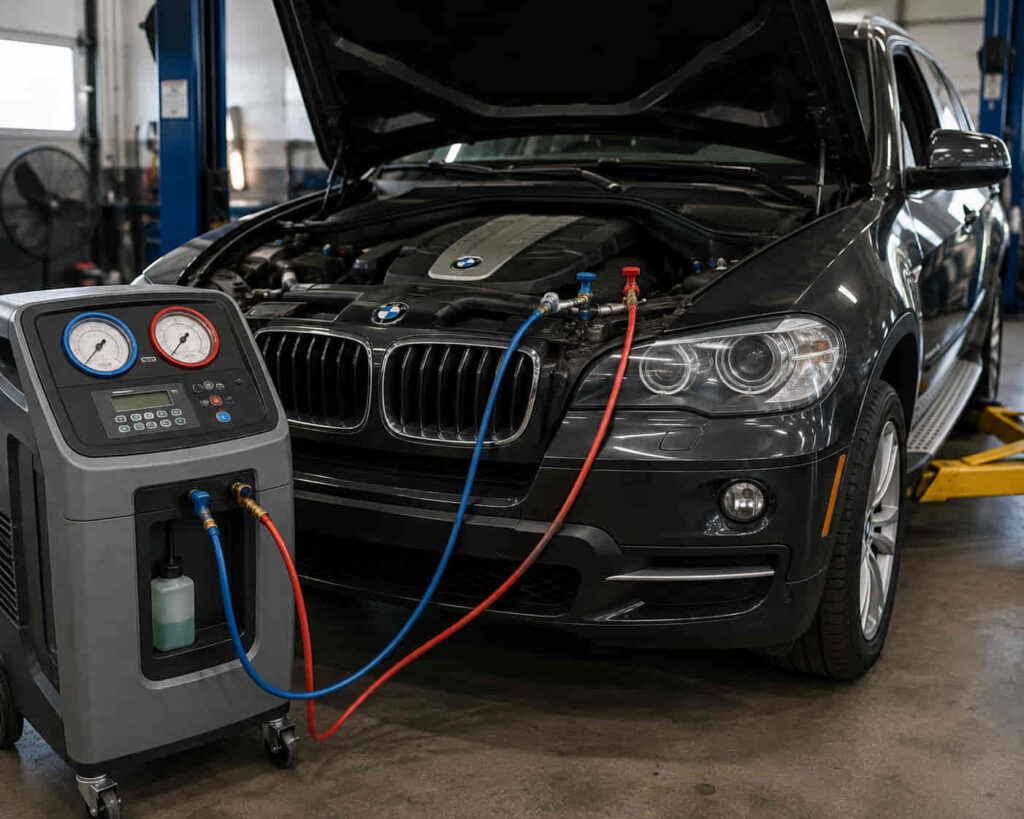
A BMW X5 AC recharge restores the correct refrigerant charge when the air-conditioning system contains an insufficient amount of refrigerant, but a recharge does not fix every problem that causes the AC to blow warm air. Refrigerant is essential to the heat-transfer process that allows the system to remove heat from the cabin. When the charge is incorrect, cooling performance can decline and the AC system may no longer operate as intended.
An AC recharge should also be distinguished from an AC repair. Adding the correct refrigerant addresses refrigerant quantity, while problems involving a leak, compressor, condenser, evaporator, airflow system, electrical component, or HVAC control can require separate diagnosis and repair. This distinction matters because repeatedly recharging a system that is losing refrigerant does not correct the underlying source of the loss.
BMW X5 AC recharge requirements also vary by model year and system specification, so refrigerant type and charge quantity should be verified for the specific vehicle rather than assumed across every X5 generation. The following seven sections explain how to recognize a potential recharge requirement, how often recharge is actually needed, which refrigerant specifications matter, what affects service cost, why refrigerant can be lost, what happens during professional AC service, and why an X5 may still fail to blow cold air after a recharge.
How do you know if your BMW X5 needs an AC recharge?
A BMW X5 may need an AC recharge when an insufficient refrigerant charge prevents the air-conditioning system from cooling the cabin correctly. The most relevant symptom is a noticeable reduction in cooling performance, such as air from the vents remaining warmer than expected even when the AC is set to a low temperature. This happens because the refrigerant must circulate through the AC system at the correct charge level for heat to be transferred effectively from inside the cabin.
Reduced cooling alone does not confirm that the BMW X5 is low on refrigerant. The AC system depends on several connected components to produce and distribute cold air, so similar symptoms can originate from compressor, condenser, evaporator, airflow, electrical, sensor, or HVAC control problems. Refrigerant level is therefore one diagnostic direction rather than an automatic explanation whenever the vents stop producing sufficiently cold air.
Cooling behavior can provide additional diagnostic context. An X5 that previously cooled normally but has progressively lost cooling performance requires investigation into what changed within the system. If refrigerant loss is confirmed, determining why the charge became insufficient is more important than simply adding refrigerant. A system that continues losing refrigerant can return to the same cooling problem after recharge because the underlying fault remains present.
Professional diagnosis establishes whether refrigerant charge is actually related to the symptom before recharge is treated as the solution. The technician can evaluate system operation and compare the refrigerant condition with the specification applicable to the vehicle. This distinction prevents an owner from paying for repeated recharges when the BMW X5 actually requires leak detection or repair of another AC component.
How often does a BMW X5 need an AC recharge?
A BMW X5 does not need an AC recharge simply because a fixed number of months or years has passed; recharge should be based on the condition and refrigerant requirements of the AC system. Automotive air conditioning circulates refrigerant within a closed system, so refrigerant should not be treated like engine oil that is routinely drained and replaced according to a conventional oil-service interval.
This distinction changes how owners should interpret an AC system that becomes low on refrigerant. Adding refrigerant can restore the specified charge, but it does not explain why the system became undercharged. When a meaningful amount of refrigerant has escaped, the integrity of the system needs to be considered. A leak or another service-related issue can cause cooling performance to decline again after the newly added refrigerant is lost.
Vehicle age alone is therefore not enough to determine whether a BMW X5 requires recharge. Two X5s of the same model year can have different AC conditions because their operating history, previous AC repairs, component condition, and system integrity differ. One vehicle can continue cooling correctly without requiring refrigerant correction, while another can require diagnosis because its system is no longer maintaining the intended charge.
The correct service decision is based on the individual BMW X5 rather than a universal recharge schedule. When the AC cools normally and system operation remains correct, adding refrigerant without establishing a need does not provide a meaningful maintenance benefit. When cooling performance deteriorates, diagnosis should establish whether refrigerant quantity is responsible and whether a leak or component fault must be corrected before the recharge can provide a lasting result.
Read more: Are BMW Expensive to Maintain
What refrigerant does a BMW X5 use?
The refrigerant used in a BMW X5 depends on the model year and the air-conditioning system installed in the specific vehicle. BMW has produced the X5 across multiple generations, and refrigerant specifications have changed as automotive AC technology and refrigerant standards have evolved. For this reason, owners should not assume that the refrigerant specified for one X5 model year is correct for another.
Refrigerant type and refrigerant quantity are also separate specifications. Identifying the correct refrigerant does not establish how much should be added to the system. The required charge is determined by the AC system specification for the individual vehicle, and the correct quantity is important because cooling performance depends on the system operating with an appropriate refrigerant charge.
Using an incorrect refrigerant or charging the system to an incorrect quantity can interfere with normal AC operation. An undercharged system may provide inadequate cooling because there is insufficient refrigerant circulating through the system. Adding refrigerant beyond the specified charge is not a solution to weak cooling either, because the AC system is designed to operate within defined conditions rather than on the principle that more refrigerant produces colder air.
The refrigerant specification should therefore be verified for the specific BMW X5 before service begins. Model year, vehicle information, applicable service documentation, and the refrigerant information provided for the vehicle give a stronger basis for service than a generic specification found for another X5 generation. This is particularly important when an owner is considering a recharge after purchasing a used vehicle with an incomplete AC service history.
How much does a BMW X5 AC recharge cost?
The cost of a BMW X5 AC recharge depends on the refrigerant specification, amount of refrigerant required, labor rate, diagnostic work, and whether the system requires leak detection or repair. A straightforward recharge and a service that includes diagnosis and component repair are different jobs, so they should not be represented by one universal price.
The condition of the AC system is one of the largest variables. When diagnosis establishes that the system requires correction of its refrigerant charge without another repair, the service remains relatively limited in scope. When the refrigerant level is low because the system is leaking, the total expense can increase because locating and repairing the source of the leak becomes a separate part of the work. The recharge itself does not repair the component or connection through which refrigerant escaped.
Model year can also affect service cost because different BMW X5 generations can have different refrigerant and system requirements. Refrigerant specification influences both the service procedure and material cost, while the amount required depends on the particular AC system. Labor pricing adds another variable because BMW dealerships and independent BMW specialists can charge different rates for diagnosis and service.
Owners should therefore request a cost estimate that distinguishes AC diagnosis, refrigerant service, leak testing, replacement parts, and repair labor when those items are required. This provides a more accurate picture than comparing advertised recharge prices alone. A low initial recharge price can become irrelevant when the system contains a leak or another fault that must be repaired before normal cooling can be maintained.
The most useful way to evaluate BMW X5 AC recharge cost is to connect price with the underlying problem. Recharge cost covers correction of the refrigerant charge, while AC repair cost covers the fault responsible for refrigerant loss or another cooling-system failure. Keeping these expenses separate prevents a basic recharge price from creating an unrealistic expectation of what it will cost to restore an AC system with a mechanical or electrical problem.
Why does a BMW X5 lose AC refrigerant?
A BMW X5 can lose AC refrigerant when the sealed air-conditioning system develops a leak that allows refrigerant to escape. The leak can occur at a connection, hose, seal, condenser, evaporator, compressor-related sealing point, or another part of the refrigerant circuit. The amount and speed of refrigerant loss depend on the location and severity of the leak, which is why one X5 can lose cooling performance gradually while another develops a noticeable problem over a shorter period.
Refrigerant loss directly affects cooling because the AC system depends on the correct charge to transfer heat from the cabin. When enough refrigerant escapes, the system can no longer operate under its intended conditions and vent temperatures can rise. Adding refrigerant can temporarily restore the required charge, but it does not seal the point where the refrigerant escaped. The same cooling problem can therefore return when an active leak remains in the system.
Vehicle age can increase the relevance of leak diagnosis because seals, connections, hoses, and other AC components are exposed to years of vibration, temperature changes, pressure cycles, moisture, road debris, and normal material deterioration. The condenser is positioned where it can be exposed to external damage, while leaks in less accessible components can be more difficult to identify. The location of the refrigerant loss consequently affects both diagnostic complexity and repair cost.
A BMW X5 that repeatedly requires refrigerant should therefore be evaluated for the source of the loss rather than treated with repeated recharges alone. Leak detection establishes whether the system can retain the correct refrigerant charge after service. Once the source is identified, the defective component or sealing point can be repaired before the system is returned to its specified operating condition. This sequence addresses both the immediate refrigerant shortage and the reason it occurred.
What happens during a BMW X5 AC recharge service?
A BMW X5 AC recharge service restores the refrigerant system to the specification required for the vehicle and verifies whether the AC can operate correctly after service. A professional service should begin by evaluating the existing cooling problem rather than assuming that every weak AC system is undercharged. This initial diagnosis matters because compressor, electrical, airflow, control, and other faults can produce symptoms similar to insufficient refrigerant.
The refrigerant already present in the system must be handled with appropriate AC service equipment. System condition and refrigerant charge can then be evaluated against the specification for the particular BMW X5. The applicable refrigerant type and charge quantity should come from vehicle-specific information because specifications can differ between model years and AC configurations. Guessing the required quantity or adding refrigerant until the vent air feels colder does not establish that the system has been charged correctly.
Leak evaluation becomes important when the system contains less refrigerant than expected. A significant shortage indicates that refrigerant has left the closed circuit, so restoring the charge without considering the source of that loss can produce only a temporary result. When a leak is identified, the appropriate repair depends on its location and the component involved. The refrigerant circuit can then be serviced according to the requirements of the repaired system.
After the correct charge has been established, AC operation should be checked to determine whether cooling performance has returned and whether the system is functioning as expected. If the BMW X5 continues blowing warm or insufficiently cold air despite the correct refrigerant condition, diagnosis needs to move beyond recharge. This outcome indicates that refrigerant quantity alone does not explain the cooling problem.
The value of a professional recharge therefore extends beyond adding refrigerant. The service should establish the correct refrigerant condition, evaluate whether refrigerant loss requires further attention, and confirm whether the AC system produces the expected result afterward. This approach separates a genuine recharge requirement from mechanical, electrical, airflow, or control problems that require a different repair.
Why is your BMW X5 AC still not cold after a recharge?
A BMW X5 AC can remain warm after a recharge when low refrigerant was not the underlying problem, the system is still leaking refrigerant, the refrigerant charge is incorrect, or another AC component is not operating correctly. Recharge corrects refrigerant quantity when an undercharged system is the cause of poor cooling. It does not repair a compressor, condenser, evaporator, airflow problem, electrical fault, or HVAC control issue.
A continuing refrigerant leak is one reason cooling can return briefly and then deteriorate again. Recharging an undercharged system restores the refrigerant that was lost but does not close the path through which it escaped. If a hose, seal, connection, condenser, evaporator, or another part of the refrigerant circuit is leaking, the new charge can gradually escape and reproduce the original symptom. The appropriate next step is to identify and repair the leak rather than continue adding refrigerant.
The refrigerant charge itself also needs to match the specification for the particular BMW X5. An undercharged system may not contain enough refrigerant to transfer heat effectively, while adding more refrigerant than specified is not a method for increasing cooling performance. Refrigerant type and quantity should therefore be verified against vehicle-specific requirements, especially when previous AC service history is unknown.
A compressor-related fault requires a different diagnostic path because refrigerant cannot perform the required cooling cycle if the system cannot circulate and manage it correctly. Electrical or control faults can also interfere with compressor operation even when the refrigerant charge is correct. This is why the presence of refrigerant does not by itself confirm that the complete AC system is functioning properly.
Heat rejection and cabin airflow create additional diagnostic directions. The condenser must release heat from the refrigerant, while the evaporator and blower system must allow cooled air to reach the cabin. A restriction, component fault, airflow problem, or related control issue can reduce vent cooling even after refrigerant has been serviced correctly. Diagnosis should therefore follow the actual system behavior rather than automatically repeating the recharge.
The timing of the symptom provides useful context. AC that remains warm immediately after a correctly performed recharge suggests that refrigerant quantity was not the only problem or that the system still requires diagnosis. AC that becomes cold after recharge but loses cooling again points more strongly toward continuing refrigerant loss or another condition that develops during operation. In both situations, identifying the cause provides more value than repeatedly treating the symptom.
A successful BMW X5 AC recharge should restore cooling when insufficient refrigerant is the actual cause of the problem. If the AC remains warm afterward, the next step is diagnosis of the refrigerant circuit and related AC components rather than adding refrigerant again without confirming the fault.