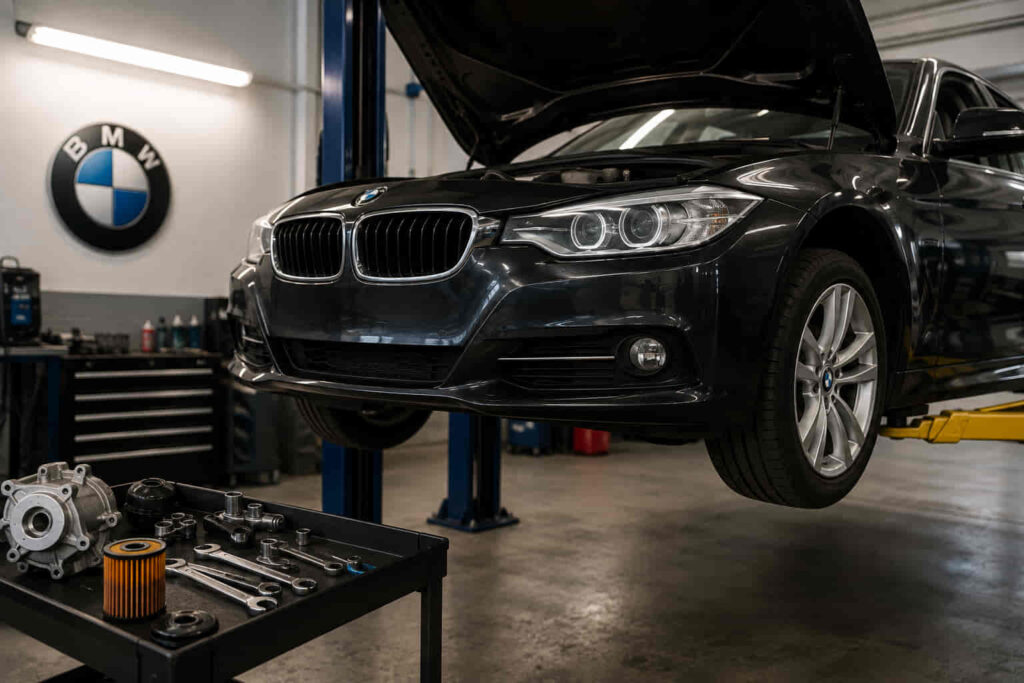
BMWs are generally more expensive to maintain than mainstream vehicles because their parts, labor requirements, engineering complexity, and repair costs are higher. The actual amount an owner spends, however, depends on the BMW model, vehicle age, mileage, maintenance history, warranty coverage, and where the vehicle is serviced. A newer BMW covered by a maintenance program has a substantially different ownership-cost profile from a high-mileage BMW that is outside its factory warranty.
BMW ownership costs also include two expenses that should be evaluated separately: scheduled maintenance and unexpected repairs. Scheduled maintenance covers services required to keep the vehicle operating correctly, while repair costs arise when components wear out, leak, malfunction, or fail. As a BMW accumulates mileage, the second category becomes increasingly important because aging mechanical, electrical, cooling, suspension, and drivetrain components can require replacement.
This article explains how expensive BMWs are to maintain, what owners should expect to spend on maintenance and repairs, why BMW service costs are relatively high, how costs differ between BMW models, and how vehicle age affects long-term expenses. It also compares BMW maintenance costs with other luxury brands and explains whether the ownership experience justifies the additional expense.
Are BMWs expensive to maintain?
Yes, BMWs are expensive to maintain compared with mainstream vehicles, particularly after factory maintenance coverage and warranty protection end. The higher expense comes from the combination of scheduled servicing, premium replacement parts, specialized labor, and repairs associated with increasingly complex mechanical and electronic systems. The difference becomes more significant as the vehicle ages because owners begin paying not only for routine service but also for components that have reached the end of their service life.
The important distinction is between maintenance and repair. Maintenance consists of planned work intended to prevent excessive wear and keep the vehicle operating correctly, including engine oil and filter changes, brake-fluid service, filters, spark plugs, inspections, and other model-specific services. Repair expenses arise when a component no longer functions as intended. A leaking gasket, worn suspension component, failed cooling-system part, or electrical fault therefore belongs to a different cost category from an oil change. Combining both categories gives a more accurate picture of what it costs to own a BMW.
Vehicle age and mileage also determine how expensive a BMW becomes to maintain. A newer BMW with applicable maintenance coverage can have relatively predictable out-of-pocket service expenses because covered scheduled work does not require direct payment at each visit. Once that coverage expires, the owner assumes a larger portion of routine service costs. As mileage increases further, wear-related repairs can occur alongside scheduled maintenance, increasing the total annual ownership expense.
For this reason, the purchase price alone does not determine whether a BMW is affordable. A used BMW can have an attractive purchase price while requiring a larger maintenance reserve than a newer example of the same model. Buyers should evaluate the vehicle’s age, mileage, service history, warranty status, mechanical condition, and expected repair requirements together rather than assuming that every BMW carries the same maintenance cost.
How much does BMW maintenance cost per year?
Annual BMW maintenance costs do not have one fixed figure because scheduled service and repair requirements change according to the model, age, mileage, condition, and coverage of the vehicle. A new BMW under applicable maintenance coverage can require relatively little direct spending on covered scheduled services, while an older vehicle outside warranty can generate substantially higher expenses when routine maintenance and repairs occur during the same ownership year.
Routine service is the more predictable portion of the budget. Engine oil and filter changes, brake-fluid replacement, engine and cabin filters, spark plugs, inspections, tires, and brake components follow different replacement intervals rather than becoming due at the same time. This means annual spending is uneven. An ownership year containing only basic service can be relatively inexpensive, whereas a year that includes brakes, tires, spark plugs, fluids, and another scheduled service will cost considerably more.
Repair costs create greater variation. A BMW that has been maintained correctly and requires no major repairs may incur primarily scheduled expenses. Another BMW of the same age can require suspension, cooling-system, electrical, gasket, or drivetrain work. The second vehicle will have a substantially higher annual bill even though both cars carry the same badge and may have similar mileage. This is why a single average maintenance figure should not be interpreted as the amount every BMW owner will pay each year.
Long-term cost is therefore more useful than evaluating one service invoice. Buyers considering a used BMW should examine several years of expected maintenance and repair exposure, particularly after warranty expiration. A lower purchase price does not eliminate the cost of maintaining the vehicle to the standard required by its original engineering and performance specifications.
Why are BMWs expensive to maintain?
BMW maintenance is relatively expensive because premium parts, specialized labor, engineering complexity, strict service requirements, and age-related repairs can increase the amount an owner spends over the vehicle’s lifetime. These factors interact with each other. A technically complex component can require more diagnostic time, specialized equipment, a higher-priced replacement part, and additional labor to install it correctly.
Parts are one cost driver. BMW vehicles are engineered around model- and system-specific components, and maintaining original operating characteristics can require OEM or equivalent-quality replacement parts. The relevant expense is not limited to major engine or transmission components. Braking, suspension, cooling, electrical, sensor, and emissions systems can contain specialized parts that increase the final repair invoice when replacement becomes necessary.
Labor is another major factor because diagnosis and repair require familiarity with BMW systems. Modern BMWs integrate mechanical hardware with electronic control modules, sensors, software, and onboard diagnostic systems. A fault that appears to be a simple mechanical problem can therefore require diagnostic procedures before a technician identifies the component responsible. More diagnostic and repair time translates directly into higher labor charges, particularly at facilities with higher hourly rates.
Engineering complexity can amplify both parts and labor expenses. Performance, comfort, emissions control, safety, and driver-assistance functions rely on interconnected systems rather than isolated components. When a fault occurs, technicians must determine whether the underlying cause is mechanical, electrical, electronic, software-related, or a combination of these. Correct diagnosis matters because replacing the visible failed component without addressing the underlying cause can lead to repeated repairs.
Age is the final factor that changes the cost equation. Rubber seals deteriorate, suspension components wear, cooling-system parts age, batteries lose capacity, and other mechanical or electrical components accumulate operating cycles. These processes occur in all vehicles, but replacing them on a premium vehicle can be more expensive because of its component specifications and labor requirements. Consequently, the financial difference between maintaining a newer BMW and an older BMW is not simply the number of oil changes required; it is the increasing probability that scheduled maintenance and age-related repairs will overlap.
Which BMW models are the most expensive to maintain?
Larger, more powerful, and more technically complex BMW models are generally more expensive to maintain than smaller models with simpler configurations. A BMW 7 Series or X5 can therefore create a different maintenance budget from a 3 Series or X3. The difference does not come from the model name alone. Engine configuration, drivetrain, suspension technology, wheel and tire size, braking hardware, optional equipment, and the number of electronic systems all influence the cost of servicing and repairing a specific vehicle.
The BMW 3 Series is positioned toward the smaller end of BMW’s passenger-car range, which can make it less costly to maintain than larger luxury models when vehicles of comparable age and condition are considered. Its maintenance requirements still extend beyond basic oil changes. Brakes, tires, fluids, filters, ignition components, suspension parts, cooling-system components, and electronic systems all contribute to long-term ownership expenses. Engine choice also matters because different powertrains do not necessarily have identical service requirements or repair exposure.
The BMW X3 follows a similar principle in the compact luxury SUV category. Its size does not make maintenance inexpensive in absolute terms, but it can avoid some of the cost associated with larger and more complex BMW SUVs. Drivetrain specification, wheel and tire packages, suspension configuration, and powertrain choice can materially change the cost profile between two X3 vehicles. This is why buyers should evaluate the exact year, engine, drivetrain, and service history rather than relying only on the X3 badge when estimating future expenses.
The BMW X5 can require a larger maintenance budget because it combines a larger vehicle platform with luxury equipment, performance-oriented powertrains, and more substantial wear components. Larger tires and braking components can increase replacement expenses, while more complex drivetrain, suspension, comfort, and electronic systems create additional areas that may require diagnosis or repair as the vehicle ages. An X5 with a more complex powertrain or extensive optional equipment can therefore have a different long-term cost profile from a more simply configured example.
The BMW 7 Series sits at the higher end of this cost spectrum because it combines flagship-level comfort, performance, electronics, and chassis technology. More systems create more components that must continue operating correctly as the vehicle gets older. A used 7 Series may depreciate enough to appear inexpensive relative to its original price, but depreciation does not reduce the technical complexity of the vehicle or automatically make replacement parts and repairs inexpensive. The gap between acquisition cost and maintenance requirements is particularly important when evaluating an older flagship BMW.
Model selection should therefore be treated as a maintenance decision as well as a purchase decision. Comparing a 3 Series, X3, X5, and 7 Series only by used purchase price can conceal substantial differences in future expenses. The exact powertrain, equipment level, condition, mileage, previous maintenance, and repair history provide a stronger basis for estimating cost than the BMW badge alone.
Do BMW maintenance costs increase as the car gets older?
BMW maintenance and repair expenses generally increase as the vehicle ages and accumulates mileage because more components reach their wear limits and factory coverage eventually expires. During the earlier years of ownership, scheduled servicing accounts for a larger share of predictable maintenance. As the vehicle becomes older, scheduled work continues while wear-related and age-related repairs begin to overlap with it, increasing the potential annual expense.
Mileage affects components according to how frequently and under what conditions they operate. Brakes and suspension components experience repeated mechanical loads, while seals and gaskets are exposed to heat cycles. Cooling-system components repeatedly operate across changing temperatures, and batteries and electrical components accumulate operating cycles. Age adds another dimension because materials can deteriorate even when annual mileage is relatively low. A low-mileage older BMW is therefore not automatically equivalent to a newer vehicle simply because its odometer reading is lower.
Warranty expiration also changes who pays for qualifying repairs. A defect repaired under applicable warranty coverage does not create the same direct expense for the owner as an equivalent failure after coverage ends. Once the vehicle is outside warranty, repair exposure shifts toward the owner. This transition explains why two otherwise similar BMWs can have very different short-term ownership costs depending on their age and coverage status.
Maintenance history can have an equally important effect. A BMW with documented servicing, timely fluid changes, correctly completed repairs, and replacement of worn components provides a different ownership proposition from a neglected vehicle with missing records. Deferred maintenance does not remove an expense; it transfers that expense into the future and can allow one problem to contribute to additional wear. For a used BMW buyer, the condition and service history of the individual vehicle can therefore matter more than a broad statement about the reliability of the model.
Are BMWs expensive to maintain after 100,000 miles?
A BMW with more than 100,000 miles can be expensive to maintain because scheduled service may coincide with the replacement of aging mechanical, cooling, suspension, electrical, and sealing components. The 100,000-mile point should not be treated as a mechanical expiration date, however. Mileage is one indicator of accumulated use, while maintenance history, driving conditions, engine type, model year, previous repairs, and current condition determine the actual amount of work a specific vehicle requires.
At higher mileage, the financial issue is cumulative wear rather than one service triggered precisely when the odometer reaches 100,000 miles. Suspension components can develop play or lose effectiveness, seals and gaskets can deteriorate, cooling components can require replacement, and electronic or mechanical parts can fail after years of heat cycles and operation. Several smaller repairs occurring within the same ownership period can produce a substantial bill even when the engine and transmission remain functional.
Preventive maintenance becomes especially important in this stage of ownership. Correcting a leak, worn component, or cooling-system problem early can prevent the original fault from affecting connected components. Conversely, deferred maintenance makes the purchase price of a high-mileage BMW a poor indicator of its real cost. A cheaper vehicle that immediately requires multiple repairs can become more expensive than a better-maintained example purchased at a higher initial price.
For this reason, a pre-purchase inspection has particular value when buying a high-mileage BMW. The inspection should establish the present mechanical condition and identify existing or developing repair requirements rather than merely confirm that the vehicle runs during a short test drive. Service records provide additional context by showing which major maintenance and repair items have already been completed. A BMW exceeding 100,000 miles can remain viable when it has been maintained correctly, but the buyer should budget according to the condition of the individual vehicle rather than assuming that past reliability guarantees low future expenses.
Is BMW maintenance more expensive than Mercedes-Benz, Audi, and Lexus?
BMW maintenance costs are generally competitive with Mercedes-Benz and Audi within the luxury segment, while Lexus tends to provide a lower-cost ownership profile. However, brand-level comparisons have limits because the actual expense depends on vehicle class, model, powertrain, age, mileage, service history, and repair requirements. Comparing a BMW 3 Series with a flagship luxury sedan, for example, provides little useful information about which brand is inherently more expensive to maintain.
BMW and Mercedes-Benz share several factors that contribute to higher ownership costs. Both manufacturers produce premium vehicles with specialized components, sophisticated powertrains, extensive electronics, and model-specific service requirements. The cost difference between comparable vehicles can therefore be smaller than the difference between individual models within either brand. A performance-oriented BMW or Mercedes-Benz with larger brakes, tires, complex suspension hardware, and a more powerful engine will generally expose its owner to more expensive consumable parts and potential repairs than a simpler entry-level configuration.
BMW and Audi also occupy a similar maintenance category because both brands combine premium components with complex mechanical and electronic systems. Drivetrain configuration becomes particularly relevant when comparing individual vehicles. An Audi equipped with a specific all-wheel-drive system should not automatically be compared with a differently configured BMW solely by annual brand averages. The useful comparison is between vehicles of similar size, age, performance, mileage, and drivetrain complexity. Under those conditions, maintenance history and the condition of the individual vehicle can become more important than relatively small differences between brand-level averages.
Lexus creates a different comparison because a buyer may be evaluating the trade-off between German performance-oriented luxury vehicles and a luxury vehicle selected partly for lower long-term ownership exposure. BMW can require a larger maintenance and repair budget, particularly as vehicles age outside warranty coverage. This does not establish that every Lexus is inexpensive to maintain or every BMW is costly. It means that buyers prioritizing predictable long-term expenses should compare reliability, scheduled service requirements, parts prices, repair exposure, and depreciation alongside purchase price and vehicle features.
The timeframe of the comparison also matters. One year of maintenance can produce a misleading result because major service and repair events do not occur at identical intervals. A BMW requiring only routine service during one year can appear inexpensive, while another vehicle requiring brakes, tires, suspension work, and a scheduled service during the same period can appear exceptionally costly. A multi-year ownership period provides a more useful picture because it captures both recurring maintenance and less frequent replacement or repair events.
For prospective buyers, the practical question is therefore not simply whether BMW costs more than Mercedes-Benz, Audi, or Lexus. The more useful question is how much a specific BMW is likely to cost compared with equivalent alternatives over the intended ownership period. Matching vehicles by class, age, mileage, powertrain, condition, and service history produces a stronger comparison and prevents broad brand averages from creating unrealistic expectations.
Does BMW warranty cover maintenance and repairs?
BMW warranty and maintenance coverage can reduce out-of-pocket ownership expenses, but warranty protection and scheduled maintenance coverage are not the same thing. A vehicle warranty primarily addresses qualifying defects and failures during the applicable coverage period, while a maintenance program addresses specified scheduled services. Owners should therefore determine which program applies to their specific BMW before assuming that a service or repair will be covered.
This distinction matters because routine maintenance, wear items, and mechanical failures represent different expense categories. An oil service performed as part of an applicable maintenance program is different from replacing a component because it failed due to a covered defect. Wear-related components can also be subject to separate conditions. The vehicle’s model year, original in-service date, mileage, applicable program, and coverage terms determine whether the owner or BMW pays for a particular service.
BMW Ultimate Care can make maintenance expenses more predictable on eligible vehicles because specified factory-recommended maintenance is included for the applicable period. However, maintenance coverage should not be interpreted as unlimited protection against every ownership expense. Tires, collision damage, damage caused by improper use, excluded wear items, and repairs outside applicable warranty terms can remain the owner’s responsibility. The exact coverage should therefore be verified against the terms attached to the individual vehicle rather than inferred from the presence of the BMW Ultimate Care name.
Coverage becomes particularly important when comparing a new BMW with a used one. A newer vehicle with remaining warranty and maintenance benefits can have lower short-term out-of-pocket costs even when its purchase price is higher. An older BMW purchased after those protections expire transfers a larger share of scheduled maintenance and repair risk to the owner. Buyers comparing two vehicles should therefore treat remaining coverage as part of the total ownership-cost calculation.
Is it cheaper to maintain a BMW at an independent mechanic?
Maintaining a BMW at a qualified independent BMW specialist can reduce labor costs for many services and repairs, but the lowest hourly rate does not automatically produce the lowest total repair cost. Technician experience, diagnostic accuracy, parts quality, equipment, warranty status, and the complexity of the repair all affect the final expense. The correct comparison is therefore between the total cost and quality of completing the same repair correctly.
BMW dealerships provide technicians, diagnostic systems, service information, and procedures specifically associated with the manufacturer’s vehicles. This can be valuable for warranty work, software-related procedures, recalls, complex diagnostics, and services requiring manufacturer-specific equipment. The trade-off is that dealership labor rates and parts pricing can make owner-paid work more expensive than equivalent work performed by a qualified independent specialist.
An independent BMW specialist can be a strong option for routine maintenance and many repairs after warranty coverage ends. A workshop that regularly services BMW vehicles is more likely to understand model-specific failure patterns, diagnostic procedures, fluid specifications, and repair requirements than a general repair shop with limited experience with the brand. Accurate diagnosis has direct financial value because replacing the wrong component increases parts and labor expenses without correcting the original fault.
Owners should therefore choose a service provider according to the work being performed rather than using dealership or independent status as the only criterion. Warranty and recall work can favor an authorized BMW center, while routine maintenance and established mechanical repairs may be economically attractive at an experienced independent BMW specialist. Maintaining detailed invoices and service records is also valuable because documented maintenance helps future technicians understand previous work and gives a prospective buyer stronger evidence of how the vehicle has been maintained.
How can you reduce BMW maintenance costs?
BMW owners can reduce long-term maintenance expenses by servicing the vehicle on schedule, addressing developing faults early, using appropriate parts and fluids, choosing the service provider carefully, and avoiding neglected used vehicles. The objective is not to eliminate maintenance spending. It is to prevent routine maintenance from becoming a more expensive repair and to avoid paying for unnecessary or incorrectly diagnosed work.
Following the appropriate maintenance schedule creates the foundation for cost control. Engine oil, filters, brake fluid, spark plugs, and other service items have specific functions, and delaying their replacement can affect connected systems. Saving money by repeatedly postponing necessary maintenance can therefore increase future expenses rather than reduce them. Preventive servicing is most financially useful when it protects a more expensive component from accelerated wear or failure.
Early diagnosis follows the same principle. Fluid leaks, warning messages, abnormal noises, vibration, changes in engine operation, and cooling-system problems should be investigated before the underlying fault progresses. A minor leak does not become less expensive because it is ignored. Continued operation can allow the original problem to affect surrounding components, turning a limited repair into a larger job involving additional parts and labor.
Parts selection also influences total cost. The cheapest available component is not automatically the most economical choice if its fit, durability, or specification is inadequate for the application. Conversely, owners should not assume that every repair requires the most expensive purchasing option. Appropriate OEM or high-quality equivalent components can be evaluated according to the specific repair, vehicle requirements, warranty considerations, and expected service life.
Service-provider selection can further reduce expenses. Comparing a dealership estimate with a reputable independent BMW specialist is useful for owner-paid work, particularly after warranty expiration. The comparison should include the diagnosis, parts being installed, labor required, warranty on the completed repair, and total price rather than the labor rate alone. A lower estimate based on an incomplete diagnosis can ultimately cost more if the vehicle requires repeated visits.
Used-car selection provides the largest opportunity to avoid preventable expenses before ownership even begins. A BMW with complete service records, evidence of appropriate repairs, and a satisfactory pre-purchase inspection can justify a higher purchase price than a neglected example. Deferred maintenance remains attached to the vehicle when ownership changes. Buying the cheapest BMW available can therefore mean purchasing both the car and the previous owner’s unpaid maintenance obligations.
Is a BMW worth buying if maintenance costs are high?
A BMW can be worth buying despite higher maintenance costs when the buyer values its driving characteristics, performance, comfort, technology, and premium features enough to justify the additional ownership expense. Maintenance cost should therefore be treated as one component of the buying decision rather than the only measure of value. The more important question is whether the total cost of owning a specific BMW fits the buyer’s budget throughout the intended ownership period.
Purchase price alone can create a misleading picture, particularly in the used market. Depreciation can make an older BMW considerably cheaper to purchase than it was when new, but the cost of maintaining its mechanical and electronic systems does not decline at the same rate. A vehicle that originally belonged to a premium price segment still contains components designed for that vehicle, even after its market value has fallen substantially. This explains why an inexpensive used BMW can become expensive to own when the purchase is followed by deferred maintenance and age-related repairs.
A well-maintained BMW with documented service history presents a stronger ownership proposition than a cheaper example with unknown maintenance. Service records help establish whether scheduled work has been completed and whether previous faults were repaired correctly. A pre-purchase inspection can then identify current mechanical problems and developing expenses before the transaction is completed. Paying more for a properly maintained vehicle can produce a lower total ownership cost than buying the lowest-priced example and repairing accumulated problems afterward.
The intended ownership period also changes the calculation. A buyer planning to own a newer BMW while warranty and applicable maintenance coverage remain active faces a different financial risk from someone purchasing an older, high-mileage BMW for long-term ownership. The second buyer needs a larger repair reserve because scheduled maintenance can overlap with failures or replacements involving suspension, cooling, electrical, sealing, drivetrain, and other aging components. The affordability of the purchase should therefore include future maintenance and repair capacity, not merely the ability to make the initial payment.
BMW makes the most financial sense for buyers who deliberately accept higher operating costs in exchange for the characteristics they value in the vehicle. A buyer whose primary objective is minimizing maintenance and repair expenses should give greater weight to alternatives with lower long-term ownership exposure. By contrast, a buyer who prioritizes BMW’s combination of performance, handling, comfort, technology, and luxury can reasonably accept a larger maintenance budget when that expense has already been incorporated into the ownership decision.
Ultimately, BMWs are expensive to maintain relative to mainstream vehicles, but high maintenance costs do not automatically make them poor purchases. Model, powertrain, age, mileage, condition, warranty coverage, service history, and previous maintenance determine the financial risk of an individual vehicle. Evaluating those factors before purchase provides a more useful answer than asking whether the BMW brand as a whole is expensive to own.