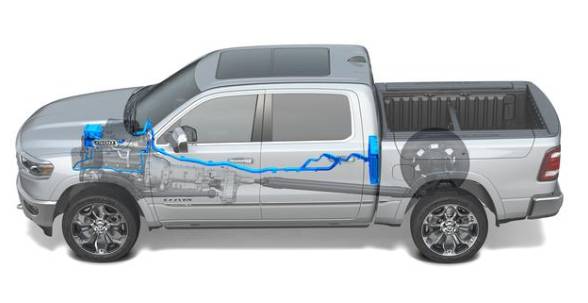
The RAM eTorque battery is not located under the hood like the conventional 12-volt battery. On RAM 1500 models equipped with the eTorque mild hybrid system, the 48-volt lithium-ion battery pack is typically mounted behind the rear seat against the back wall of the cab. This placement often surprises owners who expect all vehicle batteries to be located in the engine compartment.
The battery’s location is an intentional engineering decision rather than a packaging compromise. Positioning the high-voltage battery inside the cab helps protect it from water, road debris, and extreme underbody impacts while improving weight distribution and shortening the distance to other eTorque components. It also allows the battery’s cooling and electrical systems to operate in a more controlled environment than they would underneath the vehicle.
This guide explains exactly where the RAM eTorque battery is located across different model years, whether its position changes between the 3.6L Pentastar V6 and 5.7L HEMI V8 engines, and how to access it safely for inspection or service. You’ll also learn which components surround the battery, the symptoms that indicate it may require inspection, and the key safety precautions to follow before working around the 48-volt mild hybrid system. By the end of this guide, you’ll have a clear understanding of the battery’s location and its role within the RAM eTorque system.
Where Is the RAM eTorque Battery Located?
The RAM eTorque battery is typically mounted behind the rear seat against the back wall of the cab rather than under the hood. This location applies to RAM 1500 models equipped with the eTorque mild hybrid system, where the 48-volt lithium-ion battery pack is installed inside the cabin to protect it from moisture, road debris, and impact damage.
Unlike the conventional 12-volt battery that powers standard electrical accessories, the eTorque battery supplies energy to the 48-volt mild hybrid system. It works with the Belt Starter Generator (BSG) to support engine start-stop operation, regenerative braking, and torque assistance during acceleration. Because the battery is part of a high-voltage system, it is positioned in a protected area where temperature, vibration, and environmental exposure can be better controlled.
On most Crew Cab models, the battery sits directly behind the rear seatback, secured to the rear cab wall with dedicated mounting brackets. Access generally requires folding or removing the rear seat and taking off one or more interior trim panels. Once the panel is removed, the rectangular battery pack, high-voltage connectors, cooling components, and wiring harness become visible.
This mounting position also shortens the electrical path between the battery and the vehicle’s hybrid control components while keeping the battery away from excessive engine heat. The result is improved thermal management, better crash protection, and greater long-term reliability for the eTorque system.
Which RAM Models Have the eTorque Battery in This Location?
Most RAM 1500 trucks equipped with the eTorque mild hybrid system use the same general battery location regardless of engine choice. While interior trim and mounting hardware may vary slightly between model years and cab configurations, the battery remains mounted behind the rear seat inside the cab rather than underneath the vehicle or inside the engine compartment.
Where Is the Battery on 2019–2021 RAM 1500?
The first generation of fifth-generation RAM 1500 trucks equipped with eTorque, including many 2019, 2020, and 2021 models, places the 48-volt battery behind the rear seat against the rear cab wall. Owners can typically reach the battery after folding the rear seat forward and removing the interior access panel covering the battery compartment.
Although the battery location remains consistent, the surrounding trim panels, insulation, and mounting brackets may differ depending on whether the truck is configured as a Tradesman, Big Horn, Laramie, Rebel, Limited, or another trim level. These differences affect the disassembly process rather than the battery’s actual position.
Where Is the Battery on 2022–Present RAM 1500?
RAM continued using the same battery placement on later eTorque-equipped models. Trucks produced from 2022 onward generally retain the battery behind the rear seat, although some interior panels and service procedures were updated to improve accessibility and component packaging.
Owners servicing newer vehicles should always refer to the repair information specific to their model year because fastener locations, trim clips, wiring routing, and safety procedures may vary even when the battery itself occupies the same area.
Does the Battery Location Change Between the 3.6L Pentastar V6 and 5.7L HEMI V8?
The battery location does not significantly change between the 3.6L Pentastar V6 eTorque and the 5.7L HEMI V8 eTorque systems. Both engines use a 48-volt lithium-ion battery mounted behind the rear seat to power the mild hybrid system.
The primary differences between these powertrains involve engine calibration, Belt Starter Generator specifications, and hybrid system operation rather than battery placement. As a result, owners of either engine can expect to find the battery in essentially the same protected area inside the cab, although connector layouts, cooling components, or wiring harness routing may differ slightly between configurations.
How Can You Access the RAM eTorque Battery?
Accessing the RAM eTorque battery requires removing interior components instead of opening the hood. Because the battery is integrated into a 48-volt electrical system, any inspection or service should begin with proper safety procedures to minimize the risk of electrical shock or damage to hybrid components.
Which Interior Panels Need to Be Removed?
Most RAM 1500 eTorque models require the rear seat to be folded forward or partially removed before the battery compartment can be reached. After gaining clearance, the interior trim panel covering the rear cab wall is removed to expose the battery assembly.
Depending on the model year and trim level, additional insulation panels, protective covers, or mounting brackets may also need to be detached before the battery can be fully accessed. Keeping track of clips and fasteners during disassembly helps prevent damage when reinstalling the interior.
What Tools Are Required?
Basic access typically requires common hand tools such as socket wrenches, extension bars, trim removal tools, and screwdrivers designed for automotive interior panels. Plastic trim tools are recommended because they reduce the likelihood of scratching or breaking interior clips during removal.
If battery replacement or electrical diagnosis is required, additional service equipment may be necessary, including insulated tools and diagnostic equipment capable of communicating with the vehicle’s hybrid control modules.
What Safety Precautions Should You Follow Before Accessing the Battery?
Always treat the eTorque battery as a high-voltage component even though it operates at 48 volts. Before removing covers or disconnecting electrical connectors, turn the vehicle off completely, remove the key or key fob from the immediate area, and allow the hybrid system to power down according to the manufacturer’s service procedure.
Avoid disconnecting high-voltage connectors without following the recommended service sequence. Never use damaged tools or work around exposed electrical terminals while the system is energized. If the battery shows signs of physical damage, swelling, fluid leakage, or overheating, discontinue the inspection immediately and have the vehicle evaluated by a qualified technician familiar with RAM’s eTorque system.
Why Is the eTorque Battery Mounted Behind the Rear Seat?
RAM mounts the eTorque battery behind the rear seat to improve safety, durability, weight distribution, and system efficiency. Unlike a conventional 12-volt battery, the 48-volt lithium-ion battery is a high-value component that benefits from being installed inside the cab, where it is better protected from harsh environmental conditions.
One of the primary reasons for this location is crash protection. The rear cabin structure provides a reinforced area that shields the battery from road debris, water intrusion, and impacts that are more likely to occur underneath the vehicle. Keeping the battery inside the cab also reduces exposure to mud, salt, and moisture, all of which can accelerate corrosion and shorten the lifespan of electrical components.
Thermal management is another important factor. Lithium-ion batteries perform more consistently within a controlled temperature range than when exposed to excessive heat or freezing conditions. By mounting the battery inside the cabin, RAM creates a more stable operating environment that helps maintain battery performance during both hot summers and cold winters. The battery pack also integrates with a dedicated cooling system that regulates operating temperature during charging and regenerative braking.
Vehicle balance also influences the battery’s placement. A lithium-ion battery pack weighs considerably more than many electronic control modules. Positioning that weight closer to the center of the truck helps improve overall weight distribution, contributing to better handling and ride stability compared with placing the battery entirely at the front of the vehicle.
The location also simplifies the electrical architecture of the mild hybrid system. The battery can be connected efficiently to the Belt Starter Generator, DC-DC converter, and hybrid control modules through protected wiring routes inside the vehicle. Shorter cable runs reduce electrical losses while minimizing the amount of high-voltage wiring exposed beneath the truck.
What Components Are Located Near the eTorque Battery?
The eTorque battery is surrounded by several components that allow the mild hybrid system to store, manage, and deliver electrical energy efficiently. Understanding these nearby parts makes it easier to identify the system during inspection and helps owners recognize why servicing should be performed carefully.
The most noticeable component is the high-voltage wiring harness. These insulated cables carry electrical power between the battery, the Belt Starter Generator, and other hybrid system components. Because they operate at higher voltage than conventional automotive wiring, they are clearly protected and routed to minimize damage during normal vehicle operation.
Near the battery assembly, owners may also find the battery management electronics that monitor voltage, current, charging status, and operating temperature. These control systems continuously balance battery performance and communicate with the vehicle’s powertrain control module to determine when energy should be stored or delivered.
The battery cooling system is another essential component located adjacent to the battery pack. Depending on the vehicle configuration, cooling ducts or ventilation passages help dissipate heat generated during charging and regenerative braking. Maintaining proper battery temperature improves efficiency and extends the service life of the lithium-ion cells.
The DC-DC converter is another key part of the eTorque system. Rather than supplying accessories directly from the 48-volt battery, this unit converts high-voltage power into 12 volts to recharge the conventional battery and support standard vehicle electronics. Although its exact mounting position varies by model year, it functions as the bridge between the hybrid electrical system and the truck’s traditional electrical architecture.
Many vehicles also include service disconnects, protective covers, mounting brackets, and warning labels around the battery compartment. These features help technicians isolate the high-voltage system during maintenance while reducing the risk of accidental contact with energized components.
How Can You Tell If the eTorque Battery Needs Inspection?
Several warning signs can indicate that the RAM eTorque battery should be inspected before a complete system failure occurs. While the battery is designed for long-term durability, declining performance or electrical faults often produce noticeable symptoms that affect vehicle operation.
Warning Messages
Dashboard warnings are usually the first indication of a developing problem. Drivers may see messages related to the charging system, hybrid system, or auto start-stop function. In some cases, the malfunction indicator lamp may illuminate after the vehicle detects abnormal battery voltage, communication errors, or charging irregularities within the eTorque system.
Starting and Stop-Start Problems
A properly functioning eTorque battery supports smooth engine restarts during automatic stop-start events. If the battery begins to lose capacity, the start-stop system may become unavailable, operate inconsistently, or be disabled entirely by the vehicle’s control software. Drivers may also notice rougher engine restarts or delayed engagement after stopping at traffic lights.
Charging System Symptoms
The eTorque battery works continuously with the Belt Starter Generator to recover energy during braking and provide torque assistance during acceleration. If charging performance deteriorates, drivers may experience reduced regenerative braking efficiency, inconsistent electrical assistance, or warning messages indicating charging system faults. These symptoms often develop gradually rather than appearing suddenly.
Diagnostic Trouble Codes
The most reliable way to confirm an eTorque battery issue is by scanning the vehicle with a diagnostic tool capable of communicating with the hybrid control modules. Diagnostic Trouble Codes (DTCs) can identify problems involving battery voltage, temperature sensors, communication circuits, charging performance, or battery management functions. Because several hybrid components work together, retrieving fault codes helps distinguish a battery problem from issues involving the Belt Starter Generator, DC-DC converter, or related electrical systems before unnecessary parts are replaced.
Is the eTorque Battery the Same as the 12-Volt Battery?
No, the RAM eTorque battery and the 12-volt battery serve different purposes and are separate components. Although both supply electrical power, they operate at different voltages and support different vehicle systems.
The 12-volt battery powers conventional electrical equipment such as the headlights, infotainment system, power windows, instrument cluster, and engine control modules. It also provides the initial power required to activate vehicle electronics when the truck is started.
The eTorque battery is a 48-volt lithium-ion battery designed specifically for the mild hybrid system. It stores energy recovered during regenerative braking and supplies power to the Belt Starter Generator during engine restarts and acceleration. Rather than replacing the 12-volt battery, it works alongside it to improve fuel efficiency and overall vehicle performance.
Both batteries are connected through a DC-DC converter that continuously transfers energy from the 48-volt system to recharge the 12-volt battery when needed. This allows traditional vehicle electronics to continue operating normally while the eTorque system manages hybrid functions independently.
Because the two batteries perform different tasks, a failure in one does not necessarily mean the other has failed. However, faults within the eTorque system can indirectly affect charging performance and disable features such as Auto Start-Stop.
Can You Drive with a Faulty eTorque Battery?
Yes, most RAM trucks can continue driving with a faulty eTorque battery, but several hybrid functions will be disabled. The vehicle is designed to enter a reduced operating mode when the system detects a battery or electrical fault, allowing the engine to continue running while protecting hybrid components from further damage.
In many cases, drivers will notice that the Auto Start-Stop system stops functioning first. Regenerative braking and electric torque assistance may also become unavailable because the battery can no longer store or deliver energy efficiently. The truck continues to rely on its gasoline engine, making the driving experience similar to a conventional pickup without mild hybrid assistance.
Although the vehicle usually remains drivable, ignoring warning messages is not recommended. A deteriorating battery may place additional demand on the charging system or indicate another fault involving the Belt Starter Generator, DC-DC converter, or battery management electronics. Prompt diagnosis helps prevent secondary failures that may increase repair costs.
If the vehicle displays multiple hybrid system warnings, experiences repeated charging faults, or enters a limited-performance mode, it should be inspected as soon as possible. Continuing to drive with unresolved electrical faults can eventually affect system reliability and reduce overall fuel efficiency.
How Long Does a RAM eTorque Battery Typically Last?
A RAM eTorque battery typically lasts between 8 and 10 years under normal driving conditions, although actual lifespan depends on usage, climate, and maintenance. Because the battery uses lithium-ion technology, it is designed to withstand thousands of charging and discharging cycles throughout the vehicle’s service life.
Driving habits significantly influence battery longevity. Vehicles that accumulate consistent highway mileage often place less stress on the battery than trucks frequently driven in stop-and-go traffic, where regenerative braking and repeated engine restarts occur more often. However, the battery management system continuously regulates charging levels to reduce unnecessary wear.
Environmental conditions also affect long-term performance. Extended exposure to extremely high temperatures accelerates lithium-ion battery degradation, while prolonged operation in very cold climates may temporarily reduce available capacity until the battery reaches its optimal operating temperature.
Routine maintenance is minimal because the battery is largely maintenance-free. Instead of requiring periodic servicing, it relies on onboard monitoring systems that continuously evaluate voltage, temperature, and charging performance. Drivers should investigate hybrid system warning lights promptly, as early diagnosis often prevents small electrical issues from developing into major battery failures.
How Much Does It Cost to Replace a RAM eTorque Battery?
Replacing a RAM eTorque battery is considerably more expensive than replacing a conventional 12-volt battery because it is a high-voltage lithium-ion component integrated into the vehicle’s mild hybrid system. The total replacement cost depends on the model year, engine configuration, labor rates, and whether original equipment or remanufactured parts are used.
The battery itself generally represents the largest portion of the repair cost. Additional expenses may include diagnostic testing, software updates, calibration procedures, and labor required to remove interior trim panels and safely disconnect the high-voltage system. If related components such as the DC-DC converter, wiring harness, or cooling system also require repair, the overall cost increases further.
Owners should obtain an inspection before approving battery replacement because warning messages do not always indicate a failed battery. In some cases, software faults, charging issues, or defective electrical connections produce symptoms that resemble battery failure but require a different repair.
Checking warranty coverage is also worthwhile. Depending on the vehicle’s age, mileage, and applicable emissions or hybrid system warranty, part or all of the replacement cost may be covered by the manufacturer.
Can You Replace the eTorque Battery Yourself?
Replacing a RAM eTorque battery is generally not recommended for most vehicle owners because it involves working with a high-voltage electrical system. Unlike replacing a standard automotive battery, servicing the 48-volt battery requires following manufacturer safety procedures to prevent personal injury and component damage.
Battery replacement begins with properly de-energizing the hybrid system before disconnecting any high-voltage connectors. Incorrect procedures may trigger electrical faults, damage control modules, or create safety hazards during servicing. After installation, some vehicles may also require diagnostic equipment to verify system operation, clear fault codes, or perform calibration procedures.
Experienced technicians familiar with hybrid electrical systems have the insulated tools, service information, and diagnostic equipment necessary to complete the repair safely. For most owners, professional replacement reduces the risk of accidental damage while ensuring the mild hybrid system continues to operate correctly after installation.
Frequently Asked Questions About RAM eTorque Battery Location
Is the eTorque battery underneath the truck?
No. The eTorque battery is typically mounted inside the cab behind the rear seat rather than underneath the vehicle. This location provides better protection from water, debris, and impact damage.
Is the eTorque battery inside the cab?
Yes. The battery is installed against the rear wall of the cab behind the rear seat, where it remains protected from external environmental conditions and excessive engine heat.
Can water damage the eTorque battery?
The battery is housed in a sealed enclosure and installed inside the cabin to minimize exposure to water. Under normal operating conditions, rain and road splash should not reach the battery. However, flood damage or significant water intrusion into the cabin can affect high-voltage electrical components and should be inspected immediately.
Does every RAM 1500 have an eTorque battery?
No. Only RAM 1500 models equipped with the optional or standard eTorque mild hybrid system include the 48-volt lithium-ion battery. Trucks powered by conventional engines without the eTorque system use only a standard 12-volt battery.
Can the eTorque battery be disconnected safely?
Yes, but only by following the manufacturer’s recommended service procedure. Because the battery is part of a high-voltage hybrid system, disconnecting it improperly can create electrical hazards or trigger diagnostic faults. Anyone unfamiliar with hybrid vehicle servicing should leave battery disconnection to a qualified technician.