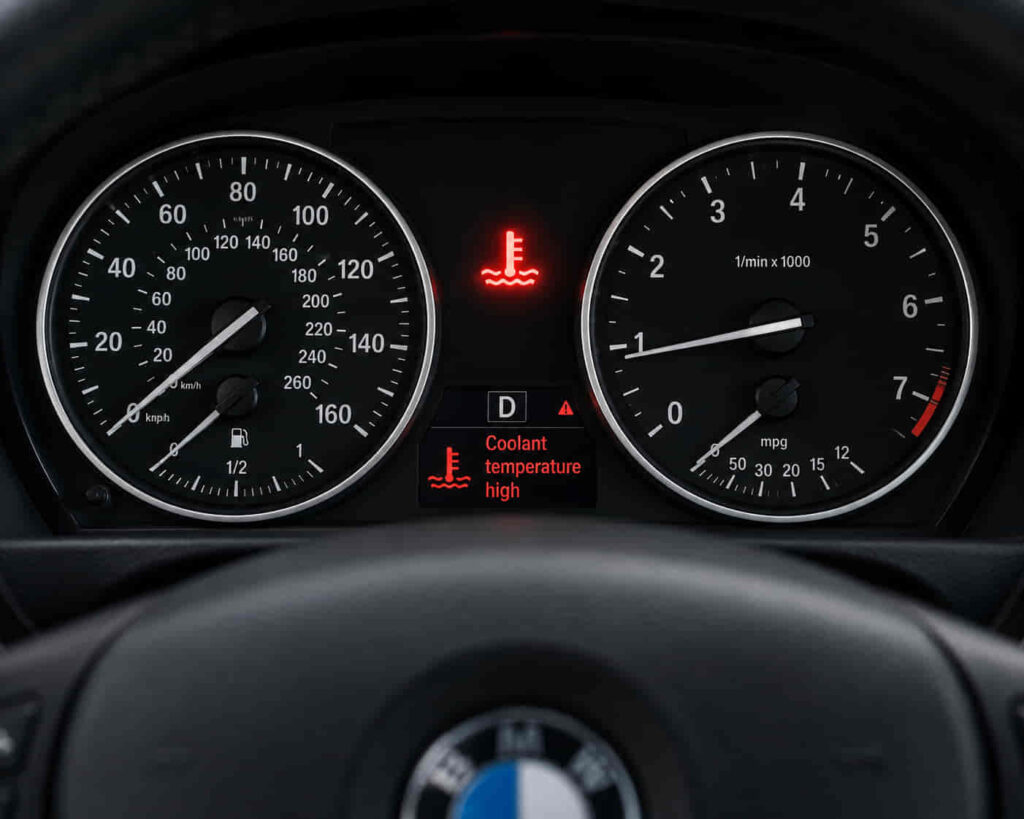
A BMW coolant light usually means the cooling system requires attention, with a low coolant level being one of the first conditions to check. The warning should not be ignored because the engine depends on the correct amount and circulation of coolant to control operating temperature. A coolant warning does not automatically mean the engine is overheating, but continued coolant loss or a cooling-system fault can eventually reduce the system’s ability to remove engine heat.
Low coolant is also a symptom rather than a complete diagnosis. A BMW can lose coolant through a leak involving the expansion tank, hoses, radiator, connections, or other parts of the cooling circuit. A faulty coolant level sensor can create a warning even when the reservoir appears full, while water pump, thermostat, and related cooling-system problems require diagnosis based on how the system is actually operating. Simply adding coolant therefore does not repair the reason the warning appeared when an underlying fault is present.
This article explains seven reasons your BMW coolant light can come on and how each problem relates to coolant level, circulation, and engine temperature. It also helps distinguish a straightforward low-coolant condition from a leak, sensor fault, or cooling-system problem that requires repair.
Why is your BMW coolant level low?
Your BMW coolant level is low when the cooling system contains less coolant than required to maintain its specified operating level. When the level drops sufficiently, the monitoring system can trigger a coolant warning and alert the driver that the cooling system requires attention. The immediate condition is insufficient coolant, but identifying why the level decreased is necessary to determine whether topping it up actually resolves the problem.
Coolant operates within the engine’s cooling circuit rather than functioning as a fluid that should routinely disappear in large quantities during normal driving. A BMW that repeatedly requires additional coolant therefore needs more attention than a one-time warning alone can explain. The relevant question is not only how much coolant is currently in the system, but whether the system is retaining coolant correctly.
Checking coolant level should be performed under the conditions specified for the vehicle, particularly because a cooling system can be hot and pressurized after the engine has been running. Opening a pressurized cooling system while hot can release hot coolant or steam. Once the system is safe to inspect, the actual coolant level can be compared with the appropriate level indication for the vehicle.
Adding the correct coolant can restore the level when the system is genuinely low, but topping up coolant does not repair the cause of recurring coolant loss. If the warning returns after the level has been corrected, the cooling system should be evaluated for leakage or another condition responsible for the loss. This distinction prevents repeated topping-up from becoming a substitute for diagnosis.
Can a coolant leak turn on the BMW coolant light?
Yes, a coolant leak can turn on the BMW coolant light because escaping coolant gradually reduces the amount of fluid remaining in the cooling system. Once the level falls far enough for the vehicle to detect an insufficient coolant condition, the warning can appear. A leak therefore creates a direct relationship between coolant loss and the dashboard warning, although the location and rate of leakage can differ between vehicles.
Coolant can escape from several points in the cooling circuit, including the expansion tank, hoses, connections, radiator, seals, and other components that contain or circulate coolant. A larger leak can produce an obvious loss over a short period, while a smaller leak can reduce the level gradually. Heat and system pressure can also affect how a leak presents, which means coolant loss may not always be equally visible when the vehicle is parked and cold.
Evidence of coolant loss can appear around the affected component or beneath the vehicle, but the absence of an obvious puddle does not by itself establish that the system is leak-free. The location of the fault, the amount being lost, and the conditions under which leakage occurs affect whether visible evidence is easy to identify. Diagnosis therefore needs to establish where coolant is leaving the system rather than relying only on the warning light.
Repeated coolant warnings after topping up create a stronger reason to investigate system integrity. Adding coolant restores the quantity that has been lost, whereas repairing the leaking component addresses the mechanism causing the loss. The sequence is leak → coolant loss → low coolant level → warning, so repeatedly correcting only the coolant level leaves the first part of that sequence unresolved.
A coolant leak also becomes more important when the warning is accompanied by abnormal engine temperature or signs of overheating. Insufficient coolant can reduce the cooling system’s ability to absorb and transfer engine heat. If engine temperature is rising abnormally, continuing to drive can increase the risk of engine damage, making the temperature condition more urgent than simply clearing the coolant warning.
Can a faulty coolant level sensor cause the warning?
Yes, a faulty coolant level sensor can cause a BMW coolant warning even when the cooling system contains the correct amount of coolant. The sensor is responsible for detecting coolant level information used by the vehicle’s warning system. When the sensor, its electrical connection, or the related circuit does not provide the expected signal, the vehicle can display a low-coolant warning that does not correspond with the actual level in the expansion tank.
This possibility becomes particularly relevant when the coolant warning remains on or repeatedly returns even though the coolant level has been checked correctly and remains within the specified range. Adding more coolant in this situation does not address the underlying problem. Overfilling the expansion tank is not a valid solution to a warning generated by inaccurate level detection, because coolant quantity and coolant-level monitoring are separate parts of the system.
Diagnosis should therefore compare the dashboard warning with the physical condition of the cooling system. If the coolant is genuinely low, the source of coolant loss needs to be investigated. If the level remains correct and there is no evidence that coolant is being lost, the sensor and its associated electrical connections become more relevant diagnostic areas. This distinction prevents a warning-system fault from being treated automatically as a coolant leak.
A sensor-related warning also needs to be separated from an engine-temperature problem. The coolant level sensor indicates a condition associated with coolant quantity; it does not establish by itself that the engine is overheating. If the BMW also shows abnormal engine temperature, overheating messages, or other cooling-system symptoms, diagnosis must extend beyond the level sensor because a separate circulation or temperature-control problem may be present.
Can a damaged expansion tank trigger the BMW coolant light?
Yes, a damaged BMW expansion tank can contribute to a coolant warning when a crack, sealing problem, or connection allows coolant to escape and lowers the system’s coolant level. The expansion tank forms part of the cooling circuit and accommodates changes in coolant volume as operating temperature changes. Its ability to contain coolant correctly is therefore directly connected to maintaining the required coolant level.
Expansion tanks and their surrounding connections operate through repeated heating and cooling cycles. A loss of sealing integrity can allow coolant to leave the system, and the resulting level reduction can eventually trigger the warning. The problem should therefore be understood as a causal sequence: the damaged component permits coolant loss, the amount of coolant decreases, and the vehicle detects the resulting low-level condition.
A problem around the expansion tank can also explain why an owner tops up the coolant only to see the warning return later. The newly added coolant temporarily restores the quantity in the system, but it does not repair a damaged tank or sealing point. Continued loss brings the coolant level down again, recreating the condition responsible for the warning.
The tank itself should not be assumed to be defective solely because the warning appears. Coolant can be lost elsewhere in the cooling system, while a sensor fault can produce a warning without an actual shortage. Diagnosis needs to establish whether coolant is escaping from the expansion tank area and whether the physical level is decreasing over time. This keeps the repair focused on the component responsible for the problem rather than replacing parts based only on the dashboard message.
An expansion-tank problem requires greater urgency when coolant loss is accompanied by abnormal engine temperature. The warning identifies a condition requiring attention, while rising engine temperature indicates that the cooling system may no longer be controlling engine heat correctly. In that situation, continuing to drive can expose the engine to overheating and potential damage, so restoring coolant level alone should not be treated as a complete repair.
Can a water pump problem cause a BMW coolant warning?
A BMW water pump problem can contribute to a cooling-system warning or overheating condition because the water pump is responsible for circulating coolant through the engine’s cooling circuit. However, a failing water pump does not automatically mean the coolant level is low. Coolant quantity and coolant circulation are separate conditions, so the warning displayed by the vehicle and the actual coolant level need to be evaluated together.
The water pump moves coolant through the engine and other parts of the cooling system so absorbed heat can be transferred away from critical engine components. When circulation becomes inadequate, engine temperature can rise even when coolant remains in the system. This creates an important diagnostic distinction: a BMW can have enough coolant in the expansion tank while still experiencing a cooling problem because the coolant is not circulating as required.
A water pump can also become relevant to a low-coolant condition when the pump or an associated sealing area develops a leak. In that situation, the causal sequence changes from a circulation problem to water pump leak → coolant loss → low coolant level → warning. The same component can therefore be associated with different cooling-system symptoms depending on the type of failure.
Temperature behavior helps determine the seriousness of the problem. A coolant warning accompanied by increasing engine temperature, an overheating message, or other abnormal temperature behavior requires more urgent attention than an isolated level warning with normal engine temperature. Continuing to operate an overheating engine can expose cylinder-head components, gaskets, and other engine parts to damaging temperatures.
Adding coolant does not repair a water pump that cannot circulate coolant correctly. Likewise, replacing a water pump should not be assumed to be the correct repair solely because a coolant warning appeared. Diagnosis must establish whether the system is actually low on coolant, whether coolant is leaking, and whether circulation is functioning correctly. This separates the visible dashboard symptom from the mechanical fault responsible for it.
Can a thermostat problem cause a BMW coolant warning?
A BMW thermostat problem can cause cooling-system temperature problems, but a faulty thermostat does not necessarily cause a low-coolant warning by itself. The thermostat regulates coolant flow according to engine operating temperature, making it a temperature-control component rather than a direct measurement of how much coolant is present in the system.
When a thermostat does not regulate coolant flow correctly, the engine can operate outside its intended temperature range. A thermostat that prevents the cooling system from managing heat correctly can contribute to excessive engine temperature, while a different failure condition can interfere with the engine reaching or maintaining the intended operating temperature. The resulting symptoms therefore need to be interpreted according to actual engine-temperature behavior rather than assuming that every thermostat fault produces the same warning.
This distinction is important when diagnosing a BMW coolant light. If the physical coolant level is low, the investigation should establish where coolant has been lost. If the coolant level is correct but the engine is developing abnormal temperature behavior, circulation and temperature-control components such as the thermostat become more relevant. A dashboard coolant message, coolant quantity, and engine temperature are related diagnostic signals, but they do not describe the same condition.
A thermostat problem can also exist alongside another cooling-system fault. For example, coolant loss and abnormal temperature control can occur during the same period without one automatically proving the other. Correct diagnosis therefore follows the complete cooling-system condition rather than replacing the thermostat simply because the vehicle has displayed a coolant-related warning.
The practical distinction is that low coolant requires an explanation for coolant loss, while abnormal temperature with adequate coolant requires investigation of how the cooling system is circulating and controlling heat. Making this distinction helps prevent repeated coolant top-ups from being used to address a problem that actually involves cooling-system operation.
Can radiator or coolant hose problems turn on the BMW coolant light?
Yes, radiator or coolant hose problems can turn on the BMW coolant light when they allow enough coolant to escape for the system to detect a low coolant level. The radiator, hoses, connections, and related sealing points form part of the circuit responsible for containing and circulating coolant. A leak anywhere along this path can gradually reduce coolant quantity and eventually produce a warning.
Radiator damage can create coolant loss because the radiator must contain pressurized coolant while repeatedly experiencing temperature changes during engine operation. Physical damage, deterioration, or leakage around the radiator and its connections can allow coolant to leave the closed system. The resulting warning is therefore not caused by the radiator simply existing within the cooling circuit; it occurs when a radiator-related fault changes coolant level or contributes to another cooling-system problem.
Coolant hoses create a similar causal relationship. Hoses transport coolant between major parts of the cooling system and must remain sealed as temperature and pressure change. A damaged hose, compromised connection, or sealing problem can allow coolant to escape. A small loss can produce a gradual decline in coolant level, while a more substantial failure can remove coolant rapidly enough to create a more urgent cooling-system problem.
The rate of coolant loss affects how the problem presents. A slow leak can initially appear as a coolant warning that returns periodically after the reservoir has been topped up. A larger leak can produce visible coolant loss and reduce the cooling system’s ability to manage engine heat over a much shorter period. This difference explains why two BMWs displaying a coolant warning can require different levels of urgency even when the dashboard message appears similar.
Visible coolant around the radiator, hoses, connections, or beneath the vehicle can provide evidence of a leak, but diagnosis should not depend on a visible puddle alone. A leak can occur under operating temperature and pressure, and its location can make the escaping coolant difficult to observe during a basic inspection. Repeated loss after the coolant level has been restored provides a stronger reason to inspect the system for the source of the leak.
Adding coolant can correct the immediate low-level condition, but it cannot repair a leaking radiator, hose, or connection. When the warning repeatedly returns, the repair needs to address the component responsible for coolant loss. This distinction is especially important because continuing to replace lost coolant without correcting the leak allows the underlying cooling-system fault to remain.
A coolant warning becomes more urgent when it appears together with abnormal engine temperature or an overheating warning. Coolant quantity, coolant circulation, and temperature control work together to protect the engine from excessive heat. If coolant is being lost rapidly or engine temperature is increasing, continuing to drive can increase the risk of engine damage. The appropriate response is therefore determined by both the coolant warning and the actual operating condition of the cooling system.