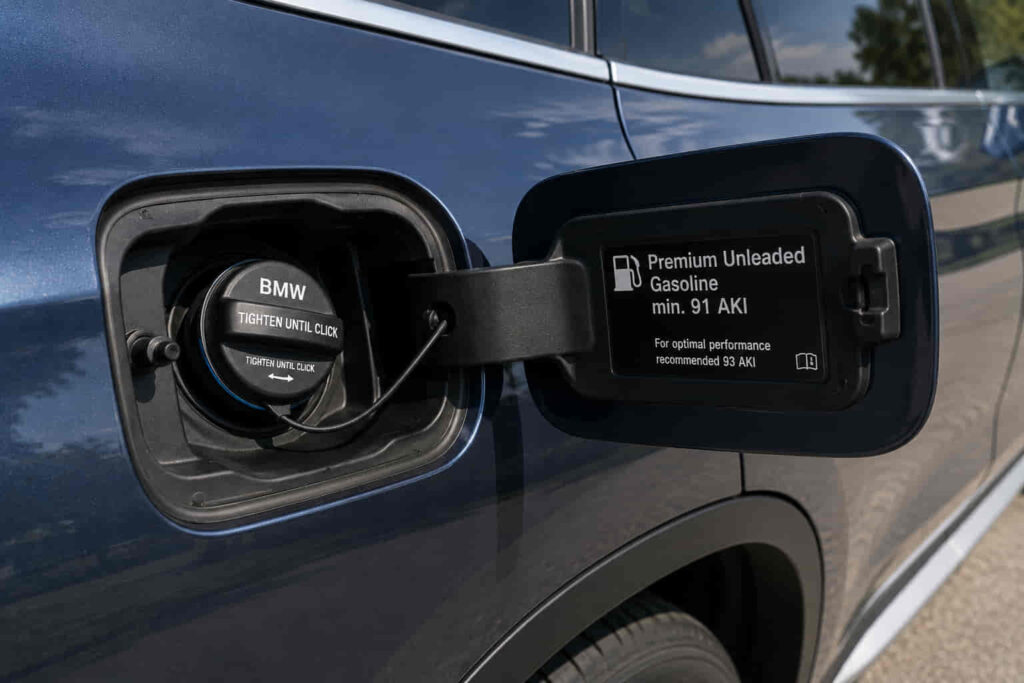
The BMW X3 uses gasoline with an octane rating specified for its particular engine and model year, and many gasoline-powered X3 configurations are designed to run on premium-grade fuel. However, the correct BMW X3 gas type should be determined from the fuel requirement for the specific vehicle rather than assuming that every X3 has the same octane requirement. Engine configuration, model year, market specification, and manufacturer recommendations can affect which fuel grade should be used.
There are 5 key things to know about BMW X3 gas type: the recommended gasoline grade, the correct octane rating, whether premium gas is required or recommended, whether regular gas can be used, and how fuel requirements can differ between X3 configurations. These distinctions matter because a minimum acceptable octane rating is not necessarily the same as the manufacturer’s recommended fuel grade.
This guide explains what gas a BMW X3 takes, whether the BMW X3 requires premium gas, and what can happen when a lower-octane fuel is used. It also explains how to verify the correct fuel requirement for a specific X3 so that the fuel choice is based on the vehicle’s specification rather than a general recommendation for the BMW brand.
What Are the 5 Things to Know About BMW X3 Gas Type?
The 5 main things to know about BMW X3 gas type are the recommended gasoline grade, the required octane rating, the difference between recommended and minimum octane, whether regular gas is acceptable, and whether the fuel requirement changes by engine or model year. These factors should be considered together because “premium gas” is a retail fuel category, while the vehicle’s octane specification provides the more precise standard for selecting gasoline.
The first consideration is the recommended gasoline grade for the specific BMW X3. Gasoline-powered X3 models should be fueled according to the specification assigned to their engine and market configuration rather than according to a general rule for all BMW vehicles. Premium gasoline is associated with many BMW X3 configurations, but the applicable specification should be verified for the individual vehicle. This prevents a recommendation for one X3 engine or model year from being incorrectly applied to another.
The second consideration is octane rating. Octane indicates a gasoline’s resistance to abnormal combustion or knock under compression, which is particularly relevant to engines calibrated around a specified fuel quality. In the United States and Canada, fuel pumps commonly display the Anti-Knock Index, or AKI, while many other markets use Research Octane Number, or RON. These rating systems produce different numerical values, so an AKI number should not be treated as numerically identical to a RON number when comparing BMW X3 fuel requirements between markets.
The third consideration is the distinction between recommended octane and minimum acceptable octane. A manufacturer’s preferred fuel specification and the lowest fuel grade permitted for a particular configuration do not necessarily describe the same operating target. If BMW documentation provides both values for a specific X3, the recommended grade represents the fuel around which normal operation should be evaluated, while the minimum specification defines a lower boundary under the stated conditions. This distinction is why the question “Does a BMW X3 take regular or premium gas?” cannot always be answered accurately with a single fuel grade for every X3.
The fourth consideration is whether regular gasoline can be used. Regular gas should not be treated as interchangeable with premium gas solely because both are gasoline. The relevant difference for this question is the octane specification shown for the vehicle. If a regular fuel grade falls below the applicable requirement, choosing it conflicts with that specification. If the documentation for a particular X3 permits a lower octane than the recommended grade, that is a vehicle-specific allowance rather than evidence that regular gasoline is appropriate for every BMW X3.
The fifth consideration is the exact X3 configuration. The BMW X3 has been produced across multiple generations, model years, engines, and markets, so fuel information should be attached to the specific vehicle being discussed. A recommendation for one powertrain cannot automatically establish the requirement for every vehicle carrying the X3 name. The owner’s manual and vehicle-specific fuel information therefore take priority over a generic statement about BMW X3 gas type.
These 5 factors create a more precise answer than simply saying that a BMW X3 “takes premium.” The correct fuel decision combines the specific X3 configuration with its specified octane requirement. Once those two pieces of information are known, terms such as regular and premium become useful labels rather than substitutes for the manufacturer’s actual fuel specification.
Does a BMW X3 Require Premium Gas?
Whether a BMW X3 requires premium gas depends on the fuel specification for its exact engine, model year, and market, although premium-grade gasoline is specified or recommended for many gasoline-powered X3 configurations. The important distinction is whether the applicable BMW documentation describes a particular octane level as recommended or establishes it as the minimum permitted grade. Those terms should not be used interchangeably.
Premium gasoline is relevant to the BMW X3 because octane rating affects a fuel’s resistance to knock. Combustion pressure and temperature can create conditions in which the air-fuel mixture begins to burn abnormally. Higher-octane gasoline has greater resistance to this type of combustion, allowing an engine designed around that fuel quality to operate according to its intended calibration. This is why octane requirement is more technically useful than selecting fuel simply because the pump labels it “premium.”
Using premium gasoline also does not mean that a higher octane number is always better. The correct target is the octane specification for the vehicle, not the highest octane available at the gas station. Once the fuel satisfies the engine’s requirement, choosing an even higher grade should not automatically be described as producing additional power, better fuel economy, or greater engine protection. Those outcomes would require evidence for the particular engine and operating conditions.
The same principle explains why BMW X3 owners should be cautious with broad claims that premium is either always mandatory or unnecessary. If the vehicle specifies a recommended grade while separately permitting a lower minimum grade, the two fuels represent different positions within the manufacturer’s stated operating range. If the vehicle establishes a specific minimum requirement, fuel below that threshold should not be treated as an equivalent alternative.
For a definitive answer, the driver should match the fuel to the specification of the individual BMW X3. Model name alone does not establish every relevant engine and fuel parameter. Checking the vehicle-specific information eliminates the ambiguity between “BMW recommends premium” and “BMW requires premium,” which is one of the most important distinctions when determining the correct BMW X3 gas type.
Read more: How to Permanently Turn Off BMW Auto Start Stop
What Octane Gas Should You Put in a BMW X3?
You should put gasoline in a BMW X3 that meets the octane specification listed for the vehicle’s exact engine, model year, and market. The octane requirement is more precise than relying only on labels such as regular, mid-grade, or premium because those commercial fuel grades can represent different octane ratings depending on where the vehicle is operated.
Octane rating measures gasoline’s resistance to uncontrolled combustion under pressure. An engine compresses an air-fuel mixture before combustion, and fuel with adequate knock resistance allows that combustion process to occur within the conditions anticipated by the engine’s calibration. Using the specified octane is therefore not simply a preference for more expensive gasoline; it matches the fuel’s combustion characteristics to the requirements established for the engine.
The rating system also matters when determining the correct BMW X3 gas type. Fuel pumps in the United States commonly display AKI, or Anti-Knock Index, while RON, or Research Octane Number, is used in many other countries. Because AKI and RON use different calculation methods, their displayed numbers should not be compared as though they were the same scale. An X3 owner reading fuel information from another market should first identify which octane standard the specification uses.
The correct octane also should not be interpreted as “the highest number available.” A higher octane rating does not automatically make gasoline better for a BMW X3 once the fuel already satisfies the applicable specification. Octane describes resistance to knock rather than serving as a universal measurement of gasoline quality, engine cleanliness, horsepower, or fuel economy. Selecting the appropriate grade therefore starts with the vehicle requirement rather than with the price or highest number displayed at the pump.
For this reason, a single octane number should not be assigned to every BMW X3 without identifying the relevant configuration. The X3 name covers different engines, generations, model years, and market specifications. The fuel information for the exact vehicle should determine the octane choice, especially when online recommendations conflict or use a different rating system.
Can You Put Regular Gas in a BMW X3?
Regular gas can only be treated as suitable for a BMW X3 when its octane rating satisfies the minimum fuel specification stated for that particular vehicle. The word “regular” alone does not establish compatibility because the important technical variable is the fuel’s octane rating compared with the requirement of the engine.
This distinction becomes important when an X3 has a recommended octane specification and a separate minimum acceptable specification. If BMW documentation for the vehicle permits a lower grade under defined conditions, using that grade is different from using gasoline below the stated minimum. The first situation remains within the vehicle’s specified fuel range, while the second falls outside it. Describing both situations simply as “using regular gas” removes information that an X3 owner needs to make the correct decision.
Using an allowed lower-octane fuel also does not mean it is identical to the recommended grade. An engine-management system controls combustion using parameters such as ignition and fueling strategies, and operating conditions influence how the engine responds to the fuel being used. If the manufacturer identifies one octane level as recommended while permitting another as a minimum, the recommended grade remains the appropriate reference point for intended operation.
Regular gasoline should therefore not be selected solely to reduce the price of a fill-up without checking its octane number. The price difference between regular and premium does not determine whether either fuel is suitable for the engine. Compatibility comes from matching the pump’s octane rating to the specification for the individual BMW X3.
The same rule prevents the opposite mistake of assuming that every X3 must always receive the most expensive premium grade available. Use the specified or recommended octane for the vehicle rather than automatically choosing the lowest or highest fuel grade at the pump. This approach answers the regular-versus-premium question according to the engine’s requirement instead of applying a generic rule to the entire BMW X3 range.
Does Using Regular Gas Affect BMW X3 Performance?
Using regular gas can affect BMW X3 performance when its octane rating is lower than the fuel grade recommended for the specific engine, but the effect depends on the vehicle’s fuel specification and operating conditions. Regular gasoline should therefore be evaluated by its octane rating rather than by the word “regular” alone. A lower-priced fuel that satisfies the applicable specification is fundamentally different from gasoline that falls below the minimum octane requirement.
The relationship between octane and performance comes from combustion control. A turbocharged gasoline engine can operate under substantial cylinder pressure, and sufficient octane resistance helps prevent abnormal combustion under those conditions. Modern engine-management systems monitor operating conditions and adjust combustion parameters when necessary. If lower-octane gasoline is permitted but is below the recommended grade, the engine may alter its operating strategy under conditions where greater knock resistance would otherwise be beneficial.
This does not mean that every BMW X3 will experience an obvious loss of acceleration immediately after being filled with regular gas. Engine configuration, ambient temperature, load, driving style, boost demand, and the difference between the recommended and actual octane ratings can influence the outcome. A measurable horsepower or acceleration penalty should therefore not be assigned to every X3 without evidence for the specific powertrain and fuel grades being compared.
The reverse claim also requires qualification. Premium gasoline should not automatically be described as a performance modification. If an X3 is already operating on the octane grade for which its engine is specified, filling the tank with an even higher-octane gasoline does not by itself establish that the engine will produce additional power. The useful comparison is between the engine’s specification and the fuel being used, not simply between the regular and premium labels displayed at a gas station.
For an X3 owner, the practical rule is to use the recommended fuel specification when consistent intended performance is the priority. Use a lower grade only when it remains within the specifications provided for that particular vehicle. This keeps the decision tied to the BMW X3 engine rather than to the assumption that regular gasoline always reduces performance or premium gasoline always increases it.
Does Premium Gas Improve BMW X3 Fuel Economy?
Premium gas does not automatically improve BMW X3 fuel economy simply because it has a higher octane rating. Octane primarily describes a fuel’s resistance to knock, while fuel economy measures how far the vehicle travels for a given quantity of fuel. Treating higher octane as a direct MPG upgrade confuses two different fuel attributes.
Fuel economy is influenced by the complete operating system rather than octane alone. Engine calibration, traffic, speed, acceleration, temperature, tire condition, vehicle load, terrain, and driving behavior can all change fuel consumption. This makes it difficult to attribute a small MPG difference between two tanks solely to the gasoline grade without controlling the other variables.
The engine’s fuel specification remains relevant. If a particular BMW X3 is calibrated around a recommended octane level, using that fuel allows the engine to operate with the fuel quality anticipated for that configuration. Using an allowed but lower grade may result in different engine-management behavior under certain operating conditions. That possibility, however, is not the same as proving that premium gasoline will produce a fixed percentage increase in fuel economy.
Using an octane grade above the vehicle’s applicable specification should likewise not be expected to create proportional fuel savings. Paying for a higher number at the pump only makes sense from an octane perspective when the engine requires or can make meaningful use of that knock resistance. Premium gasoline is therefore best selected because it matches the BMW X3 fuel recommendation, not because premium fuel universally delivers more miles per gallon.
Does BMW X3 Gas Type Change by Model Year or Engine?
BMW X3 gas requirements can differ by engine, model year, generation, and market, so one fuel recommendation should not be applied automatically to every X3. The BMW X3 is a model family rather than a single unchanging powertrain, and its specifications have evolved across different generations and vehicle configurations.
Engine configuration is one reason this distinction matters. Different X3 variants can use different powertrains and engine calibrations, meaning the fuel specification attached to one variant does not establish the requirement for another. Even when two vehicles carry the X3 name, their applicable gasoline and octane information should be checked independently.
Model year adds another layer of specificity. Manufacturers can revise engines, software, available powertrains, and operating specifications during a model’s production life. An online answer written for an older BMW X3 should therefore not be assumed to describe a newer model accurately. The model year should be identified before a vehicle-specific octane recommendation is applied.
Market specification matters for both fuel availability and terminology. A North American X3 owner may see an AKI number at the pump, while an owner in a market using RON will see a different numerical scale. This can make two recommendations appear inconsistent even when they describe broadly corresponding fuel resistance using different rating methods. The rating system must therefore be identified before comparing octane numbers across markets.
The most accurate answer to “What gas does a BMW X3 take?” is consequently attached to the exact vehicle rather than the model name alone. Model year, engine configuration, market, and the vehicle’s stated octane requirement provide the context needed to determine BMW X3 gas type. This vehicle-specific approach prevents specifications from one X3 generation or powertrain from being generalized across the entire model family.
How Can You Find the Correct Gas Type for Your BMW X3?
You can find the correct gas type for your BMW X3 by checking the fuel specification provided for the exact vehicle rather than relying on a general recommendation for the X3 model family. The relevant specification should identify the appropriate gasoline and octane requirement for the vehicle’s engine, model year, and market. This is more reliable than assuming that every X3 requires the same grade because BMW has produced the model with different powertrains and configurations.
The vehicle’s fuel information is the most direct reference when choosing gasoline at the pump. Depending on the X3 configuration and market, applicable fuel information can be provided around the fuel-filler area and in the owner’s documentation. The owner’s manual adds context because it can distinguish the recommended fuel specification from a minimum permitted specification when such a distinction applies to that vehicle. This difference matters when deciding whether a lower-octane gasoline is an acceptable alternative or falls outside the stated requirement.
The octane rating system must also match the market in which the fuel is being purchased. An X3 owner using an AKI-based fuel pump should compare the vehicle requirement with AKI values, while a RON specification should be interpreted using the corresponding rating system. Comparing the displayed numbers without identifying the rating standard can produce an incorrect fuel choice even when both sources are discussing gasoline octane.
Vehicle-specific information becomes particularly important when buying a used BMW X3 or reading advice written for a different model year. A recommendation associated with another X3 generation, engine, or market does not replace the specification assigned to the actual vehicle. When online information and vehicle-specific documentation differ, the specification applicable to the exact X3 should determine the fuel choice.
What Happens If You Put the Wrong Gas in a BMW X3?
What happens after putting the wrong gas in a BMW X3 depends on whether the mistake involves the wrong octane grade or the wrong fuel type, because these are two different situations. Using gasoline with a lower octane rating than recommended is not equivalent to filling a gasoline-powered vehicle with an incompatible fuel. The response should therefore be based on what entered the tank rather than treating every fueling mistake as the same problem.
A lower-octane gasoline primarily changes the fuel’s resistance to knock. If the grade remains within a lower minimum specification explicitly permitted for the particular X3, it should be distinguished from gasoline that falls below the vehicle’s stated minimum. Engine-management systems can respond to combustion conditions, but this should not be interpreted as permission to ignore the manufacturer’s octane specification. The correct response is to return to the recommended fuel grade rather than repeatedly relying on a lower grade without confirming that it is permitted.
An incompatible fuel type presents a different problem because the issue is no longer simply octane. Starting or continuing to operate the vehicle can move the incorrect fuel through additional parts of the fuel system. If an X3 has been filled with a fuel that is incompatible with its powertrain, the vehicle should not be treated as though it merely received the wrong gasoline grade. Vehicle-specific service guidance should be obtained before normal operation is resumed.
The distinction between these situations prevents unnecessary conclusions in both directions. A minor octane-grade difference should not automatically be described as equivalent to a wrong-fuel event, while an incompatible fuel should not be dismissed as an octane issue. Identifying the fuel used, its octane rating, and the exact BMW X3 configuration establishes which situation actually occurred.
Is Premium Gas Worth It for a BMW X3?
Premium gas is worth using in a BMW X3 when it matches the recommended or required octane specification for that specific vehicle. The value of premium gasoline should therefore be measured against the engine’s fuel requirement rather than against the assumption that expensive fuel is inherently better.
When premium-grade gasoline provides the octane level specified for an X3, using it keeps fuel selection aligned with the engine’s intended operating specification. This is the strongest reason to choose premium. The decision does not require claims that premium automatically cleans the engine better, adds horsepower, extends engine life, or increases fuel economy. Those are separate claims that require evidence beyond the octane label itself.
Using a higher octane than the applicable specification also should not be treated as an automatic upgrade. Octane measures resistance to knock, so purchasing additional octane provides no guaranteed proportional increase in performance or MPG. The appropriate target remains the grade specified for the vehicle.
Cost becomes relevant when the particular X3 documentation distinguishes between recommended and minimum acceptable octane levels. A driver considering a less expensive grade should first determine whether that fuel remains within the manufacturer’s specification and understand that “permitted” and “recommended” describe different standards. Fuel price alone does not change the engine’s requirement.
For BMW X3 owners, the final rule is straightforward: match the gasoline to the octane specification of the exact X3 rather than choosing fuel based only on the BMW badge, the premium label, or the lowest pump price. Checking the vehicle’s fuel information and owner’s documentation provides a more reliable answer than applying one BMW X3 gas type recommendation to every engine, model year, and market.