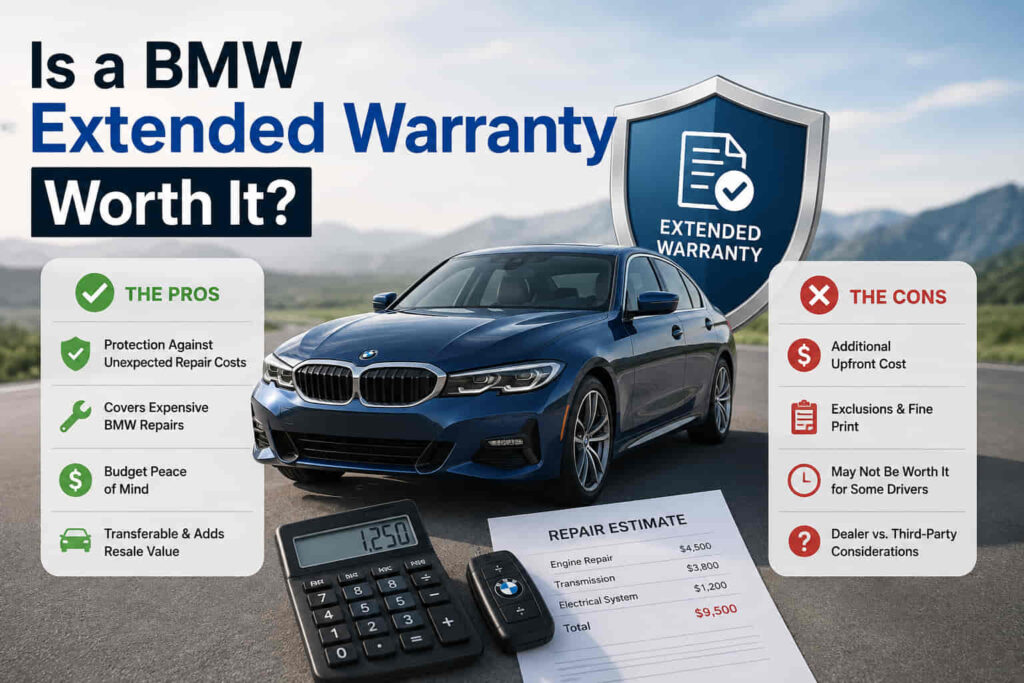
A BMW extended warranty can be worth it if you plan to keep your vehicle after its original warranty expires and want financial protection from eligible unexpected repairs. Its actual value depends on the price of the coverage, the components included, exclusions, deductible requirements, vehicle age and mileage, and how long you intend to own the BMW. An extended warranty is therefore most valuable when its protection matches your expected repair exposure rather than simply because the vehicle is a BMW.
There are 7 main reasons a BMW extended warranty may justify its cost. Coverage can reduce exposure to expensive eligible repair bills, provide protection during longer ownership, cover certain costly vehicle systems, and make some ownership expenses more predictable. Its value can become more relevant after applicable factory coverage ends, particularly for an owner who prefers transferring part of the financial risk of unexpected mechanical repairs instead of paying the entire eligible repair cost out of pocket.
However, an extended warranty does not automatically make financial sense for every BMW owner. The decision requires comparing the contract price and deductible with its actual coverage, exclusions, remaining factory protection, expected ownership period, and potential repair costs. Evaluating these factors determines whether a BMW extended warranty provides meaningful financial protection or simply adds another ownership expense.
Can a BMW Extended Warranty Protect You From Expensive Repair Bills?
A BMW extended warranty can be worth it when it protects the owner from eligible unexpected repairs that would otherwise require a significant out-of-pocket payment. The primary financial benefit is not that the warranty eliminates every ownership expense, but that it transfers part of the risk of certain covered mechanical or electrical failures from the vehicle owner to the warranty or service-contract provider.
This protection matters because repair expenses are uncertain. An owner can budget for scheduled maintenance such as oil changes, filters, and other predictable service, but an unexpected failure can create a substantially different financial obligation. When that failure involves a component covered by the contract, the owner may be responsible only for the applicable deductible and expenses excluded by the agreement rather than the entire eligible repair bill. The value comes from limiting exposure to qualifying repair costs during the coverage period.
However, a BMW extended warranty should not be treated as unlimited repair protection. Coverage depends on the specific contract, and routine maintenance, wear items, pre-existing problems, or explicitly excluded components may not qualify. A plan that appears comprehensive based on its name can provide less financial protection than expected if important components or failure conditions are excluded. The contract terms therefore matter more than the phrase “extended warranty” itself.
The financial value becomes clearer when the warranty price is compared with the repair risk it actually covers. A plan costing thousands of dollars but excluding the systems most relevant to the vehicle may provide poor value, while coverage that protects against several potentially expensive eligible failures can substantially reduce financial uncertainty. The correct comparison is therefore not simply warranty cost versus one repair bill; it is total contract cost versus the repair exposure transferred during the entire coverage period.
Do High BMW Repair Costs Make an Extended Warranty Worth It?
Higher potential repair costs can make a BMW extended warranty more valuable because the financial benefit of coverage increases when an eligible failure would otherwise create a large repair bill. This does not mean every BMW will develop an expensive problem or that an extended warranty will always cost less than paying for repairs directly. It means repair-cost exposure is one of the main variables that should determine whether the coverage is economically reasonable.
The mechanism is straightforward. Consider two owners who pay the same amount for extended coverage. The first owner experiences no covered failures during the contract period, while the second experiences an eligible failure with a repair cost substantially higher than the deductible. The same warranty produces different direct financial outcomes for these owners because warranty value depends partly on which covered failures actually occur. This uncertainty is why an extended warranty functions primarily as risk protection rather than a guaranteed method of reducing total ownership costs.
Repair cost alone is also insufficient for judging a plan. A costly component provides no warranty value if the contract excludes that component or the specific cause of failure. Conversely, coverage of expensive powertrain, electrical, or technology-related components can increase the potential value of a contract when those systems are explicitly included. Owners should therefore compare the systems covered by the agreement with the types of repair expenses they are trying to protect themselves against.
This comparison becomes particularly important before purchasing coverage based only on fear of a large repair bill. The relevant question is not whether a BMW can be expensive to repair, but whether the specific extended warranty covers enough meaningful repair exposure to justify its price. A strong evaluation compares the contract price, deductible, covered components, exclusions, coverage period, and potential eligible repair costs together. That approach determines the financial value of the warranty more accurately than assuming that high repair costs automatically make extended coverage worthwhile.
Read more: bmw tire pressure reset
Is a BMW Extended Warranty Worth It If You Keep the Car for Several Years?
A BMW extended warranty can become more valuable if you plan to keep the car for several years beyond its original warranty coverage. Longer ownership increases the period in which the owner may be financially responsible for eligible mechanical or electrical repairs, making the relationship between ownership length and extended coverage an important part of the decision.
The timing of coverage matters because an owner who sells or trades the BMW while substantial original warranty protection remains has less opportunity to use additional protection. An owner who keeps the vehicle after that protection ends faces a different financial position. Repair costs that previously qualified for warranty coverage may become the owner’s responsibility unless another applicable protection plan is in place. Extended coverage can reduce this exposure when the failure and component meet the terms of the contract.
Vehicle age and mileage also affect this calculation because a BMW changes mechanically as it accumulates use. However, age or mileage alone does not prove that an extended warranty is worthwhile. The more useful comparison combines the vehicle’s condition, remaining factory protection, expected ownership period, extended warranty term, coverage limits, exclusions, and contract price. A long ownership period strengthens the case for additional protection only when the contract continues to provide meaningful coverage during the years or mileage the owner expects to need it.
For example, an owner planning to replace a BMW soon has a different warranty need from someone intending to keep the same vehicle well beyond the end of its existing coverage. The second owner has a longer period of exposure to unexpected repair expenses and therefore more opportunity to benefit from eligible claims. The key question is not simply how old the BMW is, but how much uncovered ownership remains and how much relevant repair risk the extended warranty transfers during that period.
Can a BMW Extended Warranty Cover Expensive Vehicle Systems?
A BMW extended warranty can provide substantial value when it covers vehicle systems that would be expensive to repair out of pocket, but the specific contract determines which components and failures qualify. Coverage breadth is therefore more important than assuming that every plan sold as an extended warranty protects the entire vehicle.
Different contracts can provide different levels of protection. Depending on the agreement, coverage may extend to eligible components within major mechanical, powertrain, electrical, or technology-related systems. The presence of an expensive system in a BMW does not mean every failure involving that system is covered. The component, cause of failure, coverage period, claim conditions, and exclusions must all satisfy the contract before the repair qualifies.
This distinction becomes important as vehicles integrate mechanical components with electronic control units, sensors, displays, comfort equipment, and other technology. A warranty that protects only a narrow group of components creates a different financial benefit from one that covers a broader range of eligible systems. Two plans with similar prices can therefore have substantially different value when their covered-component definitions and exclusions are compared.
Owners should evaluate coverage before focusing on the maximum contract term or the marketing name of the plan. A longer warranty provides limited additional protection if the systems that concern the owner are excluded. Conversely, meaningful coverage of high-cost components can strengthen the financial case for an extended warranty when the owner intends to keep the BMW throughout the protected period. The value comes from the repair exposure actually covered, not from the number of years printed on the warranty alone.
Can a BMW Extended Warranty Make Ownership Costs More Predictable?
A BMW extended warranty can make part of the vehicle’s ownership costs more predictable by replacing some exposure to eligible unexpected repair bills with a known contract cost and any applicable deductible. This does not make the total cost of owning a BMW predictable because maintenance, wear items, insurance, fuel, tires, and excluded repairs remain separate expenses. The financial benefit applies specifically to repairs covered under the warranty or vehicle service contract.
Without extended coverage, the owner retains the financial risk of unexpected repairs after applicable warranty protection ends. A month with no mechanical problems may create no repair expense, while an eligible component failure in another month can result in a substantial unplanned bill. Extended coverage changes this risk structure. The owner pays an agreed price for protection and, when a qualifying failure occurs, the contract determines how much of the eligible repair cost is covered and how much remains the owner’s responsibility.
The deductible is an important part of this calculation. A warranty with a lower purchase price but a deductible applied to qualifying repairs can create a different total cost from a more expensive plan with different deductible terms. Coverage limits and exclusions can change the result further. For this reason, owners should evaluate the complete financial structure of the agreement rather than comparing the purchase price alone.
Predictability can be especially valuable for an owner who prefers a planned ownership budget over accepting the full risk of an unexpected covered repair. However, an extended warranty does not guarantee financial savings. An owner who makes few or no eligible claims may pay more for the contract than the amount received in covered repairs. Its economic value is therefore based on both potential repair protection and the owner’s willingness to pay a known amount to reduce uncertain financial exposure.
Is Extended Coverage Valuable After the BMW Factory Warranty Expires?
Extended coverage can be valuable after applicable BMW factory warranty protection expires because the owner would otherwise become financially responsible for repairs that are no longer covered by that original protection. The value increases when the owner plans to keep the vehicle during this uncovered period and the extended plan protects against repair risks that would be expensive to absorb personally.
Factory warranty expiration creates an important transition in the ownership cycle. Before expiration, an eligible defect may fall within the manufacturer’s applicable warranty terms. After that protection ends, the same owner can face a different financial responsibility. Extended coverage is designed to address part of this post-warranty exposure, but the exact protection depends on the agreement purchased rather than simply continuing every term of the original warranty.
An extended warranty should therefore not be interpreted as an automatic extension of identical factory coverage. Contract terms can define covered components, exclusions, deductibles, mileage limits, time limits, claim procedures, and other conditions differently. A plan that extends protection for several years can still provide limited value if its exclusions remove the repairs most relevant to the owner. Conversely, appropriate coverage during a substantial post-factory-warranty ownership period can reduce exposure to eligible repair bills.
The remaining factory protection should also be considered before purchasing additional coverage. Paying for protection that substantially overlaps with coverage already available can reduce the practical value received during that period. The stronger case exists when the extended protection corresponds with the period in which the owner expects to keep the BMW without applicable original warranty coverage. The relevant comparison is therefore not simply how long the extended warranty lasts, but how much useful protection it provides during the owner’s actual uncovered ownership period.
Does a BMW Extended Warranty Provide Peace of Mind?
A BMW extended warranty can provide peace of mind by reducing uncertainty about how much an owner may need to pay for eligible unexpected repairs. The value comes from transferring part of a defined financial risk to the warranty or service-contract provider rather than knowing that every future repair will be covered. For owners who prefer predictable financial exposure, this protection can have value even when total covered claims do not ultimately exceed the price paid for the plan.
This benefit is different from direct repair-cost savings. A warranty produces measurable financial savings when the amount paid for eligible repairs exceeds the relevant cost of obtaining and using the coverage. Peace of mind, by contrast, comes from knowing that qualifying failures are subject to predetermined contract terms. An owner may therefore value the protection because a large eligible repair is less likely to create an unexpected out-of-pocket expense during the coverage period.
The benefit depends on understanding the contract before purchasing it. Coverage limits, exclusions, deductibles, claim requirements, and the definition of a covered failure determine how much financial uncertainty is actually transferred. A plan with extensive exclusions can provide less reassurance because an owner may discover that a repair expected to be covered does not qualify. Reading the contract is therefore part of the value assessment rather than an administrative step that should be completed after purchase.
Peace of mind is most relevant for an owner who intends to keep the BMW beyond existing coverage and does not want to assume the full financial risk of eligible mechanical or electrical failures. An owner with sufficient funds to absorb unexpected repairs and a preference for self-insuring that risk may assign less value to the same contract. The seventh reason a BMW extended warranty can be worth it is therefore financial certainty, but its value depends on the owner’s tolerance for repair risk and the protection the contract actually provides.
When Is a BMW Extended Warranty Not Worth It?
A BMW extended warranty is less likely to be worth it when the contract price is high relative to the useful coverage received, the owner will sell the vehicle before benefiting from much of the protection, or exclusions substantially limit the repair risks the owner wants covered. Extended coverage should therefore be evaluated as a financial product with specific benefits and limitations rather than an automatic requirement for owning a BMW.
Expected ownership length is one of the clearest examples. An owner planning to sell or trade the vehicle while meaningful existing warranty protection remains may receive limited practical benefit from purchasing additional coverage. The same issue can occur when a substantial portion of the extended protection overlaps with coverage already available. What matters is the amount of useful protection available during the period when the owner would otherwise bear the repair risk personally.
The contract can also provide poor value when its exclusions and restrictions significantly narrow eligible repairs. A low-priced plan is not necessarily a better purchase if the components most relevant to the owner are excluded. Likewise, paying more for broad coverage is difficult to justify when the owner has a short remaining ownership period or is financially comfortable paying unexpected repairs directly. Warranty price must always be evaluated alongside coverage rather than in isolation.
Self-insuring is the principal alternative. Instead of purchasing extended coverage, an owner can reserve money for future repairs and retain the risk personally. This approach avoids the upfront warranty cost but exposes the owner to the full expense of unexpected repairs when they occur. The decision therefore depends partly on risk tolerance: extended coverage exchanges an upfront, more predictable cost for protection against specified repair risks, while self-insuring preserves the upfront money but leaves those risks with the owner.
What Does a BMW Extended Warranty Not Cover?
A BMW extended warranty does not necessarily cover every repair, maintenance service, or component because coverage is defined by the specific contract and its exclusions. This distinction is essential when deciding whether a BMW extended warranty is worth it. The financial value of a plan depends as much on what it excludes as on what it advertises as covered.
Routine vehicle maintenance should not automatically be treated as an extended-warranty benefit. Scheduled servicing and other normal ownership expenses serve a different purpose from protection against eligible mechanical breakdowns. Wear-related components and conditions may also be treated differently from covered failures depending on the agreement. An owner who calculates warranty value by adding routine maintenance expenses to potential repair savings can therefore overestimate the protection being purchased.
Exclusions become particularly important when a repair involves a component that appears to fall within a covered vehicle system. Coverage of a system does not automatically mean every possible failure involving that system qualifies. The cause of the failure, vehicle condition, contract requirements, previous problems, and specific exclusion language can affect claim eligibility. The written agreement must therefore be checked before assuming that a particular repair will be paid.
This creates a practical rule for comparing BMW extended warranty options: evaluate covered failures and exclusions together. Broad marketing terms provide less useful information than the actual contract language defining eligibility. A warranty becomes more valuable when its protection closely matches the repair risks an owner wants to transfer and less valuable when exclusions leave those same risks primarily with the owner.
How Much Does a BMW Extended Warranty Cost?
The cost of a BMW extended warranty varies because the price depends on the vehicle, coverage selected, contract length, mileage limits, deductible terms, and other conditions attached to the plan. A single price should therefore not be treated as representative of every BMW or every extended protection option. The relevant financial question is whether the quoted price provides enough useful coverage to justify the cost for the specific vehicle and ownership period.
Price should be evaluated together with the deductible and coverage terms. A lower upfront price does not automatically produce a lower total ownership cost if the contract provides narrower protection or requires the owner to pay more when eligible repairs occur. Likewise, a more expensive plan does not automatically provide better value simply because its purchase price is higher. The financial value depends on how much relevant repair exposure the contract transfers during the period the owner expects to use it.
Vehicle age, mileage, and the requested coverage period can also influence the value equation. These factors affect how long protection remains useful and how the plan overlaps with existing coverage. An owner purchasing protection for a relatively short uncovered ownership period has a different financial calculation from an owner planning to keep the BMW for several additional years.
The strongest way to evaluate a quote is to compare the total warranty expense with the protection actually received. That comparison should account for the contract price, applicable deductible, covered components, exclusions, coverage term, mileage limit, and remaining factory protection. Without a specific quote and contract, declaring a BMW extended warranty either cheap or expensive provides little useful information because price only becomes meaningful when measured against coverage and repair exposure.
Is a BMW Extended Warranty Worth It for a Used BMW?
A BMW extended warranty can be worth it for a used BMW when the vehicle has limited remaining warranty protection, the owner expects to keep it for several years, and the contract provides meaningful coverage for eligible repair risks. Buying a used BMW does not by itself make extended coverage necessary. Vehicle condition, age, mileage, existing protection, warranty eligibility, and contract cost all affect the decision.
A used vehicle can create a different risk profile from a BMW that remains within substantial original warranty coverage. As ownership continues, the buyer may eventually become responsible for eligible repair expenses that would previously have fallen within applicable warranty protection. An extended plan can transfer part of that financial exposure when the relevant components and failures meet the contract requirements.
The condition and history of the used BMW remain important because an extended warranty should not be treated as a way to correct every problem that existed before coverage began. Contract conditions and exclusions determine whether a repair qualifies, and a pre-existing problem may be treated differently from a failure that develops during the covered period. A pre-purchase vehicle inspection and warranty therefore serve different functions: an inspection helps identify the condition of the vehicle before purchase, while warranty coverage addresses qualifying future events according to its terms.
The decision should consequently be vehicle-specific. A well-maintained used BMW with remaining protection, a short expected ownership period, and an expensive extended plan can present a weaker case for additional coverage. A vehicle that will be kept through a substantial uncovered period can create a stronger case when the plan offers relevant protection at a price the owner considers reasonable. Used status increases the importance of evaluating repair exposure, but it does not automatically make an extended warranty worth the cost.
Is a BMW Extended Warranty Better Than a Third-Party Warranty?
A BMW extended warranty is not automatically better than a third-party warranty because the better option depends on coverage, exclusions, deductible terms, repair requirements, claims procedures, contract length, and the organization responsible for the agreement. Comparing provider names without comparing the contracts can therefore produce the wrong purchasing decision.
Coverage is the first meaningful comparison. Two plans can use similar language while protecting different components or defining eligible failures differently. A plan with broader relevant coverage may provide more value even when its purchase price is higher, while a cheaper contract can become less useful if exclusions remove the repair risks the owner is specifically trying to protect against.
The repair and claims process also affects practical value. Contract terms can determine where covered work is performed, how authorization is obtained, which documentation is required, what deductible applies, and how an eligible claim is handled. These conditions matter because warranty value is realized when a covered repair is needed, not when the contract is purchased. A plan that appears attractive on price but creates restrictions inconsistent with the owner’s repair preferences can therefore be a poor fit.
The correct comparison is contract against contract. Review equivalent coverage periods and compare the covered components, exclusions, deductible structure, claims requirements, repair options, and total price. Choose the plan whose actual terms best match the BMW, expected ownership period, repair risk, and owner’s financial priorities rather than assuming that either manufacturer-related or third-party coverage is universally superior.
How Do You Decide if a BMW Extended Warranty Is Worth the Cost?
A BMW extended warranty is worth the cost when the financial protection and risk reduction provided by the contract justify its total price for your specific vehicle and expected ownership period. The decision should combine warranty cost, deductible, coverage, exclusions, remaining factory protection, vehicle condition, age and mileage, expected ownership length, and the owner’s ability to absorb unexpected repairs.
Start with the period in which protection will actually be useful. An owner who expects to keep the BMW well beyond applicable factory coverage has more potential exposure to out-of-pocket repairs than someone planning to sell the vehicle soon. The extended warranty should then be evaluated against that uncovered ownership period. Coverage that primarily overlaps with existing protection or extends well beyond the expected sale date provides less practical value.
Next, determine which financial risks the contract actually transfers. Covered components and eligible failures should correspond with the repair exposure the owner wants protection against, while exclusions reveal which expenses remain the owner’s responsibility. The deductible must be included because an eligible claim can still require an out-of-pocket payment. A contract should not be judged by its maximum term or marketing description when its actual terms provide limited relevant protection.
The final decision depends on risk tolerance as well as expected cost. An owner who can comfortably maintain a repair fund may prefer to self-insure and accept the possibility of paying a large future repair bill. Another owner may prefer paying a known warranty cost to reduce exposure to qualifying unexpected repairs. Neither strategy guarantees the lowest total expenditure because future failures cannot be known in advance.
For that reason, the answer to “Is a BMW extended warranty worth it?” is conditional rather than universal. A BMW extended warranty is most likely to be worth it when you plan to keep the vehicle beyond existing warranty protection, the contract covers meaningful high-cost repair risks, exclusions are reasonable, and the total price fits the amount of financial risk you want to transfer. It is less compelling when the coverage is narrow, the price is high relative to the protection received, substantial existing coverage remains, or you plan to sell the BMW before receiving meaningful value from the contract.