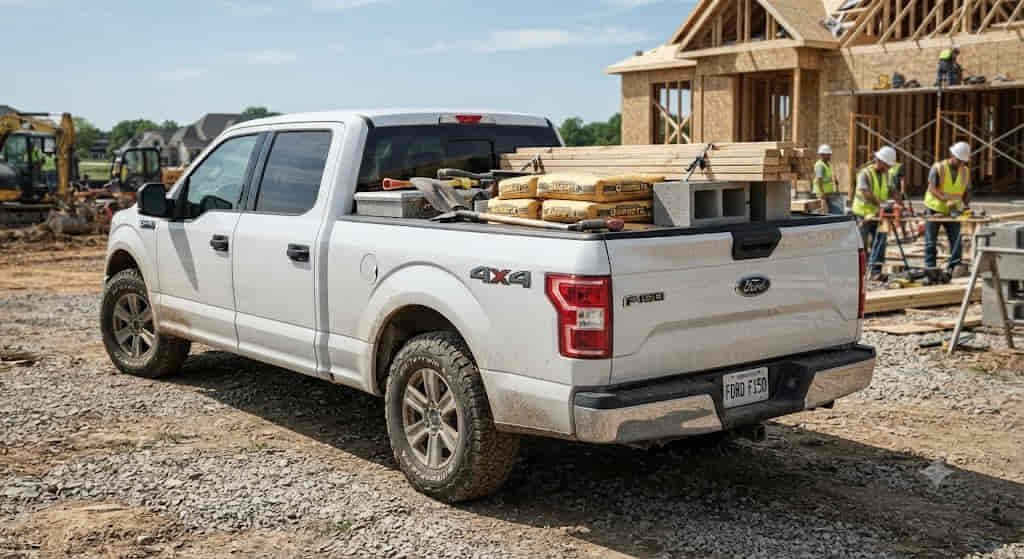
Ford F150 payload capacity describes how much weight the truck can carry inside the vehicle, including passengers, cargo, accessories, and other loads that count against the vehicle’s allowable weight. It is one of the most important specifications to understand when using an F-150 for hauling tools, materials, recreational equipment, or trailer-related cargo.
Payload capacity should not be confused with towing capacity. Towing capacity refers to the weight of a loaded trailer the F-150 can tow, while payload refers to the weight carried by the truck itself. Ford defines payload as the combined maximum allowable weight of cargo and passengers that the vehicle is designed to carry.
The maximum available payload varies considerably between F-150 configurations. Ford’s current specifications show that payload can change with engine, drivetrain, cab configuration, accessories, and other vehicle configuration factors. For example, Ford lists up to 2,440 pounds of available payload for the 2025 and 2026 F-150, but that figure does not apply to every F-150.
What Is Ford F150 Payload Capacity?
Payload capacity is the amount of weight an F-150 can carry within its allowable vehicle weight limits. This includes people sitting in the cab, cargo placed in the bed or cabin, aftermarket equipment, and certain trailer-related loads transferred to the truck.
The concept is easiest to understand through the relationship between Gross Vehicle Weight Rating and the vehicle’s unloaded weight. Ford explains that payload can typically be calculated by subtracting curb weight from GVWR. The resulting figure represents the available capacity for passengers and cargo under the applicable configuration.
In real-world use, the maximum advertised payload is not necessarily the amount available on a particular truck. A heavily equipped F-150 can weigh more than a lightly equipped truck, leaving less remaining capacity for occupants and cargo.
Ford F150 Payload Capacity vs Towing Capacity
Payload and towing capacity describe two different types of vehicle capability.
Payload is the weight carried by the F-150 itself. Towing capacity is the maximum allowable loaded trailer weight that the vehicle can tow under a particular configuration.
This distinction becomes especially important when towing because the trailer’s tongue weight is transferred to the truck. Although most of the trailer’s weight remains supported by its own axles, the portion applied to the hitch becomes part of the load carried by the F-150.
An F-150 can therefore remain within its maximum trailer rating while still exceeding its available payload if passengers, cargo, accessories, and tongue weight collectively push the truck beyond its allowable vehicle weight.
Ford F150 Payload Capacity and GVWR
GVWR, or Gross Vehicle Weight Rating, is the maximum allowable loaded weight of the truck itself. It includes the vehicle, occupants, cargo, fluids, and other applicable loads.
Payload is the remaining capacity within that GVWR after accounting for the truck’s actual unloaded weight.
This relationship explains why two F-150 trucks with the same engine can have different available payload ratings. Equipment, cab configuration, drivetrain, wheels, tires, options, and accessories can change vehicle weight and therefore change the amount of remaining payload.
The GVWR and vehicle-specific carrying information should therefore be treated as configuration-specific rather than assuming that every F-150 with the same engine has identical payload capacity.
How Much Payload Can a Ford F150 Carry?
There is no single payload number that applies to every Ford F-150. Ford’s published figures demonstrate substantial variation between powertrains and configurations.
For the 2025 F-150, Ford lists available maximum payload figures of up to 1,775 pounds for the 2.7L EcoBoost V6, 2,440 pounds for the 3.5L EcoBoost V6, 1,815 pounds for the 3.5L PowerBoost Full Hybrid V6 in the towing guide, 2,225 pounds for the 5.0L V8, 1,405 pounds for the high-output 3.5L EcoBoost Raptor, and 1,410 pounds for the 5.2L supercharged V8 Raptor R. Ford notes that maximum payload varies with accessories and vehicle configuration.
Ford’s consumer specifications also show a maximum available payload of 2,440 pounds for the 2025 F-150.
These figures should be treated as maximum available ratings rather than the payload capacity of every truck equipped with that engine.
Ford F150 Payload Capacity by Engine
Engine selection can affect payload because different powertrains have different weights and are paired with different vehicle configurations.
The 3.5L EcoBoost has one of the highest available payload ratings in the current F-150 lineup, while the high-output EcoBoost used in the Raptor and the supercharged V8 used in the Raptor R have lower maximum payload ratings. Ford’s published data illustrates why engine type and vehicle configuration need to be considered together.
The PowerBoost hybrid also demonstrates why powertrain comparison cannot be based solely on horsepower or towing capability. Its hybrid components add weight to the vehicle, and the resulting payload rating can differ from a comparable gasoline configuration.
The correct payload figure should therefore be matched to the exact truck rather than inferred from engine displacement alone.
Ford F150 Payload Capacity by Cab and Configuration
Cab configuration can influence payload because Regular Cab, SuperCab, and SuperCrew models have different weights and packaging.
Ford lists Regular Cab, SuperCab, and SuperCrew configurations for the F-150, and available payload varies according to the complete vehicle configuration.
Drivetrain can also affect the available payload. A four-wheel-drive configuration can weigh differently from a two-wheel-drive configuration, changing the amount of remaining payload.
Bed length, wheels, tires, trim level, factory packages, and optional equipment can also contribute to differences between otherwise similar trucks.
For this reason, “F-150 payload by engine” is useful for understanding general capability, but it should not replace the vehicle-specific payload information for an individual truck.
How to Find the Payload Capacity of Your Ford F150
The most reliable way to determine the payload capacity of a particular F-150 is to use the vehicle’s own weight-rating information rather than relying on a generic online chart.
Ford recommends using the information on the doorjamb label for the specific vehicle’s carrying capacity. Ford’s towing resources also distinguish the published maximum payload from the rating of an individual vehicle.
This distinction is important because advertised maximum payload figures are based on particular configurations. An individual F-150 with additional factory options or aftermarket equipment may have a lower available payload.
When calculating the remaining capacity for a trip, the actual occupants, cargo, accessories, and applicable trailer tongue load should all be considered.
Ford F150 Payload Capacity and Curb Weight
Curb weight is the weight of the vehicle in a specified unloaded condition, while payload represents the additional allowable load within the vehicle’s weight rating.
A lighter F-150 can have more available payload than a heavier F-150 with the same GVWR. This is one reason why payload ratings can vary even among trucks with similar engines and trim levels.
Adding accessories can reduce practical payload because accessories become part of the vehicle’s loaded weight. Bed covers, running boards, toolboxes, racks, winches, bumpers, suspension components, and other equipment can all consume part of the available carrying capacity.
The correct calculation therefore considers the actual truck rather than simply starting with a maximum advertised number.
Ford F150 Payload Capacity and Passengers
Passengers count toward payload. This is especially important when the truck is used for work crews or family trips because several occupants can consume a significant portion of the available carrying capacity before cargo is loaded into the bed.
For example, an F-150 with a high advertised payload rating can still have considerably less capacity remaining after several passengers, tools, and accessories are added.
Payload should therefore be viewed as one total weight budget rather than a separate allowance for the bed and another allowance for the cabin.
Read more: Ford F150 Generations
Ford F150 Payload Capacity and Bed Cargo
Cargo carried in the truck bed is part of the F-150’s payload. Lumber, construction materials, camping equipment, motorcycles, recreational gear, tools, and other cargo all contribute to the loaded vehicle weight.
The location of cargo can also matter because axle loading is affected by where the weight is placed. A truck may remain below its overall GVWR while an individual axle approaches its own allowable rating.
Heavy cargo should therefore be secured correctly and distributed in accordance with the vehicle and cargo manufacturer’s requirements.
Ford F150 Payload Capacity and Tongue Weight
When an F-150 tows a conventional trailer, tongue weight becomes part of the load imposed on the truck. Ford explains that tongue weight is the downward force exerted on the hitch ball by the trailer coupler.
This means that trailer weight cannot simply be treated as separate from payload. A trailer may weigh thousands of pounds, but only its portion transferred through the hitch directly adds to the truck’s payload load.
Passengers, bed cargo, aftermarket equipment, and tongue weight therefore need to be considered together when evaluating the remaining payload available for a towing setup.
Ford F150 Payload Capacity and Trailer Towing
Payload and towing ratings interact even though they represent different limits.
A truck may have a high maximum trailer rating but comparatively limited payload. When a trailer is attached, the tongue load consumes part of the F-150’s available payload, leaving less capacity for passengers and cargo.
Ford’s towing guides explicitly note that payload and towing are independent attributes and may not be achieved simultaneously.
This is why selecting an F-150 for towing should involve more than comparing maximum trailer ratings. The truck’s payload rating must also support the occupants, cargo, hitch equipment, and trailer tongue load.
Ford F150 Payload Capacity and Accessories
Factory and aftermarket accessories can reduce the practical payload available for cargo.
A heavier wheel and tire combination, bed rack, tonneau cover, toolbox, auxiliary equipment, winch, replacement bumper, camper equipment, or other accessory adds weight to the truck. That weight becomes part of the loaded vehicle and reduces the remaining payload.
The impact may be small for a lightweight accessory but significant when several heavy accessories are installed together.
This is particularly relevant for work trucks and overlanding builds because accessories can accumulate into several hundred pounds before any passengers or cargo are added.
Ford F150 Payload Capacity and Axle Ratings
GVWR is not the only weight-related limit that matters. The front and rear axles also have their own weight ratings.
Cargo location changes how much weight is carried by each axle. A load concentrated near the rear of the bed can increase rear-axle loading more than the same total weight positioned closer to the front of the bed.
For towing applications, tongue weight can also increase rear-axle loading. Therefore, remaining payload should not be evaluated solely by adding up cargo weight without considering axle distribution.
The vehicle’s certification information and applicable Ford documentation should be used when determining the allowable axle and vehicle loading for a specific F-150.
Ford F150 Payload Capacity by Model Year
Payload capacity has changed throughout the history of the F-150. Different generations introduced new frames, engines, body materials, suspension systems, transmissions, and configurations.
The 2015 generation, for example, introduced a high-strength aluminum-alloy body that reduced vehicle weight compared with the previous generation, while later generations introduced additional powertrain and technology changes.
Current F-150 payload figures should therefore not be applied retroactively to older trucks. A 2015, 2020, 2021, or 2026 F-150 can have different payload characteristics depending on its specific configuration.
For model-year research, the correct Ford towing guide and vehicle-specific certification information should take priority over generic F-150 payload charts.
How to Calculate Ford F150 Remaining Payload
Remaining payload can be understood as the vehicle’s allowable payload minus the weight already added to the truck.
The calculation starts with the vehicle-specific payload rating and accounts for occupants, cargo, accessories, and applicable trailer tongue load. If the truck has already been modified with heavy equipment, that equipment should be included before calculating how much additional cargo can be carried.
For a towing setup, the calculation should also account for hitch equipment and tongue weight rather than treating the trailer as completely separate from the truck.
Ford’s general payload guidance uses the relationship between GVWR and curb weight, but the actual doorjamb information for the specific vehicle is the better reference when determining real-world carrying capacity.
What Happens If You Exceed Ford F150 Payload Capacity?
Exceeding the vehicle’s payload capacity can increase stress on the suspension, tires, wheels, brakes, drivetrain, frame, and other components. It can also affect handling, steering response, braking distance, stability, and overall vehicle control.
Excessive loading can also create an axle overload even when the total vehicle weight appears close to an acceptable value.
For these reasons, payload should be treated as a vehicle safety limit rather than a suggestion. Cargo should be weighed when its actual weight is uncertain, particularly when the truck is being loaded near its rated capacity.
Ford F150 Payload Capacity FAQ
What is the maximum payload capacity of a Ford F150?
The maximum available payload varies by model year and configuration. For the 2025 and 2026 F-150, Ford lists up to 2,440 pounds of available payload, but the maximum does not apply to every F-150.
How is Ford F150 payload capacity calculated?
Payload is generally related to GVWR minus the vehicle’s curb weight. Ford recommends using the vehicle-specific information and doorjamb label when determining actual carrying capacity.
Does towing reduce Ford F150 payload capacity?
Yes. The trailer’s tongue weight is transferred to the F-150 and therefore consumes part of the truck’s available payload.
Do passengers count toward F150 payload?
Yes. Passengers are part of the weight carried by the vehicle and therefore count against available payload.
Does a tonneau cover reduce F150 payload?
A tonneau cover adds weight to the truck, so technically it consumes part of the available payload. The reduction depends on the actual weight of the cover.
Is F150 payload capacity the same as towing capacity?
No. Payload is the weight carried by the truck, while towing capacity is the maximum loaded trailer weight the vehicle is rated to tow.
Where can I find my F150’s exact payload rating?
The vehicle-specific doorjamb certification information is the best starting point. Ford also provides towing and vehicle-specific information for determining the applicable ratings.