An Audi parking brake malfunction means the electronic parking brake (EPB) system has detected a fault that may prevent the parking brake from engaging, releasing, or operating reliably. The warning may appear because of low battery voltage, a faulty parking brake actuator or switch, damaged wiring or connectors, a rear brake caliper problem, or a related electronic control fault. The exact cause must be diagnosed before replacing components.
The severity depends on how the parking brake behaves after the warning appears. A vehicle with a warning message but a parking brake that releases normally presents a different situation from an Audi with a brake that remains engaged, fails to hold the vehicle, or displays additional braking-system warnings. A malfunction that affects normal brake operation requires more immediate attention than an isolated, intermittent EPB warning.
Diagnosing the problem starts with the warning symptoms and progresses through battery-voltage checks, diagnostic trouble codes, electrical connections, the parking brake switch, actuators, and rear calipers. This guide explains the symptoms and causes of an Audi parking brake malfunction, whether the vehicle is safe to drive, how the fault is diagnosed and reset, which repairs address specific causes, and what can help prevent the malfunction from returning.
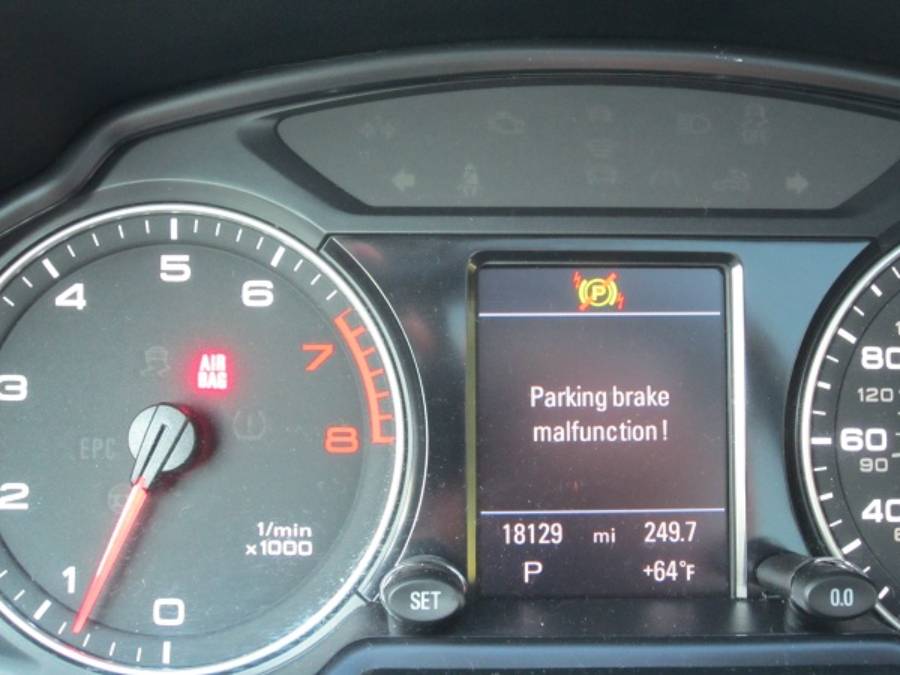
What Does an Audi Parking Brake Malfunction Mean?
An Audi parking brake malfunction means the electronic parking brake system has detected a fault that can interfere with its ability to engage, release, or confirm the position of the parking brake. Unlike a conventional handbrake that uses a manually operated lever and cable, the electronic parking brake relies on electrical commands and electromechanical components to apply and release the rear parking brakes. A fault anywhere in this operating chain can trigger a warning even when the parking brake still appears to work.
The warning does not identify one specific failed component. It indicates that the electronic parking brake system has detected an operating condition outside its expected parameters. The underlying problem can involve insufficient electrical voltage, a parking brake switch or electrical connection, an actuator mechanism, or another component involved in controlling the brake. This distinction matters because replacing a parking brake motor, caliper, or switch based only on the dashboard message does not establish that the component has failed.
An Audi can also display a parking brake malfunction intermittently. For example, an electrical condition can cause a warning during one start cycle and disappear during another. A warning that disappears should not automatically be treated as a repaired fault, particularly when it returns repeatedly. Stored diagnostic information and the conditions present when the warning occurred provide more useful evidence than the warning message alone.
The physical behavior of the parking brake helps determine the seriousness of the malfunction. A parking brake that releases normally but produces an intermittent warning requires diagnosis, while a brake that remains applied can prevent the vehicle from being driven normally. A brake that fails to engage creates a different risk because the parking brake may not hold the vehicle after it is parked. The warning message, therefore, should be evaluated together with what the parking brake actually does.
What Are the Symptoms of an Audi Parking Brake Malfunction?
The main symptoms of an Audi parking brake malfunction are a dashboard warning, a parking brake that does not release, a brake that fails to engage, and an intermittent warning that repeatedly appears and disappears. The exact symptom depends on which part of the electronic parking brake system is affected and whether the fault interrupts an electrical command, actuator movement, or confirmation that the brake has reached the requested position.
A parking brake malfunction message or warning indicator is often the first observable symptom. The warning can appear even when the driver can still engage and release the parking brake because the control system has detected a fault without a complete loss of operation. This is why the warning itself should be treated as diagnostic information rather than proof that the rear brake caliper or actuator needs replacement.
A parking brake that remains engaged is a more restrictive symptom. The driver may attempt to release the brake but find that the system does not respond as expected. Because the electronic parking brake depends on an electrical command followed by mechanical movement at the rear brakes, failure at either stage can interfere with release. Repeatedly operating the switch does not identify which stage has failed and should not replace proper diagnosis.
The opposite symptom occurs when the parking brake does not engage. In this situation, the driver requests the parking brake but the system cannot reliably apply it or confirm that it has been applied. This symptom is particularly important when parking because the driver should not assume that the electronic parking brake is holding the vehicle merely because the switch was activated.
An intermittent warning is another useful diagnostic clue. A message that appears during startup, disappears after restarting the vehicle, and later returns can point toward a fault that is not permanently present. Electrical supply and connection problems are among the areas that need to be investigated in this situation, but the warning pattern alone is not sufficient to identify the failed component. Diagnostic fault information should be combined with battery, wiring, switch, actuator, and brake-system checks before determining the repair.
What Causes an Audi Parking Brake Malfunction?
An Audi parking brake malfunction can result from six main problem areas: low battery voltage, a faulty parking brake actuator or motor, a defective parking brake switch, damaged wiring or connectors, rear brake caliper problems, and faults in related electronic control systems. These causes can produce similar dashboard warnings even though the failed component and required repair are different. Identifying the cause therefore requires matching the warning and physical symptoms with diagnostic fault codes and component tests.
A weak battery or unstable system voltage is one electrical condition to investigate when an electronic parking brake warning appears. The EPB depends on sufficient electrical power to receive commands and operate its electromechanical components. Low voltage can interfere with this process and may produce electronic faults, particularly when the warning occurs during or shortly after vehicle startup. Battery condition should therefore be checked before assuming that an expensive parking brake component has failed.
The parking brake actuator or motor is another potential source of failure because it converts an electrical command into the mechanical action required to apply or release the parking brake. A malfunction in this mechanism can result in a brake that does not engage, does not release, or produces a fault when the system cannot complete the requested movement. An actuator should not be replaced solely because these symptoms occur, however, because electrical supply and mechanical brake problems can produce similar behavior.
A faulty parking brake switch can interrupt the driver’s command to the EPB system. The switch serves as an input rather than performing the braking action itself, so a switch fault can exist even when the actuators and rear brakes remain mechanically functional. Diagnosis should establish whether the system is receiving the expected switch input before the switch is identified as the cause.
Damaged wiring, loose connections, corrosion, or poor electrical contact can also interrupt power or communication within the parking brake system. These faults are especially relevant when the malfunction is intermittent because vehicle movement, moisture, temperature changes, or connector condition can affect an electrical connection. For example, a warning that repeatedly disappears and returns can justify inspecting electrical connections rather than immediately replacing the actuator.
Rear brake caliper problems can cause a parking brake malfunction when the EPB mechanism cannot apply or release the brake as commanded. Mechanical resistance, a damaged mechanism, or another caliper-related fault can prevent the expected movement even when an electrical command is present. This creates an important diagnostic distinction: an actuator-related fault and a mechanically restricted brake can produce similar symptoms but require different repairs.
Faults elsewhere in the vehicle’s electronic control systems may also accompany an EPB warning, but they should be diagnosed from vehicle-specific fault information rather than assumed from the parking brake message alone. Audi models and model years do not all use identical system configurations. When ABS, ESC, or other brake-related warnings appear at the same time, the diagnostic scan becomes particularly important for determining whether the warnings share an underlying fault or represent separate problems.
The cause should ultimately be established through a sequence of tests rather than by replacing the component most commonly associated with the warning. Battery voltage, stored diagnostic trouble codes, switch inputs, wiring and connectors, actuator operation, and rear brake components provide separate pieces of evidence. This diagnostic sequence reduces the risk of replacing a functioning component while leaving the actual parking brake fault unresolved.
Can You Drive With an Audi Parking Brake Malfunction?
You should only drive with an Audi parking brake malfunction when the parking brake fully releases, the normal braking system behaves correctly, and no additional warning indicates a more serious brake-system fault. Do not continue driving when the parking brake remains engaged, the vehicle shows abnormal braking behavior, or the warning is accompanied by symptoms that make normal vehicle control uncertain. The dashboard message alone does not determine whether the vehicle is safe to drive; the actual behavior of the braking system is the critical factor.
An Audi that displays a parking brake malfunction but releases the parking brake normally may still be movable. This situation does not mean the fault should be ignored. An intermittent electrical or electronic problem can remain stored in the vehicle’s control system even after the warning disappears. Driving should be limited until the fault is diagnosed, particularly when the warning repeatedly returns.
Do not attempt to drive normally when the parking brake remains applied after a release command. Driving against an engaged rear parking brake can create excessive heat and place additional stress on brake components. Repeatedly accelerating to overcome the resistance does not fix the malfunction and can turn an electronic or actuator problem into additional mechanical brake damage.
A parking brake that fails to engage creates a different safety issue. The vehicle may retain normal service-brake operation while losing the function intended to hold it stationary when parked. In this situation, the driver should not assume that selecting the parking brake switch has secured the vehicle. The malfunction needs diagnosis before the electronic parking brake can again be considered reliable.
Additional brake-related warnings require greater caution. A parking brake malfunction appearing together with ABS, ESC, or other braking-system warnings can indicate that the problem extends beyond an isolated parking brake command. The exact relationship depends on the vehicle configuration and stored faults, so the warnings should be scanned and diagnosed rather than attributed automatically to one component.
Professional assistance is the safer option when the parking brake cannot be released, normal braking feels abnormal, several brake warnings appear together, or the driver cannot determine whether the vehicle can be controlled safely. A diagnostic scan can then establish whether the malfunction is confined to the EPB or is associated with another braking or electrical fault.
How Do You Diagnose an Audi Parking Brake Malfunction?
Diagnose an Audi parking brake malfunction by identifying the symptoms, checking the vehicle’s electrical supply, scanning the relevant control modules for diagnostic trouble codes, inspecting switches and electrical connections, and testing the actuator and rear brake components indicated by the results. Diagnosis should move from evidence to component testing rather than starting with replacement of the parking brake motor or caliper.
Start by recording exactly when the warning occurs and what the parking brake does at the same time. Determine whether the brake engages, releases, remains stuck, or operates normally despite the warning. Also note whether the malfunction occurs only during startup, returns intermittently, or appears together with ABS, ESC, or other brake warnings. These observations establish the symptom pattern that the remaining tests need to explain.
Check battery condition and system voltage early in the diagnostic process. The electronic parking brake requires a stable electrical supply, so an electrical problem should be excluded before an actuator or control component is condemned. This check is especially relevant when the warning first appears during startup or when the vehicle shows other signs of low or unstable electrical power.
The next step is to scan the vehicle’s relevant control modules with diagnostic equipment capable of communicating with the systems installed on the Audi being tested. Stored and current diagnostic trouble codes provide a more specific starting point than the dashboard message because they can identify the circuit, component, signal, or operating condition detected by the control system. Fault codes should be interpreted together with symptoms and test results rather than treated as automatic instructions to replace the component named in a code description.
Electrical inspection should follow when the diagnostic evidence points toward a switch, power supply, wiring, connector, or communication problem. Inspect relevant connectors and wiring for poor contact, damage, corrosion, or another condition capable of interrupting power or signals. Intermittent warnings deserve particular attention because an electrical connection can fail temporarily while still appearing functional during a later visual inspection.
The parking brake switch should also be tested when the system does not respond correctly to driver commands. A functioning switch must provide the expected input to the control system when the driver requests engagement or release. If the command is registered correctly but the brake does not move as requested, diagnosis can progress toward the actuator and mechanical brake components rather than replacing the switch without evidence.
Actuator and rear brake inspection becomes necessary when electrical commands are present but the system cannot complete the requested movement. The technician must distinguish an electrical actuator failure from mechanical resistance or a caliper-related problem. Both conditions can produce a parking brake that remains engaged or fails to apply, but replacing an actuator will not correct a separate mechanical restriction.
What Audi Parking Brake Fault Codes Should You Check?
Check the diagnostic trouble codes stored in the control modules relevant to the parking brake and braking system rather than relying on a universal list of Audi parking brake codes. The applicable codes can differ according to Audi model, model year, control-module configuration, and the specific EPB system installed. For this reason, a code should be interpreted using vehicle-specific diagnostic information.
A useful diagnostic code identifies where the control system detected an abnormal condition, but it does not always prove that the component named in the description has failed. For example, a circuit-related fault can originate from the component itself, its connector, damaged wiring, an inadequate electrical supply, or another condition affecting the circuit. The correct process is therefore fault code → related circuit or component → test → confirmed cause → repair.
Clearing codes before recording them can remove useful diagnostic information. Read and document the stored faults first, investigate the conditions associated with them, perform the appropriate tests, and clear the codes after the underlying problem has been addressed. The vehicle should then be operated or tested as appropriate to determine whether the fault returns.
Professional diagnosis is appropriate when the parking brake remains locked, the required control modules cannot be accessed with available diagnostic equipment, electrical testing is inconclusive, or actuator/caliper work requires procedures beyond the owner’s equipment and experience. Electronic parking brake service can also involve service-mode or adaptation procedures on applicable systems, making vehicle-specific repair information important before mechanical work begins.
How Do You Reset an Audi Parking Brake Malfunction?
Reset an Audi parking brake malfunction only after identifying and correcting the condition that triggered the warning. Restarting the vehicle or clearing a diagnostic trouble code can remove a warning from the dashboard, but neither action repairs a weak electrical supply, damaged wiring, faulty switch, actuator problem, or mechanical brake fault. A successful reset therefore means the system passes its checks after the underlying problem is corrected, not simply that the warning disappears.
Restarting the vehicle can make an intermittent parking brake warning disappear when the fault is no longer present during the next operating cycle. This result is useful diagnostically, but it does not prove that the EPB is repaired. A warning that disappears after restarting and later returns indicates that the underlying condition still needs investigation. The driver should record when the warning occurs and whether the parking brake engages and releases normally rather than repeatedly restarting the vehicle as a repair strategy.
Battery and electrical condition should be checked when the malfunction appears during startup or alongside other signs of electrical instability. Correcting an inadequate electrical supply may allow the electronic parking brake system to operate normally again when low voltage caused the fault. Disconnecting the battery, however, should not be treated as a universal Audi parking brake reset procedure. Audi models use different electronic configurations, and removing battery power does not repair a defective component or damaged circuit.
A diagnostic scanner can clear stored fault codes after the cause has been diagnosed and repaired. The correct sequence is to read and record the codes, test the indicated system, correct the confirmed fault, clear the codes, and verify operation. Clearing the code before diagnosis can remove useful information while leaving the malfunction unchanged.
A warning that returns immediately or repeatedly after codes are cleared provides evidence that the fault remains present. For example, an unresolved wiring problem, switch fault, actuator failure, or mechanical restriction can cause the control system to detect the same abnormal condition again. Repeatedly clearing the warning in this situation delays diagnosis rather than solving the problem.
Vehicle-specific procedures matter when electronic parking brake components are serviced. Depending on the Audi model and system configuration, brake work can require diagnostic equipment for service mode, basic settings, or adaptation procedures. A generic reset sequence should therefore not be applied to every Audi without confirming the correct procedure for the model, model year, and installed braking system.
How Do You Fix an Audi Parking Brake Malfunction?
Fix an Audi parking brake malfunction by repairing the confirmed cause of the fault, which may involve restoring proper battery voltage, replacing a defective switch, repairing wiring or connectors, servicing an actuator, or repairing the affected rear brake components. The correct repair follows diagnosis because several electrical and mechanical faults can produce similar parking brake warnings.
Correct the battery or electrical supply problem first when testing confirms inadequate or unstable voltage. The EPB depends on electrical power for control and actuation, so restoring the required electrical condition can resolve a malfunction caused by insufficient supply. The charging system should also be considered when appropriate because replacing a battery without determining why voltage is inadequate can leave the original electrical problem unresolved.
Replace the parking brake switch when testing confirms that it does not provide the expected command to the system. A warning message or failure to engage or release the brake is not sufficient evidence by itself because the same symptoms can occur farther downstream in the electrical or mechanical system. Confirming the switch input prevents replacement of a functioning control when the actual fault is located elsewhere.
Repair damaged wiring or electrical connections when inspection and testing identify an open circuit, poor connection, damaged conductor, corrosion, or another electrical defect. The repair should restore reliable power or signal transmission rather than merely make the warning disappear temporarily. After the circuit is repaired, the system should be tested again to confirm that the parking brake responds correctly and that the related fault does not return.
Repair or replace the parking brake actuator when diagnosis confirms that the actuator cannot perform the commanded movement despite receiving the correct electrical input. The actuator is responsible for converting the system’s command into mechanical parking-brake operation, so an internal failure can prevent engagement or release. Actuator replacement should follow confirmation of the failure because wiring faults and mechanical brake resistance can imitate actuator symptoms.
Rear brake or caliper problems require mechanical repair when the parking brake mechanism cannot move correctly because of a fault in the brake assembly. A mechanically restricted brake can prevent the EPB from completing its requested movement even when the electrical system and actuator command are functioning. The affected brake components should therefore be inspected before concluding that an electronic component alone is responsible.
Complete the repair by clearing applicable fault codes and verifying both engagement and release of the parking brake. Required service-mode, basic-setting, calibration, or adaptation procedures should be performed according to the specific Audi system being serviced. The final verification is important because a dashboard warning that disappears without correct physical operation does not establish that the parking brake has been repaired.
The repair process should consequently follow a consistent sequence: identify the symptom, retrieve diagnostic information, test the suspected circuit or component, confirm the cause, perform the repair, and verify normal EPB operation. This sequence prevents unnecessary parts replacement and addresses the malfunction itself rather than only removing its warning from the dashboard.
How Much Does It Cost to Fix an Audi Parking Brake Malfunction?
The cost to fix an Audi parking brake malfunction depends on the diagnosed cause because the repair can range from correcting a minor electrical problem to replacing an actuator or rear brake component. A single repair price cannot accurately represent every EPB malfunction. The final bill depends on the failed component, Audi model and model year, labor time, diagnostic work, parts selection, and whether additional programming or adaptation is required.
Diagnostic cost is the first expense when the cause is not already known. Proper diagnosis can include scanning the relevant control modules, checking battery and charging voltage, testing electrical circuits, inspecting the parking brake switch, and evaluating actuator or rear caliper operation. Paying for diagnosis before authorizing parts replacement can reduce the total repair cost when several components could produce the same warning.
Battery-related faults are generally resolved differently from mechanical EPB failures. If testing confirms that inadequate voltage is responsible for the malfunction, the repair may involve charging or replacing the battery or correcting a charging-system problem. The parking brake actuator or rear caliper should not be replaced merely because the EPB warning appeared while battery voltage was low.
Electrical repairs also vary considerably in scope. Replacing a confirmed faulty parking brake switch is different from tracing an intermittent wiring fault through connectors and harnesses. A damaged connector located quickly may require relatively little labor, while an intermittent circuit problem can require substantially more diagnostic time even when the replacement part itself is inexpensive.
Actuator and rear caliper faults can produce higher repair costs because they involve components that perform or support the mechanical parking-brake action. The exact repair depends on the EPB design installed on the vehicle and whether the failed component can be serviced separately or is associated with a larger brake assembly. Labor requirements can also increase when rear brake components must be removed and serviced.
Programming, basic settings, calibration, or adaptation can add to the repair process when required by the specific Audi system. These procedures should not be assumed necessary for every parking brake malfunction, but they need to be included in the repair estimate when the applicable service procedure requires them.
For this reason, an accurate estimate should identify at least four items: the confirmed fault, the required replacement or repair, labor time, and any required electronic setup after the repair. Comparing estimates without these details can be misleading because one quote may include diagnosis and post-repair procedures while another covers only parts and installation.
How Can You Prevent Audi Parking Brake Malfunctions?
You can reduce the risk of Audi parking brake malfunctions by maintaining a healthy electrical system, servicing the rear brakes correctly, addressing electrical damage promptly, and diagnosing intermittent EPB warnings before they develop into persistent faults. Preventive maintenance cannot eliminate every actuator or electronic failure, but it can reduce faults associated with neglected electrical and brake-system conditions.
Maintain the battery and charging system because the electronic parking brake depends on stable electrical power. A battery that is approaching the end of its service life or a charging problem can affect more than one electronic system in the vehicle. Battery condition deserves particular attention when an EPB warning appears during startup or is accompanied by other electrical symptoms.
Rear brake servicing should account for the electronic parking brake system installed on the vehicle. EPB-equipped brakes are not always serviced in the same way as conventional mechanically operated parking brakes. Using the correct service procedure helps prevent damage to actuators or related brake components during pad, rotor, or caliper work.
Keep wiring and connectors in good condition, particularly when previous inspection identifies moisture, corrosion, physical damage, or loose electrical connections. A small connection problem can create an intermittent fault before progressing to a more consistent failure. Correcting the electrical defect at this stage is preferable to repeatedly clearing the warning.
Treat recurring warnings as diagnostic evidence rather than waiting for the parking brake to stop operating completely. An Audi that displays the warning once and then operates normally may not require the same immediate response as a vehicle with a locked parking brake, but a warning that repeatedly returns establishes a pattern that should be investigated.
Preventive maintenance is therefore based on preserving the conditions the EPB needs to function: stable electrical power, reliable electrical connections, correctly serviced rear brakes, and early diagnosis of abnormal operation. These measures address the supporting systems around the electronic parking brake rather than relying on a reset after a malfunction occurs.
Why Does an Audi Parking Brake Malfunction Keep Coming Back?
An Audi parking brake malfunction keeps returning when the underlying fault remains unresolved, occurs intermittently, or was reset without a complete diagnosis and repair. Clearing a warning removes the displayed or stored fault information under certain conditions, but it does not restore a defective circuit, switch, actuator, electrical supply, or mechanical brake component.
An unresolved electrical problem is one reason a warning can disappear and later return. A loose connection, damaged wire, unstable voltage, or intermittent circuit condition may operate normally during one drive cycle and fail during another. This pattern explains why a vehicle can appear repaired immediately after a restart or code clear even though no physical repair has been performed.
Replacing a component without confirming the cause can also leave the malfunction unchanged. For example, replacing an actuator will not correct a wiring fault that prevents the actuator from receiving the correct power or command. Likewise, replacing a switch will not resolve mechanical resistance at a rear brake. Each replacement should be supported by test results that connect the failed component to the observed malfunction.
A recurring warning after a previous repair also requires checking whether the original and current faults are actually the same. Reading the current diagnostic trouble codes and comparing them with the original diagnostic information helps establish whether the first repair failed to resolve the problem, another related fault has developed, or a separate system is now producing the warning.
The correct response to a recurring Audi parking brake malfunction is therefore to scan the system again, document the current faults, reproduce the symptom where practical, test the indicated components or circuits, and verify the repair before clearing the warning. Repeated resets without this process can hide useful diagnostic evidence and delay correction of the actual fault.
Read more: Audi E Tron Problems You Never Knew
What Should You Do When an Audi Parking Brake Malfunction Appears?
Treat an Audi parking brake malfunction as a fault that requires diagnosis rather than a warning that only needs to be reset. First, determine whether the parking brake releases and engages normally and whether any additional brake, ABS, or ESC warnings are present. Do not continue driving when the parking brake remains engaged, normal braking behavior changes, or the vehicle cannot be operated safely.
Diagnosis should then move from the electrical supply to the components responsible for EPB operation. Check battery and system voltage, retrieve diagnostic trouble codes, inspect relevant wiring and connectors, verify parking brake switch inputs, and test the actuator and rear brake components indicated by the diagnostic results. This sequence separates electrical faults from actuator or mechanical brake problems and reduces unnecessary parts replacement.
A restart or diagnostic-code clear can remove the warning under certain conditions, but a reset is not a repair. When the malfunction returns, the underlying problem remains unresolved or another fault needs diagnosis. The correct repair is the one supported by testing, followed by fault-code clearing where appropriate and verification that the parking brake engages and releases correctly.