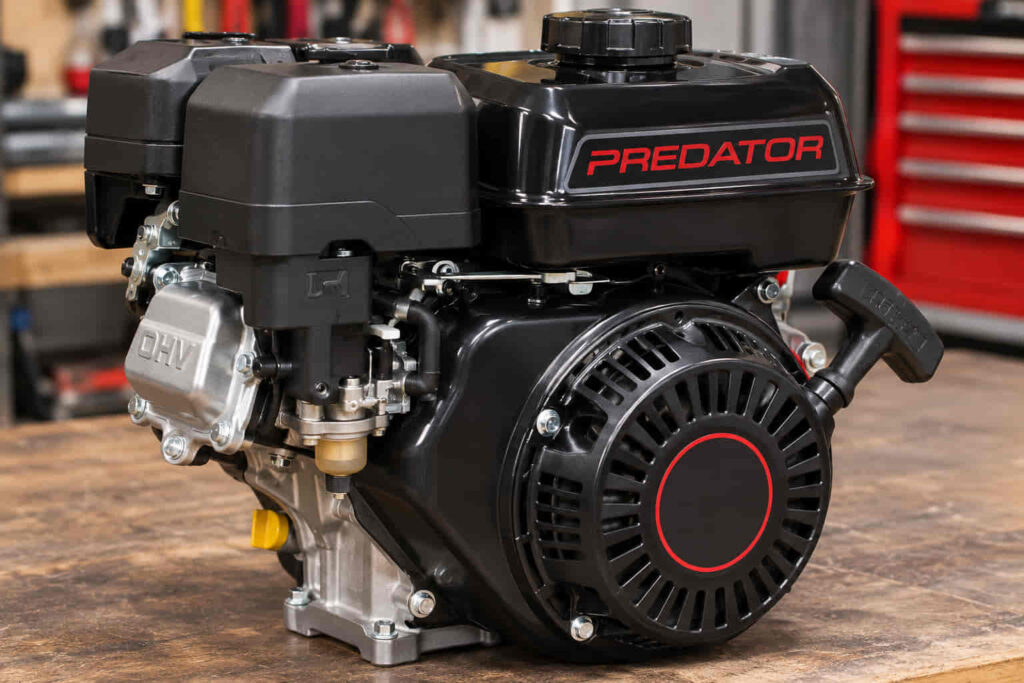
Predator engines are sold under the Predator brand owned by Harbor Freight Tools, an American tool and equipment retailer headquartered in California. The engines are sourced through outside manufacturing suppliers rather than being identified as products of a single Harbor Freight-operated engine factory. Predator engines are widely associated with overseas manufacturing, particularly China, although Harbor Freight does not publicly identify one original equipment manufacturer responsible for every Predator engine model.
This distinction is important because Predator engines are frequently described online as products manufactured by Lifan, Loncin, or RATO. These companies are established Chinese small-engine manufacturers, but the available official Harbor Freight product information does not establish that any one of them manufactures the entire Predator engine lineup.
Predator engines are not manufactured by Honda, Briggs & Stratton, Kohler, or Kawasaki simply because Harbor Freight advertises them as replacements for engines from those brands. The company’s official engine comparison chart identifies compatible applications, not common ownership or manufacturing responsibility.
The Predator engine family includes the popular 212cc 6.5-horsepower horizontal-shaft engine, the 224cc Max Performance model, the 301cc and 420cc engines, the larger 459cc Max Performance engine, and the 670cc V-twin. Harbor Freight also sells the specialized Predator 212cc GHOST racing engine.
These engines power or replace engines in equipment such as generators, pressure washers, water pumps, tillers, log splitters, and other small gasoline-powered machines. The GHOST model is specifically developed for go-kart racing.
Predator has become recognizable because of its competitive pricing, relatively simple engine architecture, and availability through Harbor Freight’s retail network.
However, understanding who owns the brand, who physically manufactures the engines, and how individual models differ is essential when evaluating their reliability, replacement parts, warranty coverage, and long-term ownership costs.
Who Makes Predator Engines?
Harbor Freight Tools is the company behind Predator engines, but the actual factory producing an individual engine may be an outside supplier whose identity is not disclosed in the public product listing.
Harbor Freight sells Predator engines under its own brand.
The company’s official product descriptions explicitly identify Predator as a Harbor Freight Tools brand.
This establishes the relationship between the retailer and the engines offered to consumers.
However, brand ownership is not identical to physical manufacturing.
A company can develop product specifications, manage quality requirements, arrange distribution, and provide customer support without operating every factory involved in production.
Predator engines are generally understood to follow this private-label manufacturing model.
The retailer markets the product, provides technical documentation, and handles relevant product support through its established network.
Manufacturing and component sourcing may involve outside companies.
The precise supplier arrangement can also vary between engine families or production periods.
For example, a small 212cc single-cylinder engine and a much larger 670cc V-twin do not necessarily originate from the same production facility.
The same applies to specialized racing engines and engine assemblies installed in Predator generators.
Therefore, the most accurate answer to the question is that Harbor Freight owns and markets Predator engines, while the precise original factory must be verified for the specific engine.
A claim naming one factory as the manufacturer of every Predator engine requires stronger documentation than the brand’s public product listings currently provide.
Who Owns the Predator Engine Brand?
Predator is a proprietary product brand of Harbor Freight Tools, the American retailer known for selling tools, automotive equipment, generators, and workshop machinery.
Harbor Freight has operated in the United States since 1977.
The business offers equipment across numerous product categories.
Some products are marketed under the Harbor Freight name, while others use specialized brands.
Predator is associated with gasoline-powered equipment and related products.
The broader Predator lineup includes standalone engines, portable generators, inverter generators, pressure washers, and other power equipment.
The brand’s exclusive retail relationship with Harbor Freight is an important distinguishing feature.
Predator engines are not a separate Honda or Briggs & Stratton product line.
Likewise, there is no basis for treating Predator as a subsidiary of Lifan or Loncin merely because those manufacturers participate in the Chinese small-engine industry.
Harbor Freight is the consumer-facing company responsible for Predator branding and the relevant product support channels.
Its published 212cc owner’s manual identifies Harbor Freight as the issuer of the documentation and provides Harbor Freight contact information for engine support.
However, these details establish brand responsibility rather than identifying the physical factory responsible for every engine component.
For warranty questions, parts availability, and product identification, Harbor Freight remains the appropriate official starting point.
Where Are Predator Engines Manufactured?
Predator engines are commonly associated with Chinese manufacturing, but the precise factory and country of final assembly should be confirmed for the individual engine model rather than assumed from the brand name.
China is a major global manufacturing center for small gasoline engines.
Numerous factories produce engines for generators, pumps, agricultural equipment, and other machinery.
These manufacturers may supply products to several international brands.
Private-label manufacturing arrangements can also involve different suppliers for different engine sizes.
Harbor Freight does not present one publicly identified factory as the manufacturer of every Predator engine in its current engine catalog.
This means a statement such as every Predator engine is manufactured by the same Chinese company would be too broad without additional evidence.
The most reliable source for a particular unit’s country of origin is its actual product label, original packaging, import documentation, or manufacturer-specific certification record.
A country-of-origin marking can identify where the unit was manufactured or assembled.
However, it may not disclose the company that produced every internal component.
For example, an engine assembled in one country could contain a carburetor, ignition module, or bearing sourced from another supplier.
Therefore, engine origin should be understood at several levels.
Brand ownership, physical assembly, engine design, and component manufacturing are related but distinct activities.
For consumers, the practical priorities are whether the engine meets the required specifications and whether replacement parts and technical support are available.
Are Predator Engines Made in China?
Many Predator engines are described as Chinese-manufactured products, but a buyer should verify the country of origin on the exact engine rather than assume the same sourcing arrangement applies to every Predator product.
The distinction matters because Predator is not a single engine model.
The product family includes small utility engines, larger V-twins, racing engines, and power equipment with integrated engines.
Different products can involve different production arrangements.
The identity of a supplier may also change over time.
Even when the engine’s country of manufacture is confirmed as China, this does not establish which Chinese company produced it.
China has numerous independent manufacturers capable of producing four-stroke gasoline engines.
Their products may share similar architectures while differing in material specifications, machining, assembly, and quality control.
Therefore, a Chinese country-of-origin label is not sufficient evidence that an engine was made by Lifan, Loncin, or RATO.
For buyers comparing engines, country of origin is only one consideration.
The engine’s construction, warranty, operating requirements, and service support are more directly relevant to ownership.
A properly maintained engine produced by a qualified supplier can provide dependable performance regardless of the country associated with the manufacturing facility.
Does Lifan Make Predator Engines?
Lifan is frequently mentioned in discussions about Predator engines, but Harbor Freight does not publicly identify Lifan as the confirmed manufacturer of its entire engine lineup.
Lifan is a Chinese manufacturer associated with motorcycles, engines, and power equipment.
The company has produced small gasoline engines for various applications.
Some Lifan engines use layouts similar to the horizontal-shaft utility engines sold under the Predator name.
This similarity has contributed to online speculation that the companies share manufacturing arrangements.
However, a similar cylinder displacement or engine appearance does not prove a common factory.
Many utility engines use comparable construction because they are designed for similar equipment.
A single-cylinder overhead-valve engine with a horizontal crankshaft is a common design throughout the small-engine industry.
Several manufacturers produce engines based on this general arrangement.
Therefore, the relationship between Lifan and an individual Predator engine should be verified through manufacturer records or other direct evidence.
It would be misleading to state that all Predator engines are Lifan engines without documentation supporting that claim.
The most useful approach for identifying parts is to begin with the exact Harbor Freight item number.
This provides a more dependable reference than assuming an engine belongs to another manufacturer’s product family.
Are Predator Engines Made by Loncin or RATO?
Loncin and RATO are also frequently discussed as potential Predator engine suppliers, but the public Harbor Freight engine catalog does not establish either company as the exclusive manufacturer of the complete Predator range.
Loncin is a Chinese engine and powersports manufacturer with experience producing gasoline engines and related machinery.
RATO is another manufacturer associated with small engines, generators, and outdoor power equipment.
Both participate in an industry where private-label production arrangements are common.
Because Predator engines occupy similar markets, comparisons between these manufacturers are understandable.
However, there is a difference between identifying a plausible supplier and verifying a specific production contract.
A component number, casting resemblance, or similar engine layout may provide a useful research clue.
It does not automatically establish the original equipment manufacturer.
The correct evidence would include a manufacturer declaration, identifiable certification record, applicable import documentation, or other reliable model-specific information.
It is also possible for different Predator products to have different suppliers.
The brand’s small horizontal-shaft engines and large V-twins should not automatically be assigned to the same factory.
Therefore, the safest conclusion is that Loncin and RATO should not be presented as confirmed manufacturers of every Predator engine without additional verification.
For servicing, Harbor Freight’s item number and parts documentation remain the primary references.
Does Honda Make Predator Engines?
No. Predator engines are not Honda-branded engines, and Harbor Freight’s compatibility comparisons do not establish Honda as their manufacturer.
The confusion is particularly common with the Predator 212cc engine.
Harbor Freight markets this engine as a possible replacement for several Honda horizontal-shaft engines.
The official comparison includes Honda GX120, GX160, and GX200 applications.
However, the chart concerns replacement suitability.
It is not a statement that Honda manufactures the Predator engine.
The Honda GX200 and Predator 212 share a broadly similar small-engine layout.
Both are single-cylinder four-stroke gasoline engines intended for utility equipment.
Their designs include an overhead-valve arrangement and a horizontal output shaft.
However, they have different nominal displacements.
The Honda GX200 is approximately 196cc, while the Predator engine is 212cc.
Component specifications and production details also differ.
A Predator engine may fit equipment originally powered by a Honda engine when the mechanical installation requirements are satisfied.
That does not make the engines identical.
The mounting pattern, crankshaft dimensions, keyway, shaft rotation, and other details must be checked.
Honda and Predator replacement parts should never be assumed interchangeable merely because the engines look similar.
Are Predator Engines Honda Clones?
The term Honda clone is often used informally to describe certain Predator utility engines because their general architecture resembles popular Honda GX-series engines.
However, the term should be interpreted carefully.
A clone in the small-engine aftermarket usually refers to an engine using a familiar arrangement of components and dimensions.
It does not necessarily mean every internal component is identical.
The Predator 212cc and Honda GX200 provide a useful example.
Both use air cooling, four-stroke operation, and an overhead-valve design.
They can also serve similar equipment applications.
However, differences may exist in cylinder dimensions, crankshafts, cylinder heads, valve trains, carburetors, ignition components, and external fittings.
Predator engines have also been produced in different configurations.
A component that fits one Predator 212 version may not fit another.
Therefore, a replacement piston, cylinder head, camshaft, or flywheel should not be purchased solely because it is advertised for a Honda GX200 clone.
The exact engine version must be identified.
The same caution applies to performance modifications.
A part designed for one engine arrangement may require different clearances or supporting components when installed in another.
The most accurate technical description is that certain Predator engines share familiar utility-engine design principles with Honda GX-series products, but they are distinct products.
Who Makes the Predator 212cc Engine?
The Predator 212cc engine is sold by Harbor Freight under its Predator brand, while the exact contract manufacturer for every 212cc production version is not identified in the official product information reviewed.
The Predator 212cc is one of the best-known engines in the company’s lineup.
Harbor Freight lists it as a 6.5-horsepower, four-stroke, overhead-valve gasoline engine.
It uses a single-cylinder configuration with forced-air cooling.
The standard engine has a horizontal output shaft.
Its design makes it suitable as a replacement engine for various types of stationary equipment when installation requirements are met.
Harbor Freight identifies its displacement as 212cc.
The published bore and stroke are approximately 70 mm and 55 mm.
Certain models use a cast-iron cylinder liner and a ball-bearing-supported crankshaft.
The product also includes features such as a low-oil shutdown sensor and a fuel shutoff valve.
However, the exact specifications depend on the item number and production version.
The 212cc engine has appeared under several Harbor Freight item numbers, including 69730 and 60363.
These identifiers are important when ordering parts.
Harbor Freight provides separate parts references for different item numbers.
The 212cc engine’s popularity has generated a large aftermarket, but that does not establish one universal parts configuration.
For maintenance and repairs, the correct item number should always be checked.
What Is the Difference Between Predator 212 Hemi and Non-Hemi?
Predator 212 Hemi and non-Hemi refer to different cylinder head and combustion chamber configurations associated with versions of the 212cc engine.
The terminology is especially common among small-engine performance enthusiasts.
A Hemi-style head has a combustion chamber layout that differs from the conventional non-Hemi design.
However, the term should not be interpreted as meaning that the engine is related to Chrysler’s automotive HEMI V8.
The Predator 212 is a small single-cylinder utility engine.
Different head configurations may affect valve train geometry and component compatibility.
Certain aftermarket modifications are specific to one version.
For example, cylinder head components, valve springs, pushrods, and performance camshaft arrangements may not be interchangeable without additional verification.
The exact crankshaft and flywheel combination also matters.
An engine advertised simply as Predator 212 may not provide enough information for selecting internal performance parts.
The owner should identify the actual item number and inspect the engine configuration.
Parts suppliers often distinguish between Hemi and non-Hemi applications.
However, the terminology used by the aftermarket should be checked against the engine’s actual physical specifications.
The manufacturer or seller’s compatibility instructions should take precedence over assumptions based on appearance.
Who Makes the Predator 212cc GHOST Racing Engine?
The Predator 212cc GHOST is a specialized kart racing engine developed and marketed by Harbor Freight under its Predator Racing product line.
Harbor Freight launched the GHOST engine in June 2022.
The company describes it as a racing-focused product developed with input from experienced karting specialists.
It differs from the standard Predator 212cc utility engine.
The GHOST features a reinforced engine structure with a cast-iron cylinder liner.
It also uses a dual ball-bearing racing crankshaft arrangement, racing-oriented internal components, and a high-flow intake design.
Its digital ignition system includes an electronic engine speed limiter.
Harbor Freight’s 2022 launch announcement describes a limiter near 6,100 RPM for the original racing configuration.
However, owners should follow the specifications for their actual model and production version.
The GHOST is intended for racing applications.
It is not simply a standard 212cc engine with different exterior decals.
The dedicated racing configuration also has different maintenance and parts considerations.
Harbor Freight offers an accessory kit for the GHOST engine.
The kit and other supporting components must be selected according to the actual engine and kart installation.
The manufacturer’s racing application and safety instructions should be followed rather than treating a standard utility engine as equivalent to the GHOST.
Who Makes the Predator 224cc Engine?
The Predator 224cc Max Performance engine is another Harbor Freight-branded gasoline powerplant designed as a higher-displacement alternative to the standard 212cc engine.
Harbor Freight lists the 224cc model as a 6.6-horsepower overhead-valve engine.
It uses a horizontal output shaft and recoil starting system.
The official product specifications identify a 58 mm crankshaft stroke.
This is longer than the 55 mm stroke listed for the standard 212cc engine.
The 224cc engine also produces higher published torque.
Harbor Freight identifies maximum torque of approximately 10.23 lb-ft for the referenced EPA-compliant model.
The model is intended for a variety of utility applications.
These include equipment such as water pumps, pressure washers, log splitters, and other compatible machinery.
Harbor Freight also markets the 224cc as a possible replacement for selected 212cc and Honda GX-series engine applications.
However, replacement compatibility must be checked carefully.
The engine’s physical dimensions and crankshaft output arrangement must match the equipment.
The precise factory supplying the 224cc engine is not conclusively identified in the public product specifications reviewed.
Therefore, a claim that the 224cc is manufactured by one particular Chinese company should be supported by model-specific documentation.
For ordinary owners, the primary concern is compatibility, maintenance support, and performance under the intended load.
Who Makes the Predator 301cc and 420cc Engines?
The Predator 301cc and 420cc engines are larger gasoline utility engines sold under Harbor Freight’s Predator brand for equipment requiring greater displacement and power.
The 301cc engine is commonly marketed with an output of approximately 8 horsepower.
The 420cc model is commonly advertised at 13 horsepower.
These engines use a horizontal-shaft configuration suited to various types of mechanical equipment.
Compared with the 212cc model, the larger engines offer additional displacement.
This can provide stronger torque characteristics for demanding applications.
A log splitter or large water pump may require more output than a small utility engine can provide.
However, displacement alone does not determine whether an engine is suitable.
The equipment’s required operating speed, torque, mounting arrangement, and power transmission system must be evaluated.
Harbor Freight provides compatibility references for replacing engines from several established manufacturers.
For example, its chart identifies Honda GX270 applications for the 301cc class and Honda GX340/GX390 applications for the 420cc class.
However, these comparisons do not prove a shared manufacturer.
The engines remain Predator-branded products.
The precise contract factory associated with every version is not disclosed in the official product pages examined.
Owners should use the Harbor Freight item number when ordering internal replacement parts.
This is particularly important when comparing older engines with newer Max Performance alternatives.
Who Makes the Predator 459cc Engine?
The Predator 459cc Max Performance engine is a larger-displacement utility engine marketed by Harbor Freight as an alternative to selected 420cc-class industrial gasoline engines.
Harbor Freight lists the model at 15.8 horsepower.
The engine uses a four-stroke, overhead-valve architecture with a horizontal output shaft.
The official specification identifies approximately 24.5 lb-ft of maximum torque at 2,800 RPM.
The engine is intended for demanding applications such as log splitters, water pumps, and related power equipment.
Its larger displacement distinguishes it from the standard Predator 420cc engine.
However, additional displacement is not the only change.
Harbor Freight advertises the Max Performance engine with revised components intended to support greater output.
The product also includes features such as a low-oil shutdown sensor and a fuel shutoff system.
Certain configurations provide both electric and recoil starting.
However, the electrical requirements must be checked before installation.
A replacement engine that uses electric starting may require compatible battery wiring and controls.
The 459cc engine is marketed as a possible replacement for selected Honda, Briggs & Stratton, Kohler, and other utility engines.
However, compatibility depends on the complete equipment installation.
The exact physical OEM supplier is not identified in the official public listing reviewed.
Who Makes the Predator 670cc V-Twin Engine?
The Predator 670cc V-twin is a larger gasoline engine sold by Harbor Freight for equipment requiring substantially greater power than a small single-cylinder utility engine.
Harbor Freight advertises the engine with an output of approximately 22 horsepower.
It uses two cylinders arranged in a V configuration.
The engine features electric starting and a horizontal output shaft.
Its construction includes cast-iron cylinder running surfaces.
The V-twin configuration provides a different power delivery characteristic from the company’s smaller single-cylinder models.
This makes it suitable for certain larger equipment installations.
Harbor Freight identifies applications such as mowers, high-pressure washers, and water pumps.
However, equipment compatibility must be verified carefully.
A 670cc engine is substantially larger and heavier than a Predator 212cc.
Its mounting dimensions, crankshaft configuration, electrical connections, exhaust routing, and operating requirements differ.
A simple engine swap may therefore require substantial changes to the equipment.
The actual manufacturing factory is not publicly identified as one exclusive OEM across all 670cc production versions.
The engine should be serviced according to its specific Predator manual.
Oil capacity, ignition components, and maintenance requirements should not be copied from the smaller single-cylinder engines.
The 670cc is a distinct powertrain configuration within the broader Predator product family.
Who Makes the Engines in Predator Generators?
Predator generators are sold under Harbor Freight’s Predator brand, but the company does not publicly identify one engine manufacturer responsible for every generator model.
The Predator generator lineup is broader than the standalone engine catalog.
It includes conventional portable generators, inverter generators, and models capable of operating on different fuels.
Some generators use gasoline only.
Others are designed for gasoline and propane or additional fuel configurations.
The installed engine depends on the generator’s power output and design.
For example, Harbor Freight’s January 2026 product announcement identifies a 224cc Predator engine in a 5,000-watt portable generator.
The same announcement identifies a 420cc Predator engine in a 10,000-watt portable generator.
These engines support the generators’ electrical output systems.
However, a generator consists of more than an engine.
Its alternator, inverter electronics, fuel system, control board, frame, and other components may originate from different suppliers.
Therefore, the manufacturer of a complete Predator generator should not automatically be treated as the manufacturer of every standalone Predator engine.
The correct parts information should be obtained using the generator’s model and item number.
Generator owners should also follow the generator-specific maintenance schedule.
An engine’s displacement alone does not establish the correct oil capacity, filter, or operating procedure for every generator.
Read more: Best Ford Diesel Engines
Are Predator Engines Reliable?
Predator engines can provide dependable performance for many light-duty and moderate-duty applications, but reliability depends on the specific model, proper installation, maintenance, and operating load.
The standard Predator 212cc uses a relatively straightforward design.
Its single-cylinder four-stroke configuration is common throughout the utility-engine industry.
Harbor Freight identifies features such as a cast-iron cylinder liner and a ball-bearing-supported output shaft.
These are useful mechanical characteristics.
However, a component’s presence does not establish a guaranteed service life.
Customer reviews on Harbor Freight’s website are generally favorable for the standard 212cc engine.
The product has received thousands of ratings.
However, retail reviews are not a controlled durability test.
They can provide insight into owner satisfaction, but they do not establish the percentage of engines that fail after a particular number of operating hours.
Reliability also depends on the application.
A lightly loaded water pump may place different demands on an engine from a machine operated near its maximum rated output for extended periods.
Fuel quality and oil maintenance are especially important.
Air-cooled engines can also overheat if their cooling passages become obstructed.
A properly maintained Predator engine may offer good value.
However, buyers who require continuous commercial operation should compare warranty coverage, duty-cycle requirements, parts support, and the complete cost of ownership.
How Long Do Predator Engines Last?
Predator engine lifespan varies widely, and Harbor Freight does not establish one universal operating-hour lifespan for its entire engine range.
A small gasoline engine’s durability depends on mechanical design, operating load, maintenance, and environmental conditions.
An engine that operates under moderate load with clean air and suitable lubrication may remain serviceable for a long period.
The same engine can experience accelerated wear when operated with insufficient oil or a clogged air filter.
Dust is especially damaging.
Abrasive particles entering the combustion chamber can wear cylinder walls and piston rings.
Cooling also matters.
Predator’s smaller utility engines use forced-air cooling.
Grass, dust, and other debris can obstruct the engine’s cooling surfaces.
Operating at excessive temperature can damage internal components.
Fuel condition is another important factor.
Stale gasoline can leave deposits in the carburetor.
This may cause hard starting or surging even when the pistons and crankshaft remain healthy.
Therefore, a carburetor problem should not automatically be interpreted as the engine reaching the end of its mechanical life.
Claims that every Predator engine lasts a fixed number of hours are not supported by manufacturer-wide durability data.
The better approach is to evaluate the actual engine’s oil consumption, starting behavior, compression, operating temperature, and maintenance history.
What Are the Most Common Predator Engine Problems?
Common troubleshooting concerns for Predator small engines include hard starting, carburetor contamination, rough idle, stalling, fuel delivery restrictions, oil leaks, and abnormal operating temperatures.
However, these symptoms are not unique to Predator.
They can occur in many four-stroke gasoline utility engines.
A hard-starting engine may have stale fuel.
The carburetor passages may also contain deposits.
A damaged spark plug can prevent reliable ignition.
Low engine oil can create a different problem.
Certain Predator engines contain a low-oil shutdown sensor that can prevent normal operation when the oil level falls below the intended range.
This system is useful, but it does not eliminate the need for regular dipstick checks.
An engine that starts and then stalls may have a restricted fuel supply or a problem with the carburetor.
Surging can occur when the fuel mixture becomes unstable.
A clogged air filter can also affect performance.
Abnormal knocking or loss of power requires more careful evaluation.
These symptoms may involve incorrect engine load, lubrication problems, or internal mechanical damage.
The correct diagnosis should follow the owner’s manual.
Replacing the carburetor, ignition coil, or other components without confirming the fault may not resolve the problem.
What Oil Do Predator Engines Use?
Predator engine oil requirements depend on the specific model, ambient temperature, and operating conditions.
For the standard 212cc engine covered by Harbor Freight manual item 69730, the manufacturer recommends SAE 10W-30 for temperatures above 32°F.
The same manual identifies SAE 5W-30 for temperatures at or below 32°F.
Its published oil capacity is approximately 0.5 US quart.
However, this specification should not automatically be applied to the 224cc, 420cc, 459cc, or 670cc engines.
Larger engines have different sump and lubrication arrangements.
The specific manual should determine oil capacity and viscosity.
Predator engines are four-stroke gasoline engines, so the standard models use engine oil in a separate crankcase.
They do not require premixed gasoline and two-stroke oil.
Correct oil level is especially important during installation.
A replacement engine may be shipped without operating oil.
The owner must verify that the crankcase has been filled before starting it.
Harbor Freight’s 212cc manual warns that operating without the correct oil level can damage the engine.
A low-oil sensor should not be used as a substitute for checking the dipstick.
Regular oil changes and correct viscosity selection are important for long-term reliability.
What Fuel Do Predator Engines Use?
Predator gasoline engines generally require clean, fresh unleaded gasoline meeting the octane and ethanol requirements specified in the applicable owner’s manual.
For the referenced 212cc engine, Harbor Freight specifies unleaded gasoline rated at 87 octane or higher.
The manual also recommends stabilized gasoline under its stated fuel guidelines.
The engine should not be operated using inappropriate high-ethanol blends.
For the referenced manual, gasoline containing more than 10% ethanol is not approved.
However, fuel requirements should always be checked against the actual engine’s documentation.
Some Predator generators are designed for multiple fuels.
A dual-fuel model may operate on gasoline or propane.
A tri-fuel generator may support an additional approved fuel.
These fuel configurations require their own systems and procedures.
A gasoline-only engine should not be converted to another fuel without suitable certified equipment and applicable instructions.
Fuel storage is another important consideration.
Gasoline can deteriorate during extended inactivity.
Deposits may form inside the carburetor and fuel passages.
The engine may then become difficult to start.
Proper fuel storage and seasonal maintenance help reduce avoidable problems.
The fuel system should also be inspected for leakage before operation.
Gasoline-powered equipment must be operated outdoors because engine exhaust contains dangerous carbon monoxide.
Are Predator Engine Replacement Parts Available?
Harbor Freight offers replacement parts for several Predator engines through its official parts support system, although availability varies by model and component.
The company’s replacement parts website allows customers to search using the item number, UPC, or part identifier.
This is important because engines with similar displacement can use different components.
For example, Harbor Freight maintains parts references for different versions of the Predator 212cc engine.
Parts may include carburetors, recoil starters, spark plugs, gaskets, switches, and other service components.
However, the availability of a parts diagram does not guarantee that every internal component is currently offered for purchase.
Harbor Freight notes that only the parts listed through its current support system are available for direct ordering.
Some owners also use aftermarket components.
The Predator 212cc has a particularly extensive aftermarket because of its popularity.
However, aftermarket compatibility should be evaluated carefully.
The differences between Hemi and non-Hemi configurations matter.
The same applies to crankshaft dimensions, flywheels, valve train components, and carburetor arrangements.
A component described as compatible with a Honda clone should not automatically be considered correct for every Predator engine.
Using the actual Harbor Freight item number provides the best starting point for selecting replacement parts.
What Warranty Do Predator Engines Have?
Warranty coverage varies by Predator model, but Harbor Freight’s standard 212cc engine documentation includes a 90-day limited product warranty and a separate emissions-control warranty.
The distinction between these warranties is important.
Harbor Freight’s official 212cc product support information identifies a 90-day warranty against defects in materials and workmanship, subject to the stated limitations.
The same product information also describes a two-year emissions control system warranty.
However, the emissions warranty applies to the covered emissions components and conditions.
It should not be interpreted as a two-year comprehensive warranty for every engine component.
Different Predator products may have different warranty terms.
Generators, racing engines, and other power equipment should be checked independently.
Harbor Freight may also offer additional protection plans for eligible products.
These plans are separate from the original manufacturer’s warranty and have their own conditions.
Warranty exclusions may apply to improper maintenance, misuse, unauthorized alterations, or other circumstances identified in the contract.
This is especially relevant for heavily modified engines.
An engine used outside the manufacturer’s intended application may not receive the same coverage as one installed and maintained correctly.
Buyers should review the actual written warranty before purchasing.
The warranty period should not be confused with the engine’s expected lifespan.
Predator vs Honda Engines: Which Is Better?
Predator engines generally compete on purchase value, while genuine Honda GX-series engines have a long-established commercial-engine reputation and broader specialized service history.
The Predator 212cc and Honda GX200 are frequently compared because they serve similar utility applications.
Their architectures are broadly similar.
Both use a horizontal-shaft, single-cylinder, four-stroke design.
However, their exact specifications differ.
The Predator engine has 212cc of displacement.
The Honda GX200 uses approximately 196cc.
Predator engines are often attractive to buyers trying to replace a failed engine without spending as much as they might on a premium commercial model.
However, purchase price is not the only ownership factor.
Commercial users should consider parts availability, service support, operating hours, warranty coverage, and the cost of downtime.
A machine that operates every day may justify a more expensive engine if the available service network reduces downtime.
For occasional homeowner use, a lower-cost engine may provide better value.
The correct choice depends on the equipment.
The engines are not automatically interchangeable simply because Harbor Freight’s chart lists them as comparable.
Crankshaft dimensions, mounting holes, shaft rotation, and other specifications must be checked.
The best engine is the one that provides the required performance, suitable durability, and dependable service support for its application.
Predator vs Briggs & Stratton Engines
Predator and Briggs & Stratton engines serve many overlapping small-equipment applications, but their product histories, engine families, and service arrangements differ.
Briggs & Stratton is a long-established engine manufacturer associated with outdoor power equipment.
Its engines are found in many lawn mowers, generators, and other machines.
Predator is Harbor Freight’s private-label power equipment brand.
Some Predator engines are advertised as alternatives to selected Briggs & Stratton models.
However, this does not establish that the two companies share manufacturing facilities.
Engine comparison should focus on the actual models.
A small single-cylinder Predator utility engine may have very different specifications from a Briggs & Stratton V-twin designed for lawn equipment.
Similarly, an engine marketed for occasional use should not automatically be compared with a commercial-duty powerplant.
Warranty and parts support also matter.
Briggs & Stratton has an established network of dealers and service providers in many markets.
Predator buyers primarily use Harbor Freight’s product support system and available aftermarket suppliers.
The best choice depends on the equipment’s working hours and the owner’s access to service.
A Predator may be an economical replacement for a compatible machine.
A Briggs & Stratton engine may be preferable when the equipment manufacturer specifies its particular powertrain or specialized service requirements.
Predator vs Kohler Engines
Predator and Kohler engines compete in selected utility-equipment categories, but the two brands have different product portfolios and manufacturing relationships.
Kohler is associated with small gasoline engines for lawn equipment, generators, and industrial applications.
Its product families include single-cylinder and V-twin configurations.
Predator offers several competing engine sizes.
For example, Harbor Freight identifies certain Kohler CH-series engines in its replacement compatibility information.
However, these references concern engine application classes.
They do not establish that Kohler manufactures Predator engines.
The appropriate comparison depends on intended use.
A Predator 420cc engine may be considered for certain equipment originally using an engine in a similar performance category.
However, the replacement must have compatible mounting and output specifications.
Kohler also offers specialized engine configurations with different lubrication, starting, and control systems.
A similarly sized Predator may not provide an identical installation.
For commercial equipment, maintenance access and service support are important considerations.
For an older machine with a failed engine, purchase cost may be the deciding factor.
The best replacement should match the equipment’s required torque, governed speed, crankshaft configuration, and duty cycle.
Can a Predator Engine Replace a Honda or Briggs Engine?
A Predator engine can replace certain Honda, Briggs & Stratton, Kohler, Yamaha, or Kawasaki engines when the complete mechanical and operating requirements are compatible.
Harbor Freight provides a replacement comparison chart for several Predator models.
The chart identifies equipment originally powered by other popular engine families.
However, the company cautions that compatibility varies according to the shaft and mounting pattern.
The crankshaft must match the equipment’s power transmission system.
Important details include shaft diameter, length, keyway, thread size, and rotation direction.
The mounting bolt pattern must also fit.
A replacement engine may have the correct horsepower but a different output shaft.
This can prevent the original pulley, clutch, or coupling from fitting safely.
Engine height and surrounding clearance also matter.
A larger fuel tank or different muffler may interfere with the equipment frame.
The throttle linkage and starting controls must be compatible.
Electrical starting systems introduce additional requirements.
The replacement should also meet applicable emissions and safety requirements.
A standard stationary-equipment engine should not be installed in a vehicle contrary to the manufacturer’s instructions.
Harbor Freight’s standard 212cc manual explicitly warns against installing that utility engine on a vehicle, while the separate GHOST model is designed for kart racing.
The correct engine selection depends on the product’s intended and approved application.
How Can You Identify the Manufacturer of Your Predator Engine?
The best way to investigate a Predator engine’s actual manufacturing origin is to begin with its Harbor Freight item number, engine identification label, production markings, and model-specific documentation.
The Predator name alone is not enough.
A 212cc engine may have different part numbers and production versions.
A 420cc engine is also not identical to a 459cc Max Performance model.
The engine’s product label should be inspected.
Important information can include displacement, model identifier, serial number, emissions family, and country-of-origin marking.
The original packaging may also contain relevant manufacturer or importer information.
For engines sold in the United States, emissions documentation can provide additional clues.
The Environmental Protection Agency assigns engine-family identifiers for applicable certification requirements.
However, an EPA engine-family identifier should not automatically be interpreted as the name of the physical assembly factory.
Certification responsibility and manufacturing location may involve different entities.
The owner should also inspect Harbor Freight’s parts documentation.
Part numbers can help distinguish engine generations and component arrangements.
However, part number similarities do not independently establish the name of a contract manufacturer.
When direct documentation is unavailable, the exact factory identity may remain unconfirmed.
That uncertainty is preferable to presenting an unsupported manufacturer name as fact.
Are Predator Engines Worth Buying?
Predator engines can be worthwhile for owners who want a relatively affordable gasoline utility engine with straightforward operation and accessible retail support.
The strongest value depends on the application.
For a water pump, log splitter, or other compatible machine, an appropriately sized Predator may provide a practical replacement.
The 212cc is especially recognizable because of its compact design and broad aftermarket familiarity.
Larger engines provide additional torque for more demanding applications.
However, buyers should not choose an engine based only on horsepower or price.
The intended equipment must be compatible.
The output shaft and mounting dimensions are particularly important.
The engine must also be suitable for the expected operating hours and load.
A homeowner using equipment occasionally may prioritize a low purchase price.
A commercial operator may place greater value on long-term parts availability, repair support, and reduced downtime.
Warranty coverage should also be considered.
A short limited product warranty may be acceptable for some applications but less attractive for equipment that must operate continuously.
Maintenance requirements are another factor.
Clean oil, fresh gasoline, proper air filtration, and adequate cooling are essential.
A correctly installed and maintained Predator engine can represent good value.
However, a more expensive commercial engine may be the better investment when the equipment’s workload and downtime costs justify it.
Final Verdict: Who Really Makes Predator Engines?
Predator engines are sold under the Predator brand owned by Harbor Freight Tools, while the precise contract manufacturer responsible for each engine model is not consistently disclosed in the company’s public product information.
Harbor Freight controls the consumer-facing brand, product range, retail distribution, and official support channels.
The engines are widely associated with overseas manufacturing, particularly China.
However, country of origin and factory identity should be verified for the specific product.
Lifan, Loncin, and RATO are often mentioned in online discussions about Predator manufacturing.
These companies are active in the Chinese engine industry.
However, the available official evidence does not establish that any one of them manufactures every Predator engine.
The relationship with Honda is clearer.
Honda does not manufacture Predator engines merely because Harbor Freight advertises compatibility with selected Honda GX-series models.
The Predator 212cc and Honda GX200 use related general utility-engine design principles, but they are distinct products.
Harbor Freight’s Predator lineup includes the standard 212cc engine, the 224cc Max Performance model, the 301cc and 420cc utility engines, the 459cc Max Performance engine, and the 670cc V-twin.
The company also offers the specialized 212cc GHOST racing engine.
These engines serve different equipment applications and may have different suppliers, components, and service requirements.
For most buyers, the exact factory is less important than the engine’s mechanical compatibility, documented specifications, replacement parts support, and expected workload.
However, manufacturing origin remains relevant when researching quality control or identifying specialized components.
The best approach is to distinguish verified information from speculation.
Harbor Freight’s brand ownership is confirmed.
The precise factory associated with every Predator engine is not.
Ultimately, Predator is an established Harbor Freight small-engine brand offering a range of gasoline powerplants designed for practical utility and selected racing applications. Its value depends on choosing the correct model, installing it safely, and maintaining it according to the manufacturer’s instructions.