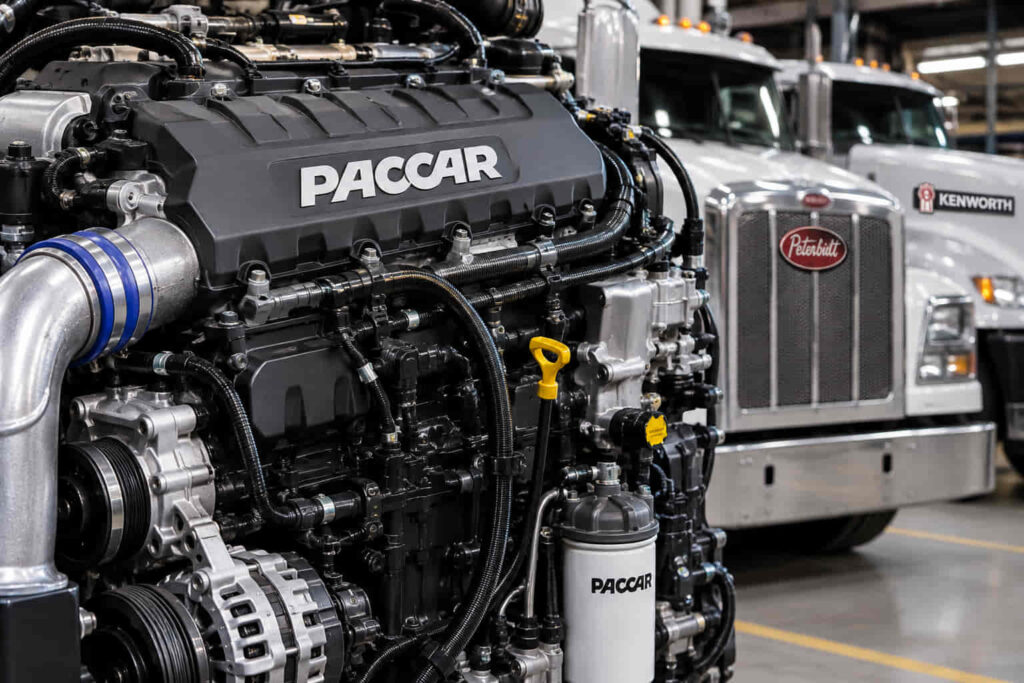
Who makes PACCAR engines? PACCAR Inc. manufactures its own MX-13 and MX-11 diesel engines through its global engine operations, including production facilities in Columbus, Mississippi, Eindhoven in the Netherlands, and Ponta Grossa in Brazil. However, not every engine carrying the PACCAR name is manufactured by PACCAR. The smaller PACCAR PX-7 and PX-9 engines are manufactured by Cummins Inc. and supplied for use in Kenworth and Peterbilt trucks.
PACCAR is the parent company of Kenworth, Peterbilt, and DAF Trucks. Through its DAF subsidiary, PACCAR developed the MX engine family for heavy-duty commercial transportation. The MX-13 is a 12.9-liter inline-six diesel engine designed for demanding highway and vocational applications, while the MX-11 is a smaller 10.8-liter engine developed to balance performance, fuel efficiency, and vehicle weight.
The company also maintains a long-standing relationship with Cummins, which supplies engines for several medium-duty and heavy-duty truck applications. Understanding the difference between PACCAR-manufactured MX engines and Cummins-manufactured PX engines is essential when selecting a truck, purchasing replacement parts, comparing maintenance costs, or identifying the manufacturer of an existing engine.
Who Actually Makes PACCAR Engines?
PACCAR Inc. is the manufacturer of the PACCAR MX-11 and MX-13 engines, while Cummins Inc. manufactures the PACCAR PX-7 and PX-9 engines under a commercial supply arrangement.
This distinction explains why different sources sometimes identify different manufacturers for PACCAR-branded diesel engines.
PACCAR is an established commercial vehicle manufacturer with operations in North America, Europe, South America, and other international markets.
The company manufactures trucks under the Kenworth, Peterbilt, and DAF names and develops powertrain components specifically for commercial transportation.
Its heavy-duty MX engine family is developed and manufactured within PACCAR’s own engine operations.
The European engineering heritage of the MX series comes primarily from DAF Trucks, a Dutch manufacturer that became part of PACCAR in 1996.
DAF had already been developing and manufacturing diesel engines for decades before the MX family was introduced.
After becoming a PACCAR subsidiary, its engineering resources became an important foundation for the company’s global engine program.
The MX-13 and MX-11 engines are therefore genuine PACCAR-manufactured engines rather than rebadged Cummins products.
The situation is different for the smaller PX family.
The PACCAR PX-7 and PX-9 are associated with Cummins medium-duty diesel engine technology and are manufactured by Cummins.
PACCAR’s own operator manuals confirm this relationship.
The identification plate illustrations for both PX engines explicitly identify Cummins Inc. as the manufacturer.
However, PACCAR markets these products within its own engine lineup and provides relevant service and product support through its commercial vehicle network.
This arrangement allows PACCAR to offer multiple engine sizes without independently manufacturing every engine in its product range.
For truck owners, the most important distinction is the engine model.
An MX-13 or MX-11 comes from PACCAR’s manufacturing operations, while a PX-7 or PX-9 is manufactured by Cummins.
What Is PACCAR and How Is It Connected to DAF?
PACCAR is the American parent company of Kenworth, Peterbilt, and DAF Trucks, and its European subsidiary DAF played a major role in developing the PACCAR MX diesel engine family.
PACCAR Inc. is headquartered in Bellevue, Washington.
Its business includes commercial vehicle manufacturing, diesel engine production, powertrain engineering, replacement parts, and financial services.
The company’s truck brands operate in different markets.
Kenworth and Peterbilt are especially well known in North America, while DAF is a major commercial vehicle manufacturer in Europe.
PACCAR acquired DAF Trucks in 1996, expanding its international manufacturing and engineering capabilities.
DAF already had extensive experience producing diesel engines.
The company began manufacturing its own DAF-branded engines in 1957 and later introduced important developments in turbocharging and intercooling technology.
This experience helped establish the engineering foundation for the PACCAR MX engine program.
DAF introduced the MX engine in 2005 as part of its heavy-duty truck development.
The engine family was subsequently adapted for other PACCAR vehicle brands and regional emissions requirements.
This means the PACCAR MX engine is not simply an American engine that was later exported to Europe.
Its development history is closely linked to DAF’s Dutch engineering operations.
However, it is also inaccurate to describe DAF as a completely independent engine supplier selling engines to PACCAR.
DAF is a wholly owned subsidiary of PACCAR.
Its engine development and manufacturing operations belong to the same corporate group.
Today, PACCAR coordinates engine engineering, production, vehicle integration, and aftermarket support across its international operations.
The relationship between PACCAR and DAF is therefore best understood as a parent company and subsidiary working within a shared global powertrain program.
Where Are PACCAR Engines Manufactured?
PACCAR manufactures diesel engines in Columbus, Mississippi; Eindhoven, the Netherlands; and Ponta Grossa, Brazil. These locations form an important part of the company’s international engine production network.
The Columbus factory is the primary PACCAR engine manufacturing location associated with North American MX engine production.
The facility began operations in 2010, supporting the introduction of PACCAR’s heavy-duty engine program for Kenworth and Peterbilt trucks.
It was developed with modern production equipment, advanced manufacturing processes, and specialized quality-control systems.
PACCAR’s 2025 annual report identifies nearly 400,000 engines manufactured at the Columbus facility since its opening.
The company has also invested in additional remanufacturing capacity at the site.
In the Netherlands, engine production is closely connected to DAF’s Eindhoven operations.
DAF’s engine factory and related manufacturing facilities support the production of powertrains used in the company’s European heavy-duty truck range.
Eindhoven is also an important center for engine engineering and manufacturing technology.
PACCAR’s Brazilian operations are located in Ponta Grossa, Paraná.
This facility supports the company’s presence in South American commercial vehicle markets.
Different engine and vehicle configurations are produced according to regional demand, manufacturing arrangements, and emissions regulations.
PACCAR’s annual reporting identifies all three locations as part of its diesel engine production footprint.
However, the location where a truck is assembled does not necessarily identify where its engine was manufactured.
A Kenworth assembled in the United States may use a PACCAR MX engine from Columbus or a Cummins engine manufactured through Cummins operations.
Similarly, a DAF truck assembled in Europe may use a PACCAR engine produced within the company’s European manufacturing network.
The engine’s identification plate and production records provide the most reliable way to determine its exact manufacturing origin.
Who Makes the PACCAR MX-13 Engine?
The PACCAR MX-13 engine is developed and manufactured by PACCAR through its engine operations, with major production facilities in Columbus, Mississippi, and Eindhoven, the Netherlands.
The MX-13 is one of PACCAR’s principal heavy-duty diesel engines.
It features a 12.9-liter displacement and an inline-six-cylinder configuration.
The engine is designed to deliver the torque required for long-distance freight transportation, heavy hauling, and demanding vocational applications.
In current North American EPA configurations, PACCAR advertises MX-13 power ratings from approximately 405 to 510 horsepower.
Maximum torque ratings reach approximately 1,850 lb-ft, depending on the selected configuration.
These specifications vary across model years and regional emissions certifications.
European versions may use different power ratings and calibration strategies.
The engine incorporates modern diesel technologies, including high-pressure common-rail fuel injection, turbocharging, electronic engine management, and exhaust aftertreatment systems.
These systems work together to provide strong low-speed torque while meeting applicable emissions requirements.
The MX-13 also uses compacted graphite iron in major structural components.
This material provides a combination of strength and weight-saving characteristics suited to heavy-duty engine construction.
Compared with ordinary gray cast iron, compacted graphite iron can offer advantages in mechanical strength under demanding operating conditions.
The engine is engineered to operate efficiently at relatively low engine speeds.
This allows the powertrain to take advantage of engine downspeeding, where the vehicle maintains highway speed at lower RPM when the transmission and axle ratios are appropriately matched.
Lower engine speeds can reduce frictional losses and support fuel economy.
However, actual efficiency depends on vehicle weight, route conditions, gearing, driving behavior, and engine calibration.
The MX-13 is widely used in PACCAR’s Class 8 truck applications.
For owners who want to know whether the MX-13 is made by Cummins, the answer is no.
It is a PACCAR engine developed within the company’s own diesel engine program.
Who Makes the PACCAR MX-11 Engine?
The PACCAR MX-11 is manufactured by PACCAR and shares its engine development heritage with DAF’s European diesel engineering program.
The MX-11 is a 10.8-liter inline-six diesel engine designed for applications where lower weight and efficient torque delivery are important.
It was introduced in Europe in 2013 and entered the North American market in 2016.
Compared with the 12.9-liter MX-13, the MX-11 has a smaller displacement and a lighter overall design.
PACCAR advertises North American power ratings from approximately 355 to 445 horsepower.
Peak torque can reach approximately 1,700 lb-ft, depending on the engine configuration.
This makes the MX-11 suitable for a range of applications, including regional transportation, construction-related hauling, and certain heavy-duty highway operations.
The smaller engine can provide an advantage when vehicle payload is important.
Reducing engine weight may allow a truck to carry additional cargo without exceeding its gross vehicle weight restrictions.
However, the benefit depends on the complete truck configuration.
Transmission choice, axle ratings, suspension components, and other equipment all influence available payload.
The MX-11 uses modern fuel injection and engine management technology similar in purpose to the systems used by the larger MX-13.
Both engines are designed to operate effectively with PACCAR’s broader powertrain components, including compatible automated transmissions.
Although the MX-11 and MX-13 share engineering concepts, they are not simply identical engines with different electronic calibrations.
Their displacements, physical dimensions, internal components, and operating characteristics differ.
Replacement parts and service specifications must match the exact engine.
For operators seeking a balance between fuel efficiency, lower engine weight, and substantial diesel torque, the MX-11 can be an alternative to a larger-displacement powerplant.
Like the MX-13, it is a PACCAR-manufactured engine rather than a Cummins engine sold under a different name.
Does Cummins Manufacture PACCAR Engines?
Yes. Cummins manufactures the PACCAR PX-7 and PX-9 engines, but it does not manufacture the PACCAR MX-11 or MX-13 engine families.
The relationship between PACCAR and Cummins is an important part of the North American commercial truck industry.
PACCAR builds its own heavy-duty MX engines but also purchases diesel engines from Cummins for use in its trucks.
Cummins is a major independent engine manufacturer with extensive experience developing engines for commercial vehicles, industrial equipment, power generation, and other applications.
PACCAR’s relationship with Cummins allows Kenworth and Peterbilt to offer different engine configurations based on customer requirements.
Some customers prefer engines manufactured within the PACCAR group.
Others select Cummins engines because of their existing fleet equipment, service relationships, or specific power requirements.
The PX engine family is an example of a PACCAR-branded product manufactured by another company.
The 2024 PACCAR PX-7 operator’s manual includes an engine identification plate illustration identifying Cummins Inc. as its manufacturer.
The PX-9 manual provides the same confirmation.
Both manuals also include engine identification information commonly associated with Cummins service procedures, including an engine serial number and control parts list.
This makes the manufacturing relationship explicit rather than merely a similarity in engine specifications.
PACCAR’s corporate reporting also confirms its continued engine supply relationship with Cummins.
In its 2025 annual filing, PACCAR states that engines installed in its trucks but not manufactured by PACCAR are purchased from Cummins.
The same report indicates that approximately 29% of Kenworth and Peterbilt heavy-duty trucks sold in the United States and Canada during 2025 were equipped with PACCAR-manufactured engines.
This illustrates the importance of Cummins as a powertrain supplier within the PACCAR truck portfolio.
The distinction is essential for maintenance because PX engines and MX engines have different mechanical designs, parts catalogs, and technical requirements.
Read more: DD13 Oil Capacity
Are PACCAR PX Engines the Same as Cummins Engines?
PACCAR PX engines are Cummins-manufactured diesel engines based on Cummins medium-duty engine technology, but their PACCAR-specific configurations, calibration, and service arrangements should be verified before assuming complete component interchangeability.
The PACCAR PX-7 is a 6.7-liter inline-six diesel engine.
Its displacement and underlying engine architecture are closely associated with the Cummins B6.7 engine family.
The PX-9 is an 8.9-liter inline-six diesel engine associated with the Cummins L-series platform.
These engines are used primarily in medium-duty and selected vocational commercial truck applications.
Their smaller displacement makes them suitable for vehicles that do not require the torque and power of a 12.9-liter heavy-duty engine.
The PX-7 offers a compact engine package for applications such as regional delivery and municipal services.
The PX-9 provides additional displacement and torque for heavier medium-duty workloads.
However, similar engine architecture does not guarantee that every component is identical.
Engine control software, fuel system calibration, emissions equipment, accessory mounting arrangements, and vehicle integration can vary by engine model and production year.
PACCAR may also specify application-specific equipment to suit particular Kenworth and Peterbilt models.
Consequently, a replacement component sold for a Cummins B6.7 should not automatically be installed in a PX-7 without confirming compatibility.
The same principle applies when comparing a PX-9 with a Cummins L9.
The manufacturer of the underlying engine may be Cummins, but the vehicle’s official service documentation determines the correct maintenance and repair procedures.
Owners should use the engine serial number and control parts list when identifying compatible replacement components.
This avoids the common mistake of treating all engines with the same displacement as mechanically interchangeable.
Which PACCAR Engines Are Used in Kenworth Trucks?
Kenworth trucks can be equipped with PACCAR MX engines, Cummins-manufactured PACCAR PX engines, or other Cummins engines, depending on the truck model and application.
Kenworth is one of PACCAR’s principal truck brands.
Its product range includes highway tractors, heavy-duty vocational trucks, and medium-duty commercial vehicles.
Different vehicle classes require different engine characteristics.
The PACCAR MX-13 is commonly associated with Class 8 highway trucks and heavy-duty applications where high torque and sustained performance are important.
The Kenworth T680 is a well-known long-haul platform offering powertrain configurations suited to efficient highway operation.
The Kenworth T880 is designed for more demanding vocational applications, including construction and heavy hauling.
Depending on configuration, these trucks may be equipped with PACCAR MX powerplants.
The MX-11 is another option for applications where lower engine weight and strong torque are desirable.
Kenworth also offers Cummins engines in various truck models.
The Cummins X15 is particularly relevant to heavy-duty applications requiring substantial horsepower and torque.
This engine has a larger displacement than the PACCAR MX-13 and offers different performance ratings.
Medium-duty Kenworth trucks can use PACCAR PX-7 and PX-9 engines.
These engines are manufactured by Cummins but marketed through PACCAR’s powertrain lineup.
The exact engine options depend on the truck model, emissions requirements, production year, and vehicle configuration.
Consequently, the Kenworth badge does not identify the engine manufacturer.
A Kenworth truck can contain a PACCAR-manufactured MX engine or a Cummins-manufactured engine.
The engine identification plate provides the most direct confirmation.
Which PACCAR Engines Are Used in Peterbilt Trucks?
Peterbilt trucks use PACCAR MX-13 and MX-11 engines in selected heavy-duty configurations, while PX-7, PX-9, and Cummins-branded engines are available for other applications.
Peterbilt is another major PACCAR-owned truck manufacturer.
The brand produces vehicles for long-distance transportation, regional distribution, construction, and specialized commercial operations.
The Peterbilt Model 579 is one of the company’s principal on-highway trucks.
Its engine lineup includes the PACCAR MX-13 and MX-11, along with selected Cummins engines.
The MX-13 provides the higher displacement and torque range of PACCAR’s two principal heavy-duty engine families.
The MX-11 offers a smaller and lighter alternative.
Peterbilt’s vocational vehicles also use engine configurations selected for demanding operating conditions.
For medium-duty trucks, the Cummins-manufactured PX family provides different power and torque options.
The PX-7 is suited to lighter medium-duty requirements, while the PX-9 provides greater displacement for heavier workloads.
Peterbilt also offers natural gas engine options in certain configurations.
These engines have separate technologies and service requirements from conventional diesel MX or PX powerplants.
An important distinction exists between the truck manufacturer and engine manufacturer.
Peterbilt manufactures the vehicle but does not independently produce the engines installed under the PACCAR MX or PX names.
The MX engines come from PACCAR’s engine manufacturing network, while the PX engines are manufactured by Cummins.
For maintenance and engine replacement, the correct engine model and serial number are therefore more important than the Peterbilt vehicle name alone.
Are PACCAR Engines Made in the USA?
Many PACCAR MX engines used in North American trucks are manufactured in Columbus, Mississippi, while other PACCAR engines are produced in Europe and South America. The PACCAR PX-7 and PX-9 are manufactured by Cummins, with their 2024 operator manuals identifying U.S. assembly.
PACCAR opened its Columbus engine manufacturing facility in 2010.
The factory became an important part of the company’s effort to produce its own heavy-duty diesel engines for the North American market.
The facility uses specialized production equipment and manufacturing processes to assemble and test commercial vehicle engines.
Its development also allowed PACCAR to expand engine production beyond its established European operations.
However, PACCAR is an international manufacturer.
Its MX engine family has strong engineering and production roots in Eindhoven, the Netherlands.
The company also maintains diesel engine production capabilities in Brazil.
As a result, the statement that PACCAR engines are made in America is correct for many North American MX engines but should not be interpreted as applying to every engine carrying the brand.
The PX engine family introduces another distinction.
The 2024 PX-7 and PX-9 identification plate illustrations specify Cummins as the manufacturer and indicate assembly in the United States.
These engines are sold through PACCAR’s powertrain program, but their manufacturing origin belongs to Cummins operations.
The exact location where an individual engine was assembled should be confirmed from its identification plate or manufacturing records.
This matters when purchasing replacement engines, identifying engine configurations, or investigating production-related service information.
It can also help owners distinguish between the engine factory and the plant where the complete truck was assembled.
A truck assembled in Texas, Ohio, or Washington does not necessarily have an engine manufactured at that same facility.
How Are PACCAR MX Engines Designed and Manufactured?
PACCAR MX engines are developed using the company’s diesel engineering resources, advanced manufacturing facilities, and extensive engine testing programs intended to support durability and fuel efficiency.
Heavy-duty diesel engines are designed for operating conditions that differ considerably from those experienced by passenger cars.
Commercial trucks may spend long periods carrying heavy loads, operating at sustained highway speeds, or performing frequent low-speed vocational work.
An engine intended for these applications must withstand repeated combustion pressure, high thermal loads, and substantial torque demand.
PACCAR’s MX engine program focuses on balancing these requirements with fuel efficiency and vehicle integration.
The company uses advanced materials, including compacted graphite iron, in major engine components.
Material selection helps control engine weight while maintaining the strength required for heavy-duty operation.
Modern manufacturing equipment supports precision machining and consistent component assembly.
Cylinder dimensions, crankshaft alignment, bearing clearances, and other mechanical specifications must remain within the appropriate tolerances.
The fuel injection system also requires accurate manufacturing and electronic control.
Common-rail injection technology allows the engine to manage fuel pressure and injection timing according to operating conditions.
Turbocharger systems improve cylinder filling and support torque production.
The exhaust aftertreatment system helps the engine comply with applicable emissions requirements.
PACCAR’s annual reporting identifies two major engine research and development centers with advanced test facilities.
These include engine test cells and equipment used to evaluate performance under different operating conditions.
Durability testing helps engineers study component behavior over extended operating cycles.
However, factory testing does not guarantee that an engine will operate indefinitely without repairs.
Maintenance quality, duty cycle, cooling system condition, and fuel quality remain important throughout the engine’s service life.
PACCAR’s manufacturing strategy is intended to improve consistency and reliability while allowing its engines to integrate closely with Kenworth, Peterbilt, and DAF vehicles.
Are PACCAR Engines Reliable?
PACCAR MX-11 and MX-13 engines are designed for heavy-duty commercial reliability, but their actual service life depends on maintenance, operating conditions, emissions system health, and the quality of repairs.
The MX engine family has been used extensively in commercial trucks across several markets.
PACCAR’s annual reports identify substantial cumulative engine production and ongoing investment in manufacturing and remanufacturing capacity.
This large installed population reflects the company’s established position in heavy-duty diesel engines.
However, production volume alone does not establish that an engine is more reliable than competing products.
Reliability should be evaluated through operating history, maintenance costs, failure frequency, repair availability, and the consequences of unexpected downtime.
The MX-13 and MX-11 use modern common-rail diesel fuel systems.
These components depend on clean fuel and correctly functioning injection equipment.
Fuel contamination can damage injectors and other precision components, leading to expensive repairs.
The turbocharger also requires reliable lubrication and appropriate operating temperatures.
Inadequate oil supply, contaminated lubricant, or abnormal operating conditions can reduce turbocharger life.
Emissions components introduce additional maintenance considerations.
Modern diesel exhaust aftertreatment systems may include exhaust gas recirculation, diesel particulate filtration, selective catalytic reduction, and related sensors.
Problems in these systems can cause warning lights, reduced engine performance, or operational restrictions.
However, an emissions system fault does not necessarily indicate internal engine wear.
A sensor or aftertreatment problem should be distinguished from serious mechanical damage involving pistons, bearings, or the crankshaft.
For fleet operators, reliability also depends on the speed and availability of repairs.
Access to diagnostic equipment, replacement parts, trained technicians, and appropriate service facilities can significantly affect vehicle downtime.
A well-maintained PACCAR MX engine can provide dependable commercial service, but its manufacturer name alone cannot guarantee a specific lifespan or operating cost.
How Long Do PACCAR Engines Last?
PACCAR MX engines are engineered for extended heavy-duty commercial operation, but there is no single mileage figure that accurately predicts the lifespan of every MX-11 or MX-13 engine.
Commercial diesel engine longevity depends on operating hours, duty cycle, load, maintenance, and internal component condition.
A truck used primarily for long-distance highway transportation may accumulate mileage under relatively stable operating conditions.
A vocational truck may experience more frequent acceleration, heavy loads, and extended idling while covering fewer miles.
As a result, two engines with the same odometer reading may have very different amounts of accumulated wear.
Maintenance history is especially important.
Regular oil changes using approved lubricants help protect crankshaft bearings, camshaft components, turbocharger bearings, and other moving surfaces.
Fuel filtration helps prevent contamination from damaging high-pressure injection equipment.
Cooling system maintenance reduces the risk of overheating and its consequences.
Excessive engine temperatures can damage cylinder head sealing surfaces, degrade lubricant, and create additional mechanical stress.
The aftertreatment system must also operate correctly.
Repeated unresolved emissions faults can interfere with vehicle operation and create expensive repairs.
An engine approaching high mileage should be evaluated through oil consumption, oil pressure, cooling system condition, engine performance, and diagnostic information rather than mileage alone.
PACCAR’s investment in engine remanufacturing further demonstrates that these engines can remain valuable after substantial service.
A remanufactured engine can restore worn components when the original assembly is suitable for the process.
However, the need for remanufacturing depends on mechanical condition and economics rather than an automatic mileage limit.
For fleet planning, maintenance records and operating data provide a more meaningful measure of remaining useful life than a generic prediction that every PACCAR engine will reach the same mileage.
PACCAR MX-13 vs. Cummins X15: Who Makes the Better Engine?
The PACCAR MX-13 is manufactured by PACCAR, while the Cummins X15 is manufactured by Cummins Inc. Both are heavy-duty inline-six diesel engines, but they differ in displacement, power ratings, operating characteristics, and support arrangements.
The PACCAR MX-13 has a displacement of 12.9 liters.
Current North American configurations are advertised with horsepower ratings reaching approximately 510 horsepower and maximum torque of 1,850 lb-ft.
The Cummins X15 has a displacement of approximately 15 liters.
Certain X15 configurations produce up to approximately 605 horsepower and 2,050 lb-ft of torque.
The larger displacement and available higher ratings can make the X15 attractive for applications requiring greater power output.
However, maximum horsepower alone should not determine the best engine choice.
Many highway trucks operate most efficiently at loads and engine speeds well below maximum rated horsepower.
PACCAR designed the MX-13 to provide strong low-speed torque and support efficient integration with its powertrain components.
Depending on the vehicle configuration, this can make the MX-13 attractive for operators prioritizing fuel efficiency and integrated truck performance.
The Cummins X15 offers a broad range of power ratings and a substantial installed base across multiple commercial vehicle manufacturers.
Some operators value familiarity with Cummins diagnostic systems and established service relationships.
Maintenance requirements also differ.
Oil capacity, filter specifications, emissions components, diagnostic procedures, and replacement parts must correspond to the exact engine.
The engine with the lower purchase price is not necessarily the one with the lowest lifetime operating cost.
A fleet should evaluate expected fuel consumption, planned routes, vehicle weight, maintenance expenses, service coverage, and downtime risk.
Neither engine can be declared universally more reliable solely from its displacement or manufacturer.
For heavy-haul applications requiring the highest available power ratings, the X15 may offer an advantage.
For operators prioritizing integration with the PACCAR powertrain and the available MX-13 performance range, the PACCAR engine may be an appropriate choice.
PACCAR MX-11 vs. PX-9: What Is the Difference?
The PACCAR MX-11 is a 10.8-liter heavy-duty engine manufactured by PACCAR, while the PX-9 is an 8.9-liter Cummins-manufactured engine marketed under the PACCAR name.
Although both engines appear in PACCAR’s product portfolio, they have different manufacturing origins and intended applications.
The MX-11 is part of the same heavy-duty engine family as the larger MX-13.
It is designed to provide substantial torque while reducing engine weight compared with larger-displacement alternatives.
Current North American MX-11 ratings reach approximately 445 horsepower and 1,700 lb-ft of torque.
The PX-9 is based on Cummins medium-duty diesel engine technology.
PACCAR advertises PX-9 power ratings ranging from approximately 260 to 450 horsepower, with maximum torque reaching approximately 1,250 lb-ft.
The available performance figures depend on model year and configuration.
The MX-11 offers greater maximum torque, making it suitable for demanding applications where sustained heavy loads are important.
The PX-9 provides a smaller-displacement alternative for vehicles where its torque range and operating characteristics meet the required workload.
Engine weight, fuel economy, installation requirements, transmission compatibility, and service costs should also influence the selection.
The two engines do not use identical internal components.
Their fuel systems, engine electronics, lubrication requirements, and service procedures must be evaluated independently.
The manufacturing distinction matters when sourcing replacement parts.
The MX-11 belongs to PACCAR’s own engine production program.
The PX-9 is manufactured by Cummins, although it is marketed and supported through PACCAR’s engine portfolio.
For owners comparing the two, the correct choice depends on the truck’s intended duty cycle rather than the assumption that both engines share the same manufacturer because they carry the PACCAR name.
What Maintenance Do PACCAR Engines Require?
PACCAR diesel engines require regular engine oil and filter changes, fuel system maintenance, cooling system inspections, and emissions system servicing according to the specific engine model and duty cycle.
Maintenance requirements differ between MX and PX engines.
The PACCAR MX-11 and MX-13 use lubrication and filtration systems developed for the MX engine family.
The Cummins-manufactured PX engines have different oil capacities, service procedures, and maintenance schedules.
For example, the EPA 2024 MX-11 specification sheet identifies an oil system capacity of approximately 39 US quarts.
It also lists oil and filter change intervals of up to 75,000 miles for qualifying normal line-haul operation with limited idling.
Applications with greater idling or severe vocational use have shorter published intervals.
These intervals should not be applied automatically to every engine or truck.
The engine model, emissions generation, oil approval, and actual operating conditions must be considered.
Oil quality affects the lubrication of bearings, camshafts, and turbocharger components.
Fuel filter maintenance is equally important because modern common-rail diesel systems rely on precise high-pressure injection equipment.
Water or particles entering the fuel system can damage injectors and pumps.
Cooling system maintenance helps protect the engine from excessive operating temperatures.
Aftertreatment components also require attention.
Diesel particulate filters, selective catalytic reduction systems, DEF-related components, and sensors must remain in suitable condition to maintain emissions compliance and vehicle performance.
Unexpected warning lights should be diagnosed promptly rather than ignored.
PACCAR also provides connected vehicle and diagnostic support features intended to help operators identify developing maintenance issues.
However, electronic monitoring does not eliminate routine inspections.
Correct servicing remains essential regardless of whether the engine was manufactured directly by PACCAR or supplied by Cummins.
What Warranty Do PACCAR Engines Have?
PACCAR advertises a standard base warranty of 2 years or 250,000 miles for eligible MX engines, along with major-component coverage of 5 years or 500,000 miles, subject to the applicable warranty terms and operating-hour limits.
The manufacturer’s current MX engine warranty information identifies a base engine coverage period of 24 months, 250,000 miles, or 400,000 kilometers.
It also specifies a 6,250-hour limit for the relevant base coverage.
Major component coverage extends to 60 months, 500,000 miles, or 800,000 kilometers, with a corresponding 12,500-hour limitation.
The warranty typically expires when the first applicable time, mileage, or hour limit is reached.
Additional coverage may be available through extended protection plans.
However, the existence of an extended plan does not mean it is automatically included with every engine.
The exact warranty depends on the engine, vehicle application, purchase terms, and selected protection.
Warranty coverage for PX engines should be checked separately because they are Cummins-manufactured products with their own applicable service and warranty documentation.
Maintenance requirements also affect warranty eligibility.
Damage caused by improper maintenance, unsuitable fluids, overheating, or unauthorized modifications may be subject to exclusions depending on the written terms.
Owners should preserve service records and installation information.
These documents can help establish compliance with maintenance requirements and support a warranty claim.
For fleet operators, warranty coverage is only one part of the ownership decision.
Repair turnaround time, dealer availability, parts supply, and labor reimbursement conditions can also affect total operating costs.
The appropriate warranty document should always be confirmed for the exact engine serial number and application.
Who Services and Repairs PACCAR Engines?
PACCAR engines are supported through authorized Kenworth, Peterbilt, DAF, and other relevant service networks, while the specific engine model determines the appropriate parts, diagnostics, and repair procedures.
PACCAR provides service support for its powertrain products through a network of authorized facilities.
In North America, Kenworth and Peterbilt dealers are important sources of engine diagnostics, maintenance, parts, and warranty assistance.
PACCAR Powertrain also provides access to technical resources, operator manuals, maintenance information, and authorized repair locations.
Its support website identifies a network of more than 800 service locations associated with powertrain assistance.
For MX engines, technicians use engine-specific diagnostic systems and service information.
The engine management system, fuel injection equipment, turbocharger, and emissions components must be inspected according to PACCAR procedures.
For PX engines, the manufacturing relationship with Cummins affects technical identification and the underlying engine architecture.
PACCAR’s PX manuals refer to engine serial numbers and Cummins control parts lists.
These identifiers are useful when determining the exact engine configuration and ordering compatible parts.
However, an engine’s Cummins manufacturing origin does not automatically mean every Cummins service location is authorized to administer a particular PACCAR warranty.
Owners should confirm the appropriate service and warranty route for their specific product.
The most reliable repair facility is one with access to the correct diagnostic equipment, technical documentation, and replacement components.
This distinction becomes particularly important for high-pressure fuel system repairs, internal engine work, and electronic calibration.
A technician familiar with one PACCAR engine family may still need different equipment and service information to work on another.
How Can You Identify Who Manufactured Your PACCAR Engine?
The most reliable way to identify a PACCAR engine manufacturer is to check the engine model designation and identification plate, then verify the engine serial number against the appropriate technical documentation.
An engine labeled MX-13 or MX-11 belongs to PACCAR’s own heavy-duty engine manufacturing program.
A PX-7 or PX-9 is manufactured by Cummins and marketed through the PACCAR powertrain portfolio.
This distinction can usually be established before any mechanical disassembly is necessary.
The engine model may appear on the engine cover or identification label.
However, visual appearance alone should not be used as the final reference.
Components may have been replaced, engine covers may be missing, and a vehicle may have undergone an engine swap.
The identification plate contains more precise information.
For PACCAR PX engines, the manufacturer’s operator manuals show an identification plate specifying Cummins Inc. as the manufacturer.
These plates also identify the engine serial number, model information, manufacturing date, and control parts list.
The engine serial number is especially important for selecting correct replacement parts.
Different production years may include changes to sensors, fuel injection components, emissions equipment, and engine electronics.
Even engines with the same displacement can use different hardware.
For an MX engine, PACCAR service documentation and the engine identification information can establish the correct specification.
The vehicle identification number may help determine the engine originally installed in the truck.
However, it cannot always establish the current engine configuration if a replacement has been fitted.
When purchasing a used Kenworth or Peterbilt, confirming the actual engine model is essential.
The engine manufacturer’s identity affects parts compatibility, diagnostic requirements, maintenance costs, and warranty conditions.
Does PACCAR Manufacture Electric Powertrains?
PACCAR also develops and markets electric powertrain systems for commercial trucks, expanding its operations beyond conventional diesel engines.
The company’s electric vehicle programs include powertrain technologies used in battery-electric Kenworth, Peterbilt, and DAF trucks.
Electric powertrains operate differently from diesel engines.
Instead of producing torque through fuel combustion, electric motors convert electrical energy into mechanical rotation.
The powertrain uses components such as traction motors, power electronics, high-voltage batteries, thermal management systems, and control software.
PACCAR’s current product range includes heavy-duty and medium-duty ePowertrain systems.
These systems are designed for commercial vehicle applications with different operating requirements.
Medium-duty electric trucks may prioritize urban delivery, regional distribution, and stop-and-go operation.
Heavy-duty electric vehicles require greater energy storage and continuous power capability for demanding transportation.
PACCAR integrates electric propulsion technology within its commercial vehicle engineering and manufacturing activities.
However, this does not establish that every battery cell, electrical semiconductor, or related component is manufactured entirely in-house.
Modern electric powertrains depend on specialized manufacturing and supplier networks.
The distinction between complete powertrain development and individual component manufacturing is therefore important.
For the question of who makes PACCAR engines, the conventional diesel MX and PX manufacturing relationships remain the primary concern.
Electric powertrains represent a separate technology category that does not use the combustion-engine architecture associated with the MX-11, MX-13, PX-7, or PX-9.
Does PACCAR Remanufacture Its Own Engines?
Yes. PACCAR operates engine remanufacturing activities and has expanded its facilities to support the restoration of high-mileage MX engines.
Remanufacturing differs from manufacturing a completely new engine.
The process begins with an existing engine assembly that has already been used.
The engine is disassembled, cleaned, inspected, and evaluated to determine which components can be restored and which require replacement.
Reusable components may undergo precision machining to return them to acceptable specifications.
Worn or damaged parts are replaced with components meeting the required standards.
The engine is then reassembled and subjected to appropriate quality checks.
The purpose is to provide a replacement engine with restored mechanical condition while reusing selected materials and components.
PACCAR’s 2025 annual report confirms that the company completed construction of a new engine remanufacturing facility in Columbus, Mississippi.
The facility was developed to support the restoration of high-mileage PACCAR MX engines.
PACCAR also has remanufacturing operations associated with its European manufacturing network.
These investments are relevant to long-term truck ownership because commercial vehicles may remain economically useful after their original engines require major internal repairs.
A remanufactured engine can provide an alternative to purchasing a completely new assembly or rebuilding the original engine through an independent workshop.
However, a remanufactured engine should not automatically be considered identical to a brand-new engine in every respect.
Warranty coverage, included components, technical updates, and pricing depend on the specific product.
Owners should confirm whether a replacement is new, remanufactured, or used before purchasing.
The manufacturer, product specifications, and warranty terms should be documented to ensure that the replacement engine meets the vehicle’s requirements.
Are PACCAR Engines Better Than Cummins Engines?
PACCAR MX engines and Cummins engines are both established heavy-duty diesel powertrain options, but neither manufacturer produces the best engine for every truck or operating condition.
The most appropriate choice depends on vehicle application, required torque, fuel efficiency, maintenance costs, and service availability.
PACCAR’s MX engines are developed for close integration with Kenworth, Peterbilt, and DAF vehicles.
This integration may include engine calibration, transmission compatibility, electronic controls, and other powertrain functions.
The MX-13 offers substantial torque for Class 8 applications, while the MX-11 provides a lighter alternative where its performance is sufficient.
Cummins engines are used across a broad range of commercial vehicles from several manufacturers.
This creates a large installed base and an established aftermarket for many Cummins engine families.
The Cummins X15 is particularly relevant for heavy-duty applications requiring high horsepower and torque.
Cummins also manufactures the smaller PACCAR PX engines, demonstrating that the two companies are commercial partners as well as competing engine suppliers.
A direct comparison should focus on specific engines rather than treating PACCAR and Cummins as two completely separate vehicle systems.
Comparing an MX-13 with an X15 is different from comparing an MX-11 with a PX-9.
Engine displacement and available power ratings influence the applications for which each engine is most suitable.
Ownership costs can also vary.
Fuel consumption depends on driving conditions, truck configuration, and engine calibration.
Maintenance expenses depend on service intervals, parts prices, repair complexity, and local labor rates.
A fleet already operating Cummins-equipped vehicles may benefit from technician familiarity and an established parts inventory.
Another fleet may prioritize the integrated PACCAR powertrain and its corresponding dealer support.
The manufacturer alone does not determine reliability.
Correct maintenance, appropriate engine sizing, and suitable service support are more important for achieving dependable long-term operation.
Which PACCAR Engine Should You Choose?
The best PACCAR engine depends on the truck’s intended duty cycle, required horsepower and torque, vehicle weight, and long-term operating costs.
For long-distance Class 8 transportation, the MX-13 is a principal PACCAR-manufactured option.
Its 12.9-liter displacement and available torque range make it suitable for demanding highway operation.
The engine is designed to work efficiently with compatible transmissions and driveline configurations.
The MX-11 offers a different balance.
Its smaller displacement and lower weight may provide advantages in applications where payload and fuel efficiency are particularly important.
However, the engine must still provide enough torque for the expected loads.
For medium-duty vehicles, the Cummins-manufactured PX-7 and PX-9 provide additional options.
The PX-7 can be suitable for lighter commercial applications where its power output meets the requirements.
The PX-9 offers greater displacement and torque for heavier medium-duty operation.
The choice between a PX engine and an MX engine should consider more than peak horsepower.
Two engines may offer similar maximum horsepower ratings but have different torque characteristics, operating speed ranges, and intended applications.
Transmission compatibility and axle gearing also influence performance.
An engine that is appropriately matched to the truck can operate more efficiently and experience less unnecessary stress than one consistently used outside its ideal workload.
Service access is another consideration.
Operators should determine whether local repair facilities have the correct equipment and experience for the selected engine.
Warranty coverage, parts availability, and expected vehicle ownership duration can affect the final decision.
For fleet purchases, comparing complete powertrain configurations under realistic operating conditions generally provides more useful information than comparing engine brands alone.
Final Verdict: Who Makes PACCAR Engines?
PACCAR Inc. manufactures the MX-11 and MX-13 diesel engines through its own engine production operations, while Cummins Inc. manufactures the PACCAR PX-7 and PX-9 engines. This is the essential distinction behind the PACCAR engine brand.
PACCAR’s heavy-duty MX engines were developed through the company’s DAF engineering heritage and are manufactured within its international production network.
Key manufacturing locations include Columbus, Mississippi; Eindhoven, the Netherlands; and Ponta Grossa, Brazil.
The MX-13 is a 12.9-liter inline-six engine developed for demanding heavy-duty applications.
The MX-11 is a 10.8-liter inline-six engine designed to balance performance, engine weight, and fuel efficiency.
The smaller PX-7 and PX-9 engines are manufactured by Cummins, although they are sold under the PACCAR name for selected Kenworth and Peterbilt applications.
PACCAR also purchases Cummins-branded engines for other truck configurations, including heavy-duty models.
This relationship explains why two Kenworth or Peterbilt trucks can carry the same vehicle brand while having engines from different manufacturers.
The distinction affects service procedures, engine parts, diagnostic equipment, and warranty arrangements.
If the engine is a PACCAR MX-11 or MX-13, it is manufactured by PACCAR. If it is a PACCAR PX-7 or PX-9, it is manufactured by Cummins.
For an individual truck, the engine identification plate and serial number provide the most reliable confirmation of its manufacturer and exact configuration.
Understanding these differences helps truck owners make more informed decisions about engine reliability, replacement parts, maintenance requirements, and long-term operating costs.