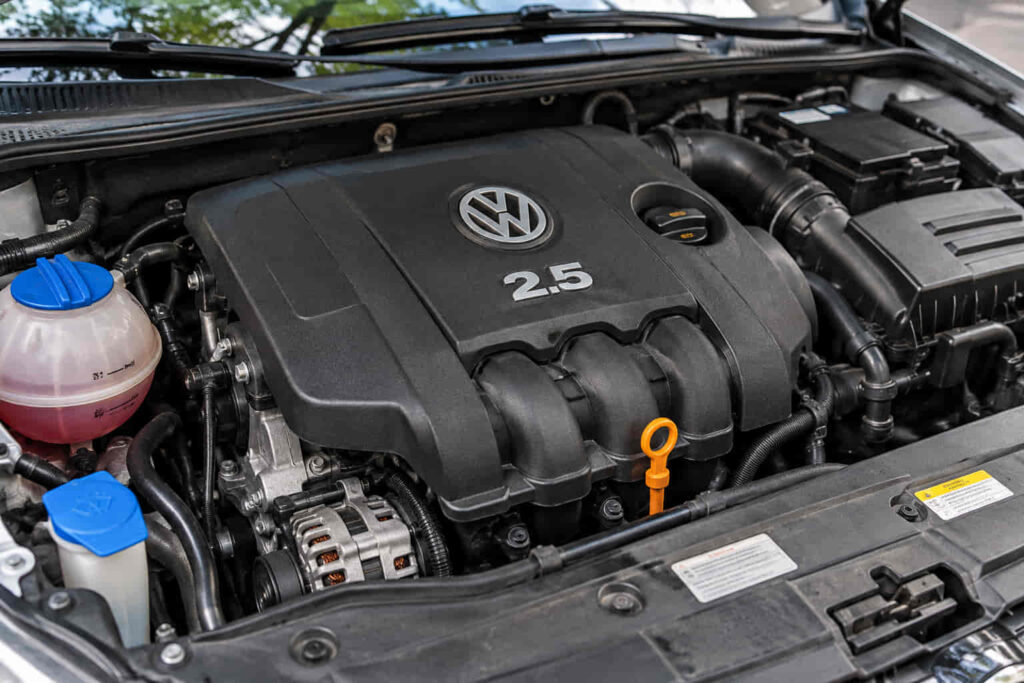
The VW 2.5 engine life expectancy is commonly estimated at 200,000 to 250,000 miles, with some well-maintained engines exceeding 300,000 miles without a complete rebuild. Volkswagen’s naturally aspirated 2.5-liter five-cylinder engine is known for its durable cast-iron block, conventional fuel injection system, and relatively simple mechanical design compared with many turbocharged engines.
Found in Volkswagen Jetta, Rabbit, Golf, Beetle, and Passat models, the 2.5L engine became a popular choice among drivers looking for dependable performance and manageable maintenance costs. Its moderate factory horsepower, robust internal construction, and lack of a turbocharger contribute to its reputation for high-mileage reliability.
However, engine longevity depends on more than mechanical design. Timing chain condition, engine oil quality, cooling system performance, and the timely repair of oil leaks can significantly influence how long the engine remains serviceable.
The 200,000–250,000-mile range is a practical estimate rather than an official Volkswagen lifespan rating. Understanding the engine’s common problems, maintenance requirements, and warning signs provides a more reliable way to evaluate its remaining life.
How Long Does a VW 2.5 Engine Last?
A properly maintained Volkswagen 2.5-liter five-cylinder engine can often last 200,000 miles or more, while reaching 250,000 to 300,000 miles is possible when major mechanical components remain healthy. There is no fixed mileage at which every VW 2.5 engine must be replaced.
The engine’s service life depends primarily on lubrication, operating temperature, driving conditions, and accumulated mechanical wear.
A VW 2.5 that receives regular oil changes and operates without overheating may maintain good compression and oil pressure after many years of use. Conversely, an engine subjected to prolonged low oil levels, excessive heat, or neglected maintenance may develop serious internal damage much earlier.
Highway driving can also influence longevity. Engines used for consistent highway travel often operate at relatively stable temperatures and loads, while frequent short trips expose the engine to repeated cold starts and additional temperature changes.
However, highway mileage is not automatically less damaging in every situation. Sustained high engine loads, inadequate cooling, and excessive operating speeds can accelerate wear regardless of driving environment.
The condition of the engine is therefore more important than the number displayed on the odometer.
An engine with 180,000 miles, documented oil changes, minimal oil consumption, and stable compression may have greater remaining life than a poorly maintained example with only 100,000 miles.
Individual owners have reported VW 2.5 engines operating beyond 300,000 miles, demonstrating the engine’s potential durability. These reports are useful examples but do not establish a statistically verified average lifespan.
For most owners, 200,000 miles is a reasonable long-term durability target, while 250,000 miles or more becomes increasingly dependent on the engine’s maintenance history and mechanical condition.
Why Is the VW 2.5 Five-Cylinder Engine So Reliable?
The VW 2.5 engine is considered reliable because it combines a strong cast-iron engine block, naturally aspirated induction, multipoint fuel injection, and moderate factory power output. These characteristics reduce some of the mechanical and thermal demands associated with more complex performance-oriented engines.
The 2.5-liter engine belongs to Volkswagen’s EA855 five-cylinder engine family and has a displacement of approximately 2,480 cubic centimeters.
Its inline-five configuration uses five cylinders arranged in a single row, with a dual overhead camshaft cylinder head and four valves per cylinder.
Early versions produced approximately 150 horsepower, while later models increased output to around 170 horsepower.
The relatively modest horsepower output is significant because the engine does not rely on high turbocharger boost pressure to achieve its factory performance.
Unlike many smaller turbocharged Volkswagen engines, the naturally aspirated 2.5 does not require a turbocharger, boost control system, intercooler, or high-pressure gasoline direct-injection pump.
These absent components reduce the number of potential mechanical failure points.
The engine uses multipoint fuel injection, which introduces gasoline into the intake ports rather than directly into the combustion chambers.
This system avoids the high-pressure fuel delivery hardware required by gasoline direct-injection engines.
It also allows gasoline to contact the intake valve surfaces during normal operation, helping reduce the likelihood of severe intake valve carbon accumulation compared with certain direct-injection designs.
The cast-iron cylinder block provides strong support for the cylinders and crankshaft, while the aluminum cylinder head helps manage combustion heat.
The timing chain system eliminates the routine timing belt replacement requirement found on some other Volkswagen engines.
However, the timing chain still depends on proper lubrication and can develop wear over time.
The engine’s durability does not mean it is free from maintenance problems. Rather, its reputation comes partly from the fact that many commonly reported faults affect peripheral components instead of immediately requiring a complete engine rebuild.
A vacuum pump gasket leak or a defective crankcase ventilation component may require repair, but neither necessarily indicates serious piston or crankshaft wear.
This distinction between external component failures and internal engine damage is essential when evaluating Volkswagen 2.5 reliability.
What Are the Most Common VW 2.5 Engine Problems?
The most commonly reported VW 2.5 engine problems include vacuum pump oil leaks, PCV system failures, timing chain wear, ignition coil problems, coolant leaks, and aging engine seals. These problems can affect reliability, but they do not all indicate that the engine is approaching the end of its useful life.
Oil leakage is one of the most recognizable issues.
The mechanical vacuum pump can develop leaks around its housing or sealing surfaces, allowing oil to accumulate near the transmission side of the engine.
Because of its location, this leakage can sometimes be mistaken for a rear main seal problem.
The positive crankcase ventilation system is another common concern.
When the PCV diaphragm or associated ventilation components fail, the engine may develop excessive crankcase vacuum, rough idling, whistling noises, or air-fuel mixture faults.
The timing chain system presents a different type of risk.
Although generally designed for extended service, the chain, guides, and tensioning components can wear with age and mileage.
If timing synchronization becomes incorrect, the engine may develop rattling noises, poor performance, or trouble codes related to crankshaft and camshaft position.
Ignition system deterioration is also possible as the vehicle ages.
Worn spark plugs and damaged ignition coils can cause misfires, hesitation, unstable idling, and reduced fuel economy.
Cooling system problems may involve worn hoses, thermostat faults, water pump leaks, or damaged cooling components.
These problems deserve immediate attention because overheating can damage internal engine components even when the engine was previously operating normally.
The important distinction is that these faults have different consequences for engine longevity.
Replacing an ignition coil may restore normal operation without affecting the engine’s remaining mechanical life. In contrast, ignoring low oil pressure or severe overheating can permanently damage bearings, pistons, and cylinder head components.
For this reason, the best way to evaluate VW 2.5 engine reliability is to consider both the frequency of maintenance problems and the severity of the damage they can cause.
Does the VW 2.5 Engine Have Timing Chain Problems?
The VW 2.5 engine uses timing chains rather than a timing belt, and although the system is generally durable, chain elongation, guide wear, tensioner problems, and camshaft timing faults can occur.
The timing chain synchronizes crankshaft movement with the camshafts.
This relationship controls when the intake and exhaust valves open and close during the combustion cycle.
Correct timing allows the engine to maintain efficient cylinder filling, compression, and exhaust gas removal.
The 2.5-liter engine has a timing chain arrangement positioned at the transmission end of the engine.
This location makes significant timing system repairs more complicated than similar work on engines with easily accessible front-mounted timing components.
Access to certain chain components may require removal of the transmission or extensive disassembly, depending on the repair.
As a result, labor can represent a substantial portion of timing chain replacement costs.
Timing chain wear can develop gradually.
Over time, the chain and its associated components may experience mechanical wear that affects timing accuracy.
Oil contamination or inadequate lubrication can also contribute to problems within the timing system.
A rattling noise during startup may indicate a chain or tensioner issue, particularly when the noise becomes persistent or is accompanied by engine performance problems.
However, not every rattling sound originates from the timing chain.
Accessory bearings, exhaust components, and other moving parts can create similar noises.
Electronic diagnostics may reveal crankshaft and camshaft correlation problems when valve timing deviates from the intended range.
These faults should be investigated rather than automatically interpreted as proof that the chain must be replaced.
Unlike a timing belt with a manufacturer-specified service interval, the VW 2.5 timing chain does not normally require replacement at a fixed mileage as part of routine maintenance.
A properly functioning timing chain can remain in service beyond 200,000 miles.
However, severe wear or loss of timing synchronization can cause significant engine problems.
The most effective approach is to maintain proper engine oil quality, investigate unusual startup noises, and repair confirmed timing system faults before they become more serious.
Why Do VW 2.5 Engines Develop Oil Leaks and PCV Problems?
VW 2.5 oil leaks commonly originate from aging seals, the mechanical vacuum pump, and engine cover sealing areas, while PCV failures can disrupt crankcase pressure and cause drivability problems.
The vacuum pump is an important source of oil leakage on this engine.
Its purpose is to provide vacuum for the brake booster and associated functions, depending on the vehicle configuration.
The pump is installed near the transmission end of the engine.
As its seals deteriorate, engine oil can escape from the pump assembly and spread onto surrounding components.
Oil collecting near the engine and transmission connection may initially suggest a rear main seal leak.
However, replacing the rear main seal without confirming the source can result in unnecessary labor and leave the original leak unresolved.
A careful inspection after cleaning the affected area can help identify whether oil is escaping from the vacuum pump or another sealing surface.
The crankcase ventilation system creates a separate group of problems.
During normal engine operation, a small amount of combustion gas passes the piston rings and enters the crankcase.
The PCV system regulates the removal of these gases and directs them into the intake system.
If its diaphragm fails, the engine may experience abnormal vacuum conditions.
This can create rough idling, whistling sounds, lean mixture fault codes, or abnormal oil movement.
The precise repair arrangement depends on the engine configuration and replacement component design.
A failed crankcase ventilation component may require replacing the affected assembly rather than treating the problem as a simple external vacuum hose leak.
Neither a vacuum pump leak nor a PCV malfunction automatically means that the engine has excessive internal wear.
However, these problems should be corrected promptly.
Significant oil leakage can lower the crankcase oil level, while prolonged ventilation faults can affect drivability and oil consumption.
Maintaining proper sealing and crankcase pressure helps prevent smaller maintenance issues from creating additional engine problems.
Does the VW 2.5 Engine Burn Oil at High Mileage?
Some VW 2.5 engines develop increased oil consumption as they age, but excessive oil burning is not inevitable and should be investigated rather than treated as a normal consequence of high mileage.
Engine oil forms a protective film between the piston rings and cylinder walls.
A small quantity may enter the combustion chamber during normal operation, but substantial consumption can indicate a developing problem.
Piston ring wear is one possible cause.
As the rings and cylinder walls experience mechanical wear, their ability to control oil movement and maintain combustion sealing may decline.
Oil may then enter the combustion chamber and burn with the air-fuel mixture.
Valve stem seal deterioration can also contribute to oil consumption.
These seals help control the amount of oil reaching the valve stems and guides.
When they wear, additional oil may enter the intake or combustion process.
The PCV system should also be considered because an abnormal crankcase pressure condition can influence oil movement.
Not every apparent oil consumption problem involves internal burning.
An external vacuum pump leak or another gasket failure can reduce the oil level even when the cylinders remain mechanically healthy.
Symptoms of oil burning may include blue-gray exhaust smoke, increased oil consumption, spark plug deposits, and a need to add oil frequently between services.
However, the absence of visible smoke does not prove that oil consumption is normal.
The most useful approach is to monitor the quantity of oil added over a measured driving distance.
If consumption increases noticeably, the engine should be checked for external leaks, ventilation problems, and possible internal wear.
Compression and cylinder leakage tests can help assess the mechanical sealing condition when necessary.
An engine with high mileage but stable oil consumption may remain suitable for continued operation.
The greater risk occurs when oil loss is ignored and the engine operates with an insufficient supply of lubricant.
Read more: 7.3 Powerstroke Engine Rebuild
What Oil and Oil Change Interval Help a VW 2.5 Last Longer?
Using engine oil that meets Volkswagen’s required specification and changing it at the appropriate interval are among the most effective ways to extend VW 2.5 engine life expectancy.
Many North American Volkswagen 2.5 applications require synthetic engine oil meeting VW 502 00.
Depending on the model year and engine configuration, recommended viscosities commonly include SAE 5W-40 and SAE 5W-30.
The Volkswagen approval standard is particularly important because viscosity alone does not establish whether an oil meets the manufacturer’s lubrication requirements.
Oil must provide appropriate protection for bearings, camshafts, piston rings, and timing components throughout the engine’s operating temperature range.
The timing chain system also depends on a reliable oil supply.
Low oil levels, contamination, and prolonged oil degradation can create conditions that increase mechanical wear.
Volkswagen’s 2013 Jetta SportWagen 2.5-liter maintenance schedule specifies an engine oil and filter change every 10,000 miles under the applicable service schedule.
However, driving conditions can influence lubricant deterioration.
Frequent short trips, extended idling, dusty environments, and repeated cold starts may place additional demands on the engine oil.
For owners operating under more demanding conditions, a shorter interval of approximately 5,000 to 7,500 miles may be considered as a conservative maintenance strategy, although it is not a universal factory requirement.
The correct interval should follow the service instructions for the specific vehicle and its operating conditions.
Oil capacity also varies by configuration.
For example, Volkswagen documentation for the 2013 Jetta 2.5-liter CBTA and CBUA engines specifies approximately 6.3 US quarts, equivalent to 6.0 liters, with the oil filter changed.
Other model years may have different quantities, so the owner’s manual should be used to confirm the correct refill amount.
Both overfilling and underfilling can create lubrication problems.
The final level should be verified using the manufacturer’s recommended dipstick procedure.
An engine that receives the correct oil but frequently operates below the minimum oil level can still suffer accelerated wear.
Regular oil checks are particularly important for older engines with existing leaks or oil consumption.
Consistent lubrication maintenance offers greater long-term value than relying on supplemental oil additives to compensate for neglected servicing.
Can Overheating and Ignition Problems Shorten VW 2.5 Engine Life?
Overheating can significantly shorten VW 2.5 engine life by damaging cylinder head sealing surfaces and internal components, while unresolved ignition problems can reduce combustion efficiency and damage the catalytic converter.
The engine uses a cast-iron block combined with an aluminum cylinder head.
These materials expand at different rates when exposed to heat.
Under normal conditions, the engine is designed to accommodate this thermal expansion.
However, severe overheating can place excessive stress on the head gasket and cylinder head.
A coolant leak, defective thermostat, damaged water pump, restricted radiator, or malfunctioning cooling fan can prevent the engine from maintaining its intended operating temperature.
If the temperature rises beyond the safe operating range, the engine may experience lubrication breakdown, cylinder head distortion, or other mechanical damage.
A small coolant leak should therefore be repaired before it develops into a major overheating event.
Repeated coolant loss without an obvious external leak may require pressure testing to identify the source.
The coolant must also meet the applicable Volkswagen specification.
Using an incompatible coolant mixture can create corrosion and deposit problems within the cooling system.
Ignition system maintenance influences reliability in a different way.
The 2.5-liter engine uses five spark plugs and electronically controlled ignition coils.
As the spark plugs age, electrode wear and deposits can increase the voltage required for reliable combustion.
A deteriorated ignition coil may fail intermittently, especially under acceleration.
The resulting misfire can cause rough running, hesitation, reduced power, and increased fuel consumption.
If unburned gasoline enters the exhaust system, it can overheat and damage the catalytic converter.
Volkswagen’s maintenance schedule for the 2013 Jetta SportWagen 2.5 specifies spark plug replacement at 40,000-mile intervals or according to the applicable time limit.
Other model years should follow their own maintenance requirements.
A flashing check engine light associated with severe misfiring warrants immediate attention.
Maintaining proper cooling and reliable ignition helps prevent failures that can turn a mechanically healthy engine into an expensive repair project.
Can a VW 2.5 Engine Last 200,000 or 300,000 Miles?
A VW 2.5 engine can reach 200,000 miles with appropriate maintenance, and some examples surpass 300,000 miles, but the probability of reaching either milestone depends on the engine’s history and current condition.
The difference between a 150,000-mile engine and a 250,000-mile engine is not necessarily the condition of the pistons or crankshaft alone.
As mileage accumulates, peripheral components are also exposed to aging and repeated operating cycles.
Rubber seals may harden, vacuum components may deteriorate, and cooling system parts may require replacement.
These repairs are normal considerations during extended vehicle ownership.
At 150,000 miles, a healthy VW 2.5 may still provide many years of service.
The engine should be evaluated for stable idle quality, normal oil consumption, reliable starting, and an absence of unusual internal noises.
Maintenance records become increasingly valuable at this stage.
An engine that consistently received approved oil and prompt repairs is generally a stronger candidate for continued operation than one with an uncertain service history.
At 200,000 miles, the condition of the timing system and lubrication system becomes particularly important.
A timing chain that remains correctly synchronized and operates without abnormal noise may continue functioning.
However, worn components should not be ignored simply because the engine is still running.
Oil consumption and compression can help indicate the state of the piston rings and cylinder sealing surfaces.
A 250,000-mile engine with normal compression and manageable oil consumption may remain mechanically serviceable.
Reaching 300,000 miles is more demanding, although not impossible.
At this point, even if the core engine remains healthy, the vehicle may require substantial repairs involving the transmission, suspension, electrical system, and cooling components.
The practical life of the vehicle may therefore be shorter than the potential life of the engine itself.
For long-term ownership, the most useful question is not whether every VW 2.5 can survive 300,000 miles, but whether the individual engine continues to meet acceptable mechanical operating standards.
What Are the Signs That a VW 2.5 Engine Is Near the End of Its Life?
Signs that a VW 2.5 engine may have substantial internal wear include persistently low compression, excessive oil consumption, abnormal crankcase pressure, low oil pressure, and serious mechanical knocking.
These symptoms are more significant than mileage alone.
A high-mileage engine that starts normally, runs smoothly, and maintains its oil level may remain mechanically healthy.
Conversely, an engine with considerably fewer miles can require major repairs if it has experienced overheating or lubrication failure.
Loss of compression is an important indicator.
The piston rings, cylinder walls, and valves must seal sufficiently to maintain the pressure required for efficient combustion.
When sealing deteriorates, the engine may develop difficult starting, uneven idle, misfires, and reduced power.
A compression test can help identify cylinders with abnormal pressure.
A cylinder leakage test may provide further information about whether pressure escapes through the piston rings, intake valves, or exhaust valves.
Excessive blow-by can indicate piston ring wear, but the PCV system must be evaluated before assuming that internal engine damage is responsible.
Persistent low oil pressure is another warning sign.
Worn bearings, insufficient oil supply, or lubrication system defects can prevent the engine from maintaining proper oil pressure.
A deep knocking noise that follows engine speed and load may suggest damage involving crankshaft or connecting rod bearings.
If the oil pressure warning illuminates, the engine should be shut down safely and inspected before continued operation.
By contrast, a rough idle caused by an ignition coil or PCV fault does not necessarily indicate serious mechanical deterioration.
Similarly, a vacuum pump oil leak may appear dramatic without requiring internal engine repair.
The correct diagnosis should distinguish component-level maintenance problems from conditions that justify major engine rebuilding or replacement.
Is the VW 2.5 Engine More Reliable Than the 2.0 TSI?
The naturally aspirated VW 2.5 engine can offer simpler long-term maintenance than certain older 2.0 TSI engines, although the reliability of the 2.0 TSI varies significantly by generation.
The main difference is engine architecture.
The VW 2.5 uses a naturally aspirated five-cylinder configuration with multipoint fuel injection.
Many Volkswagen 2.0 TSI engines use turbocharging and direct gasoline injection.
Turbocharging allows the 2.0-liter engine to produce substantial power and torque despite its smaller displacement.
However, the system introduces additional components such as the turbocharger, boost control hardware, charge-air plumbing, and associated oil and cooling connections.
Direct fuel injection also uses a high-pressure fuel delivery system.
These components can increase repair complexity when failures occur.
Certain earlier 2.0 TSI generations also developed known concerns involving timing chain tensioners and other mechanical components.
However, Volkswagen revised the EA888 engine family across subsequent generations, and later versions should not automatically be judged by the weaknesses of earlier designs.
The 2.5 engine avoids several turbocharged direct-injection components.
Its conventional fuel injection system is comparatively straightforward, and its moderate power output can reduce some operating stresses.
However, the 2.5 is not universally superior.
Its fuel economy can be less favorable than that of newer turbocharged engines.
Its timing chain location also makes major timing repairs labor-intensive.
A well-maintained modern 2.0 TSI may offer excellent reliability, while a neglected VW 2.5 can still experience expensive failures.
The better long-term choice depends on the exact engine version, maintenance history, operating conditions, and total ownership cost.
For drivers who prioritize mechanical simplicity and naturally aspirated operation, the VW 2.5 remains an appealing option.
Is a High-Mileage VW 2.5 Worth Buying?
A high-mileage Volkswagen with the 2.5-liter engine can be a reasonable purchase when the engine is mechanically sound, maintenance records are available, and the vehicle’s overall condition justifies the asking price.
A vehicle with 150,000 or 200,000 miles should not automatically be rejected solely because of its odometer reading.
However, a high-mileage purchase requires more careful evaluation than a simple engine startup.
A cold start can reveal symptoms that disappear after the engine warms up.
Unusual rattling, rough idling, delayed starting, or persistent misfiring may indicate conditions requiring diagnosis.
The engine should operate smoothly both before and after reaching normal temperature.
Oil leakage should also be investigated.
The vacuum pump is a known source of leaks, but other engine seals and gaskets can deteriorate with age.
The exact source matters because repair costs vary considerably.
An oil-stained engine compartment does not automatically mean that the engine’s internal components are worn out.
However, extensive leakage combined with a low oil level can suggest poor maintenance.
The cooling system deserves equal attention.
Repeated coolant loss, signs of overheating, or contamination may indicate problems that can threaten engine longevity.
A diagnostic scan can reveal stored engine fault codes, while a mechanical inspection can assess compression or other conditions when symptoms justify further testing.
The transmission should also be evaluated carefully.
A mechanically healthy engine does not compensate for a failing automatic transmission or extensive drivetrain problems.
Suspension wear, electrical faults, corrosion, and brake condition can significantly influence the economics of buying an older Volkswagen.
The strongest high-mileage purchase is generally the vehicle with consistent service records, acceptable mechanical test results, and a realistic allowance for age-related repairs.
How Can You Extend the Life Expectancy of a VW 2.5 Engine?
The most effective way to extend VW 2.5 engine life expectancy is to maintain proper lubrication, prevent overheating, address oil leaks early, and repair ignition or timing system problems before they cause additional damage.
Oil maintenance provides the foundation for long-term reliability.
The engine should use oil meeting the required Volkswagen specification, and the filter should be replaced according to the appropriate maintenance schedule.
The oil level should also be monitored regularly.
A vehicle with a small external leak may continue running normally for some time, but the risk increases if the lost oil is not replaced.
Repairing vacuum pump and gasket leaks helps maintain the correct oil quantity.
The crankcase ventilation system should also function correctly.
Abnormal crankcase pressure can interfere with engine operation and contribute to oil-related problems.
Cooling system maintenance is equally important.
The radiator, thermostat, water pump, cooling fans, and hoses should be kept in suitable condition.
Coolant loss or overheating symptoms should be investigated immediately rather than waiting for the engine to display severe performance problems.
Spark plugs should be replaced according to the manufacturer’s recommendations.
Ignition coil faults should be corrected before repeated misfires damage exhaust aftertreatment components.
The timing chain should be monitored for abnormal noise or synchronization faults, but routine replacement without a diagnosed need is generally unnecessary.
Driving habits also influence durability.
Repeated high-load operation while the engine is still cold places additional demands on the lubrication system.
Moderate driving during initial warm-up allows the engine and oil to approach their intended operating temperatures.
Frequent short trips can increase the importance of appropriate oil maintenance because moisture and fuel contamination may accumulate when the engine does not remain warm long enough.
Keeping maintenance records helps owners identify developing problems and avoid repeated diagnostic work.
Ultimately, preventing major engine damage is often more economical than repairing it after prolonged neglect.
Is It Better to Rebuild or Replace a High-Mileage VW 2.5 Engine?
Rebuilding a VW 2.5 engine may be worthwhile when the vehicle is otherwise in excellent condition, but installing a compatible used engine can sometimes be more economical when extensive internal damage has occurred.
A complete engine rebuild involves disassembly, inspection, and restoration of internal components.
The cylinder bores, crankshaft, piston rings, bearings, cylinder head, and other parts must be evaluated.
Worn components are replaced, while reusable parts may require precision machining.
This process can restore engine compression and lubrication when mechanical wear is the primary problem.
However, labor and machine shop expenses can be substantial.
An older Volkswagen with a relatively low market value may not justify a costly complete rebuild unless the owner plans to retain the vehicle for a long period.
A used replacement engine provides another option.
Because the 2.5-liter five-cylinder was installed in multiple Volkswagen models, replacement engines may be available from automotive recyclers and specialist suppliers.
Compatibility still needs to be confirmed.
Different engine codes, production years, sensors, intake components, and wiring arrangements may affect installation.
A replacement engine with an unknown history also presents risk.
A lower-mileage used engine is not necessarily healthier if it has experienced poor maintenance or overheating.
Before choosing a rebuild or replacement, the original engine should undergo appropriate testing.
A vacuum pump leak, faulty ignition coil, or damaged PCV system does not justify replacing the entire engine when its internal components remain healthy.
Similarly, a timing chain repair can be expensive without requiring a complete rebuild.
The decision should be based on confirmed mechanical damage, repair costs, replacement engine condition, and the value of the complete vehicle.
For a VW 2.5 that still maintains normal compression, oil pressure, and acceptable oil consumption, continued maintenance is generally preferable to rebuilding solely because it has accumulated high mileage.
Final Verdict: What Is the VW 2.5 Engine Life Expectancy?
The VW 2.5 engine life expectancy is commonly estimated at 200,000 to 250,000 miles with proper maintenance, and some well-maintained examples can exceed 300,000 miles. The actual lifespan depends on lubrication, cooling system health, timing chain condition, and the quality of maintenance throughout the engine’s service life.
Its cast-iron block, naturally aspirated design, and multipoint fuel injection contribute to the engine’s reputation for durability.
Common problems such as vacuum pump oil leaks, PCV failures, ignition system deterioration, and timing chain wear can create repair expenses, but they do not automatically mean that the engine has reached the end of its life.
Significant internal wear is better evaluated through compression, oil pressure, oil consumption, and mechanical condition than mileage alone.
A VW 2.5 engine with 200,000 miles can remain serviceable when it has been maintained correctly and shows no major symptoms of internal damage.
Likewise, a lower-mileage engine may require substantial repairs after prolonged overheating, oil starvation, or neglected maintenance.
For owners who want their VW 2.5 engine to last 250,000 miles or longer, maintaining the correct engine oil, repairing leaks promptly, protecting the cooling system, and addressing unusual engine noises are the most important priorities.
Overall, the Volkswagen 2.5-liter five-cylinder remains a strong option for drivers seeking a durable, naturally aspirated gasoline engine with relatively straightforward maintenance requirements and proven high-mileage potential.