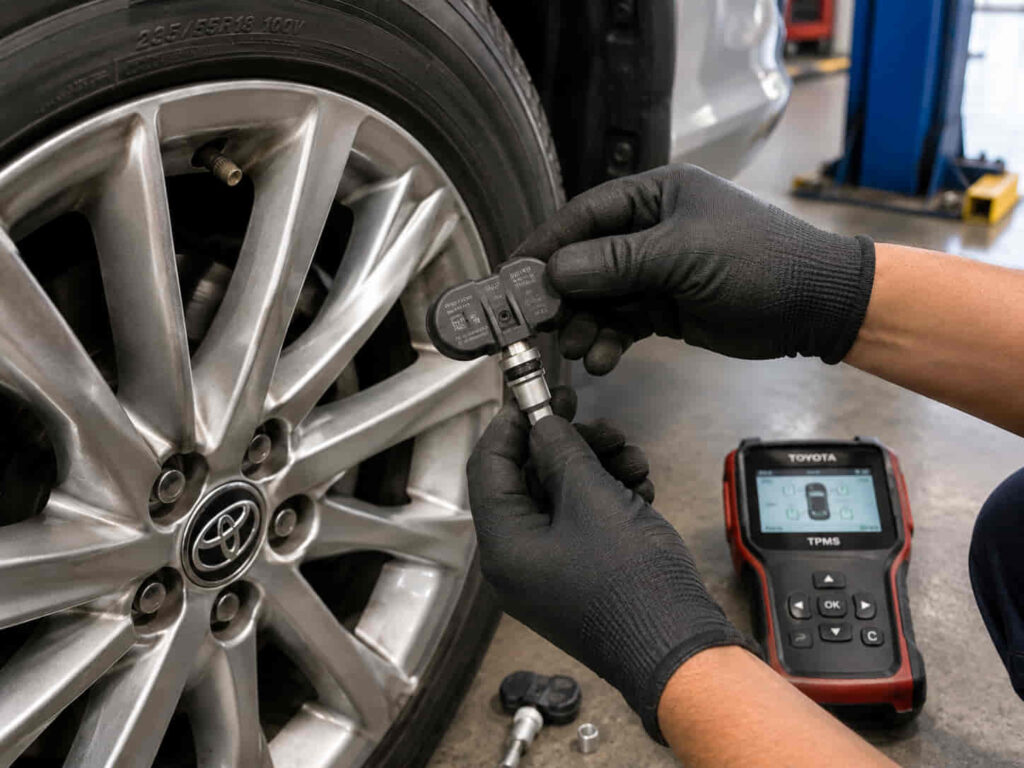
A Toyota TPMS sensor needs replacement when its internal battery is depleted, the sensor is physically damaged, or the vehicle can no longer receive a valid pressure signal from the sensor. Replacing the sensor is different from correcting low tire pressure or performing a TPMS reset. A warning light caused by an underinflated tire does not mean the sensor itself has failed.
The replacement process involves identifying the faulty sensor, accessing the sensor inside the wheel assembly, installing a compatible replacement, and completing any required sensor registration or relearn procedure. The exact procedure varies by Toyota model, model year, and TPMS configuration, so sensor compatibility and registration requirements should be confirmed for the specific vehicle before replacement.
Cost also depends on more than the price of the sensor. The final Toyota TPMS sensor replacement cost can include the replacement sensor, tire removal and installation labor, wheel service, programming or sensor ID registration, and system verification. For this reason, diagnosing the cause of the TPMS warning before replacing parts is the first step toward avoiding unnecessary repairs.
This guide explains when a Toyota TPMS sensor should be replaced, how to identify a failed sensor, how long TPMS sensors last, what affects replacement cost, and what happens during the replacement and programming process.
A Toyota TPMS sensor needs to be replaced when it can no longer measure or transmit tire-pressure data correctly because of battery depletion, physical damage, valve-stem damage, or an internal electronic failure. A TPMS warning light alone does not confirm sensor failure because the system is designed to warn the driver when tire pressure is outside the expected range. The first step is therefore to check and correct tire pressure before treating the warning as a sensor problem.
A failed sensor becomes more likely when the TPMS warning remains after all tires have been inflated to the vehicle’s specified pressure or when diagnostic equipment cannot obtain a valid reading from one wheel. The distinction matters because adding air, resetting the system, and replacing a sensor solve different problems. Low tire pressure requires correcting the pressure and identifying the cause of air loss, while a sensor that no longer communicates requires diagnosis of the TPMS sensor and its related components.
Battery depletion is another reason a Toyota TPMS sensor eventually requires replacement. The sensor operates with an internal battery that powers pressure monitoring and wireless communication. Once that battery can no longer provide sufficient power, the sensor stops performing its monitoring function reliably. Because the battery is integrated into the sensor assembly on typical direct TPMS designs, service generally involves replacing the sensor rather than treating it like a conventional replaceable battery.
Physical damage can require replacement even when the sensor’s electronics and battery are still functional. The sensor is mounted at the wheel and can be affected during tire removal, tire installation, wheel repair, or an impact involving the wheel. Damage involving the sensor body or associated valve components can therefore create a TPMS fault independently of battery age. Diagnosis should identify the actual failed component before a replacement sensor is installed.
The most reliable way to determine which Toyota TPMS sensor has failed is to diagnose each wheel rather than replace sensors based only on the dashboard warning. A compatible TPMS diagnostic tool can be used to communicate with individual sensors and evaluate whether they are transmitting data. This process separates a defective sensor from low tire pressure, registration problems, or other TPMS faults and reduces unnecessary replacement.
How Long Do Toyota TPMS Sensors Last?
Toyota TPMS sensors are service-life components because their internal batteries eventually lose the ability to power the sensor. Their useful life should therefore be evaluated according to sensor age and actual diagnostic condition rather than assuming every sensor must be replaced after a fixed number of years. Driving conditions, sensor design, operating frequency, temperature exposure, and the number of transmissions made by the sensor can affect how long the battery remains functional.
The sensor battery also explains why an older Toyota may experience TPMS sensor failures close together. Sensors originally installed at the same time have experienced a similar period of service, so the failure of one aging sensor can indicate that the remaining original sensors are also approaching the later stage of their service lives. This does not mean all four sensors are automatically defective. It means sensor age becomes relevant when deciding whether replacing only the failed unit or replacing several aging units is more economical.
Replacing Toyota tires does not automatically require replacing functional TPMS sensors. Tire replacement and TPMS sensor replacement address different components with different service conditions. However, tire replacement provides a practical opportunity to inspect aging sensors because the tire is already being serviced. If an older sensor is close to the end of its expected service life, replacing it during tire service can avoid paying for another tire removal and installation procedure if the sensor fails soon afterward.
For the same reason, a functioning sensor should not be replaced solely because a TPMS warning light appears. Sensor replacement should follow diagnosis, not precede it. Confirming tire pressure, identifying which sensor is communicating incorrectly, and determining whether the fault involves the sensor itself creates a more precise repair decision than replacing TPMS components by assumption.
Read more: Toyota P1305
How Much Does Toyota TPMS Sensor Replacement Cost?
Toyota TPMS sensor replacement cost is determined by the price of the sensor, tire service labor, installation, and any programming or registration required after installation. The sensor price alone does not represent the complete repair cost because a TPMS sensor is installed at the wheel and must function as part of the vehicle’s tire pressure monitoring system. The exact total therefore varies by Toyota model, model year, replacement sensor type, and the service provider performing the work.
Parts are the first component of the total cost. A replacement sensor must be compatible with the TPMS configuration used by the specific Toyota vehicle. OEM sensors and compatible aftermarket sensors can differ in purchase price, but price should not be the only selection criterion. The replacement must use the correct application and communication protocol for the vehicle because an incompatible sensor can be physically installed without communicating correctly with the TPMS system. Verifying compatibility before installation prevents paying for tire service twice if the wrong sensor has to be removed.
Labor is the second component because replacing a TPMS sensor involves more than connecting a component accessible from outside the vehicle. The sensor is associated with the wheel and valve assembly, so the technician must gain access to it without damaging the tire, wheel, or replacement sensor. The tire is then returned to its operating position, inflated to the specified pressure, and the wheel assembly is checked before the TPMS procedure is completed. Replacing multiple sensors during the same tire service can therefore have a different labor structure from replacing a single failed sensor during a separate visit.
Programming, sensor ID registration, or relearn procedures can add another service step. A newly installed sensor must not only measure tire pressure; the vehicle must also be able to identify and receive its signal correctly. The required procedure depends on the Toyota model, model year, TPMS design, and replacement sensor being used. For this reason, a quote for Toyota TPMS sensor replacement should clarify whether sensor installation and the required TPMS setup are included rather than comparing providers only by the advertised sensor price.
A precise replacement estimate should consequently be based on the vehicle application and diagnosis of the failed component. Quoting one universal price for every Toyota would ignore differences in sensor specifications, labor rates, wheel configurations, and TPMS procedures. The useful comparison is the total installed cost for a compatible sensor with the required system setup and verification, not simply the lowest component price.
How Is a Toyota TPMS Sensor Replaced?
A Toyota TPMS sensor is replaced by confirming the failed sensor, accessing the sensor at the wheel, removing the defective unit, installing a compatible replacement, restoring the tire and wheel assembly, and completing the required TPMS setup. Diagnosis comes first because replacing a working sensor will not correct a warning caused by low tire pressure, another failed sensor, or a system registration problem.
Once the defective sensor has been identified, the technician must access the sensor mounted at the wheel. This generally requires releasing tire pressure and moving the tire away from the sensor area so the old component can be removed safely. The procedure requires care because improper tire service can damage the sensor, valve components, tire bead, or wheel. This physical location is also why TPMS sensor replacement is commonly performed by tire shops, dealerships, and repair facilities equipped for wheel and tire service rather than treated as a simple external electronic-component replacement.
The new TPMS sensor must match the vehicle application before it is installed. Compatibility involves more than fitting the sensor into the wheel. The sensor must be capable of communicating in the manner expected by the Toyota’s TPMS system. Depending on the type of replacement sensor, preparation can also involve configuring the sensor before or during installation. Selecting and verifying the correct sensor before completing tire reassembly reduces the risk of discovering a communication problem after the physical installation is finished.
After the replacement sensor is secured, the tire and wheel assembly is restored and the tire is inflated to the vehicle’s specified pressure. Correct tire pressure remains essential because a functional sensor reports pressure; it does not correct an underinflated tire. The technician can then proceed with the registration, programming, initialization, or relearn procedure required by the particular vehicle and sensor configuration.
The final step is verification. A completed TPMS sensor replacement should result in both a correctly installed sensor and a TPMS system that recognizes valid tire-pressure information. Verification distinguishes a complete repair from merely installing a new component. If the system still reports a fault, the next step is diagnosis of sensor registration, compatibility, tire pressure, other wheel sensors, and the TPMS system rather than immediately replacing another component.
Does a New Toyota TPMS Sensor Need to Be Programmed?
A new Toyota TPMS sensor may require programming, sensor ID registration, or a relearn procedure before the vehicle can use its tire-pressure data correctly. The exact requirement depends on the Toyota model, model year, TPMS system, and replacement sensor type. Installing a sensor physically inside the wheel does not by itself guarantee that the vehicle will recognize it, so the TPMS setup procedure must be confirmed for the specific vehicle rather than applying one procedure to every Toyota.
Programming and relearning describe different operations. Programming generally refers to configuring a programmable replacement sensor so it can operate with the intended vehicle application. Sensor ID registration involves storing or associating the sensor’s identification information with the vehicle’s TPMS system. Relearning allows the system to establish or update the relationship between installed sensors and the vehicle. These terms are sometimes used interchangeably in service discussions, but they should not automatically be treated as the same procedure.
This distinction explains why a new TPMS sensor can be installed correctly while the TPMS warning remains active. The sensor may be physically functional and capable of measuring pressure, but the vehicle may not yet be receiving or associating its signal correctly. In that situation, replacing the newly installed sensor again without checking its configuration, registration, and compatibility can add unnecessary parts and labor without correcting the underlying problem.
The required setup also affects the choice of replacement sensor. Some replacement applications involve sensors prepared for a specific vehicle, while programmable aftermarket sensors may need to be configured with compatible TPMS equipment. The sensor must ultimately provide the identification and pressure information expected by the vehicle. For that reason, sensor compatibility should be confirmed before installation rather than after the tire has been reassembled.
A Toyota TPMS relearn should also not be confused with correcting tire pressure. A relearn procedure establishes or restores communication within the monitoring system, while inflation changes the actual air pressure inside the tire. If a tire is underinflated, performing a relearn does not repair the pressure problem. Conversely, adding air does not repair a sensor that has stopped transmitting because of an internal failure or depleted battery.
Toyota owners should therefore treat sensor installation and TPMS system setup as two connected parts of the same replacement process. The repair is complete when the compatible sensor is installed, the required registration or relearn procedure has been performed, and the system verifies valid tire-pressure information without an unresolved TPMS fault.
Can You Replace a Toyota TPMS Sensor Yourself?
A Toyota TPMS sensor can be replaced as a DIY repair only when the person has the equipment and vehicle-specific information required for both tire service and TPMS setup. The electronic sensor itself is only one part of the job. Accessing it typically involves working with the tire and wheel assembly, while completing the repair can require TPMS diagnostic or programming equipment.
Physical access is the first limitation. The sensor is located at the wheel rather than in an easily accessible area of the engine compartment or cabin. Replacing it requires releasing tire pressure and gaining sufficient access to the sensor without damaging the tire bead, wheel, valve components, or new sensor. Tire-changing equipment makes this process fundamentally different from replacing an externally accessible automotive sensor.
TPMS equipment creates the second limitation. Before replacement, a diagnostic tool can help determine whether the suspected sensor is actually communicating. After replacement, compatible equipment may be needed to configure the replacement sensor or complete the applicable registration procedure. Skipping diagnosis creates the risk of replacing a functioning sensor when the actual cause is low tire pressure, another sensor, an incompatible sensor configuration, or a system-level fault.
Vehicle-specific procedures create the third limitation. Toyota TPMS configurations are not identical across every model and model year, so a procedure that works for one Toyota should not automatically be applied to another. Sensor specifications and registration requirements should be checked against the exact vehicle application. This is particularly important when using aftermarket programmable sensors because physical fit alone does not establish electronic compatibility.
Professional replacement is the more appropriate option when the failed sensor has not been identified, tire removal equipment is unavailable, the replacement requires programming or sensor ID registration, or the TPMS warning remains after previous service. A tire shop, Toyota dealership, or appropriately equipped repair facility can combine tire service with sensor diagnosis and system verification. The relevant advantage is not simply convenience; it is the ability to complete the mechanical and electronic parts of the repair as one process.
DIY replacement makes more sense when the person already has suitable tire-service equipment, a compatible TPMS tool, the correct replacement sensor, and access to the procedure for the specific Toyota. Without those requirements, replacing the sensor professionally reduces the risk of tire damage, incompatible sensor installation, incomplete registration, and repeated tire-service labor.
Should You Use an OEM or Aftermarket TPMS Sensor for a Toyota?
Both OEM and compatible aftermarket TPMS sensors can be used for Toyota TPMS sensor replacement, but the replacement sensor must match the vehicle’s TPMS requirements. The practical decision should be based on compatibility, programming requirements, expected service life, warranty, and total installed cost rather than choosing a sensor only because it is labeled OEM or because it has a lower purchase price.
An OEM TPMS sensor is designed for a defined Toyota vehicle application, which can make parts identification and compatibility verification more straightforward when the correct sensor is selected for the vehicle. This does not eliminate the need to confirm the application. Toyota vehicles span different models, generations, and model years, so a sensor intended for one application should not be assumed to work with every Toyota that uses a tire pressure monitoring system.
Aftermarket TPMS sensors provide another replacement option, including programmable sensors designed to support multiple vehicle applications. Their broader application coverage can reduce the number of different sensors a service provider needs to stock, but the sensor must be configured correctly for the vehicle before the repair is considered complete. A sensor that physically fits the wheel but cannot communicate as required by the vehicle is not a compatible replacement.
Programming requirements are therefore part of the OEM-versus-aftermarket decision. A programmable replacement sensor may require a compatible TPMS tool to configure its operating information for the Toyota application. The vehicle may then require the appropriate sensor registration or relearn procedure. The exact process depends on the sensor and vehicle configuration, which is why the replacement part and service procedure should be considered together.
Price should be evaluated as total installed cost rather than sensor price alone. A less expensive sensor does not produce a lower-cost repair if incorrect compatibility leads to additional diagnosis, tire removal, reinstallation, or programming work. Conversely, paying more for a sensor provides little practical benefit if a lower-priced compatible sensor meets the required application and is installed and configured correctly. The relevant comparison is between replacement options that can perform the same required TPMS function on the specific vehicle.
The correct Toyota TPMS sensor is ultimately the sensor that matches the vehicle application, can communicate correctly with the TPMS system, and can be successfully registered or relearned when required. Confirming the Toyota model, model year, and sensor application before installation is more reliable than selecting a replacement based only on brand or price.
Should You Replace One or All Toyota TPMS Sensors?
You can replace one failed Toyota TPMS sensor without automatically replacing every sensor on the vehicle. TPMS sensors operate as individual monitoring components, so one sensor can fail while the remaining sensors continue to transmit valid pressure information. Replacing only the confirmed failed unit is therefore appropriate when the other sensors remain functional and there is no evidence that they require replacement.
Sensor age changes the economics of that decision. TPMS sensors installed at approximately the same time have experienced a similar period of service, and their internal batteries have aged over the same general interval. If one original sensor fails because its battery has reached the end of its service life, the remaining original sensors may also be approaching the later part of their service lives. This does not prove that the other sensors will fail immediately, but it creates a reason to evaluate their age and condition before choosing a single-sensor repair.
Replacing several aging sensors during the same tire service can reduce repeated labor in the right situation. Each future sensor failure may require another wheel and tire service operation as well as additional TPMS setup. When multiple original sensors are already near the end of their useful service period, addressing them during one service visit can reduce the likelihood of returning shortly afterward for another age-related sensor failure. The value comes from consolidating related service, not from a rule that TPMS sensors must always be replaced as a set.
Replacing all sensors is less justified when the failed unit was damaged independently of age. For example, a sensor damaged during wheel or tire service does not establish that the sensors on the other wheels have the same defect. The same principle applies when diagnosis identifies an isolated electronic failure. In these situations, replacing functioning sensors without another technical or economic reason adds parts cost without addressing an existing fault.
The condition of the tires can also influence replacement timing. If an older Toyota is already undergoing tire replacement and its original TPMS sensors have accumulated substantial service time, evaluating the sensors at that point can prevent another tire-service operation later. In contrast, relatively recent sensors that communicate normally do not require replacement merely because new tires are being installed.
The decision should therefore follow the failure mechanism: replace the individual sensor when the problem is isolated, and consider replacing multiple sensors when similar age and remaining service life make repeated failures and repeated labor economically relevant. Diagnosis should determine which sensor has failed, while sensor age and current tire service determine whether replacing additional units provides practical value.
Why Is the Toyota TPMS Light Still On After Sensor Replacement?
A Toyota TPMS light can remain on after sensor replacement when tire pressure is incorrect, the new sensor has not been registered or relearned correctly, the replacement sensor is incompatible, another sensor has failed, or the TPMS has another unresolved fault. Installing a new sensor addresses the failed component, but it does not automatically correct every condition that can activate a tire pressure monitoring warning.
Tire pressure should be checked first because the TPMS continues to monitor pressure after a sensor has been replaced. A correctly installed and communicating sensor can still report an underinflated tire. Pressure should be checked against the specification for the vehicle rather than selecting a pressure based on the tire alone. If the warning reflects actual low pressure, resetting or relearning the TPMS without correcting the pressure does not resolve the underlying condition.
Sensor registration is another possible cause when the warning appears after replacement. The vehicle must be able to recognize the replacement sensor and receive the information it transmits. If the required sensor ID registration, programming, initialization, or relearn procedure was not completed correctly, the new sensor may be physically functional while the vehicle still treats its information as unavailable. The appropriate next step is to verify the procedure required for the specific Toyota model and model year rather than repeatedly attempting a generic reset.
Compatibility should be checked when registration does not resolve the problem. Physical installation does not establish electronic compatibility. A replacement sensor must support the application required by the vehicle and, in the case of a programmable sensor, must be configured correctly. This is why sensor application should ideally be confirmed before installation; discovering an incompatible component afterward can require another tire-service operation.
Another wheel sensor can also be responsible for the warning. Replacing one confirmed failed sensor does not renew the batteries or electronics inside the remaining sensors. This becomes particularly relevant when several original sensors are of a similar age. A diagnostic scan of each wheel can determine whether the replacement sensor is communicating and whether another sensor has stopped transmitting, which is more precise than assuming the newly installed component caused the continuing warning.
A reset should therefore not be treated as a universal repair for a TPMS light. Resetting or relearning changes the system’s monitoring state or sensor association; it does not repair low tire pressure, a dead sensor battery, an incompatible sensor, or a damaged component. If the warning remains after correct tire pressure and the required TPMS setup have been verified, further diagnosis should identify the unresolved fault before additional sensors are replaced.
Where Should You Get a Toyota TPMS Sensor Replaced?
A Toyota TPMS sensor should be replaced by a service provider that can diagnose the failed sensor, perform tire and wheel service safely, install a compatible replacement, complete the required TPMS setup, and verify that the system operates correctly afterward. Toyota dealerships, tire shops, and properly equipped independent repair shops can meet these requirements, but the available equipment and service scope should be confirmed before choosing a provider.
A Toyota dealership can be a practical choice when vehicle-specific diagnosis, OEM parts identification, or access to Toyota-specific service procedures is important. This can be particularly useful when the TPMS problem extends beyond an individual wheel sensor or when previous replacement attempts have not cleared the fault. The relevant benefit is access to vehicle-specific service capability rather than an assumption that every TPMS sensor must be replaced at a dealership.
A tire shop can be efficient when sensor replacement occurs together with tire installation, tire repair, wheel service, or replacement of several aging sensors. TPMS sensors are physically associated with the wheel assembly, so tire-service equipment is an important part of the replacement process. A shop that also has compatible TPMS diagnostic and programming equipment can perform the mechanical installation and electronic setup during the same service visit.
An independent automotive repair shop is another option when it has the required tire-service and TPMS capabilities. The important distinction is equipment and expertise rather than the business category itself. A provider should be able to identify which sensor has failed, verify replacement compatibility, complete any necessary programming or registration, and confirm communication with the vehicle after installation.
Price comparisons should use the complete service scope. A quote that covers only the replacement sensor cannot be compared accurately with a quote that includes diagnosis, tire service, installation, programming or registration, and final system verification. The useful Toyota TPMS sensor replacement price is the total cost required to return the TPMS to correct operation, because a lower initial price provides little value if additional service is required to complete the repair.
Before authorizing replacement, the diagnosis should also distinguish a failed sensor from low tire pressure or a registration problem. This prevents a service decision based solely on the dashboard warning light. Once sensor failure is confirmed, the replacement sensor should be selected for the specific Toyota application and the required TPMS procedure should be completed after installation.
Toyota TPMS sensor replacement is therefore a combined diagnostic, tire-service, and electronic-system procedure rather than a simple parts swap. The repair is complete when the actual failed component has been identified, a compatible sensor has been installed, the required TPMS setup has been completed, and the vehicle receives valid tire-pressure information without an unresolved system fault.