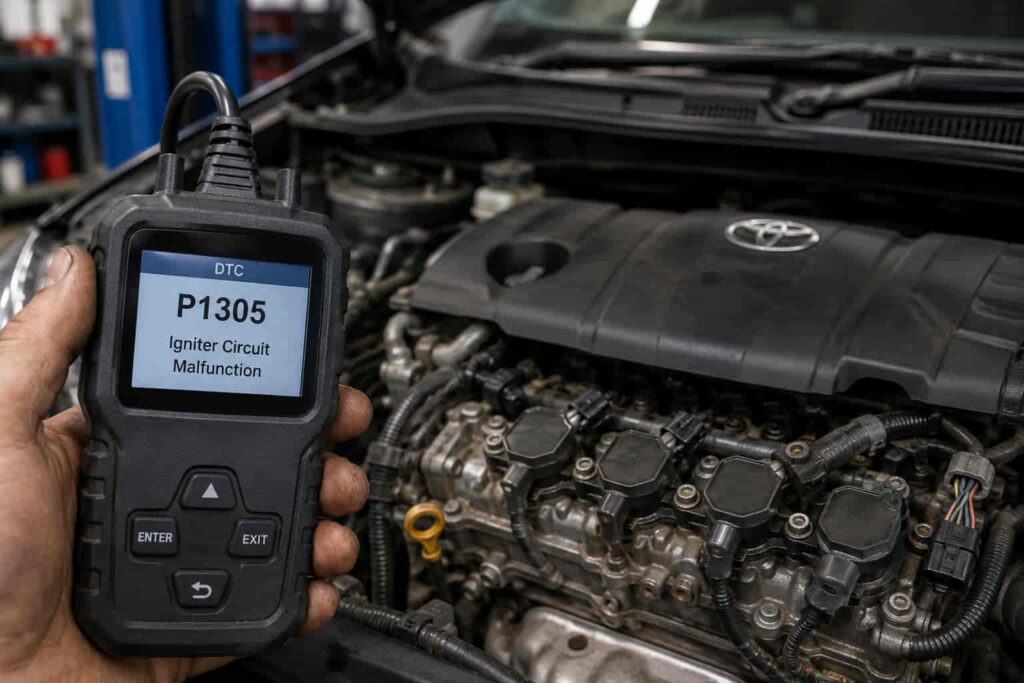
Toyota P1305 is a manufacturer-specific diagnostic trouble code that indicates an igniter circuit malfunction associated with the No. 2 ignition coil circuit on applicable Toyota engines. The engine control module (ECM) controls ignition through an ignition trigger signal, or IGT, and monitors ignition confirmation through an IGF signal returned from the ignition system. P1305 is stored when the ECM detects the specified fault in this ignition-control process.
The code does not automatically mean that the No. 2 ignition coil must be replaced. Toyota diagnostic information identifies the ignition system, an open or short in the relevant IGT/IGF circuit, the ignition coil with igniter, and the ECM among the areas that may require inspection. The exact circuit configuration and diagnostic procedure must therefore be matched to the Toyota model, model year, and engine before replacing parts.
Diagnosing Toyota P1305 requires identifying the fault that prevents the ignition system and ECM from communicating or operating as specified. This guide explains what P1305 means, how serious the fault is, the symptoms and causes associated with it, how to diagnose and repair the code, expected repair considerations, and what to check if P1305 returns after the repair.
What Does the P1305 Code Mean on a Toyota?
Toyota P1305 means “Igniter Circuit Malfunction (No. 2)” on applicable Toyota engines. The code directs diagnosis toward the No. 2 ignition coil with igniter circuit rather than identifying a failed ignition coil by itself. Toyota service information uses this definition across several engine applications, including the 1ZZ-FE, 2AZ-FE, 1MZ-FE, 2RZ-FE, and 2UZ-FE. The exact wiring and diagnostic procedure still need to be matched to the vehicle’s model year and engine.
The fault is connected to the way the engine control module manages and confirms ignition. In Toyota’s direct ignition system, the ECM determines ignition timing and sends an IGT ignition trigger signal to the appropriate ignition coil/igniter circuit. The igniter controls primary current through the ignition coil, allowing the coil to generate the high voltage required for the spark plug. The igniter then returns an IGF ignition confirmation signal to the ECM. This feedback allows the ECM to confirm that the commanded ignition event has occurred as expected.
P1305 is therefore better understood as an ignition-control circuit fault than as an automatic diagnosis of a bad coil. For example, Toyota’s diagnostic information for the 2002 Corolla 1ZZ-FE explains that the ECM uses IGF feedback as part of a fail-safe strategy and can stop fuel injection when the required ignition confirmation is not received. This relationship explains why a fault in the ignition circuit can affect engine operation rather than merely turning on a warning light.
The “No. 2” designation also has diagnostic significance. Toyota service information directs P1305 diagnosis toward the No. 2 ignition coil with igniter circuit. Related codes identify other circuits; for example, P1300 corresponds to No. 1, P1310 to No. 3, and P1315 to No. 4 on applicable four-cylinder systems. On engines with additional cylinders, further related igniter codes can be present. This code-to-circuit relationship helps isolate the area that should be tested instead of treating P1305 as a general ignition-system failure.
How Serious Is the Toyota P1305 Code?
Toyota P1305 should be diagnosed promptly because it identifies a malfunction in an ignition circuit that the ECM uses to control and verify combustion. It is more significant than a maintenance reminder or a code unrelated to immediate engine operation. The affected circuit participates directly in producing and confirming ignition, so a persistent fault can interfere with normal engine operation.
The severity depends on how the circuit has failed. An intermittent electrical connection can produce a fault that appears only under certain operating conditions, whereas a circuit or component failure that prevents the required ignition event can have a more direct effect on combustion. This is why severity should be determined from the actual symptoms, accompanying DTCs, freeze-frame information, and circuit tests rather than assigning P1305 a generic numerical severity rating.
Toyota specifically recommends reviewing freeze-frame data during P1305 troubleshooting. Freeze-frame information records engine conditions when the malfunction was detected and can show whether the engine was running or stopped, whether it was warmed up, and other operating information at the time of the fault. This evidence helps distinguish an intermittent event from a fault that repeatedly appears under similar operating conditions.
Multiple igniter codes can make the fault more significant diagnostically because they can point away from several independent coil failures and toward a shared circuit. For example, Toyota’s 1MZ-FE service information states that P1305, P1310, and P1320 appearing together can indicate an open or short in the IGF2 circuit. On an applicable 2UZ-FE V8, P1305, P1310, P1320, and P1340 appearing together similarly direct attention toward IGF2. Reading the entire DTC set is therefore more informative than diagnosing P1305 in isolation.
Can You Drive a Toyota With the P1305 Code?
Do not assume a Toyota with P1305 is suitable for continued normal driving until the ignition fault and the vehicle’s current operating condition have been assessed. P1305 concerns a circuit involved directly in ignition, and Toyota documentation shows that ignition confirmation is incorporated into the ECM’s fail-safe strategy. A vehicle that currently appears to run does not prove that the underlying circuit is functioning reliably.
The immediate decision should be based on actual engine behavior as well as the stored code. If the engine develops severe abnormal operation, repeatedly loses ignition, stalls, or exhibits another condition that makes vehicle operation unsafe or unreliable, continuing the journey introduces unnecessary risk. The correct action is to diagnose the ignition circuit rather than repeatedly clearing P1305 and waiting for it to return.
A Toyota that appears to operate normally still requires diagnosis because an intermittent wiring, connector, coil/igniter, or signal problem can disappear temporarily. Intermittent electrical faults are especially important to investigate with stored DTC information and freeze-frame data because the fault may not be present while the vehicle is stationary in a workshop. Toyota specifically incorporates freeze-frame review into its P1305 troubleshooting guidance for this reason.
Clearing the Check Engine Light does not establish that the Toyota is safe to continue driving. P1305 is resolved when the underlying ignition-circuit fault has been identified, repaired, and verified, not when the stored DTC has simply been erased. The next diagnostic step is therefore to identify the symptoms and determine which failure within the No. 2 igniter circuit is responsible for the code.
Read more: Toyota Sienna Oil Change
What Are the Symptoms of Toyota Code P1305?
Toyota P1305 can be associated with a Check Engine Light and abnormal engine operation when the No. 2 ignition circuit fault interferes with ignition. The exact symptoms depend on whether the fault is continuous or intermittent and whether the ECM continues receiving the ignition confirmation signal it expects. Toyota service information defines P1305 around the No. 2 ignition coil with igniter circuit, so symptoms should be interpreted as consequences of that ignition fault rather than as a fixed set that every vehicle will display.
A Check Engine Light is the most direct observable indication associated with the stored diagnostic trouble code. The ECM monitors ignition control and confirmation through the IGT and IGF signals. When the monitored conditions for P1305 are met, the ECM stores the fault. The warning light identifies that the engine-management system has detected a malfunction, but it does not establish whether the coil, wiring, connector, or ECM is the failed component.
Engine misfire or rough operation can occur when the circuit problem prevents the affected cylinder from receiving a normal ignition event. Combustion requires the spark plug to ignite the compressed air-fuel mixture at the intended time. When the No. 2 ignition circuit cannot perform that function correctly, the affected cylinder can contribute less torque than the other cylinders, producing uneven engine operation. Independent diagnostic references also associate P1305 with misfire, rough running, and loss of power, although the exact symptom set varies with the failure.
Loss of engine power can develop for the same reason. An engine produces its expected output when its cylinders contribute combustion events as designed. An ignition failure affecting one cylinder reduces that contribution and can make acceleration or general engine response noticeably weaker. The effect depends on engine configuration and the duration of the fault, so loss of power should be treated as a possible consequence rather than a mandatory symptom of every P1305 event.
Toyota’s fail-safe strategy can make the effect more significant than an ordinary warning light. Service information for the 1ZZ-FE explains that the ECM stops fuel injection as a fail-safe function when the required IGF ignition confirmation is not received. This protects the system when the ECM cannot confirm ignition, but it also explains why an igniter-circuit fault can materially affect engine operation.
Intermittent P1305 faults can produce less obvious symptoms. A damaged electrical connection can function normally at one moment and fail under vibration, temperature changes, or other operating conditions. The vehicle can therefore appear to run normally when inspected even though the ECM previously detected the fault. Toyota specifically directs technicians to examine freeze-frame data because it records operating conditions when the malfunction was detected.
What Causes the Toyota P1305 Code?
Toyota identifies the ignition system, an open or short in the relevant IGT or IGF circuit, the No. 2 ignition coil with igniter, and the ECM as primary trouble areas for P1305 on applicable engines. These causes belong to the same ignition-control pathway: the ECM commands ignition through IGT, the coil and igniter perform the ignition function, and IGF provides confirmation back to the ECM. A failure anywhere in that monitored pathway can lead diagnosis toward P1305.
An open or short in the IGT or IGF circuit is one of the specific electrical causes identified in Toyota repair information. IGT carries the ECM’s ignition command toward the applicable ignition coil with igniter, while IGF provides ignition confirmation to the ECM. A broken wire, shorted circuit, or connection problem can interrupt this communication even when another component in the system remains functional. This is why replacing the No. 2 ignition coil immediately after reading P1305 is not a complete diagnostic method.
The No. 2 ignition coil with igniter itself is another specified trouble area. The coil must generate the high voltage used by the spark plug, while the integrated igniter participates in controlling primary coil current and providing ignition confirmation. An internal failure that prevents this process from occurring correctly can therefore satisfy the conditions associated with the code. Toyota service documentation specifically directs technicians toward the No. 2 ignition coil with igniter circuit when P1305 is displayed.
The broader ignition system must also be checked rather than treating P1305 exclusively as an electronic signal problem. Toyota’s diagnostic sequence for the 1ZZ-FE includes checking the spark plug and spark before proceeding through harness and connector tests. This sequence matters because diagnosis should establish whether the expected ignition event is actually occurring before narrowing the fault to individual portions of the control circuit.
The wiring harness and electrical connectors between the ignition coil and ECM can create the same code when continuity or signal integrity is lost. Toyota’s inspection procedure specifically checks the harness and connector in the IGF and IGT signal circuits and directs repair or replacement when those tests fail. This provides a stronger diagnostic basis than replacing a coil simply because P1305 contains the words “Igniter Circuit Malfunction.”
The ECM is also listed by Toyota as a possible trouble area, but it should not automatically become the first replacement target. The ECM sits at the command-and-monitoring side of the circuit, so an internal fault can theoretically prevent the correct IGT output or IGF processing. However, the diagnostic sequence should first test the ignition components and circuit conditions specified for the applicable vehicle. Replacing an ECM before excluding a wiring or coil/igniter fault can turn a diagnostic problem into an unnecessarily expensive parts-replacement exercise.
Multiple related igniter codes provide additional causal information. On applicable engines, P1300, P1305, P1310, and P1315 correspond to different ignition coil with igniter circuits. If several of these codes occur together, diagnosis should consider the signal paths and components shared by the affected circuits rather than assuming that several ignition coils failed independently at the same moment. The complete DTC set therefore provides context that P1305 alone cannot provide.
P1305 identifies the circuit that needs diagnosis; it does not identify the failed part with certainty. The correct repair can only be selected after testing separates an ignition-system problem, IGT/IGF wiring fault, No. 2 coil/igniter fault, connector problem, or ECM-related condition. That distinction is the basis for the diagnostic procedure in the next section.
How Do You Diagnose Toyota Code P1305?
Diagnose Toyota P1305 by confirming the stored code, reviewing freeze-frame data, checking ignition at the affected circuit, testing the IGT and IGF wiring between the ECM and ignition coil with igniter, and isolating the failed component before replacing parts. Toyota’s diagnostic information specifically directs P1305 troubleshooting toward the No. 2 ignition coil with igniter circuit. The exact connector terminals, resistance specifications, and test sequence must be taken from the repair information for the vehicle’s model year and engine because circuit layouts differ between Toyota applications.
Begin by confirming P1305 with a capable scan tool and recording all other stored or pending DTCs before clearing anything. Freeze-frame data is particularly useful because Toyota specifies it as part of P1305 troubleshooting. It records engine conditions when the ECM detected the malfunction, helping determine whether the vehicle was running or stopped, whether the engine was warm, and other operating conditions surrounding the fault. This information becomes more valuable when P1305 is intermittent and the engine operates normally during diagnosis.
The complete DTC set should be interpreted before the No. 2 ignition coil is condemned. P1305 by itself directs attention toward the No. 2 igniter circuit, but several related igniter codes occurring simultaneously can reveal a shared signal-circuit problem. For example, Toyota service information for the 1MZ-FE identifies simultaneous P1305, P1310, and P1320 as an indication that the IGF2 circuit may be open or shorted. On the 2UZ-FE V8, P1305, P1310, P1320, and P1340 appearing together similarly direct diagnosis toward IGF2. This pattern makes the relationship between codes diagnostically more useful than treating every code as an independent failed coil.
The ignition event itself should then be checked according to the applicable Toyota service procedure. Toyota diagnostic sequences for these igniter codes begin by checking the spark plug and spark before proceeding deeper into the electrical circuit. This establishes whether the affected cylinder is producing the expected ignition event and prevents a circuit diagnosis from being based entirely on the presence of the DTC.
Inspect the No. 2 ignition coil connector and the associated wiring for conditions that can interrupt electrical continuity. A connector that is not seated correctly, damaged terminals, an open wire, or a short in the circuit can prevent the IGT command or IGF confirmation signal from traveling between the ECM and ignition system as intended. Visual inspection is useful for finding obvious damage, but a harness that looks intact externally can still have an electrical fault and therefore requires circuit testing when the initial inspection does not identify the problem.
Test the IGT and IGF circuits according to the wiring diagram and specifications for the exact Toyota application. Toyota repair information includes continuity and short-circuit checks between the engine ECU/ECM and ignition coil with igniter. The purpose is to determine whether the signal path is electrically intact rather than assuming that a missing ignition event originated inside the coil. When the harness or connector fails the specified test, Toyota’s diagnostic direction is to repair or replace the affected harness or connector.
The No. 2 ignition coil with igniter becomes a stronger failure candidate when the spark, wiring, connector, power, ground, and signal-path tests isolate the malfunction to that component. This distinction matters because P1305 identifies the circuit in which the ECM detected the fault; it does not independently prove which physical component failed. Testing before replacement reduces unnecessary parts replacement and preserves the causal relationship between diagnosis and repair.
The ECM should remain later in the diagnostic sequence. Toyota includes the ECM among possible P1305 trouble areas, but an ECM replacement should follow circuit and component testing rather than precede it. The ECM participates directly by producing the IGT command and monitoring IGF confirmation, so an ECM-side fault is technically possible. However, replacing the ECM without first excluding the ignition coil, connectors, and wiring leaves more direct failure points untested.
Intermittent P1305 faults require the same logic even when the code cannot be reproduced immediately. Use the stored freeze-frame conditions, inspect connectors and harnesses carefully, and reproduce relevant operating conditions only when it is safe and technically appropriate. A successful P1305 diagnosis identifies why the ECM lost the expected ignition-control or confirmation behavior; it does not simply identify a part that might be associated with the code.
How Do You Fix the Toyota P1305 Code?
Fix Toyota P1305 by repairing the specific ignition-circuit fault confirmed during diagnosis rather than automatically replacing the No. 2 ignition coil. The appropriate repair can involve correcting an ignition-system problem, repairing an open or short in the IGT or IGF circuit, repairing a connector, replacing a confirmed faulty ignition coil with igniter, or addressing an ECM-related fault after the other specified circuit conditions have been excluded. Toyota’s service information identifies these areas as part of the P1305 diagnostic path.
Repair the wiring or connector when electrical testing identifies an open, short, excessive circuit fault, or damaged connection in the relevant IGT or IGF path. Restoring the circuit allows the ECM’s ignition command and the ignition confirmation signal to travel through the system as designed. Replacing the ignition coil without correcting a damaged signal wire would leave the original cause intact, allowing P1305 to remain or return.
Replace the No. 2 ignition coil with igniter when testing isolates the malfunction to that component. The replacement must match the Toyota model and engine because ignition components are application-specific. After installation, the surrounding connector and wiring should still be inspected and secured correctly. A new component cannot compensate for a poor terminal connection or damaged harness supplying the same circuit.
Correct the ignition-side fault when inspection identifies a problem affecting the spark or the applicable ignition-system checks. Toyota’s diagnostic sequence incorporates spark inspection before deeper harness testing on applicable engines, demonstrating that the repair path should follow the result of the test rather than a predetermined assumption that P1305 always equals coil replacement.
An ECM-related repair should be considered only when the vehicle-specific diagnostic procedure supports that conclusion. Because the ECM controls IGT and monitors IGF, it forms part of the P1305 circuit, but it is also one of the most consequential components to replace without proof. Verify the applicable wiring, connections, ignition coil with igniter, and specified circuit conditions before concluding that the ECM is responsible.
After the repair, clear the stored DTC using the appropriate diagnostic method and operate or test the vehicle under the conditions required to verify the repair. Recheck for P1305 and related ignition codes rather than treating the disappearance of the Check Engine Light immediately after clearing as proof of success. The ECM needs an opportunity to monitor the repaired circuit again.
The final verification should also include engine operation. A repair is stronger when the relevant symptoms are gone, the ignition circuit operates correctly, and P1305 does not reset after the applicable monitor conditions are satisfied. If the code returns, the diagnostic process should resume from the evidence rather than replacing the next component in sequence.
The correct Toyota P1305 repair follows a simple causal relationship: confirm the failure, repair the confirmed cause, and verify that the ECM no longer detects the fault. This approach prevents P1305 troubleshooting from becoming repeated ignition-coil, wiring, or ECM replacement without evidence.
How Much Does It Cost to Fix Toyota P1305?
The cost to fix Toyota P1305 depends on the confirmed cause because P1305 identifies an ignition-circuit malfunction, not a specific component that must always be replaced. A repair can involve an ignition coil with igniter, wiring or connector repair, another ignition-system correction, or an ECM-related repair. The vehicle model, engine, labor rate, parts selection, and diagnostic time therefore determine the final price.
An ignition coil replacement is one possible repair when testing confirms that the No. 2 ignition coil with igniter has failed. Current repair estimates illustrate how vehicle application affects the price. For example, RepairPal estimates ignition-coil replacement on a Toyota Pickup at approximately $140–$222, including an estimated $79–$133 for parts and $61–$90 for labor. These figures are an example rather than a universal Toyota P1305 repair price because labor access, coil design, model, engine, taxes, and location can change the total.
A wiring or connector fault produces a different cost structure. The replacement material itself can be inexpensive when the problem is limited to a connector or short section of wiring, but electrical diagnosis and harness repair can require more labor than replacing an accessible ignition coil. Toyota service information specifically directs P1305 diagnosis toward the No. 2 ignition coil with igniter circuit and associated signal paths, which is why circuit testing should occur before a repair estimate is treated as final.
An ECM-related repair can be substantially more consequential, but the ECM should not be replaced simply because P1305 remains stored. Toyota’s ignition system uses the ECM to send the IGT ignition command and receive the IGF ignition confirmation signal. A fault elsewhere in this pathway can therefore create the code while the ECM remains functional. Testing the coil/igniter, connectors, wiring, and applicable ignition circuit first prevents an expensive control-module replacement from being used as a diagnostic experiment.
Diagnostic labor must also be considered when comparing repair prices. A technician may need to retrieve all DTCs, examine freeze-frame data, reproduce an intermittent condition, inspect the ignition system, and test IGT or IGF circuits before identifying the failed component. That diagnostic time has value because it separates the cost of finding the problem from the cost of replacing the component that caused it.
The most accurate Toyota P1305 repair estimate can only be calculated after the root cause has been identified. A quote based solely on the code assumes the diagnosis before testing has proved it. The financially efficient approach is therefore to diagnose first and price the confirmed repair second.
How Do You Clear the P1305 Code on a Toyota?
Clear Toyota P1305 with an appropriate scan tool after the underlying ignition-circuit fault has been diagnosed and repaired. Erasing the DTC removes stored diagnostic information from the ECM, but it does not repair a faulty No. 2 ignition coil with igniter, an open or shorted IGT/IGF circuit, a damaged connector, or another condition responsible for the code.
Read and preserve diagnostic information before clearing P1305 during the initial troubleshooting process. Toyota specifically instructs technicians to use freeze-frame data because it records engine conditions when the malfunction was detected. Clearing the code too early can remove useful context that helps determine whether the engine was running, whether it was warmed up, and what operating conditions existed when the ECM recognized the fault.
Once the confirmed repair has been completed, clear P1305 using the scan tool procedure appropriate for the vehicle. The next objective is not simply to see an unlit Check Engine Light but to allow the ECM to monitor the ignition system again. Toyota’s system uses the IGT signal to control ignition and the IGF signal to confirm ignition operation, so verification requires the repaired circuit to function correctly when the relevant monitoring conditions occur.
Recheck the vehicle for P1305 and related DTCs after the verification process. Related igniter codes can provide important information because Toyota assigns different P13xx codes to individual ignition coil with igniter circuits on applicable engines. For example, P1300 identifies No. 1, P1305 identifies No. 2, P1310 identifies No. 3, and P1315 identifies No. 4 on applicable four-cylinder systems. Toyota V8 applications extend this sequence to additional ignition circuits.
A code that clears and then returns should be treated as evidence that the fault remains present or that the original diagnosis did not identify the complete cause. Repeatedly erasing P1305 can temporarily remove the warning indication without restoring the ignition circuit. It can also make intermittent troubleshooting more difficult when diagnostic information is repeatedly discarded.
Toyota P1305 is successfully cleared only in the practical sense when the confirmed fault has been repaired and the code does not return after the ECM monitors the circuit again. Code deletion is therefore a verification step after repair, not a repair method by itself.
What Should You Do If Toyota P1305 Comes Back After Repair?
If Toyota P1305 returns after a repair, diagnose the No. 2 ignition coil with igniter circuit again instead of replacing another component without testing. A returning code indicates that the ECM has detected the P1305 fault conditions again. This can happen because the original cause remains present, an intermittent electrical problem was missed, the previous repair did not restore the circuit completely, or another fault exists within the monitored ignition pathway.
Start by retrieving P1305 and every accompanying DTC without immediately clearing them. The relationship between codes can narrow the diagnostic direction. On applicable Toyota engines, P1300, P1305, P1310, and P1315 identify different ignition coil with igniter circuits, while engines with additional cylinders use related codes for further circuits. Several igniter codes returning together can therefore indicate a shared signal-circuit problem rather than simultaneous independent coil failures.
Freeze-frame data should also be compared with information from the original failure when available. Toyota incorporates freeze-frame review into its P1305 diagnostic procedure because the stored operating conditions can help reproduce an intermittent fault. If P1305 repeatedly appears at similar engine temperatures, speeds, loads, or operating conditions, that pattern provides diagnostic evidence that may not be visible while the vehicle is stationary in a workshop.
Reinspect any component disturbed during the previous repair. A newly installed ignition coil does not eliminate the possibility of a poor electrical connection at its connector, damaged terminals, or an intermittent harness fault. Likewise, repairing a visible section of wiring does not prove that the complete IGT or IGF circuit between the ignition system and ECM is electrically sound. The relevant circuit should be retested according to the Toyota wiring diagram and diagnostic specifications for the exact model, model year, and engine.
A recurring P1305 after ignition coil replacement is particularly important because it demonstrates why the code should not be interpreted as “replace coil No. 2.” Toyota defines the fault around the No. 2 ignition coil with igniter circuit, which includes the component and its monitored electrical pathway. If a replacement coil does not resolve the code, the wiring, connectors, ignition operation, signal circuits, and other specified trouble areas must remain in the diagnostic process.
Intermittent wiring faults deserve additional attention when P1305 disappears and returns unpredictably. Electrical continuity can change with connector movement, engine vibration, temperature, or harness position. A circuit can therefore pass a test while stationary and fail during vehicle operation. Inspection should focus on reproducing and electrically confirming the fault rather than repeatedly clearing the code until it stays away temporarily.
The ECM should only become the repair target when vehicle-specific testing supports that conclusion. Toyota includes the ECM among the possible P1305 trouble areas because it generates the IGT ignition command and monitors IGF confirmation. However, a returning code after one unsuccessful repair does not establish ECM failure. The remaining ignition components and circuit paths should first be excluded according to the applicable diagnostic procedure.
The final repair must be verified under conditions that allow the ECM to monitor the ignition circuit again. Clear the DTC after correcting the confirmed fault, operate or test the vehicle as required, and scan the system again for P1305 and related codes. Normal engine operation combined with a code that does not return after appropriate monitoring provides stronger evidence of a successful repair than an immediately cleared Check Engine Light.
A recurring Toyota P1305 means the diagnostic process is not finished. Return to the circuit evidence, identify the remaining root cause, repair it, and verify the result instead of moving from one replacement part to another.