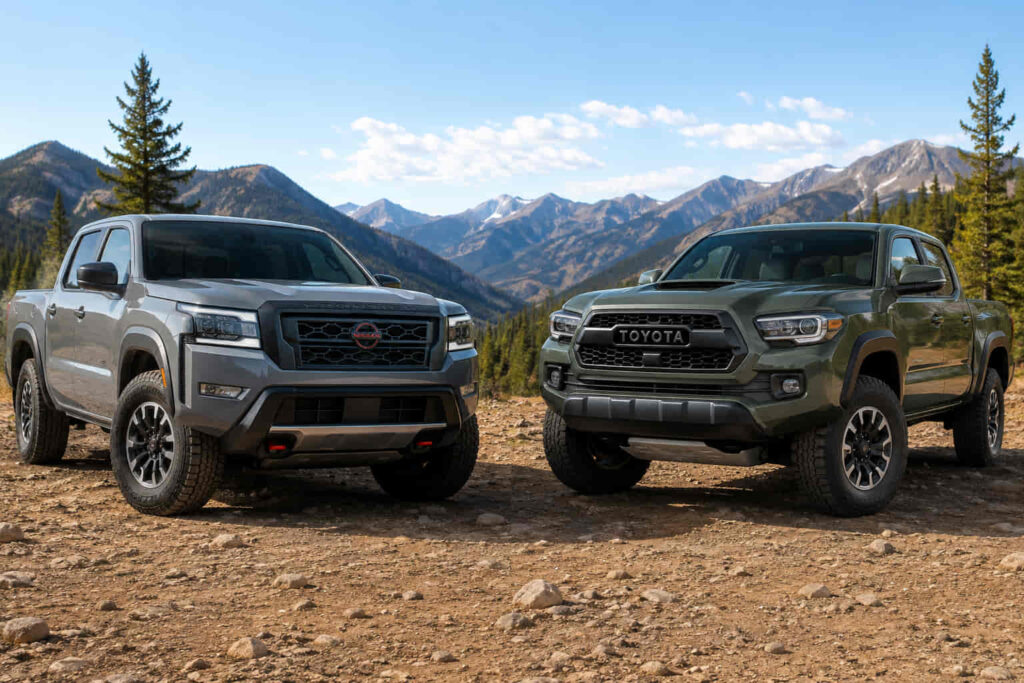
The 2026 Nissan Frontier and 2026 Toyota Tacoma take different approaches to the midsize pickup market, making the better truck dependent on whether the buyer prioritizes standard V6 power, maximum torque, fuel economy, towing, technology, or off-road capability. The Frontier keeps its powertrain simple with a standard 3.8-liter V6 producing 310 horsepower and 281 lb-ft of torque, while the Tacoma offers a 2.4-liter turbocharged i-FORCE engine and an available i-FORCE MAX hybrid that reaches 326 horsepower and 465 lb-ft of torque.
Price alone does not separate them significantly at the entry level. The 2026 Frontier starts at $32,150, while the 2026 Tacoma starts at $32,445 based on the manufacturers’ current U.S. pricing. Their differences become more substantial as powertrains, cab configurations, drivetrains, technology, and specialized off-road trims enter the comparison.
Choosing between the Nissan Frontier vs Toyota Tacoma therefore requires more than comparing horsepower or starting MSRP. The relevant question is which truck delivers the stronger combination of performance, towing and payload capability, fuel efficiency, interior usability, technology, off-road equipment, and ownership value for a specific use case. This comparison uses the 2026 model year so that specifications from different generations are not mixed into the same buying decision.
What Is the Difference Between the Nissan Frontier and Toyota Tacoma?
The main difference between the 2026 Nissan Frontier and Toyota Tacoma is that the Frontier centers its lineup on one standard V6 powertrain, while the Tacoma offers a broader range of turbocharged gas and hybrid configurations. The Frontier uses a 3.8-liter V6 producing 310 horsepower and 281 lb-ft of torque across the lineup. The Tacoma uses a 2.4-liter turbocharged i-FORCE engine in gas models and offers an i-FORCE MAX hybrid that produces up to 326 horsepower and 465 lb-ft of torque. The Frontier therefore provides more horsepower as standard, while the Tacoma offers substantially more maximum torque when equipped with its available hybrid powertrain.
That powertrain difference defines much of the buying decision. The Frontier gives buyers one engine specification rather than requiring them to move through the lineup to access its 310-horsepower output. The Tacoma provides more powertrain variation, including an available six-speed manual transmission on selected gas models and an eight-speed automatic, while its hybrid system expands maximum performance beyond the Frontier’s V6 output. Buyers who prioritize a straightforward naturally aspirated V6 configuration have a stronger reason to consider the Frontier, while buyers who want turbocharged or hybrid choices have more options within the Tacoma lineup.
Capability also produces different advantages rather than one truck winning every measurement. Nissan lists the 2026 Frontier with maximum towing capacity of up to 7,150 pounds, while Toyota lists the 2026 Tacoma at up to 6,500 pounds. Payload reverses that result at the lineup maximum: Toyota reports up to 1,705 pounds for the Tacoma, while Nissan’s detailed 2026 specifications show Frontier payload ratings varying by configuration and reaching up to 1,590 pounds in its business guide. Maximum ratings apply only to qualifying configurations, so they should not be treated as the capacity of every Frontier or Tacoma.
The Tacoma differentiates itself further through the breadth of its specialized configurations. Toyota offers gas and i-FORCE MAX hybrid models as well as dedicated off-road versions such as TRD Off-Road, TRD Pro, and Trailhunter. Available off-road hardware includes equipment such as an electronically locking rear differential, Multi-Terrain Select, CRAWL Control, and the Stabilizer Disconnect Mechanism on applicable trims. The Frontier follows a simpler range, with the PRO-4X serving as its primary factory 4×4 off-road configuration. The practical distinction is breadth: Tacoma gives buyers more ways to configure the truck around specific performance and trail priorities, while Frontier maintains a less complex powertrain strategy.
The Nissan Frontier vs Toyota Tacoma comparison therefore does not produce one winner from the specifications alone. The Frontier emphasizes standard V6 horsepower and a higher maximum towing figure, while the Tacoma emphasizes powertrain choice, higher available torque, higher maximum payload, and a wider range of specialized configurations. The better approach depends on whether the buyer values standard equipment and simplicity or wants a broader range of performance and off-road choices.
Is the Nissan Frontier or Toyota Tacoma Cheaper?
The 2026 Nissan Frontier has the lower advertised starting MSRP, but the difference between the two trucks is small at the entry point. Nissan lists the Frontier from $32,150, while Toyota currently lists the Tacoma from $32,445, a difference of $295 before applicable destination charges, taxes, options, and other fees. Starting MSRP therefore gives the Frontier a slight price advantage but does not establish which truck represents better value in an equivalent configuration.
Configuration matters because the lowest advertised price does not necessarily describe the cab, drivetrain, bed, or equipment a particular buyer needs. For example, Nissan’s current specifications list a Frontier Crew Cab S 4×2 from $33,550 and Crew Cab SV 4×2 from $36,190. Toyota lists the Tacoma SR from $32,445 and SR5 from $36,535, but Tacoma pricing and equipment also change with cab, drivetrain, powertrain, and trim selection. Comparing only the two lowest numbers can therefore create a false equivalence if the underlying trucks are configured differently.
The price spread becomes larger toward the specialized end of the Tacoma lineup. Toyota lists configurations such as the TRD Off-Road at $42,715, the TRD Off-Road i-FORCE MAX at $47,535, and Trailhunter at $63,650. These prices correspond to progressively different powertrain and off-road equipment rather than simply more expensive versions of the same basic truck. Frontier’s range is narrower; for example, Nissan currently lists the Crew Cab PRO-4X 4×4 Long Bed from $42,370. Direct price comparisons should consequently match trucks by intended use and equipment instead of assuming that trim positions across the two brands are equivalent.
Frontier is cheaper by $295 at the advertised starting-price level, but purchase value depends on the configuration being compared. A buyer who wants the Frontier’s standard 310-horsepower V6 receives that engine without moving to another powertrain. A Tacoma buyer, however, has access to configurations the Frontier does not directly replicate, particularly the 326-horsepower, 465-lb-ft i-FORCE MAX hybrid and specialized Trailhunter and TRD Pro models. The correct price comparison is therefore the cost of obtaining the capability and equipment the buyer actually needs, not simply which manufacturer publishes the lowest starting MSRP.
Does the Nissan Frontier or Toyota Tacoma Have Better Performance?
The 2026 Nissan Frontier provides more standard horsepower, while the Toyota Tacoma provides substantially more maximum torque and slightly more maximum horsepower with its available i-FORCE MAX hybrid. Frontier’s standard 3.8-liter V6 produces 310 horsepower and 281 lb-ft of torque. Toyota’s standard i-FORCE lineup uses a 2.4-liter turbocharged engine with output that varies by configuration and reaches up to 278 horsepower and 317 lb-ft of torque, while the available i-FORCE MAX hybrid reaches 326 horsepower and 465 lb-ft.
Those numbers describe different performance strategies. Frontier’s V6 exceeds the Tacoma gas engine’s maximum horsepower figure by 32 horsepower, giving Nissan a clear standard-horsepower advantage. The Tacoma gas engine, however, produces up to 36 lb-ft more torque than the Frontier, while the i-FORCE MAX increases the difference to 184 lb-ft. Torque is particularly relevant to a pickup because stronger low- and mid-range pulling force can affect how responsive the truck feels when accelerating, climbing grades, carrying loads, or operating away from pavement.
The Tacoma’s available hybrid should not be treated as the direct equivalent of the Frontier’s standard engine when price is part of the comparison. Accessing 326 horsepower and 465 lb-ft requires an i-FORCE MAX configuration, while every Frontier receives the 310-horsepower V6 as its standard engine. This creates two different answers to the performance question: Frontier provides stronger horsepower without requiring an upgraded powertrain, while Tacoma provides the higher performance ceiling for buyers willing to choose its hybrid system.
Transmission choice creates another distinction. The Frontier pairs its V6 with an automatic transmission, whereas Toyota offers an eight-speed automatic and makes a six-speed intelligent manual transmission available on selected Tacoma configurations. The manual option gives Tacoma an additional point of differentiation for buyers who specifically want greater driver involvement, although it should not be interpreted as inherently superior for towing, commuting, or off-road driving without considering the complete configuration.
The Frontier is the stronger choice for buyers who specifically value standard V6 horsepower and a consistent powertrain across the lineup, while the Tacoma has the stronger maximum-performance specification through the i-FORCE MAX hybrid. The performance winner therefore changes with the comparison baseline: standard engine versus standard engine favors Frontier for horsepower, while maximum available output favors Tacoma for both horsepower and torque.
Read more: Toyota TPMS Sensor Replacement
Can the Nissan Frontier or Toyota Tacoma Tow More?
The 2026 Nissan Frontier can tow more than the 2026 Toyota Tacoma when comparing their maximum manufacturer-rated towing capacities. Nissan rates the Frontier for up to 7,150 pounds, while Toyota rates the Tacoma for up to 6,500 pounds. That gives the Frontier a maximum towing advantage of 650 pounds, although the maximum figure applies only to qualifying configurations rather than every truck in either lineup.
The Frontier’s towing advantage is relevant for buyers who regularly pull heavier trailers, but the 7,150-pound figure should not be applied to every cab, bed, and drivetrain combination. Nissan’s 2026 specifications demonstrate how substantially capacity can change within the same model. For example, the Crew Cab PRO-4X is rated for up to 6,680 pounds in the configuration identified by Nissan, even though the Frontier lineup reaches 7,150 pounds. This difference makes the truck’s exact configuration more important than the maximum number displayed on the model overview page.
Tacoma follows the same principle. Toyota’s maximum 6,500-pound rating represents the upper limit of the lineup rather than a universal Tacoma towing capacity. Toyota also offers towing-related technology such as an available trailer brake controller, Trailer Back Up Guide with Straight Path Assist, and an available wireless trailer camera. These systems do not increase the truck’s rated maximum towing capacity, but they can affect trailer control, visibility, and ease of maneuvering for a buyer who tows regularly.
The comparison therefore separates maximum capacity from towing experience. Frontier wins the maximum towing-capacity comparison by 650 pounds, while Tacoma counters with available technologies designed to assist with trailer operation. A buyer towing close to either truck’s limit should compare the rating of the exact engine, cab, bed, drivetrain, and equipment configuration being purchased instead of choosing between Frontier and Tacoma from the headline maximum alone.
Does the Nissan Frontier or Toyota Tacoma Have a Higher Payload Capacity?
The 2026 Toyota Tacoma has the higher maximum payload capacity, carrying up to 1,705 pounds compared with up to 1,590 pounds for the Nissan Frontier in the manufacturers’ published 2026 comparison figures. Tacoma therefore has a 115-pound advantage at the maximum. Payload and towing measure different forms of capability, which explains why Frontier can lead in maximum towing while Tacoma leads in maximum payload.
Payload measures how much weight the truck itself can carry within its rated limits rather than how much trailer weight it can pull behind it. Passengers, equipment, cargo in the bed, accessories, and applicable trailer tongue weight all consume available payload. A contractor carrying tools and materials in the bed can therefore prioritize payload differently from a recreational buyer whose primary requirement is pulling a trailer.
Configuration again changes the result. Nissan’s 2026 business specifications show Frontier payload ratings ranging substantially across cab, bed, and drivetrain combinations. The PRO-4X, for example, is listed with a lower maximum payload than the Frontier’s 1,590-pound lineup maximum. Toyota’s 1,705-pound figure similarly represents the maximum available Tacoma payload rather than the rating of every Tacoma. Selecting an off-road-oriented configuration can add equipment and change vehicle weight, so the most specialized version of a truck does not automatically provide its highest payload rating.
This distinction matters because comparing only the highest advertised capacities can produce the wrong buying decision. A Frontier configuration with the equipment a buyer wants may have a different payload rating from the model used to establish Nissan’s maximum, just as a particular Tacoma can fall below Toyota’s headline figure. Tacoma has the higher maximum payload rating, but buyers carrying substantial loads should verify the payload specification of the exact truck rather than relying on the model-wide maximum.
Is the Nissan Frontier or Toyota Tacoma More Fuel-Efficient?
The Toyota Tacoma offers the stronger fuel-economy potential, while the Nissan Frontier provides a simpler fuel-economy profile around its standard 3.8-liter V6. Nissan rates several 2026 Frontier configurations at up to 19 mpg city and 24 mpg highway, with a listed 21 mpg combined figure for applicable configurations. The off-road-oriented PRO-4X is rated lower at 16 mpg city, 20 mpg highway, and 18 mpg combined in Nissan’s current specifications.
The Frontier’s fuel consumption changes even though its 310-horsepower V6 remains standard because engine choice is not the only factor affecting efficiency. Drivetrain, vehicle configuration, tires, equipment, and the additional characteristics of an off-road model can change the amount of fuel required to move the truck. This is why the PRO-4X should not be represented by the Frontier’s highest 19-city/24-highway rating simply because both trucks use the same basic V6 engine.
Tacoma requires an even more configuration-specific comparison because Toyota offers both i-FORCE gasoline and i-FORCE MAX hybrid powertrains. The hybrid’s purpose is not limited to minimizing fuel consumption; it also increases output to as much as 326 horsepower and 465 lb-ft of torque. As a result, the Tacoma’s powertrain strategy gives buyers a combination of performance and efficiency choices that cannot be represented accurately by a single MPG figure across the entire lineup. Toyota’s configuration-dependent approach makes the exact trim and drivetrain essential when comparing fuel economy with Frontier.
The ownership effect accumulates with mileage. A small MPG difference has limited importance for a truck driven relatively few miles each year, while the same difference becomes more relevant for a daily-driven pickup covering substantial annual mileage. Actual fuel expense also depends on driving conditions, fuel prices, payload, towing frequency, terrain, and driving behavior, so an EPA rating should be treated as a standardized comparison rather than a guarantee of real-world consumption.
Tacoma is the better fit when maximum fuel-efficiency potential and powertrain choice are priorities, while Frontier provides a more straightforward combination of a standard 310-horsepower V6 and up to 19-city/24-highway mpg in applicable configurations. The correct comparison should match equivalent 2WD or 4WD configurations and the powertrain the buyer actually intends to purchase rather than comparing the most efficient Tacoma with the least efficient Frontier.
Is the Nissan Frontier or Toyota Tacoma More Comfortable Inside?
The 2026 Nissan Frontier and Toyota Tacoma can both seat up to five in their four-door configurations, but cabin comfort depends heavily on cab type, seating equipment, and how the truck will be used. Frontier Crew Cab models provide seating for five, forward-hinged rear doors, a 60/40-split rear bench, and storage beneath the rear seats. Tacoma Double Cab models also provide seating for five with a 60/40 split-folding rear seat and under-seat storage. Neither truck should therefore be judged on seating capacity alone; the more useful comparison is how the selected cab and seating configuration supports passengers during daily use.
The Frontier takes a relatively conventional approach to cabin packaging. Nissan offers cloth, premium cloth, PRO-X and PRO-4X-specific upholstery depending on trim, with leather-appointed seating available in the broader interior range. Its Crew Cab layout prioritizes straightforward passenger access and rear-seat utility, while the split rear bench and under-seat storage allow the cabin to alternate between carrying people and smaller cargo. These attributes make the Frontier practical for buyers who use the same truck for commuting, work, and occasional passenger transportation.
Tacoma offers a wider range of specialized seating environments at the upper end of its lineup. Toyota’s 2026 interior configurations include conventional Double Cab seating as well as available IsoDynamic Performance front seats on applicable off-road models. Those seats are designed around a specialized off-road use case rather than simply adding another upholstery choice. This illustrates a broader difference between the two trucks: Frontier maintains a more conventional cabin strategy, while Tacoma extends its interior options further for buyers selecting specialized configurations.
Cab configuration remains more important than the model name when rear-seat usability is a priority. A buyer who regularly carries adults should compare equivalent Crew Cab and Double Cab configurations rather than assuming every Frontier or Tacoma provides the same passenger space. The same principle applies to work-oriented buyers who prioritize in-cab cargo storage over rear passenger accommodation. Frontier provides a straightforward five-passenger Crew Cab environment, while Tacoma gives buyers a broader range of cabin and specialized seating configurations. The better interior depends on whether conventional everyday usability or additional configuration choice matters more.
Does the Nissan Frontier or Toyota Tacoma Have Better Technology?
The Toyota Tacoma offers the higher technology ceiling, while the Nissan Frontier provides the core connectivity features most midsize-truck buyers expect without requiring the most specialized configurations. Frontier offers an 8-inch NissanConnect touchscreen on its entry configuration and a 12.3-inch touchscreen on higher trims. Wireless Apple CarPlay is available across applicable higher configurations, and Nissan also offers connected services, Wi-Fi hotspot capability, and wireless smartphone charging.
Toyota extends display size further. The 2026 Tacoma can be equipped with a 14-inch multimedia touchscreen and a 12.3-inch digital gauge cluster, while wireless Apple CarPlay and Android Auto compatibility integrate smartphones without requiring a cable. Toyota also offers a 10-speaker JBL premium audio system with a removable JBL FLEX portable speaker on applicable configurations. These features give Tacoma a stronger maximum specification for buyers who place significant value on displays, digital instrumentation, and integrated cabin technology.
Screen size alone does not determine which truck has better technology. A 14-inch display provides a larger interface, but its value depends on whether the buyer chooses a Tacoma configuration that includes or offers it. The same qualification applies to Frontier’s 12.3-inch system. A feature available somewhere in a model range should not be described as standard across the entire range, because doing so makes an upper-trim specification appear representative of an entry-level truck.
Technology also extends beyond infotainment. Tacoma offers equipment such as the Multi-Terrain Monitor on applicable configurations, adding camera-based information for situations where visibility around the truck is restricted. Frontier offers an available Intelligent Around View Monitor that can assist with visibility around the vehicle and can provide guidelines when aligning the truck with a trailer hitch. These systems demonstrate how truck technology can support maneuvering and off-road or towing activities rather than functioning only as entertainment equipment.
Tacoma has the stronger maximum technology specification because it offers features such as a 14-inch multimedia display, 12.3-inch digital gauge cluster, and additional specialized technology on applicable trims. Frontier remains competitive for mainstream connectivity with its available 12.3-inch touchscreen, wireless smartphone integration, and connected features. The meaningful comparison is therefore not which truck has the longest feature list, but which features are included at the price and trim level the buyer intends to purchase.
Is the Nissan Frontier or Toyota Tacoma Safer?
Both the 2026 Nissan Frontier and Toyota Tacoma include substantial driver-assistance technology, but their safety systems use different feature packages and should not be ranked solely by counting individual functions. Nissan equips the Frontier with Safety Shield 360, while Toyota equips every 2026 Tacoma with Toyota Safety Sense 3.0. These systems are designed to assist the driver and reduce specific driving risks; neither replaces driver attention or establishes by itself that one truck will produce a better outcome in every collision.
Nissan Safety Shield 360 includes Automatic Emergency Braking with Pedestrian Detection, Rear Automatic Braking, Blind Spot Warning, Rear Cross Traffic Alert, Lane Departure Warning, and High Beam Assist. Nissan also offers additional assistance such as Intelligent Cruise Control, while Intelligent Forward Collision Warning can monitor traffic conditions ahead and warn of sudden deceleration. The combination gives Frontier coverage for forward hazards, reversing, lane departure, blind spots, and surrounding traffic during common driving situations.
Toyota Safety Sense 3.0 includes Pre-Collision System with Pedestrian Detection, Lane Departure Alert with Steering Assist, Full-Speed Range Dynamic Radar Cruise Control, Lane Tracing Assist, Road Sign Assist, Automatic High Beams, and Proactive Driving Assist. Toyota also identifies Blind Spot Monitor with Rear Cross-Traffic Alert as an additional convenience feature. Full-Speed Range Dynamic Radar Cruise Control and Lane Tracing Assist give Tacoma additional driver-assistance functionality during applicable highway driving conditions.
The systems also illustrate why driver-assistance features and overall vehicle safety should not be treated as identical concepts. Toyota explicitly states that Toyota Safety Sense has recognition and control limitations and that the driver remains responsible for safe operation. The same general distinction applies when evaluating Frontier: electronic assistance can warn the driver or intervene under defined conditions, but a list of assistance features is not a substitute for model-year-specific crash-test evidence.
Tacoma provides a broader standard suite of active driving-assistance functions in Toyota Safety Sense 3.0, particularly with technologies such as Full-Speed Range Dynamic Radar Cruise Control and Lane Tracing Assist, while Frontier’s standard Safety Shield 360 includes useful features such as Rear Automatic Braking, Blind Spot Warning, and Rear Cross Traffic Alert. A definitive overall safety winner should additionally account for current crash-test results for the relevant model year and body configuration rather than inferring crash protection from driver-assistance equipment alone.
Is the Nissan Frontier or Toyota Tacoma Better Off-Road?
The 2026 Toyota Tacoma offers the broader factory off-road lineup, while the Nissan Frontier PRO-4X provides a more concentrated off-road package built around the Frontier’s standard V6 powertrain. Toyota spreads its trail-focused hardware across configurations including TRD Off-Road, TRD Pro, and Trailhunter, giving buyers several levels of off-road specialization. Nissan primarily concentrates its dedicated factory off-road equipment in the Frontier PRO-4X. The difference is therefore less about whether either truck can leave pavement and more about how many specialized configurations each manufacturer provides.
The Frontier PRO-4X combines four-wheel drive with an electronic locking rear differential, Bilstein off-road performance shocks, skid plates, and all-terrain tires. Its 3.8-liter V6 continues to produce 310 horsepower and 281 lb-ft of torque, so choosing the dedicated off-road trim does not require switching to a different engine architecture. This configuration gives Frontier buyers a direct path from the standard V6 platform to a truck equipped for additional traction, underbody protection, and rough-surface control.
Tacoma provides more variation in both off-road equipment and powertrain choice. TRD Off-Road models can combine features such as an electronically controlled locking rear differential, Bilstein monotube shocks, Multi-Terrain Select, and CRAWL Control, while applicable configurations offer a Stabilizer Disconnect Mechanism designed to increase suspension articulation. TRD Pro extends the performance-oriented approach, while Trailhunter is positioned around overlanding and sustained trail use. The availability of the i-FORCE MAX hybrid also gives selected Tacoma off-road configurations up to 326 horsepower and 465 lb-ft of torque.
These differences matter because “better off-road” describes several use cases rather than one measurement. A buyer driving forest roads, loose surfaces, and moderate trails may not benefit from the same equipment as someone prioritizing difficult terrain or overlanding. Locking differentials improve traction when wheel slip becomes a limitation, underbody protection helps shield components from terrain contact, and specialized suspension hardware affects wheel control and articulation. Equipment should therefore be evaluated against the terrain the truck will actually encounter.
Tacoma is the stronger choice for buyers who want the widest range of factory off-road configurations and specialized trail technology, while Frontier PRO-4X provides a simpler route to a V6-powered factory off-road truck. Tacoma’s advantage is breadth and specialization rather than proof that every Tacoma is more capable off-road than every Frontier. An accurate comparison must place equivalent 4WD and off-road configurations against each other.
Is the Nissan Frontier or Toyota Tacoma More Reliable?
There is not enough model-year-specific long-term evidence to declare either the 2026 Nissan Frontier or 2026 Toyota Tacoma categorically more reliable over an entire ownership period. Reliability is a time-dependent attribute, and a current model-year truck cannot have the same long-term failure history as a vehicle that has already accumulated many years and miles. Brand reputation or the historical performance of older generations should therefore not be presented as direct proof of 2026 model reliability.
The comparison is further affected by differences in powertrain design. Frontier uses a 3.8-liter naturally aspirated V6 paired with a nine-speed automatic transmission, while Tacoma uses a turbocharged 2.4-liter four-cylinder architecture and offers an i-FORCE MAX hybrid on applicable configurations. These mechanical differences change the components and systems involved, but complexity alone does not establish failure probability. A turbocharger, hybrid system, or naturally aspirated engine should not be labeled more or less reliable without evidence tied to the relevant application and service period.
Warranty coverage provides a more concrete ownership attribute than predicting future failures. Warranty terms define which qualifying defects the manufacturer covers for a specified period, but warranty length is not itself a reliability score. A vehicle can have extensive warranty coverage without being inherently more reliable, just as a shorter warranty does not prove that a vehicle will fail more frequently. Reliability and warranty should therefore remain separate semantic attributes in a purchase comparison.
Older Frontier and Tacoma reliability records can provide historical context, but generation boundaries matter. The current Tacoma belongs to a newer generation with different powertrains, electronics, and chassis technology from older Tacomas that built much of the nameplate’s long-term reputation. Frontier history has similar limitations when data from previous configurations are applied to a current vehicle. A buyer evaluating a 2026 truck should prioritize evidence for the current generation and powertrain instead of treating decades of nameplate history as if every version were mechanically equivalent.
Neither truck should receive an absolute 2026 reliability win without sufficient long-term evidence. Toyota Tacoma has a strong historical reputation in the midsize-truck market, but historical reputation and current-generation reliability are not identical claims. Frontier’s naturally aspirated V6 may appeal to buyers who prefer its particular powertrain design, but that preference also does not prove superior durability. Current-generation reliability data, recalls, warranty coverage, maintenance requirements, and documented owner outcomes provide a stronger basis for comparison as more evidence accumulates.
Is the Nissan Frontier or Toyota Tacoma Cheaper to Own?
Neither the 2026 Nissan Frontier nor Toyota Tacoma can be declared universally cheaper to own because total ownership cost depends on purchase price, fuel consumption, maintenance, insurance, depreciation, financing, configuration, and annual mileage. Frontier begins with a slightly lower advertised starting MSRP, while Tacoma offers stronger fuel-economy potential in applicable configurations and has historically been associated with strong resale demand. These attributes affect ownership in different directions, so starting price alone cannot determine the lower-cost truck.
Purchase price creates the first cost difference. Frontier’s lower starting MSRP gives it a small initial advantage at the base level, but the difference changes as buyers add four-wheel drive, larger cabs, off-road equipment, technology packages, or higher trims. Tacoma’s lineup also extends into specialized hybrid and off-road configurations at substantially higher prices. The relevant ownership calculation therefore starts with the transaction price of comparable trucks rather than the manufacturers’ lowest advertised prices.
Fuel cost becomes more important as annual mileage increases. Frontier’s standard V6 provides a consistent powertrain strategy, while Tacoma offers multiple engine configurations with different efficiency characteristics. A buyer driving 20,000 miles per year gives fuel economy more financial weight than a buyer driving 6,000 miles annually. Towing, payload, terrain, traffic, and driving style can further change real-world consumption, which means EPA estimates are comparison tools rather than exact predictions of annual fuel expense.
Depreciation can outweigh relatively small differences in fuel or routine maintenance costs over a multi-year ownership period. Resale value depends on purchase price, vehicle condition, mileage, configuration, regional demand, and the used-truck market at the time of sale. Tacoma’s established resale reputation is relevant to a buyer’s evaluation, but future resale value for a specific 2026 truck should not be presented as guaranteed. The same distinction applies to Frontier: a lower acquisition price can improve the initial value equation without proving that its total depreciation cost will be lower.
Maintenance and repair costs also accumulate over time rather than being determined by one specification. Routine service schedules, tire replacement, brake wear, drivetrain maintenance, off-road use, towing frequency, and unexpected repairs all influence the final amount. Specialized tires and suspension equipment on an off-road truck can produce a different ownership profile from a lower trim used primarily for commuting, even when both vehicles carry the same model name.
Frontier has an advantage for buyers primarily focused on a lower entry price and standard V6 power without moving into a higher powertrain tier, while Tacoma can make a stronger ownership case when fuel efficiency, configuration choice, and potential resale value receive greater weight. The cheaper truck ultimately depends on the exact trim, annual mileage, length of ownership, and use case. Comparing those variables produces a more meaningful ownership decision than treating MSRP as total cost.
Should You Buy a Nissan Frontier or Toyota Tacoma?
Buy the 2026 Nissan Frontier if you prioritize standard V6 horsepower, maximum towing capacity, a straightforward powertrain lineup, and a slightly lower starting price; choose the 2026 Toyota Tacoma if you prioritize maximum torque, higher maximum payload, broader powertrain choices, more available technology, and a wider range of specialized off-road configurations. Neither truck wins every comparison attribute, so the better purchase depends on which capabilities have the greatest value for the way the truck will actually be used.
The Frontier makes a strong case for buyers who want substantial performance without moving to an upgraded powertrain. Its standard 3.8-liter V6 produces 310 horsepower and 281 lb-ft of torque, giving it more horsepower than the Tacoma’s non-hybrid i-FORCE engine at its maximum output. Frontier also reaches a maximum towing capacity of 7,150 pounds, compared with 6,500 pounds for Tacoma. Combined with its slightly lower advertised starting MSRP, those attributes make Frontier particularly relevant to buyers who prioritize conventional V6 power, towing capability, and a relatively simple path through the powertrain lineup.
Tacoma becomes more compelling when powertrain flexibility and maximum available performance carry greater weight. Its available i-FORCE MAX hybrid reaches 326 horsepower and 465 lb-ft of torque, exceeding the Frontier’s V6 by 16 horsepower and 184 lb-ft of torque at the maximum-output level. Tacoma also reaches a higher maximum payload rating and gives buyers gas and hybrid configurations rather than building the entire lineup around one engine. The result is greater flexibility for buyers willing to select their configuration around a specific combination of performance, efficiency, capability, and price.
Off-road buyers have a similar choice between simplicity and specialization. The Frontier PRO-4X concentrates Nissan’s primary factory off-road equipment into a clear configuration with four-wheel drive, an electronic locking rear differential, Bilstein shocks, skid plates, and all-terrain tires. Tacoma spreads its off-road strategy across TRD Off-Road, TRD Pro, and Trailhunter, with available equipment such as an electronically locking rear differential, Multi-Terrain Select, CRAWL Control, specialized suspension hardware, and the Stabilizer Disconnect Mechanism on applicable configurations. Tacoma is therefore the stronger fit for buyers who want more factory off-road choices, while Frontier PRO-4X provides a more direct route to an off-road-oriented V6 truck.
Tacoma also has the stronger technology ceiling. Available equipment such as a 14-inch multimedia touchscreen, 12.3-inch digital gauge cluster, Toyota Safety Sense 3.0, and specialized trail and towing technologies gives Toyota more room to configure a technology-focused truck. Frontier still covers the major connectivity and driver-assistance requirements with its available 12.3-inch touchscreen and standard Safety Shield 360, making the difference more relevant to buyers seeking higher-end equipment than to those primarily interested in basic smartphone integration and active safety functions.
Reliability should not determine the 2026 comparison through reputation alone. Tacoma has substantial historical recognition for durability and resale demand, but the current generation uses different powertrain and electronic systems from the older Tacomas responsible for much of that reputation. Frontier’s naturally aspirated V6 may appeal to buyers who prefer that engine design, but powertrain architecture by itself does not prove greater long-term reliability. Current-generation service history, recalls, maintenance requirements, warranty coverage, and long-term ownership data should carry more weight as evidence accumulates.
The final decision therefore depends on the buyer’s dominant use case. The Nissan Frontier has the clearer advantage for buyers seeking standard V6 horsepower, the higher maximum towing rating, and a slightly lower entry price. The Toyota Tacoma has the clearer advantage for buyers seeking maximum torque, higher maximum payload, greater powertrain variety, more available technology, and a broader factory off-road lineup. Buyers should compare equivalent cab, drivetrain, bed, and trim configurations before purchasing because the headline maximum specifications do not apply to every version of either truck.
For a buyer without one dominant requirement, the Tacoma offers the broader range of configurations and therefore more opportunities to tailor the truck around a specific use case. The Frontier counters with a simpler proposition: every version begins with the same 310-horsepower V6, and buyers can select the cab, drivetrain, bed, and equipment around that foundation. The Toyota Tacoma provides greater configuration breadth, while the Nissan Frontier provides greater powertrain simplicity. That distinction is the most useful final separator between these two midsize pickups.