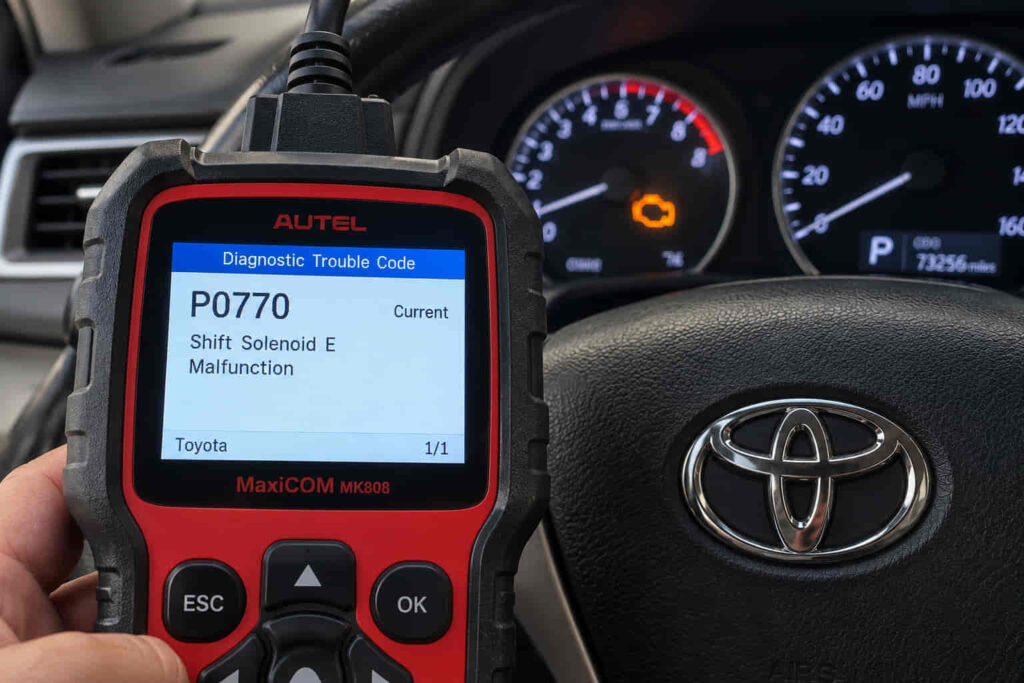
Toyota P0770 is a transmission-related diagnostic trouble code associated with Shift Solenoid E and its control system. When a Toyota stores this code, the transmission control system has detected that the expected operation of the solenoid does not match the commanded operation. The problem may affect how the automatic transmission controls hydraulic pressure and changes gears.
P0770 does not automatically mean that Shift Solenoid E has failed and needs replacement. The underlying fault can involve the solenoid itself, its wiring or electrical connector, transmission fluid, the valve body, hydraulic operation, or another transmission-related component. Replacing the solenoid without testing these areas can leave the original problem unresolved.
The severity of Toyota P0770 depends on how the transmission behaves after the code appears. A vehicle may initially show only a Check Engine Light, while a more developed fault may cause delayed shifting, harsh gear changes, transmission slipping, or other drivability problems. Accurate diagnosis therefore requires more than reading the DTC with an OBD-II scanner. This guide explains what Toyota P0770 means, the symptoms and causes associated with it, how to diagnose the fault systematically, and which repair should be performed after the actual cause is identified.
What Does the P0770 Code Mean on a Toyota?
Toyota P0770 means the transmission control system has detected a malfunction associated with Shift Solenoid E. The solenoid is part of the automatic transmission control system, where electronically controlled solenoids influence hydraulic fluid flow to help the transmission operate the required gear or operating state. When the actual response does not correspond with what the control system expects, P0770 can be stored and the Check Engine Light may illuminate.
Shift Solenoid E works within a larger electrical and hydraulic system rather than as an isolated component. The vehicle’s control system sends an electrical command to the relevant solenoid, the solenoid affects transmission-fluid flow, and hydraulic pressure contributes to the operation of the transmission. A fault anywhere in this control path can interfere with the expected transmission response. This relationship explains why P0770 can appear alongside noticeable shifting problems even though the driver does not directly control the solenoid.
The presence of P0770 does not prove that Shift Solenoid E itself is defective. A diagnostic trouble code identifies the system in which the control module detected an abnormal condition; it does not automatically identify the component that must be replaced. The diagnostic process must therefore distinguish a defective solenoid from an electrical connection problem, transmission-fluid issue, hydraulic fault, valve-body problem, or another fault capable of affecting the same control process.
This distinction is important because replacing Shift Solenoid E based only on the stored code can result in an unnecessary repair. The correct approach is to treat P0770 as the starting point of the diagnosis, inspect the related transmission system, test the relevant electrical circuit and solenoid according to the specifications for the specific Toyota model and transmission, and repair the fault confirmed by those tests.
How Serious Is the Toyota P0770 Code?
Toyota P0770 should be diagnosed promptly because the fault can interfere with normal automatic-transmission operation. The practical severity depends on the symptoms occurring with the code. A Toyota that has only illuminated the Check Engine Light presents a different immediate situation from one that slips, shifts harshly, delays a gear change, or cannot operate through its expected gear range.
Continuing to drive becomes more concerning when P0770 is accompanied by substantial changes in transmission behavior. Slipping, severe delayed engagement, repeated harsh shifts, inability to select or maintain the expected gear, or other major drivability changes indicate that the transmission is not operating normally. Driving under those conditions can also make diagnosis harder if an existing electrical or hydraulic problem develops into a broader transmission issue.
A Toyota with P0770 should therefore not be judged as safe to drive solely because the engine still starts and the vehicle still moves. Driving decisions should be based on actual transmission behavior. If the vehicle shifts normally and the only indication is a warning light, it should still be inspected before the fault is allowed to persist. If the transmission is slipping, losing normal gear operation, producing severe shifting symptoms, or the vehicle cannot be driven predictably, continued driving should be avoided until the fault is diagnosed.
P0770 should also not be cleared repeatedly as a substitute for diagnosis. Clearing the DTC removes stored diagnostic information but does not repair the condition that caused the transmission control system to set the code. A proper repair ends with clearing the stored code, operating the vehicle under appropriate test conditions, and rescanning the system to confirm that P0770 does not return.
Read more: Toyota C0200
What Are the Symptoms of Toyota P0770?
The main symptoms of Toyota P0770 are an illuminated Check Engine Light and abnormal automatic-transmission operation, including delayed shifts, harsh shifts, slipping, or difficulty operating through the expected gear range. The exact symptoms depend on the Toyota model, transmission design, operating conditions, and the specific electrical or hydraulic fault responsible for setting the code. A vehicle can also store P0770 before the driver notices a substantial change in transmission behavior.
The Check Engine Light is often the clearest indication because the transmission control system can detect an abnormal operating condition before it becomes obvious from the driver’s seat. When the control system determines that Shift Solenoid E or the system associated with its operation is not responding as expected, it can store P0770 in diagnostic memory. An OBD-II scan can then retrieve the code and provide a starting point for further testing. The warning light identifies the presence of a detected fault, but it does not establish whether the solenoid, wiring, transmission fluid, valve body, or another component is responsible.
Shifting symptoms occur when the fault affects the transmission’s ability to control fluid flow and hydraulic operation correctly. The driver may notice a delay before a gear engages, an unusually firm gear change, transmission slipping, or gear behavior that differs from normal operation. These symptoms are diagnostically important because they connect the electrical fault information stored by the vehicle with the mechanical and hydraulic behavior of the transmission. A more severe change in shifting generally warrants faster inspection than a stored code with no noticeable drivability symptoms.
P0770 symptoms should also be evaluated together rather than using one symptom to diagnose a failed component. Transmission slipping, for example, is not exclusive to Shift Solenoid E failure. Hydraulic problems, transmission-fluid conditions, valve-body faults, and internal transmission problems can produce overlapping symptoms. The combination of the stored DTC, other related codes, transmission behavior, fluid condition, and electrical test results provides stronger diagnostic evidence than any single symptom.
What Causes the P0770 Code on a Toyota?
Toyota P0770 can be caused by a faulty Shift Solenoid E, a damaged solenoid circuit, poor electrical connections, transmission-fluid problems, valve-body or hydraulic faults, and other transmission-related failures that prevent the control system from obtaining the expected response. The correct cause cannot be determined from the P0770 code alone because several components participate in the same electrical-to-hydraulic control process.
A defective Shift Solenoid E is one possible cause because the solenoid must respond correctly to an electrical command for the transmission control system to operate as designed. An electrically failed or mechanically malfunctioning solenoid can prevent the expected change in transmission operation. The diagnostic process still needs to confirm the failure against specifications for the particular Toyota transmission before the solenoid is replaced. Using a resistance value or test procedure from a different transmission can produce an incorrect diagnosis.
Wiring and connector faults can produce P0770 without an internally failed solenoid. Damaged wiring, an open or shorted circuit, corrosion, loose terminals, or a poor connector contact can interfere with the electrical path between the control system and the solenoid. In this situation, replacing a functional solenoid does not repair the interrupted circuit. Visual inspection and electrical testing are therefore necessary parts of diagnosis, especially when wiring damage, contamination, previous repairs, or connector deterioration is present.
Transmission fluid and hydraulic operation also need to be evaluated because an automatic transmission depends on controlled fluid pressure to perform its functions. An incorrect fluid level, unsuitable fluid condition, restricted hydraulic passage, or valve-body problem can interfere with the transmission response expected after a solenoid command. Fluid inspection is therefore useful for identifying evidence that shifts the diagnosis away from a purely electrical problem. The fluid type, checking procedure, and acceptable condition must be evaluated according to the requirements of the specific Toyota model rather than using one universal procedure for every transmission.
Valve-body and internal transmission faults become more relevant when the electrical circuit and Shift Solenoid E test correctly but the transmission continues to behave abnormally and P0770 returns. The valve body directs hydraulic fluid through transmission passages, so a hydraulic control problem can prevent the commanded operation from producing the expected result. Internal wear or mechanical damage can create additional transmission symptoms that overlap with a solenoid-related fault. These possibilities should be investigated after simpler electrical and fluid-related causes have been evaluated rather than assuming that P0770 immediately requires major transmission repair.
The diagnostic order matters because the least expensive repair is not necessarily the first possibility listed by a scanner, and the most expensive transmission component should not be condemned without supporting test results. Toyota P0770 should be approached as a fault within a connected system: the control system provides the command, the electrical circuit carries it, the solenoid responds to it, and the hydraulic system converts that response into transmission operation. Identifying where this sequence fails is the basis for choosing the correct repair.
How Do You Diagnose the P0770 Code on a Toyota?
Diagnosing Toyota P0770 requires checking the stored trouble codes, transmission fluid, wiring and connectors, Shift Solenoid E circuit, solenoid operation, and then the hydraulic or mechanical transmission system if the electrical tests pass. The diagnosis should move from accessible electrical and fluid checks toward more invasive transmission testing. This sequence reduces the risk of replacing Shift Solenoid E when the actual fault is elsewhere in the control system.
Start by scanning the vehicle for P0770 and any additional diagnostic trouble codes rather than diagnosing P0770 in isolation. Related transmission or electrical codes can change the direction of the diagnosis because several simultaneous circuit faults may indicate a shared wiring, connector, power-supply, or control problem instead of one defective solenoid. Available freeze-frame or diagnostic data should also be reviewed to determine the operating conditions under which the fault was detected. After recording this information, clearing the codes and determining whether P0770 returns can help distinguish a persistent fault from an intermittent condition, but clearing the code alone does not constitute a repair.
The transmission fluid should be inspected before condemning an electrical component. The correct inspection procedure depends on the Toyota model and transmission because fluid specifications and level-checking methods are not identical across all Toyota vehicles. The technician should verify the correct fluid level and look for abnormal fluid condition or evidence of leakage. Fluid that shows signs of significant contamination or transmission deterioration provides diagnostic information that should be considered alongside the stored code and shifting symptoms rather than treated as an unrelated maintenance issue.
The wiring harness and electrical connectors associated with the transmission should then be inspected for visible damage, loose connections, corrosion, contamination, damaged terminals, or other conditions capable of interrupting the solenoid circuit. This step is important because an electrical path that cannot reliably carry the control signal can produce a fault associated with Shift Solenoid E even when the solenoid itself remains functional. Wiring problems should be repaired and the circuit retested before replacing the solenoid.
Electrical testing can then determine whether the Shift Solenoid E circuit and the solenoid itself operate within the specification required for that particular Toyota transmission. Depending on the vehicle and available service procedure, diagnosis can involve circuit continuity, resistance, voltage, connector, or solenoid-operation checks. The measured results must be compared with Toyota service information for the exact model, model year, engine and transmission configuration. A resistance specification from another Toyota transmission should not be treated as universal because transmission designs and component specifications can differ.
Shift Solenoid E should only be considered defective after the relevant tests provide evidence that it cannot operate as specified. A failed electrical test can support replacement of the solenoid after the surrounding circuit has been verified. A solenoid that passes its electrical tests, however, changes the diagnostic direction. The technician then needs to determine whether hydraulic control, the valve body, or an internal transmission condition is preventing the commanded solenoid operation from producing the expected transmission response.
Hydraulic and valve-body diagnosis becomes especially important when P0770 repeatedly returns despite normal wiring and solenoid test results. The valve body controls transmission-fluid routing through hydraulic passages, and a restriction or mechanical problem can interfere with the response expected by the transmission control system. Evidence such as persistent abnormal shifting, transmission-fluid contamination, or other transmission-related DTCs can provide additional context for deciding whether further hydraulic or internal inspection is justified.
The final diagnostic step is verification. After the confirmed fault has been repaired, the stored DTC should be cleared and the vehicle should be tested under appropriate operating conditions. The system should then be scanned again to determine whether P0770 or related transmission codes return. Normal shifting combined with no returning fault provides stronger evidence of a successful repair than simply turning off the Check Engine Light.
The most important diagnostic principle is that P0770 identifies where investigation should begin, not which part should automatically be replaced. Testing the fluid condition, electrical path, Shift Solenoid E and hydraulic system in a logical sequence separates a confirmed component failure from faults that merely produce a similar transmission response.
How Do You Fix the P0770 Code on a Toyota?
To fix Toyota P0770, repair the electrical, solenoid, transmission-fluid, valve-body, or internal transmission fault confirmed during diagnosis, then clear the code and verify that it does not return. Replacing Shift Solenoid E is the correct repair only when testing confirms that the solenoid itself has failed. P0770 should not be treated as an automatic instruction to replace one transmission component.
An electrical fault should be repaired before replacing a functional solenoid. Damaged wiring, poor terminal contact, corrosion, contamination, or a loose connector can interrupt the circuit associated with Shift Solenoid E and cause the transmission control system to detect abnormal operation. Repairing the affected wiring or connection restores the electrical path when the solenoid and other transmission components remain within specification. The circuit should be tested again after the repair to confirm that the original electrical fault has been eliminated.
A transmission-fluid problem requires a repair appropriate to the condition identified during inspection. An incorrect fluid level, leakage, or abnormal fluid condition should not simply be ignored while replacing electrical components. The correct fluid and service procedure must match the specific Toyota model and transmission. Fluid condition can also provide evidence about the state of the transmission, so severely contaminated fluid or signs of internal deterioration may justify further diagnosis instead of assuming that a routine fluid service will resolve P0770.
Shift Solenoid E should be replaced when diagnostic testing confirms that the solenoid cannot operate according to the specification for the applicable Toyota transmission and the surrounding circuit has been verified. Depending on transmission design, accessing the solenoid can require removal of components such as the transmission pan and access to the valve-body area. The exact location, removal procedure, fluid requirements, tightening specifications, and post-repair procedures should therefore come from service information for the exact Toyota model, year, and transmission rather than from a universal P0770 repair procedure.
Valve-body or hydraulic repair becomes relevant when the electrical circuit and Shift Solenoid E test correctly but the transmission cannot produce the expected hydraulic response. A valve-body fault can interfere with transmission-fluid routing and prevent a correctly commanded solenoid from producing the intended operation. In this situation, repeatedly replacing the solenoid is unlikely to correct the underlying hydraulic problem. The valve body and related hydraulic system need to be inspected before determining whether cleaning, repair, component replacement, or a more extensive transmission repair is justified.
Internal transmission repair should be considered when diagnostic evidence indicates mechanical damage or deterioration beyond the solenoid and valve-body control system. This is a different repair path from replacing Shift Solenoid E and should be supported by transmission symptoms, fluid condition, additional diagnostic findings, or internal inspection. P0770 by itself is not sufficient evidence to conclude that an entire transmission needs replacement.
After completing the confirmed repair, clear P0770 with an appropriate diagnostic scanner and test the vehicle under suitable operating conditions. The transmission should be monitored for normal gear operation and the vehicle should be scanned again for P0770 and related DTCs. A Check Engine Light that turns off immediately after codes are cleared does not prove that the problem has been repaired. Successful verification requires the fault to remain absent after the transmission has been operated sufficiently for the control system to evaluate the affected system again.
How Much Does It Cost to Fix Toyota P0770?
The cost to fix Toyota P0770 depends on the confirmed cause because the required repair can range from an electrical or transmission-fluid correction to Shift Solenoid E, valve-body, or internal transmission repair. A single universal P0770 repair price would be misleading because the diagnostic code identifies a malfunctioning system rather than one guaranteed failed component.
A wiring or connector problem can require substantially less work than a transmission repair when the damaged section is accessible and the fault is limited to an electrical connection. The cost increases when diagnosis requires extensive circuit tracing or access to wiring located around transmission components. For this reason, diagnostic labor is part of the repair decision rather than an unnecessary expense: accurate testing can prevent the cost of replacing a solenoid that was functioning correctly.
Shift Solenoid E replacement costs depend on the price of the applicable component and the labor required to reach it. Access varies by Toyota model and transmission design, so two vehicles storing the same P0770 code do not necessarily require the same amount of labor. Transmission fluid, seals, gaskets, and other service items required during disassembly can also affect the final repair bill.
Valve-body and internal transmission problems generally represent a more extensive repair path because diagnosis and access involve more of the transmission assembly. The final cost depends on whether the confirmed problem can be repaired at the valve-body level or requires deeper internal transmission work. Vehicle model, transmission type, replacement-part choice, labor rate, and the extent of damage all influence the final amount.
An accurate P0770 repair estimate should therefore be produced after diagnosis identifies the failed system. The estimate should state what caused the code, which component or circuit requires repair, what related parts or fluids are required, and how much labor is involved. This approach provides a more useful cost estimate than assigning the same repair price to every Toyota displaying P0770.
Which Toyota Models Can Show the P0770 Code?
P0770 can appear on Toyota vehicles equipped with an automatic transmission and control system capable of detecting the malfunction represented by this DTC, but the diagnostic procedure should be matched to the exact vehicle and transmission. The same P0770 code should not be interpreted as proof that every Toyota uses an identical Shift Solenoid E, wiring layout, valve body, electrical specification, or repair procedure.
This distinction matters when diagnosing P0770 across different Toyota models and model years. Transmission designs can differ even when two vehicles display the same diagnostic trouble code. Solenoid location, connector arrangement, transmission-fluid specification, electrical test values, and access procedures therefore need to be identified from service information that matches the vehicle being repaired. Applying specifications from a different Toyota transmission can turn a correct DTC reading into an incorrect component diagnosis.
The vehicle identification process should consequently occur before component-level testing. The technician should establish the Toyota model, model year, engine configuration, and transmission application before selecting wiring diagrams, test specifications, or replacement parts. This is particularly important when a model has been sold with more than one powertrain or transmission configuration.
For SEO and diagnostic accuracy, model-specific P0770 topics are better treated as separate supporting pages when sufficient technical information exists. A page targeting a specific Toyota model can address its transmission configuration, component location, testing procedure, and repair requirements without forcing those specifications onto every vehicle carrying the Toyota name. Those supporting pages can then connect back to this broader Toyota P0770 guide as part of the same transmission diagnostic topic cluster.
What Other Transmission Codes Can Appear With Toyota P0770?
Other transmission DTCs can appear alongside Toyota P0770, and those additional codes can provide diagnostic context for determining whether the fault is isolated to Shift Solenoid E or affects a broader electrical, hydraulic, or transmission-control system. The useful information comes from the relationship between the codes rather than simply from the number of codes stored.
For example, a technician should interpret multiple solenoid or electrical faults differently from a single P0770 code. Several circuit-related faults appearing together can justify investigating shared wiring, connectors, electrical supply, or control paths before replacing individual transmission components. Conversely, P0770 accompanied by additional transmission-performance faults can provide evidence that hydraulic or mechanical operation also requires investigation. The complete scan result therefore helps establish diagnostic direction.
Related codes should be recorded before they are cleared because removing them can eliminate useful information about the conditions detected by the vehicle. Their status and available diagnostic data can help determine whether faults occurred together, whether one appeared as a consequence of another, or whether separate systems require testing. Each code must still be diagnosed according to the applicable Toyota service information rather than assuming that every transmission DTC has the same cause.
This relationship also creates a natural semantic cluster around Toyota transmission diagnostics. Individual pages covering specific shift-solenoid, transmission-control, or hydraulic-performance codes can answer the search intent for each DTC in greater depth, while contextual internal links can connect codes that genuinely overlap during diagnosis. This structure is more useful than placing unrelated DTC numbers on a page solely to increase keyword coverage.
How Can You Prevent Toyota Transmission Problems After Fixing P0770?
The most effective way to reduce the risk of transmission problems after repairing Toyota P0770 is to correct the original cause completely, use the transmission fluid specified for the vehicle, address leaks or electrical damage, and investigate new shifting symptoms before they develop into larger faults. Preventive work should follow the requirements of the exact Toyota transmission rather than a universal maintenance schedule or fluid procedure.
Transmission-fluid condition deserves attention because the automatic transmission relies on the correct fluid for hydraulic operation and other transmission functions. The specified fluid type should be used, and the level should be checked using the procedure applicable to the vehicle. A continuing leak should be repaired rather than repeatedly correcting the fluid level because loss of fluid can reproduce operating problems without addressing their source.
Electrical connections should also remain protected and secure after a P0770 repair. Wiring that has been damaged by heat, abrasion, contamination, poor previous repairs, or connector deterioration can create intermittent faults that are more difficult to reproduce than a permanently open circuit. Repairing the damaged area correctly and confirming connector integrity reduces the possibility that an electrical problem will return after the original DTC has been cleared.
Changes in transmission behavior should be investigated when they first become noticeable. Delayed engagement, abnormal shifting, slipping, or a returning Check Engine Light provides diagnostic information before the condition necessarily progresses further. Scanning the vehicle at this stage can also preserve DTC and operating data that help identify whether the new symptom is related to the previous P0770 repair or represents a separate transmission fault.
Preventing another P0770 is ultimately different from repeatedly clearing the code. A successful repair removes the condition that caused the control system to detect the malfunction, while preventive maintenance protects the electrical, fluid, and transmission systems that support normal operation. When the repair is followed by normal shifting and P0770 remains absent after appropriate verification, the diagnostic and repair process can be considered complete.