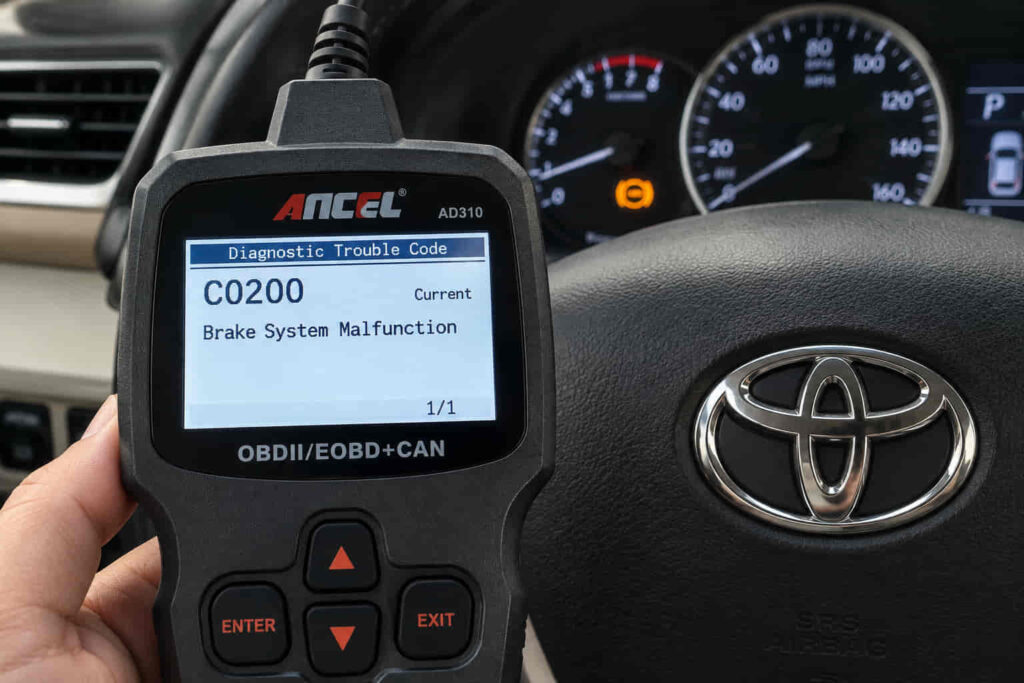
Toyota C0200 is an ABS-related diagnostic trouble code that indicates a problem involving a wheel speed sensor signal or its associated circuit. The wheel speed sensors provide rotational-speed data that the skid control ECU uses to monitor individual wheels and operate functions such as the anti-lock braking system. When the control system detects an abnormal signal or circuit condition associated with C0200, it stores the code and may illuminate the ABS warning light.
A stored C0200 code does not automatically mean the wheel speed sensor itself has failed. The fault can originate from the sensor, damaged wiring, a loose or corroded electrical connector, or another component responsible for producing or transmitting the wheel-speed signal. The exact code definition, affected wheel position, test specifications, and diagnostic procedure should therefore be confirmed for the specific Toyota model and model year before replacing parts.
Diagnosing Toyota C0200 requires identifying where the wheel-speed signal becomes abnormal rather than replacing the first component associated with the code. This guide explains what Toyota C0200 means, what causes it, which symptoms can appear, how serious the fault is, how to diagnose and fix it, and what to check before clearing the code after repair.
Toyota C0200: Meaning, Causes, Symptoms, and Fixes
Toyota C0200 is an ABS-related diagnostic trouble code that indicates a problem involving a wheel speed sensor signal or its associated circuit. The wheel speed sensors provide rotational-speed data that the skid control ECU uses to monitor individual wheels and operate functions such as the anti-lock braking system. When the control system detects an abnormal signal or circuit condition associated with C0200, it stores the code and may illuminate the ABS warning light.
A stored C0200 code does not automatically mean the wheel speed sensor itself has failed. The fault can originate from the sensor, damaged wiring, a loose or corroded electrical connector, or another component responsible for producing or transmitting the wheel-speed signal. The exact code definition, affected wheel position, test specifications, and diagnostic procedure should therefore be confirmed for the specific Toyota model and model year before replacing parts.
Diagnosing Toyota C0200 requires identifying where the wheel-speed signal becomes abnormal rather than replacing the first component associated with the code. This guide explains what Toyota C0200 means, what causes it, which symptoms can appear, how serious the fault is, how to diagnose and fix it, and what to check before clearing the code after repair.
What Does the C0200 Code Mean on a Toyota?
Toyota code C0200 indicates that the ABS control system has detected an abnormal condition involving a wheel speed sensor signal or the electrical circuit responsible for transmitting that signal. Toyota uses wheel-speed information to determine how quickly individual wheels are rotating. The skid control ECU compares these inputs while the vehicle is moving and uses them to determine when anti-lock braking intervention is required.
A wheel speed sensor works by detecting wheel rotation and converting that movement into an electrical signal that the control system can interpret. The signal must remain within the expected operating conditions as the wheel rotates. A missing, interrupted, or otherwise abnormal signal can prevent the control unit from reliably determining wheel speed. When the conditions defined for C0200 are met, the control system records the diagnostic trouble code so the affected circuit can be investigated.
C0200 should therefore be treated as a diagnostic starting point rather than proof that a particular component needs replacement. A wheel speed sensor may produce the abnormal signal, but damaged wiring or poor electrical connections can interfere with the same signal before it reaches the control unit. Mechanical conditions affecting how the sensor detects wheel rotation can also produce symptoms that resemble an electrical sensor failure. The diagnostic process must identify which part of this signal path is responsible.
The exact description and diagnostic conditions for C0200 should be verified against the repair information for the Toyota model and model year being serviced. Toyota ABS configurations are not identical across every vehicle, and component design, connector layout, test specifications, and diagnostic procedures can differ. Using vehicle-specific information prevents a generic C0200 definition from being turned into an incorrect parts-replacement decision.
What Causes the C0200 Code on a Toyota?
Toyota C0200 can be caused by a faulty wheel speed sensor, an open or shorted sensor circuit, damaged wiring or connectors, a problem affecting wheel-speed signal generation, or a fault elsewhere in the ABS control circuit. These causes share one result: the control system does not receive the wheel-speed information it expects. The correct repair depends on identifying which part of that signal path has failed.
A faulty wheel speed sensor is one possible cause because the sensor is responsible for generating wheel-rotation information. Physical damage, internal electrical failure, contamination, or another condition that prevents the sensor from producing a usable signal can cause the control unit to detect an abnormality. Sensor replacement is justified when testing confirms that the sensor itself is defective, not merely because C0200 appears on a scan tool.
Wiring and connector faults can produce the same code even when the wheel speed sensor remains functional. A broken wire can interrupt the circuit, while damaged insulation can allow an unintended short. Moisture, corrosion, loose terminals, damaged connector locks, or wiring that has been stretched or rubbed against surrounding components can also interfere with signal transmission. This is why visual and electrical inspection of the circuit should occur before a functioning sensor is condemned.
The components responsible for generating a readable wheel-speed signal must also be considered. Depending on the Toyota ABS configuration, physical damage, excessive movement, improper installation, or a problem involving components associated with the sensor’s detection of wheel rotation can distort the signal. In these cases, installing another sensor without correcting the underlying mechanical condition may leave C0200 unresolved or cause it to return.
A skid control ECU or ABS control-unit fault belongs later in the diagnostic path because other signal-path faults should be eliminated first. The module receives and processes sensor information, so an internal or circuit-related problem can theoretically affect fault detection. However, replacing an ABS control module without first testing the sensor, connector, wiring, and relevant signal-generating components creates a high risk of an unnecessary and potentially expensive repair. The diagnostic evidence should determine the failed component rather than the code name alone.
Read more: Toyota P1604
Toyota C0200: Meaning, Causes, Symptoms, and Fixes
Toyota C0200 is an ABS-related diagnostic trouble code that indicates a problem involving a wheel speed sensor signal or its associated circuit. The wheel speed sensors provide rotational-speed data that the skid control ECU uses to monitor individual wheels and operate functions such as the anti-lock braking system. When the control system detects an abnormal signal or circuit condition associated with C0200, it stores the code and may illuminate the ABS warning light.
A stored C0200 code does not automatically mean the wheel speed sensor itself has failed. The fault can originate from the sensor, damaged wiring, a loose or corroded electrical connector, or another component responsible for producing or transmitting the wheel-speed signal. The exact code definition, affected wheel position, test specifications, and diagnostic procedure should therefore be confirmed for the specific Toyota model and model year before replacing parts.
Diagnosing Toyota C0200 requires identifying where the wheel-speed signal becomes abnormal rather than replacing the first component associated with the code. This guide explains what Toyota C0200 means, what causes it, which symptoms can appear, how serious the fault is, how to diagnose and fix it, and what to check before clearing the code after repair.
What Does the C0200 Code Mean on a Toyota?
Toyota code C0200 indicates that the ABS control system has detected an abnormal condition involving a wheel speed sensor signal or the electrical circuit responsible for transmitting that signal. Toyota uses wheel-speed information to determine how quickly individual wheels are rotating. The skid control ECU compares these inputs while the vehicle is moving and uses them to determine when anti-lock braking intervention is required.
A wheel speed sensor works by detecting wheel rotation and converting that movement into an electrical signal that the control system can interpret. The signal must remain within the expected operating conditions as the wheel rotates. A missing, interrupted, or otherwise abnormal signal can prevent the control unit from reliably determining wheel speed. When the conditions defined for C0200 are met, the control system records the diagnostic trouble code so the affected circuit can be investigated.
C0200 should therefore be treated as a diagnostic starting point rather than proof that a particular component needs replacement. A wheel speed sensor may produce the abnormal signal, but damaged wiring or poor electrical connections can interfere with the same signal before it reaches the control unit. Mechanical conditions affecting how the sensor detects wheel rotation can also produce symptoms that resemble an electrical sensor failure. The diagnostic process must identify which part of this signal path is responsible.
The exact description and diagnostic conditions for C0200 should be verified against the repair information for the Toyota model and model year being serviced. Toyota ABS configurations are not identical across every vehicle, and component design, connector layout, test specifications, and diagnostic procedures can differ. Using vehicle-specific information prevents a generic C0200 definition from being turned into an incorrect parts-replacement decision.
What Causes the C0200 Code on a Toyota?
Toyota C0200 can be caused by a faulty wheel speed sensor, an open or shorted sensor circuit, damaged wiring or connectors, a problem affecting wheel-speed signal generation, or a fault elsewhere in the ABS control circuit. These causes share one result: the control system does not receive the wheel-speed information it expects. The correct repair depends on identifying which part of that signal path has failed.
A faulty wheel speed sensor is one possible cause because the sensor is responsible for generating wheel-rotation information. Physical damage, internal electrical failure, contamination, or another condition that prevents the sensor from producing a usable signal can cause the control unit to detect an abnormality. Sensor replacement is justified when testing confirms that the sensor itself is defective, not merely because C0200 appears on a scan tool.
Wiring and connector faults can produce the same code even when the wheel speed sensor remains functional. A broken wire can interrupt the circuit, while damaged insulation can allow an unintended short. Moisture, corrosion, loose terminals, damaged connector locks, or wiring that has been stretched or rubbed against surrounding components can also interfere with signal transmission. This is why visual and electrical inspection of the circuit should occur before a functioning sensor is condemned.
The components responsible for generating a readable wheel-speed signal must also be considered. Depending on the Toyota ABS configuration, physical damage, excessive movement, improper installation, or a problem involving components associated with the sensor’s detection of wheel rotation can distort the signal. In these cases, installing another sensor without correcting the underlying mechanical condition may leave C0200 unresolved or cause it to return.
A skid control ECU or ABS control-unit fault belongs later in the diagnostic path because other signal-path faults should be eliminated first. The module receives and processes sensor information, so an internal or circuit-related problem can theoretically affect fault detection. However, replacing an ABS control module without first testing the sensor, connector, wiring, and relevant signal-generating components creates a high risk of an unnecessary and potentially expensive repair. The diagnostic evidence should determine the failed component rather than the code name alone.
What Symptoms Can Toyota Code C0200 Cause?
The primary symptom associated with Toyota C0200 is an ABS warning light, although additional stability or traction-control warnings and abnormal ABS operation can appear depending on the vehicle and the underlying fault. The warning occurs because the control system has identified wheel-speed information that it cannot reliably use. A driver may therefore see a warning indicator before noticing any obvious change in how the vehicle behaves during normal driving.
An ABS-related fault does not necessarily produce the same symptoms as a conventional hydraulic brake failure. The vehicle may still respond normally to the brake pedal during routine stops while the anti-lock function is impaired or unavailable. The difference becomes more important when wheel lock is likely, such as during hard braking or when tire grip is reduced. The warning light should therefore be treated as evidence that the electronic braking system requires diagnosis even when normal driving feels unchanged.
Traction-control or vehicle-stability warnings can also accompany an ABS-related wheel-speed fault on Toyota vehicles equipped with systems that share wheel-speed data. These functions need accurate information about individual wheel rotation to determine whether a wheel is slipping or whether vehicle movement differs from the intended direction. An unreliable wheel-speed input can consequently affect more than one control function, although the exact warning lights and disabled functions depend on the Toyota model and system configuration.
A scan tool capable of accessing ABS data can reveal a symptom that is not visible to the driver. The affected wheel-speed signal may disappear, remain at an implausible value, become intermittent, or differ unexpectedly from the other wheels while the vehicle is moving. Comparing live wheel-speed data can therefore connect the stored C0200 code with the actual signal problem and help distinguish an active fault from a code stored after an intermittent event.
The combination of symptoms also provides diagnostic context. An ABS warning light with C0200 and abnormal wheel-speed data directs attention toward the sensor and its signal path, while several related codes or warning indicators may justify examining shared wiring, power, communication, or control-system conditions. Symptoms narrow the diagnostic direction, but they do not identify the failed component without further testing.
Is Toyota Code C0200 Serious, and Can You Drive With It?
Toyota C0200 should be diagnosed promptly because a wheel-speed signal fault can interfere with ABS and other vehicle-control functions that depend on accurate wheel-speed data. Its severity is determined by which functions have been affected and whether any additional brake-system faults are present. The absence of unusual braking during ordinary driving does not establish that the anti-lock braking system is operating correctly.
ABS is designed to help prevent wheel lock during braking conditions in which available tire grip is exceeded. Accurate wheel-speed information allows the control system to recognize rapid wheel deceleration and regulate braking when required. If the system cannot rely on one of its wheel-speed inputs, the electronic assistance available during hard braking can be affected. This makes the fault more relevant on wet, icy, loose, or otherwise low-traction surfaces than a driver might notice during a routine stop on dry pavement.
A Toyota with C0200 may remain physically driveable when normal braking is present and no severe brake symptoms occur, but that does not make continued driving risk-free. The appropriate action is to have the ABS fault diagnosed rather than assuming that an illuminated ABS warning light is harmless. Driving conditions should also be considered because a loss of anti-lock or stability-related assistance matters most when the tires approach their traction limit.
Driving should not continue merely on the assumption that C0200 is only a sensor problem when additional brake warnings or abnormal braking behavior are present. A red brake-system warning, major change in brake-pedal response, reduced braking effectiveness, unusual mechanical noise, or another significant braking symptom requires separate evaluation because C0200 alone does not explain every possible brake-system failure. The safe decision must be based on the vehicle’s complete condition rather than the diagnostic code in isolation.
C0200 should ultimately be viewed as a fault that changes the reliability of information used by the electronic braking system. Diagnosing it early restores confidence that the ABS and related functions are receiving valid wheel-speed data and also reduces the chance of replacing unrelated components based solely on a stored code.
How Do You Diagnose Toyota Code C0200?
Diagnose Toyota C0200 by confirming the code, checking related ABS trouble codes, inspecting the wheel speed sensor circuit, examining live wheel-speed data, and electrically testing the suspected circuit before replacing any component. The objective is to determine whether the abnormal signal originates at the sensor, wiring and connector, a component involved in generating the wheel-speed signal, or the control side of the circuit. Replacing the wheel speed sensor based only on C0200 skips the tests needed to identify the actual failure.
Start by connecting a diagnostic scan tool that can communicate with the Toyota ABS or skid control system. A basic OBD-II reader designed primarily for powertrain codes may not provide the ABS data required for this diagnosis. Confirm that C0200 is stored and record any additional ABS, traction-control, or stability-control codes before clearing anything. Multiple codes matter because they can indicate whether the problem is isolated to one wheel-speed circuit or involves a condition shared by several parts of the system. Clearing the codes before recording this information can remove useful diagnostic context.
Inspect the suspected wheel speed sensor, electrical connector, and accessible wiring after confirming the code. The inspection should identify physical evidence that can interrupt or distort the wheel-speed signal, including broken wires, damaged insulation, loose terminals, connector damage, corrosion, moisture intrusion, or wiring that has contacted a moving component. The sensor and surrounding components should also be checked for physical damage or installation problems. Finding visible damage provides a stronger repair direction than assuming that the sensor has failed internally.
Use live ABS data to compare wheel-speed readings when the scan tool and vehicle support this function. A correctly operating system should provide wheel-speed information that changes logically with actual wheel rotation. A reading that remains absent, drops intermittently, behaves implausibly, or differs unexpectedly from the other wheels gives evidence that the corresponding signal path requires further testing. Live-data comparison is especially useful when C0200 is intermittent because a wiring or connection problem may only appear as the wheel, suspension, or harness moves.
Electrical testing should follow the circuit design and specifications for the exact Toyota model and model year. A multimeter can be used where the applicable diagnostic procedure calls for resistance, voltage, continuity, or short-circuit testing, but one generic resistance specification should not be applied to every Toyota wheel speed sensor. Sensor technology and ABS configurations differ between vehicles. Compare measured values with the Toyota repair specification for the vehicle being diagnosed rather than treating an internet-wide resistance range as a pass-or-fail standard.
The wiring circuit should be isolated from the sensor when testing shows that the expected wheel-speed signal is missing. Continuity and short-circuit tests help determine whether the signal is being lost between the sensor connector and the control unit. A sensor that passes its applicable test does not eliminate C0200 if an open wire, short, poor terminal contact, or intermittent harness fault prevents its output from reaching the skid control ECU. Harness movement during testing can also expose an intermittent connection that appears normal while the wiring remains stationary.
Mechanical conditions must be investigated when the sensor and electrical circuit test correctly but the wheel-speed signal remains abnormal. The sensor depends on a physical relationship with the rotating components it monitors, so damage, excessive movement, incorrect installation, or another defect affecting signal generation can create an implausible reading without an obvious open circuit. The exact components and inspection procedure depend on the ABS design fitted to the vehicle, which is another reason to use model-specific Toyota repair information.
The skid control ECU or ABS control unit should become a primary suspect only after the relevant sensor, wiring, connectors, signal-generating components, power conditions, and specified circuit tests have been verified. Control-module replacement should be supported by diagnostic evidence rather than reached by elimination after installing several unnecessary parts. Module replacement can also introduce additional vehicle-specific procedures, so confirming the failure before repair prevents both unnecessary expense and an unresolved C0200 code.
The diagnosis is complete when testing identifies a specific failure that explains why the expected wheel-speed information cannot be received or interpreted correctly. This creates a direct relationship between the diagnostic result and the repair: damaged wiring is repaired as wiring, a failed sensor is replaced as a sensor, and a mechanical signal-generation problem is corrected at its source. That approach is more reliable than using C0200 itself as a component-replacement instruction.
How Do You Fix Toyota Code C0200?
Fix Toyota C0200 by repairing the specific sensor, wiring, connection, or wheel-speed signal problem identified during diagnosis. There is no single repair that applies to every C0200 case because the code identifies an abnormal condition in the wheel-speed signal path rather than proving that one particular component has failed. The repair should therefore correspond directly to the diagnostic result.
Replace the wheel speed sensor when testing confirms that the sensor cannot provide the expected signal and its wiring and related components are functional. The replacement sensor must be compatible with the specific Toyota model and installed correctly so it can detect wheel rotation as designed. The connector should also be inspected during replacement because installing a new sensor will not correct an open circuit, damaged terminal, corrosion, or poor electrical contact elsewhere in the same signal path.
Repair the wiring or connector when circuit testing identifies an open circuit, short circuit, damaged conductor, loose terminal, corrosion, or another connection fault. Wiring near a wheel is exposed to movement, moisture, road debris, and vibration, so physical harness damage deserves particular attention. A successful wiring repair must restore both electrical continuity and the physical protection of the circuit. Simply reconnecting a damaged wire without correcting its routing or exposure can allow the same fault to develop again.
Correct the relevant mechanical problem when electrical testing does not identify a sensor or wiring failure but the wheel-speed signal remains abnormal. Depending on the ABS design used by the specific Toyota, the sensor relies on associated rotating components to generate readable wheel-speed information. Physical damage, improper installation, excessive movement, or another condition that changes this relationship can produce an incorrect signal. Replacing the sensor alone will not resolve C0200 when the actual failure exists in the component the sensor is monitoring.
Repair or replace the skid control ECU or ABS control unit only when vehicle-specific testing supports a control-unit fault. The module should not be the first component replaced for Toyota C0200. Sensor, connector, wiring, applicable mechanical components, circuit integrity, and other specified test conditions should be verified first. This diagnostic order reduces the risk of replacing an expensive module while leaving the original signal fault unresolved.
The repair is not complete immediately after the defective component has been corrected. Clear C0200 with an appropriate diagnostic tool when the applicable repair procedure permits it, operate or road-test the vehicle under the conditions required to evaluate the ABS system, and scan the vehicle again. The repaired wheel-speed signal should behave normally and C0200 should remain absent. If the code returns, the underlying fault is still present or another part of the circuit requires diagnosis.
How Much Does It Cost to Fix Toyota Code C0200?
The cost to fix Toyota C0200 depends on the component that actually caused the fault, because repairing a connector or wire is fundamentally different from replacing a wheel speed sensor, wheel-related component, or ABS control unit. A reliable repair estimate therefore requires diagnosis before a total price can be calculated. Quoting one universal C0200 repair price would imply that every vehicle with the code requires the same repair, which is not the case.
A wiring or connector problem can involve relatively little replacement hardware but require substantial diagnostic and labor time when the damage is intermittent or difficult to access. A confirmed wheel speed sensor failure normally shifts more of the cost toward the replacement component and the labor required to access and install it. The final amount varies with Toyota model, model year, sensor design, labor rate, parts source, and whether corrosion or physical damage complicates removal.
The repair can become more expensive when the fault involves a hub, bearing, or another component associated with wheel-speed signal generation on a vehicle where those parts are relevant to the diagnostic result. In that situation, replacing only the sensor may not correct the underlying problem. The estimate must account for the component configuration on the specific vehicle rather than treating every Toyota ABS system as mechanically identical.
An ABS or skid control module fault can also change the repair cost substantially, which is why module replacement requires stronger diagnostic evidence. Depending on the vehicle and replacement method, the repair may involve more than installing the physical component. Vehicle-specific setup, calibration, initialization, or other service procedures may apply and should be confirmed in the relevant Toyota repair information before the repair is authorized.
Diagnostic cost should also be separated from repair cost. Paying for accurate diagnosis can prevent a more expensive parts-replacement sequence. For example, replacing a wheel speed sensor first, discovering that C0200 remains, and then repairing a damaged harness costs more than identifying the wiring failure before purchasing the sensor. The most useful estimate is therefore one produced after the failed part of the wheel-speed signal path has been identified.
Exact dollar figures should be based on the vehicle’s model, model year, location, labor rate, and current parts prices. Without those variables, presenting a narrow universal price range would create false precision. For Toyota C0200, the diagnostic result determines both the required repair and the meaningful cost estimate.
How Do You Clear Toyota Code C0200 After the Repair?
Clear Toyota C0200 only after the fault that caused the abnormal wheel-speed signal has been repaired. Erasing the diagnostic trouble code removes stored fault information from the control system, but it does not repair a defective sensor, restore a damaged circuit, or correct a mechanical condition affecting the wheel-speed signal. If the underlying failure remains active, the control system can detect the abnormal condition again and C0200 can return.
Use a diagnostic scan tool capable of communicating with the Toyota ABS or skid control system to clear the stored code when the applicable repair procedure permits it. Before erasing the code, retain any diagnostic information that may still be useful, particularly when the original fault was intermittent. Clearing diagnostic information too early can make a recurring wiring, connector, or signal problem more difficult to reproduce and identify.
Verification should follow code clearing. Operate the vehicle under appropriate conditions and monitor the relevant ABS data when the diagnostic equipment supports live data. The repaired wheel-speed signal should respond logically to wheel rotation without disappearing, becoming intermittent, or showing an unexplained difference from the other wheel-speed signals. The exact verification procedure should follow the repair information for the Toyota model and model year being serviced.
Scan the ABS system again after verification rather than assuming that an extinguished warning light proves the repair was successful. A successful C0200 repair means the original failure has been corrected, the relevant wheel-speed signal operates as specified, and the diagnostic trouble code does not return under the conditions used to verify the system. This distinction is important because clearing a code can temporarily remove a warning indicator even when the condition responsible for storing it has not been eliminated.
If C0200 returns after the repair, continue diagnosis instead of repeatedly clearing the code. A recurring code indicates that the original cause was not fully corrected, the diagnosis identified the wrong component, an intermittent circuit condition remains, or another relevant fault affects the wheel-speed signal. Rechecking the diagnostic evidence is more effective than replacing additional parts without confirming why the code returned.
What Other Toyota Codes Can Appear With C0200?
Toyota C0200 can appear with other ABS or vehicle-control diagnostic trouble codes when the control system detects more than one abnormal condition. Related codes are diagnostically important because their combination can show whether the problem is isolated to one wheel-speed signal or whether a broader electrical or control-system condition needs to be investigated.
The relationship between codes matters more than simply counting how many codes are stored. A C0200 code accompanied by another wheel-speed-related fault can change the diagnostic direction compared with C0200 appearing alone. Likewise, faults involving power supply, communication, or another shared system condition may affect several inputs or control functions at the same time. Each stored code should therefore be recorded before codes are cleared and interpreted in the context of the complete ABS system.
Diagnostic order should also be based on the relationship between the stored faults. When several codes share a possible circuit, electrical supply, connector, or control-system dependency, resolving the common fault can eliminate more than one diagnostic code. Conversely, unrelated codes should not automatically be attributed to C0200 simply because they were retrieved during the same scan. Each code must be connected to the system condition that can actually explain it.
The exact companion codes should be identified from the vehicle-specific diagnostic results rather than assumed from a generic Toyota code list. Toyota models and model years can use different ABS and stability-control configurations, so a code combination that is relevant to one vehicle should not automatically be applied to another. Reading all available codes with an ABS-capable scan tool provides the information needed to establish those relationships.
Related Toyota ABS code pages also create a useful diagnostic content cluster because each code can explain a different failure condition while remaining connected through the ABS and wheel-speed system. For a vehicle that stores several codes, moving between those code-specific diagnostic guides is more useful than treating every warning light as evidence of the same failed component.
How Can You Prevent Toyota C0200 From Returning?
Prevent Toyota C0200 from returning by correcting the root cause completely and protecting the repaired wheel-speed sensor circuit from the condition that caused it to fail. Prevention is therefore part of the repair itself. Replacing a damaged component without addressing damaged wiring routing, poor connector protection, improper installation, or another underlying condition can allow the same signal fault to develop again.
Protect the wiring harness by restoring its correct routing and securing it away from components that can stretch, crush, rub, or otherwise damage it. Wheel-area wiring operates in an environment exposed to suspension movement, vibration, water, dirt, and road debris. A repaired conductor that remains incorrectly positioned can develop another open or short circuit even when its electrical continuity is normal immediately after the repair.
Electrical connectors should remain securely locked and protected from conditions that interfere with terminal contact. Corrosion, moisture intrusion, damaged terminals, and loose connections can increase signal instability or interrupt the circuit. When connector damage contributed to C0200, repairing only the visible wire without correcting the connector condition leaves part of the original failure mechanism in place.
Correct installation is equally important when a wheel speed sensor or associated mechanical component has been removed or replaced. The sensor must operate in the physical configuration intended for the specific ABS system to produce a reliable wheel-speed signal. Damage, contamination, excessive movement, or improper positioning in relevant components can affect signal generation even when the electrical circuit itself remains intact.
Complete the preventive process by verifying the repair with diagnostic data rather than relying only on the absence of an illuminated ABS warning light. A stable wheel-speed signal, no returning C0200 code, and normal system behavior after the applicable verification procedure provide stronger evidence that the original fault has been eliminated. If the same code returns, the vehicle should be diagnosed again to identify the remaining failure mechanism instead of entering a cycle of clearing the code and replacing additional parts.