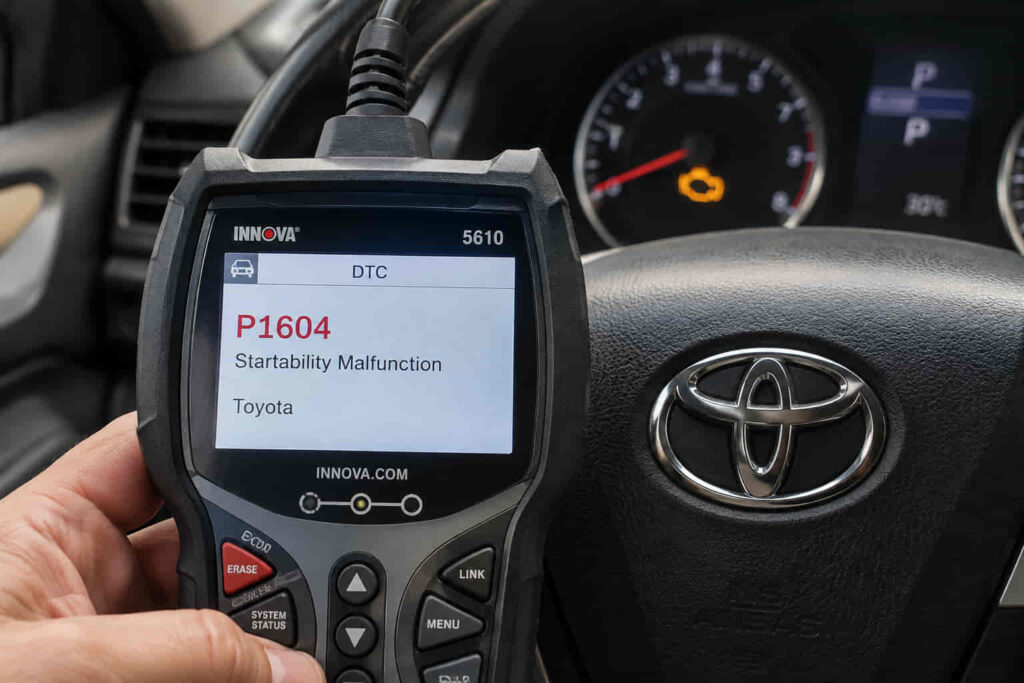
The Toyota P1604 code indicates a startability malfunction, meaning the engine control system has detected a problem associated with the engine starting process. The code can appear when a Toyota takes too long to start, fails to start normally, or experiences another condition that prevents the engine from reaching expected operation during or immediately after starting. P1604 identifies the starting-related malfunction, but it does not by itself confirm that one specific component has failed.
Diagnosing P1604 therefore requires finding the condition responsible for the starting problem instead of replacing parts based only on the code. The diagnostic process can involve checking battery and cranking conditions, electrical connections, fuel delivery, ignition operation, engine operating data, and other diagnostic trouble codes stored alongside P1604. The exact checks depend on the Toyota model, model year, symptoms, and additional DTCs present.
This guide explains what Toyota P1604 means, the symptoms associated with a startability malfunction, the systems that should be investigated, and the correct diagnostic sequence for identifying the underlying fault. It also explains how P1604 is repaired, whether the vehicle can still be driven, and why the code may return after being cleared.
What Does the P1604 Code Mean on a Toyota?
Toyota P1604 means the engine control system has detected a startability malfunction associated with the engine starting process. The code indicates that the engine did not start or transition into normal operation as expected under the conditions monitored by the vehicle. P1604 therefore describes an abnormal starting event rather than identifying one failed component.
This distinction determines how the code should be diagnosed. A Toyota engine needs adequate cranking conditions, fuel delivery, ignition, air intake, and mechanical operation to start correctly. A problem affecting one of these areas can interfere with starting and contribute to the conditions associated with P1604. For this reason, replacing a battery, starter, fuel pump, ignition coil, or another component solely because P1604 is stored is not a reliable diagnostic method. The actual fault must first be identified through symptoms, stored diagnostic information, and component testing.
The conditions surrounding the moment the code was stored are especially important. For example, a Toyota that cranks for an extended period before starting presents a different diagnostic direction from a vehicle that does not crank normally or starts and then stalls. Other DTCs stored with P1604 can also narrow the investigation because they may identify a more specific system affected during the starting event.
P1604 should therefore be treated as a starting-related diagnostic clue. The correct question is not simply which component causes P1604, but which condition prevented this specific Toyota from starting and operating as expected. The answer can vary by model, model year, engine configuration, accompanying DTCs, and the symptoms occurring when the engine is started.
How Serious Is the Toyota P1604 Code?
Toyota P1604 can range from a relatively minor stored fault to a serious problem that prevents the engine from starting. Its severity depends primarily on the underlying cause and the vehicle’s current starting behavior rather than the presence of the code alone. A Toyota that starts normally and operates without noticeable symptoms does not present the same immediate concern as one that requires repeated cranking, stalls after starting, or cannot start at all.
A persistent starting problem deserves prompt diagnosis because the condition responsible for P1604 can become progressively more disruptive. Repeated extended cranking, for example, places additional demand on the battery and starting system while still leaving the original cause unresolved. If the underlying problem affects fuel delivery, ignition, electrical power, or another system required for engine operation, the vehicle may eventually become difficult or impossible to restart.
Severity also increases when P1604 appears with symptoms such as a no-start condition or repeated stalling. In these cases, continuing to rely on the vehicle without identifying the fault creates a practical risk of being unable to restart it after the engine is switched off. A stored P1604 without current symptoms still warrants investigation, but diagnostic information and accompanying codes should be reviewed before assuming that a major component requires replacement.
The most reliable way to determine severity is to evaluate P1604 together with the starting symptoms and any additional DTCs. This keeps the diagnosis focused on the actual malfunction instead of treating the code itself as proof of a specific mechanical or electrical failure.
Read more: Toyota P0418
What Symptoms Can Occur With Toyota Code P1604?
The main symptom associated with Toyota P1604 is abnormal engine starting behavior. The engine may require longer cranking before it starts, fail to start, start inconsistently, or start and then fail to maintain normal operation. The exact symptom depends on the system responsible for the startability malfunction, so P1604 does not produce one identical set of symptoms on every Toyota.
Extended cranking is an important symptom because it shows that the engine is turning but is taking longer than expected to begin operating normally. This distinction helps narrow the diagnostic direction. An engine that cranks at an apparently normal speed but takes several attempts to start requires a different investigation from an engine that cranks slowly. The first condition can direct attention toward factors required for combustion, while slow or abnormal cranking makes battery condition, electrical connections, and starting-system performance more relevant.
A no-start condition represents a more severe form of the same starting problem. In this situation, the engine may crank without starting or the starting process itself may be abnormal. The distinction matters because “the car will not start” describes a symptom rather than a diagnosis. Determining whether the engine cranks normally is one of the first observations needed to establish which system should be tested next.
P1604 can also be stored when the starting problem is intermittent. A Toyota may start normally during inspection even though the driver previously experienced extended cranking or another abnormal starting event. In this situation, clearing the code because the vehicle currently starts normally can remove useful diagnostic information without resolving the original problem. Stored DTCs, operating data, the driver’s description of the failure, and any other codes present should be considered together before deciding that the malfunction has disappeared.
What Causes the P1604 Code on a Toyota?
Toyota P1604 can be associated with a fault that prevents the engine from starting and reaching normal operation as expected, so diagnosis must identify the underlying starting problem rather than treat P1604 as proof that one component has failed. The relevant systems can include the electrical and starting system, fuel delivery, ignition, air intake, or another engine-related condition. Which system should be tested first depends on how the engine behaves during the failed starting attempt.
Battery and starting-system conditions deserve early attention when the engine cranks slowly or inconsistently. Starting an engine requires sufficient electrical power to operate the starter and vehicle control systems under load. A weak battery, poor terminal connection, excessive resistance in an electrical connection, or a starting-system fault can therefore create abnormal cranking conditions. Battery voltage alone should not be used to condemn the battery; its condition needs to be evaluated in relation to the actual starting symptom and electrical performance during cranking.
Fuel delivery becomes more relevant when the engine cranks normally but does not start or requires excessive cranking. The engine needs the correct fuel supply during startup to establish combustion. A problem affecting fuel delivery can interrupt this process even when the starter and battery are operating correctly. Diagnosis should verify the fuel-related condition before replacing a pump, injector, or other component, because P1604 itself does not identify which part of the fuel system has failed.
Ignition faults can create a similar symptom because a gasoline engine requires properly timed ignition as well as fuel to start. A fault involving the ignition system can allow the engine to crank normally while preventing reliable combustion. The important diagnostic relationship is therefore not simply “P1604 equals an ignition problem.” Instead, an ignition fault becomes a stronger possibility when the starting behavior, additional DTCs, and test results provide evidence that spark or ignition operation is abnormal.
Air intake and engine-related conditions must also remain within the diagnostic scope when the basic electrical, fuel, and ignition checks do not explain the malfunction. The amount of air entering the engine and the engine’s ability to produce combustion affect whether startup succeeds. However, expanding immediately into every possible engine fault makes diagnosis inefficient. Testing should move from the symptoms and available diagnostic evidence toward the affected system rather than from a generic list of possible parts toward random replacement.
For this reason, the most useful way to identify the cause of Toyota P1604 is to classify the starting condition first. Slow or abnormal cranking points the investigation in one direction, while normal cranking with no start, extended cranking, or starting followed by abnormal operation points toward different diagnostic paths. Other stored trouble codes can then provide additional context and should be investigated before P1604 is used as the sole basis for replacing a component.
How Do You Diagnose Toyota Code P1604?
Diagnosing Toyota P1604 starts by identifying exactly what happens when the engine is started, then using stored trouble codes and test results to isolate the system responsible for the startability malfunction. P1604 should not be used as a direct instruction to replace a specific component. The first diagnostic distinction is whether the engine cranks normally, cranks slowly or abnormally, does not start despite cranking, requires extended cranking, or starts but fails to maintain normal operation.
The diagnostic process should begin before any stored information is erased. Read P1604 together with other DTCs and review available diagnostic data that can establish the conditions surrounding the malfunction. An additional code associated with a more specific system can provide a stronger diagnostic direction than P1604 alone. Clearing all codes immediately can remove information that helps reconstruct an intermittent starting problem, particularly when the vehicle starts normally by the time it reaches the workshop.
The battery and starting system should be investigated early when cranking is slow, inconsistent, or otherwise abnormal. The objective is to determine whether the engine and control systems receive adequate electrical power during the starting event. Battery condition, terminal connections, cables, grounds, and starting-system operation should therefore be evaluated under the conditions in which the problem occurs. A battery that shows an apparently acceptable voltage when the engine is off should not automatically be considered healthy because its behavior under starting load provides more useful diagnostic information.
When the engine cranks at an appropriate speed but does not start normally, diagnosis should move toward the conditions required for combustion. Fuel delivery is one area to investigate because the engine must receive an appropriate fuel supply during startup. The test should establish whether fuel delivery is actually abnormal before a fuel pump, injector, or related component is replaced. A normal cranking sound combined with a no-start condition does not by itself prove that the fuel system is responsible.
Ignition operation should be evaluated in the same evidence-based manner on gasoline engines. The presence of normal cranking does not confirm that combustion is occurring correctly. Diagnostic results and any accompanying ignition-related DTCs should determine whether the ignition system requires deeper testing. Replacing spark plugs or ignition coils simply because the vehicle is difficult to start can add repair cost without addressing the actual condition that caused P1604.
Air intake and engine operation become increasingly relevant when electrical supply, cranking, fuel delivery, and ignition testing do not explain the starting problem. At this stage, the technician should continue narrowing the diagnosis according to observed symptoms and measured results instead of expanding into unrelated component replacement. An abnormal sensor signal, air-related problem, mechanical condition, or another engine-management fault can affect startup, but each possibility needs evidence connecting it to the failed starting event.
Other diagnostic trouble codes are especially important when they appear with P1604. P1604 describes the startability problem, while another stored code may identify a more specific malfunction that occurred during the same event. For example, a code pointing toward a particular monitored circuit or engine system gives the technician a more precise diagnostic path than P1604 alone. The relationship between the codes should be evaluated before deciding which fault is primary and which code is a consequence of the engine failing to start normally.
Intermittent P1604 faults require the same structured approach even when the Toyota currently starts without difficulty. The absence of a symptom during inspection does not establish that the original fault has been repaired. Previous starting behavior, stored diagnostic information, electrical connections, and operating conditions at the time of failure become more important when the problem cannot be reproduced immediately.
A successful P1604 diagnosis ends with a confirmed fault rather than a suspected part. The repair should follow only after testing demonstrates which condition interfered with starting. After that condition is corrected, the vehicle should be started and operated under appropriate conditions again to verify normal starting behavior and determine whether P1604 or related DTCs return. This final verification separates an actual repair from simply clearing the code and temporarily turning off a warning indicator.
How Do You Fix Toyota Code P1604?
Fixing Toyota P1604 requires correcting the underlying condition that caused the startability malfunction, then verifying that the engine starts normally and the code does not return. There is no single P1604 repair that applies to every Toyota because the code identifies an abnormal starting condition rather than one specific failed component. The correct repair therefore depends on what the diagnostic process confirms.
When testing identifies an electrical supply or starting-system problem, the repair should address the confirmed source of abnormal cranking. This can mean correcting a poor electrical connection or repairing the specific starting-system fault found during testing. The important distinction is that the repair follows evidence from the starting condition. Installing a new battery or starter without confirming a fault does not establish that P1604 has been repaired.
A confirmed fuel-delivery problem requires the same approach. The component or condition preventing the engine from receiving the required fuel during startup should be corrected only after testing isolates the fault. Replacing a fuel pump simply because the engine cranks but does not start is not sufficient diagnosis, since a normal-cranking no-start condition can originate from more than one system.
Ignition-related repairs should also correspond to a verified ignition fault. Spark plugs, ignition coils, electrical connections, and other ignition components should not be treated as universal P1604 replacement items. When diagnostic evidence confirms that ignition operation is preventing normal startup, repairing that specific problem restores the condition required for combustion and addresses the underlying reason for the starting malfunction.
More complex cases require continued diagnosis instead of progressively replacing common starting-related parts. If battery condition, cranking performance, fuel delivery, and ignition operation test correctly, the investigation should move toward the engine-management, intake, electrical, or mechanical condition indicated by the vehicle’s symptoms and diagnostic data. This is particularly important when P1604 appears with another DTC that identifies a more specific monitored system.
Clearing P1604 is not itself a repair. Erasing the DTC removes stored diagnostic information, but it does not correct the condition that caused the engine to start abnormally. If that condition remains, the vehicle can experience the same starting problem again and P1604 can be stored again when the relevant detection conditions occur.
Repair verification should therefore be treated as part of the P1604 fix. After correcting the confirmed fault, start the engine again and verify that the original symptom has disappeared. The vehicle should no longer exhibit the extended cranking, failed starting, abnormal cranking, or related behavior that led to the diagnosis. Diagnostic information should then be checked again as appropriate to determine whether P1604 or an associated fault returns. A repair is complete when the underlying starting problem has been corrected, not simply when the stored code has been erased.
Can You Drive a Toyota With a P1604 Code?
A Toyota with P1604 may remain drivable when the engine starts and operates normally, but the code should not be ignored because the underlying fault can affect the vehicle’s ability to restart. Whether the vehicle should continue to be driven depends more on its current symptoms than on P1604 alone.
A vehicle that currently starts normally and shows no significant operating symptoms presents a different situation from one that repeatedly requires extended cranking. Even when the car drives normally after starting, an unresolved intermittent starting fault can appear again after the engine is switched off. The practical concern is therefore not limited to what happens while driving; it also includes whether the engine will restart the next time the vehicle is needed.
Driving becomes less appropriate when P1604 is accompanied by increasingly difficult starting, repeated failed starting attempts, or abnormal operation immediately after startup. These symptoms indicate that the startability malfunction is active rather than merely stored from a previous event. Continuing to use the vehicle without diagnosis can leave the driver with a car that cannot be restarted after it is parked.
A Toyota that starts and then stalls requires greater caution because the problem is no longer limited to an old stored code. Stalling or other significant engine-operation symptoms indicate that the underlying malfunction needs to be identified before normal vehicle use continues. Additional warning indicators or DTCs should also be considered because they can change both the diagnostic priority and the seriousness of the condition.
The decision to drive should therefore be based on current starting behavior, engine operation, and accompanying faults. P1604 alone does not prove that a Toyota is immediately unsafe to drive, but a persistent startability malfunction provides a clear reason to diagnose the vehicle before the problem develops into a complete no-start condition.
How Much Does It Cost to Fix Toyota Code P1604?
The cost to fix Toyota P1604 depends on the underlying fault because P1604 does not identify a single component that must be replaced. The total expense can include diagnostic labor and the repair required to correct the condition responsible for the startability malfunction. For this reason, an accurate P1604 repair price cannot be determined from the trouble code alone.
Diagnostic cost is the first variable because the technician must establish what happened during the failed or abnormal starting event. A vehicle with slow cranking may require electrical and starting-system tests, while an engine that cranks normally but does not start can require investigation of fuel delivery, ignition, engine-management data, or other systems. Intermittent problems can require additional diagnostic time because the symptom may not occur while the vehicle is being inspected.
The repair itself can range from a relatively simple correction to a more complex electrical, fuel, ignition, or engine-related repair. For example, correcting a poor electrical connection is fundamentally different in labor and parts cost from repairing a confirmed starter, fuel-delivery, or engine-management fault. Quoting one universal price for P1604 would therefore imply that the code has one universal cause, which it does not.
The most effective way to control repair cost is to diagnose the fault before authorizing parts replacement. Replacing a battery, starter, fuel pump, spark plugs, or ignition components based only on P1604 can increase the total expense without resolving the starting problem. A useful repair estimate should identify the confirmed fault, the required labor, the component or connection that actually needs attention, and any testing required after the repair.
Actual prices also vary by Toyota model, model year, engine, labor rate, parts selection, and location. A specific cost range should therefore be based on the diagnosed repair and the local market rather than presented as a fixed cost for the P1604 code itself.
Why Does Toyota P1604 Come Back After Clearing the Code?
Toyota P1604 can return after being cleared when the condition responsible for the startability malfunction has not been corrected. Clearing a diagnostic trouble code erases stored information; it does not repair the electrical, starting, fuel, ignition, engine-management, or other condition that caused the abnormal starting event.
This difference explains why a warning light or stored code can disappear temporarily after codes are erased. If the vehicle starts normally during the next few attempts, the driver may assume that clearing P1604 solved the problem. However, an intermittent fault can remain present without producing symptoms during every start. When the abnormal condition occurs again and the relevant monitoring criteria are met, the control system can store the fault again.
A returning P1604 should therefore prompt investigation of the original starting symptom rather than repeated code clearing. If the engine previously required extended cranking, the diagnostic process should determine why that occurred. If cranking was slow, electrical supply and starting performance become more relevant. If the engine cranked normally without starting, the investigation should follow the evidence toward the systems required for combustion.
A code that returns after an attempted repair also provides useful diagnostic information. The original repair may not have addressed the actual cause, the fault may be intermittent, or another related condition may still be present. The correct response is to compare the returning code, current symptoms, additional DTCs, and available diagnostic data with the conditions observed before the repair.
P1604 should only be considered resolved after the underlying starting problem has been corrected and normal starting behavior has been verified. A cleared code shows that diagnostic memory was erased; a successful startability repair shows that the cause of the code was addressed.
What Should You Do if P1604 Appears With Other Toyota Codes?
When Toyota P1604 appears with other trouble codes, diagnose the codes together because an accompanying DTC may provide more specific information about the system responsible for the starting problem. P1604 establishes the context of a startability malfunction, while another code can narrow the diagnostic path toward a particular circuit, signal, or engine system.
The relationship between the codes matters more than the number of codes stored. Several DTCs recorded during the same starting event do not necessarily represent several independent component failures. One underlying condition can affect multiple monitored values and cause the control system to store more than one code. Replacing a component for every stored DTC without establishing these relationships can lead to unnecessary repairs.
The conditions under which the codes were stored should therefore be compared whenever the available diagnostic information allows it. Codes associated with the same event can help reconstruct what occurred when the engine failed to start normally. A more system-specific DTC may provide the next testing direction, while P1604 explains that the event affected engine startability.
Diagnostic priority should be based on evidence rather than automatically assuming that P1604 must be repaired first. If another DTC identifies a malfunction that can explain the starting symptom, that fault deserves investigation as a potential underlying cause. Once the more specific problem is repaired, the engine can be tested again to determine whether normal starting has been restored and whether P1604 returns.
This relationship also makes other Toyota DTC pages useful internal-link destinations. A page about P1604 can connect naturally to a more specific trouble-code guide when that code is relevant to the diagnostic process. The link should help the reader move from startability malfunction to a more specific diagnosis, rather than linking to unrelated codes simply to increase the number of internal links.