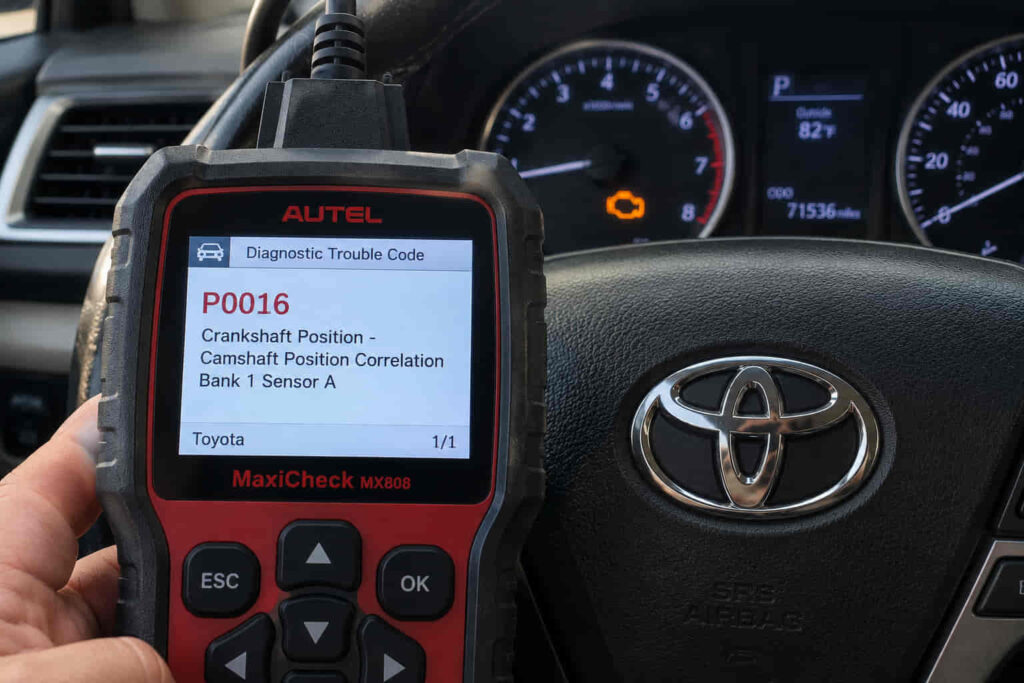
Toyota P0016 means the engine control system has detected an incorrect correlation between the crankshaft position and the Bank 1 camshaft position identified as Sensor A. The crankshaft and camshaft must remain synchronized so the engine can control valve timing correctly. When their detected positions no longer match the relationship expected by the engine control module, the vehicle can store P0016 and illuminate the Check Engine Light.
P0016 does not automatically mean the camshaft position sensor or crankshaft position sensor has failed. The code can result from a mechanical timing problem, a Variable Valve Timing (VVT) or engine-oil-related issue, an incorrect camshaft or crankshaft position signal, damaged wiring or connectors, or another condition that changes the expected relationship between the two shafts. Replacing a position sensor without confirming the cause can therefore leave the original fault unresolved.
The severity of Toyota P0016 depends on what caused the correlation error and how the engine is operating. Some vehicles may initially show a warning light, while a timing-related fault can produce starting problems, rough engine operation, reduced performance, or other drivability symptoms. This guide explains what Toyota P0016 means, what causes it, which symptoms can occur, how to diagnose the correlation fault systematically, and how to select the correct repair after identifying the underlying problem.
What Does the P0016 Code Mean on a Toyota?
Toyota P0016 means the engine control system has detected that the crankshaft position and the Bank 1 camshaft position identified as Sensor A are not correlating as expected. The crankshaft and camshaft perform different functions, but their rotational positions must remain synchronized according to the engine’s designed timing relationship. The engine control module monitors position information from both shafts and can store P0016 when their detected relationship falls outside the expected operating range.
The crankshaft converts the movement of the pistons into rotational motion, while the camshaft controls the opening and closing of the engine valves. Their relationship determines when valve events occur relative to piston movement. The engine control system uses crankshaft and camshaft position information to monitor this relationship and manage engine operation. A significant discrepancy between the expected and detected positions therefore indicates a correlation problem rather than simply an isolated sensor reading.
In the P0016 description, Bank 1 identifies the side of the engine associated with cylinder number one on engines that have more than one cylinder bank. Sensor A refers to the applicable camshaft position used by the diagnostic definition. The exact physical location and component arrangement depend on the Toyota engine, so Bank 1 and Sensor A should be identified using service information for the specific model, model year, and engine rather than by assuming that every Toyota uses the same layout.
P0016 is therefore better understood as a camshaft-to-crankshaft correlation code, not as a code that automatically identifies a defective camshaft position sensor. A sensor or its electrical circuit can contribute to incorrect position information, but the same code can also result when mechanical valve timing changes or when a system responsible for controlling camshaft timing cannot achieve the expected position. Diagnosis must determine whether the mismatch exists in the signals being reported, the actual mechanical timing of the engine, or the system controlling camshaft timing.
This distinction directly affects repair decisions. Replacing a camshaft or crankshaft position sensor without confirming that its signal is responsible for the correlation error can fail to resolve P0016. The stored code identifies the relationship that the engine control system considers incorrect; testing is required to identify why that relationship became incorrect.
How Serious Is the Toyota P0016 Code?
Toyota P0016 should be diagnosed promptly because some causes can affect actual engine timing, while other causes can interfere with the control system’s ability to determine crankshaft and camshaft position correctly. The seriousness of the code therefore depends on the underlying fault and the symptoms occurring with it rather than on the presence of the DTC alone.
A vehicle that stores P0016 while continuing to start and run normally presents a different immediate condition from an engine that is difficult to start, runs roughly, loses substantial power, produces abnormal mechanical noise, or develops other significant operating problems. These symptoms matter because P0016 can involve the relationship between crankshaft rotation and camshaft timing. When the underlying problem is mechanical rather than limited to a signal or connection fault, continuing to operate the engine can carry greater consequences.
Driving should therefore be evaluated according to engine behavior. A Toyota with a Check Engine Light but no major change in operation still requires diagnosis because the correlation fault remains present or has been detected under specific operating conditions. If P0016 is accompanied by severe rough running, significant power loss, abnormal engine noise, repeated stalling, starting difficulty, or other signs that normal engine operation has been compromised, continued driving should be avoided until the cause has been identified.
The code should not be repeatedly cleared to determine whether the vehicle can continue to be driven. Clearing P0016 removes stored diagnostic information without correcting the condition that caused the engine control system to detect the correlation error. It can also remove useful information that would otherwise help determine when the fault occurred. The appropriate response is to retrieve the available diagnostic information, identify the cause, perform the corresponding repair, and then clear and retest the system.
The severity of P0016 ultimately follows the cause. An electrical connection problem, an incorrect position signal, a VVT-related fault, and a mechanical timing problem can all lead toward the same correlation DTC but require different repairs and carry different implications for engine operation. Accurate diagnosis is therefore necessary both to determine how serious Toyota P0016 is and to prevent unnecessary replacement of components that have not been proven defective.
Read more: Toyota P0770
What Are the Symptoms of Toyota P0016?
The main symptoms of Toyota P0016 can include an illuminated Check Engine Light, difficult starting, rough or unstable engine operation, reduced power, poor acceleration, and other drivability problems associated with incorrect camshaft-to-crankshaft correlation. The exact symptoms depend on whether P0016 results from an electrical signal problem, Variable Valve Timing (VVT) malfunction, or an actual change in mechanical engine timing. A Toyota can also store the code before the driver notices a substantial difference in engine operation.
The Check Engine Light can appear when the engine control system detects that the crankshaft and Bank 1 camshaft positions no longer correlate within the expected parameters. This warning can occur even when the engine still appears to run normally because the control system monitors position information more precisely than a driver can evaluate through vehicle behavior alone. Reading P0016 with an OBD-II scanner identifies the detected correlation problem, but the warning light does not reveal whether the underlying cause is mechanical, oil/VVT-related, sensor-related, or electrical.
Starting and engine-running problems become more relevant when the correlation error affects information or mechanical timing required for normal combustion. The engine depends on the crankshaft and camshaft maintaining the correct relationship so valve operation remains coordinated with piston movement. When that relationship changes sufficiently, the engine can become harder to start, run unevenly, or respond differently during acceleration. The severity of these symptoms depends on how far actual or detected timing has moved from the relationship expected by the control system.
Reduced engine performance can occur for the same reason. Incorrect camshaft timing can affect how efficiently the cylinders fill and exhaust gases leave during the combustion cycle, while inaccurate position information can interfere with the engine control system’s ability to manage operation correctly. The driver may consequently notice weaker acceleration or a general reduction in engine performance. These symptoms become more diagnostically significant when they occur together with P0016 and other timing- or VVT-related evidence.
Symptoms alone cannot determine which component caused Toyota P0016. Rough running, starting difficulty, and reduced power are not exclusive to a camshaft sensor, crankshaft sensor, timing system, or VVT fault. They should be interpreted together with the stored codes, engine data, oil condition, electrical test results, position signals, and mechanical timing checks. This prevents a general engine symptom from being incorrectly used as proof that a particular sensor or timing component has failed.
What Causes the P0016 Code on a Toyota?
Toyota P0016 can be caused by a mechanical timing problem, a VVT or engine-oil-related fault, incorrect camshaft or crankshaft position information, damaged wiring or connectors, or another condition that prevents the control system from seeing the expected relationship between the two shafts. These causes affect different parts of the same diagnostic chain, which is why P0016 cannot identify the failed component by itself.
Mechanical timing faults are important because P0016 directly concerns crankshaft-to-camshaft correlation. If the mechanical relationship between the shafts moves away from its intended position, the signals detected by the control system can accurately report a correlation that is no longer correct. Timing-chain or other applicable timing-component problems, incorrect timing alignment, and faults affecting the ability of the timing system to maintain its intended position therefore need to be considered when the symptoms and diagnostic evidence point toward an actual mechanical timing change.
The VVT system can also contribute to P0016 because it changes camshaft timing under controlled operating conditions on engines equipped with that system. The engine control system commands a desired camshaft position and expects the actual position to respond accordingly. A problem affecting VVT operation can prevent the camshaft from reaching or maintaining the expected position, creating a discrepancy between expected camshaft timing and crankshaft position. Diagnosis must determine why VVT operation is incorrect rather than treating the presence of P0016 as proof that one VVT component has failed.
Engine oil is relevant because applicable VVT systems depend on controlled oil flow and pressure for camshaft timing operation. An incorrect oil level, unsuitable oil condition, or another lubrication-related condition that interferes with VVT operation can contribute to a timing response that differs from the commanded position. However, an oil change should not be presented as a universal P0016 fix. Oil-related correction resolves the code only when diagnosis establishes a relationship between the oil condition, VVT operation, and the detected correlation fault.
Camshaft and crankshaft position sensors represent another diagnostic branch. These sensors provide the position information the engine control system uses to evaluate the relationship between the two shafts. A faulty sensor, an abnormal signal, or a problem with the associated trigger or signal-generating system can cause the control module to receive information that does not represent the expected correlation. The sensor should still be tested before replacement because P0016 describes the relationship between signals rather than confirming that either sensor is defective.
Wiring and connector problems can affect the same position information without requiring a failed sensor. Damaged wiring, poor terminal contact, contamination, corrosion, or another electrical circuit fault can alter or interrupt a signal used for correlation monitoring. Inspecting these electrical paths is therefore necessary before replacing a camshaft or crankshaft position sensor based only on the stored DTC.
The causes of Toyota P0016 are best separated into actual timing errors and detected timing errors. An actual timing error changes the mechanical or controlled relationship between the crankshaft and camshaft, while a detected timing error can result when the control system receives incorrect position information. Determining which of these two paths produced P0016 narrows the diagnosis and prevents unnecessary replacement of sensors, VVT components, or mechanical timing parts.
Can Low or Dirty Engine Oil Cause Toyota P0016?
Low or degraded engine oil can contribute to Toyota P0016 when the oil condition interferes with the Variable Valve Timing system and prevents the camshaft from reaching the position expected by the engine control system. This relationship is relevant on Toyota engines where VVT operation depends on controlled engine-oil flow to adjust camshaft timing. An oil-related problem can therefore affect camshaft position without creating a direct electrical fault in the camshaft or crankshaft position sensor.
The connection between engine oil and P0016 occurs through camshaft timing control. The VVT system uses oil hydraulically to change or maintain camshaft position according to engine operating requirements. The engine control system commands a timing change and monitors the resulting camshaft position relative to the crankshaft. If inadequate or abnormal oil flow prevents the VVT mechanism from responding correctly, the actual camshaft position can differ from the expected position and contribute to a camshaft-to-crankshaft correlation fault.
Oil condition should consequently be inspected as part of P0016 diagnosis when it is relevant to the Toyota engine being tested. The correct oil level, viscosity, specification, service condition, and evidence of contamination or sludge can provide useful diagnostic context. The inspection should also consider whether an oil-related condition could restrict or alter operation of the passages and components responsible for VVT control. Requirements must be matched to the specific engine because Toyota engines do not all use identical lubrication and valve-timing systems.
Changing the engine oil is not a universal repair for Toyota P0016. Fresh oil cannot correct a mechanically misaligned timing system, damaged wiring, an incorrect position signal, or another component that has already failed. An oil service is a valid repair path only when diagnosis shows that the oil condition or an oil-dependent VVT problem is responsible for the incorrect camshaft timing. If P0016 remains after the oil-related condition has been corrected, diagnosis must continue instead of repeatedly changing the oil or clearing the code.
Can a Timing Chain Problem Cause Toyota P0016?
A timing chain problem can cause Toyota P0016 when it changes the mechanical relationship between the crankshaft and camshaft enough for the engine control system to detect incorrect correlation. Because the crankshaft and camshaft must remain mechanically synchronized, a timing-system fault is fundamentally different from a sensor fault: the position signals can be accurate while reporting that the shafts are genuinely no longer in the relationship expected by the control system.
The timing system transfers crankshaft rotation to the camshaft or camshafts while maintaining the designed timing relationship. If an applicable timing component can no longer maintain that relationship correctly, camshaft position can shift relative to crankshaft position. The engine control system compares the resulting position information with its expected correlation and can store P0016 when the discrepancy meets the conditions required to set the DTC.
A mechanical timing problem becomes more important to investigate when P0016 occurs with symptoms or test results that cannot be explained by an electrical signal fault alone. Starting problems, abnormal engine operation, timing-related symptoms, or position data showing a persistent correlation discrepancy can justify verification of mechanical timing after the relevant electrical and VVT checks have been considered. The exact inspection procedure depends on the Toyota engine and its timing-system design.
A timing chain should not be replaced solely because P0016 is present. The same correlation code can result from VVT operation, position-signal problems, wiring faults, or other conditions that affect actual or detected camshaft position. Mechanical timing must therefore be verified before a timing-system repair is authorized. This distinction is especially important because timing-system work can involve substantially more labor and disassembly than an external electrical repair.
The diagnostic question is not simply whether P0016 is associated with the timing chain. The correct question is whether the actual mechanical camshaft-to-crankshaft relationship has moved away from specification. If mechanical timing is correct, diagnosis should remain focused on the systems capable of producing an incorrect detected or controlled camshaft position. If mechanical timing is incorrect, the cause of that timing change must be identified and corrected before P0016 can be considered repaired.
How Do You Diagnose the P0016 Code on a Toyota?
To diagnose Toyota P0016, confirm the code and related DTCs, evaluate engine oil and VVT operation where applicable, inspect the camshaft and crankshaft position circuits, verify their signals, and check mechanical timing when the earlier tests do not explain the correlation fault. The purpose of this sequence is to determine whether P0016 represents an incorrect position signal, an incorrectly controlled camshaft position, or an actual mechanical timing error.
Diagnosis should begin with a complete scan of the engine control system rather than reading P0016 and immediately clearing it. P0016 should be recorded together with any additional camshaft, crankshaft, VVT, oil-control, or timing-related codes because the relationship between multiple DTCs can narrow the diagnostic direction. Available freeze-frame and live data can provide further context by showing the engine conditions associated with the detected fault. This information should be preserved before codes are cleared because it can help distinguish a persistent correlation problem from one that occurs only under specific operating conditions.
Engine oil should be evaluated early when the applicable Toyota engine uses oil-controlled variable valve timing. The oil level and condition should be checked, and the oil specification should match the requirements of the engine being diagnosed. Evidence of an oil-related problem becomes more significant when P0016 is accompanied by VVT behavior that does not correspond with the commanded camshaft position. Correcting an identified oil problem is appropriate, but normal oil condition does not eliminate the need to test the rest of the system.
The electrical inspection should then focus on the camshaft and crankshaft position circuits. Wiring, connectors, terminals, and related connections should be examined for damage, loose contact, corrosion, contamination, or other conditions capable of changing or interrupting position information. An electrical fault can create an apparent correlation problem even when the crankshaft and camshaft remain mechanically synchronized. Repairing the electrical path before replacing a sensor prevents a wiring problem from being mistaken for a failed component.
Camshaft and crankshaft position signals should be evaluated according to the diagnostic procedure for the exact Toyota model, model year, and engine. The important diagnostic question is whether the engine control system is receiving accurate position information from both shafts and whether their relationship corresponds with specification. Sensor power, ground, circuit integrity, signal behavior, and applicable test values should be checked using model-specific service information. One resistance, voltage, waveform, or pin assignment should not be applied universally to every Toyota engine.
A camshaft or crankshaft position sensor should therefore be replaced only when testing provides evidence that the sensor or its associated signal is defective. P0016 itself does not establish sensor failure because the sensors may be reporting a real mechanical timing discrepancy correctly. Replacing a functional sensor in that situation changes the component but leaves the actual camshaft-to-crankshaft correlation problem unchanged.
VVT operation should be investigated when the electrical position information is credible but actual camshaft position does not follow the position expected or commanded by the control system. Diagnosis needs to determine whether the camshaft timing mechanism can move and maintain position correctly under the applicable operating conditions. Oil supply, oil-control operation, VVT components, and other engine-specific mechanisms can become relevant at this stage. A VVT-related repair should be based on evidence that the timing-control system cannot produce the expected camshaft position.
Mechanical timing should be verified when electrical and VVT checks do not explain P0016 or when the available evidence indicates an actual synchronization problem. The objective is to determine whether the crankshaft and camshaft remain mechanically aligned according to the specifications for that engine. If their physical relationship is incorrect, the position sensors can both function normally while the engine control system correctly identifies an abnormal correlation.
Mechanical inspection should also determine why timing became incorrect rather than stopping after discovering misalignment. A timing system that cannot maintain the specified relationship can involve an underlying component or installation problem that must be corrected for the repair to remain effective. The timing configuration and inspection procedure vary by engine, so timing marks, component positions, disassembly procedures, and specifications must come from service information for the exact Toyota application.
Diagnostic evidence should ultimately distinguish between three paths. An electrical or signal fault causes the control system to receive incorrect position information. A VVT control fault causes actual camshaft position to differ from the commanded position. A mechanical timing fault changes the physical relationship between the crankshaft and camshaft. Identifying which path produced P0016 determines whether the correct repair involves the electrical circuit or sensor, oil/VVT system, or mechanical timing system.
The diagnosis is complete only after the repair has been verified. Once the confirmed cause has been corrected, P0016 and related codes should be cleared and the engine should be operated under conditions that allow the control system to evaluate camshaft-to-crankshaft correlation again. The vehicle should then be rescanned and its operation checked. Normal engine behavior combined with P0016 remaining absent provides stronger evidence of a successful repair than simply turning off the Check Engine Light.
How Do You Fix the P0016 Code on a Toyota?
To fix Toyota P0016, repair the oil/VVT, electrical, sensor, or mechanical timing problem confirmed during diagnosis, then clear the code and verify that the crankshaft-to-camshaft correlation fault does not return. There is no single repair that applies to every P0016 case because the same code can result from an incorrect position signal, a camshaft that does not reach its commanded position, or an actual mechanical timing error.
An engine-oil-related problem should be corrected when diagnosis establishes that it is interfering with VVT operation. The oil level and condition should meet the requirements of the applicable Toyota engine, and the correct oil specification should be used. Any condition affecting the oil supply to the VVT system also needs to be addressed if testing shows that it prevents normal camshaft timing control. An oil service should not be treated as the repair when mechanical timing or electrical testing has identified a different cause.
Electrical faults require repair of the affected circuit rather than automatic replacement of a position sensor. Damaged wiring, poor terminal contact, corrosion, contamination, or a loose connector can interfere with the camshaft or crankshaft position signal used by the engine control system to evaluate correlation. The affected wiring or connection should be repaired and the signal checked again. If the circuit operates correctly afterward and P0016 does not return, replacing the associated sensor provides no additional diagnostic value.
A camshaft or crankshaft position sensor should be replaced when testing confirms that the component cannot provide the required signal and the associated wiring, connectors, power, ground, and relevant circuit conditions have been verified. Replacement parts must correspond with the specific Toyota model and engine application. Installing a new sensor simply because P0016 contains the terms “crankshaft position” and “camshaft position” can leave the code unresolved when both sensors were accurately reporting an actual timing discrepancy.
A VVT-related repair is appropriate when diagnosis confirms that the engine cannot control camshaft position as commanded. The exact repair depends on which part of the oil-controlled timing system is responsible for the incorrect response. The repair should restore the ability of the camshaft to reach and maintain its expected position relative to the crankshaft. Because VVT designs and component arrangements vary between Toyota engines, the component test and replacement procedure should follow service information for the exact application.
Mechanical timing must be corrected when inspection confirms that the physical relationship between the crankshaft and camshaft is outside specification. In this situation, replacing sensors or repeatedly clearing P0016 cannot restore synchronization because the control system is detecting a real timing discrepancy. The affected timing components must be inspected to identify why the relationship changed, and the timing system must be restored to the specified alignment. Any component that caused or cannot reliably maintain that alignment should be addressed as part of the repair.
The repair should not end when the Check Engine Light turns off. After correcting the confirmed cause, the stored codes should be cleared and the engine operated under appropriate conditions so the control system can monitor crankshaft-to-camshaft correlation again. A final scan should confirm that P0016 and related faults remain absent, while engine operation should be checked for the starting, idle, performance, or other symptoms that were present before the repair. This verification separates an actual repair from a temporary code reset.
How Much Does It Cost to Fix Toyota P0016?
The cost to fix Toyota P0016 depends on the confirmed cause because an oil or wiring correction requires a different level of repair from sensor, VVT, or mechanical timing work. P0016 does not identify one guaranteed failed part, so a single repair price cannot accurately represent every Toyota with this code.
A relatively accessible electrical fault can require less labor when diagnosis identifies damaged wiring, a poor connector, or another localized circuit problem. The cost can increase when an intermittent signal requires additional diagnostic time or when the affected wiring is difficult to access. Paying for accurate diagnosis at this stage can prevent unnecessary spending on camshaft and crankshaft position sensors that test correctly.
Sensor replacement introduces the cost of the applicable camshaft or crankshaft position sensor and the labor required to access and replace it. The final amount varies according to Toyota model, engine configuration, component location, part selection, and local labor rate. More importantly, sensor replacement should appear on the estimate only when diagnosis has connected the sensor or its signal directly to the P0016 fault.
VVT-related repairs can vary more substantially because P0016 can involve different parts of the camshaft timing-control process. A repair involving an accessible control component differs from work requiring deeper access to the VVT or timing mechanism. The estimate should therefore identify the failed component and required labor instead of using “P0016 repair” as a generic service description.
Mechanical timing problems can represent the more extensive repair path because restoring crankshaft-to-camshaft synchronization can require access to the engine’s timing system. The final cost depends on the engine design, the components that caused the timing discrepancy, the extent of disassembly, and whether additional damage or wear is discovered during inspection. P0016 alone is not sufficient evidence to authorize this level of repair.
An accurate Toyota P0016 estimate should therefore be produced after diagnosis establishes whether the fault is oil/VVT-related, electrical, sensor-related, or mechanical. The estimate should connect each recommended part and labor operation to the confirmed cause. This cause-to-repair relationship is more useful than quoting one broad P0016 price that does not account for the actual failure.
Which Toyota Models Can Show the P0016 Code?
Toyota P0016 can appear on vehicles whose engine control system monitors crankshaft-to-camshaft correlation, but the meaning of the code does not make the diagnostic specifications identical across Toyota models and engines. The central fault remains an incorrect correlation involving the crankshaft position and the Bank 1 camshaft position identified as Sensor A, while the components and procedures used to diagnose that relationship depend on the specific engine application.
The engine configuration is particularly important when moving from the generic P0016 definition to component-level testing. Toyota vehicles can use different engines, timing-system designs, VVT arrangements, sensor locations, wiring layouts, and service specifications. Two Toyota vehicles can therefore store P0016 while requiring different access procedures and different tests to determine why the correlation fault occurred. Model year alone is also insufficient when a vehicle line was available with more than one engine configuration.
The correct vehicle and engine application should consequently be established before using a wiring diagram, identifying Bank 1 Sensor A, testing a position sensor, inspecting mechanical timing, or ordering replacement components. Service information should match the model, model year, engine, and applicable configuration. This prevents specifications from one Toyota engine from being incorrectly applied to another engine that happens to store the same P0016 code.
Model-specific P0016 pages can provide greater diagnostic depth when reliable technical information is available for each application. Instead of repeating this general article, those pages should focus on the engine configuration, component locations, known diagnostic paths, applicable specifications, and repair procedures for the targeted vehicle. This structure allows Toyota P0016 to function as the broader diagnostic entity while model-specific pages provide deeper contextual information where it is actually useful.
What Other Codes Can Appear With Toyota P0016?
Other camshaft, crankshaft, VVT, and timing-related diagnostic trouble codes can appear with Toyota P0016 and can help determine whether the correlation problem is associated with position signals, camshaft timing control, or a broader engine-timing fault. Additional codes are useful because they provide diagnostic context, not because the presence of more DTCs automatically indicates a more severe failure.
A position-sensor-related code appearing with P0016 can direct attention toward the relevant signal and electrical circuit. The technician should then determine whether the sensor signal is missing, abnormal, intermittent, or inconsistent with the actual mechanical position of the engine. The presence of a sensor-related code still does not prove that the sensor itself requires replacement because wiring, connectors, signal-generating components, and other circuit conditions can affect the same information.
VVT-related codes can shift the diagnostic focus toward the system responsible for controlling camshaft timing. If the engine control system cannot achieve or maintain the commanded camshaft position, P0016 can occur as part of a larger timing-control problem. Engine oil condition, oil-dependent control, the applicable VVT components, and actual versus commanded camshaft position then become important diagnostic evidence.
Multiple correlation or timing-related codes can also provide evidence that the problem extends beyond one isolated position signal. In that situation, the relationship between the stored DTCs should be evaluated before components are replaced. A shared mechanical timing problem or another condition affecting more than one monitored relationship requires a different diagnostic approach from a single electrical circuit fault.
All stored codes should therefore be recorded and interpreted according to their relationship with P0016 before they are cleared. This approach also creates a logical internal-link structure for a Toyota DTC content cluster. Separate pages covering individual crankshaft, camshaft, VVT, and correlation codes can connect when their diagnostic contexts genuinely overlap, allowing each page to remain focused on its own central entity rather than reproducing a generic list of related trouble codes.
How Can You Prevent Toyota P0016 From Returning?
Preventing Toyota P0016 from returning requires correcting the original correlation fault completely, maintaining the oil-dependent timing system according to the applicable engine requirements, protecting position-sensor circuits, and investigating new timing or drivability symptoms before they develop into a recurring fault. Prevention depends on the original cause because a mechanical timing failure cannot be prevented in the same way as an oil-related or electrical problem.
Repair verification is the first preventive measure. A component replacement should not be considered successful merely because the stored code was cleared. The engine should be operated under appropriate conditions and rescanned so the control system has an opportunity to evaluate crankshaft-to-camshaft correlation again. If P0016 returns, the underlying condition remains present or another part of the same diagnostic path still requires investigation.
Correct engine-oil maintenance is relevant where Toyota’s VVT system depends on controlled oil flow for camshaft timing. The engine should use the oil specification required for the application, maintain the correct oil level, and receive service according to the applicable maintenance requirements. Oil leaks or conditions that interfere with oil supply should be addressed rather than repeatedly correcting the level, because stable VVT operation depends on the lubrication system functioning as designed.
Electrical integrity also matters after a sensor- or circuit-related P0016 repair. Wiring should be protected from conditions that can damage insulation or connections, while connectors and terminals should remain secure and free from faults that interfere with position signals. An intermittent connection can be particularly difficult to diagnose because the engine may operate normally until vibration, temperature, or another operating condition causes the signal problem to reappear.
New starting problems, rough running, abnormal engine performance, unusual mechanical symptoms, or a returning Check Engine Light should be investigated rather than ignored after a previous P0016 repair. Early scanning can preserve diagnostic information and establish whether the new condition involves the same crankshaft-to-camshaft correlation fault or a separate engine problem.
A Toyota P0016 repair is therefore complete when the confirmed cause has been corrected, normal engine operation has been restored, and the correlation code remains absent after verification. Maintaining the systems involved in that original failure is more effective than treating repeated code clearing as preventive maintenance.