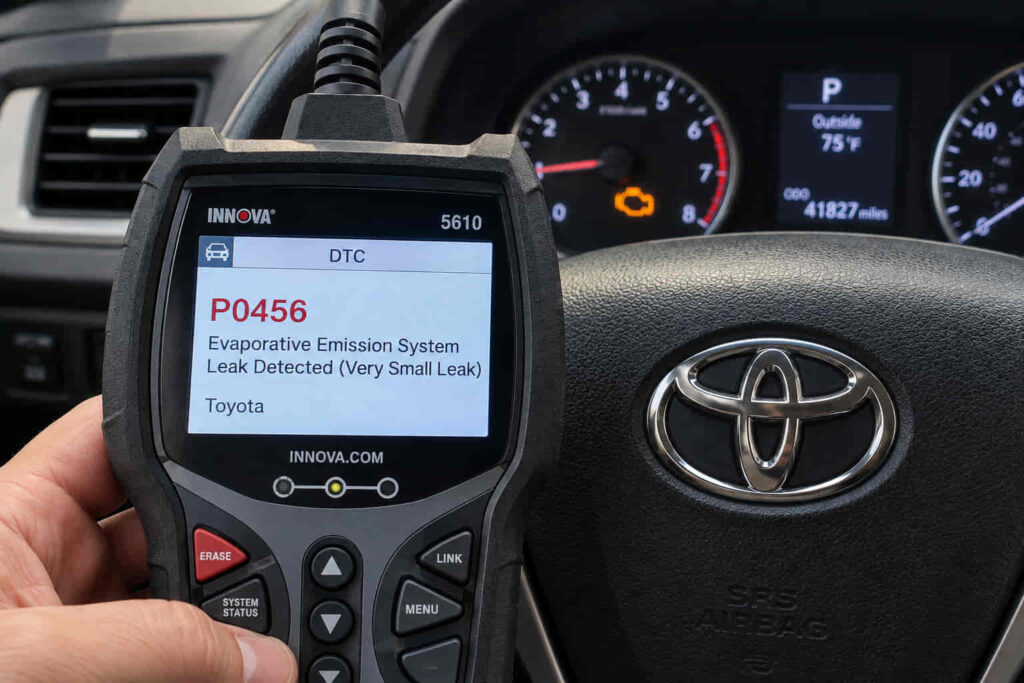
Toyota P0456 means the engine control system has detected a very small leak in the Evaporative Emission Control (EVAP) system. The EVAP system is designed to contain fuel vapor and prevent it from escaping from the vehicle’s fuel system into the atmosphere. When the engine control module performs an EVAP leak check and determines that the system cannot maintain the expected level of sealing, it can store P0456 and illuminate the Check Engine Light.
P0456 identifies an EVAP system integrity problem rather than a specific failed component. A loose or improperly sealing fuel cap can contribute to the code, but the fault can also involve EVAP hoses or connections, purge or vent control, the charcoal canister, or another part of the system that prevents it from sealing correctly. Replacing the gas cap without confirming the source of the leak can therefore leave the original problem unresolved.
A Toyota with P0456 may show little or no noticeable change in engine performance because the detected fault concerns fuel-vapor containment rather than directly indicating a combustion problem. Diagnosis should focus on locating the loss of EVAP system integrity and confirming its cause before parts are replaced. This guide explains what Toyota P0456 means, how serious it is, which symptoms and causes are relevant, how the EVAP leak should be diagnosed, and how to select the correct repair.
What Does the P0456 Code Mean on a Toyota?
Toyota P0456 means the engine control system has detected a very small leak in the Evaporative Emission Control (EVAP) system. The EVAP system is designed to keep fuel vapor contained within a controlled, sealed system instead of allowing that vapor to escape directly into the atmosphere. When the vehicle performs an EVAP leak check and the measured system behavior indicates that the expected seal cannot be maintained, the engine control module can recognize the condition as a very small leak and store P0456.
The code describes the condition detected by the monitoring system rather than identifying the exact location of the leak. The loss of sealing can occur at different points within the EVAP system because the fuel tank, vapor lines and connections, fuel cap, charcoal canister, purge side, vent side, and associated components work together to contain and control fuel vapor. A sealing problem in an applicable part of that system can affect the result of the leak test.
The term “very small leak” is also important diagnostically. It indicates that the control system has detected a relatively small loss of EVAP system integrity rather than providing evidence that a particular component has completely failed. A small sealing defect can be more difficult to locate visually because the affected area may not have an obvious disconnected hose, broken component, or large opening. Diagnosis therefore needs to identify where the system is losing integrity instead of selecting a replacement part from the code description alone.
P0456 should consequently be treated as a system-level diagnostic code rather than a component-level diagnosis. A fuel cap that does not seal correctly can contribute to the fault, but P0456 does not prove that the cap is defective. The same principle applies to purge valves, vent valves, EVAP hoses, connections, and the charcoal canister. Each suspected component must be connected to the detected leak through inspection or testing before it is considered the cause.
Understanding this distinction prevents unnecessary parts replacement. The diagnostic objective is to move from P0456 → EVAP integrity failure → leak or control problem → confirmed source → repair. Once the actual source has been identified, the repair can address the condition that caused the EVAP monitor to detect the very small leak.
How Serious Is the Toyota P0456 Code?
Toyota P0456 generally indicates an EVAP emissions-system fault rather than directly identifying an engine mechanical failure, but the code should still be diagnosed instead of being repeatedly cleared or ignored. A very small EVAP leak affects the system responsible for containing and controlling fuel vapor, and the Check Engine Light can remain illuminated while the fault is present.
A Toyota with P0456 alone may continue to start, idle, accelerate, and drive without an obvious change in engine performance. This happens because the code primarily concerns EVAP system integrity rather than directly indicating that combustion, ignition, or mechanical valve timing has failed. The absence of noticeable drivability symptoms, however, does not mean the EVAP system has passed its monitoring requirements. The control module has still detected a condition that requires diagnosis.
Whether the vehicle should continue to be driven also depends on what accompanies P0456. A Check Engine Light with otherwise normal operation presents a different situation from a vehicle with a strong fuel odor, visible fuel leakage, severe drivability problems, or additional warning indicators. Those conditions should not automatically be attributed to a very small EVAP leak. They require separate evaluation because another fuel-system or engine fault may be present alongside P0456.
The Check Engine Light creates another practical reason to diagnose the code promptly. If P0456 remains unresolved and the warning light stays illuminated, a later fault can occur while the same warning indicator is already active. Reading all stored and pending codes provides more diagnostic information than repeatedly clearing P0456 simply to turn the light off.
Clearing the code also does not repair the EVAP leak. It only removes stored diagnostic information and resets the warning until the monitoring system has another opportunity to evaluate the relevant conditions. The correct approach is to locate the loss of EVAP integrity, repair the confirmed cause, clear the DTC, and then verify that the EVAP monitor no longer detects the condition.
Read more: Toyota P0016
What Are the Symptoms of Toyota P0456?
The most direct symptom of Toyota P0456 is an illuminated Check Engine Light, while the vehicle may have little or no noticeable change in engine performance. P0456 indicates that the engine control system has detected a very small leak in the EVAP system, so the fault primarily concerns fuel-vapor containment rather than directly identifying a problem with combustion or mechanical engine operation.
The Check Engine Light can appear after the EVAP monitor detects that the system does not maintain the expected level of sealing during its diagnostic test. The driver may not notice when the leak itself develops because a very small loss of EVAP integrity does not necessarily create an immediate change in starting, idling, acceleration, or engine power. The warning light can therefore be the first indication that the vehicle has stored P0456.
A fuel-vapor odor may become relevant when an EVAP fault allows vapor to escape, but odor should not be treated as a required symptom of P0456. The code can be stored without an obvious smell, and a noticeable fuel odor can also indicate a condition that requires investigation beyond the stored DTC. The source of the odor should be identified rather than assuming that a very small EVAP leak fully explains it.
Significant drivability symptoms should also be evaluated separately. Severe rough running, repeated stalling, difficult starting, or a major loss of engine power is not enough by itself to identify P0456 as the cause. If these symptoms occur while P0456 is stored, all available DTCs and relevant systems should be checked because another fault may be affecting engine operation at the same time.
The symptom pattern therefore provides an important diagnostic clue. A Check Engine Light with otherwise normal vehicle operation is consistent with the system-level nature of a very small EVAP leak, while additional symptoms can justify a broader diagnosis. The stored code, operating symptoms, and test results should be evaluated together before any EVAP component is replaced.
What Causes the P0456 Code on a Toyota?
Toyota P0456 is caused when the EVAP monitoring system detects that the fuel-vapor containment system cannot maintain the expected level of sealing for a very small leak test. The underlying problem can involve the fuel cap or its sealing surface, EVAP hoses and connections, purge- or vent-side sealing, the charcoal canister or associated components, or another condition that changes the system behavior used for leak detection.
A fuel cap becomes a possible cause when it cannot maintain the required seal between the filler opening and the closed EVAP system. An improperly installed cap, a sealing problem, or damage affecting the cap or its mating surface can allow the system to lose integrity during an EVAP test. This explains why the fuel cap is relevant to P0456, but the relationship does not mean every Toyota with this code requires a new cap.
EVAP hoses, vapor lines, and their connections create another potential leak path because they connect components responsible for containing and routing fuel vapor. A small crack, damaged connection, loose fitting, deteriorated sealing point, or another loss of integrity can allow vapor or test pressure to escape. A very small defect may not be visually obvious, which is why a normal-looking system does not always eliminate the need for further leak testing.
Purge-side operation can contribute when an applicable purge component or connection prevents the EVAP system from behaving as required during monitoring. The purge system controls the movement of stored fuel vapor toward the engine under appropriate operating conditions. If a component that should control or isolate that flow cannot perform correctly, the resulting system behavior can interfere with the leak test and contribute to an EVAP-related DTC.
The vent side is equally relevant because the EVAP system must control its connection with outside air during operation and diagnostic testing. A vent valve or associated sealing path that cannot achieve the required state can prevent the system from maintaining the conditions necessary for a successful leak check. Diagnosis must confirm the valve’s operation and sealing ability before it is identified as the cause of P0456.
The charcoal canister and its associated connections should be considered when evidence points toward that area of the system. The canister is part of the fuel-vapor management path, and damage to the housing, ports, connections, or related sealing points can affect EVAP integrity. The presence of P0456 alone does not justify canister replacement because the same system-level code can originate elsewhere.
The most useful way to interpret these causes is through a common mechanism: a component or connection fails to maintain the required EVAP condition, the system loses the expected sealing integrity, the leak-monitoring test detects the discrepancy, and the engine control module stores P0456. Diagnosis should follow this causal chain until the actual leak or control problem is demonstrated. This approach prevents the fuel cap, purge valve, vent valve, or charcoal canister from being replaced simply because each component is associated with the EVAP system.
Can a Loose or Bad Gas Cap Cause Toyota P0456?
A loose, incorrectly installed, damaged, or poorly sealing gas cap can contribute to Toyota P0456 when it prevents the EVAP system from maintaining the sealed condition required during leak monitoring. The fuel cap closes an opening in the fuel-vapor containment system, so its ability to seal is directly relevant when the engine control system checks the EVAP system for leakage.
The connection between the gas cap and P0456 is based on sealing rather than on the cap being electronically monitored as the failed component. If the cap is not correctly seated or its sealing interface cannot close the filler opening as required, the EVAP system can lose integrity. When the vehicle later performs its applicable leak-monitoring routine, that loss of sealing can produce system behavior consistent with a very small leak.
The cap itself is not the only part of this sealing point that matters. The cap should be inspected together with the area against which it seals because contamination, physical damage, deterioration, or another condition affecting the interface can prevent an otherwise functional cap from sealing correctly. Inspection should therefore establish whether the fuel-filler sealing point can maintain integrity rather than relying only on whether the cap appears present and tight.
Correcting an obvious cap installation problem is a reasonable first action when the cap was not properly secured. However, tightening or replacing the gas cap is not a universal repair for Toyota P0456. If the cap and its sealing area are in acceptable condition and P0456 returns after the system completes its monitoring process, the diagnostic path should continue through the remaining EVAP components and connections.
A replacement gas cap should likewise be treated as a repair only when evidence supports a problem at that sealing point. Installing a new cap and clearing the DTC without confirming the fault can temporarily remove the Check Engine Light while leaving a small hose leak, valve-sealing problem, canister-related leak, or another EVAP fault unresolved. The relevant diagnostic question is therefore not simply whether a gas cap can cause P0456, but whether the fuel-cap sealing point is the location where the EVAP system is losing integrity.
Can an EVAP Purge or Vent Valve Cause Toyota P0456?
An EVAP purge or vent valve can contribute to Toyota P0456 when it does not control or seal its vapor path as required during EVAP operation and leak monitoring. These valves perform different functions within the system, but both can influence whether the EVAP system reaches and maintains the conditions the engine control system expects when evaluating system integrity.
The purge side controls the movement of stored fuel vapor from the EVAP system toward the engine under appropriate operating conditions. During diagnostic conditions that require a particular system state, the applicable purge control must behave as expected. If the purge path does not control or seal vapor flow correctly, the EVAP system can respond differently from the expected leak-test behavior. That discrepancy can become relevant to P0456 when diagnosis connects the purge-side condition with the detected loss of system integrity.
The vent side controls the EVAP system’s relationship with outside air. Normal EVAP operation requires the vent path to change state according to the system’s operating strategy, while leak monitoring can require the system to establish conditions that allow its sealing integrity to be evaluated. If the applicable vent valve cannot reach or maintain the required state, the system may be unable to produce the expected test result.
A valve-related problem must be distinguished from a leak in the hoses, connections, seals, or components around the valve. Finding smoke or another indication of leakage near a valve does not automatically prove that the internal valve mechanism has failed. The diagnostic process should determine whether leakage originates from the valve itself, its connection, an attached vapor line, or another sealing point in the same area.
Purge and vent valves should therefore be tested according to the procedure for the exact Toyota application before replacement. The relevant checks can involve commanded operation, circuit integrity, airflow or sealing behavior, and other application-specific tests. Universal electrical values or test conditions should not be applied across Toyota models because EVAP configurations and diagnostic procedures can differ by vehicle, model year, and powertrain.
Replacing both valves as a precaution is not an evidence-based P0456 repair. If testing confirms that one valve cannot perform its required control or sealing function, repairing that fault creates a direct relationship between the diagnostic evidence and the replacement decision. If both valves operate correctly, diagnosis should continue toward the remaining EVAP system because the very small leak has not yet been isolated.
How Do You Diagnose the P0456 Code on a Toyota?
To diagnose Toyota P0456, confirm the DTC and related diagnostic information, inspect the fuel cap and visible EVAP connections, evaluate purge and vent operation, and perform an appropriate EVAP leak test when the source of the very small leak is not visible. The objective is to identify the exact point where the system loses sealing integrity or the component that prevents the EVAP system from reaching the conditions required for leak monitoring.
Diagnosis should begin with a complete scan rather than reading P0456 and immediately clearing it. The technician should record P0456 together with other stored or pending EVAP-related codes and preserve available freeze-frame information before resetting the system. Additional DTCs can change the diagnostic direction because a circuit, purge-control, vent-control, or other EVAP fault appearing with P0456 can provide evidence about which part of the system requires testing.
The fuel cap and its sealing area provide a practical early inspection point because they can be checked without disassembling the EVAP system. The cap should be correctly installed, while its seal and mating surface should be inspected for conditions that prevent proper closure. Finding an obvious sealing problem creates a plausible repair path, but a cap that looks normal does not prove that the entire EVAP system is leak-free.
Visible EVAP hoses, vapor lines, connections, and accessible components should then be inspected for evidence of lost integrity. A disconnected line, damaged hose, deteriorated connection, cracked component, or compromised sealing point can allow the EVAP system to fail its leak test. P0456 represents a very small leak, however, so the defect may be too small to locate reliably through visual inspection alone. The absence of visible damage should therefore lead to additional testing rather than an assumption that the fuel cap must be responsible.
Purge and vent operation should be evaluated because the EVAP system must control vapor flow and establish the correct system state before its integrity can be assessed. The diagnostic process should determine whether the applicable valves respond correctly and whether they can control or seal their paths when required. Circuit operation and physical sealing are separate diagnostic questions: a valve can receive an electrical command while still failing to control vapor flow correctly, while an electrical fault can prevent an otherwise functional valve from being operated as intended.
When visual inspection and functional checks do not identify the source, an EVAP smoke or leak test can help locate a small loss of system integrity. The test introduces an appropriate test medium into the EVAP system under controlled conditions so the technician can inspect for escape at hoses, connections, seals, valves, the canister area, and other applicable points. A visible leak provides stronger evidence for a repair decision than replacing components solely because they are commonly associated with P0456.
The EVAP system must be configured correctly for the leak test to produce meaningful results. A path that remains intentionally open can allow test medium to escape and be mistaken for a defective component, while excessive or inappropriate test pressure can make the procedure unreliable or unsuitable for the system. The correct setup, test method, pressure or vacuum specification, valve state, and access point should therefore come from service information for the exact Toyota model, model year, and powertrain being diagnosed rather than from a universal P0456 procedure.
Smoke-test findings must also be interpreted at the actual leak location. If smoke appears around a purge valve, vent valve, canister, or fuel-filler area, the technician should determine whether it originates from the component itself, a seal, an attached hose, a connector interface, or another nearby path. Identifying the area is only the first step; isolating the failed sealing point prevents an adjacent functional component from being replaced unnecessarily.
If no external leak is identified, diagnosis should continue with the EVAP components and monitoring functions relevant to the specific Toyota application. The key question remains whether the system is physically losing integrity or whether a control condition prevents the leak-monitoring process from operating as expected. Application-specific service information becomes particularly important at this stage because EVAP architecture and leak-detection strategies can differ between Toyota vehicles.
The fuel cap, purge valve, vent valve, and charcoal canister should therefore be replaced only after testing connects the component to the P0456 condition. Replacing the most accessible or most commonly suspected part first can increase repair cost without identifying the source of the very small leak. The correct diagnostic sequence moves from the DTC to system-level evidence, then from system-level evidence to the individual leak or control fault.
Diagnosis is complete only after the confirmed problem has been repaired and the result has been verified. P0456 can be cleared after the repair, but clearing the code alone does not prove that EVAP integrity has been restored. The vehicle must have an opportunity to run the applicable monitoring process again, after which diagnostic information should be checked to confirm that the very small leak is no longer detected and P0456 does not return.
How Do You Fix the P0456 Code on a Toyota?
To fix Toyota P0456, repair the specific EVAP leak or control problem confirmed during diagnosis, then clear the code and verify that the EVAP system can complete its monitoring process without detecting the very small leak again. The correct repair depends on where the system is losing integrity or which component prevents the EVAP system from establishing the conditions required for leak detection.
A fuel-cap-related repair is appropriate when inspection or testing confirms that the cap or its sealing interface cannot maintain the required seal. An incorrectly installed cap should be secured correctly, while a damaged or defective cap should be replaced with a part suitable for the specific Toyota application. The filler sealing area must also be checked because replacing the cap will not correct damage or contamination at the surface against which it seals.
An EVAP hose or connection should be repaired when diagnosis identifies it as the actual leak path. Depending on the location and component design, the repair can involve restoring a connection or replacing a damaged hose, seal, fitting, or related component. The important point is that the repair eliminates the demonstrated loss of system integrity rather than replacing unrelated EVAP parts in the same area.
A purge or vent component should be repaired or replaced when testing confirms that it cannot control or seal its vapor path as required. Electrical operation and physical sealing should both be considered before replacement. A valve that does not receive the correct electrical command requires a different repair path from a valve that receives the command but cannot perform the required mechanical function. Replacing the valve without distinguishing between these conditions can leave a circuit fault unresolved.
A charcoal canister or related component should be replaced only when inspection or leak testing identifies a defect associated with that component. A leak at the canister area can originate from the housing, an attached connection, a seal, or another nearby EVAP path, so the exact source should be isolated before an expensive component is authorized for replacement. P0456 alone is not evidence that the charcoal canister has failed.
After the confirmed repair is completed, the stored DTC can be cleared and the system should be checked again. The Check Engine Light turning off immediately after codes are erased does not demonstrate that the leak has been repaired because the EVAP monitor may not yet have rerun. The vehicle needs an opportunity to complete the applicable monitoring conditions so the engine control system can evaluate EVAP integrity again.
A successful Toyota P0456 repair therefore requires both fault correction and repair verification. If the EVAP monitor completes without detecting the original very small leak and P0456 remains absent, the repair has stronger diagnostic confirmation. If the code returns, diagnosis should continue from the new test results instead of repeatedly clearing the code or replacing additional components without evidence.
How Much Does It Cost to Fix Toyota P0456?
The cost to fix Toyota P0456 depends on the confirmed source of the EVAP fault because a fuel-cap or connection problem requires a different repair from a failed valve, damaged canister, or difficult-to-locate leak. P0456 identifies a system condition rather than one failed component, so there is no single repair price that accurately applies to every Toyota with this code.
A problem at an accessible sealing point can require relatively limited parts and labor when the source is identified quickly. A fuel cap, seal, hose connection, or similar external problem generally involves a different repair scope from a fault located deeper within the EVAP system. The diagnostic time required to locate a very small leak can also influence the total cost even when the component ultimately responsible is inexpensive.
Purge- or vent-related repairs include more than the price of the replacement component. The estimate can depend on component location, accessibility, required testing, Toyota model and powertrain configuration, and local labor rates. If the actual problem is damaged wiring or a poor electrical connection rather than the valve itself, the appropriate cost should reflect circuit repair instead of unnecessary valve replacement.
Canister-related repairs can involve a different cost level because the component, associated hoses, seals, mounting location, and labor requirements vary between Toyota applications. A smoke test that identifies leakage in the canister area should still be followed by isolation of the exact failed point. This prevents a complete canister assembly from being included in the estimate when the actual leak originates from an attached connection or another serviceable part.
Diagnostic labor is particularly relevant to P0456 because a very small EVAP leak may not be visible during a basic inspection. Locating the source can require functional valve testing, EVAP system preparation, smoke or leak testing, and verification after repair. Accurate diagnosis can therefore reduce total repair cost by preventing the replacement of a gas cap, purge valve, vent valve, or charcoal canister that has not been proven defective.
An accurate Toyota P0456 estimate should consequently be created after diagnosis identifies whether the required repair involves a sealing point, EVAP line or connection, electrical circuit, purge or vent control, charcoal canister area, or another confirmed source of the leak. The estimate should connect every recommended part and labor operation to diagnostic evidence instead of assigning a generic price to the P0456 code itself.
Which Toyota Models Can Show the P0456 Code?
Toyota P0456 can appear on vehicles whose EVAP monitoring system is capable of detecting the very small leak condition represented by this DTC, but the diagnostic procedure and component layout can differ between Toyota applications. The central fault remains a loss of EVAP system integrity detected during monitoring, while the exact components, test procedures, and service specifications depend on the vehicle and powertrain being diagnosed.
The Toyota model name alone does not provide enough information for component-level diagnosis. Vehicles within the same model line can use different engines, powertrains, model-year configurations, EVAP layouts, valve locations, vapor-line routing, and monitoring strategies. A diagnostic procedure that applies to one configuration should therefore not be assumed to apply unchanged to another vehicle simply because both store P0456.
Vehicle identification becomes particularly important when locating the purge and vent components, accessing the charcoal canister, interpreting wiring diagrams, or performing an application-specific EVAP test. Service information should match the Toyota model, model year, powertrain, and relevant emissions configuration. This reduces the risk of testing the wrong component or applying a specification from a different EVAP system.
Model-specific Toyota P0456 pages can provide additional value when reliable application-level information is available. A page focused on a particular vehicle should add details such as component locations, system configuration, diagnostic procedures, applicable specifications, and repair considerations instead of repeating the general explanation of P0456. This allows the main Toyota P0456 article to cover the central DTC while vehicle-specific pages expand the topical network with genuinely different information.
What Other EVAP Codes Can Appear With Toyota P0456?
Other EVAP-related diagnostic trouble codes can appear with Toyota P0456 and provide additional evidence about whether the fault involves system leakage, purge or vent control, an electrical circuit, or another part of EVAP operation. Related codes should be interpreted together with P0456 because their diagnostic relationship can be more useful than treating every stored DTC as an independent component failure.
When another leak-related code is stored, the combination can provide more context about how the engine control system has evaluated EVAP integrity. The technician should determine when the codes were recorded and whether they represent the same underlying leak or separate test results. The presence of multiple EVAP codes does not justify replacing multiple components without establishing a causal relationship between the faults.
A purge- or vent-related DTC can shift the diagnostic direction toward the control functions required to manage vapor flow and establish the correct conditions for EVAP monitoring. The associated valve, circuit, wiring, connectors, and sealing behavior can then be tested according to the applicable Toyota diagnostic procedure. A control-related code provides a reason to investigate that path, but it still does not prove that the named component itself has failed.
Electrical and EVAP system codes should be evaluated in the same evidence-based manner. If a circuit problem prevents a valve from operating correctly, repairing the circuit can restore EVAP operation without replacing the valve. Conversely, a component that receives the correct electrical command but cannot perform its required mechanical function can require component-level repair. The diagnostic evidence determines which path is appropriate.
Related Toyota EVAP codes also create useful semantic connections within a DTC content cluster. Individual pages can explain each code’s specific detected condition while linking to supporting content about EVAP leak diagnosis, purge control, vent control, fuel-vapor containment, and component testing. This structure is more useful than placing a long list of loosely related codes inside the P0456 article without explaining their diagnostic relationship.
How Can You Prevent Toyota P0456 From Returning?
Preventing Toyota P0456 from returning requires fully correcting the original EVAP leak or control fault, maintaining the sealing points involved in fuel-vapor containment, and verifying that the EVAP monitoring system no longer detects the very small leak after repair. Prevention should address the mechanism that originally caused P0456 rather than relying on repeated code clearing.
Repair verification is the first requirement because clearing P0456 only removes the stored diagnostic information. The EVAP monitor must have an opportunity to evaluate the system again after the repair. If the required monitoring process completes without detecting the original loss of integrity and the code remains absent, there is stronger evidence that the actual fault has been corrected.
The fuel cap and its sealing interface should remain in a condition that allows the fuel system to close as designed. The cap should be installed correctly after refueling, while damage or contamination affecting the sealing area should be addressed when discovered. This does not mean the gas cap requires routine replacement; it means a known EVAP sealing point should continue to perform its intended function.
EVAP hoses, connections, and repaired sealing points should also remain secure. A previous P0456 repair involving a vapor line, fitting, valve connection, canister area, or another sealing interface should restore the integrity of that specific path rather than provide only a temporary seal. If the same code returns, the previous repair and surrounding EVAP components should be evaluated using new diagnostic evidence.
Purge and vent components should remain electrically connected and mechanically capable of performing their required control functions. Wiring damage, loose connections, or another condition that prevents correct valve operation can recreate an EVAP monitoring problem even when no obvious external leak is visible. A returning P0456 should therefore trigger diagnosis of the system rather than automatic replacement of the component repaired during the previous visit.
A Toyota P0456 repair is complete when the confirmed source of the EVAP fault has been corrected, the system has regained the required integrity or control function, and P0456 remains absent after appropriate verification. This cause-to-repair-to-verification sequence provides a stronger basis for preventing recurrence than replacing commonly suspected EVAP parts without confirming which condition originally caused the code.