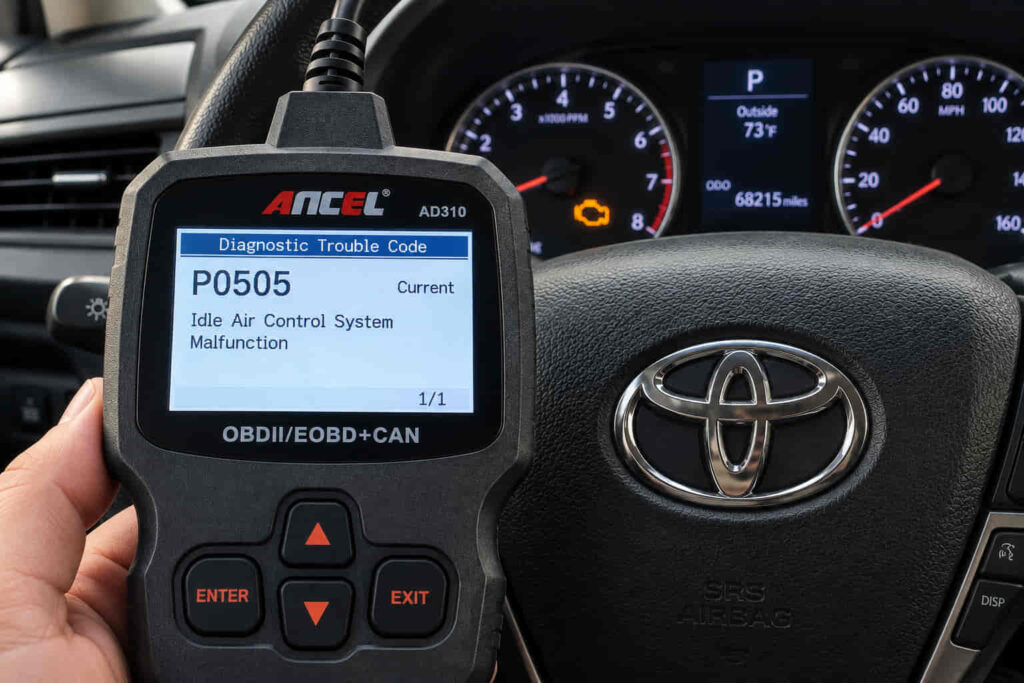
Toyota P0505 is an OBD-II diagnostic trouble code related to a malfunction in the engine’s idle control system. When this code is stored, the engine control module (ECM) has detected a problem with the system responsible for maintaining the correct engine speed while the vehicle is idling. Depending on the Toyota model, model year, engine, and idle-control design, the underlying fault can involve airflow control, the throttle body, an idle air control component, an intake or vacuum leak, electrical wiring, or another problem that prevents the ECM from controlling idle speed correctly.
A Toyota with a P0505 code may develop an abnormally high, low, rough, or unstable idle. More severe idle-control problems can cause the engine to stall, particularly when engine speed drops toward idle. The Check Engine Light may also illuminate when the ECM stores the fault. However, P0505 identifies a problem within the idle-control system; the code alone does not prove that a specific component, such as an idle air control valve, needs replacement.
Diagnosing Toyota P0505 therefore requires identifying what is disrupting idle control before replacing parts. This guide explains what P0505 means, the symptoms and causes associated with the code, how serious the problem can be, how to diagnose it systematically, and which repair should be performed once the actual fault has been confirmed.
Toyota P0505: Meaning, Causes, Symptoms, and Fixes
Toyota P0505 is an OBD-II diagnostic trouble code related to a malfunction in the engine’s idle control system. When this code is stored, the engine control module (ECM) has detected a problem with the system responsible for maintaining the correct engine speed while the vehicle is idling. Depending on the Toyota model, model year, engine, and idle-control design, the underlying fault can involve airflow control, the throttle body, an idle air control component, an intake or vacuum leak, electrical wiring, or another problem that prevents the ECM from controlling idle speed correctly.
A Toyota with a P0505 code may develop an abnormally high, low, rough, or unstable idle. More severe idle-control problems can cause the engine to stall, particularly when engine speed drops toward idle. The Check Engine Light may also illuminate when the ECM stores the fault. However, P0505 identifies a problem within the idle-control system; the code alone does not prove that a specific component, such as an idle air control valve, needs replacement.
Diagnosing Toyota P0505 therefore requires identifying what is disrupting idle control before replacing parts. This guide explains what P0505 means, the symptoms and causes associated with the code, how serious the problem can be, how to diagnose it systematically, and which repair should be performed once the actual fault has been confirmed.
What Does the P0505 Code Mean on a Toyota?
The P0505 code means that a Toyota has detected a malfunction in the idle control system. The idle control system regulates engine speed when the accelerator pedal is not being used, allowing the engine to continue running at an appropriate RPM while the vehicle is stopped or operating under low-load conditions. P0505 indicates that this control process is not functioning as expected; it does not, by itself, identify one failed component.
The engine control module plays a central role in this process because engine idle cannot remain constant under every operating condition. The amount of air required to maintain idle changes as engine load and operating conditions change. When the control system cannot regulate that airflow or maintain the expected idle behavior, the ECM can recognize the abnormal condition and store a diagnostic trouble code associated with idle control.
The hardware used to control idle also differs between Toyota applications. Some engines use an idle air control valve as an important part of idle regulation, while other configurations integrate airflow and idle control differently through the throttle system. This distinction matters during diagnosis because finding P0505 on a scan tool does not automatically mean that an IAC valve is defective or even that the vehicle uses the same idle-control arrangement as another Toyota with the same code.
P0505 should therefore be treated as a system-level diagnostic starting point rather than a component replacement instruction. The correct diagnostic path is to identify why the engine cannot maintain the intended idle condition, then determine whether the cause comes from airflow, an intake leak, throttle-body operation, an applicable idle-control component, wiring, electrical connections, or another fault affecting the system.
What Symptoms Can a Toyota Have With a P0505 Code?
A Toyota with P0505 can have five important symptom patterns: high idle, low idle, rough or unstable idle, engine stalling, and an illuminated Check Engine Light. The exact combination depends on how the idle-control system is malfunctioning. A minor fault may produce little noticeable change beyond the warning light, whereas a larger airflow or control problem can make engine speed difficult to maintain.
High idle occurs when engine speed remains above its intended level after the driver releases the accelerator. This condition can develop when excess air enters the engine or when the system responsible for regulating idle airflow cannot reduce it correctly. The driver may notice that the engine continues to run faster than expected while the vehicle is stationary, making the abnormal idle particularly noticeable after the engine has settled from startup.
Low, rough, or unstable idle represents a different control problem. Instead of remaining at a relatively stable engine speed, RPM can drop too far or fluctuate while the vehicle is stopped. The engine may feel rough because combustion and engine speed are no longer being maintained under a stable idle condition. An airflow restriction, uncontrolled intake air, or a malfunction within the relevant idle-control mechanism can contribute to this behavior, so the symptom alone cannot identify which component requires repair.
Engine stalling is the more serious drivability symptom associated with an idle-control problem. If engine speed falls too low and the control system cannot compensate, the engine can stop running as it approaches idle. This can become apparent when the driver comes to a stop, releases the accelerator, or operates the engine under conditions where the idle-control system needs to compensate for a changing load. Repeated stalling makes diagnosis more urgent because the problem has progressed beyond a stored fault code to an observable loss of engine operation.
The Check Engine Light can illuminate even when the driver notices few other symptoms. In that situation, reading P0505 confirms the area in which the ECM detected a malfunction but does not establish the root cause. The stored code, the actual idle behavior, other diagnostic codes, available operating data, and physical inspection must be considered together. This distinction prevents a common diagnostic error: replacing an idle-control component solely because P0505 appears on an OBD-II scanner.
Read more: Toyota P0456
What Causes the P0505 Code on a Toyota?
Toyota P0505 can be caused by faults that prevent the engine from controlling airflow correctly at idle, including throttle-body contamination, an idle air control system fault, an intake or vacuum leak, and electrical problems affecting the control circuit. The exact cause depends on the Toyota model, model year, engine, and idle-control design. For this reason, P0505 should be diagnosed as an idle-control system fault rather than treated as proof that one particular component has failed.
A dirty throttle body is one possible cause because deposits can interfere with the airflow required to maintain a stable idle. Airflow through the throttle area has a direct effect on engine speed when the accelerator is released. If contamination changes the effective airflow through this area or interferes with normal throttle operation, the ECM may have difficulty maintaining the intended idle condition. Cleaning the throttle body is therefore relevant when inspection confirms significant contamination, but cleaning should not be treated as a universal repair for every Toyota displaying P0505.
The idle air control valve is another potential cause on Toyota applications that use a separate IAC valve for idle regulation. The valve controls bypass air according to the requirements of the engine control system. A valve that sticks, becomes restricted, or cannot respond correctly can result in an idle speed that is too high, too low, or unstable. However, Toyota idle-control designs vary between engines and model years, so the presence of P0505 does not establish that an IAC valve is defective. The vehicle’s specific system configuration must be identified before this component is tested or replaced.
An intake or vacuum leak can also disrupt idle because it allows air to enter the engine through a path the control system does not intend to use. This additional airflow can make the actual idle condition differ from the condition the ECM is attempting to maintain. Vacuum hoses, intake connections, gaskets, and other potential leakage points therefore become relevant diagnostic areas when P0505 appears together with an abnormal idle. A confirmed air leak should be repaired before replacing an idle-control component because the component may simply be responding to an airflow problem created elsewhere in the intake system.
Electrical faults become important when the applicable idle-control hardware cannot communicate or operate correctly. Damaged wiring, poor connector contact, open circuits, short circuits, or related electrical problems can prevent a control component from receiving the required command or supplying the expected response. A technician should therefore inspect the relevant connectors and wiring instead of assuming that an electrically controlled component itself has failed.
The ECM is part of the idle-control process, but it should not be the first component condemned when P0505 is stored. A P0505 code establishes that an idle-control malfunction has been detected; it does not establish that the ECM caused the malfunction. Airflow faults, intake leaks, applicable idle-control components, wiring, connectors, and other system-specific causes should be tested first. This diagnostic order reduces unnecessary parts replacement and connects each repair decision to a verified fault.
How Serious Is the P0505 Code on a Toyota?
Toyota P0505 can range from a moderate fault with few noticeable symptoms to a serious drivability problem when it causes unstable idle or repeated engine stalling. Severity should be determined from the vehicle’s actual behavior rather than from the presence of the diagnostic code alone. A Toyota that maintains a stable idle while displaying only the Check Engine Light presents a different immediate risk from a vehicle that cannot remain running when engine speed falls to idle.
A high or unstable idle requires attention because engine speed is no longer being controlled as intended. The driver may notice excessive RPM while stationary, fluctuating engine speed, roughness, or abnormal behavior when transitioning from acceleration to idle. These symptoms indicate that P0505 is affecting engine operation rather than existing only as a stored diagnostic record. Continued diagnosis is necessary because the same observable symptom can originate from different faults within or around the idle-control system.
Low idle becomes more serious when engine speed approaches the point at which the engine cannot continue running. If the idle-control system cannot compensate for changing airflow or engine load, the engine can stall when the accelerator is released or when the vehicle comes to a stop. Repeated stalling increases the practical risk of driving because the driver may lose engine power unexpectedly during normal vehicle operation.
The Check Engine Light alone does not determine whether P0505 requires an immediate component replacement. It indicates that the ECM has detected and stored an abnormal condition that requires diagnosis. The appropriate response is to evaluate the idle quality, determine whether stalling or other drivability symptoms are present, scan for additional diagnostic trouble codes, and identify the underlying fault before choosing a repair. This approach treats the diagnostic code as evidence of a system problem while avoiding the assumption that the first component associated with idle control must be replaced.
Can You Drive a Toyota With a P0505 Code?
A Toyota with P0505 may remain driveable when the engine maintains a stable idle and no significant drivability symptoms are present, but the vehicle should not be considered safe to continue driving normally if it repeatedly stalls or cannot maintain a predictable idle. The decision depends on how strongly the idle-control malfunction is affecting engine operation.
When the Check Engine Light is the primary symptom and the engine continues to idle consistently, the vehicle may still operate while diagnosis is arranged. This does not mean the code should be ignored. P0505 indicates that the ECM has detected a fault within the idle-control process, and a problem that is initially intermittent or mild can require repair even when the vehicle remains driveable.
Driving becomes more problematic when P0505 causes large RPM fluctuations, excessively high or low idle, hesitation around idle conditions, or repeated stalling. Stalling is particularly important because the engine can shut off as the vehicle slows or stops. A Toyota showing these symptoms should be diagnosed promptly rather than driven normally until the underlying fault is identified.
The safest repair decision therefore comes from the symptoms plus diagnosis, not the P0505 code in isolation. A scan tool identifies the affected diagnostic area, while inspection and testing establish whether the problem originates from airflow, an intake leak, throttle-body condition, the applicable idle-control hardware, an electrical circuit, or another system-specific fault.
How Do You Diagnose the P0505 Code on a Toyota?
Diagnosing Toyota P0505 requires checking the engine’s actual idle condition, related diagnostic trouble codes, intake airflow, throttle body, applicable idle-control components, and electrical circuits before replacing parts. The purpose of diagnosis is to identify why the ECM cannot maintain the expected idle condition. Because P0505 describes an idle-control system malfunction rather than confirming failure of one component, replacing an idle air control valve or throttle-related component immediately can leave the original problem unresolved.
Diagnosis should begin by confirming the stored P0505 code with an OBD-II scan tool and checking whether other diagnostic trouble codes are present. Related codes can change the diagnostic direction because an idle problem may exist alongside another airflow, electrical, or engine-management fault. Available freeze-frame and operating data can also provide context about the conditions under which the ECM detected the malfunction. After recording this information, the engine should be observed at idle to determine whether RPM is high, low, unstable, or sufficiently low to cause stalling.
The intake system should then be inspected for uncontrolled airflow. A vacuum or intake leak can introduce air through a path that interferes with normal idle regulation, so hoses, intake connections, gaskets, and other relevant sealing points should be examined according to the engine configuration. This inspection is particularly important when the engine has a high or unstable idle. Repairing a confirmed leak before evaluating replacement components prevents an airflow problem from being misdiagnosed as a failed idle-control device.
The throttle body is another important diagnostic area because deposits or abnormal throttle operation can affect the airflow available at idle. Its condition should be inspected rather than automatically assuming that cleaning will clear P0505. Visible contamination becomes diagnostically meaningful when it can plausibly interfere with the throttle or idle airflow on the specific engine. If cleaning is appropriate for that Toyota configuration, the correct service procedure should be followed, including any applicable idle or throttle relearn procedure specified for the vehicle.
On Toyota engines equipped with a separate idle air control valve, the IAC system should be tested only after confirming that the vehicle actually uses that design. The objective is to determine whether the valve and its control circuit can regulate bypass airflow as commanded. A restricted or sticking valve can interfere mechanically with airflow, while an electrical fault can prevent an otherwise functional component from operating. These are different failure mechanisms and should not be treated as the same diagnosis simply because both can produce P0505.
Electrical inspection should focus on the wiring and connectors associated with the applicable idle-control system. Loose connections, damaged terminals, corrosion, open circuits, or short circuits can interrupt the electrical path required for a control component to operate correctly. When a wiring defect is confirmed, repairing the circuit is more appropriate than replacing a component that is unable to function only because its electrical supply or control path is defective.
The ECM should become a primary suspect only when the relevant mechanical, airflow, component, and electrical checks support that conclusion. Replacing the ECM without eliminating more direct causes is not a valid first-line repair for Toyota P0505. The diagnostic sequence should establish evidence for each step: confirm the code, characterize the idle problem, inspect for uncontrolled airflow, evaluate the throttle and applicable idle-control hardware, test the electrical circuit, and then investigate control-module faults when the preceding checks do not identify the cause.
A successful diagnosis ends by connecting the observed symptom to a verified failure mechanism. For example, an intake leak must be confirmed as an unintended airflow path, throttle-body contamination must be relevant to airflow or throttle operation, and an electrical problem must be demonstrated in the affected circuit. This evidence-based approach separates diagnosis from parts replacement and determines which repair can actually prevent P0505 from returning.
How Do You Fix the P0505 Code on a Toyota?
Fixing Toyota P0505 requires repairing the specific airflow, idle-control, or electrical fault confirmed during diagnosis rather than replacing a predetermined component. The correct repair can involve correcting an intake or vacuum leak, servicing a contaminated throttle body, repairing wiring or connectors, or repairing or replacing an applicable idle-control component. The required fix depends on the Toyota model, engine, idle-control design, and diagnostic findings.
A confirmed intake or vacuum leak should be repaired at its source because uncontrolled air can prevent the engine-management system from regulating idle correctly. Replacing an idle-control component while an intake leak remains does not remove the airflow fault responsible for the abnormal idle. After the leak is repaired, engine idle should be checked again to determine whether the ECM can maintain the expected operating condition and whether P0505 returns.
Throttle-body service is appropriate when inspection establishes that contamination is interfering with normal airflow or throttle operation. Deposits should be removed using a procedure suitable for the specific throttle-body design rather than assuming that aggressive cleaning is appropriate for every Toyota. The vehicle may also require a specified initialization, idle relearn, or throttle-related procedure after service, depending on its engine-management system. The applicable service information should determine this step because Toyota configurations differ by model and model year.
A defective idle air control component should be repaired or replaced only on Toyota applications that use that component and only after testing supports the diagnosis. A sticking or restricted mechanism represents a different failure from an open circuit, damaged connector, or defective wire. Separating the mechanical component from its electrical control circuit prevents a functional part from being replaced when the actual failure exists elsewhere.
Electrical faults require circuit repair rather than repeated component replacement. Damaged wiring, poor terminal contact, corrosion, an open circuit, or a short circuit can prevent the relevant idle-control hardware from operating as commanded. Once the electrical defect has been corrected, the circuit and engine idle should be retested before the repair is considered complete.
The repair process is finished only when the underlying fault has been corrected and the engine can maintain the intended idle condition. Clearing P0505 without correcting its cause only removes the stored diagnostic information temporarily. A successful Toyota P0505 repair corrects the verified failure mechanism and confirms that the fault does not return after the vehicle is retested.
Does Cleaning the Throttle Body Fix Toyota P0505?
Cleaning the throttle body can fix Toyota P0505 when throttle-body contamination is the confirmed cause of the idle-control malfunction, but it cannot repair every condition that triggers the code. Cleaning is relevant because deposits around the throttle area can alter airflow or interfere with normal throttle operation, which can make stable idle control more difficult.
The diagnostic relationship between contamination and P0505 is more important than the presence of dirt alone. A throttle body can contain deposits while the actual fault originates from an intake leak, electrical problem, idle-control component, or another part of the system. In that situation, cleaning may change idle behavior temporarily without eliminating the condition responsible for the diagnostic trouble code.
Throttle-body cleaning should therefore follow inspection rather than replace diagnosis. When significant contamination is found and its location can affect the airflow or operation relevant to idle, service becomes a justified repair step. The throttle body should be serviced according to the requirements of the specific Toyota configuration, especially when electronic throttle-control components are involved.
Idle behavior should be verified after the service is completed. Some Toyota configurations may require an applicable initialization or relearn procedure following throttle-related service, while others may use a different strategy. The correct procedure should be determined from vehicle-specific service information rather than applied universally to every Toyota with P0505.
If P0505 returns after appropriate throttle-body service, further diagnosis is required. The returning code indicates that cleaning alone did not eliminate the detected idle-control malfunction, so intake leakage, applicable idle-control hardware, wiring, connectors, and other relevant causes must remain within the diagnostic path.
Should You Replace the Idle Air Control Valve for Toyota P0505?
You should replace an idle air control valve for Toyota P0505 only when the vehicle uses a separate IAC valve and diagnostic testing confirms that the valve has failed. P0505 identifies an idle-control system malfunction; it does not state that the IAC valve itself is defective.
This distinction is important because Toyota used different idle-control designs across vehicles, engines, and model years. A diagnostic approach that assumes every Toyota P0505 requires the same IAC repair ignores differences in engine-management architecture. The vehicle’s configuration should first establish which component controls idle airflow and how that component is intended to operate.
An IAC-related problem can also originate outside the valve itself. A restricted airflow passage can affect mechanical operation, while damaged wiring or a poor connector can prevent electrical operation. An intake leak can create an abnormal idle even when the valve functions correctly. Replacing the IAC valve in these situations leaves the actual failure mechanism in place.
Testing should therefore establish whether the component can perform its intended function and whether its electrical circuit is intact before replacement. If testing confirms a failed IAC valve, replacement becomes a repair supported by diagnostic evidence. If testing shows that the valve functions correctly, diagnosis should continue toward the airflow, intake, wiring, connector, or other system condition responsible for P0505.
This approach also prevents unnecessary parts replacement. The correct component to replace is the component proven defective during diagnosis, not simply the component most commonly associated with the name of the trouble code.
How Do You Clear a P0505 Code After Repairing a Toyota?
Clear Toyota P0505 only after the fault responsible for the idle-control malfunction has been repaired, then verify that the engine maintains a stable idle and the code does not return. Erasing the diagnostic trouble code with an OBD-II scan tool removes stored fault information from the ECM, but it does not repair an intake leak, contaminated throttle body, defective idle-control component, damaged circuit, or other condition that originally caused P0505.
Before clearing the code, the completed repair should correspond to the fault identified during diagnosis. If an intake leak was confirmed, the leak should be corrected and the intake system checked again. If throttle-body contamination affected operation, the throttle body should be serviced using a procedure appropriate for that Toyota. If testing identified an electrical or idle-control component fault, the affected circuit or component should be repaired before the stored code is erased. This sequence makes code clearing the verification stage of the repair rather than a substitute for repair.
After the repair, P0505 can be cleared with a compatible scan tool when appropriate for the vehicle. The engine should then be started and allowed to reach the conditions needed to evaluate idle quality. Actual behavior matters at this stage: RPM should remain appropriately controlled instead of becoming excessively high, dropping toward a stall, or fluctuating abnormally. Any vehicle-specific initialization, throttle, or idle relearn procedure required after the repair should be performed according to the applicable Toyota service information.
The vehicle should then be retested under operating conditions that previously produced the symptom. If the engine formerly stalled as it returned to idle, for example, verification should establish that it now transitions to idle without stalling. The scan tool should also be used to check for returning or pending diagnostic trouble codes. A Check Engine Light that remains off immediately after codes are erased does not by itself prove that the fault has been repaired because the ECM may need additional operating time before it can detect the condition again.
Toyota P0505 is successfully repaired when the underlying fault has been corrected, idle control operates normally, and subsequent testing does not reproduce the malfunction. If P0505 returns, the diagnostic process should continue instead of repeatedly clearing the code. A returning code indicates that the ECM is still detecting an idle-control problem or that the original diagnosis did not account for every relevant fault.
How Can You Prevent the P0505 Code From Returning?
Preventing Toyota P0505 from returning requires maintaining the components and connections that affect idle airflow and correcting developing idle problems before they become persistent faults. There is no single maintenance procedure that guarantees P0505 will never recur because the code can originate from different mechanical, airflow, and electrical conditions. Prevention should therefore focus on the failure mechanism identified on the specific vehicle.
The intake system should remain sealed because unintended airflow can interfere with the ECM’s ability to maintain the intended idle condition. Aging or damaged hoses, deteriorated connections, and other intake sealing problems should be addressed when they are discovered rather than waiting for a persistent high, low, or unstable idle to develop. When an intake leak caused the original P0505, checking the repaired area during future service provides a direct preventive connection to the previous failure.
Throttle-body condition also deserves attention when contamination was relevant to the original diagnosis. Deposits that interfere with airflow or throttle operation should be addressed using a service method suitable for the vehicle rather than through unnecessary cleaning at arbitrary intervals. This distinction matters because preventive maintenance should respond to the engine’s design and actual condition, not assume that every P0505 originates from throttle-body deposits.
Electrical connections should be protected from conditions that create intermittent control problems. Wiring damage, loose or damaged terminals, corrosion, and poor connector contact can interrupt operation of electrically controlled engine-management components. An intermittent circuit problem may disappear during one inspection and return later, so previously repaired wiring and connectors should receive particular attention if the same idle symptoms reappear.
Changes in engine idle provide an early reason to investigate the system. A Toyota that begins idling consistently higher or lower than expected, fluctuates at idle, runs roughly, or approaches a stall is displaying information that can be evaluated before the condition becomes more disruptive. Scanning the vehicle and diagnosing the symptom at this stage can identify an airflow, control, or electrical problem without waiting for repeated stalling or another persistent P0505 event.
The most effective way to prevent repeated P0505 repairs is to preserve the connection between symptom, diagnosis, and verified cause. Throttle-body cleaning should follow evidence of a relevant throttle-body condition, an IAC valve should be replaced only when the vehicle uses one and testing confirms failure, and electrical components should be repaired when circuit testing identifies the defect. This evidence-based repair process reduces both unnecessary parts replacement and the likelihood that an unresolved idle-control fault will trigger Toyota P0505 again.