Have you noticed the AC light in your Toyota blinking unexpectedly while driving? If so, you are not alone. Many Toyota owners experience this issue and immediately wonder whether it is a minor electrical glitch or a warning sign of a more expensive air conditioning problem. In some cases, the air conditioner may continue to work normally, while in others, the system may stop producing cold air altogether.
A blinking AC light is Toyota’s way of alerting the driver that the air conditioning system has detected an abnormal condition. The underlying cause can range from a faulty relay or wiring issue to refrigerant pressure problems, sensor malfunctions, or even a failing AC compressor. Ignoring the warning may lead to reduced cooling performance and potentially higher repair costs in the future.
The good news is that not every blinking AC light requires an expensive repair. With a basic understanding of how the system works and a structured diagnostic approach, many issues can be identified quickly and accurately.
In this guide, you will learn the most common causes of a Toyota AC light blinking, how to diagnose the problem step by step, possible DIY fixes, and the repair costs you can expect before visiting a mechanic. Whether you drive a Corolla, Camry, RAV4, Tacoma, or Highlander, this article will help you get your air conditioning system back to normal.
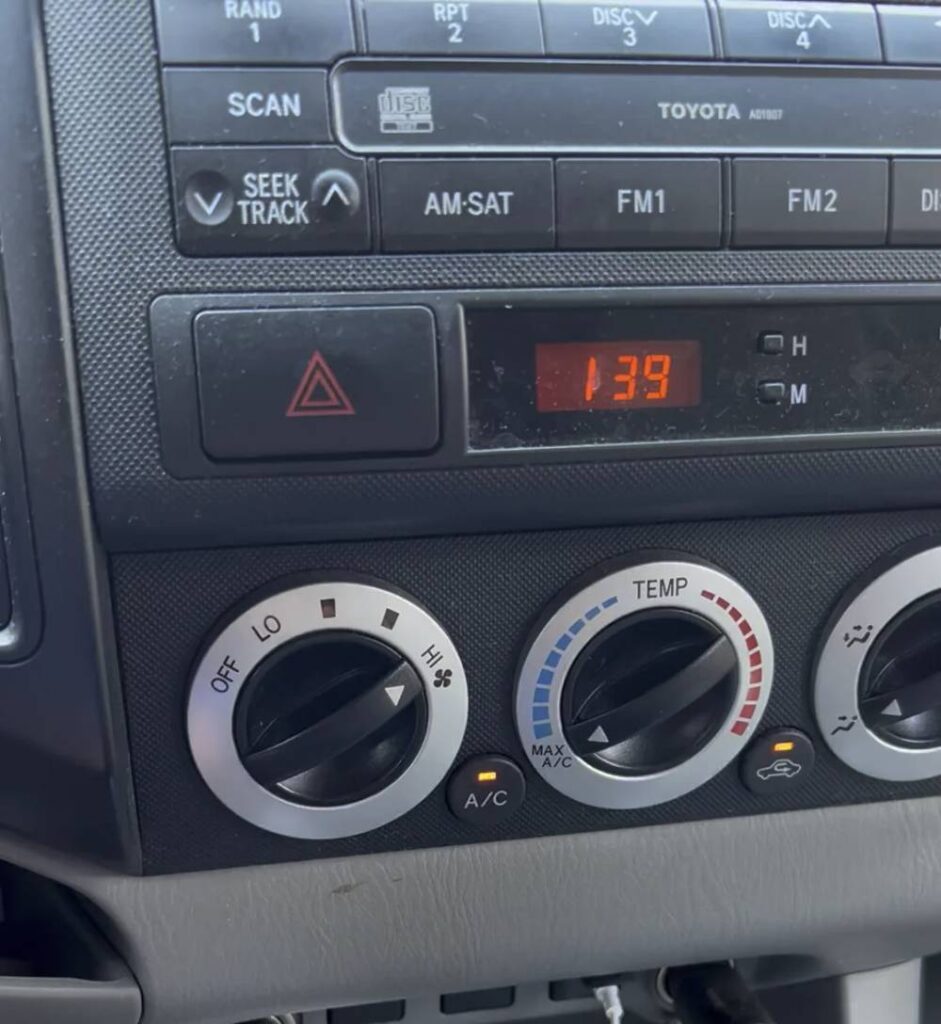
What Does a Blinking Toyota AC Light Mean?
A blinking AC light is not simply an indicator that something is wrong with the air conditioning system. In many Toyota vehicles, it serves as a built in diagnostic warning designed to alert drivers when the system detects an abnormal operating condition.
Toyota’s air conditioning system continuously monitors several components, including the compressor, magnetic clutch, refrigerant pressure sensors, and electrical circuits. When the system notices a mismatch between expected and actual operating conditions, it may trigger the AC light to blink as a warning.
One of the most common reasons for this warning involves a discrepancy between compressor speed and engine speed. The vehicle’s control system expects the compressor to operate within a specific range. If the compressor clutch slips, fails to engage properly, or the compressor itself develops internal issues, the system may interpret this as a malfunction and activate the blinking light.
Unlike a solid AC indicator, which simply shows that the air conditioner is turned on, a blinking light typically signals that the system has detected a fault and may reduce or disable cooling performance to prevent further damage.
Understanding this warning is important because it often appears before a complete system failure occurs. Addressing the issue early can help prevent more extensive repairs and keep your cabin comfortable during hot weather.
Cause #1: Faulty AC Compressor Clutch
One of the most common causes of a Toyota AC light blinking is a failing AC compressor clutch. The compressor clutch plays a critical role in the air conditioning system by engaging and disengaging the compressor when cooling is needed.
When you turn on the air conditioner, the clutch receives an electrical signal that allows it to connect the compressor to the engine’s drive belt. This process enables the compressor to circulate refrigerant throughout the system and produce cold air.
Over time, the clutch can wear out due to heat, friction, and repeated engagement cycles. As the clutch deteriorates, it may begin slipping or fail to engage consistently. When this happens, the vehicle’s control system may detect abnormal compressor operation and trigger the blinking AC light.
Several symptoms often accompany a failing compressor clutch. Drivers may notice intermittent cooling, warm air coming from the vents, unusual clicking sounds when the AC is activated, or cooling performance that changes unpredictably while driving.
Many vehicle owners assume the entire compressor has failed when they see a blinking AC light. However, in numerous cases, the problem is isolated to the clutch assembly. Repairing the clutch early can often be significantly less expensive than replacing the entire compressor unit.
Prompt diagnosis is important because continued operation with a slipping clutch can place additional stress on the compressor and eventually lead to more costly damage.
Cause #2: Bad AC Compressor
A failing AC compressor is another major reason why a Toyota AC light may begin blinking. The compressor is often referred to as the heart of the air conditioning system because it is responsible for circulating refrigerant and maintaining the pressure needed for effective cooling.
As compressors age, internal components can wear out due to normal use. Bearings may deteriorate, valves can become damaged, and internal seals may fail. In severe cases, the compressor can seize completely, preventing refrigerant from moving through the system.
When the compressor does not operate correctly, Toyota’s climate control system may detect irregular compressor speed or pressure fluctuations. As a protective measure, the system can trigger the blinking AC light to alert the driver to a potential problem.
Common signs of compressor failure include a complete loss of cold air, loud grinding or squealing noises, visible oil leaks around the compressor housing, and a compressor clutch that repeatedly engages and disengages.
In some situations, a damaged compressor can release metal debris into the refrigerant lines. This contamination can spread throughout the air conditioning system and increase repair costs because additional components may need replacement.
While compressor replacement is one of the more expensive AC repairs, addressing the issue quickly can help prevent further damage and restore reliable cooling performance. A professional diagnosis is often necessary to confirm whether the compressor itself is failing or if another component is causing the blinking AC light.
Cause #3: Defective AC Relay
A defective AC relay is one of the simplest yet most frequently overlooked causes of a blinking Toyota AC light. The relay functions as an electrical switch that controls power delivery to the air conditioning compressor. When the AC system is activated, the relay receives a signal from the vehicle’s control module and allows electrical current to reach the compressor clutch.
Over time, relays can wear out due to repeated switching cycles, heat exposure, moisture intrusion, or internal electrical failures. When a relay begins to fail, it may intermittently interrupt power to the compressor. As a result, the compressor may engage and disengage unexpectedly, causing the air conditioning system to operate inconsistently.
Drivers often notice symptoms such as intermittent cooling, warm air from the vents, or a compressor that fails to activate even though the AC button is illuminated. In some Toyota models, these irregular operating conditions can trigger the AC warning light to blink.
Fortunately, relay problems are usually inexpensive to diagnose and repair. In many cases, owners can perform a simple relay swap test by exchanging the AC relay with another identical relay from the vehicle’s fuse box. If the problem disappears after the swap, the faulty relay is likely the cause.
Because relays are relatively inexpensive compared to compressors or climate control modules, checking them early in the diagnostic process can save both time and money.
Cause #4: Electrical or Wiring Problems
Modern Toyota air conditioning systems rely on a network of sensors, connectors, control modules, and wiring harnesses. Even a minor electrical problem can interfere with communication between components and trigger a blinking AC light.
Electrical issues can develop for several reasons. Wiring may become damaged due to vibration, age, rodent activity, previous repair work, or exposure to extreme temperatures. Connectors can loosen over time, while moisture and corrosion may create resistance that disrupts electrical signals.
When the system receives inconsistent information from sensors or loses communication with key components, it may interpret the situation as a malfunction. This can cause the AC light to blink and, in some cases, disable compressor operation as a protective measure.
Common symptoms associated with wiring problems include intermittent AC performance, unpredictable cooling, warning lights that appear and disappear, and compressor engagement issues. Because electrical faults can mimic many other air conditioning problems, they are often difficult to identify without proper testing.
A visual inspection is usually the first step. Check for damaged wires, loose connectors, corrosion, or signs of overheating around electrical connections. Technicians may also use a multimeter to verify voltage levels, continuity, and ground integrity throughout the system.
Addressing electrical issues promptly is important because minor wiring faults can eventually lead to larger system failures if left unresolved.
Cause #5: Low or Incorrect Refrigerant Pressure
Refrigerant pressure plays a critical role in the performance of any automotive air conditioning system. Toyota vehicles are designed to operate within a specific pressure range, and deviations from that range can trigger a blinking AC light.
Low refrigerant pressure is often caused by leaks in hoses, seals, condensers, evaporators, or other system components. Even a small leak can gradually reduce refrigerant levels over time, leading to poor cooling performance and abnormal pressure readings.
On the other hand, excessive refrigerant can be just as problematic. Some vehicle owners attempt to recharge their air conditioning systems without proper diagnostic equipment, which may result in overcharging. Excessive pressure can strain system components and cause the control module to detect abnormal operating conditions.
When pressure falls outside acceptable limits, pressure sensors send warning signals to the vehicle’s climate control system. The system may then activate the blinking AC light to alert the driver and prevent potential damage to the compressor.
Symptoms of refrigerant pressure problems often include weak airflow, reduced cooling efficiency, fluctuating vent temperatures, and unusual compressor cycling. In severe cases, the air conditioner may stop cooling entirely.
It is important to understand that simply adding refrigerant is not always the correct solution. If a leak exists, adding more refrigerant without repairing the underlying problem will only provide temporary relief. Accurate diagnosis using professional pressure gauges and leak detection equipment is essential for identifying the true source of the issue and restoring proper system performance.
Cause #6: AC Control Module or Sensor Failure
Toyota air conditioning systems depend on multiple sensors and electronic control modules to maintain optimal cooling performance. These components constantly monitor temperature, refrigerant pressure, compressor operation, and various system parameters. When one of these sensors or modules fails, the AC system may no longer receive accurate information, leading to a blinking AC light.
Common sensors involved in air conditioning operation include refrigerant pressure sensors, evaporator temperature sensors, ambient temperature sensors, and cabin temperature sensors. If any of these components begin sending incorrect readings, the control module may interpret the situation as a fault and activate a warning.
For example, a faulty pressure sensor may falsely indicate dangerously high or low refrigerant pressure even when the system is operating normally. Similarly, a malfunctioning temperature sensor may cause the climate control system to make incorrect adjustments, resulting in poor cooling performance and system warnings.
In some cases, the climate control module itself may develop software or hardware issues. Electrical surges, moisture intrusion, aging components, or internal circuit failures can all contribute to module malfunction.
Drivers experiencing sensor or module problems may notice inconsistent cooling, sudden temperature changes, intermittent AC operation, or a blinking AC light that appears without any obvious mechanical issue. Because these problems are often difficult to identify through visual inspection alone, professional diagnostic equipment is typically required.
An OBD-II scanner capable of accessing HVAC-related data can help technicians identify stored fault codes and pinpoint the exact component responsible for the problem. Early diagnosis can prevent unnecessary parts replacement and reduce overall repair costs.
Cause #7: Recent Battery Disconnection or System Reset Issues
Some Toyota owners notice a blinking AC light shortly after replacing the battery, disconnecting battery terminals, or performing electrical repairs. While this situation can be alarming, it does not always indicate a major mechanical problem.
Many modern Toyota vehicles rely on electronic control modules that store calibration data and learned operating parameters. When battery power is interrupted, these modules may temporarily lose stored information and require a relearning process before normal operation can resume.
Following a battery replacement, the climate control system may need to recalibrate sensor readings, compressor operation, and other system settings. During this adjustment period, the AC light may blink even though no actual component failure exists.
In some cases, a simple reset procedure can resolve the issue. This may involve turning the ignition on and off, allowing the system to complete its initialization process, or using a diagnostic scan tool to clear stored fault codes. The exact procedure varies depending on the Toyota model and year.
However, if the blinking light persists after the system has had sufficient time to recalibrate, further diagnosis may be necessary. A battery replacement can occasionally expose pre-existing electrical weaknesses, such as failing relays, poor connections, or weak sensors that were already nearing failure.
Understanding the relationship between battery disconnection and climate control system behavior can help owners avoid unnecessary repairs while ensuring that genuine faults are not overlooked.
How to Diagnose a Toyota AC Light Blinking Step by Step
Diagnosing a blinking Toyota AC light becomes much easier when a systematic approach is followed. Rather than immediately replacing parts, it is important to identify the root cause before investing time and money into repairs.
The first step is to evaluate cooling performance. Turn on the air conditioning system and observe whether cold air is being produced. If the cabin cools normally, the issue may be related to sensors, relays, or electrical controls rather than a major compressor failure.
Next, inspect compressor operation. With the engine running and the AC activated, observe whether the compressor clutch engages properly. Frequent cycling, slipping, or failure to engage may indicate clutch or compressor issues.
The third step involves checking the AC relay. A relay swap test using an identical relay from the fuse box can quickly determine whether the relay is causing intermittent compressor operation.
Afterward, refrigerant pressure should be inspected using appropriate gauges. Low or excessive pressure can trigger system warnings and significantly affect cooling performance.
The fifth step is scanning the vehicle for diagnostic trouble codes. Modern scan tools can often reveal valuable information about sensor failures, communication issues, and control module faults that may not be visible during a physical inspection.
Next, examine wiring and electrical connectors throughout the air conditioning system. Look for loose connections, corrosion, damaged insulation, or signs of overheating.
If no obvious cause is identified after completing these steps, professional diagnosis may be required. Specialized equipment can evaluate compressor efficiency, sensor accuracy, refrigerant flow, and module communication in greater detail.
By following a structured diagnostic process, vehicle owners can avoid unnecessary part replacements and significantly increase the likelihood of identifying the true cause of a blinking Toyota AC light.
How to Reset a Blinking Toyota AC Light
After diagnosing and addressing the underlying cause, many Toyota owners want to know how to reset the blinking AC light. It is important to understand that a reset alone will not permanently solve the problem if a fault still exists. The warning light will typically return if the system continues to detect abnormal conditions.
One common reset method involves disconnecting the vehicle’s battery. Start by turning off the engine and removing the negative battery terminal. Leave the battery disconnected for approximately 10 to 15 minutes to allow the vehicle’s electronic control modules to fully power down. Reconnect the battery, start the engine, and test the air conditioning system. In some cases, the blinking light may disappear if the issue was related to temporary system memory or calibration data.
Another method involves inspecting and resetting the relevant air conditioning fuse. A blown or partially damaged fuse can create electrical irregularities that affect AC operation. Replace any damaged fuse with one that matches the manufacturer’s specifications and verify whether the warning light clears.
For vehicles equipped with advanced diagnostic capabilities, a scan tool may be used to clear stored fault codes. This approach is often the most effective because it removes fault information directly from the control module while also providing insight into the original cause of the warning.
If the AC light begins blinking again shortly after the reset, additional diagnosis is necessary. The warning system is designed to identify genuine operating issues, and repeated warnings should never be ignored.
Toyota AC Light Blinking Repair Cost
The cost of repairing a blinking Toyota AC light can vary significantly depending on the root cause, vehicle model, labor rates, and local repair market conditions. Some issues require only minor electrical repairs, while others involve replacing major air conditioning components.
A faulty relay is typically one of the least expensive repairs. Replacement parts are inexpensive, and labor requirements are minimal. In many cases, the total repair cost remains well below one hundred dollars.
Refrigerant-related repairs can vary depending on whether the system simply requires recharging or has an active leak. Leak detection, component replacement, and refrigerant recharging may increase overall expenses.
Sensor replacement costs generally fall within the moderate range. The exact price depends on sensor location, accessibility, and the complexity of the diagnosis process.
Compressor clutch repairs can be more expensive because they often require partial disassembly of the air conditioning system. However, replacing only the clutch assembly is usually less costly than replacing the entire compressor.
When the compressor itself fails, repair costs increase substantially. In addition to the compressor, technicians may need to replace related components, flush contaminated refrigerant lines, and recharge the system.
The following estimates provide a general overview of common repair expenses:
| Repair Type | Estimated Cost |
|---|---|
| AC Relay Replacement | $20 to $100 |
| Refrigerant Recharge | $100 to $300 |
| Sensor Replacement | $100 to $500 |
| Compressor Clutch Repair | $250 to $800 |
| AC Compressor Replacement | $800 to $2,000+ |
These figures are intended as general estimates. Actual repair costs may differ based on vehicle age, location, and parts availability.
Frequently Asked Questions
Why is my Toyota AC light blinking but the air conditioner still works?
A blinking AC light does not always indicate complete system failure. In many cases, the vehicle detects an abnormal condition before cooling performance is affected. Early-stage compressor clutch wear, sensor issues, relay problems, or electrical faults can trigger the warning while the system continues to produce cold air.
Can I continue driving with a blinking AC light?
Yes, the vehicle can usually be driven safely. However, the air conditioning system should be inspected as soon as possible. Ignoring the warning may allow minor issues to develop into more expensive repairs, particularly if the compressor or clutch is involved.
Does a blinking AC light always mean the compressor is bad?
No. Although compressor-related problems are common, many other issues can trigger the warning. Faulty relays, refrigerant pressure problems, damaged wiring, sensor failures, and control module issues can all produce similar symptoms.
How do I know if the compressor clutch is failing?
Common signs include intermittent cooling, clicking noises when the AC is activated, frequent compressor cycling, and a blinking AC light. A visual inspection may reveal that the clutch is slipping or failing to engage properly.
Can low refrigerant cause the AC light to blink?
Yes. Low refrigerant pressure is one of the most common causes of AC system warnings. Leaks or insufficient refrigerant levels can trigger pressure-related fault conditions that activate the blinking light.
Which Toyota models commonly experience this issue?
The problem has been reported across a wide range of Toyota vehicles, including the Corolla, Camry, RAV4, Highlander, Tacoma, Tundra, Prius, and several Lexus models that share similar air conditioning system components.
Conclusion
A Toyota AC light blinking should never be dismissed as a harmless inconvenience. While the issue may be caused by something as simple as a faulty relay, temporary electrical interruption, or low refrigerant pressure, it can also signal developing compressor or clutch problems that may become significantly more expensive if left unresolved.
The key to avoiding unnecessary repairs is accurate diagnosis. By understanding how Toyota’s air conditioning system operates and following a logical troubleshooting process, vehicle owners can identify potential problems early and make informed repair decisions. Checking compressor operation, inspecting relays, verifying refrigerant pressure, scanning for fault codes, and examining electrical connections are all valuable steps that can help pinpoint the root cause.
In many cases, early intervention can restore normal cooling performance while preventing further damage to the system. Whether you choose to perform basic inspections yourself or seek professional assistance, addressing a blinking AC light promptly is the best way to maintain comfort, reliability, and long term air conditioning performance.
If your Toyota AC light is blinking, start with the diagnostic steps outlined in this guide and take action before a minor warning develops into a major repair bill.