Have you recently seen a “Drive-Start Control Malfunction” warning appear on your Toyota’s dashboard? If so, you’re probably wondering whether it’s safe to continue driving, how serious the problem is, and how much it might cost to repair.
This warning can be alarming, especially when it appears unexpectedly during your daily commute or a long road trip. Many drivers immediately fear expensive repairs, engine failure, or a breakdown on the road. Fortunately, a Drive-Start Control Malfunction does not always indicate a major mechanical issue. In many cases, the warning can be triggered by a weak battery, faulty sensors, software glitches, or communication errors between vehicle systems.
Toyota’s Drive-Start Control system is designed to help prevent unintended acceleration by monitoring driver inputs and vehicle conditions. When the system detects abnormal data or a potential safety concern, it may activate a warning message to alert the driver.
In this guide, you’ll learn exactly what a Drive-Start Control Malfunction means, the most common causes behind the warning, how to diagnose the issue, and the most effective solutions to get your vehicle back to normal. Whether you’re driving a Toyota Camry, Corolla, RAV4, Highlander, or Prius, this article will help you understand the problem and take the right next steps.
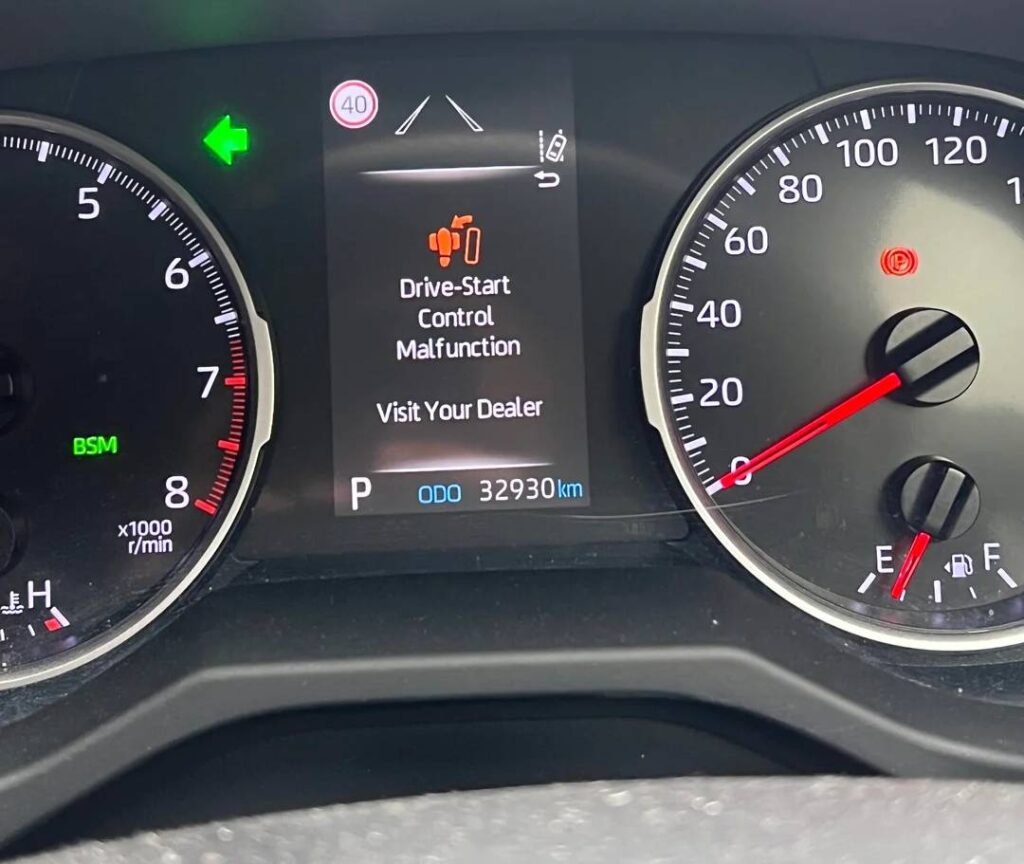
What Is Drive-Start Control Malfunction?
The Drive-Start Control system is a safety feature developed by Toyota to reduce the risk of unintended acceleration. It continuously monitors various inputs, including accelerator pedal position, brake operation, transmission status, and engine performance. By analyzing these signals, the system helps ensure that the vehicle responds appropriately to driver commands.
When the vehicle detects an abnormal condition within this system or receives conflicting data from related components, it may display a “Drive-Start Control Malfunction” warning message on the dashboard. This warning indicates that the system can no longer guarantee normal operation and requires inspection.
Many drivers assume that the warning means the Drive-Start Control system itself has failed. In reality, the message often appears because another component has developed a fault. A weak battery, faulty throttle body, damaged sensor, or engine management issue can all trigger the warning.
The Drive-Start Control system is commonly found in modern Toyota vehicles, including the Toyota Camry, Corolla, RAV4, Highlander, Prius, Tacoma, and several Lexus models. Because the system communicates with multiple vehicle control modules, even a minor electrical issue can sometimes generate a warning.
While the vehicle may continue to operate normally, the warning should never be ignored. Diagnosing the underlying cause early can help prevent more expensive repairs and ensure that important safety systems continue to function correctly.
Signs and Symptoms of a Drive-Start Control Malfunction
The most obvious symptom is the appearance of a warning message on the instrument cluster or infotainment display. In some vehicles, the message may appear alone, while in others it may be accompanied by additional warning lights.
One of the most common accompanying indicators is the Check Engine Light. When both warnings appear simultaneously, the problem is often related to the engine management system, emissions components, or sensor failures. Reading the diagnostic trouble codes stored in the vehicle’s computer can provide valuable clues about the root cause.
Some drivers also notice changes in vehicle performance. The engine may feel less responsive during acceleration, or the transmission may not shift as smoothly as usual. In certain situations, the vehicle can enter a protective mode commonly known as “limp mode.” This safety feature limits engine power to reduce the risk of further damage.
Other symptoms may include rough idling, hesitation during acceleration, unexpected engine vibrations, or intermittent warning messages that appear and disappear. If the issue is related to electrical components, drivers may experience multiple dashboard warnings at the same time.
Paying attention to these symptoms can help narrow down the possible causes and make diagnosis faster and more accurate. The sooner the issue is identified, the lower the risk of additional damage to related vehicle systems.
Common Causes of Drive-Start Control Malfunction
Several different issues can trigger a Drive-Start Control Malfunction warning, ranging from simple electrical problems to more complex engine management faults.
A weak or failing battery is one of the most common causes. Modern Toyota vehicles rely heavily on stable voltage levels for communication between control modules. When battery voltage drops below normal levels, various systems may begin reporting errors.
Battery replacement can also trigger the warning. After a battery change, some vehicle systems may require recalibration or a relearning procedure before they can function correctly again.
Faulty accelerator pedal sensors are another frequent culprit. Since the Drive-Start Control system monitors throttle input, inaccurate sensor readings can cause the vehicle to detect a potential safety issue. Similarly, problems with the throttle body or throttle position sensor can generate warning messages.
Engine-related faults often contribute as well. Misfires, mass airflow sensor failures, oxygen sensor problems, and fuel system issues can all affect how the engine control module interprets vehicle operation. As a result, the Drive-Start Control system may activate a warning as a precaution.
Electrical wiring problems should not be overlooked. Corroded connectors, damaged wires, loose terminals, or moisture intrusion can interrupt communication between vehicle systems. Even a small wiring defect can create intermittent faults that are difficult to diagnose.
In more serious cases, software errors or failures within the Engine Control Unit (ECU) may be responsible. Although less common, outdated software or internal ECU faults can interfere with system communication and trigger the warning message.
Understanding these potential causes is the first step toward identifying the correct repair solution and avoiding unnecessary replacement of expensive components.
Is It Safe to Drive With a Drive-Start Control Malfunction?
The answer depends on the underlying cause of the warning and how the vehicle behaves after the message appears. In some situations, the warning may be caused by a minor electrical issue, such as low battery voltage or a temporary communication error between control modules. If the vehicle starts normally, accelerates smoothly, and shows no other warning lights, it may be possible to drive cautiously for a short distance while arranging a proper inspection.
However, drivers should never assume the warning is harmless. Because the Drive-Start Control system is linked to critical safety and engine management functions, the warning can sometimes indicate a more serious problem. If the vehicle experiences reduced power, rough idling, hesitation, transmission issues, or unexpected changes in acceleration, continued driving could increase the risk of mechanical damage or unsafe operating conditions.
Extra caution is required if the Check Engine Light is flashing rather than remaining steadily illuminated. A flashing Check Engine Light often indicates an active engine misfire that could damage the catalytic converter if ignored. In this situation, the vehicle should be stopped as soon as it is safe to do so, and professional assistance should be sought.
Drivers should also avoid long trips, heavy towing, or aggressive acceleration while the warning is active. Even if the vehicle appears to operate normally, hidden issues may worsen over time and lead to more expensive repairs.
The safest approach is to diagnose the problem as soon as possible. Early detection can prevent minor faults from developing into major repairs while ensuring that important safety systems continue to function as designed.
How to Fix a Drive-Start Control Malfunction
Fixing a Drive-Start Control Malfunction begins with identifying the exact cause rather than replacing parts at random. Since the warning can be triggered by multiple systems, a structured diagnostic approach is essential.
The first step is to check the battery condition. Low voltage is responsible for a surprising number of dashboard warnings in modern vehicles. Inspect the battery terminals for corrosion, ensure all connections are tight, and test the battery’s voltage. If the battery is weak or nearing the end of its service life, replacing it may resolve the issue.
Next, restart the vehicle and observe whether the warning returns. Temporary software glitches can occasionally trigger false alerts, and a simple restart may clear them. If the warning persists, further diagnosis is required.
Using an OBD-II scanner is one of the most effective ways to identify the source of the problem. Diagnostic trouble codes stored in the vehicle’s computer can reveal whether the issue is related to the engine, throttle system, sensors, transmission, or electrical components. Recording these codes before clearing them is important because they provide valuable information during troubleshooting.
The accelerator pedal sensor and throttle body should also be inspected. Dirt buildup, wear, or sensor failure can interfere with accurate throttle input readings. Cleaning the throttle body and verifying sensor operation may resolve the warning in some cases.
Technicians should also inspect wiring harnesses, connectors, and ground points throughout the vehicle. Loose connections, corrosion, and damaged wiring can create communication errors between control modules.
If no hardware issues are found, a software update may be necessary. Toyota periodically releases updates that address system bugs and communication issues. An authorized service center can determine whether updated software is available for the vehicle.
When the warning remains active despite these checks, professional diagnosis is strongly recommended. Advanced diagnostic equipment may be required to identify ECU faults, module communication errors, or other complex problems.
Repair Costs and Prevention Tips
The cost of repairing a Drive-Start Control Malfunction varies significantly depending on the root cause. Simple issues can often be resolved quickly and inexpensively, while major electronic failures may require substantial investment.
If the problem is caused by a weak battery, repair costs are generally limited to battery testing or replacement. Cleaning battery terminals or resetting vehicle systems may cost very little compared to more complex repairs.
Sensor-related issues typically fall into the moderate repair category. Replacing an accelerator pedal position sensor, throttle position sensor, or mass airflow sensor usually costs less than replacing major control modules. Labor costs will vary based on vehicle model and local service rates.
Electrical repairs can become more expensive if technicians must trace damaged wiring hidden within the vehicle. The time required to locate intermittent faults often contributes significantly to the total repair bill.
In rare cases where the Engine Control Unit requires replacement or reprogramming, repair costs can increase substantially. Because the ECU controls many essential vehicle functions, replacement often involves specialized programming procedures and security system synchronization.
Preventive maintenance remains the best defense against Drive-Start Control Malfunction warnings. Regular battery inspections can help identify voltage problems before they affect vehicle electronics. Keeping the engine properly maintained reduces the likelihood of sensor and performance-related faults. Protecting electrical components from moisture and corrosion can also prevent communication issues between control modules.
Drivers should never ignore dashboard warning lights, even when the vehicle appears to operate normally. Addressing small problems early often costs far less than waiting until a failure affects multiple systems. Routine inspections, timely repairs, and adherence to the manufacturer’s maintenance schedule can significantly reduce the likelihood of encountering a Drive-Start Control Malfunction in the future.
Frequently Asked Questions
Can a Drive-Start Control Malfunction go away on its own?
In some cases, yes. If the warning was triggered by a temporary voltage fluctuation, a software communication error, or a recently disconnected battery, the message may disappear after restarting the vehicle or completing a drive cycle. However, if the warning returns repeatedly, the underlying issue should be diagnosed as soon as possible.
Can I reset a Drive-Start Control Malfunction myself?
You may be able to clear the warning using an OBD-II scanner or by addressing the issue that triggered it. Simply clearing the code without fixing the root cause is not recommended because the warning will likely return. Always identify and repair the underlying problem before attempting a reset.
Does a Drive-Start Control Malfunction mean my engine is damaged?
Not necessarily. The warning can be caused by a variety of issues, many of which are unrelated to severe engine damage. Common causes include battery problems, sensor failures, wiring faults, and software glitches. A proper diagnostic scan is required to determine the exact cause.
Can a battery replacement trigger a Drive-Start Control Malfunction?
Yes. Many Toyota owners report seeing the warning after replacing or disconnecting the battery. This can occur because certain control modules temporarily lose stored calibration data. In many cases, the system relearns normal parameters after driving, but some vehicles may require a manual reset or recalibration procedure.
How much does it cost to fix a Drive-Start Control Malfunction?
Repair costs can range from less than $100 for simple battery or sensor-related issues to over $2,000 if major electronic control modules require replacement. The exact cost depends on the vehicle model, labor rates, and the specific component that has failed.
Should I ignore the warning if the car drives normally?
No. Even if the vehicle appears to operate normally, the warning indicates that the system has detected an abnormal condition. Ignoring the problem could allow a minor issue to develop into a more expensive repair and may affect the performance of important safety features.
Conclusion
A Drive-Start Control Malfunction warning can be frustrating and concerning, especially when it appears without any obvious symptoms. While many drivers immediately assume the worst, the reality is that this warning can be triggered by a wide range of issues, from a weak battery and faulty sensors to wiring problems and software-related faults.
Understanding how the Drive-Start Control system works is the first step toward resolving the issue. Because the system is designed to enhance vehicle safety and prevent unintended acceleration, any warning associated with it deserves attention. Fortunately, many of the most common causes can be identified through a systematic diagnostic process that begins with checking battery condition, scanning for trouble codes, and inspecting key sensors and electrical connections.
The most important thing to remember is that the warning itself is not the diagnosis. It is simply an indication that the vehicle has detected an abnormal condition somewhere within its network of interconnected systems. Rather than guessing or replacing parts unnecessarily, vehicle owners should focus on identifying the root cause and performing the appropriate repair.
By following the manufacturer’s maintenance schedule, keeping the battery and electrical system in good condition, and addressing dashboard warnings promptly, drivers can reduce the risk of future problems and maintain reliable vehicle performance. If the warning persists or is accompanied by additional symptoms such as reduced power, rough engine operation, or a flashing Check Engine Light, professional diagnosis should be considered a priority.
Taking action early can save both time and money while helping ensure that your Toyota continues to operate safely, efficiently, and reliably for years to come.