Tire rotation and wheel alignment are two different tire maintenance services: tire rotation changes the position of the tires on the vehicle, while wheel alignment adjusts the angles of the wheels to match manufacturer specifications. Both services can help manage tire wear, but they address different causes and should not be treated as interchangeable.
Tire rotation moves tires between approved positions, such as from the front axle to the rear axle, to distribute tread wear more evenly across the tire set. This matters because front and rear tires can wear at different rates due to steering, braking, drivetrain layout, vehicle weight distribution, and driving conditions. Wheel alignment does not reposition the tires. Instead, it corrects alignment angles such as camber, caster, and toe when they fall outside the vehicle’s specified range.
The difference becomes important when deciding which service your car needs. Uneven wear between tire positions may indicate that a rotation is due, while vehicle pulling, an off-center steering wheel, or abnormal tread wear can justify an alignment inspection. This guide compares tire rotation vs alignment by purpose, tire wear, warning signs, service frequency, cost, and the situations in which both services may be appropriate.
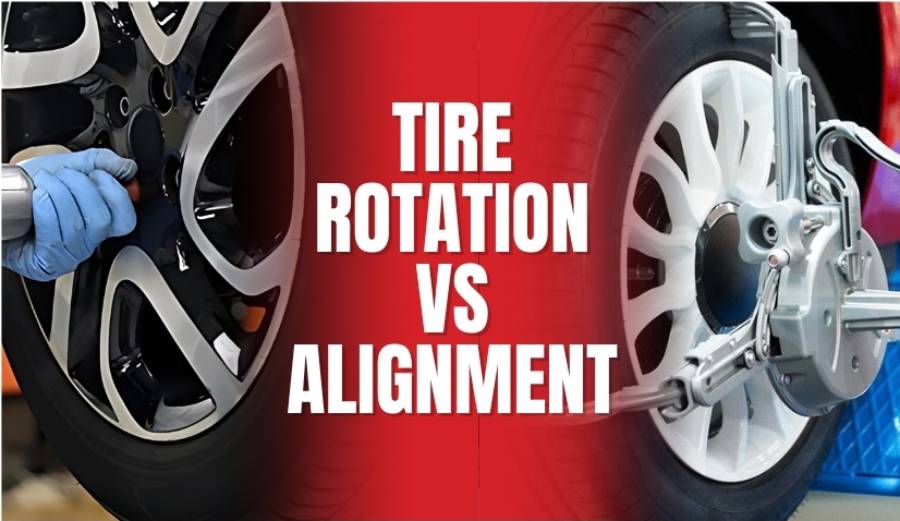
What Is the Difference Between Tire Rotation and Wheel Alignment?
The main difference between tire rotation and wheel alignment is what the service changes: tire rotation changes the position of the tires, while wheel alignment adjusts the angles at which the wheels contact the road. Tire rotation primarily helps distribute tread wear across the tire set. Wheel alignment keeps the wheels positioned according to the vehicle manufacturer’s alignment specifications.
During a tire rotation, a technician moves tires between approved positions on the vehicle. For example, the front tires may move to the rear while the rear tires move to the front, although the correct rotation pattern depends on drivetrain layout, tire type, and wheel configuration. The tires on different axles do not always wear at the same rate because steering, braking, weight distribution, and driven-wheel forces place different loads on them. Changing their positions helps distribute these wear patterns across the set.
A wheel alignment addresses wheel geometry rather than tire position. The service measures and, where applicable, adjusts alignment angles such as camber, caster, and toe against manufacturer specifications. Camber describes the inward or outward tilt of a wheel when viewed from the front. Caster relates to the steering axis when viewed from the side, while toe describes whether the fronts of paired wheels point toward or away from each other. Incorrect alignment can contribute to abnormal tire wear and changes in how the vehicle tracks or steers.
| Factor | Tire Rotation | Wheel Alignment |
|---|---|---|
| What changes? | Tire positions | Wheel alignment angles |
| Primary purpose | Distribute tire wear | Correct wheel geometry |
| Tires repositioned? | Yes | No |
| Common reason for service | Scheduled tire maintenance | Alignment symptoms or specifications |
| Can address tire wear? | Helps distribute wear | Corrects alignment-related causes of wear |
| Steering-related service? | No | Yes |
The two services therefore complement each other but are not substitutes. Rotating tires cannot correct incorrect camber, caster, or toe, and aligning the wheels does not redistribute tires that have spent thousands of miles in the same positions. A vehicle may need only one service or both, depending on its maintenance schedule, tire condition, steering behavior, and alignment measurements.
How Do Tire Rotation and Wheel Alignment Affect Tire Wear?
Tire rotation distributes wear among different tire positions, while wheel alignment corrects wheel geometry that can cause abnormal tread wear. Both services can support longer usable tire life when performed for the correct reason, but they influence tire wear through different mechanisms.
Front and rear tires can experience different loads throughout normal driving. Front tires are involved in steering and commonly handle substantial braking forces, while drivetrain configuration determines which tires transmit engine or motor torque to the road. Vehicle weight distribution and driving conditions add further differences. Regular rotation changes where each tire operates, preventing one position from consistently accumulating wear faster than the others.
Rotation does not, however, repair the underlying geometry of a misaligned wheel. A tire that develops abnormal wear because its wheel is operating outside the specified alignment range can continue wearing incorrectly after being moved to another position. Rotation may change where that tire operates, but it does not correct the alignment condition responsible for the wear.
Wheel alignment addresses this problem by bringing applicable wheel angles back within manufacturer specifications. Correcting an alignment-related cause can help prevent additional abnormal wear, but an alignment cannot restore tread rubber that has already worn away. For example, if a tire has already developed substantial edge wear, correcting the alignment can address the cause without returning the damaged tread to its original depth or shape.
Tire inspection is therefore important when abnormal wear is discovered. The wear pattern, remaining tread depth, tire condition, inflation pressure, alignment measurements, and condition of relevant steering or suspension components can help determine whether the vehicle needs rotation, alignment, another repair, or tire replacement. Rotation manages how wear is distributed; alignment addresses wheel geometry that can contribute to abnormal wear.
What Are the Signs You Need a Tire Rotation?
There are 4 main signs that your tires may be due for rotation: differences in tread wear between tire positions, reaching the recommended rotation interval, faster wear on one axle, and position-related wear identified during a tire inspection. These signs indicate that changing tire positions may help distribute future wear more evenly across the tire set.
Different tread wear between the front and rear tires is one of the clearest reasons to check the rotation schedule. Tires do not experience identical forces at every position. Steering, braking, drivetrain layout, vehicle weight distribution, road conditions, and driving habits can cause tires on one axle to wear faster than those on the other. Rotation changes their operating positions so the same tires do not continuously experience the highest-wear conditions.
Reaching the recommended service interval is another reason to rotate the tires even when obvious wear differences are not yet visible. Tire rotation is primarily preventive maintenance, so waiting for severe uneven wear defeats part of its purpose. The appropriate interval should follow the vehicle manufacturer’s maintenance schedule and applicable tire manufacturer guidance because tire design, drivetrain configuration, and vehicle use can affect rotation requirements.
Faster wear on one axle can also indicate that rotation is due. For example, the tires on the driven or heavily loaded axle may experience different wear rates from tires elsewhere on the vehicle. Rotation can redistribute this exposure when the tire and wheel configuration permits it. Directional tires, staggered wheel setups, and other specialized configurations may require specific rotation patterns or limit which positions can be exchanged.
A tire inspection provides the most useful context for interpreting these signs. Tread depth should be compared across tire positions and across the width of each tire rather than treating every form of uneven wear as a rotation issue. Rotation can manage position-related differences in wear, but it cannot correct alignment problems, improper inflation, damaged suspension components, or an already damaged tire. Identifying the wear pattern helps determine whether rotation alone is appropriate or another service should be investigated.
What Are the Signs You Need a Wheel Alignment?
There are 4 common signs that a vehicle may need an alignment inspection: pulling to one side, an off-center steering wheel while traveling straight, abnormal or rapid tire wear, and a change in steering or tracking after hitting a pothole or curb. These symptoms can occur when wheel alignment angles are outside specification, although an inspection is necessary because steering, suspension, tire, and road conditions can produce similar symptoms.
A vehicle that consistently pulls to one side on a reasonably level road may have an alignment problem. Wheel angles influence how the tires track relative to the vehicle and road surface. When relevant angles differ from their specified values, the vehicle may require steering input to maintain a straight path. Road crown, uneven tire pressure, tire condition, and mechanical problems can also contribute to pulling, so pulling alone does not confirm misalignment.
An off-center steering wheel is another reason to investigate alignment. When the vehicle travels straight but the steering wheel remains noticeably rotated, the steering and wheel positions may not be correctly centered relative to each other. Alignment measurement can determine whether toe or other applicable settings are outside manufacturer specifications. A technician should also inspect related steering or suspension components when symptoms indicate a mechanical problem rather than assuming that adjustment alone will correct it.
Abnormal tread wear provides additional evidence because alignment geometry affects how a tire contacts and moves across the road. Wear concentrated on an inner or outer portion of the tread, rapid wear, or other unusual patterns can justify an alignment check. However, tread wear is evidence of a condition rather than a diagnosis by itself. Incorrect tire pressure, worn components, tire damage, and other mechanical conditions can create or contribute to uneven wear.
A noticeable change after hitting a pothole, curb, or other road hazard also warrants attention. A sufficiently strong impact can affect alignment or damage a tire, wheel, steering component, or suspension component. If the vehicle begins pulling, the steering wheel becomes off-center, or unusual tire wear appears after an impact, an inspection can identify whether alignment adjustment or mechanical repair is required. Correct alignment depends on functioning steering and suspension components, so damaged parts should not be treated as an alignment adjustment problem alone.
How Often Should You Rotate Your Tires?
You should rotate your tires according to the interval specified by the vehicle manufacturer or tire manufacturer, with many maintenance schedules placing rotation around every 5,000 to 8,000 miles. The correct interval takes priority over a general mileage rule because drivetrain layout, tire design, wheel configuration, vehicle use, and manufacturer requirements can change how frequently rotation is needed.
Tire rotation works best as preventive maintenance rather than a response to severe tread wear. Each tire position experiences a different combination of steering, braking, acceleration, and vehicle load. Leaving the same tires in the same positions for extended periods can allow these differences to accumulate. Moving the tires at the recommended interval redistributes their operating conditions before large differences in tread depth develop.
Drivetrain layout can influence how tires wear. Front-wheel-drive vehicles place propulsion forces on the front tires in addition to their steering duties, while rear-wheel-drive and all-wheel-drive systems distribute driving forces differently. Driving conditions also matter. Frequent acceleration, hard cornering, heavy loads, rough roads, and extensive stop-and-go driving can increase tire wear and make regular inspections more important.
Not every tire set can follow the same rotation pattern. Directional tires are designed to rotate in a specified direction, while staggered setups may use different tire or wheel sizes on the front and rear axles. These configurations can restrict how tires are moved. Check the owner’s manual and tire manufacturer’s instructions before choosing a rotation interval or pattern, especially when the vehicle uses directional, staggered, or other specialized tire configurations.
How Often Should You Get a Wheel Alignment?
Wheel alignment does not necessarily follow the same fixed mileage schedule as tire rotation; it should be checked according to manufacturer guidance and when tire wear, steering behavior, an impact, or relevant mechanical work indicates that alignment may have changed. This makes alignment more condition-dependent than routine tire rotation.
A vehicle can remain within its alignment specifications without requiring an adjustment at every tire rotation. Alignment angles do not become incorrect simply because the tires have traveled a predetermined number of miles. For this reason, performing an alignment automatically at every rotation is not necessary unless the manufacturer specifies it or an inspection identifies a reason to measure or correct the alignment.
There are several situations in which an alignment check becomes more relevant. A vehicle that consistently pulls to one side, develops an off-center steering wheel, or shows abnormal tire wear may have wheel geometry outside specification. A significant pothole or curb impact can also justify an inspection, particularly when steering or tracking changes immediately afterward. These conditions provide a stronger reason to check alignment than mileage alone.
Steering and suspension work can also affect the alignment decision. Replacing or adjusting components that influence wheel position may require an alignment check or adjustment as part of the repair procedure. The exact requirement depends on the component, vehicle design, and repair performed.
The distinction between the two maintenance schedules is therefore important: tire rotation is generally a recurring preventive service, while wheel alignment is primarily specification- and condition-based. Following the vehicle manufacturer’s maintenance information and responding to tire or steering symptoms helps avoid both unnecessary alignment services and prolonged driving with incorrect wheel geometry.
Do You Need an Alignment After a Tire Rotation?
No, you do not automatically need a wheel alignment after every tire rotation because rotating the tires does not change the vehicle’s wheel alignment angles. Tire rotation changes where the tires are installed, while alignment measures and adjusts wheel geometry. A vehicle with correct alignment before a routine rotation does not require an alignment simply because the tires have changed positions.
A routine tire rotation involves removing the wheels and reinstalling them in approved positions. This process does not normally alter camber, caster, or toe. For example, moving a front tire to the rear can change which tire experiences particular driving forces, but it does not change the suspension geometry that determines the wheel’s alignment. This is why rotation and alignment should be treated as separate maintenance procedures rather than consecutive services that must always be performed together.
An alignment inspection becomes appropriate when other evidence indicates a possible problem. Vehicle pulling, an off-center steering wheel, abnormal tread wear, and a noticeable steering change after hitting a pothole or curb are 4 reasons to investigate alignment. Finding unusual wear during a tire rotation can also prompt further inspection because technicians have an opportunity to compare tread condition across all four tire positions.
Tire wear discovered during rotation does not automatically prove that alignment is incorrect. Incorrect inflation pressure, tire damage, worn steering or suspension components, and differences in operating conditions can also affect tread wear. Alignment measurements and a mechanical inspection help distinguish these causes before an adjustment is performed.
The practical rule is straightforward: get a tire rotation because the tires are due for rotation, and check the alignment when symptoms, inspection findings, manufacturer guidance, or vehicle repairs provide a reason to do so. One service does not automatically require the other.
Can You Get a Tire Rotation and Wheel Alignment at the Same Time?
Yes, you can get a tire rotation and wheel alignment during the same service visit when the vehicle needs both procedures. Performing them together can be appropriate because rotation addresses tire position and wear distribution, while alignment addresses wheel geometry. Completing one service does not prevent the other from being performed.
For example, consider a vehicle that has reached its scheduled tire rotation interval but also pulls consistently to one side and has an off-center steering wheel. The rotation can address the scheduled tire-maintenance requirement, while an alignment inspection can determine whether the wheel angles are outside manufacturer specifications. If adjustment is required and the steering and suspension components are in suitable condition, both services can be completed during the same visit.
Another scenario occurs when abnormal tread wear is discovered during rotation. Comparing all four tires can reveal differences that were not obvious during everyday driving. The wear pattern may justify checking tire pressure, wheel alignment, and relevant steering or suspension components. If alignment measurements show wheel angles outside specification, correcting the alignment can address that cause while the rotation redistributes the tires according to the appropriate pattern.
Performing both services at the same time should therefore be based on maintenance requirements and vehicle condition rather than convenience alone. A vehicle that only needs routine rotation does not gain an alignment requirement simply because both services are available. Likewise, a vehicle with an alignment problem needs the underlying cause addressed even when its tires are not yet due for rotation.
Tire rotation and wheel alignment work together when both are necessary, but they remain independent procedures. Rotation changes tire positions; alignment corrects wheel geometry. Keeping this distinction clear prevents one service from being used as a substitute for a different tire or steering problem.
How Much Do Tire Rotation and Wheel Alignment Cost?
Tire rotation generally costs less than wheel alignment because rotation mainly involves moving tires between approved positions, while alignment requires specialized equipment to measure and adjust wheel angles. The actual price of either service varies by vehicle, repair shop, location, tire configuration, and whether the service is included in an existing maintenance package.
Tire rotation is a relatively straightforward maintenance procedure. A technician removes the wheels, moves the tires according to the appropriate rotation pattern, reinstalls the wheels, and tightens the wheel fasteners according to the required procedure and specifications. The final price can depend on the vehicle and tire configuration, but some tire retailers and service centers include periodic rotations with a tire purchase or maintenance plan. In those cases, the owner may not pay a separate rotation charge.
Wheel alignment requires a different process. Alignment equipment measures wheel angles against vehicle specifications, allowing the technician to determine whether applicable settings such as toe, camber, or caster are within their specified ranges and whether adjustments are available. The service can cost more when the vehicle requires a more involved alignment procedure or when inspection identifies worn or damaged steering and suspension components that must be addressed before an accurate alignment can be completed.
Vehicle design also affects alignment pricing. Adjustment procedures and available alignment settings differ between vehicles, and some models require additional procedures or equipment. Local labor rates and whether the work is performed at an independent repair shop, tire center, or dealership can create further price differences. For this reason, a single price cannot accurately represent every vehicle or service location.
Cost should not determine whether a vehicle receives rotation or alignment because the services solve different problems. Choose tire rotation based on the vehicle’s rotation requirements and tire condition; choose an alignment inspection based on manufacturer guidance, alignment measurements, steering symptoms, tire wear, impacts, or relevant repairs. Paying for the less expensive service will not correct a problem that requires the other procedure.
What Is the Difference Between Tire Rotation, Alignment, and Wheel Balancing?
Tire rotation changes tire positions, wheel alignment corrects wheel angles, and wheel balancing corrects uneven weight distribution within a wheel-and-tire assembly. All three services relate to tires and vehicle operation, but each addresses a different maintenance condition. One service cannot automatically correct a problem that belongs to another.
Tire rotation focuses on where each tire operates on the vehicle. Tires at different positions experience different steering, braking, acceleration, and load forces, which can produce different wear rates. Moving tires according to an approved rotation pattern helps distribute these effects across the tire set. Rotation does not change wheel alignment angles or correct an imbalance within an individual wheel-and-tire assembly.
Wheel alignment focuses on the geometric position of the wheels relative to the vehicle and road. Alignment equipment measures applicable angles, including toe, camber, and caster, against manufacturer specifications. Incorrect alignment can contribute to abnormal tire wear, vehicle pulling, or an off-center steering wheel. Adjusting the alignment addresses wheel geometry rather than changing tire positions.
Wheel balancing addresses weight distribution around a rotating wheel-and-tire assembly. Even a small difference in mass around the assembly can create forces as rotational speed increases. During balancing, equipment identifies the location and amount of imbalance so corrective weights can be applied where appropriate. A balance problem is therefore different from both position-related tire wear and incorrect alignment geometry.
| Service | What It Changes | Primary Purpose | Common Reason to Check |
|---|---|---|---|
| Tire rotation | Tire position | Distribute tread wear | Rotation interval or position-related wear |
| Wheel alignment | Wheel angles | Maintain specified wheel geometry | Pulling, off-center steering, abnormal wear |
| Wheel balancing | Weight distribution of wheel-and-tire assembly | Reduce effects of rotational imbalance | Speed-related vibration or after tire service |
Symptoms can help determine which system should be inspected, but they should not be treated as a definitive diagnosis. For example, vibration at certain road speeds can justify checking wheel and tire balance, but tire damage, bent wheels, suspension problems, and other mechanical conditions can also produce vibration. Similarly, pulling can indicate an alignment issue but can also result from tire pressure, tire condition, road characteristics, or steering and suspension problems.
The practical distinction is based on what needs to be corrected: rotate the tires to change their positions, align the wheels to correct wheel geometry, and balance a wheel-and-tire assembly to correct weight imbalance. Identifying the actual condition before selecting a service prevents unnecessary maintenance and helps ensure that the underlying tire, wheel, steering, or suspension problem is addressed.
Which Service Does Your Car Need: Tire Rotation or Alignment?
Your car needs a tire rotation when the tires are due to change positions for more even tread wear, while it needs an alignment when wheel geometry is outside specification or symptoms indicate that alignment should be checked. Some vehicles need both services at the same visit, but tire condition, steering behavior, maintenance history, and inspection findings should determine the service rather than treating rotation and alignment as interchangeable.
Choose a tire rotation when the vehicle has reached its recommended rotation interval or inspection shows meaningful differences in wear between tire positions. Rotation is primarily preventive maintenance. Moving the tires to approved positions changes the forces each tire experiences and helps prevent the same tires from remaining in higher-wear positions throughout their service life. The correct rotation schedule and pattern depend on manufacturer guidance, drivetrain layout, and tire configuration.
Check the wheel alignment when the vehicle consistently pulls to one side, the steering wheel remains off-center while driving straight, abnormal tread wear develops, or steering behavior changes after a significant pothole or curb impact. These conditions can indicate incorrect wheel geometry, but they do not confirm misalignment by themselves. Tire pressure, tire damage, wheel condition, and worn steering or suspension components can produce similar symptoms, so inspection and alignment measurements are needed to identify the cause.
Your vehicle may need both services when two maintenance conditions exist at the same time. For example, a car may have reached its scheduled rotation interval while also developing abnormal tread wear and an off-center steering wheel. The tires can be rotated according to the correct pattern, while an alignment inspection determines whether camber, caster, toe, or other applicable measurements are outside manufacturer specifications. Completing both services addresses separate maintenance requirements rather than using one procedure to compensate for the other.
Use the following distinction when deciding what to investigate:
| Vehicle Condition | Tire Rotation | Alignment Check |
|---|---|---|
| Recommended rotation interval reached | Yes | Not automatically |
| Front and rear tires wearing at different rates | Usually appropriate | Check if wear pattern suggests another problem |
| Vehicle consistently pulls to one side | Does not correct the cause | Appropriate |
| Steering wheel is off-center while driving straight | Does not correct the cause | Appropriate |
| Abnormal or rapid tread wear | May be part of tire maintenance | Appropriate to investigate |
| Steering changes after a pothole or curb impact | Not a corrective service | Appropriate to investigate |
| Rotation is due and alignment symptoms are present | Appropriate | Appropriate |
The key difference is that tire rotation manages where tires operate and how wear is distributed, while wheel alignment manages the geometric position of the wheels. Follow the vehicle and tire manufacturers’ maintenance requirements for rotation, and investigate alignment when measurements, symptoms, impacts, tire wear, or relevant repairs provide a reason to do so. This approach addresses the actual maintenance condition instead of choosing a service based only on mileage or price.