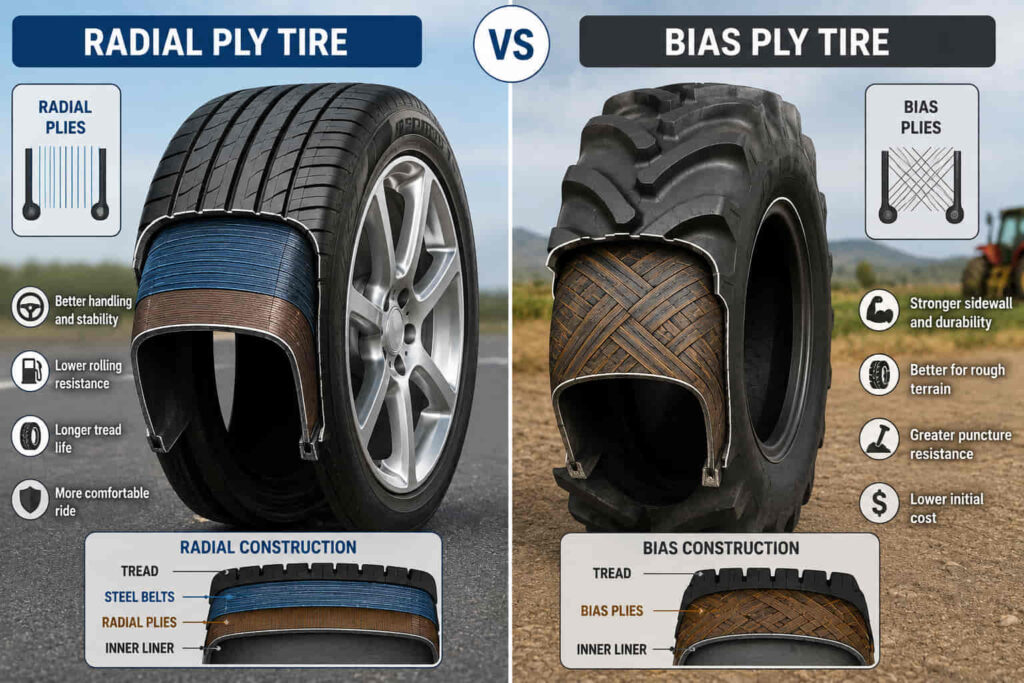
Radial and bias trailer tires use different internal construction methods that affect heat management, durability, handling stability, and overall towing performance. The main difference between these two tire types comes from how the internal cords are arranged inside the tire structure, which changes the way the tire flexes, carries weight, and performs under towing conditions.
Trailer tires operate under different demands compared with passenger vehicle tires. A trailer tire must support heavy loads, remain stable while carrying weight, and handle the stress created by towing. Because trailers often spend long periods traveling at highway speeds, factors such as heat buildup, sidewall strength, and tread durability become important considerations.
Radial trailer tires use cord layers that run perpendicular to the direction of travel, allowing the tread and sidewall areas to function with more flexibility. This construction typically provides better heat dissipation, lower rolling resistance, and improved performance during long-distance towing.
Bias trailer tires use diagonal cord layers that overlap across the tire structure, creating a stiffer and stronger sidewall design. This construction can provide advantages in certain applications where ruggedness and resistance to sidewall damage are important.
Choosing between radial and bias trailer tires depends on how the trailer is used, including towing distance, road conditions, load requirements, and operating environment.
This guide explains the differences between radial and bias trailer tires, how each construction works, their performance advantages, and which type is better for boat trailers, RV trailers, utility trailers, and other towing applications.
How Are Radial Trailer Tires Constructed?
Radial trailer tires are constructed with cord layers positioned at approximately 90 degrees to the direction of travel, allowing the tire’s tread and sidewall areas to perform more independently. This construction method changes how the tire flexes under load and improves several important characteristics for towing applications.
The internal structure of a radial tire typically includes steel or reinforced belt layers beneath the tread area, while the body cords run across the tire from bead to bead in a radial pattern. This design allows the tread surface to maintain more consistent contact with the road while reducing unnecessary movement within the tire structure.
One major advantage of radial construction is improved heat management. Trailer tires often operate under heavy loads for extended periods, and excessive heat is one of the main causes of tire degradation. Because radial tires generate less internal friction during flexing, they can operate at lower temperatures during highway towing.
Radial trailer tires also provide improved ride quality because the sidewalls can flex more easily while the tread remains stable. This flexibility helps reduce vibration transferred through the trailer, which can improve towing comfort and reduce stress on trailer components.
For example, a travel trailer used for regular highway trips between different states often benefits from radial tires because long-distance towing creates continuous heat and load demands that radial construction handles effectively.
Radial construction is now widely used for modern trailer applications because it provides a strong balance between durability, efficiency, and highway performance.
How Are Bias Trailer Tires Constructed?
Bias trailer tires are constructed with multiple layers of cords arranged diagonally across each other, creating a more rigid tire structure with stronger sidewall support. This traditional construction method has been used for decades and remains suitable for specific towing environments where structural stiffness is valuable.
In a bias tire, the cord layers run at an angle from one side of the tire to the other, with additional layers overlapping in a crisscross pattern. This creates a thicker and more reinforced sidewall compared with radial construction.
The main characteristic of bias construction is its stiffness. A stronger sidewall can provide resistance against impacts, cuts, and damage in environments where trailers operate on rough surfaces or at lower speeds.
However, the same rigidity that provides strength can also create more heat during extended highway operation. Because the entire tire structure flexes together, internal friction can increase when the tire travels at higher speeds for long periods.
Bias trailer tires are often considered suitable for applications where durability and ruggedness are more important than maximum highway efficiency. They are commonly used in certain utility trailers, agricultural applications, and equipment trailers where operating conditions may involve uneven terrain.
For example, a small equipment trailer frequently traveling on construction sites or rough access roads may benefit from the stronger sidewall characteristics of bias construction.
Read more: Who Makes Nexen Tires
Are Radial Trailer Tires Better Than Bias Trailer Tires?
Radial trailer tires are generally better for most modern towing applications because they provide improved heat control, highway stability, and tread performance compared with bias trailer tires. However, the better choice depends on how the trailer is used because each construction type has different performance advantages.
The biggest difference between radial and bias trailer tires appears during long-distance towing. Radial tires are designed to reduce internal friction and allow better heat dissipation, which is important because trailer tires often operate under heavy loads for extended periods. Lower operating temperatures can help reduce stress on the tire structure and improve service life.
Radial construction also provides better rolling efficiency because the tread maintains more consistent contact with the road surface. This can improve towing stability and reduce unnecessary energy loss when pulling a trailer over highways.
Bias trailer tires have advantages in specific conditions. Their stiffer sidewall construction provides strong resistance against impacts and damage, which can be useful for trailers operating on rough terrain, construction sites, or low-speed environments.
The choice between the two types should be based on the trailer’s primary use rather than assuming one design is always superior. A trailer traveling thousands of highway miles each year has different requirements compared with a trailer used occasionally on uneven surfaces.
For example, an RV owner traveling long distances across highways will usually benefit more from radial trailer tires, while an equipment trailer frequently used on rough ground may still find value in bias construction.
Are Bias Trailer Tires Stronger Than Radial Trailer Tires?
Bias trailer tires are not always stronger than radial trailer tires, but their rigid sidewall construction gives them specific strength advantages in certain operating conditions. The idea that bias tires are simply stronger comes from their traditional design, which creates a thicker and more reinforced sidewall structure.
The strength of a trailer tire depends on the type of stress it needs to handle. Bias tires can perform well when resistance to sidewall damage, impact protection, and structural stiffness are priorities. This makes them useful in applications where trailers move at lower speeds across uneven surfaces.
Radial tires, however, often provide better structural performance during high-speed towing because they manage heat and load forces more efficiently. The separation between the sidewall and tread movement allows radial tires to maintain better road contact while reducing internal stress.
Load capacity is also influenced by factors beyond construction type. Tire size, load range, inflation pressure, materials, and manufacturer specifications all determine how much weight a trailer tire can safely support.
A bias tire with the correct specifications can be the right choice for a demanding application, while an incorrectly selected radial tire may not perform well. The key factor is matching the tire design with the trailer’s operating environment.
For example, a farm trailer moving slowly across fields may benefit from the rigid structure of a bias tire, while a cargo trailer traveling regularly on highways may achieve better results with a radial tire designed for extended road use.
Which Trailer Tires Are Better for Long-Distance Highway Towing?
Radial trailer tires are usually the better choice for long-distance highway towing because they are designed to handle continuous operation, manage heat more effectively, and maintain better stability at higher speeds. Highway towing creates unique challenges because trailer tires must support heavy loads while rotating continuously for extended periods.
Heat buildup is one of the most important factors affecting trailer tire performance. When a tire flexes repeatedly under load, internal friction creates heat inside the structure. Excessive heat can accelerate rubber degradation, weaken internal components, and increase the risk of tire failure. Radial construction reduces this internal movement, allowing the tire to operate more efficiently during long trips.
Radial trailer tires also provide better tracking stability because the tread remains more consistent against the road surface. This helps reduce trailer movement and improves control, especially when towing larger RV trailers, travel trailers, or enclosed cargo trailers on highways.
Bias trailer tires can still perform well in certain situations, but their strengths are usually better suited to shorter-distance towing, lower speeds, or environments where sidewall toughness is a priority.
For example, an RV owner traveling several hundred miles on interstate highways will generally benefit from radial trailer tires because they are designed for sustained speed and heat management. A small utility trailer used occasionally for local transportation may not require the same level of highway-focused performance.
Which Trailer Tires Are Better for Boat, RV, and Utility Trailers?
The best trailer tire construction depends on the trailer type, operating environment, and frequency of use. Boat trailers, RV trailers, and utility trailers each create different demands, meaning the ideal choice may vary between applications.
RV and travel trailers typically benefit from radial tires because they often travel long distances at highway speeds while carrying significant weight. The improved heat control and smoother operation of radial construction make them suitable for extended recreational travel.
Boat trailers can also benefit from radial trailer tires, especially when they are used for highway transportation between different locations. However, because boat trailers may encounter ramps, gravel areas, and uneven surfaces, tire selection should also consider sidewall durability and load requirements.
Utility trailers have more varied requirements. A lightweight utility trailer used for occasional local hauling may work well with either construction type. However, trailers carrying equipment, tools, or heavy materials should be matched with tires designed for the expected load and terrain.
The application matters more than the construction label alone. A properly selected tire with the correct load rating and inflation pressure will perform better than a tire chosen only because it uses radial or bias construction.
For example, a contractor transporting equipment on paved roads may prefer radial tires for highway stability, while a landscaping trailer regularly entering rough job sites may value the impact resistance of a suitable bias tire.
How Long Do Radial and Bias Trailer Tires Last?
The lifespan of radial and bias trailer tires depends on factors such as usage frequency, load conditions, inflation pressure, storage environment, and maintenance practices. Construction type influences durability, but it is only one part of overall tire service life.
Radial trailer tires often achieve longer service life in highway applications because they generate less heat and experience less internal stress during extended towing. Their ability to maintain cooler operating temperatures can help slow wear and material degradation.
Bias trailer tires can also provide reliable service when used in appropriate conditions. Their rigid construction may perform well in applications where trailers experience frequent impacts or operate at lower speeds.
However, trailer tires are affected by age as well as mileage. A trailer that sits unused for long periods can still experience rubber aging, weather cracking, and structural deterioration. Proper storage away from sunlight, maintaining recommended tire pressure, and regular inspections are important for both radial and bias tires.
The actual replacement timing depends on tire condition, manufacturer recommendations, and operating environment rather than mileage alone.
For example, a trailer tire used only a few times per year may require replacement due to aging even if the tread appears acceptable, while a frequently used highway trailer may wear out sooner because of continuous load and heat exposure.
How Do You Choose Between Radial and Bias Trailer Tires?
Choosing between radial and bias trailer tires requires evaluating the trailer’s purpose, towing distance, load requirements, and operating conditions. The correct choice is not simply about selecting the more advanced construction type but finding the tire that matches how the trailer is actually used.
Radial trailer tires are generally the preferred option for drivers who frequently tow on highways, travel long distances, or prioritize smoother operation and improved heat management. They are especially common for RV trailers, travel trailers, and modern cargo trailers.
Bias trailer tires remain useful for specific applications where strong sidewall construction and resistance to rough conditions are important. They can be a practical choice for certain agricultural, equipment, and low-speed trailer applications.
Before selecting a tire, drivers should consider the trailer’s weight, maximum load requirements, tire size, speed rating, and recommended inflation pressure. These specifications determine whether a tire can safely handle the demands placed on it.
The best trailer tire is the one that matches the trailer’s operating environment. A premium radial tire may not provide the expected benefit if it is used outside its intended conditions, while a properly selected bias tire can perform effectively in the right application.
For example, a family using an RV trailer for annual road trips will likely benefit from radial trailer tires, while a business using a utility trailer on rough terrain may find a correctly rated bias tire better suited to its needs.