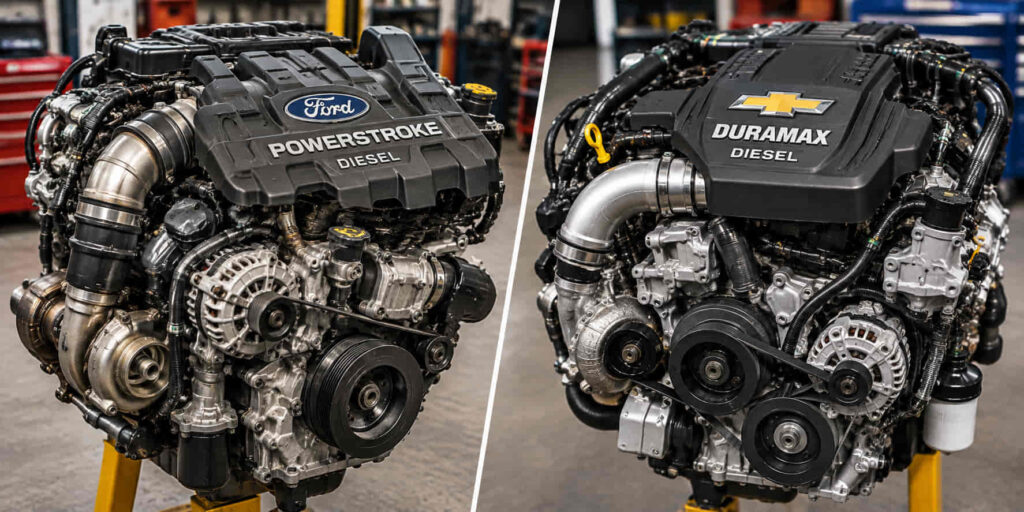
Powerstroke vs Duramax: Which diesel engine is better? The Ford 6.7L Power Stroke currently offers more factory horsepower and torque than the Chevrolet and GMC 6.6L Duramax, while both engines provide strong towing performance, advanced diesel technology, and substantial long-term durability when properly maintained. For 2026, Ford’s standard 6.7L Power Stroke produces 475 horsepower and 1,050 lb-ft of torque, while the High Output version increases output to 500 horsepower and 1,200 lb-ft. The 2026 Duramax 6.6L L5P produces 470 horsepower and 975 lb-ft of torque.
However, higher horsepower does not automatically mean better reliability, lower maintenance costs, or a longer engine lifespan. The best choice depends on the engine generation, truck configuration, towing requirements, maintenance history, and total cost of ownership.
The Power Stroke name covers several diesel engine generations, including the 7.3L, 6.0L, 6.4L, and modern 6.7L V8. Duramax also has a long history, beginning with the LB7 in 2001 and continuing through the LLY, LBZ, LMM, LML, and current L5P engine families.
These generations have different fuel injection systems, turbochargers, mechanical designs, and known reliability concerns. Comparing a 2002 Power Stroke with a 2026 Duramax is therefore very different from comparing the latest Ford Super Duty with a modern Chevrolet Silverado HD.
Understanding the differences in horsepower, torque, towing capacity, fuel economy, engine construction, transmission performance, and maintenance costs helps determine which diesel powertrain best suits daily driving, commercial work, and heavy-duty towing.
What Is the Difference Between Powerstroke and Duramax?
Power Stroke is Ford’s diesel engine brand, while Duramax is General Motors’ diesel engine brand used primarily in Chevrolet and GMC vehicles. Both are known for turbocharged diesel powertrains designed to deliver substantial low-speed torque.
The modern heavy-duty comparison involves the Ford 6.7-liter Power Stroke V8 and the GM 6.6-liter Duramax V8.
Both engines use eight cylinders, turbocharging, high-pressure common-rail fuel injection, and electronically controlled emissions systems.
However, their mechanical architectures differ.
Ford’s 6.7L Power Stroke uses a compacted graphite iron engine block with aluminum cylinder heads.
Its reverse-flow cylinder head arrangement places the exhaust outlets toward the center of the engine, allowing the turbocharger to sit within the engine’s V-shaped valley.
The Duramax 6.6L uses a cast-iron block and aluminum cylinder heads in a more conventional engine arrangement.
Both designs are intended to withstand substantial combustion pressures and deliver the torque needed for heavy-duty transportation.
The Power Stroke engine is paired with Ford’s Super Duty truck platform, including models such as the F-250, F-350, and F-450.
The Duramax is offered in Chevrolet Silverado HD and GMC Sierra HD trucks.
Modern GM vehicles also offer a smaller 3.0-liter Duramax inline-six diesel engine in selected light-duty trucks and SUVs.
Ford does not currently offer an equivalent diesel option in its F-150 lineup for the 2026 model year.
Therefore, the Powerstroke vs Duramax comparison should begin by identifying whether the intended application is a heavy-duty pickup, light-duty truck, commercial vehicle, or used diesel platform.
Who Makes Power Stroke and Duramax Engines?
Ford Motor Company develops and manufactures the modern 6.7L Power Stroke diesel engine, while General Motors produces the 6.6L Duramax through DMAX, its engine manufacturing subsidiary in Moraine, Ohio.
The manufacturing history of Power Stroke engines has changed over time.
The original 7.3L Power Stroke, introduced in 1994, was developed and manufactured by International, the company historically associated with Navistar.
International also manufactured the later 6.0L and 6.4L Power Stroke engines.
Ford eventually developed its own diesel engine program.
The 6.7L Power Stroke introduced for the 2011 model year was engineered by Ford rather than supplied as a continuation of the earlier International engine families.
This was an important shift because Ford gained direct control over the engine’s mechanical design, fuel system integration, turbocharger configuration, and ongoing development.
Duramax has a different manufacturing history.
General Motors and Isuzu established the DMAX diesel engine venture to develop and manufacture engines for GM trucks.
The first Duramax 6.6L engine entered the market for the 2001 model year.
Over time, GM expanded its role in the company, and DMAX is now identified as a subsidiary of General Motors.
The DMAX facility in Moraine, Ohio, continues manufacturing diesel engines for Chevrolet Silverado HD and GMC Sierra HD vehicles.
Consequently, modern Power Stroke and Duramax engines are both developed within their respective automotive manufacturers’ powertrain organizations.
Neither is simply a rebadged engine produced by the other company.
Powerstroke vs Duramax Horsepower: Which Makes More Power?
The 2026 Ford 6.7L Power Stroke produces more factory horsepower than the 2026 GM 6.6L Duramax, especially when comparing Ford’s High Output configuration.
Ford offers two principal 6.7L Power Stroke power ratings in its 2026 Super Duty pickup lineup.
The standard engine produces 475 horsepower at 2,600 RPM.
The High Output version produces 500 horsepower at the same engine speed.
The 2026 Chevrolet Silverado HD and GMC Sierra HD use the 6.6L Duramax L5P, rated at 470 horsepower at 2,800 RPM.
This gives the standard Ford engine a five-horsepower advantage over the Duramax.
The High Output Power Stroke produces 30 horsepower more than the GM engine.
However, these factory ratings represent peak crankshaft output under standardized testing conditions.
They do not indicate how much power reaches the wheels after drivetrain losses.
Transmission efficiency, axle configuration, tire size, vehicle weight, and other factors influence measured wheel horsepower.
Engine speed is another distinction.
The Ford diesel reaches its rated maximum horsepower at 2,600 RPM, while the Duramax’s published peak horsepower occurs at 2,800 RPM.
These figures provide information about the engine’s power delivery characteristics, but they do not describe the entire horsepower curve.
The ability to maintain power over a broad operating range is especially important for towing.
A truck that retains useful power during long climbs may perform differently from another truck with similar peak horsepower.
Therefore, the Power Stroke has the advantage in published maximum factory horsepower, but real-world acceleration and towing performance depend on the complete truck.
Powerstroke vs Duramax Torque: Which Has More Torque?
The Ford 6.7L Power Stroke produces more maximum torque than the 6.6L Duramax in the 2026 heavy-duty pickup comparison.
The standard Power Stroke develops 1,050 lb-ft at 1,600 RPM.
Ford’s High Output version increases maximum torque to 1,200 lb-ft at the same engine speed.
The 6.6L Duramax L5P produces 975 lb-ft at 1,600 RPM.
This means the standard Power Stroke has a 75 lb-ft advantage.
The High Output Power Stroke offers 225 lb-ft more torque than the current Duramax.
Torque is particularly relevant to heavy-duty diesel trucks because it influences the engine’s ability to generate rotational force at relatively low engine speeds.
When a truck accelerates while carrying a heavy trailer, substantial torque helps maintain performance without requiring the engine to operate near its maximum RPM.
However, maximum engine torque does not directly equal the force delivered to the tires.
Transmission gear ratios, axle gearing, torque converter behavior, and tire dimensions affect the torque available at the wheels.
An engine with lower peak torque may still provide effective towing performance when paired with a well-matched transmission.
Both modern engines produce their published peak torque at 1,600 RPM.
This demonstrates their emphasis on low-speed power delivery.
Ford’s High Output configuration provides a significant numerical advantage, but whether that additional torque is valuable depends on the load being towed.
For moderate trailers, the Duramax’s 975 lb-ft is already substantial.
For operators frequently towing near the upper limits of a properly equipped truck, the additional available Power Stroke torque may be attractive.
Powerstroke vs Duramax Engine Design and Construction
The 6.7L Power Stroke and 6.6L Duramax use different engine block materials and turbocharger packaging strategies, although both are modern turbocharged diesel V8 engines with four valves per cylinder.
Ford’s 6.7L Power Stroke uses compacted graphite iron for its cylinder block.
This material combines characteristics that make it suitable for high-pressure diesel engine construction.
Its strength allows engineers to develop a robust block while managing overall engine weight.
The engine also uses aluminum cylinder heads.
A distinguishing feature is its reverse-flow design.
The exhaust ports face toward the center of the engine, where the turbocharger is positioned.
This arrangement reduces the distance exhaust gases must travel before reaching the turbine.
It also creates a different intake and exhaust packaging layout from a traditional outward-facing exhaust manifold arrangement.
The Duramax L5P uses a cast-iron engine block and aluminum cylinder heads.
Its conventional cylinder head configuration and exhaust arrangement differ from Ford’s reverse-flow system.
The engine has a 6.6-liter displacement, equivalent to approximately 403 cubic inches.
Ford’s 6.7-liter engine displaces approximately 406 cubic inches.
The difference in displacement is relatively small, meaning the performance gap cannot be explained simply by engine size.
Fuel injection equipment, turbocharger characteristics, combustion chamber design, calibration, and internal component geometry all contribute to output.
Both engines use electronically controlled high-pressure common-rail injection.
This allows precise fuel delivery timing and multiple injection events under suitable operating conditions.
Neither architecture is automatically more reliable because of its block material or turbocharger location.
Durability depends on how the complete system is engineered and maintained.
Powerstroke vs Duramax Towing Capacity
The 2026 Ford Super Duty offers a maximum advertised towing rating of 40,000 pounds with the High Output Power Stroke in a properly equipped configuration, while the 2026 Chevrolet Silverado HD offers up to 36,000 pounds with the Duramax 6.6L.
Ford’s maximum rating requires a specific truck configuration and the appropriate towing package.
The company’s published 2026 specifications identify the maximum 40,000-pound capability for a qualifying gooseneck towing arrangement.
The standard 6.7L Power Stroke is associated with a maximum available towing rating of 38,600 pounds in the applicable Ford towing guide.
Chevrolet advertises a maximum 36,000-pound towing capacity for a properly equipped 2026 Silverado 3500HD with the Duramax engine.
That maximum is associated with a specific two-wheel-drive dual-rear-wheel configuration and the required trailering equipment.
The comparison demonstrates that Ford offers a higher maximum published towing figure across these truck lineups.
However, it is not a direct engine-only comparison.
Ford’s maximum rating involves an F-450 pickup configuration, whereas Chevrolet’s maximum involves a Silverado 3500HD.
These vehicles have different chassis designs, weight ratings, axle capacities, and configurations.
A direct comparison between similarly equipped F-350 and Silverado 3500HD trucks may produce a different result from comparing the highest rating available in each manufacturer’s entire lineup.
Trailer hitch type also matters.
Conventional bumper-pull towing ratings differ from fifth-wheel and gooseneck ratings.
Cab configuration, bed length, drivetrain, axle ratio, passengers, cargo, and optional equipment can reduce the towing capacity of an individual truck.
The correct towing capacity is determined by the complete vehicle configuration and its applicable ratings.
For owners pulling equipment trailers, fifth-wheel campers, or commercial loads, both engines are capable powertrains.
The more important question is whether the specific truck has adequate towing capacity, payload, and braking capability for the intended trailer.
Which Is Better for Heavy Towing: Powerstroke or Duramax?
The 6.7L Power Stroke High Output is particularly attractive for maximum-rated heavy towing because of its 1,200 lb-ft torque rating, while the 6.6L Duramax remains a strong alternative with substantial power and an integrated Allison-branded transmission.
Heavy towing is not simply a test of peak horsepower.
A diesel truck may spend extended periods climbing grades with a heavy trailer.
During these conditions, the engine must maintain sufficient power while the cooling system controls heat.
The transmission must also select and maintain appropriate gear ratios.
Both Ford and GM use ten-speed automatic transmissions in their current heavy-duty diesel pickups.
These transmissions provide a broad range of ratios to help keep the engine operating within an effective speed range.
Ford’s additional maximum torque can be useful when moving heavy loads.
However, traction, gearing, vehicle weight, and transmission calibration influence how that torque is delivered.
Engine braking is another important consideration.
Modern diesel trucks commonly use exhaust braking strategies to help control vehicle speed on downhill grades.
This reduces reliance on service brakes during prolonged descents.
Both powertrains also use sophisticated engine and transmission management systems to coordinate performance while towing.
Cooling capacity is especially important because sustained load creates heat in the engine, transmission, and other drivetrain components.
A truck that remains within acceptable temperatures can operate more consistently during long climbs.
For the heaviest possible loads within manufacturer ratings, a properly equipped Power Stroke Super Duty may offer greater maximum capability.
For owners who do not require the highest ratings, the Duramax offers more than enough torque for many demanding towing applications.
The correct choice should be based on the specific trailer weight, tongue or pin weight, truck payload, and the operating conditions encountered most often.
Powerstroke vs Duramax Reliability: Which Engine Is More Dependable?
Neither Power Stroke nor Duramax is universally more reliable across every generation. Reliability depends heavily on the specific engine family, production year, maintenance history, and known component weaknesses.
The Power Stroke name covers engines with significantly different designs.
The 7.3L Power Stroke has a strong reputation for long-term durability.
The later 6.0L and 6.4L engines developed more controversial reliability records because of problems involving cooling, fuel injection, emissions systems, and other components.
The Ford-developed 6.7L Power Stroke represented a substantial change in engine design.
It has undergone several revisions since 2011, including turbocharger and internal component improvements.
The Duramax family also contains multiple generations.
The early LB7 became known for fuel injector problems.
The LLY had certain cooling and overheating concerns.
The LBZ gained a strong reputation among diesel enthusiasts, while the LML introduced a different high-pressure fuel pump design that became an important consideration for used-truck buyers.
The newer L5P brought another major change in fuel system engineering.
These differences make a single reliability ranking misleading.
A well-maintained 2018 Duramax L5P may be a more attractive purchase than a neglected early Power Stroke.
Conversely, a carefully maintained later-generation 6.7L Power Stroke may provide better ownership value than a Duramax with unresolved fuel system or emissions problems.
Reliability also includes the components surrounding the engine.
Turbochargers, fuel pumps, cooling systems, transmissions, sensors, and aftertreatment equipment can create costly repairs even when the engine’s block and rotating assembly remain healthy.
The most useful comparison therefore focuses on the exact engine generation and the mechanical condition of the truck being considered.
Which Power Stroke Engine Generations Are the Most Reliable?
The 7.3L Power Stroke and later versions of the Ford-developed 6.7L Power Stroke are generally regarded as stronger reliability choices than the 6.0L and 6.4L generations, although maintenance and individual condition remain important.
The 7.3L Power Stroke was used in Ford trucks from the 1994 model-year transition through 2003.
It used a cast-iron V8 architecture and hydraulically actuated electronically controlled fuel injectors.
Its relatively straightforward design helped establish a strong reputation for durability.
However, the engine is now old enough that electrical problems, oil leaks, worn injectors, and supporting drivetrain issues are significant ownership considerations.
The 6.0L Power Stroke introduced for 2003 brought greater power and a more advanced turbocharger and injection system.
It also became associated with cooling system and head gasket concerns.
Its oil cooler and exhaust gas recirculation system are especially important maintenance areas.
The 6.4L Power Stroke followed for the 2008 model year.
It adopted high-pressure common-rail injection and a compound turbocharger arrangement.
However, its complex systems and certain durability concerns can make major repairs expensive.
Ford introduced the independently developed 6.7L Power Stroke for 2011.
This engine has undergone multiple improvements.
Early 2011–2014 models have a different turbocharger configuration from later versions and are associated with more reported turbo-related concerns.
Ford revised the turbocharger arrangement for the 2015 model year.
The 2020 model year introduced further powertrain updates, including a ten-speed automatic transmission.
The 2023 engine update introduced additional changes, including the High Output configuration.
Later versions benefit from several development cycles, but they still require careful fuel system, cooling, and emissions maintenance.
What Are the Common Problems With the 6.0 and 6.4 Power Stroke?
The 6.0L and 6.4L Power Stroke engines have different known failure patterns, and buyers should understand these issues before comparing them with older Duramax models.
The 6.0 Power Stroke uses a HEUI fuel injection system that depends on high-pressure engine oil.
This creates several potential diagnostic challenges.
High-pressure oil leaks, injector control problems, and related component failures can cause difficult starting or poor engine operation.
The engine’s oil cooler also deserves attention.
Restrictions within the oil cooler can reduce cooling effectiveness and contribute to problems affecting the EGR cooler.
A damaged EGR cooler may allow coolant to enter areas where it does not belong.
Repeated overheating or abnormal cooling system pressure can also affect head gasket sealing.
However, a symptom involving coolant loss does not automatically prove that the head gasket has failed.
The oil cooler, EGR cooler, and other cooling components must be evaluated through appropriate testing.
The 6.4 Power Stroke uses a different fuel injection system.
Its high-pressure common-rail design and dual-stage turbocharging system provided substantial factory performance.
However, the engine’s emissions strategy and regeneration process could contribute to fuel dilution of the engine oil under certain operating conditions.
Other concerns include cooling system faults, emissions-related problems, and expensive internal failures.
The severity of these issues varies between individual trucks.
A properly repaired and maintained 6.0 Power Stroke can remain useful for many years.
Nevertheless, buying a used 6.0 or 6.4 requires more detailed investigation than simply assuming that every engine carrying the Power Stroke name has the same reliability as the 7.3 or modern 6.7.
Which Duramax Engine Generations Are the Most Reliable?
The Duramax LBZ and later L5P are frequently considered desirable generations, but the reliability of any Duramax engine depends on its production year, condition, fuel system, maintenance, and supporting components.
The original LB7 introduced the 6.6L Duramax to GM heavy-duty trucks for the 2001 model year.
It delivered strong diesel performance and modern common-rail injection technology.
However, the LB7 developed well-documented injector problems.
General Motors issued a special coverage policy addressing certain injector failures in affected vehicles.
The LLY appeared during the 2004 model year and introduced further engine changes.
Some LLY applications developed overheating concerns, particularly under sustained load.
The LBZ arrived for the 2006 model year and continued into the early 2007 production period.
It is popular among diesel enthusiasts because of its performance characteristics and relatively straightforward emissions equipment compared with later models.
However, the LBZ is not free from mechanical wear or fuel system problems.
The LMM followed for the 2007 model-year transition and introduced diesel particulate filter equipment.
The LML arrived for the 2011 model year with increased power and a different fuel system configuration.
The 2011–2016 LML used a Bosch CP4 high-pressure fuel pump, which is an important concern when evaluating used vehicles.
For 2017, GM introduced the L5P engine family.
The L5P includes substantial changes to fuel injection, turbocharging, and internal engine components.
It also uses a Denso high-pressure fuel system rather than the earlier LML’s Bosch CP4 arrangement.
The L5P remains the primary Duramax engine used in current heavy-duty Chevrolet and GMC pickups.
For used-truck buyers, each generation should be evaluated separately instead of assuming that every Duramax engine shares the same mechanical strengths and weaknesses.
Powerstroke vs Duramax Fuel Pump Problems
High-pressure fuel pump reliability is an important consideration for both Power Stroke and Duramax engines because a serious pump failure can damage multiple components within the fuel injection system.
Modern common-rail diesel engines use very high fuel injection pressures.
These pressures allow the injectors to deliver precisely controlled quantities of diesel fuel.
However, the system depends on clean fuel and appropriate lubrication within the pump.
Fuel contamination, water, excessive wear, or internal component failure can cause serious problems.
Certain 6.7L Power Stroke engines use Bosch CP4-family high-pressure fuel pumps.
The CP4 has been associated with concerns involving internal wear and metal contamination.
When a pump fails severely, metallic debris may spread through the fuel system.
This can affect fuel rails, injectors, fuel lines, and other components.
A complete repair may therefore involve more than replacing the pump alone.
The 2011–2016 Duramax LML also used a Bosch CP4-family pump.
The fuel system in the later L5P was redesigned, incorporating a Denso high-pressure pump and different injection equipment.
This is an important reason why the LML and L5P should not be treated as the same engine for reliability comparisons.
However, a different pump manufacturer does not mean that the L5P fuel system is immune to contamination or mechanical failure.
All modern high-pressure diesel injection systems require clean, properly specified fuel.
Regular fuel filter replacement and prompt attention to water-in-fuel warnings can reduce avoidable risks.
A used diesel truck should also be inspected for previous fuel system repairs.
Documentation of injector or high-pressure pump replacement may reveal important information about the engine’s history.
Is the Ford 6.7 Power Stroke More Reliable Than the Duramax L5P?
Both the Ford 6.7L Power Stroke and GM Duramax L5P are capable modern heavy-duty diesel engines, but there is no reliable universal rule that one will outlast the other.
The comparison becomes more meaningful when similar model years are considered.
A 2026 Power Stroke is the result of more than a decade of Ford development following the engine’s introduction in 2011.
The L5P has also undergone continued refinement since its 2017 introduction.
Both engines use sophisticated fuel injection, turbocharging, cooling, and emissions systems.
These technologies support high torque and improved efficiency but also introduce expensive components.
Ford’s compacted graphite iron block and reverse-flow engine arrangement provide a distinctive mechanical design.
The Duramax’s cast-iron block and Denso fuel injection system represent a different engineering approach.
Neither design alone establishes superior lifespan.
A reliable comparison would require extensive failure-rate information across comparable vehicle populations, operating conditions, and maintenance histories.
Public owner reports do not provide a controlled comparison of that kind.
A high-mileage truck used for frequent highway towing may experience different wear from a low-mileage truck that spends substantial time idling.
Fuel quality and maintenance can also substantially influence both engines.
The best ownership decision therefore depends on the truck’s documented service history, current mechanical condition, and the quality of local repair support.
For new truck buyers, both modern engines provide substantial performance.
For used truck buyers, the production year, maintenance history, fuel system condition, emissions system health, and transmission performance deserve greater attention than brand reputation alone.
Powerstroke vs Duramax Engine Lifespan
Both Power Stroke and Duramax engines can provide several hundred thousand miles of service when properly maintained, but neither manufacturer guarantees that every engine will reach a specific mileage.
Engine longevity depends on more than the strength of the cylinder block.
Crankshaft bearings, pistons, connecting rods, cylinder heads, turbochargers, and fuel injection components all experience mechanical wear.
The rate of wear depends on operating conditions.
A diesel truck used primarily for highway transportation may accumulate mileage under relatively stable engine loads.
A construction truck may experience frequent idling, heavy acceleration, and repeated high-load operation while covering fewer miles.
Engine operating hours therefore provide useful information alongside odometer mileage.
Many diesel owners consider 200,000 miles an important long-term ownership milestone.
Reaching 300,000 miles or more is possible for well-maintained examples of both engine families.
However, these figures are not statistically verified average lifespans for all Power Stroke or Duramax generations.
A truck can also require expensive repairs long before the core engine experiences significant internal wear.
Fuel injectors, high-pressure pumps, turbochargers, sensors, and emissions components may fail independently of the crankshaft and pistons.
This distinction is especially important when evaluating total ownership cost.
An engine with normal compression and oil pressure may remain mechanically healthy despite an expensive emissions system fault.
Conversely, a truck that starts and runs normally may still have developing bearing or cylinder wear.
Compression testing, oil consumption monitoring, oil analysis, and careful inspection can help assess the condition of a high-mileage engine.
The most realistic approach is to evaluate engine life through maintenance history and mechanical health rather than relying on a universal Power Stroke or Duramax mileage claim.
Read more: Best Remanufactured Engines
Powerstroke vs Duramax Fuel Economy
Neither the 6.7L Power Stroke nor the 6.6L Duramax has a universal fuel economy advantage because diesel consumption depends on vehicle weight, gearing, towing load, driving conditions, and engine calibration.
Heavy-duty pickups are not normally subject to the same consumer fuel economy labeling requirements as lighter passenger vehicles.
As a result, directly comparable EPA fuel economy estimates are not generally available for every F-250, F-350, Silverado HD, and Sierra HD configuration.
This makes real-world fuel economy comparisons more difficult.
A single owner’s mileage report may reflect a particular axle ratio, tire size, driving speed, and trailer weight.
Another owner’s truck may operate under completely different conditions.
Engine displacement is also an imperfect predictor.
The Duramax has a displacement of 6.6 liters, while the Power Stroke has a displacement of 6.7 liters.
The difference is relatively small.
Fuel economy is more strongly influenced by operating efficiency and the complete vehicle configuration.
Transmission gear ratios can affect highway engine speed.
Aerodynamic drag becomes especially important during high-speed driving.
Towing a large enclosed trailer can increase fuel consumption substantially, regardless of engine brand.
Regeneration of the diesel particulate filter may also influence fuel usage.
A truck that frequently performs short trips may experience different regeneration behavior from one operating continuously at highway temperatures.
For the most useful comparison, owners should evaluate fuel consumption under similar conditions and loads.
An improvement of one or two miles per gallon can be financially meaningful for a commercial truck covering substantial annual mileage.
However, any fuel savings should be considered alongside engine purchase price, maintenance expenses, and possible repairs.
Does the 3.0 Duramax Have Better Fuel Economy Than a Power Stroke?
The 3.0L Duramax inline-six is designed for a different vehicle category from the heavy-duty 6.7L Power Stroke and can offer strong fuel economy in light-duty trucks.
The 2026 Chevrolet Silverado 1500 offers a 3.0-liter Duramax turbo-diesel engine producing 305 horsepower and 495 lb-ft of torque.
Chevrolet advertises an EPA-estimated highway fuel economy rating of up to 28 MPG for qualifying configurations.
The engine is also used in selected GMC Sierra 1500 trucks and GM full-size SUVs.
This powerplant uses an inline-six arrangement rather than the V8 configuration found in the heavy-duty Duramax.
Its smaller displacement and vehicle application are intended to provide a balance of efficiency, torque, and everyday driving performance.
Chevrolet advertises maximum towing capability of up to 13,300 pounds for properly equipped 2026 Silverado 1500 models with this diesel engine.
However, a Silverado 1500 is not equivalent to a Ford F-350 or Chevrolet Silverado 3500HD.
The trucks have different frames, axles, suspension components, brakes, gross vehicle weight ratings, and towing capacities.
A 3.0-liter Duramax may be an attractive option for drivers who want diesel fuel economy and moderate towing capability without purchasing a heavy-duty truck.
The 6.7L Power Stroke is designed for substantially greater heavy-duty towing and hauling requirements.
The correct comparison is therefore based on vehicle class and workload.
Fuel economy advantages should not be treated as evidence that the 3.0 Duramax is better suited for heavy commercial towing than a larger diesel V8.
Powerstroke vs Duramax Transmission Reliability
Modern Power Stroke and Duramax trucks use ten-speed automatic transmissions, but their transmission designs, control systems, and service requirements differ.
Ford pairs the current 6.7L Power Stroke with its TorqShift ten-speed automatic transmission.
Earlier 6.7L Power Stroke trucks, including 2011–2019 Super Duty applications, used a six-speed TorqShift automatic.
The ten-speed transmission arrived for the 2020 model year.
It provides a wider range of gear ratios and allows the engine to operate near its preferred RPM under different loads.
The modern Duramax is paired with an Allison-branded ten-speed automatic transmission.
GM introduced this transmission configuration for the 2020 Silverado HD and Sierra HD diesel lineup.
Earlier Duramax pickup trucks used Allison six-speed automatic transmissions in several engine generations.
The Allison name has a long association with GM heavy-duty diesel trucks.
However, the modern ten-speed transmission is a different product from the older Allison six-speed units.
It should not be assumed that every Allison-branded transmission has identical internal components or reliability characteristics.
Both modern transmissions use electronic control strategies to coordinate gear selection with engine output.
When towing, this helps the truck maintain suitable engine speed and respond to changes in load.
However, transmission reliability depends on fluid condition, temperature, mechanical loading, software calibration, and maintenance.
A powerful diesel engine can accelerate transmission wear when the vehicle is overloaded or aggressively modified.
For used trucks, shift quality should be evaluated during cold and warm operation.
Unusual engagement delays, persistent slipping, harsh shifts, or overheating deserve diagnosis.
The transmission can represent a substantial ownership expense, making its condition just as important as engine reliability.
Powerstroke vs Duramax Maintenance Costs
Power Stroke and Duramax maintenance costs depend on engine generation, service requirements, fluid capacity, filter replacement intervals, and repair complexity rather than brand name alone.
One measurable difference is engine oil capacity.
Ford’s 2026 6.7L Power Stroke pickup engine has a published oil and filter capacity of 15 US quarts, equivalent to approximately 14.2 liters.
GM’s 2026 technical capacity information lists approximately 10 US quarts, or 9.5 liters, for the Silverado HD equipped with the 6.6L Duramax L5P.
This means the Ford engine requires more oil during a standard service.
However, oil quantity alone does not establish total maintenance cost.
The correct lubricant specification, service interval, filter price, and labor rate also matter.
Both engines require fuel filtration because their high-pressure injection systems depend on clean diesel.
Water contamination is particularly concerning.
Improper fuel can damage pumps and injectors, resulting in expensive repairs.
Cooling system maintenance is another consideration.
The Power Stroke uses a sophisticated cooling arrangement, including separate circuits for certain systems in current configurations.
The Duramax also uses substantial cooling equipment to manage engine, transmission, and charge-air temperatures.
Both engines use diesel exhaust fluid and aftertreatment systems in current applications.
These systems introduce consumables and service requirements beyond ordinary oil and filter replacement.
The total expense also depends on the availability of parts and qualified service facilities.
An engine that requires fewer routine service materials may still be more expensive to own if it experiences a major component failure.
For a fair comparison, owners should evaluate maintenance over several years rather than focusing only on the cost of one oil change.
Are Power Stroke Engines More Expensive to Repair Than Duramax?
Neither engine family is consistently cheaper to repair because costs depend on the failed component, the engine generation, labor accessibility, replacement parts, and the extent of damage.
Certain Power Stroke repairs can be labor-intensive because of the engine’s packaging and truck design.
For example, access to some components on the 6.7L Power Stroke may require extensive disassembly.
High-pressure fuel system repairs can also become expensive if metal contamination spreads after a pump failure.
However, Duramax engines have their own costly repair possibilities.
The LB7’s fuel injector arrangement made injector replacement an important expense on certain early trucks.
The LML’s high-pressure fuel system is another major consideration.
Turbocharger, emissions, and cooling system repairs can also require substantial labor.
The Duramax L5P has different fuel injection components from the older LML.
Consequently, estimates developed for an LML repair should not automatically be applied to an L5P.
The same principle applies to Power Stroke generations.
A repair involving the HEUI injection system on a 7.3 or 6.0 Power Stroke differs from servicing the common-rail system on a 6.7.
Repair costs can also vary according to whether the engine is installed in a pickup or another commercial vehicle.
Local labor rates and replacement part availability influence the final invoice.
An accurate comparison should involve the specific repair required.
For buyers evaluating used trucks, the more useful question is which expensive failures are associated with the particular engine generation and whether those components have already been inspected or repaired.
Powerstroke vs Duramax Emissions Systems
Modern Power Stroke and Duramax engines use emissions control systems including exhaust gas recirculation, diesel particulate filtration, and selective catalytic reduction with diesel exhaust fluid.
These technologies are designed to reduce regulated emissions from diesel combustion.
Exhaust gas recirculation, commonly called EGR, directs a controlled amount of exhaust gas back into the intake system.
This helps reduce combustion temperatures under selected operating conditions and can lower nitrogen oxide formation.
Diesel particulate filters capture soot from the exhaust stream.
The filter must periodically undergo regeneration to burn accumulated soot.
Selective catalytic reduction uses diesel exhaust fluid, commonly called DEF, to help reduce nitrogen oxide emissions.
Both Ford and GM integrate these systems with electronic engine management.
However, component layouts and diagnostic strategies differ between manufacturers and model years.
Problems can involve temperature sensors, pressure sensors, DEF delivery components, particulate filter restrictions, or EGR system operation.
Frequent short trips can complicate diesel particulate filter regeneration because the engine may not remain at suitable operating conditions for sufficient periods.
Repeatedly interrupting regeneration can contribute to maintenance concerns.
However, a warning light does not automatically indicate that the diesel particulate filter must be replaced.
The underlying cause may involve a sensor, exhaust temperature control, or another system.
Proper diagnosis is essential.
Removing required emissions components or using software designed to disable them can violate emissions regulations.
For owners who use their trucks primarily for short urban trips, modern diesel aftertreatment requirements should be considered before selecting either engine.
Which Is Better for Cold Weather: Powerstroke or Duramax?
Both modern Power Stroke and Duramax engines are designed to start and operate in cold weather, but starting performance depends heavily on battery condition, fuel quality, glow plug operation, and the use of appropriate winter-grade fluids.
Diesel engines rely on compression ignition.
During cold weather, the engine and intake air begin at lower temperatures, creating additional challenges for reliable combustion.
Glow plugs help improve cold-start conditions by providing heat within the combustion chamber.
Ford and GM use electronically controlled glow plug systems in their modern diesel engines.
The engine management system determines when glow plug assistance is required.
Battery performance is especially important.
Cold temperatures reduce available battery capacity while increasing the effort required to crank the engine.
Weak batteries or damaged electrical connections can therefore cause starting problems even when the engine is mechanically healthy.
Diesel fuel properties also matter.
Fuel can become more difficult to pump or filter at very low temperatures if it contains wax components unsuitable for the ambient conditions.
Winter-grade diesel and appropriate fuel handling reduce this risk.
Engine block heaters can help prepare the engine for starting in severe cold.
However, their availability and recommended use depend on vehicle configuration and manufacturer instructions.
The engine oil must also meet the appropriate viscosity requirements.
A lubricant that becomes excessively resistant to flow can increase cranking effort and delay lubrication.
Modern Power Stroke and Duramax engines are both capable of cold-weather operation.
A well-maintained truck with suitable winter fuel and a healthy electrical system will generally be more dependable than a poorly maintained truck of either brand.
Powerstroke vs Duramax Aftermarket Upgrades
Both Power Stroke and Duramax engines have extensive aftermarket support for performance tuning, turbochargers, fuel systems, intake components, and drivetrain upgrades.
Diesel enthusiasts frequently modify these engines to improve horsepower, torque, throttle response, and towing performance.
However, the effectiveness of an upgrade depends on the original engine configuration.
The 7.3L Power Stroke uses HEUI injection and responds to upgrades involving injectors, high-pressure oil capacity, and tuning.
The 6.7L Power Stroke uses common-rail injection and a different turbocharger and engine management architecture.
Duramax performance modifications also differ between generations.
An LBZ, LML, and L5P do not use identical fuel systems.
A larger turbocharger may increase airflow potential, but the engine must also have sufficient fuel delivery and suitable calibration.
Increasing fuel delivery without adequate airflow can raise exhaust gas temperature and smoke output.
The transmission must also be capable of handling additional torque.
A truck with a worn automatic transmission may experience premature clutch or torque converter failure after aggressive tuning.
Fuel pump condition becomes especially important when modifying engines that already have known fuel system vulnerabilities.
For towing, conservative calibration and effective cooling may provide more practical value than maximum horsepower.
Owners should also consider emissions compliance.
Aftermarket components that interfere with required emissions control systems can be illegal for road use.
For both Power Stroke and Duramax, the best performance build is one in which the fuel system, turbocharger, engine internals, transmission, and cooling systems are matched to the intended workload.
Which Is Better for Daily Driving: Powerstroke or Duramax?
For daily driving, the better choice depends more on truck comfort, size, fuel economy, maneuverability, and maintenance requirements than on the small difference between the standard 6.7L Power Stroke and 6.6L Duramax horsepower ratings.
Both modern heavy-duty diesel engines produce far more torque than most drivers need during ordinary commuting.
The standard Power Stroke produces 1,050 lb-ft, while the Duramax produces 975 lb-ft.
These figures are primarily valuable when the truck is carrying or towing substantial loads.
For unloaded driving, transmission calibration, suspension design, tire selection, and vehicle weight may have a greater influence on the driving experience.
The truck’s dimensions also matter.
A long-wheelbase dual-rear-wheel truck can be difficult to maneuver in crowded parking areas regardless of engine brand.
A single-rear-wheel pickup may provide more convenient daily use.
Maintenance should also be considered.
Heavy-duty diesel engines contain sophisticated fuel injection and emissions systems designed around demanding workloads.
Drivers who make frequent short trips may not benefit from the operating characteristics of a large diesel engine.
Short trips can also complicate certain aftertreatment regeneration requirements.
For someone who needs occasional towing but primarily drives without a trailer, a gasoline powertrain or light-duty diesel may be more economical.
The 3.0-liter Duramax in the Silverado 1500 is one example of a diesel option designed for a different balance of efficiency and capability.
However, buyers who regularly tow large trailers may value the greater structural capacity of a heavy-duty platform.
The correct decision is therefore based on how the truck will be used throughout the year.
Which Is Better for Commercial Work: Powerstroke or Duramax?
Both Power Stroke and Duramax engines are suitable for commercial applications, but the best choice depends on fleet requirements, vehicle configuration, service availability, and downtime costs.
Commercial trucks often operate under demanding conditions.
Some travel long distances while towing trailers.
Others spend substantial time idling at job sites or carrying equipment through stop-and-go traffic.
These operating patterns affect engine maintenance requirements.
A truck used for long-haul work may accumulate high mileage with relatively consistent engine temperatures.
A vocational vehicle may experience more operating hours per mile.
The engine must be appropriately matched to these conditions.
Ford offers several Super Duty configurations, including chassis cab vehicles suited to specialized equipment.
GM provides Silverado HD and medium-duty truck platforms with diesel powertrain options.
The availability of body configurations, axle ratings, power takeoff equipment, and commercial upfitting support can influence the purchasing decision.
Dealer support also matters.
A fleet operating far from a qualified repair facility may experience substantial downtime if a major engine problem occurs.
Parts availability and technician familiarity are therefore important considerations.
For fleet managers, evaluating cost per mile or cost per operating hour can provide a clearer picture than comparing maximum horsepower.
Fuel expense, preventive maintenance, unexpected repairs, depreciation, and vehicle utilization all contribute to total ownership cost.
The strongest commercial option is generally the truck that meets its workload requirements while providing dependable service support.
The engine brand is only one part of that decision.
What Should You Check Before Buying a Used Powerstroke or Duramax?
Before purchasing a used Power Stroke or Duramax truck, verify its engine generation, maintenance history, fuel system condition, cooling system performance, transmission operation, and emissions system status.
A diesel engine’s reputation does not guarantee that an individual truck has been maintained correctly.
The first step is identifying the exact engine.
A 2006 Ford Super Duty may contain a 6.0L Power Stroke, while a 2016 truck uses the 6.7L.
A 2006 Chevrolet Silverado HD may use the LLY or LBZ Duramax depending on its configuration and production details.
The engine code and vehicle identification information are essential.
Maintenance records should show regular engine oil and fuel filter replacement.
The correct fluid specifications matter because modern diesel systems are sensitive to contamination.
Cold starting can reveal problems that may disappear after the engine reaches operating temperature.
Excessive cranking, rough running, abnormal smoke, or unusual engine noises deserve attention.
A diagnostic scan can identify stored fault codes and provide information about fuel pressure, exhaust aftertreatment, and other systems.
However, the absence of a warning light does not guarantee that the truck has no developing problems.
The transmission should be tested under different operating conditions.
Harsh shifting, slipping, or unusual engagement behavior may indicate expensive repairs.
Cooling system pressure, coolant condition, and signs of overheating should also be evaluated.
For engines with known fuel pump concerns, available service history and prior repairs are particularly important.
An independent inspection by a technician familiar with the specific diesel engine family can help identify expensive problems before purchase.
Is a Used 7.3 Powerstroke Better Than an Older Duramax?
A used 7.3L Power Stroke can be attractive for buyers seeking a mechanically straightforward diesel truck, while certain older Duramax generations offer stronger factory performance and different ownership advantages.
The 7.3L Power Stroke was produced through 2003 in Ford’s principal pickup applications.
It developed a reputation for durability because of its strong cast-iron engine construction and relatively uncomplicated emissions equipment compared with later diesel generations.
However, it uses an older HEUI fuel injection system.
Its injectors depend on high-pressure engine oil and electronic control.
Oil system faults, injector wear, and electrical problems can affect starting and drivability.
The earliest Duramax LB7 appeared in 2001, creating an overlapping period during which buyers could choose between these diesel technologies.
The LB7 used high-pressure common-rail injection.
It offered strong factory performance and a different engine operating character.
However, injector reliability became a documented concern.
The later LBZ Duramax is especially popular among buyers seeking an older diesel without the particulate filter equipment introduced on subsequent generations.
Its combination of performance and relatively straightforward emissions configuration has contributed to its enthusiast reputation.
Nevertheless, both a 7.3 Power Stroke and an LBZ Duramax are now old vehicles.
Age-related deterioration can affect fuel lines, seals, cooling components, transmissions, suspension, and electrical systems.
A lower-mileage truck that has been neglected may be less desirable than a higher-mileage example with complete maintenance records.
For used diesel ownership, vehicle condition and documented repairs usually matter more than choosing a historical engine based solely on reputation.
Powerstroke vs Duramax Resale Value
Resale value depends on the complete truck, including the engine generation, mileage, maintenance history, trim level, drivetrain, condition, and regional demand.
Diesel trucks often attract buyers who value towing performance and long-term commercial capability.
However, not every diesel model retains value equally.
Certain engine generations have strong reputations among enthusiasts.
The 7.3L Power Stroke and Duramax LBZ are examples of older engines that may attract buyers specifically interested in their mechanical designs.
Newer 6.7L Power Stroke and L5P Duramax trucks may also maintain demand because of their substantial towing capabilities.
However, resale value cannot be determined from engine reputation alone.
A truck with extensive corrosion, damaged bodywork, or a failing transmission may lose significant value even if its engine is mechanically healthy.
Service records can increase buyer confidence.
Evidence of correct fuel filter maintenance, oil changes, cooling system repairs, and emissions system servicing may make a truck easier to evaluate.
Unverified modifications can have the opposite effect.
Aggressive tuning or questionable emissions alterations may cause some buyers to expect additional mechanical or legal risk.
Truck configuration also influences demand.
Single-rear-wheel pickups, dual-rear-wheel trucks, crew cabs, and specialized commercial configurations appeal to different buyers.
For owners planning to sell their truck later, keeping it mechanically sound and preserving maintenance documentation is more reliable than assuming either diesel engine brand will automatically deliver better resale value.
Which Is Cheaper to Own: Powerstroke or Duramax?
The lower-cost engine depends on the truck’s purchase price, fuel consumption, maintenance schedule, expected repairs, and how long the owner plans to keep the vehicle.
The initial purchase price can differ substantially depending on trim, drivetrain, engine option, and available incentives.
The Power Stroke High Output option may add cost compared with a lower-output diesel configuration.
A Duramax truck can also become expensive when equipped with premium trims, specialized towing packages, or additional equipment.
Fuel expense is another consideration.
A truck that regularly tows heavy loads will consume more fuel than an otherwise similar truck driven without a trailer.
Even a modest difference in average fuel economy can become meaningful over a high annual mileage.
Routine maintenance differs between engines.
The current Ford 6.7L requires more engine oil per standard oil change than the GM 6.6L Duramax.
However, the complete maintenance cost includes fuel filters, fluids, labor, and service intervals.
Unexpected repairs can outweigh these routine differences.
A high-pressure fuel system failure, turbocharger replacement, or major emissions repair can create substantial expenses.
Warranty coverage may reduce some of this risk for newer vehicles, subject to the applicable terms and exclusions.
Depreciation and resale value also matter.
An expensive truck that retains more value may have a different ownership cost from a lower-priced truck that depreciates more rapidly.
The best comparison should calculate expected costs over the intended ownership period.
A truck purchased for daily commuting has different financial requirements from one used to generate commercial revenue.
Neither Power Stroke nor Duramax can be declared universally cheaper without considering the complete ownership situation.
Powerstroke vs Duramax: Which Should You Buy?
Choose the modern 6.7L Power Stroke when maximum available factory torque and the highest Super Duty towing configurations are major priorities. Choose the 6.6L Duramax when its powertrain characteristics, Chevrolet or GMC platform, and service support better match your requirements.
For maximum published engine output, Ford has the advantage in the 2026 comparison.
The High Output Power Stroke produces 500 horsepower and 1,200 lb-ft of torque.
The Duramax L5P produces 470 horsepower and 975 lb-ft.
Both engines deliver substantial performance for heavy-duty trucks.
For very heavy trailers, the complete truck configuration is more important than engine output alone.
The Ford Super Duty lineup offers a maximum advertised 40,000-pound towing configuration.
The Chevrolet Silverado HD lineup offers a maximum of 36,000 pounds.
However, these are not equivalent truck configurations, and individual vehicle capacities vary.
For used-truck buyers, engine generation becomes more important.
The 7.3L Power Stroke has different maintenance characteristics from the modern 6.7L.
Similarly, an LBZ Duramax differs substantially from an LML or L5P.
A buyer should evaluate the exact engine and its known concerns rather than treating the brand as one unchanging mechanical design.
Daily driving requirements also influence the decision.
Heavy-duty diesel pickups may be unnecessarily large and expensive for owners who rarely tow substantial loads.
For fuel-efficiency-focused light-duty use, GM’s 3.0L Duramax is another option.
Ultimately, the best diesel truck is the one that provides adequate towing and payload capacity, reliable service history, manageable operating expenses, and suitable support for its intended work.
Final Verdict: Powerstroke vs Duramax — Which Diesel Engine Is Better?
The Ford 6.7L Power Stroke is the stronger choice for maximum factory horsepower and torque in the 2026 heavy-duty diesel comparison, while the GM 6.6L Duramax remains a highly capable alternative with competitive performance and a long-established diesel engine history.
Ford’s standard 6.7L Power Stroke produces 475 horsepower and 1,050 lb-ft of torque.
The High Output version increases performance to 500 horsepower and 1,200 lb-ft.
The 2026 Duramax L5P produces 470 horsepower and 975 lb-ft.
Ford also offers a higher maximum advertised towing configuration across the current Super Duty lineup, although the vehicles used to achieve each manufacturer’s maximum towing rating are not identical.
Reliability is more complicated than horsepower.
The 7.3L Power Stroke is known for its historical durability, while the 6.0L and 6.4L generations have more demanding reliability considerations.
The modern Ford-developed 6.7L has undergone substantial refinement since 2011.
Duramax engines have also evolved considerably.
The LB7 had documented injector issues, the LBZ became popular among enthusiasts, the LML introduced a Bosch CP4 fuel pump, and the L5P adopted a redesigned Denso fuel system.
These differences make engine generation and maintenance history essential when evaluating used vehicles.
Both modern engines require proper lubrication, clean fuel, reliable cooling, and correctly functioning emissions equipment.
High-pressure injection systems, turbochargers, transmissions, and aftertreatment components can create expensive repairs if neglected.
For buyers who prioritize the highest available towing capability and torque output, the modern Power Stroke has a measurable advantage. For buyers who prioritize the Duramax powertrain, GM truck features, and their preferred service network, the 6.6L L5P is a strong alternative.
The most reliable purchasing decision comes from comparing the exact truck configurations, assessing the relevant engine generation, and evaluating total ownership cost rather than choosing solely on the Power Stroke or Duramax name.