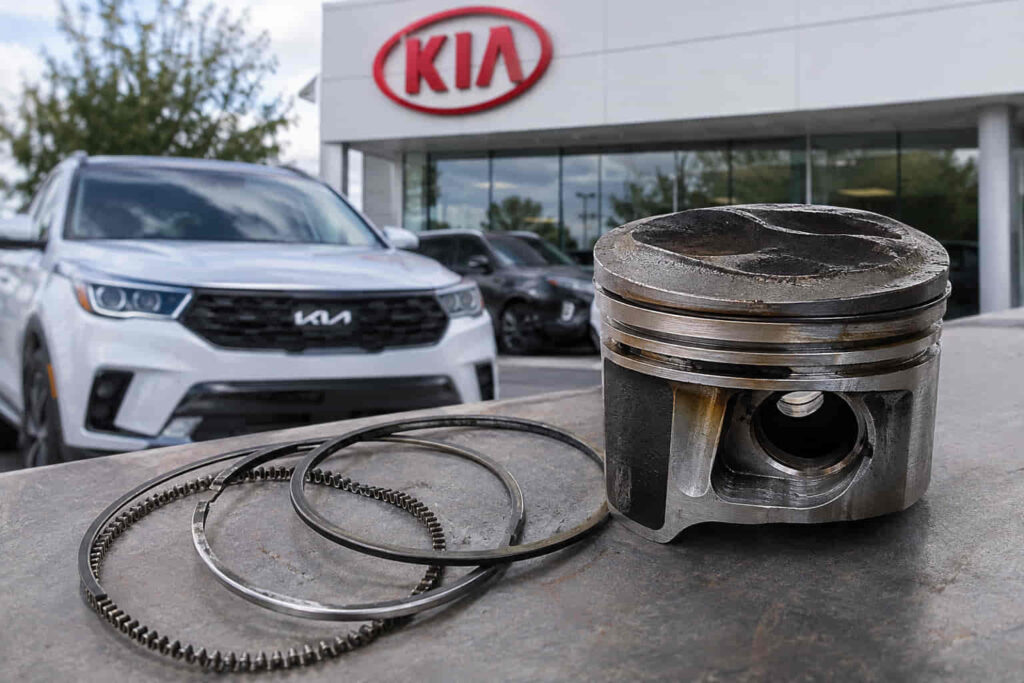
The Kia piston ring recall affects certain Kia Soul and Kia Seltos vehicles from model years 2020 through 2023 equipped with 2.0-liter engines. Kia issued two major safety recalls, SC209 in 2021 and SC336 in 2025, to address defective piston oil rings that can cause engine damage, sudden engine stalling, and an increased risk of fire. Affected vehicles may qualify for free engine inspections, software updates, or engine replacement through authorized Kia dealerships.
The problem involves piston oil rings that may have been improperly manufactured, allowing internal engine components to deteriorate during operation. As damage progresses, drivers may experience abnormal engine noises, excessive oil consumption, or an illuminated oil pressure warning light. Severe engine damage can cause the vehicle to lose power while driving, creating a safety hazard, particularly at highway speeds.
The recalls involve specific production populations rather than every Kia Soul or Seltos manufactured during these model years. Owners must check their 17-character Vehicle Identification Number (VIN) through the National Highway Traffic Safety Administration (NHTSA) or Kia’s official recall lookup system to confirm eligibility. This guide explains which Kia models are affected, what causes piston ring failure, how to recognize warning signs, and how Kia handles recall repairs at no cost to eligible owners.
What Is the Kia Piston Ring Recall?
The Kia piston ring recall is a safety recall addressing defective piston oil rings in certain Kia Soul and Kia Seltos vehicles equipped with 2.0-liter engines. Kia initiated two separate recall campaigns, SC209 in April 2021 and SC336 in February 2025, after identifying manufacturing defects that could cause internal engine damage, engine stalling, and an increased risk of fire. The National Highway Traffic Safety Administration (NHTSA) identifies these campaigns as 21V259000 and 25V099000, respectively.
Recall SC209 addresses piston oil rings that may not have received the proper heat treatment during manufacturing. Heat treatment determines the hardness and durability of metal components exposed to repeated friction and high operating temperatures. When piston oil rings lack the required hardness, they can wear or chip prematurely, potentially damaging the cylinder walls and other internal engine components. Progressive engine damage can eventually result in engine seizure or a sudden loss of power while driving.
Recall SC336 covers an additional population of Kia Soul and Seltos vehicles manufactured with piston oil rings that may have been produced incorrectly by a supplier. Although both recalls involve piston oil ring defects and similar engine safety risks, they represent separate manufacturing investigations with different affected vehicle populations. Owners should therefore identify the applicable recall campaign rather than assume that all piston ring problems fall under SC209.
An open Kia piston ring recall requires an authorized Kia dealer to perform the applicable recall remedy without charging the vehicle owner. Depending on the campaign and inspection results, the remedy may involve inspecting the engine, replacing it when required, and installing or updating piston ring noise sensing software. Recall eligibility is determined by the vehicle’s VIN and production records, not simply by the presence of engine noise or excessive oil consumption.
Which Kia Models and Years Are Affected by the Piston Ring Recall?
The Kia piston ring recalls cover certain 2020–2023 Kia Soul and 2021–2023 Kia Seltos vehicles equipped with the 2.0-liter Nu Multi-Point Injection (MPI) engine. The two campaigns collectively identify 284,505 potentially affected vehicles in the United States, including 147,249 vehicles under recall SC209 and 137,256 under recall SC336. These figures represent the reported recall populations, not the number of engines confirmed to have failed. NHTSA+1
Under recall SC209, Kia identified certain 2020–2021 Soul vehicles manufactured between November 24, 2018, and October 24, 2020, along with certain 2021 Seltos vehicles manufactured between November 20, 2019, and October 15, 2020. The campaign includes approximately 125,400 Soul vehicles and 21,849 Seltos vehicles. All affected vehicles use the 2.0L Nu MPI engine, and the recall specifically addresses piston oil rings that may have become excessively hard because of improper heat treatment during manufacturing. NHTSA+1
Recall SC336 expanded the affected model-year coverage to certain 2021–2023 Kia Soul and Seltos vehicles. According to Kia’s March 31, 2025 recall documentation, the affected Soul vehicles were manufactured between July 2, 2020, and April 19, 2022, while the affected Seltos vehicles were manufactured between July 2, 2020, and July 1, 2022. This campaign covers approximately 83,621 Soul vehicles and 53,635 Seltos vehicles. Both models are equipped with the 2.0L Nu MPI engine, and the defect involves a supplier manufacturing quality deviation affecting the piston oil rings. NHTSA+1
The distinction between model year and manufacturing date is essential when determining recall eligibility. A 2022 Kia Soul, for example, falls within the model-year range of SC336, but that alone does not establish that its engine contains the defective component. Likewise, a 2021 Kia Seltos may fall within the model-year coverage of either campaign, depending on its production records. The vehicle’s VIN determines whether a specific Kia Soul or Seltos is included in an applicable recall, and owners should verify that information before scheduling repairs.
Read more: how to remove sunscreen from car interior
What Causes the Kia Piston Ring Defect?
The Kia piston ring defect results from manufacturing irregularities that compromise the durability of piston oil rings inside certain 2.0L Nu MPI engines. Recall SC209 involves improperly heat-treated piston oil rings, while recall SC336 addresses a separate manufacturing quality deviation involving piston oil rings supplied for affected engines. Both defects can damage internal engine components, although the specific manufacturing circumstances differ between the two recall campaigns.
In recall SC209, improper heat treatment can make piston oil rings excessively hard and susceptible to chipping. Piston oil rings are installed in grooves around the lower portion of each piston and regulate the amount of lubricating oil remaining on the cylinder walls. As the piston moves up and down, these rings remove excess oil while maintaining the lubrication needed to reduce friction between moving components. When an excessively hard ring chips, fragments can become trapped between the piston and cylinder wall, creating abrasive contact that damages the cylinder surface.
Cylinder wall damage can interfere with oil control, increase friction, and accelerate wear inside the combustion chamber. Damaged piston rings may also allow excessive engine oil to enter the combustion chamber, where it burns during normal engine operation. As deterioration progresses, the engine may develop abnormal noises, consume more oil than expected, or experience mechanical failure. Severe internal damage can eventually prevent the crankshaft and pistons from moving freely, resulting in engine seizure.
Recall SC336 involves piston oil rings that may have been manufactured incorrectly because of a supplier quality deviation. Although the resulting damage can resemble the failures associated with SC209, the recalls should not be treated as evidence of an identical heat-treatment defect. The common mechanical concern is that defective piston oil rings can damage the engine during operation, creating a potential loss-of-power hazard before the driver receives sufficient warning.
What Are the Safety Risks of Defective Kia Piston Rings?
The two primary safety risks associated with defective Kia piston rings are sudden engine stalling and engine fire. Both recall SC209 and SC336 identify internal engine damage as the underlying hazard, with continued vehicle operation increasing the possibility of mechanical failure. An engine that stalls unexpectedly can interrupt vehicle propulsion in traffic, while oil leaking from a damaged engine block onto hot exhaust components can create a fire hazard. These risks are documented in Kia’s official safety recall notices submitted to the NHTSA.
Engine stalling can occur when piston ring damage progresses beyond the cylinder walls and affects other moving components. Under recall SC209, Kia explains that excessive cylinder bore wear can increase oil consumption and eventually contribute to connecting rod bearing seizure. A seized bearing can cause extensive engine damage and stop the engine from operating. When this happens while the vehicle is moving, the driver may experience an unexpected loss of propulsion, increasing the risk of a collision during highway driving, intersection crossings, or other situations requiring continuous engine power.
An engine fire represents a separate consequence of severe mechanical damage. In the SC209 failure scenario, a seized connecting rod bearing can lead to a connecting rod puncturing the engine block. The resulting opening allows engine oil to escape and potentially contact hot exhaust components. Recall SC336 identifies a similar fire hazard involving oil leakage through a damaged engine block. The fire risk arises from engine oil contacting hot surfaces after severe internal damage, not simply from the presence of defective piston rings.
Warning signs can appear before complete engine failure. Kia identifies increased oil consumption, abnormal engine noise, and illumination of the oil pressure warning light as indicators associated with the recalled piston ring defects. Owners who experience these symptoms should stop in a safe location, turn off the engine, and avoid driving the vehicle until it has been inspected. Kia advises affected owners to arrange towing to an authorized dealership rather than continue operating a potentially damaged engine. Owners in the United States can contact Kia Roadside Assistance at 1-800-333-4542 for assistance.
How Can You Check a Kia Piston Ring Recall by VIN?
You can check whether your Kia is affected by a piston ring recall by entering its 17-character Vehicle Identification Number (VIN) into the NHTSA recall lookup tool or Kia’s official recall website. Both systems identify outstanding safety recalls associated with a specific vehicle, allowing owners to determine whether their Kia Soul or Seltos requires an authorized dealership inspection or repair. VIN verification is more reliable than checking the model year alone because recall SC209 and SC336 apply only to designated vehicle production populations.
The VIN is a unique identification code assigned to each vehicle during manufacturing. Kia owners can find it on the driver’s side of the dashboard, where it is visible through the windshield, or on the certification label attached to the driver’s door jamb. The VIN also appears on vehicle registration documents, insurance records, and the vehicle title. Each VIN contains information about the vehicle’s manufacturer, characteristics, model year, assembly plant, and production sequence, which helps manufacturers identify vehicles included in safety recall campaigns.
To check an outstanding recall, visit the NHTSA recall lookup website, select the VIN search option, and enter the complete 17-character identification number. The database displays unrepaired safety recalls associated with the vehicle, including the applicable recall description and manufacturer information. Owners can also use Kia’s official recall lookup to check their vehicle’s recall status. A VIN search showing no open recalls does not necessarily establish that the vehicle has never been recalled, because completed recall repairs generally do not appear as outstanding safety recalls.
For the Kia piston ring recalls, owners should look for campaign SC209, associated with NHTSA recall number 21V259000, or campaign SC336, associated with NHTSA recall number 25V099000. A vehicle may share the same model year and engine configuration as recalled vehicles without being included in the affected manufacturing population. The VIN-specific recall status determines whether Kia has identified the vehicle as requiring the applicable safety recall remedy. If a recall appears, the owner should contact an authorized Kia dealership, provide the VIN, and schedule the required inspection or repair. Owners who cannot confirm their recall status online can contact Kia Customer Care at 1-800-333-4542.
How Does Kia Repair Vehicles Affected by the Piston Ring Recall?
Kia repairs vehicles affected by the piston ring recalls through authorized dealership inspections, engine replacement when required, and installation or updating of the Piston Ring Noise Sensing System (PNSS), according to the applicable recall campaign. The repair procedure depends on the vehicle’s recall eligibility, engine condition, and the specific instructions issued by Kia. The objective is to identify engines showing signs of internal damage, replace engines that meet the recall’s replacement criteria, and provide additional monitoring for abnormal engine operation.
For recall SC209, authorized Kia technicians follow the manufacturer’s inspection and repair procedures to evaluate the engine for conditions associated with defective piston oil rings. The inspection process can involve checking for abnormal engine noise and other indicators of internal engine damage. Vehicles that meet the specified replacement criteria receive an engine replacement under the recall. Vehicles that do not require engine replacement receive the applicable PNSS software update, which is designed to detect abnormal engine noise associated with developing mechanical damage.
The Piston Ring Noise Sensing System monitors engine operating signals to identify noise patterns that may indicate deterioration associated with the piston ring defect. When the system detects a qualifying abnormal condition, it can activate the malfunction indicator lamp and provide a warning through the vehicle’s engine management system. This additional monitoring helps alert drivers to potential engine damage before further operation increases the risk of severe failure. However, PNSS software does not repair defective piston rings, restore damaged cylinder walls, or reverse existing mechanical wear. Its function is to improve the detection of abnormal engine conditions so that the vehicle can be inspected and repaired when necessary.
Recall SC336 also provides an inspection-based remedy that may include engine replacement and PNSS software installation or updating. Because SC336 involves a separate manufacturing defect and vehicle population, dealerships must follow the service instructions associated with that campaign rather than automatically applying the SC209 procedure. An engine replacement is not required for every recalled vehicle; the applicable inspection results and Kia’s technical criteria determine whether replacement is necessary. Owners should request confirmation of the recall work performed, including whether the engine was replaced or the monitoring software was updated.
Recall repairs must be performed by an authorized Kia dealership to ensure that the manufacturer’s prescribed procedures, replacement components, and software calibrations are used. After completing the repair, the dealership records the recall remedy against the vehicle’s VIN in Kia’s service system. Owners should retain the repair invoice or service completion record, even when the recall work is performed at no charge. This documentation helps establish the vehicle’s repair history and provides useful information for future maintenance, warranty inquiries, or resale.
Is the Kia Piston Ring Recall Repair Free?
Yes, Kia piston ring recall repairs are free for vehicles covered by recall SC209 or SC336, including the required engine inspection, applicable software updates, and engine replacement when authorized under the recall remedy. Federal motor vehicle safety recall requirements generally obligate manufacturers to correct qualifying safety defects without charging vehicle owners. Kia provides these remedies through authorized dealerships, and eligibility is determined by the vehicle’s VIN and the repair procedures associated with the applicable recall campaign.
The free repair coverage applies to the specific defect identified in the recall rather than every mechanical problem involving the engine. For example, a 2021 Kia Seltos included in recall SC209 may receive the required inspection and Piston Ring Noise Sensing System (PNSS) software update at no charge. If the engine meets Kia’s recall-specific replacement criteria, the dealership performs the authorized engine replacement without charging the owner for covered parts or labor. However, unrelated repairs, such as correcting damage caused by an independent cooling system failure, are not automatically included in the piston ring recall remedy.
Kia piston ring recall coverage is separate from the vehicle’s standard powertrain warranty. A safety recall remains applicable to an affected vehicle even after its original factory warranty expires, provided the recall is still open and the vehicle meets the manufacturer’s eligibility requirements. This distinction matters for owners of older Kia Soul and Seltos vehicles whose original warranty periods have ended. A qualifying recall repair does not require the owner to purchase an extended warranty or demonstrate that the vehicle is still within its original mileage limits.
Owners who previously paid for repairs related to the recalled piston ring defect may also qualify for reimbursement under Kia’s applicable reimbursement program. Eligibility depends on whether the previous repair addressed the same defect, when the repair occurred, and whether the owner can provide supporting documentation. Repair invoices, proof of payment, vehicle identification information, and descriptions of the work performed help Kia evaluate reimbursement requests. A previously paid engine replacement does not automatically qualify for reimbursement merely because the vehicle belongs to a recalled model year.
Owners should contact an authorized Kia dealership with their VIN to confirm the outstanding recall, available remedy, and any required parts before scheduling service. Kia Customer Care can also provide information about recall eligibility and reimbursement procedures at 1-800-333-4542. A qualifying recall repair must be completed without charging the owner for the prescribed remedy, although unrelated maintenance or repairs requested during the same visit may carry separate charges.
What Are the Symptoms of Kia Piston Ring Failure?
The primary symptoms associated with Kia piston ring failure include excessive engine oil consumption, abnormal engine noises, an illuminated oil pressure warning light, and unexpected engine stalling. These warning signs can develop when defective piston oil rings damage the cylinder walls or contribute to progressive internal engine wear. Kia identifies abnormal engine noise and oil-related warning indicators as important signs of potential engine damage in vehicles affected by the piston ring recalls. However, these symptoms are not exclusive to the recalled defect and require mechanical inspection to determine their underlying cause.
Excessive oil consumption can occur when damaged piston oil rings no longer regulate the lubricating oil remaining on the cylinder walls. During normal operation, piston oil rings remove excess oil from the cylinder surface while leaving a thin protective film. When the rings or cylinder walls become damaged, additional oil may enter the combustion chamber and burn with the air-fuel mixture. Drivers may notice that the engine oil level decreases between scheduled maintenance intervals, requiring repeated oil additions. Severe oil consumption can reduce the available lubrication and accelerate wear in other engine components, including crankshaft bearings and connecting rod bearings.
Abnormal engine noise is another warning sign of potential internal damage. Affected engines may develop knocking, tapping, or other unusual mechanical sounds as friction increases or internal components deteriorate. Noise associated with connecting rod bearing damage can become more noticeable as engine speed changes because the damaged components experience repeated mechanical loading. Although engine knocking can result from several mechanical conditions, persistent or worsening noise in a recalled Kia Soul or Seltos requires prompt inspection. Continuing to drive with severe internal engine noise increases the risk of additional damage and complete engine failure.
The oil pressure warning light indicates a potentially serious lubrication problem. When engine oil pressure falls below the required operating threshold, critical components may no longer receive sufficient lubrication to prevent damaging metal-to-metal contact. In vehicles with severe piston ring-related engine damage, excessive oil consumption or secondary mechanical deterioration can contribute to lubrication problems. Drivers should safely stop the vehicle and shut off the engine if the oil pressure warning light illuminates while driving. Continuing to operate an engine with inadequate oil pressure can cause extensive damage within a short period, regardless of whether the vehicle is included in a Kia recall.
Unexpected engine stalling is among the most serious symptoms because it can indicate advanced mechanical failure. If internal engine damage progresses to bearing seizure or another condition that prevents normal crankshaft rotation, the engine may stop running without sufficient warning. The resulting loss of propulsion can make it difficult to maintain speed or maneuver safely in traffic. Power steering assistance and other engine-dependent functions may also be affected, depending on the vehicle’s design and operating condition. Drivers who experience sudden engine shutdown should move to a safe location when possible and arrange professional assistance rather than repeatedly attempting to restart a damaged engine.
The presence of these symptoms does not automatically confirm a defective piston oil ring or establish eligibility for recall SC209 or SC336. Excessive oil consumption can also result from worn valve stem seals, external oil leaks, or other engine conditions, while knocking noises and low oil pressure can have separate mechanical causes. A VIN recall check establishes whether the vehicle is included in an affected production population, while a mechanical inspection identifies the cause and severity of the engine problem. Owners experiencing abnormal engine noise, persistent oil loss, or an oil pressure warning should arrange an authorized Kia inspection promptly, even if their VIN does not show an outstanding piston ring recall.
How Much Does Kia Piston Ring Repair Cost Without Recall Coverage?
Kia piston ring repair costs depend on the extent of engine damage, the repair method, and the labor required to restore the engine. When a Kia Soul or Seltos is not eligible for a free recall remedy or applicable warranty coverage, owners may need to pay for piston ring replacement, engine rebuilding, or complete engine replacement. Replacing damaged piston rings requires substantial engine disassembly, while severe cylinder wall damage or connecting rod bearing failure can make an engine replacement more practical than repairing individual components.
Piston ring replacement is labor-intensive because the rings are located inside the engine’s cylinders, around the pistons. Technicians must remove major engine components, extract the pistons, inspect the cylinder walls, and install replacement rings that meet the manufacturer’s specifications. The repair may also require new gaskets, seals, engine oil, and other components disturbed during disassembly. If the cylinder walls have developed scoring or excessive wear, replacing the rings alone may not restore proper compression or oil control. Additional machining or replacement of damaged internal components may be necessary.
An engine rebuild becomes more extensive when piston ring failure damages the cylinder walls, pistons, crankshaft bearings, or connecting rods. Rebuilding involves inspecting and restoring multiple internal components to acceptable mechanical tolerances. The total cost depends on the availability of replacement parts, machine shop services, and the number of labor hours required. A complete engine replacement eliminates the need to repair individual damaged components inside the original engine, but the expense varies according to whether the replacement assembly is new, remanufactured, or used. Installation labor, fluids, and associated components also contribute to the final invoice.
For Kia owners comparing repair options, the most useful estimate is a written, VIN-specific quotation from a qualified repair facility. The quotation should distinguish diagnostic charges, replacement parts, labor, machining requirements, and warranty coverage for the completed work. Published average engine repair prices cannot reliably establish the cost of a particular piston ring failure without knowing the engine’s condition. Owners should verify recall and warranty eligibility before authorizing an out-of-pocket engine repair, because a qualifying Kia piston ring recall remedy may eliminate the cost of the covered inspection or engine replacement.
If a dealership determines that the vehicle is not eligible for recall coverage, owners should request an explanation of the decision and retain the diagnostic findings. A vehicle outside the affected recall population may still qualify for assistance under an applicable factory warranty, extended warranty, or other manufacturer coverage program. However, the presence of engine damage does not automatically establish warranty eligibility. The repair facility must identify the mechanical failure, and the applicable coverage terms determine whether Kia or the vehicle owner is responsible for the repair expense.
Can You Buy a Used Kia Soul or Seltos With a Piston Ring Recall?
You can buy a used Kia Soul or Seltos that was included in a piston ring recall, but its recall completion status and engine condition should be verified before purchase. A vehicle previously affected by recall SC209 or SC336 is not necessarily unsafe after receiving the prescribed remedy. However, an outstanding recall or unresolved engine symptoms can expose the buyer to mechanical problems, unexpected downtime, and safety risks. The most important distinction is whether the vehicle has received the required recall service and whether its engine shows evidence of existing damage.
A used Kia Soul from model years 2020 through 2023 or a Kia Seltos from model years 2021 through 2023 deserves particular attention when equipped with the 2.0L Nu MPI engine. These model-year ranges overlap with the vehicle populations identified in the two piston ring recall campaigns, although not every vehicle within those years is affected. Buyers should obtain the vehicle’s 17-character VIN and check it through the NHTSA recall database or Kia’s official recall lookup system. The results help identify outstanding safety recalls, but a separate service history review is necessary to determine which repairs were previously completed.
Recall completion records provide important information about the engine’s repair history. A dealership service invoice may show that Kia performed an engine inspection, installed the Piston Ring Noise Sensing System software update, or replaced the engine under the applicable recall procedure. Buyers should examine the recorded service date, mileage, repair description, and replacement components. If an engine replacement was performed, the service documentation should identify the work completed and any applicable parts or repair warranty. A completed recall establishes that the prescribed remedy was recorded, but it does not guarantee that the engine is free from unrelated mechanical problems.
A pre-purchase mechanical inspection should focus on engine oil consumption, abnormal operating noises, visible oil leaks, and warning lights. A technician can inspect the engine oil level and condition, listen for unusual mechanical sounds during operation, and check for diagnostic trouble codes stored in the engine control system. When the vehicle’s maintenance history or symptoms justify additional testing, compression testing or other engine diagnostic procedures can help evaluate internal mechanical condition. These checks are particularly valuable when the seller cannot provide complete maintenance records or when the vehicle has experienced previous engine-related repairs.
Buyers should also distinguish a completed recall from a vehicle that remains eligible for an outstanding repair. An open safety recall generally follows the affected vehicle rather than its original owner, so a subsequent owner can arrange the applicable remedy through an authorized Kia dealership. Nevertheless, purchasing a vehicle with unresolved engine damage introduces uncertainty about its immediate reliability and repair needs. The safest purchasing decision is based on a verified VIN recall status, documented service history, and an independent assessment of the engine’s mechanical condition. These records help buyers determine whether the vehicle has received the required safety remedy and whether additional repairs may be necessary after purchase.