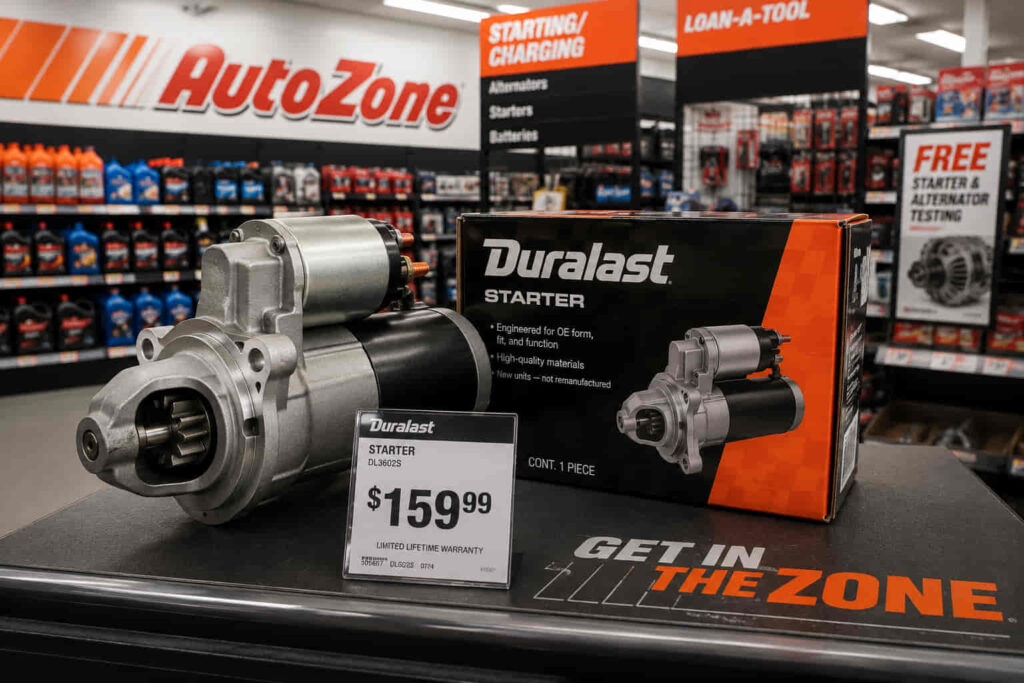
A failing starter is one of the most common reasons a vehicle refuses to start even when the battery is fully charged. When this happens, many drivers turn to AutoZone because it offers a wide selection of replacement starters for domestic, European, and Asian vehicles. However, one of the first questions shoppers ask is, “How much does a starter cost at AutoZone?” The answer is not a single price because starter motors vary significantly based on the vehicle, engine size, brand, warranty, and whether the unit is new or remanufactured.
Understanding the actual cost involves more than comparing price tags. Buyers should also consider the quality of the starter, core charges, warranty coverage, installation expenses, and long-term reliability. In many cases, paying slightly more for a premium starter can reduce the likelihood of premature failure and lower the total cost of ownership over several years.
This guide explains everything you need to know about AutoZone starter prices, including what affects the cost, how different starter options compare, and whether purchasing a starter from AutoZone represents good value. By the end of this article, you’ll have a clear understanding of how to choose the right starter for your vehicle while avoiding unnecessary expenses.
How Much Does a Starter Cost at AutoZone?
Starter prices at AutoZone typically range from approximately $70 to more than $400, depending on the vehicle and the replacement part selected. Most compact cars and older sedans use relatively inexpensive starter motors, while larger SUVs, pickup trucks, diesel vehicles, and luxury models require more powerful units that cost considerably more. Rather than offering one universal starter, AutoZone stocks hundreds of vehicle-specific models engineered to match the electrical and mechanical requirements of different engines.
For many popular passenger vehicles, a remanufactured starter generally falls within the lower end of the price range, often between $70 and $180. These units are rebuilt using original housings with new wear components and undergo testing before being sold again. Because manufacturers reuse major structural parts, remanufactured starters are usually less expensive while still delivering dependable performance for daily driving. They remain a popular choice among budget-conscious vehicle owners who want to restore reliable engine starting without paying the premium associated with brand-new components.
New starters typically cost more because every major internal component is newly manufactured rather than rebuilt. Prices commonly range from $150 to over $400, especially for vehicles equipped with larger engines, start-stop technology, or more complex electrical systems. Premium product lines frequently include upgraded bearings, improved solenoids, heavier-duty windings, and extended warranty coverage, making them suitable for drivers planning to keep their vehicles for many years.
Vehicle type is one of the biggest factors influencing starter prices. A starter designed for a four-cylinder Honda Civic or Toyota Corolla is mechanically simpler and requires less torque than one built for a heavy-duty Chevrolet Silverado, Ford F-250, or RAM truck. Likewise, luxury vehicles from BMW, Mercedes-Benz, Audi, and Lexus often use specialized starter assemblies that integrate with sophisticated engine management systems, resulting in significantly higher replacement costs.
The brand selected also affects pricing. AutoZone carries several replacement starter options depending on vehicle application, with premium product lines generally costing more than economy alternatives because they offer stronger internal components, longer service life, and more comprehensive warranty protection. Buyers should evaluate value rather than focusing exclusively on the lowest purchase price. A higher-quality starter that lasts well beyond 100,000 miles often proves less expensive over the life of the vehicle than replacing a lower-cost unit multiple times.
It is also important to understand that the displayed shelf price may not represent the final amount paid at checkout. Many starter motors require a refundable core charge, which temporarily increases the purchase price until the old starter is returned. This practice supports remanufacturing programs that reduce manufacturing waste while helping maintain a supply of replacement components. Buyers unfamiliar with automotive parts may initially assume the starter is more expensive than advertised when, in reality, part of the payment is refunded after the original unit is brought back.
Another consideration is that online prices and in-store availability may vary depending on the location and vehicle application. Popular starters for high-volume models are typically stocked in local stores, while less common applications may require special ordering. AutoZone’s online vehicle lookup tool allows customers to enter the year, make, model, and engine to view compatible starter options, pricing, warranty information, and inventory before visiting a store. This vehicle-specific search produces a far more accurate estimate than relying on general price ranges.
Ultimately, the cost of a starter at AutoZone should be evaluated alongside durability, warranty coverage, compatibility, and expected service life instead of price alone. Although most buyers can expect to spend between $70 and $400 for the part itself, selecting the right starter depends on balancing budget, vehicle requirements, and long-term reliability rather than choosing the least expensive option available.
What Factors Affect Starter Prices at AutoZone?
The price of a starter at AutoZone is determined by several factors rather than a single fixed retail price. Although many shoppers expect every starter motor to cost roughly the same, replacement starters are engineered for specific vehicles, electrical systems, and engine configurations. As a result, two vehicles of the same model year can have noticeably different starter prices simply because they use different engines or starting systems. Understanding these pricing factors allows buyers to compare products more accurately and avoid purchasing a starter based solely on cost.
Vehicle make and model have the greatest influence on starter pricing because every manufacturer designs its starting system differently. Compact economy cars generally use smaller starter motors with lower torque requirements, making them less expensive to manufacture and replace. In contrast, full-size pickup trucks, heavy-duty SUVs, commercial vans, and performance vehicles require larger, more powerful starters capable of turning higher-displacement engines. These starters contain larger electric motors, heavier-duty solenoids, stronger reduction gears, and more robust internal components, all of which increase production costs and retail pricing.
Engine size also plays an important role because the amount of torque required to crank an engine rises as engine displacement increases. A starter designed for a naturally aspirated four-cylinder engine performs a much lighter workload than one built for a V8, turbocharged engine, or diesel powertrain. Diesel engines, in particular, generate much higher compression during the combustion cycle, requiring starter motors with significantly greater cranking power. This additional engineering often places diesel starters among the most expensive replacement units available at AutoZone.
Another major pricing factor is whether the starter is new or remanufactured. A remanufactured starter begins as an original factory unit that has been completely disassembled, cleaned, inspected, and rebuilt using replacement components for worn parts such as bearings, brushes, bushings, solenoids, and electrical contacts. Because manufacturers reuse the original housing and other reusable components, production costs remain lower, allowing these starters to be sold at more affordable prices. For many daily drivers, a professionally remanufactured starter delivers reliable performance while providing meaningful savings compared with purchasing a brand-new unit.
New starters command higher prices because every major component is newly manufactured rather than restored. These products eliminate concerns about reused structural parts and often incorporate updated materials or design improvements that enhance durability and electrical efficiency. Premium replacement starters may feature stronger armatures, improved insulation, upgraded bearings, and higher-quality solenoids that better withstand repeated heat cycles and heavy use. Drivers who plan to keep their vehicles for many years frequently view the additional purchase cost as a worthwhile investment because it reduces the likelihood of premature replacement.
Brand selection further contributes to price differences. AutoZone offers multiple replacement options for many vehicles, ranging from economy products to premium lines with enhanced construction and longer warranty coverage. Higher-end starters typically undergo more extensive quality testing and use upgraded internal components that improve long-term reliability under demanding operating conditions. Although budget-friendly options can restore normal engine starting, premium models often provide greater confidence for vehicles exposed to frequent stop-and-go traffic, extreme temperatures, or heavy towing.
Warranty coverage represents another factor that influences retail pricing. Replacement starters backed by longer warranties generally cost more because the manufacturer assumes greater long-term responsibility for product performance. Limited lifetime warranties are commonly associated with premium starter lines, while economy models may include shorter coverage periods. For drivers intending to own their vehicles well beyond the average replacement interval, extended warranty protection can offset a higher initial purchase price by reducing future repair expenses if the starter fails prematurely.
Vehicle technology has also become increasingly important in determining starter prices. Modern automobiles incorporate advanced engine management systems, automatic start-stop technology, electronic immobilizers, and integrated powertrain controls that require more sophisticated starter assemblies. These starters must communicate seamlessly with multiple electronic control modules while delivering rapid and consistent engine engagement. The increased complexity of modern electrical systems often results in higher manufacturing costs than those associated with older vehicles that use simpler mechanical starting systems.
Market availability and parts demand can also affect pricing. Starters for high-volume vehicles such as the Honda Civic, Toyota Corolla, Ford F-150, and Chevrolet Silverado are produced in much larger quantities than components designed for low-production luxury or specialty vehicles. Greater production volume generally lowers manufacturing costs through economies of scale, while limited-production parts remain more expensive because fewer units are manufactured and distributed. Buyers may therefore notice that replacement starters for rare imports or discontinued models cost significantly more than those for common passenger vehicles.
Finally, refundable core charges influence the amount customers pay during the initial purchase. Many remanufactured starters include a core deposit that is refunded once the old starter is returned for rebuilding. This program supports sustainable manufacturing by allowing usable components to be restored instead of discarded while helping maintain inventory for future replacement parts. Although the temporary deposit increases the upfront payment, it does not represent the permanent cost of the starter when the original unit is returned according to the retailer’s policy.
Understanding these factors explains why there is no universal AutoZone starter price. The final cost depends on the interaction between vehicle requirements, engine specifications, product type, brand quality, warranty coverage, and market availability. Evaluating all of these elements together allows buyers to select a starter that provides the best balance between affordability, reliability, and long-term value rather than simply choosing the lowest-priced option on the shelf.
Read more: SUVs With Captain Seats
Does AutoZone Sell New and Remanufactured Starters?
AutoZone sells both new and remanufactured starters, giving customers the flexibility to choose a replacement that matches their budget, driving habits, and long-term ownership plans. While both types are designed to restore reliable engine starting, they differ in manufacturing process, price, component quality, and expected service life. Understanding these differences helps buyers make an informed decision rather than selecting the least expensive option available.
A new starter is manufactured entirely from new components, including the armature, solenoid, bearings, brushes, gears, housing, and electrical contacts. Because every internal part is newly produced, these starters are built to meet the specifications required for modern vehicle starting systems without relying on reused components. This manufacturing process typically results in greater consistency and durability, particularly for vehicles that experience frequent engine starts, extreme weather conditions, or heavy daily use. Drivers who rely on their vehicles for commuting, commercial work, or long-distance travel often choose new starters because they offer greater confidence over an extended ownership period.
New starters also benefit from continuous improvements in manufacturing technology. Many aftermarket manufacturers have refined their designs by using stronger permanent magnets, upgraded copper windings, improved insulation materials, and more durable solenoid assemblies than those found in some original equipment units produced years earlier. These engineering improvements help reduce internal resistance, improve cranking efficiency, and increase resistance to heat and vibration, two of the most common causes of starter failure over time.
Remanufactured starters follow a different production process. Instead of building an entirely new unit, manufacturers begin with an original starter that has been removed from another vehicle. The unit is completely disassembled, cleaned, and carefully inspected before worn or damaged components are replaced. Critical parts such as bearings, brushes, bushings, seals, electrical contacts, and solenoids are commonly renewed, while reusable structural components such as the housing and certain internal assemblies are restored if they continue to meet engineering specifications. After reassembly, the starter undergoes performance testing to verify that it produces the required cranking torque and electrical output before being offered for sale.
Because remanufactured starters reuse selected components, they generally cost less than brand-new replacements. This lower production cost allows retailers such as AutoZone to provide affordable replacement options for older vehicles where minimizing repair expenses is often a priority. For many passenger cars and light trucks, a professionally remanufactured starter delivers reliable everyday performance while reducing the overall cost of the repair. Advances in remanufacturing technology have also improved consistency compared with earlier rebuilding practices, making today’s remanufactured starters more dependable than many drivers expect.
The choice between new and remanufactured starters often depends on vehicle age and ownership goals. Owners of older vehicles with high mileage may prefer a remanufactured starter because it restores reliable starting performance without investing heavily in a vehicle approaching the later stages of its service life. Conversely, drivers who own newer vehicles or plan to keep their cars for many additional years frequently view the higher purchase price of a new starter as a worthwhile investment. Spending more upfront can reduce the likelihood of another starter replacement while providing additional peace of mind during long-term ownership.
Warranty coverage should also be considered when comparing the two options. Many premium new starters available at AutoZone include longer warranty protection than entry-level remanufactured products, although warranty terms ultimately depend on the manufacturer and product line. A longer warranty not only reflects the manufacturer’s confidence in the product but also reduces potential replacement costs if a failure occurs within the coverage period. Buyers should compare warranty duration alongside product quality instead of focusing exclusively on retail price.
Reliability is another important consideration. Both new and professionally remanufactured starters are capable of delivering dependable performance when manufactured according to strict quality standards. However, new starters eliminate the uncertainty associated with reused structural components because every major part begins its service life at the same time. This consistency becomes increasingly valuable for vehicles subjected to demanding operating conditions such as frequent stop-and-go driving, heavy towing, commercial fleet use, or operation in extremely hot or cold climates where the starter experiences higher mechanical and thermal stress.
Environmental impact is an additional factor that distinguishes remanufactured starters. Rebuilding existing components reduces raw material consumption, lowers manufacturing energy requirements, and diverts usable automotive parts from landfills. By extending the life cycle of original equipment components, remanufacturing supports a more sustainable automotive repair industry while still providing consumers with dependable replacement parts. For environmentally conscious drivers, selecting a high-quality remanufactured starter can balance affordability with reduced environmental impact.
Ultimately, neither option is universally better because each serves a different type of buyer. New starters offer maximum durability, the latest manufacturing improvements, and greater long-term confidence, making them well suited for newer vehicles and owners seeking the longest possible service life. Remanufactured starters provide excellent value, lower purchase costs, and dependable performance for many everyday driving situations, making them an attractive solution for budget-conscious repairs. Evaluating vehicle age, expected ownership duration, driving conditions, warranty coverage, and repair budget together will lead to a better purchasing decision than comparing price alone.
Which Starter Brands Does AutoZone Carry?
AutoZone carries several starter brands that serve different price points, performance requirements, and vehicle applications. Rather than offering a single replacement option, the retailer provides multiple product lines so customers can choose between budget-friendly solutions and premium starters with enhanced durability and warranty coverage. Although availability varies by vehicle, the most common options include Duralast, Duralast Gold, and other aftermarket manufacturers that meet or exceed original equipment specifications for compatible vehicles.
Duralast is the primary starter brand sold at AutoZone and is designed to meet the needs of most everyday drivers. These starters are engineered as direct-fit replacements, allowing them to match the factory mounting points, electrical connections, and gear engagement required by the original starter motor. Because they are built specifically for each vehicle application, installation is generally straightforward when the correct part number is selected. Duralast starters are widely used on compact cars, midsize sedans, crossovers, SUVs, and light-duty pickup trucks, making them one of the most commonly purchased replacement starters available through AutoZone.
One reason Duralast remains popular is its balance between affordability and reliability. Instead of focusing solely on low pricing, the product line is designed to provide dependable starting performance under normal driving conditions while maintaining competitive costs. Many units undergo quality-control testing to verify proper torque output, electrical performance, and solenoid operation before reaching retail stores. This testing process helps reduce manufacturing defects and ensures the starter can consistently engage the flywheel and crank the engine under typical operating conditions.
For buyers seeking greater durability, AutoZone also offers Duralast Gold starters for many vehicle applications. This premium product line is intended for drivers who expect longer service life or place higher demands on their vehicles. Compared with standard replacement starters, Duralast Gold models often incorporate upgraded bearings, higher-quality brushes, reinforced solenoids, improved electrical contacts, and stronger internal components that better withstand repeated heat cycles and heavy daily use. These improvements help maintain consistent cranking performance throughout years of operation while reducing wear caused by frequent engine starts.
The difference between Duralast and Duralast Gold is not simply a higher price. Premium starters are typically engineered to perform more consistently under demanding conditions such as stop-and-go commuting, commercial fleet operation, rideshare driving, frequent short trips, and towing. Vehicles exposed to these environments may cycle the starter motor dozens of times each day, creating additional mechanical stress and heat buildup inside the starter assembly. Higher-grade internal materials help minimize premature wear, making premium starters an attractive option for owners planning to keep their vehicles for an extended period.
Depending on the vehicle, AutoZone may also stock replacement starters from other aftermarket manufacturers. These brands are selected based on compatibility, supplier availability, and regional inventory rather than applying one universal product line to every automobile. Some imported vehicles, luxury models, hybrid powertrains, and commercial applications require specialized starters produced by manufacturers with expertise in those specific systems. By partnering with multiple suppliers, AutoZone can support a much broader range of vehicle applications than would be possible with a single brand alone.
Compatibility remains more important than brand recognition when selecting a starter. Even two vehicles from the same manufacturer may require completely different starter motors because engine displacement, transmission design, production year, or trim level can alter the mounting configuration and electrical specifications. AutoZone’s vehicle lookup system helps eliminate compatibility issues by filtering available starters according to the exact year, make, model, engine size, and drivetrain entered by the customer. This vehicle-specific approach reduces the likelihood of purchasing an incompatible starter while ensuring proper fitment and reliable operation after installation.
Warranty coverage is another distinguishing factor among AutoZone’s starter offerings. Standard replacement starters typically include manufacturer-backed warranty protection, while premium product lines frequently provide longer coverage periods that reflect higher-quality materials and construction. Although warranty length should never be the only factor influencing a purchase, it provides additional confidence that the manufacturer stands behind the product’s expected service life. Buyers comparing multiple starter options should evaluate warranty terms together with component quality, expected mileage, and intended ownership duration rather than focusing solely on the purchase price.
Price differences between starter brands should also be viewed from a long-term ownership perspective. An economy starter may reduce the initial repair cost, but a premium replacement can deliver better value if it provides significantly longer service life and lowers the risk of future failures. Since replacing a starter often involves several hours of labor on many modern vehicles, minimizing the likelihood of repeating the repair can outweigh the additional cost of purchasing a higher-quality component. This is particularly true for vehicles where starter replacement requires removing intake manifolds, engine mounts, or other major components to access the starter assembly.
Customer reviews and purchasing trends further demonstrate why Duralast remains AutoZone’s flagship starter brand. Many drivers choose it because it combines broad vehicle coverage, consistent quality standards, nationwide availability, and convenient warranty support through AutoZone’s extensive retail network. Premium Duralast Gold products attract buyers who prioritize durability and long-term reliability, while economy alternatives appeal to owners seeking an affordable repair for older or high-mileage vehicles. Rather than one brand being universally superior, the best choice depends on the vehicle’s value, expected ownership period, daily driving conditions, and overall repair budget.
Ultimately, AutoZone’s starter selection is designed to accommodate a wide range of drivers rather than offering a one-size-fits-all solution. Whether purchasing a standard Duralast starter for an economical repair or investing in a premium Duralast Gold unit for maximum durability, buyers should evaluate compatibility, warranty coverage, construction quality, and long-term ownership costs together. Choosing the right starter is less about selecting the most recognizable brand and more about finding the product that best matches the vehicle’s mechanical requirements and the owner’s expectations for reliability.
Does AutoZone Charge a Core Fee for a Starter?
Yes, AutoZone charges a core fee for many replacement starters, particularly remanufactured units. The core charge is a refundable deposit added to the purchase price when the starter is bought. It is not an additional product fee or hidden cost. Instead, the deposit encourages customers to return their old starter so it can be rebuilt and reused in the remanufacturing process. Understanding how the core charge works is important because many buyers mistakenly believe the starter itself is more expensive than advertised when, in reality, part of the amount paid at checkout is refundable.
A starter motor contains durable structural components that often remain suitable for reuse even after the internal electrical parts have worn out. The aluminum housing, mounting brackets, drive assembly, and other major components can frequently be restored to original specifications through industrial remanufacturing. Rather than manufacturing an entirely new housing for every replacement starter, remanufacturers recover these reusable parts, inspect them for damage, replace worn internal components, and assemble them into reliable replacement units. This process reduces manufacturing costs while extending the service life of valuable automotive materials.
The core charge exists because the returned starter, commonly referred to as the “core,” has economic value. Without a refundable deposit, many worn starters would simply be discarded instead of entering the remanufacturing supply chain. By offering customers an incentive to return the original unit, retailers help maintain a consistent inventory of reusable components for future production. This closed-loop system has become standard throughout the automotive aftermarket and is commonly used not only for starters but also for alternators, brake calipers, steering racks, water pumps, and numerous other rebuildable components.
The amount of the core charge varies depending on the vehicle application and the specific starter being purchased. Smaller passenger vehicles typically have lower core deposits, while heavy-duty truck, diesel, commercial, and luxury vehicle starters may require substantially larger deposits because the components themselves are more valuable. Since the deposit is tied to the reusable value of the original starter rather than the retail price alone, two replacement starters with similar selling prices may have different core charges.
Receiving the refund is generally a straightforward process. After installing the replacement starter, the customer returns the original starter to an AutoZone store, where the staff verifies that it qualifies as a rebuildable core. Once accepted, the refundable deposit is credited back according to the original payment method and the retailer’s current return procedures. This means the customer’s final cost is reduced after the old starter has been successfully returned.
However, not every returned starter automatically qualifies for a refund. The core must usually be complete and capable of entering the remanufacturing process. A severely damaged housing, missing major structural components, extensive physical destruction, or evidence that the unit cannot reasonably be rebuilt may reduce or eliminate its rebuildable value. While cosmetic wear and normal operating damage are expected, components that have been intentionally dismantled or catastrophically damaged may not meet the manufacturer’s rebuilding requirements. For this reason, vehicle owners should avoid discarding or disassembling the old starter before returning it.
The core charge also explains why shoppers sometimes notice two different prices displayed for the same starter. One figure represents the retail selling price of the replacement unit, while the higher amount shown at checkout includes the refundable core deposit. Buyers unfamiliar with automotive parts often mistake the combined total as the permanent purchase price, leading to unnecessary confusion. Once the original starter is returned and the deposit is refunded, the effective cost of the replacement part becomes lower than the initial payment suggests.
Beyond reducing costs for manufacturers, the core return program provides significant environmental benefits. Rebuilding starter motors requires fewer raw materials and less energy than manufacturing entirely new units from scratch. Recovering reusable housings and structural components decreases industrial waste, conserves aluminum, steel, and copper resources, and lowers the environmental impact associated with automotive parts production. This approach aligns with broader sustainability efforts across the automotive aftermarket while allowing consumers to purchase dependable replacement parts at more competitive prices.
For buyers comparing new and remanufactured starters, understanding the relationship between core charges and pricing is essential. New starters may not always require a refundable core deposit because every component is newly manufactured, whereas remanufactured products frequently depend on returned cores to maintain production. Although the temporary deposit increases the amount paid at checkout, it should not be viewed as part of the permanent repair cost when the original starter is eligible for refund.
Ultimately, the core fee is an important part of AutoZone’s starter pricing structure rather than an unexpected extra charge. It supports the remanufacturing process, helps keep replacement part prices more affordable, reduces environmental waste, and encourages the responsible recycling of automotive components. Buyers who understand how the system works can evaluate starter prices more accurately and avoid confusing the temporary checkout total with the actual long-term cost of the replacement part.
How Much Does It Cost to Replace a Starter?
Replacing a starter costs considerably more than purchasing the part alone because the total expense includes both the replacement starter and the labor required to install it. While many drivers searching for AutoZone starter prices focus on the retail cost of the component, the complete repair bill depends on the type of vehicle, engine layout, labor rates in the local area, and whether the repair is performed by the owner, an independent repair shop, or a dealership. Understanding the full replacement cost provides a more realistic budget than looking at the price of the starter in isolation.
For most passenger vehicles, the total starter replacement cost typically ranges from $250 to $800, including parts and labor. Vehicles with simple engine layouts usually fall toward the lower end of this range because the starter is easily accessible and requires fewer labor hours to replace. Larger SUVs, pickup trucks, luxury vehicles, and models with tightly packaged engine compartments often cost significantly more because technicians must remove additional components before reaching the starter motor. In some cases, labor can account for more than half of the total repair cost.
The price of the replacement starter remains one of the largest factors affecting the final bill. Economy remanufactured starters generally cost less than premium new units, making them attractive for older vehicles where minimizing repair expenses is a priority. Premium starters with upgraded internal components and extended warranty coverage increase the initial investment but may reduce the likelihood of another replacement during the remaining life of the vehicle. When calculating total ownership costs, buyers should consider expected durability alongside the purchase price instead of automatically selecting the least expensive option.
Labor costs vary because every vehicle places the starter in a different location. On some front-wheel-drive sedans, the starter is mounted near the front of the engine and can be replaced within an hour or two using standard tools. Other vehicles position the starter beneath intake manifolds, behind exhaust components, or close to the transmission bell housing, requiring technicians to remove multiple parts before accessing the starter assembly. These additional procedures increase labor time and ultimately raise the overall repair cost.
Modern vehicle design has also contributed to higher installation costs. Manufacturers continue to optimize engine compartments for crash safety, emissions equipment, fuel efficiency, and aerodynamic performance, often leaving less space around major components. As a result, replacing a starter on many newer vehicles requires significantly more disassembly than older designs. Hybrid systems, turbocharged engines, four-wheel-drive drivetrains, and advanced electronic components can further increase installation complexity, even though the starter itself performs the same basic function of cranking the engine.
Where the repair is performed also affects the final price. Independent repair shops generally offer lower labor rates than franchised dealerships while still employing certified technicians capable of replacing starter motors on most vehicles. Dealership service departments typically charge higher hourly rates because they specialize in factory-specific diagnostics, original equipment parts, and manufacturer repair procedures. For vehicles still covered by factory warranties or requiring specialized programming after component replacement, dealership service may provide additional value despite the higher cost.
Some vehicle owners choose to replace the starter themselves to reduce repair expenses. Purchasing the replacement part from AutoZone and performing the installation can eliminate labor charges entirely, making DIY replacement an economical option for mechanically experienced individuals. However, starter replacement is not equally simple on every vehicle. Limited engine bay access, heavy electrical cables, restricted mounting locations, and safety considerations require appropriate tools and technical knowledge. Attempting the repair without adequate experience can lead to damaged electrical components, improper installation, or unnecessary diagnostic work if the starter was not the actual cause of the starting problem.
Accurate diagnosis before replacing the starter is equally important. A vehicle that fails to start does not always have a defective starter motor. Weak batteries, corroded battery terminals, faulty starter relays, damaged ignition switches, poor ground connections, failed solenoids, or charging system problems can produce symptoms that closely resemble starter failure. Replacing the starter without confirming the root cause may result in unnecessary repair costs while leaving the original problem unresolved. Performing a complete starting-system diagnosis before purchasing replacement parts helps ensure that the repair addresses the actual source of the failure.
Warranty coverage can also influence long-term replacement costs. Many premium starters sold through AutoZone include warranty protection that provides replacement coverage if the component fails during the warranty period. Although warranty terms do not cover installation labor in most situations, replacing only the failed part rather than purchasing another starter can substantially reduce future repair expenses. Buyers planning to keep their vehicles for several more years should evaluate warranty length together with product quality when comparing available starter options.
Ultimately, the total cost of replacing a starter should be evaluated as a combination of part quality, installation complexity, labor rates, and expected long-term reliability. While purchasing a starter from AutoZone generally costs between $70 and $400, the complete repair often falls between $250 and $800 after labor is included. Choosing a reliable replacement starter, confirming the correct diagnosis, and selecting the most appropriate installation option allows vehicle owners to control repair costs while restoring dependable engine starting performance.
Is Buying a Starter From AutoZone Worth It?
Buying a starter from AutoZone is worth considering for most vehicle owners because it combines competitive pricing, broad vehicle coverage, nationwide availability, and reliable warranty support. Rather than serving only as a retail auto parts store, AutoZone provides multiple replacement options that accommodate different budgets, vehicle types, and ownership goals. For drivers who need a replacement starter quickly, the ability to compare several compatible products in one place often simplifies the repair process and reduces vehicle downtime.
One of AutoZone’s biggest advantages is its extensive inventory. The retailer carries replacement starters for thousands of domestic, Asian, and European vehicles, including compact cars, sedans, SUVs, pickup trucks, commercial vans, and performance models. This broad catalog allows customers to search by year, make, model, engine size, and drivetrain, ensuring the replacement starter matches the vehicle’s original specifications. Selecting the correct starter is critical because even small differences in mounting configuration, electrical connectors, or gear engagement can prevent proper installation or cause premature failure.
AutoZone also appeals to buyers because it offers multiple price tiers instead of limiting customers to a single replacement option. Budget-conscious drivers can often choose an economical remanufactured starter that restores reliable engine starting at a lower cost, while those seeking maximum durability can upgrade to premium product lines with enhanced internal components and longer warranty coverage. This flexibility allows buyers to balance repair costs with expected vehicle ownership rather than paying for features they may not need.
Warranty protection represents another reason many consumers purchase starters from AutoZone. Many replacement starters include manufacturer-backed warranties that provide additional confidence if the component experiences an unexpected defect. Premium product lines frequently offer extended or limited lifetime warranty coverage for eligible applications, reducing future replacement expenses if the starter fails within the warranty period. Although warranty policies vary by manufacturer and product line, the availability of nationwide warranty service through AutoZone stores provides greater convenience than purchasing parts from smaller local suppliers with limited locations.
Convenience is another significant advantage. With thousands of retail locations and an established online ordering system, customers can quickly determine whether a compatible starter is available locally or requires special ordering. Many stores support same-day pickup for in-stock products, allowing drivers to begin repairs immediately rather than waiting several days for shipping. This rapid availability becomes especially valuable when a failed starter leaves a vehicle unusable and transportation is urgently needed for work, family responsibilities, or daily commuting.
AutoZone’s online vehicle lookup system further improves the purchasing experience by reducing compatibility errors. Instead of manually comparing part numbers or relying solely on visual inspection, customers can enter their vehicle information to receive a list of compatible starters along with pricing, warranty details, product specifications, and customer reviews. This digital filtering process minimizes the risk of purchasing an incorrect component while making it easier to compare multiple replacement options before making a final decision.
Customer reviews also contribute to the buying process by providing practical insight into long-term product performance. While individual experiences naturally vary depending on vehicle condition, installation quality, and driving habits, reviewing customer feedback helps buyers identify products that consistently deliver reliable starting performance over extended periods. Comparing verified user experiences alongside warranty coverage and product specifications creates a more informed purchasing decision than relying on price alone.
Price competitiveness further strengthens AutoZone’s position in the automotive aftermarket. In many cases, starter prices are comparable to those offered by other national retailers such as O’Reilly Auto Parts, Advance Auto Parts, and NAPA Auto Parts. Differences in pricing often result from manufacturer selection, warranty coverage, promotional discounts, or regional inventory rather than dramatic variations in base retail cost. Because these differences are usually relatively small, buyers often place greater value on immediate availability, warranty support, and store convenience than on saving a modest amount of money.
Despite these advantages, purchasing from AutoZone may not always represent the best solution for every situation. Owners of newer luxury vehicles, specialty performance cars, or vehicles still covered by factory warranties may prefer original equipment starters supplied through dealerships because they exactly match the factory-installed components. Similarly, some professional repair facilities recommend OEM parts for complex electrical systems where manufacturer-specific engineering may provide additional assurance. Evaluating vehicle age, expected ownership period, and repair objectives helps determine whether an aftermarket replacement or an OEM starter is the more appropriate investment.
Another consideration is the overall value of the repair relative to the vehicle itself. Investing in a premium starter with extended warranty coverage often makes sense for newer vehicles expected to remain in service for many years. Conversely, owners of older, high-mileage vehicles approaching the end of their useful life may prioritize affordability over maximum longevity. AutoZone’s broad product selection accommodates both approaches by allowing customers to choose the replacement starter that best aligns with their vehicle’s condition and repair budget.
Ultimately, buying a starter from AutoZone offers a strong balance of affordability, selection, convenience, and warranty support for the majority of drivers. The retailer’s wide inventory, multiple quality levels, reliable vehicle compatibility tools, and nationwide store network make it a practical destination for starter replacement parts. Rather than asking whether AutoZone sells good starters, the more important question is which starter best matches your vehicle, driving habits, and long-term ownership plans. Selecting the appropriate product based on quality, compatibility, warranty, and expected service life will provide far greater value than focusing exclusively on the lowest purchase price.
Frequently Asked Questions
How much does a starter cost at AutoZone?
A starter at AutoZone typically costs between $70 and $400 or more, depending on the vehicle, engine size, brand, and whether you choose a new or remanufactured unit. Economy cars generally require less expensive starters, while heavy-duty trucks, luxury vehicles, and diesel engines often use more complex starter assemblies that cost significantly more.
Does AutoZone sell new and remanufactured starters?
Yes. AutoZone offers both new and remanufactured starters for most passenger cars, SUVs, pickup trucks, and commercial vehicles. New starters use entirely new components and usually provide the longest service life, while remanufactured starters reuse the original housing and replace worn internal parts, making them a more affordable option for many drivers.
Does AutoZone charge a core fee for starters?
Many starter motors sold by AutoZone include a refundable core charge. This deposit is returned after you bring back your old starter in rebuildable condition. The core return program supports the remanufacturing process, reduces waste, and helps keep replacement part prices more affordable.
Can AutoZone test a starter?
Yes. AutoZone offers free starter testing at many participating locations. If the starter has already been removed from the vehicle, store associates can typically test its electrical performance to determine whether it operates within the manufacturer’s specifications. This service helps confirm whether the starter is actually defective before purchasing a replacement.
Does AutoZone install starters?
No. AutoZone sells replacement starters but does not provide starter installation services. Customers can install the starter themselves or have the repair completed by an independent repair shop or dealership.
How much does it cost to replace a starter?
The total cost to replace a starter generally ranges from $250 to $800, including both the replacement part and labor. Vehicles with limited engine access, larger engines, or more complex electrical systems usually require additional labor, increasing the overall repair cost.
Is it better to buy a new or remanufactured starter?
The best choice depends on your vehicle and ownership plans. A new starter is typically the better option for newer vehicles, commercial use, or long-term ownership because every component is newly manufactured. A remanufactured starter offers excellent value for older vehicles and budget-conscious repairs while still providing dependable starting performance when professionally rebuilt.
How long does a starter usually last?
Most starter motors last between 100,000 and 150,000 miles, although actual lifespan depends on driving habits, engine condition, climate, and maintenance. Frequent short trips, repeated engine starts, weak batteries, and excessive heat can shorten starter life, while a properly maintained electrical system often allows the starter to remain reliable well beyond the average service interval.
What are the signs of a failing starter?
Common symptoms include a single clicking noise when turning the key, slow engine cranking, intermittent starting problems, grinding noises during startup, or the engine failing to crank despite having a fully charged battery. These symptoms should be confirmed through proper diagnosis because battery, alternator, ignition switch, or wiring problems can produce similar starting issues.
Is buying a starter from AutoZone worth it?
For most drivers, yes. AutoZone offers competitive pricing, a wide selection of compatible starters, nationwide store availability, convenient online vehicle lookup tools, and manufacturer-backed warranties. Choosing the correct starter based on compatibility, warranty coverage, and expected service life typically provides better long-term value than selecting the lowest-priced option alone.