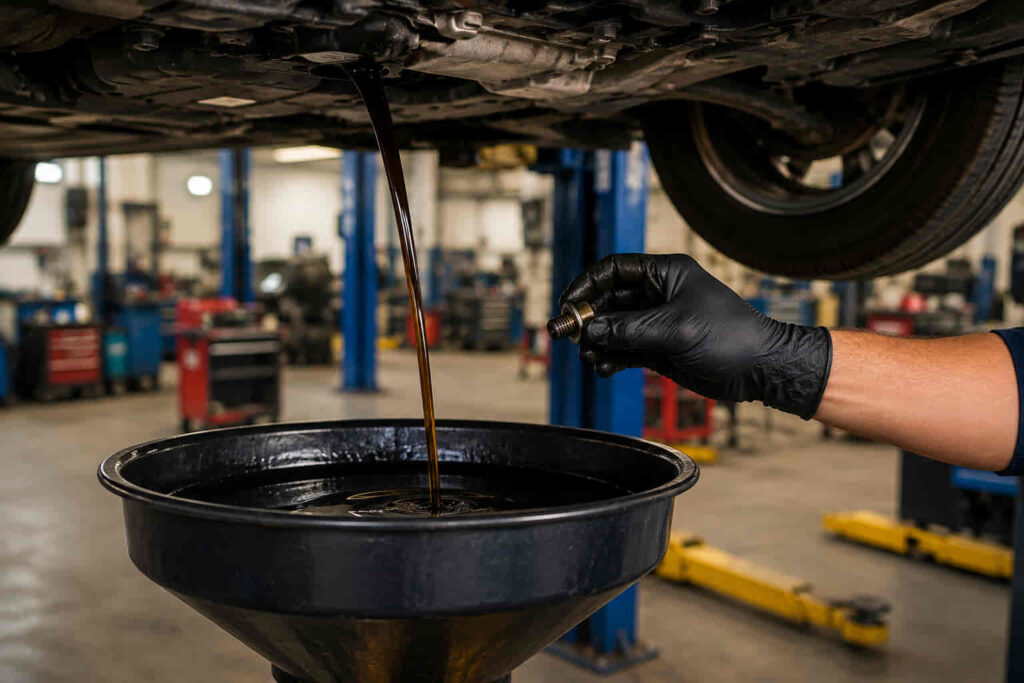
Used motor oil is one of the most recyclable automotive fluids, but it becomes an environmental hazard when disposed of incorrectly. A single oil change typically produces four to five quarts of used engine oil, and this oil can contaminate soil, groundwater, and waterways if it is poured onto the ground, into storm drains, or mixed with household waste. Fortunately, many automotive retailers, service centers, and municipal recycling facilities accept used motor oil free of charge, making responsible disposal both convenient and environmentally beneficial.
Among these locations, Walmart is one of the names drivers search for most frequently because of its nationwide presence and Auto Care Centers. However, Walmart is only one option. Several major automotive chains—including AutoZone, Advance Auto Parts, O’Reilly Auto Parts, and NAPA Auto Parts—also participate in used oil recycling programs, while local government recycling facilities often accept larger quantities and additional automotive fluids.
This guide ranks the best places to recycle used motor oil, explains whether Walmart accepts used oil, and helps you choose the most convenient recycling location based on the type of oil you have, local availability, and recycling policies.
What Are the Best Places That Accept Used Motor Oil for Recycling?
Several nationwide retailers, automotive service providers, and municipal recycling programs accept used motor oil because recycled engine oil can be cleaned, re-refined, and reused as high-quality lubricating oil or industrial fuel. Although each location has its own acceptance policy, container requirements, and daily volume limits, these organizations represent the most reliable recycling options across the United States.
Walmart is one of the most searched destinations for used oil recycling because many stores operate an Auto Care Center that performs oil changes. Many Walmart Auto Care Centers accept used motor oil from customers, but participation is determined at the individual store level rather than through a nationwide mandatory policy. Stores that accept used oil generally require customers to bring uncontaminated engine oil in a sealed container and may impose quantity limits depending on storage capacity. Calling the local Auto Care Center before visiting helps confirm whether that specific location currently accepts used oil.
AutoZone is another widely available option for recycling used motor oil. Many AutoZone stores provide free used oil collection for DIY vehicle owners who perform oil changes at home. The company typically accepts conventional and synthetic engine oil that has not been mixed with coolant, gasoline, brake fluid, or other automotive chemicals. Because contaminated oil cannot be re-refined efficiently, mixing different fluids often results in rejection of the entire container.
Advance Auto Parts also participates in used motor oil recycling at many participating locations. Customers can bring sealed containers of used engine oil during regular business hours, where employees transfer the oil into specialized storage tanks before it is collected by licensed recycling companies. Some stores also accept used oil filters after excess oil has been properly drained, although acceptance varies by location.
O’Reilly Auto Parts has established one of the largest retail oil recycling programs in the automotive aftermarket industry. Many stores accept used motor oil free of charge and encourage customers to recycle oil whenever they purchase replacement engine oil or oil filters. This process creates a closed-loop recycling system that helps reduce improper disposal while supporting sustainable lubricant production.
NAPA Auto Parts offers used motor oil recycling through numerous independently owned locations. Because NAPA stores operate under different ownership structures, recycling services differ between locations. Many stores provide free oil collection for residential customers but limit the amount accepted during each visit to ensure adequate storage capacity.
Firestone Complete Auto Care may also accept used motor oil, particularly at locations that perform oil changes and vehicle maintenance. Since Firestone already contracts with licensed waste oil collectors, some service centers allow customers to dispose of small amounts of used motor oil during business hours. Availability depends on local management and state environmental regulations.
Valvoline Instant Oil Change centers primarily collect used oil generated during their own maintenance services, but some independently operated locations also accept used motor oil from the public. Contacting the service center beforehand helps determine whether customer drop-offs are available.
Local government recycling centers remain one of the most dependable solutions for used motor oil disposal. Many county and city recycling facilities accept larger quantities than retail stores while also collecting transmission fluid, hydraulic oil, antifreeze, and other household hazardous waste. These facilities are designed to process automotive fluids safely and often provide year-round recycling services.
Household Hazardous Waste (HHW) collection sites serve residents who need to dispose of automotive chemicals alongside other hazardous household materials. Unlike retail stores, HHW facilities usually have broader acceptance criteria and are equipped to manage multiple waste streams under environmental regulations. This makes them an ideal option for homeowners performing multiple vehicle maintenance projects.
Independent auto repair shops complete the list because many locally owned garages already work with licensed oil recycling companies. Although not every repair shop accepts oil from the public, some businesses allow local residents to recycle small quantities as a community service. Establishing a relationship with a neighborhood repair shop can provide a convenient long-term disposal option, particularly in areas where large retail chains are unavailable.
Together, these ten recycling options cover nearly every situation a vehicle owner may encounter. Walmart remains one of the most recognizable choices, but combining national retailers, municipal recycling programs, and independent repair facilities gives drivers multiple safe, legal, and environmentally responsible ways to recycle used motor oil instead of allowing it to become hazardous waste.
Why Should You Recycle Used Motor Oil Instead of Throwing It Away?
Recycling used motor oil prevents long-term environmental contamination while preserving a valuable petroleum resource that can be refined and reused. Unlike many automotive fluids that degrade beyond recovery, used engine oil remains recyclable after impurities such as dirt, metal particles, combustion byproducts, and moisture are removed through industrial re-refining processes. This allows the base oil to return to lubricant production instead of becoming hazardous waste, reducing the demand for newly extracted crude oil and lowering the environmental footprint of lubricant manufacturing.
Improper disposal creates immediate and long-lasting environmental consequences because used motor oil contains contaminants that accumulate during engine operation. As oil circulates through an engine, it collects microscopic metal fragments, carbon deposits, oxidation products, and traces of fuel combustion. These contaminants transform clean lubricant into hazardous waste when released into the environment. If poured onto soil or into storm drains, the oil can migrate into groundwater, rivers, lakes, and coastal ecosystems where it damages aquatic habitats and reduces water quality. Unlike biodegradable organic materials, petroleum-based lubricants persist in the environment and require costly remediation once contamination occurs.
Used motor oil also poses risks to municipal wastewater infrastructure because sewage treatment facilities are not designed to remove petroleum products efficiently. Oil discharged into sinks, floor drains, or toilets forms surface films that interfere with oxygen exchange in water while coating pipes and treatment equipment. Even relatively small quantities contribute to pollution because petroleum spreads rapidly across water surfaces, affecting ecosystems far beyond the original disposal point. Responsible recycling eliminates this risk by directing used oil into regulated collection systems instead of public drainage networks.
Re-refining used motor oil is significantly more resource-efficient than producing lubricant from newly extracted crude oil. During the recycling process, licensed facilities remove contaminants through dehydration, vacuum distillation, and hydrotreatment before restoring the base oil to industry specifications. The recovered base oil can then be blended with new additive packages to manufacture high-quality lubricants that meet modern engine requirements. This circular process conserves natural resources while reducing greenhouse gas emissions associated with crude oil extraction, transportation, and refining.
Economic benefits further reinforce the importance of recycling. Recovered motor oil remains a valuable industrial commodity because it can be converted into lubricants, industrial burner fuel, asphalt products, or raw materials for petroleum-based manufacturing. Instead of treating used oil as waste, the recycling industry recognizes it as a recoverable resource with commercial value. This economic incentive explains why automotive retailers, repair shops, and municipal recycling facilities invest in collection programs that encourage consumers to recycle rather than dispose of oil improperly.
Environmental regulations across the United States also support responsible used oil management. The U.S. Environmental Protection Agency (EPA) classifies used oil as a recyclable material when it is properly handled and encourages collection through certified recycling programs. Many state governments supplement these federal guidelines with additional requirements covering storage containers, transportation, spill prevention, and recycling procedures. These regulations are designed to maximize oil recovery while minimizing accidental releases that could affect public health and natural ecosystems.
Recycling also supports sustainable vehicle ownership by extending environmental responsibility beyond routine maintenance. Changing engine oil protects engine components by reducing friction, controlling temperature, and removing contaminants, but responsible maintenance does not end once fresh oil enters the engine. Proper disposal completes the maintenance cycle by ensuring that the removed lubricant re-enters the industrial supply chain instead of becoming an environmental pollutant. Drivers who recycle every oil change contribute directly to resource conservation while reducing the cumulative environmental impact of millions of vehicles serviced each year.
For these reasons, recycling used motor oil is not simply a recommended practice—it is the most effective method of protecting the environment, conserving petroleum resources, supporting the circular economy, and complying with environmental regulations. Whether the oil is recycled through Walmart, AutoZone, a municipal recycling center, or another authorized collection site, directing used motor oil into certified recycling programs delivers measurable environmental and economic benefits that extend far beyond a single vehicle owner.
What Types of Used Oil Can Be Recycled?
Most recycling programs accept several categories of used lubricating oil, but acceptance depends on whether the oil remains uncontaminated. Motor oil that contains only normal engine wear contaminants can typically be processed through re-refining systems, while oil mixed with incompatible automotive fluids often becomes unsuitable for conventional recycling. Understanding which products qualify before visiting a recycling location increases acceptance rates and prevents unnecessary rejection.
Used conventional motor oil is the most widely accepted recyclable lubricant because it represents the largest volume collected from passenger vehicles. After thousands of miles of engine operation, conventional oil accumulates soot, oxidation products, microscopic metal particles, and combustion residues, yet its base oil remains recoverable through industrial refining. Retail collection programs operated by automotive stores and municipal recycling facilities are primarily designed to handle this category of engine oil.
Synthetic motor oil is equally recyclable despite its more advanced chemical formulation. Many drivers incorrectly assume synthetic lubricants require separate disposal because they contain engineered base stocks and specialized additive packages. In reality, synthetic oil follows the same collection and re-refining pathway as conventional oil. Once contaminants are removed during processing, the recovered base stock can be reused to manufacture new lubricants that satisfy current industry performance standards. As synthetic engine oils become increasingly common in modern vehicles, recycling facilities have adapted their operations to process both lubricant types efficiently.
Diesel engine oil is accepted by many recycling facilities because its petroleum base can also be recovered. However, diesel lubricants generally contain higher concentrations of soot and combustion byproducts due to compression ignition engines. Professional re-refining facilities are equipped to remove these contaminants, although some small retail collection sites may impose quantity restrictions for heavy-duty diesel oil generated by commercial vehicles or fleet maintenance.
Motorcycle engine oil can also be recycled in most programs when it has not been contaminated with other fluids. Since many motorcycles use integrated engine and transmission lubrication systems, the used oil may contain different additive chemistry than passenger vehicle oil. Nevertheless, licensed recycling facilities typically process motorcycle oil alongside conventional automotive lubricants without requiring separate handling procedures.
Used oil filters are recyclable because they contain both steel components and residual lubricating oil. Before recycling, filters should be drained according to local environmental regulations so excess oil can be recovered separately. Some automotive retailers accept drained oil filters together with used motor oil, while others require customers to use municipal recycling centers that process both metal components and residual lubricant. Recycling oil filters not only recovers recyclable steel but also prevents trapped petroleum products from entering landfills.
Transmission fluid, hydraulic oil, gear oil, and other specialized lubricants require additional verification because acceptance policies vary between recycling facilities. Some municipal hazardous waste centers process multiple automotive fluids through dedicated collection systems, whereas many retail stores limit collection exclusively to used engine oil. Mixing these fluids with motor oil before recycling should always be avoided because contamination can reduce the efficiency of re-refining and may cause an entire batch to be rejected.
The single most important requirement across nearly every recycling program is maintaining oil purity. Used motor oil should never be mixed with antifreeze, brake fluid, gasoline, solvents, paint, or household chemicals. Once contamination occurs, the oil often loses its value as a recyclable lubricant and instead requires specialized hazardous waste treatment. Keeping engine oil isolated from other fluids ensures it remains suitable for re-refining and maximizes the environmental benefits of recycling.
Drivers who understand these distinctions can prepare used oil correctly before visiting Walmart, AutoZone, Advance Auto Parts, municipal recycling centers, or any other authorized collection site. Clean, uncontaminated engine oil remains one of the most recyclable automotive products available, allowing valuable petroleum resources to be recovered repeatedly instead of being discarded after a single service interval.
Read more: How Much Does a Starter Cost at AutoZone
How Should You Prepare Used Motor Oil Before Taking It to a Recycling Center?
Preparing used motor oil correctly increases the likelihood that a recycling center will accept it and ensures the oil can be safely transported and re-refined. Most collection programs require the oil to remain uncontaminated because recycling facilities are designed to process used lubricating oil, not mixtures of automotive chemicals. A few minutes spent handling the oil properly after an oil change prevents contamination that could otherwise render an entire container unsuitable for recycling.
The first step is transferring the used motor oil into a clean, leak-proof container with a secure lid. The original motor oil bottle is usually the best option because it is designed to store petroleum products and can be sealed tightly for transportation. Plastic containers that previously held engine oil also reduce the risk of chemical contamination. Containers that once stored bleach, paint, pesticides, household cleaners, or food products should not be used because residual substances can compromise the quality of the collected oil and create safety concerns during recycling.
Maintaining oil purity is the most important requirement throughout the recycling process. Used motor oil should never be mixed with antifreeze, brake fluid, transmission fluid, gasoline, solvents, or any other automotive or household chemical. Even small amounts of incompatible fluids can alter the chemical composition of the oil, making it unsuitable for re-refining. Many retail recycling programs automatically reject contaminated oil because separating mixed fluids is significantly more expensive than processing clean used engine oil.
Proper storage before transportation also protects both the environment and personal safety. The container should remain tightly sealed and stored upright in a cool, dry location away from direct sunlight until it is delivered to a recycling facility. Positioning the container inside a plastic storage bin or spill tray during transport provides additional protection against accidental leaks that could stain vehicle interiors or contaminate the surrounding environment.
Many recycling locations also impose quantity limits based on the storage capacity of their collection tanks. Retail stores commonly accept used oil generated from household vehicle maintenance, while larger municipal recycling centers often accommodate higher volumes from multiple oil changes. Drivers who maintain several vehicles or perform regular fleet maintenance should contact the recycling facility beforehand to verify volume restrictions and avoid unnecessary return trips.
Checking the recycling location before leaving home saves time and prevents inconvenience. Participation varies between stores, even within the same retail chain, because individual locations operate under different storage capacities, waste collection schedules, and local environmental regulations. Confirming that the facility is currently accepting used motor oil, asking about daily limits, and verifying business hours ensures the recycling process proceeds without delays.
Preparing used motor oil properly benefits every stage of the recycling chain. Clean storage, contamination prevention, secure transportation, and compliance with local collection policies allow recycling facilities to recover valuable base oil efficiently while minimizing environmental risks. These simple preparation steps ensure that used engine oil remains a recyclable resource rather than becoming hazardous waste.
Does Every Walmart Store Accept Used Oil?
Not every Walmart store accepts used motor oil because participation depends on whether the location operates an Auto Care Center and whether that facility currently offers public oil recycling services. Although Walmart is frequently mentioned as a convenient place to recycle engine oil, there is no company-wide guarantee that every store provides this service. Understanding how Walmart’s automotive operations are organized helps explain why acceptance policies vary from one location to another.
Walmart stores equipped with an Auto Care Center routinely generate used motor oil through customer oil change services. These facilities already maintain storage tanks and work with licensed waste oil collection companies to remove used lubricants from the premises. Because the infrastructure for handling used oil already exists, many locations also allow customers to recycle small quantities of engine oil from home oil changes. However, each store manager retains discretion over public acceptance based on storage availability, local regulations, operational capacity, and contracted recycling services.
Storage capacity is one of the primary reasons acceptance policies differ. Used oil collection tanks must remain below regulated capacity limits until licensed recycling contractors remove the accumulated oil. If a collection tank approaches its maximum capacity before the scheduled pickup, the store may temporarily suspend public drop-offs to remain compliant with environmental regulations. As a result, a Walmart location that accepted used oil last month may temporarily stop accepting additional oil until its storage system has been emptied.
State and local environmental regulations also influence Walmart’s recycling policies. Waste oil management requirements vary across jurisdictions, including rules governing storage, transportation, spill prevention, reporting, and contractor licensing. Some states encourage broad public collection programs through retail stores, while others place greater emphasis on municipal recycling facilities. Individual Walmart stores must comply with these local requirements, leading to differences in customer recycling services across the country.
The most reliable way to determine whether a Walmart store currently accepts used motor oil is to contact the Auto Care Center directly before visiting. Employees can confirm whether the location accepts customer drop-offs, explain any quantity restrictions, specify acceptable container types, and provide guidance on operating hours. This simple verification prevents unnecessary travel and allows drivers to choose an alternative recycling location if the store is temporarily unable to receive additional oil.
Even when a Walmart location does not accept used motor oil, nearby alternatives are usually available. National automotive retailers, municipal recycling centers, household hazardous waste facilities, and independent repair shops collectively create an extensive recycling network across the United States. This means that the inability of one Walmart store to accept used oil rarely prevents responsible disposal, as multiple authorized recycling options are typically available within the same community.
Walmart remains one of the most recognized destinations for used motor oil recycling because of its nationwide presence and extensive network of Auto Care Centers. However, drivers should view Walmart as part of a broader recycling ecosystem rather than the only available option. Verifying participation in advance and understanding the reasons behind location-specific policies helps ensure a smoother recycling experience while supporting environmentally responsible vehicle maintenance.
Is Used Oil Recycling Free?
Used motor oil recycling is free at most retail stores, municipal recycling centers, and household hazardous waste collection facilities because used oil is considered a recoverable resource rather than ordinary waste. Recycling companies purchase or collect used lubricating oil for re-refining or energy recovery, allowing many collection locations to offer disposal services without charging residential vehicle owners. As a result, drivers who perform routine oil changes at home can usually recycle their used engine oil without incurring additional disposal costs.
National automotive retailers such as Walmart, AutoZone, Advance Auto Parts, O’Reilly Auto Parts, and many NAPA Auto Parts locations generally provide free used oil collection when they participate in recycling programs. These businesses already handle significant quantities of waste oil generated through automotive maintenance services, making it practical to accept small amounts from the public. Although the recycling service itself is typically free, stores often establish quantity limits to ensure their storage systems remain available for daily operations.
Municipal recycling centers also provide free used oil recycling in many communities because local governments seek to reduce illegal dumping and prevent environmental contamination. Collecting used motor oil through publicly funded recycling programs is significantly less expensive than cleaning contaminated soil, groundwater, or stormwater systems after improper disposal. This preventive approach protects natural resources while reducing long-term environmental remediation costs.
Quantity restrictions remain one of the few limitations associated with free recycling programs. Retail locations commonly accept oil generated from household vehicle maintenance but may restrict each visit to a specific number of gallons. These limits allow businesses to serve more customers while maintaining sufficient storage capacity between scheduled waste oil collections. Drivers with unusually large volumes of used oil should consider municipal recycling centers, which often have greater storage capabilities and can accommodate higher quantities.
Free recycling programs generally apply only to uncontaminated motor oil. Oil mixed with antifreeze, brake fluid, gasoline, solvents, paint, or other chemicals may no longer qualify for standard recycling because contaminated petroleum products require specialized hazardous waste treatment. In these situations, disposal procedures become more complex and may involve different collection facilities or additional handling requirements. Maintaining oil purity throughout the oil change process remains the simplest way to ensure free acceptance.
Commercial businesses should also recognize that free recycling programs are primarily intended for residential customers. Repair shops, fleet operators, construction companies, and other organizations generating large quantities of waste oil usually work directly with licensed waste management companies that provide scheduled collection services under commercial agreements. These arrangements differ from public drop-off programs because they involve significantly larger volumes and additional regulatory requirements.
Although free recycling is widely available, contacting the collection location before transporting used oil remains a practical step. Confirmation helps verify current participation, operating hours, accepted quantities, and any temporary restrictions resulting from full storage tanks or scheduled waste collection. Spending a few minutes confirming these details ensures a smooth recycling experience while avoiding unnecessary trips.
Free used motor oil recycling reflects the economic value of recovered lubricants and the environmental importance of responsible disposal. By making recycling accessible without charging consumers, retailers and local governments encourage proper waste management practices that conserve petroleum resources, reduce pollution, and support a more sustainable automotive industry.
What Happens to Used Motor Oil After Recycling?
Used motor oil begins a new industrial lifecycle after it enters an authorized recycling system. Although the oil has reached the end of its service life inside an engine, its base oil remains valuable and can be restored through advanced refining technologies. Rather than becoming waste, properly collected motor oil is transformed into a reusable raw material that supports lubricant manufacturing, industrial production, and energy recovery.
The recycling process starts with collection and transportation. Once storage tanks at retail stores, automotive service centers, or municipal recycling facilities reach designated levels, licensed waste oil contractors transport the collected oil to specialized processing plants. Throughout transportation, the oil remains separated from incompatible waste streams to preserve its value and simplify downstream processing.
At the recycling facility, the first stage involves removing contaminants that accumulated during engine operation. Water, fuel residues, dirt, metal particles, carbon deposits, and degraded additives are separated using filtration, dehydration, centrifugation, and other pre-treatment technologies. Eliminating these impurities stabilizes the used oil and prepares it for more advanced refining processes.
High-quality used motor oil often undergoes re-refining, which restores the base oil to performance standards comparable to newly refined lubricating oil. Modern re-refining facilities employ vacuum distillation and hydrotreatment to remove oxidation products, sulfur compounds, nitrogen contaminants, and remaining impurities at the molecular level. After purification, the recovered base oil receives new additive packages that restore properties such as viscosity stability, oxidation resistance, corrosion protection, detergent performance, and anti-wear capability. The finished lubricant can then be used in passenger vehicles, commercial trucks, industrial machinery, and numerous other applications.
Not all collected oil is converted into new lubricants. Some recycled oil serves as industrial burner fuel in facilities specifically designed to utilize recovered petroleum products. Other portions become raw materials for manufacturing asphalt products, construction materials, marine lubricants, hydraulic fluids, or industrial oils. These alternative recovery pathways ensure that valuable petroleum resources remain productive instead of being discarded after a single use.
The environmental benefits of this circular process extend well beyond waste reduction. Re-refining used motor oil requires substantially fewer natural resources than producing lubricating base oil entirely from crude petroleum. Recovering existing base oil reduces demand for additional crude oil extraction, decreases energy consumption during refining, and lowers greenhouse gas emissions associated with lubricant production. Each successful recycling cycle contributes to greater resource efficiency while reducing the environmental impact of the automotive industry.
Recycling also supports the principles of a circular economy by extending the useful life of petroleum products. Instead of following the traditional pattern of extraction, consumption, and disposal, recovered motor oil re-enters the manufacturing system as a valuable raw material. This continuous reuse conserves finite natural resources while creating long-term environmental and economic value for manufacturers, consumers, and recycling industries alike.
Every container of used motor oil delivered to an authorized recycling facility represents more than responsible waste disposal. It becomes part of an industrial recovery system that transforms a potentially hazardous substance into a reusable product capable of protecting engines, supporting manufacturing, and conserving petroleum resources for future use.
Frequently Asked Questions About Used Motor Oil Recycling
Many vehicle owners still have questions about what can and cannot be recycled after performing an oil change. Understanding these common situations helps prevent contamination, reduces rejected drop-offs, and ensures used motor oil enters the correct recycling stream.
One of the most common questions is whether synthetic motor oil can be recycled. The answer is yes. Synthetic motor oil follows essentially the same recycling process as conventional engine oil because both products contain recoverable base oil. Although synthetic lubricants use more advanced base stocks and additive packages, modern re-refining facilities are designed to remove contaminants and restore the base oil for future lubricant production. Drivers do not need to separate synthetic oil from conventional oil when taking it to an authorized recycling facility unless a specific collection site provides different instructions.
Many people also wonder whether used oil filters should be recycled together with engine oil. Oil filters remain recyclable because they contain steel, rubber components, and a small amount of residual lubricating oil. Before recycling, the filter should be drained according to local regulations so excess oil can be recovered separately. Some automotive retailers accept drained oil filters alongside used motor oil, while others direct customers to municipal recycling centers that process both metal components and residual petroleum products. Recycling oil filters prevents recyclable steel from entering landfills while allowing any remaining oil to be recovered through approved recycling systems.
Another frequently asked question concerns how much used motor oil can be brought to a recycling location. Most retail stores accept oil generated from routine household vehicle maintenance rather than commercial quantities. Individual locations often establish gallon limits based on available storage capacity and scheduled waste oil collection. Municipal recycling centers generally accommodate larger volumes because they are equipped with higher-capacity storage systems. Drivers maintaining multiple vehicles or servicing equipment regularly should contact the facility beforehand to confirm current quantity limits.
Many vehicle owners ask whether contaminated motor oil can still be recycled. In most cases, the answer is no. Used engine oil mixed with antifreeze, brake fluid, gasoline, diesel fuel, paint, cleaning solvents, or other chemicals usually cannot enter the standard re-refining process. Contamination changes the chemical composition of the lubricant and significantly increases treatment costs. Once different fluids have been mixed together, the material often requires specialized hazardous waste processing instead of conventional oil recycling. Preventing contamination from the beginning remains the simplest way to preserve the oil’s recycling value.
Another common concern involves accidentally mixing motor oil with engine coolant. This mixture should never be delivered to standard retail recycling programs because coolant contamination prevents efficient re-refining. Automotive recycling facilities are designed to process relatively clean used lubricating oil, not mixed automotive fluids. Drivers who accidentally combine these liquids should contact their local household hazardous waste facility or environmental agency for disposal instructions rather than attempting to recycle the mixture through a retail collection program.
Business owners frequently ask whether commercial waste oil qualifies for the same recycling programs used by residential customers. Most public collection sites are intended for individuals performing routine maintenance on personal vehicles. Repair shops, fleet operators, farms, construction companies, and industrial facilities typically generate significantly larger quantities of used oil that must be managed through licensed commercial waste oil contractors. These businesses generally operate under different environmental regulations and collection agreements than residential recycling programs.
Some drivers are uncertain whether motor oil has an expiration date for recycling. Used motor oil does not lose its recyclability simply because it has been stored for several months. If the oil has remained sealed in a clean container without contamination, it can usually be recycled whenever the owner is ready to transport it to an authorized collection site. However, long-term outdoor storage should be avoided because damaged containers increase the risk of leaks, moisture contamination, and environmental pollution.
Vehicle owners also ask whether it is necessary to recycle motor oil after every oil change. The answer is yes because every oil change produces used lubricant that still contains recoverable base oil despite being unsuitable for continued engine use. Recycling each batch ensures valuable petroleum resources remain within the production cycle instead of becoming hazardous waste. Consistently recycling used oil after every maintenance interval is one of the simplest environmental practices any vehicle owner can adopt.
Understanding these questions eliminates much of the uncertainty surrounding used motor oil recycling. Whether the oil is taken to Walmart, AutoZone, Advance Auto Parts, O’Reilly Auto Parts, a municipal recycling center, or another authorized facility, following proper storage, handling, and transportation practices ensures the recycling process remains efficient, environmentally responsible, and beneficial for future lubricant production.