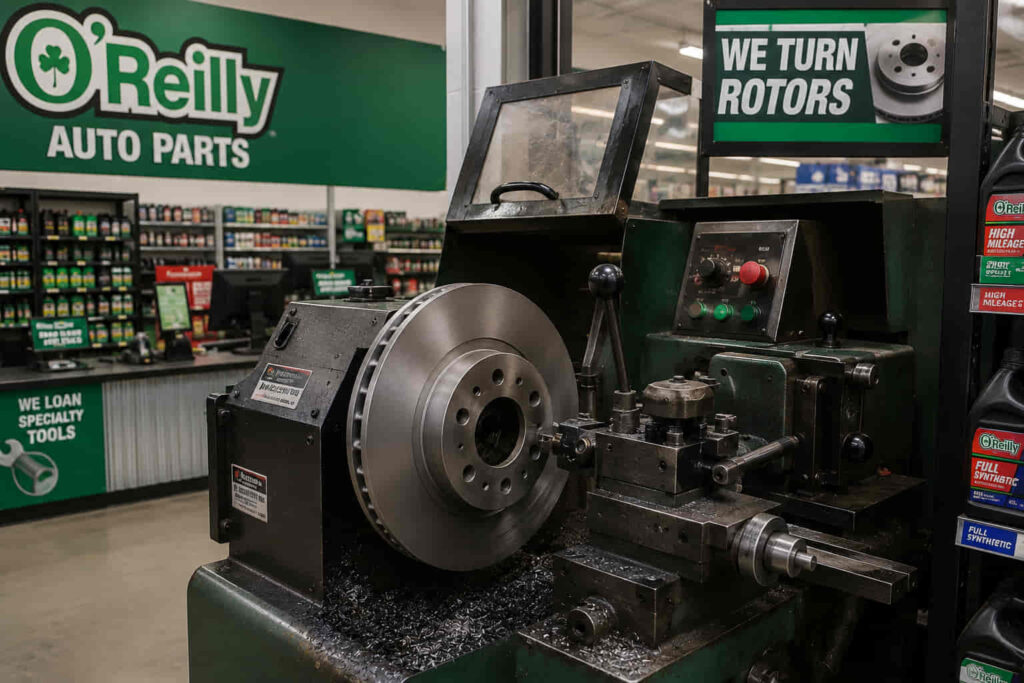
Finding a store that can turn brake rotors is not as straightforward as many drivers expect. While major auto parts retailers sell replacement brake components, they do not always provide machining services. This distinction often leads to confusion, especially for customers searching for whether O’Reilly Auto Parts or other national chains can resurface brake rotors instead of replacing them. Choosing the wrong location can waste time, increase repair costs, or result in unnecessary brake rotor replacement.
Several auto parts stores and automotive service centers across the United States offer different levels of brake support. Some locations only stock brake rotors and brake pads, while others operate full service repair facilities equipped with brake lathes capable of resurfacing worn rotors. The availability of rotor turning also depends on factors such as rotor thickness, brake condition, manufacturer specifications, and the equipment installed at each location. Understanding these differences helps drivers decide where to go before scheduling brake service.
This guide compares eight well known auto parts stores and automotive repair chains that may offer brake rotor resurfacing or related brake services, including O’Reilly Auto Parts. It also explains when resurfacing is a practical option, when replacing brake rotors is the safer choice, how much the service typically costs, and what factors determine whether a rotor can be machined. By the end of this guide, you will know which stores are worth visiting and how to make the most cost effective decision for your vehicle’s braking system.
Which Auto Parts Stores Turn Brake Rotors?
When evaluating which auto parts stores turn brake rotors, it is important to understand that most large retail chains in the automotive industry do not provide machining services as part of their standard offerings. These stores are primarily structured around parts distribution, meaning their core function is to supply replacement brake components rather than restore or resurface existing parts. Brake rotor resurfacing requires specialized brake lathe equipment, precise measurement tools, and trained technicians who can assess rotor thickness and runout according to manufacturer safety standards. Because of these technical requirements, rotor turning has gradually shifted away from retail environments and into dedicated repair facilities.
In practice, this means that even though many auto parts stores sell brake rotors and related components, they are not equipped to machine or resurface the rotors that customers bring in. This distinction is important for vehicle owners who are trying to decide whether to repair or replace their brake rotors, as it directly affects where they should go for service. Understanding this operational difference helps avoid confusion and ensures that drivers choose a location capable of performing safe and accurate brake maintenance.
O’Reilly Auto Parts, for example, operates primarily as a retail supplier of automotive parts and does not typically provide rotor resurfacing services. While the store offers a wide selection of brake rotors, brake pads, calipers, and brake fluids, the service model is focused on replacement rather than repair. This approach reflects a broader industry trend where retail chains prioritize inventory availability and fast customer service over in-house mechanical work. As a result, customers who visit O’Reilly for brake issues are usually directed toward purchasing new rotors or seeking assistance from a local machine shop or repair facility.
AutoZone follows a similar model, focusing on the sale of automotive parts and maintenance products rather than offering mechanical services such as rotor machining. Customers can find everything needed for a brake job, including rotors, pads, and installation tools, but the actual resurfacing process is not performed in-store. In cases where rotor resurfacing might still be a viable option, AutoZone staff typically recommend visiting an independent repair shop that has the proper equipment to evaluate and machine the rotors safely.
NAPA Auto Parts presents a slightly different situation because some of its locations operate as NAPA Auto Care Centers, which are full-service repair facilities. In these cases, rotor resurfacing may be available depending on the equipment and capabilities of the specific location. However, standard NAPA retail stores function similarly to other parts chains and do not perform machining services. This variation makes it necessary for customers to contact their local store directly to confirm whether rotor turning is offered, as availability is not consistent across all locations.
Advance Auto Parts also does not generally provide brake rotor machining services. Like its competitors, the company focuses on supplying replacement parts for both professional mechanics and DIY customers. Brake rotors and related components are widely available, but resurfacing equipment is not part of the typical store setup. This reflects the broader shift in the automotive retail industry toward replacement-based solutions, where installing new rotors is often more practical and cost-effective than machining older ones.
Overall, most major auto parts chains in the United States operate under a retail-only model when it comes to brake systems, meaning they sell parts but do not perform rotor resurfacing. Drivers who require this service are better served by independent machine shops, professional brake repair centers, or full-service automotive shops that have dedicated brake lathes and trained technicians. These facilities are able to measure rotor wear accurately, determine whether resurfacing is safe, and ensure that braking performance meets manufacturer specifications.
Which Repair Shops Can Resurface Brake Rotors?
Professional automotive repair shops are far more likely to resurface brake rotors than retail auto parts stores because rotor machining is a repair service rather than a parts retail function. Unlike traditional parts retailers, repair facilities invest in brake lathes, precision measuring tools, and technician training that allow them to restore brake rotors according to manufacturer specifications. Before any machining begins, technicians inspect the braking surface, measure rotor thickness, evaluate lateral runout, and determine whether the rotor still exceeds the minimum discard thickness. This inspection process ensures that resurfacing improves braking performance without compromising safety.
National brake service chains are among the most reliable places to have brake rotors resurfaced. Companies such as Pep Boys, Firestone Complete Auto Care, Midas, and Meineke often provide rotor machining as part of a complete brake service, although availability depends on the equipment and repair policies of each individual location. Many of these facilities inspect the entire braking system before recommending whether the existing rotors should be resurfaced or replaced. Instead of automatically machining every worn rotor, technicians evaluate brake vibration, scoring, heat spots, surface cracks, and overall structural integrity to determine the most appropriate repair.
Independent repair shops also remain one of the best options for rotor resurfacing. Unlike large retail chains that follow standardized service models, local repair facilities often have greater flexibility in deciding whether machining is economically worthwhile. Experienced mechanics can compare the remaining rotor thickness with the manufacturer’s specifications, assess the condition of the brake pads and calipers, and determine whether resurfacing will restore smooth braking without reducing the service life of the rotor. In many cases, independent shops can complete the work at a competitive price while providing a more personalized inspection than high volume service centers.
Machine shops represent another practical solution for drivers who only need rotor resurfacing without a complete brake repair. These facilities specialize in precision machining and frequently handle automotive components that require extremely accurate measurements. A dedicated brake lathe removes a thin and uniform layer of metal from both friction surfaces, creating a smooth finish that allows new brake pads to make even contact during the bedding process. This machining process can eliminate light grooves, minor brake pulsation, and uneven wear, provided that the rotor remains within the manufacturer’s safety limits after resurfacing.
Although rotor resurfacing is still widely available, replacing brake rotors has become increasingly common across the automotive industry. Advances in manufacturing have reduced the cost of many replacement rotors, making new components a financially attractive alternative in situations where machining and replacement produce similar labor costs. Modern vehicles also tend to use lighter brake rotors with less excess material than older designs, leaving fewer opportunities for repeated resurfacing throughout the rotor’s service life. As a result, many repair shops recommend replacement whenever machining would leave the rotor close to its minimum allowable thickness or when heat damage has permanently affected the metal structure.
Choosing the right repair facility ultimately depends on more than whether the shop owns a brake lathe. The best service providers combine accurate measurements, experienced technicians, and manufacturer approved repair procedures before deciding between resurfacing and replacement. Rather than searching for a shop that simply turns brake rotors, vehicle owners should look for a qualified brake repair center capable of evaluating the complete braking system. This approach not only improves braking performance but also reduces the risk of uneven pad wear, brake noise, pedal vibration, and premature rotor failure after the repair is completed.
How Much Does Rotor Resurfacing Cost?
Brake rotor resurfacing typically costs between $15 and $35 per rotor when the service is performed independently, although the final price varies according to the repair facility, vehicle type, and regional labor rates. Some machine shops charge only for machining because the customer removes and installs the rotors separately, while full service repair shops usually combine rotor resurfacing with brake pad replacement, inspection, and labor. As a result, the total brake service bill may range from $150 to more than $400 depending on the number of components replaced during the repair.
Labor is often the largest factor influencing the total cost rather than the machining process itself. Before a rotor can be resurfaced, technicians must remove the wheel, brake caliper, brake pads, and rotor assembly. After machining is complete, every component must be reinstalled and tested to verify proper brake operation. Vehicles equipped with integrated electronic parking brakes, performance braking systems, or heavy duty brake assemblies generally require additional labor, increasing the overall service cost even if the machining price remains unchanged.
The condition of the brake rotor also affects whether resurfacing represents good value. Rotors with light scoring, minor surface glazing, or small thickness variations can often be restored successfully with minimal material removal. However, rotors that contain deep grooves, excessive heat checking, structural cracks, or severe warping may require extensive machining or fail the minimum thickness inspection altogether. In these situations, paying for resurfacing provides little financial benefit because replacement becomes necessary immediately afterward.
The cost difference between resurfacing and replacement has narrowed significantly over the past decade. Advances in manufacturing have reduced the price of many aftermarket brake rotors, making replacement a practical alternative for a large percentage of passenger vehicles. Entry level replacement rotors are frequently available for less than the combined cost of machining and installation labor, particularly for compact cars and popular crossover models. Premium vehicles, heavy duty trucks, and performance cars, however, often use larger or specialized brake rotors that remain considerably more expensive to replace, making resurfacing a cost effective solution whenever the rotor meets manufacturer specifications.
Drivers should also consider the long term value rather than focusing only on the initial repair bill. Installing new brake pads on an uneven rotor surface can shorten pad life, increase brake noise, and create pedal vibration even if the immediate repair appears less expensive. A properly resurfaced rotor provides a uniform friction surface that allows new brake pads to bed evenly, promoting consistent braking performance and extending component life. Conversely, replacing both rotors and brake pads at the same time may reduce future maintenance costs by eliminating the possibility of recurring brake pulsation caused by worn rotor surfaces.
The most economical brake repair is not always the one with the lowest upfront price. A qualified technician evaluates rotor thickness, surface condition, heat damage, and manufacturer specifications before recommending resurfacing or replacement. This inspection ensures that every dollar spent contributes to reliable braking performance instead of paying for a repair that cannot safely extend the service life of the brake system.
When Should Brake Rotors Be Resurfaced Instead of Replaced?
Brake rotors should be resurfaced only when they remain structurally sound and still exceed the manufacturer’s minimum thickness specification after machining. Resurfacing removes a thin layer of metal from both braking surfaces to restore a smooth and uniform finish, but every machining process permanently reduces rotor thickness. For this reason, technicians measure the rotor before any work begins to confirm that enough material remains for safe operation. If the rotor cannot meet the required thickness after resurfacing, replacement becomes the only safe solution.
Surface wear is one of the most common reasons to resurface a brake rotor. Over thousands of miles, normal braking gradually creates shallow grooves, glazing, and uneven friction patterns that reduce the contact area between the brake pad and rotor. These imperfections can cause vibration, noise, and inconsistent braking even though the rotor itself remains structurally healthy. Machining removes these minor defects and creates a flat braking surface that allows new brake pads to establish full and even contact during the bedding process. The result is smoother brake operation, improved stopping consistency, and more uniform pad wear throughout the service interval.
Brake pulsation caused by thickness variation can also be corrected through resurfacing when the variation remains within repairable limits. Although many drivers describe this condition as warped rotors, true rotor warping is relatively uncommon. In most cases, the brake pedal pulsates because the rotor develops uneven thickness or accumulates irregular brake pad deposits on the friction surface. Precision machining restores both rotor faces to the same thickness, eliminating variations that create vibration during braking. This repair is only effective when the rotor has not suffered permanent heat damage or structural deformation.
Resurfacing is not appropriate for every brake rotor. Deep scoring, thermal cracking, severe corrosion, excessive heat spots, or repeated overheating permanently weaken the metal structure and cannot be corrected by removing additional material. Likewise, any rotor that measures at or below the manufacturer’s discard thickness should be replaced immediately because further machining would reduce its ability to absorb and dissipate braking heat. Thin rotors are more susceptible to brake fade, cracking, accelerated wear, and reduced stopping performance under heavy braking conditions.
Modern vehicle design has also changed the decision between resurfacing and replacement. Many manufacturers now produce lighter brake rotors with less excess material than previous generations to reduce vehicle weight and improve fuel efficiency. While these designs perform well under normal driving conditions, they leave little room for multiple resurfacing procedures during the rotor’s lifespan. As a result, many newer vehicles reach the minimum thickness specification after only one machining operation, making replacement a more practical long term solution during subsequent brake services.
The best decision is always based on measurement rather than appearance alone. Experienced technicians inspect rotor thickness, lateral runout, friction surface condition, and heat damage before recommending any repair. A rotor that appears worn may still be an excellent candidate for resurfacing, while another rotor with minimal visible wear may require immediate replacement because its structural integrity has already been compromised. Following manufacturer specifications instead of relying solely on visual inspection ensures that the braking system delivers consistent stopping power, predictable pedal feel, and long term reliability after the repair is completed.
Is Rotor Resurfacing Worth It?
Rotor resurfacing is worth it when the brake rotors remain above the manufacturer’s minimum thickness, show no structural damage, and can provide reliable braking performance after machining. In these situations, resurfacing restores a smooth friction surface without requiring the purchase of new rotors, making it a practical and cost effective repair. The process is particularly valuable for vehicles equipped with premium, heavy duty, or performance brake rotors where replacement costs are significantly higher than machining costs.
One of the biggest advantages of resurfacing is that it restores proper contact between the brake pad and the rotor. Over time, normal braking creates grooves, glazing, and uneven wear that reduce the efficiency of the braking system. A precision brake lathe removes these imperfections from both rotor faces, producing parallel braking surfaces that allow new brake pads to seat evenly. This improves pedal feel, reduces brake vibration, minimizes noise, and promotes even pad wear throughout the next service interval.
Resurfacing also helps preserve braking performance when minor defects are the only issue. Brake pedal pulsation is frequently caused by rotor thickness variation rather than severe mechanical failure. By correcting these variations, machining restores consistent brake pressure across the entire rotor surface. Drivers often notice smoother braking, more predictable stopping distances, and improved vehicle stability after the resurfaced rotors are paired with properly bedded brake pads.
Despite these benefits, rotor resurfacing is not always the most economical solution. Modern brake rotors have become substantially less expensive due to improvements in manufacturing and increased aftermarket competition. For many passenger vehicles, the combined cost of removing the rotor, machining it, and reinstalling it can approach or even exceed the price of installing a brand new replacement rotor. When labor costs are high and replacement parts are relatively inexpensive, replacing the rotor may provide greater long term value while eliminating concerns about reduced rotor thickness.
The condition of the rotor remains the deciding factor. Machining cannot repair thermal cracks, severe corrosion, excessive heat checking, deep scoring, or permanent structural distortion. Removing additional material from an already weakened rotor only shortens its remaining service life and reduces its ability to dissipate heat during repeated braking. In these situations, replacement is the safer recommendation because a new rotor restores the braking system to its intended operating specifications.
Another important consideration is how many times a brake rotor can be resurfaced. There is no universal number because every machining operation removes a different amount of material depending on the severity of the wear. Some rotors may safely support one resurfacing, while others with greater original thickness may allow two machining operations. Many modern passenger vehicles, however, are designed with thinner brake rotors that leave little machining allowance. As a result, numerous technicians choose replacement during the second brake service because the rotor is already approaching its discard thickness.
The decision should never be based solely on cost. A professional brake inspection evaluates rotor thickness, lateral runout, surface condition, heat damage, and manufacturer specifications before recommending resurfacing or replacement. Choosing the appropriate repair protects braking performance, extends brake component life, and reduces the likelihood of recurring vibration, uneven pad wear, or premature brake failure. When the rotor satisfies every safety requirement, resurfacing remains an effective method for restoring brake performance while reducing unnecessary replacement costs.
How Long Does Rotor Resurfacing Take?
Rotor resurfacing usually takes between 30 and 90 minutes per axle when it is performed as part of a scheduled brake service. The actual machining process requires only a small portion of the total repair time. Most of the labor involves removing the wheels, disassembling the brake components, inspecting the braking system, measuring rotor specifications, reinstalling the parts, and testing the brakes after the work is complete. As a result, the overall service duration depends more on the inspection and installation process than on the brake lathe itself.
The condition of the brake system has a direct impact on how long the repair takes. Rotors that have light surface wear and minimal corrosion can usually be machined quickly because little material needs to be removed to restore a smooth braking surface. Rotors with deeper grooves or uneven wear require multiple cutting passes to achieve a uniform finish, increasing machining time. If technicians discover seized caliper bolts, worn wheel bearings, damaged brake hardware, or excessive corrosion during the inspection, additional repairs may be necessary before the resurfaced rotors can be safely reinstalled.
The type of brake lathe also influences service time. Modern on car brake lathes machine the rotor while it remains attached to the vehicle hub, allowing technicians to compensate for hub runout and improve machining accuracy. This method often reduces brake pedal pulsation after the repair because the rotor is cut in its actual operating position. Off car brake lathes require technicians to remove the rotor completely before machining begins. Although both methods produce excellent results when used correctly, on car machining may reduce the need for additional adjustments during reassembly.
Shop workload is another factor that many vehicle owners overlook. A brake service appointment scheduled in advance is typically completed much faster than a walk in request during peak business hours. High volume repair facilities often prioritize vehicles that require complete brake replacement because installing new rotors is generally faster than inspecting and machining existing ones. Machine shops that specialize in brake components may also process several rotors in batches throughout the day, which can extend waiting times even though the machining itself is relatively quick.
Drivers should also consider that resurfacing is only one part of a complete brake service. Installing new brake pads on freshly machined rotors requires proper cleaning, lubrication of brake hardware, caliper inspection, and a controlled bedding procedure to establish an even transfer layer between the pad and rotor surfaces. Skipping these steps can reduce braking performance and increase the likelihood of brake noise or vibration after the repair. A thorough brake service therefore prioritizes accuracy and safety over completing the job as quickly as possible.
For most passenger vehicles, rotor resurfacing can be completed within a single service appointment, allowing drivers to return to the road the same day. However, the exact repair time ultimately depends on rotor condition, vehicle design, technician experience, shop workload, and whether additional brake components require replacement during the inspection. Allowing sufficient time for a complete evaluation ensures that the braking system performs reliably after the repair rather than simply restoring the appearance of the rotor surface.
Can You Turn Drilled or Slotted Brake Rotors?
Drilled and slotted brake rotors can sometimes be resurfaced, but the decision depends on the rotor’s design, remaining thickness, and manufacturer recommendations rather than the presence of drilled holes or machined slots alone. Unlike standard blank rotors, performance rotors are engineered with additional features that improve heat dissipation, water evacuation, and brake pad cleaning. These design characteristics also reduce the amount of usable friction material available for machining, making resurfacing a more restricted option than it is for conventional brake rotors.
Many vehicle manufacturers and aftermarket brake brands advise replacing drilled or slotted rotors instead of resurfacing them because machining can alter the geometry of the friction surface. Removing material changes the depth of the slots and reduces the structural support surrounding drilled holes. This may decrease the rotor’s ability to dissipate heat effectively during repeated high temperature braking cycles. Performance brake systems are designed to operate within precise engineering tolerances, and even a small reduction in rotor thickness can affect braking consistency under demanding driving conditions.
Cross drilled rotors require particularly careful inspection before any machining is considered. The drilled holes act as stress concentration points where repeated heating and cooling cycles can eventually produce small cracks. While superficial surface marks are generally harmless, cracks extending outward from the drilled holes indicate structural fatigue that cannot be corrected through resurfacing. Machining removes surface material but does not restore the strength of the metal, meaning a cracked rotor should always be replaced rather than repaired.
Slotted brake rotors are generally more suitable for resurfacing than cross drilled designs because the slots do not interrupt the rotor structure in the same way as drilled holes. However, machining gradually reduces slot depth with each cutting pass. As the slots become shallower, their ability to remove brake dust, maintain pad contact, and improve wet weather braking performance also declines. Once the slots no longer function as intended, replacing the rotor restores the braking characteristics originally engineered by the manufacturer.
The type of vehicle also influences whether resurfacing is recommended. High performance sports cars, heavy duty trucks, and vehicles used for towing generate substantially higher brake temperatures than ordinary passenger cars. Their braking systems depend heavily on rotor design to control heat and maintain consistent stopping performance. For these applications, many technicians prefer installing new drilled or slotted rotors instead of machining existing ones because replacement preserves the original thermal capacity and structural integrity of the braking system.
The safest approach is to follow the rotor manufacturer’s service recommendations rather than assuming every performance rotor can be machined. Before recommending resurfacing, qualified technicians inspect rotor thickness, check for thermal cracks around drilled holes, measure lateral runout, evaluate slot wear, and compare all measurements with factory specifications. If the rotor satisfies every safety requirement, resurfacing may remain a viable option. However, if machining would reduce structural strength or compromise braking performance, replacing the rotor provides the more reliable and longer lasting repair.
Can You Resurface Warped Brake Rotors?
Warped brake rotors can sometimes be resurfaced, but only when the underlying problem is minor thickness variation rather than permanent structural distortion. Although many drivers describe brake pedal vibration as warped rotors, true rotor warping is relatively uncommon on modern passenger vehicles. In most cases, the vibration results from uneven brake pad material deposits or slight differences in rotor thickness that develop after thousands of braking cycles. These conditions can often be corrected through precision machining, allowing the rotor to regain a smooth and uniform braking surface.
Brake rotor thickness variation develops gradually as brake pads wear against the rotor under different temperatures and driving conditions. Repeated heavy braking, improper wheel lug torque, or uneven brake pad transfer layers can create microscopic high and low spots across the friction surface. As the brake pads pass over these irregularities, hydraulic brake pressure fluctuates, producing the pulsation that drivers feel through the brake pedal or steering wheel. When sufficient material remains above the manufacturer’s minimum thickness specification, resurfacing removes these inconsistencies and restores parallel braking surfaces.
Heat related distortion requires a much more careful evaluation because excessive temperatures can permanently change the internal structure of the rotor. Continuous downhill braking, aggressive driving, towing heavy loads, or repeated emergency stops generate extreme heat that may create hard spots, heat checking, or localized metal fatigue. These defects cannot be corrected simply by removing surface material because the damage extends beneath the friction surface. Even if machining temporarily improves rotor smoothness, the braking vibration often returns as the weakened areas continue to wear at different rates.
Technicians rely on precision measurements rather than visual inspection to determine whether resurfacing remains a safe repair. A dial indicator measures lateral runout to identify side to side movement as the rotor rotates, while a micrometer verifies rotor thickness at multiple locations around the braking surface. These measurements distinguish repairable thickness variation from permanent structural deformation. If either measurement exceeds the manufacturer’s allowable specification after machining, replacing the rotor becomes necessary to restore proper braking performance.
Brake system components beyond the rotor itself can also create symptoms that resemble warped rotors. Sticking caliper slide pins, seized pistons, worn wheel bearings, damaged suspension components, and improperly torqued wheel lug nuts may all produce brake vibration even when the rotor remains within specification. For this reason, experienced technicians inspect the complete braking system before recommending rotor resurfacing. Correcting only the rotor without identifying the root cause often results in recurring vibration and premature brake wear.
Resurfacing is most effective when performed before excessive damage develops. Rotors that exhibit light thickness variation, minor glazing, or shallow surface imperfections usually respond well to precision machining and continue providing reliable braking performance for thousands of additional miles. Rotors showing deep thermal cracks, severe heat spots, extensive corrosion, or excessive runout should be replaced because machining cannot restore their original structural integrity. Making the decision based on accurate measurements instead of assumptions ensures that the braking system remains safe, stable, and capable of delivering consistent stopping performance under all driving conditions.
Final Answer: Does O’Reilly Turn Brake Rotors?
No, O’Reilly Auto Parts does not typically turn or resurface brake rotors at its retail locations. The company’s primary business focuses on selling replacement automotive parts rather than performing machining or mechanical repair services. Customers can purchase brake rotors, brake pads, calipers, brake fluid, and other braking components from O’Reilly, but rotor resurfacing is generally not included as one of the services available in store.
Drivers who want to resurface existing brake rotors should instead contact a full service repair shop, an independent brake specialist, or a machine shop equipped with a brake lathe. These facilities have the equipment needed to measure rotor thickness, inspect for heat damage and runout, and determine whether the rotor can be safely machined according to the manufacturer’s specifications. If the rotor remains above the minimum service thickness and has no structural defects, resurfacing can restore a smooth braking surface and improve brake performance.
In many situations, however, replacing the brake rotor has become the more practical solution. Modern aftermarket rotors are often affordable, readily available, and eliminate concerns about reduced rotor thickness after machining. Replacement is also the only safe option when the rotor has deep grooves, thermal cracks, excessive corrosion, severe heat damage, or has already reached its discard thickness. Installing new rotors together with new brake pads also helps ensure proper bedding, consistent braking performance, and longer service life.
The best choice ultimately depends on the condition of the existing brake rotors rather than the age of the vehicle alone. A professional inspection provides the measurements needed to determine whether resurfacing remains safe or whether replacement offers better long term value. Instead of assuming every worn rotor should be turned, technicians evaluate thickness, surface condition, structural integrity, and manufacturer requirements before recommending the most appropriate repair.
If your goal is simply to find a place that turns brake rotors, O’Reilly Auto Parts is generally not the right destination. Retail auto parts stores primarily supply replacement components, while rotor resurfacing is performed by repair facilities with specialized brake machining equipment. Choosing the correct service provider from the beginning saves time, prevents unnecessary purchases, and ensures that the vehicle’s braking system continues to operate safely and reliably.
Read more: Does Walmart Take Used Oil