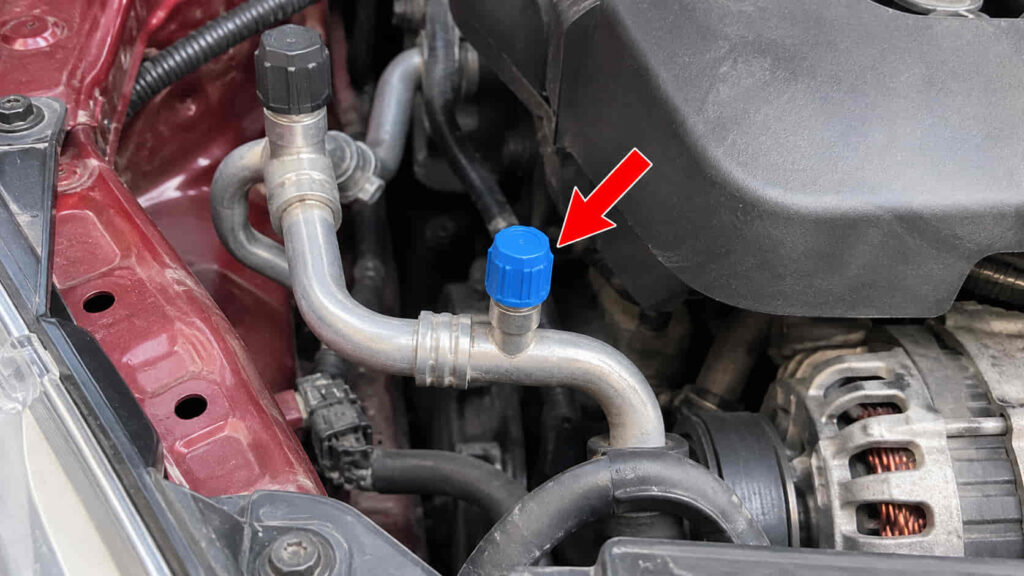
The low-side AC service port is typically located on the refrigerant suction line that carries low-pressure refrigerant from the evaporator or accumulator back to the AC compressor. On many vehicles, this line has a larger diameter than the high-pressure refrigerant line and includes a capped service fitting somewhere in the engine compartment. The port may be positioned near the firewall, close to the compressor, or along another accessible section of the suction line. Its exact location depends on the vehicle’s make, model, engine configuration, and model year.
Identifying the correct port requires understanding how the refrigerant lines connect to the AC compressor. A protective cap marked “L” can help indicate the low-pressure connection, but cap color, tubing diameter, and location should not be treated as definitive identification methods. The high-side service port belongs to a different section of the refrigerant circuit, and confusing these connections can create serious safety risks.
Finding the low-side AC port does not automatically mean the air conditioning system needs refrigerant. The correct refrigerant type, service fitting, and vehicle-specific layout must be verified before servicing a pressurized system. This guide explains where to locate the low-side AC port, how to distinguish it from the high-side connection, why its position varies between vehicles, and when professional inspection is necessary.
Where Is the Low Side AC Port Located on a Car?
The low-side AC service port is located on the low-pressure refrigerant line that returns refrigerant vapor from the evaporator or accumulator to the AC compressor. This line is commonly called the suction line, and it connects to the compressor’s inlet rather than its discharge outlet. On most passenger vehicles, the service port is accessible from the engine compartment, although its exact position varies with the design of the air conditioning system.
The suction line usually runs between the passenger compartment’s evaporator connections and the compressor mounted on the engine. Because the evaporator is generally housed inside the dashboard, its refrigerant lines pass through or connect near the firewall separating the passenger compartment from the engine bay. The low-side service port may be installed along this route, including near the firewall, beside the compressor, or on another accessible section of the suction line. In vehicles equipped with an accumulator, the port may also be located on or near that component, depending on the system configuration.
The larger refrigerant line is often the easiest starting point for locating the low-side AC port. Low-pressure refrigerant returning to the compressor is primarily vapor, which occupies more volume than liquid refrigerant under comparable conditions. The suction line is therefore commonly larger in diameter than the high-pressure liquid line. It may also be insulated to limit heat absorption and prevent condensation from forming on nearby components. However, tubing diameter and insulation are supporting clues rather than reliable identification methods on their own.
The location becomes easier to understand by following the refrigerant’s path through the air conditioning system. After absorbing heat inside the evaporator, the refrigerant returns through the low-pressure circuit toward the compressor. The service port provides access to that portion of the system for appropriate diagnostic and maintenance procedures. By contrast, the high-side service port is connected to the pressurized discharge or liquid-side circuit. These ports serve different sections of the refrigeration system and must not be confused.
For example, one vehicle may have its low-side port positioned on an aluminum suction line near the firewall, while another may place the fitting on a hose assembly closer to the compressor. Both arrangements serve the same function because the port remains connected to the low-pressure return circuit. The correct location is determined by the refrigerant line’s connection to the compressor inlet, not by a universal position within the engine bay. A vehicle-specific service diagram is the most reliable reference when the routing cannot be identified visually.
How Do You Find the Low Pressure AC Port Under the Hood?
To find the low-pressure AC port under the hood, locate the AC compressor, identify its suction line, and follow that line until you find the appropriate capped service fitting. Perform the visual inspection with the engine switched off and the components cool enough to approach safely. The compressor is commonly mounted toward the front or lower section of the engine and is connected to refrigerant lines that carry refrigerant into and out of the unit. Its exact mounting position depends on the vehicle’s engine and accessory layout.
Start by identifying the refrigerant connections at the compressor rather than searching randomly for plastic caps. The suction connection carries low-pressure refrigerant vapor into the compressor, while the discharge connection carries compressed, high-temperature refrigerant toward the condenser. On many vehicles, the suction line has a larger diameter and may transition between aluminum tubing and a flexible rubber hose. Following this line away from the compressor helps identify the portion of the system where the low-side service port should be located.
The low-side port typically appears as a small service fitting with a removable protective cap attached to the suction line or a connected component. Some caps are marked with the letter “L,” while others have different markings or colors. The cap protects the fitting from dirt and moisture, but its appearance is not a standardized location guide across all vehicle manufacturers. A cap that looks similar to a low-side fitting may belong to another service connection, so the refrigerant circuit must be verified before attempting to attach equipment.
If the port is not visible near the compressor, continue tracing the suction line toward the firewall. On some vehicles, the fitting is installed higher in the engine compartment to improve service access. On others, the line passes beneath an intake duct, engine cover, or another component before reaching the service connection. For example, a vehicle with a compact transverse engine may have its compressor mounted low in the engine bay while the low-side port remains accessible near the upper firewall area. This arrangement allows technicians to reach the fitting without accessing the compressor directly.
A vehicle-specific AC system diagram becomes particularly important when the suction line branches around other components or disappears behind protective covers. The correct diagram should match the vehicle’s make, model, model year, engine, and refrigerant system. Factory service information can identify the low-pressure service fitting and distinguish it from the high-pressure connection without relying on assumptions about cap color or hose size.
Finding the port is an identification procedure, not a reason to open the refrigerant system or add refrigerant. Do not loosen refrigerant lines, depress service valves, or force a charging connector onto a fitting that has not been positively identified. If the line routing or service port cannot be confirmed, consult the manufacturer’s service information or have a qualified automotive AC technician locate it. This approach prevents confusion between the two pressure circuits and avoids unnecessary interference with a sealed, pressurized system.
Read more: audi inspection due reset
How Can You Tell the Low Side AC Port From the High Side Port?
You can distinguish the low-side AC port from the high-side port by identifying which section of the refrigerant circuit each fitting connects to. The low-side port is installed on the suction circuit that returns low-pressure refrigerant vapor to the compressor. The high-side port is located on the high-pressure circuit between the compressor outlet and the expansion device, commonly on a discharge or liquid refrigerant line. Both ports provide access to the air conditioning system, but they connect to sections that operate at different pressures.
The compressor creates this pressure difference by drawing refrigerant vapor from the suction line and compressing it before sending it toward the condenser. The condenser releases heat from the refrigerant, allowing it to condense into liquid under suitable operating conditions. The refrigerant then passes through an expansion device, which reduces its pressure before it enters the evaporator. After absorbing heat inside the evaporator, the refrigerant returns through the low-pressure suction line. Following this sequence explains why the low-side service port belongs to the compressor inlet circuit while the high-side port belongs to the compressor discharge and liquid-side circuit.
Refrigerant line diameter provides a useful visual clue, but service fitting size is a separate characteristic. The suction line commonly has a larger outside diameter than the high-pressure liquid line because it carries lower-density refrigerant vapor. However, on R-134a automotive systems, the low-side service fitting is typically smaller than the high-side fitting. The different connector sizes help prevent service equipment intended for one pressure circuit from being connected to the other. This means a larger refrigerant tube does not necessarily have a larger service connector.
Protective caps may also help with identification, particularly when they include an “L” for low pressure or an “H” for high pressure. Nevertheless, cap colors and markings are not reliable substitutes for confirming the refrigerant line’s connection. Caps can be replaced, and their appearance varies between manufacturers and refrigerant systems. A service port should not be identified solely because it has a blue, black, or red cap.
For example, consider a vehicle with two capped fittings near the front of the engine compartment. One fitting is attached to a relatively large suction hose returning to the compressor inlet, while the other is installed on a smaller refrigerant line connected to the high-pressure circuit. The first fitting is the likely low-side service connection, even if both caps have similar appearances. The correct identification should still be checked against the vehicle’s refrigerant plumbing diagram, especially when the compressor connections are difficult to see.
Never attempt to determine which port is correct by forcing a charging hose or adapter onto an unfamiliar fitting. Automotive AC systems use specified service connections, and refrigerant types such as R-134a and R-1234yf have distinct fitting requirements. The U.S. Environmental Protection Agency prohibits using adapters to convert refrigerant-specific fittings because doing so can create contamination risks. When the ports cannot be distinguished confidently through their circuit connections and vehicle service information, professional identification is the safer approach.
Is the Low Side AC Port Always on the Larger AC Line?
The low-side AC port is usually located on the larger refrigerant line, but tubing diameter alone cannot confirm that a fitting belongs to the low-pressure circuit. In a conventional automotive vapor-compression air conditioning system, the suction line carries refrigerant vapor from the evaporator or accumulator toward the compressor. Because this vapor has a relatively low density, the system generally uses a larger line to move the required refrigerant mass without excessive pressure loss.
The difference becomes clearer when comparing the suction line with the high-pressure liquid line. After refrigerant releases heat inside the condenser, it can travel through a smaller line as high-pressure liquid. Liquid refrigerant has a much higher density than refrigerant vapor, so the same mass flow occupies less volume. This difference in physical state is an important reason that automotive AC systems commonly use a larger suction line and a smaller liquid line. Actual tube dimensions also depend on refrigerant type, system capacity, line length, and the manufacturer’s engineering requirements.
The suction line may have additional features that make identification easier. Some vehicles use insulation around sections of the low-pressure line to reduce unwanted heat absorption and limit condensation. The line may also include flexible hose sections that accommodate engine movement and vibration. These features help explain why a large, partially insulated refrigerant hose leading to the compressor is often a useful starting point when searching for the low-side service port. However, not every vehicle uses the same insulation arrangement, and nearby engine hoses can look similar.
The location of the service fitting matters more than the apparent size of the tubing immediately beside it. Automotive refrigerant lines may include bends, metal-to-rubber transitions, fittings, and connections that change the appearance of an otherwise continuous line. A service port might be mounted on a short rigid section attached to a larger flexible suction hose, making the relationship difficult to recognize at first glance. On a tightly packaged engine, part of the suction line may also disappear beneath an engine cover, intake duct, or other component.
For example, a driver may see a thick aluminum AC line near the firewall but find no service fitting along its visible length. The line could continue behind another component before reaching a capped connection closer to the compressor. In that situation, searching only the exposed section of the largest tube would not reveal the port. Following the line’s complete route, using a vehicle-specific diagram when necessary, provides a more dependable identification method.
The most reliable rule is to identify the low-pressure return path to the compressor rather than assuming that the largest visible tube must contain the correct service port. Tube diameter, insulation, and protective cap markings are supporting evidence. The connection to the compressor inlet and the manufacturer’s service information establish whether a fitting belongs to the low-side circuit. This distinction is particularly important before connecting any equipment to a pressurized automotive air conditioning system.
Does the Low Side AC Port Location Change by Vehicle Make and Model?
Yes, the low-side AC port location changes depending on the vehicle’s make, model, model year, engine configuration, and air conditioning system design. Although the port serves the same function in a conventional automotive refrigerant circuit, manufacturers arrange the compressor, evaporator connections, and refrigerant lines differently to accommodate available space. As a result, a service port that is easy to access near the firewall on one vehicle may be positioned close to the compressor on another.
Engine compartment layout is one of the main reasons for these differences. In a transverse-engine vehicle, the compressor and refrigerant lines must fit around the engine, transmission, cooling components, and intake system. A longitudinal-engine vehicle has a different arrangement of these components, which can change the route of the suction line. Since manufacturers generally place service fittings where technicians can access them, the port’s position depends on both the refrigerant circuit and the available servicing space. The location cannot be determined accurately from the vehicle’s brand name alone.
Even vehicles within the same model family can have different low-side service port locations. For example, service information for the 2011 Dodge Nitro identifies the low-side port on the suction line either near the rear of the engine compartment or close to the compressor, depending on engine configuration and market. By comparison, service documentation for the 2015 Fiat 500 describes its low-side port as being on the suction line near the compressor. These examples demonstrate that the underlying refrigerant connection remains consistent while the physical position of the fitting changes.
The same principle applies when comparing Ford, Chevrolet, Toyota, and Honda vehicles. A low-side port location shown in a guide for one Ford model should not automatically be applied to another Ford vehicle with a different engine or production year. Similarly, a diagram for a Toyota sedan may not match the refrigerant line layout of a Toyota SUV. Changes to the compressor mounting position, engine packaging, or air conditioning equipment can alter where a manufacturer installs the service connection. Hybrid and electric vehicles may also use electrically driven compressors and different underhood arrangements, making assumptions based on conventional belt-driven systems less useful.
The most accurate way to confirm a vehicle-specific low-side AC port location is to consult service information that matches the exact vehicle configuration. The owner’s manual may identify the air conditioning system and refrigerant type, but detailed port locations are more likely to appear in factory repair information or refrigerant plumbing diagrams. When searching for an illustration, use the correct make, model, model year, and engine specification. If different configurations are listed, the vehicle identification number can help determine which information applies. This prevents a common mistake: searching the correct area of the wrong vehicle diagram.
Why Can’t You Find the Low Side AC Port on Your Car?
You may be unable to find the low-side AC port because the service fitting is hidden behind engine compartment components, positioned away from the compressor, or located differently from the diagram you are using. The port is not always installed at the most visible point on the suction line. Manufacturers position refrigerant lines around other mechanical and electrical components, which can make a small capped fitting difficult to recognize without the correct reference information.
Limited visibility is a common obstacle in tightly packaged engine compartments. Plastic engine covers, air intake ducts, wiring assemblies, and other components may obstruct the view of the refrigerant line. The compressor itself may be mounted low on the engine, making its connections difficult to inspect from above. In these situations, the suction line can remain partly visible while the service port sits beyond a bend or behind another component. The fitting may be present and accessible through a different viewing angle even when it cannot be seen from the first position.
An incorrect reference diagram can make a properly installed low-side port appear to be missing. Online photographs sometimes show a different engine, model year, or regional vehicle configuration. For example, a guide may indicate a service port near the passenger-side firewall, while the vehicle being inspected has its fitting farther forward along the suction line. Searching only the location shown in the photograph can lead to an incorrect conclusion. Comparing the refrigerant line routing with a diagram for the exact vehicle is more reliable than matching the appearance of nearby components.
The protective cap can also affect identification. Low-side service fittings normally have caps that protect the valve area from dirt and moisture, but a missing or replacement cap may make the port harder to recognize. A fitting without a familiar blue or black cap should not automatically be dismissed, just as an unidentified capped fitting should not automatically be treated as the low-side connection. The relevant question is whether the fitting belongs to the low-pressure refrigerant circuit. Any visibly damaged or uncapped service connection should be assessed before equipment is attached.
If you still cannot identify the port, stop searching by appearance alone and verify the system layout using manufacturer-specific service information. An accurate refrigerant plumbing diagram can show the service connection relative to the compressor, evaporator lines, and any accumulator installed in the system. Perform visual inspection with the engine off and avoid reaching near hot surfaces, moving components, or electrical connections. Do not loosen refrigerant lines or press service valves to test whether a fitting is correct.
When the port remains inaccessible or its identity is uncertain, a qualified automotive AC technician can locate it using the appropriate service information. Professional assistance is especially important if the fitting appears damaged, the refrigerant lines have been modified, or the vehicle’s air conditioning system differs from the available documentation. A low-side AC port that is difficult to find is not necessarily missing; confirming the vehicle’s refrigerant line layout is the safest way to determine its actual location.
What Is the Low Side AC Port Used For?
The low-side AC service port is used to access the low-pressure side of a vehicle’s air conditioning system for pressure measurement, refrigerant recovery, and appropriate servicing procedures. It provides a connection point on the suction circuit without requiring technicians to disconnect the refrigerant lines. The port is normally protected by a removable cap and contains a service valve that remains closed when equipment is not connected. Its purpose is to provide controlled access to a sealed, pressurized refrigeration system.
One of the port’s primary functions is to help technicians evaluate how the air conditioning system operates. When suitable service equipment is connected, the low-side pressure reading provides information about the refrigerant returning to the compressor. Technicians evaluate this reading alongside high-side pressure, ambient temperature, vent temperature, compressor operation, and manufacturer specifications. The relationship between these measurements helps identify abnormal operating conditions, including restricted refrigerant flow, compressor problems, and possible refrigerant charge issues.
Low-side pressure alone cannot determine exactly how much refrigerant remains in a vehicle’s AC system. Refrigerant pressure changes with temperature and operating conditions, so a single gauge reading does not establish the total mass of refrigerant inside the system. An undercharged system may show abnormal pressures, but similar symptoms can also result from airflow restrictions or component faults. The U.S. Environmental Protection Agency explains that technicians cannot determine the existing refrigerant quantity simply by topping off a system, which creates a risk of undercharging or overcharging it. An evacuation and recharge procedure allows the specified refrigerant quantity to be measured accurately.
For example, a driver may notice that the air conditioner produces warm air and assume the system needs additional refrigerant. However, the same symptom could result from a malfunctioning compressor, an electrical control problem, or inadequate condenser airflow. The low-side port gives a technician access to useful diagnostic information, but it does not identify the cause of poor cooling by itself. Proper diagnosis requires evaluating the system as a whole rather than interpreting one pressure reading in isolation.
The service port is also used during refrigerant recovery and other maintenance operations performed with equipment designed for the vehicle’s refrigerant. These procedures matter because releasing refrigerant into the atmosphere can violate environmental regulations and expose people to pressurized refrigerant. A damaged service valve can also become a refrigerant leak point, making its condition relevant during an inspection.
The low-side AC port is a diagnostic and servicing connection, not an indicator that refrigerant must be added. Finding the correct port is only the first step toward accessing the system. Before any servicing takes place, the refrigerant type, equipment compatibility, and reason for the AC malfunction must be established.
Does the Low Side AC Port Differ Between R-134a and R-1234yf Systems?
Yes, R-134a and R-1234yf air conditioning systems use different refrigerant-specific service fittings, including their low-side AC ports. Although both systems generally place the low-side service connection on the suction circuit returning refrigerant to the compressor, their fittings are designed to prevent incompatible charging and recovery equipment from being connected. Therefore, identifying the low-pressure line is not enough to confirm which service equipment a vehicle requires.
R-134a, also called HFC-134a, was widely used in automotive air conditioning systems for decades. R-1234yf, also called HFO-1234yf, was introduced as a lower-global-warming-potential alternative and is now used in many newer vehicles. These refrigerants have different chemical properties and servicing requirements. R-1234yf is classified as mildly flammable under the ASHRAE A2L system, so vehicles designed for it must meet applicable safety requirements. The correct refrigerant depends on the vehicle’s original equipment design and any properly documented system conversion, not simply its age.
The refrigerant identification label is the primary reference for determining which refrigerant a vehicle is designed to use. This label is typically located in the engine compartment and identifies the refrigerant type, specified charge quantity, and other servicing information. A vehicle labeled for R-134a should not be assumed compatible with R-1234yf, and the reverse is equally important. The type of fitting installed on the service port provides an additional identification clue, but it does not replace checking the label and vehicle service information.
The U.S. Environmental Protection Agency requires distinct service fittings for approved automotive refrigerants to help prevent accidental mixing. This requirement applies to vehicle service ports and corresponding refrigerant handling equipment. Adapters must not be used to convert a fitting intended for one refrigerant into a connection for another. Mixing refrigerants can contaminate the vehicle’s AC system and servicing equipment, complicate refrigerant recovery, and interfere with correct system maintenance.
For example, a vehicle equipped with an R-134a system may have a low-side service port in a location similar to that of a vehicle using R-1234yf. Both ports perform the same basic function within their respective suction circuits. However, a service coupler designed for R-134a is not intended to connect directly to an R-1234yf service port. The difference is deliberate: it helps reduce the risk of adding the wrong refrigerant or contaminating equipment used to recover and recycle refrigerant.
The position of the low-side port should be identified from the vehicle’s refrigerant circuit, while the correct service connection must be verified from its refrigerant type. These are two separate checks. A driver can locate the proper suction line and still have unsuitable charging equipment for the vehicle. When the refrigerant label is missing, the system has been modified, or the installed fittings do not match the expected refrigerant, a qualified technician should verify the system before any equipment is connected. This is particularly important because an improperly converted or contaminated system may not be identifiable through fitting appearance alone.
What Mistakes Should You Avoid When Identifying the Low Side AC Port?
The most important mistake to avoid when identifying the low-side AC port is confusing it with the high-side service connection. Both fittings provide access to the refrigerant circuit, but they are installed on sections that operate at substantially different pressures when the air conditioning system is running. The low-side port connects to the suction circuit returning refrigerant to the compressor, while the high-side port connects to the compressor discharge or liquid-side circuit. Connecting equipment to an incorrectly identified port can expose incompatible tools to pressures they were not designed to handle.
Another common mistake is relying entirely on the protective cap’s color or appearance. A cap marked “L” provides a useful identification clue, but replacement caps may not match the original manufacturer’s design. Similarly, a blue cap does not automatically confirm a low-pressure connection, and a black cap does not establish that the fitting belongs to the high-pressure circuit. The cap protects the service valve from contamination; it is not a substitute for tracing the refrigerant line or consulting a vehicle-specific service diagram.
Assuming that the largest visible AC line always leads directly to the low-side service port can also cause incorrect identification. The suction line is generally larger because it transports low-density refrigerant vapor toward the compressor. However, its service fitting may be installed farther along the circuit, behind another component, or near an accumulator. For example, a driver might identify a large insulated hose near the firewall but overlook the actual low-side port because the fitting is mounted on a connected aluminum section closer to the engine. Following the line’s routing is more reliable than searching only for a cap on the largest tube.
Using the wrong vehicle diagram introduces another source of error. Refrigerant line routing can differ between engine options, model years, and vehicle generations, even when the exterior body design looks similar. A photograph showing the low-side port on a particular sedan does not establish the correct location on an SUV from the same manufacturer. Vehicle-specific documentation should match the make, model, model year, and engine configuration before it is used to identify a service connection.
Never force a refrigerant coupler onto a service fitting or use an adapter to make incompatible equipment connect. The U.S. Environmental Protection Agency requires refrigerant-specific fittings to reduce accidental mixing of different automotive refrigerants. An adapter that bypasses this protection defeats its purpose and can contaminate both the vehicle’s AC system and the servicing equipment. A fitting that does not accept the intended connector should prompt another identification check, not additional force.
A final mistake is treating the discovery of the low-side port as confirmation that the system needs refrigerant. Poor cabin cooling can result from refrigerant leaks, compressor faults, electrical problems, or inadequate condenser airflow. Adding refrigerant without diagnosing the cause can produce an incorrect charge and further complicate the original problem. Correct port identification establishes where the system can be accessed; it does not establish what repair the system requires.
When Should a Professional Locate or Inspect the Low Side AC Port?
A qualified automotive AC technician should locate or inspect the low-side service port when its position cannot be confirmed, the fitting appears damaged, or the air conditioning system requires refrigerant handling or fault diagnosis. Identifying a capped fitting is a straightforward visual task on some vehicles, but working with a pressurized refrigerant circuit requires more than recognizing its components. When the suction line is hidden, service information is unclear, or the vehicle has an unfamiliar refrigerant configuration, professional inspection reduces the risk of connecting equipment to the wrong location.
A damaged or leaking service fitting is a particularly important reason to seek professional assistance. The service valve is designed to allow controlled access while maintaining the integrity of the sealed refrigerant circuit when disconnected. Damage to the valve, fitting, or surrounding line can create a leak path. For example, oily residue around a service connection may warrant closer inspection because refrigerant leaks can carry compressor lubricant, although residue alone does not confirm an active leak. A technician can evaluate the fitting and use appropriate leak-detection methods rather than opening the valve to see whether refrigerant escapes.
Professional diagnosis is also necessary when the air conditioner continues blowing warm air after previous refrigerant servicing. Repeated loss of cooling may indicate a leak that has not been repaired. Alternatively, the system may have a compressor control problem, restricted airflow through the condenser, or another fault unrelated to refrigerant quantity. A technician can compare low-side and high-side pressures with the vehicle’s operating conditions, inspect relevant components, and determine whether additional testing is required. This approach provides more useful information than attaching a single gauge and interpreting its reading without context.
Vehicles with uncertain refrigerant identification require additional care. A missing refrigerant label, evidence of previous modifications, or fittings that do not match the expected system can make ordinary servicing procedures inappropriate. The EPA notes that automotive refrigerant can become contaminated through improper servicing, including the introduction of another refrigerant. When the contents of a system are uncertain, technicians may need refrigerant identification and dedicated recovery equipment before proceeding. This protects the vehicle and helps prevent contamination of equipment used on other cars.
In the United States, technicians who service motor vehicle air conditioning systems for payment must hold EPA Section 609 certification and use approved refrigerant handling equipment. These requirements address proper refrigerant recovery, equipment use, and environmental protection. Refrigerant must not be intentionally vented during ordinary automotive AC servicing. A professional repair facility should therefore be equipped to recover refrigerant when needed, follow the manufacturer’s procedures, and verify the specified refrigerant charge rather than releasing refrigerant or estimating the charge solely from a pressure reading.
For vehicle owners, the practical distinction is between locating a component and servicing the pressurized system behind it. Visual identification can help explain where the low-side AC port is positioned, but damaged fittings, suspected leaks, uncertain refrigerant types, and persistent cooling problems require a more complete evaluation. When the service port cannot be positively identified or the AC system needs repair, professional diagnosis is the safest way to establish both the correct connection and the underlying problem.