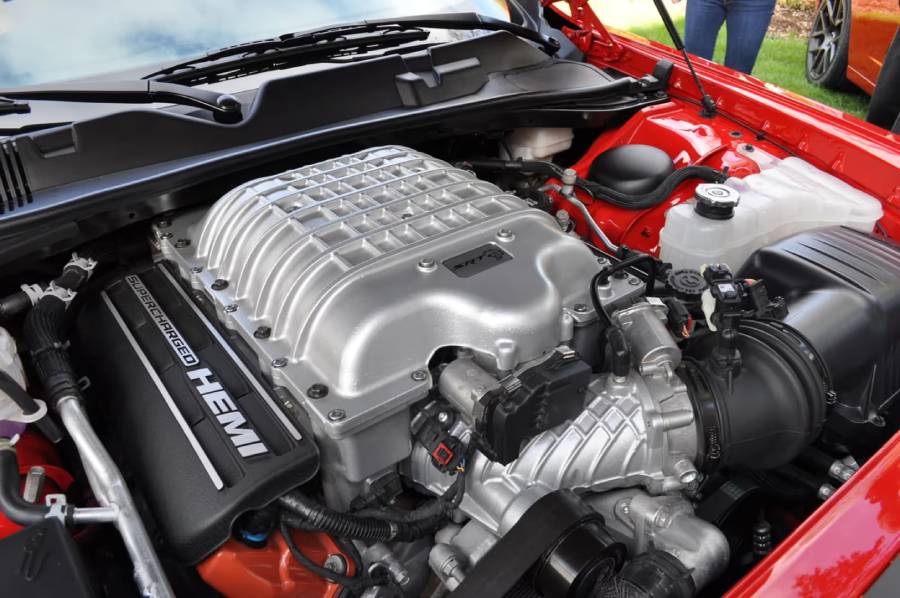
The Hellcat engine is a 6.2-liter supercharged HEMI V8 designed for high horsepower and torque output in Dodge SRT and other Stellantis performance vehicles. The original production version produces 707 horsepower and 650 lb-ft of torque, while later Hellcat-family configurations increase output through changes to the supercharger, boost pressure, engine calibration, and supporting components.
The 6.2L Hellcat uses a V8 configuration with a 4.09-inch bore, 3.58-inch stroke, and forced-induction system rather than relying on displacement alone for power. Its supercharger forces additional air into the cylinders, allowing the engine to burn more fuel during each combustion cycle and generate substantially more power than naturally aspirated HEMI V8 engines.
Hellcat engine specifications are not identical across every vehicle or model year. The Challenger SRT Hellcat, Charger SRT Hellcat, Hellcat Redeye, Jeep Grand Cherokee Trackhawk, Dodge Durango SRT Hellcat, and Ram 1500 TRX use related 6.2L supercharged HEMI configurations with different power ratings and supporting hardware. This guide breaks down the Hellcat engine’s displacement, horsepower, torque, bore and stroke, compression ratio, supercharger, internal components, RPM characteristics, oil requirements, fuel requirements, and major variants.
What Are the Complete Hellcat Engine Specs?
The Hellcat engine is a 6.2-liter supercharged HEMI V8 that combines 376 cubic inches of displacement with forced induction to produce at least 700 horsepower in its best-known production applications. The engine uses a 4.09-inch bore, 3.58-inch stroke, and a supercharger to increase the mass of air entering its eight cylinders. Exact horsepower, torque, boost pressure, and supporting specifications depend on the vehicle, model year, and Hellcat-family variant.
The standard Hellcat configuration became known for producing 707 horsepower and 650 lb-ft of torque. Later versions raised output beyond this original rating through revised engine calibration and, in higher-output variants such as the Redeye, changes to the forced-induction system and supporting hardware. This distinction matters because “Hellcat engine” is commonly used for several related versions of the 6.2L supercharged HEMI V8 rather than one specification that remained unchanged throughout production.
| Specification | Hellcat Engine |
|---|---|
| Engine type | Supercharged HEMI V8 |
| Configuration | 90-degree V8 |
| Displacement | 6.2 liters / 376 cu in |
| Cylinders | 8 |
| Bore | 4.09 in / 103.9 mm |
| Stroke | 3.58 in / 90.9 mm |
| Horsepower | 707 hp in the original production configuration; higher in later variants |
| Torque | 650 lb-ft in the original production configuration |
| Induction | Supercharged |
| Standard Hellcat supercharger | 2.4-liter |
| Fuel delivery | Electronic fuel injection |
| Fuel | Premium gasoline |
| Cooling | Liquid-cooled engine with charge-air cooling for the supercharger system |
Horsepower and related specifications must be tied to a specific Hellcat version when comparing engines. A 707-hp original Hellcat, for example, should not be treated as mechanically identical to a later Redeye simply because both belong to the 6.2L supercharged HEMI family.
What Type of Engine Is the Hellcat Engine?
The Hellcat engine is a 6.2-liter, 90-degree, supercharged HEMI V8 gasoline engine. Its eight cylinders are divided between two banks arranged in a V configuration, while forced induction increases the amount of air available for combustion. This architecture allows the engine to generate substantially greater cylinder pressure and power than a naturally aspirated engine of similar displacement.
The HEMI name refers to Chrysler’s performance-engine lineage, but the Hellcat’s defining characteristic is the combination of large V8 displacement and supercharging. The supercharger is mechanically driven by the engine and compresses intake air before it reaches the cylinders. More oxygen can therefore enter each combustion cycle, allowing additional fuel to be burned and increasing power output.
The Hellcat engine also requires internal components capable of handling the mechanical and thermal loads created by forced induction. The crankshaft, connecting rods, pistons, lubrication system, cooling system, and cylinder block work as one system rather than the supercharger being an isolated performance component. This reinforced architecture is a major reason the production engine can sustain output exceeding 700 horsepower.
How Big Is the Hellcat Engine?
The Hellcat engine has a displacement of 6.2 liters, or approximately 376 cubic inches, distributed across eight cylinders. Engine displacement represents the combined swept volume of the cylinders as the pistons travel through their strokes.
The 6.2L displacement results from the relationship between the engine’s cylinder count, 4.09-inch bore, and 3.58-inch stroke. Bore measures the diameter of each cylinder, while stroke measures the distance traveled by a piston between its upper and lower positions. Together, these dimensions determine how much volume the eight cylinders displace.
Displacement is only one reason for the Hellcat’s output. The naturally aspirated 6.4L HEMI has greater displacement, but the 6.2L Hellcat uses forced induction to move substantially more air through the engine. This illustrates why displacement alone cannot predict horsepower: airflow, boost pressure, fuel delivery, compression, engine speed, and calibration also determine how much power an engine can produce.
How Much Horsepower Does a Hellcat Engine Produce?
The original 6.2L Hellcat engine produces 707 horsepower, while later factory configurations increased output above that initial rating. The exact figure depends on model year, vehicle application, engine calibration, and Hellcat variant, making 707 hp the original baseline rather than a universal specification for every Hellcat-family engine.
The 707-hp rating established the original Challenger SRT Hellcat and Charger SRT Hellcat as unusually powerful factory production cars when the engine entered the market. Standard Hellcat output subsequently changed in certain model years, while specialized configurations pushed the same basic 6.2L supercharged HEMI architecture further.
| Engine/Application | Factory Horsepower |
|---|---|
| Original Challenger SRT Hellcat | 707 hp |
| Original Charger SRT Hellcat | 707 hp |
| Jeep Grand Cherokee Trackhawk | 707 hp |
| Dodge Durango SRT Hellcat | 710 hp |
| Ram 1500 TRX | 702 hp |
| Challenger SRT Hellcat Redeye | 797 hp in its initial configuration |
These differences demonstrate why horsepower should always be qualified by application. The Ram 1500 TRX’s 702-hp rating does not mean it uses an unrelated engine, and the Redeye’s 797-hp rating does not mean every Hellcat engine produces 797 hp. Each application combines the underlying 6.2L architecture with vehicle-specific hardware and calibration.
Horsepower also describes power output rather than the physical size of the engine. Two 6.2L Hellcat-family engines can therefore share displacement, bore, stroke, and cylinder configuration while producing different horsepower figures.
Why Do Hellcat Engines Have Different Horsepower Ratings?
Hellcat engines have different horsepower ratings because their supercharger systems, boost levels, airflow capacity, engine calibration, operating conditions, and supporting components differ by application and variant. These changes determine how much air and fuel the engine can process and how aggressively it can convert combustion pressure into usable output.
The standard Hellcat and Redeye illustrate this distinction. Both belong to the 6.2L supercharged HEMI family, but the Redeye uses performance hardware derived from the higher-output Demon program, including a larger supercharger than the standard Hellcat configuration. Increasing supercharger capacity allows the engine to move a greater mass of compressed air into the cylinders, supporting greater fuel delivery and higher power output.
Vehicle requirements also affect factory ratings. A performance coupe, high-performance SUV, and off-road pickup operate under different cooling, packaging, drivetrain, durability, and calibration requirements. The Challenger, Durango, Grand Cherokee Trackhawk, and Ram TRX therefore should not be expected to receive identical output simply because their engines share the same fundamental displacement and supercharged V8 architecture.
Engine calibration provides another layer of control. Ignition timing, fuel delivery, throttle operation, boost management, temperature protection, and other electronic parameters influence the final output available in a specific application. As a result, the correct way to identify Hellcat horsepower is by pairing the power figure with its engine variant, vehicle, and model year rather than assigning one horsepower number to the entire Hellcat family.
How Much Torque Does a Hellcat Engine Produce?
The original 6.2L supercharged Hellcat engine produces 650 lb-ft of torque, while the exact torque rating varies across higher-output Hellcat-family configurations. Torque measures rotational force at the crankshaft and is one of the primary specifications behind the Hellcat engine’s strong acceleration under load.
The original Challenger SRT Hellcat pairs its 707-horsepower rating with 650 lb-ft of torque. This output comes from combining 6.2 liters of displacement with forced induction, which increases the mass of air entering the cylinders. More available oxygen supports additional fuel combustion, producing greater cylinder pressure and increasing the rotational force transferred through the crankshaft.
The Hellcat’s supercharger also helps produce substantial torque across a broad portion of the engine’s operating range. Unlike an engine that must reach very high RPM before generating strong output, a mechanically driven supercharger begins compressing intake air in direct relation to engine operation. This characteristic contributes to the immediate power delivery associated with the 6.2L supercharged HEMI.
Torque figures differ across Hellcat-family applications because engine calibration, airflow, boost, exhaust configuration, cooling requirements, and vehicle-specific operating limits are not identical. For example, the original 707-hp Challenger SRT Hellcat produces 650 lb-ft, while higher-output derivatives can exceed the standard engine’s torque rating. A torque specification should therefore be paired with the exact engine variant and application rather than applied universally to every 6.2L supercharged HEMI.
Horsepower and torque describe different aspects of engine performance. Torque measures rotational force, while horsepower represents the rate at which work is performed and depends on both torque and engine speed. This relationship explains why two Hellcat-family configurations can have similar low- and mid-range characteristics but different peak horsepower ratings when their airflow and RPM capabilities differ.
What Are the Hellcat Engine Bore, Stroke, and Compression Ratio?
The 6.2L Hellcat engine uses a 4.09-inch bore and 3.58-inch stroke, while its compression ratio is engineered around the requirements of a supercharged high-output V8. Bore, stroke, and compression ratio affect displacement, combustion characteristics, cylinder pressure, engine speed, and the amount of forced induction the engine can accommodate.
Bore is the diameter of each cylinder, while stroke is the distance the piston travels between top dead center and bottom dead center. The Hellcat combines these dimensions across eight cylinders to create approximately 6.2 liters, or 376 cubic inches, of displacement. The engine therefore achieves its total displacement through the physical geometry of its cylinders rather than through the supercharger.
Compression ratio describes a different relationship. It compares cylinder volume when the piston is at the bottom of its stroke with the remaining combustion-chamber volume when the piston reaches the top. Because the Hellcat uses forced induction, compression ratio must work together with boost pressure, ignition control, fuel quality, charge-air temperature, and component strength to manage combustion pressure.
These three specifications should not be interpreted independently. Bore and stroke establish the engine’s fundamental displacement and geometry, while compression ratio influences how the air-fuel charge is compressed before ignition. The supercharger then increases the amount of air entering that same combustion system, creating the conditions required for the Hellcat’s high horsepower and torque output.
What Is the Hellcat Engine Bore and Stroke?
The Hellcat engine has a 4.09-inch (103.9 mm) bore and a 3.58-inch (90.9 mm) stroke. These dimensions are used across its eight cylinders to produce approximately 376 cubic inches of total displacement.
The 4.09-inch bore represents the diameter of each cylinder. A larger bore provides room for the piston and influences combustion-chamber dimensions, valve packaging, and airflow potential. In a performance engine, cylinder bore is therefore connected not only to displacement but also to the physical space available for moving air through the combustion chamber.
The 3.58-inch stroke represents the distance each piston travels from top dead center to bottom dead center. Stroke contributes directly to the swept volume of each cylinder. When the swept volume created by the 4.09-inch bore and 3.58-inch stroke is multiplied across eight cylinders, the result is the Hellcat’s approximately 6.2-liter displacement.
The Hellcat’s bore is larger than its stroke, giving the engine an oversquare bore-to-stroke relationship. This geometry is relevant to a performance application because piston speed, valve area, airflow, displacement, and RPM capability are all influenced by bore and stroke dimensions. However, the Hellcat’s power cannot be attributed to its bore-to-stroke ratio alone. Its forced-induction system, fuel delivery, cylinder heads, internal components, engine calibration, and exhaust flow work together with the underlying engine geometry.
What Is the Hellcat Engine Compression Ratio?
The standard 6.2L supercharged Hellcat HEMI uses a relatively low compression ratio for a high-performance gasoline V8 because the supercharger increases the mass and pressure of the intake charge. The exact ratio should be identified by engine variant, since higher-output derivatives within the 6.2L supercharged HEMI family can use specifications that differ from the original Hellcat configuration.
Compression ratio is calculated from the difference between cylinder volume at bottom dead center and cylinder volume at top dead center. A higher ratio compresses the air-fuel mixture into a smaller space before combustion, while a lower ratio leaves more combustion-chamber volume when the piston reaches the top of its stroke.
Forced induction changes the operating conditions of this process. The Hellcat’s supercharger compresses intake air before it enters the cylinders, increasing the oxygen mass available for combustion. Once the piston moves upward, this already pressurized intake charge is compressed again inside the cylinder. Cylinder pressure and temperature therefore become critical engineering constraints when boost and mechanical compression operate together.
The Hellcat manages these loads through the interaction of compression ratio, premium fuel, charge-air cooling, ignition timing, fuel delivery, engine calibration, and strengthened internal components. These systems help control combustion while allowing the engine to exploit supercharger boost for increased power.
Compression ratio also explains why a single specification cannot determine an engine’s output. A higher compression ratio does not automatically produce more horsepower in a supercharged application. Boost pressure, intake-air temperature, octane, ignition timing, airflow, engine speed, and component limits must all be considered together. The Hellcat’s compression strategy is therefore part of a complete forced-induction system rather than an isolated performance number.
What Supercharger Does the Hellcat Engine Use?
The standard 6.2L Hellcat engine uses an engine-driven supercharger that compresses intake air before it enters the cylinders, allowing the V8 to burn more fuel and produce more than 700 horsepower in factory applications. The original Hellcat configuration is commonly associated with a 2.4-liter supercharger, while higher-output members of the Hellcat engine family use different forced-induction hardware.
The supercharger is mechanically driven by the engine rather than powered only by exhaust gases like a turbocharger. As engine operation drives the supercharger, its rotors compress a greater mass of intake air and deliver it toward the engine. Increasing oxygen mass allows the fuel system to supply additional fuel while maintaining the required air-fuel conditions for combustion. The resulting increase in combustion energy raises both horsepower and torque.
Compressing air also generates heat. Hotter intake air is less dense and increases thermal stress, so the Hellcat’s forced-induction system uses charge-air cooling to reduce the temperature of compressed air before combustion. The supercharger, intercooling system, fuel delivery, engine cooling, and electronic controls therefore operate as one power-producing system rather than as independent components.
Supercharger specifications also help distinguish the standard Hellcat from higher-output derivatives. A larger supercharger can move more air when combined with the appropriate drive ratio, intake system, cooling capacity, fuel delivery, and engine calibration. This is one reason displacement alone cannot explain the output difference between Hellcat-family engines that share the same basic 6.2L V8 architecture.
How Much Boost Does a Hellcat Supercharger Produce?
Hellcat supercharger boost depends on the specific engine variant, so one boost-pressure figure should not be applied to every 6.2L supercharged HEMI. The original Hellcat, Redeye, and other higher-output derivatives use different forced-induction configurations and calibrations to achieve their respective factory power ratings.
Boost pressure represents intake-manifold pressure above atmospheric pressure created by forced induction. Increasing boost generally increases the mass of oxygen available to the cylinders, provided the intake system, supercharger, fuel system, cooling system, and engine calibration can support the additional airflow. More oxygen allows additional fuel to be burned, which can increase cylinder pressure and power.
Boost cannot be evaluated independently from intake-air temperature. Compressing air raises its temperature, while hotter air is less dense than cooler air at the same pressure. The charge-air cooling system therefore removes heat from the compressed intake charge before combustion. Cooler, denser air improves the amount of oxygen available to the cylinders and helps control thermal conditions under high engine load.
Exact boost values should be matched with the corresponding Hellcat variant and authoritative technical specification. Treating the original Hellcat and higher-output Redeye configuration as having identical boost would hide an important mechanical difference between the engines.
How Does the Hellcat Supercharger Increase Horsepower?
The Hellcat supercharger increases horsepower by forcing a greater mass of air into the engine, allowing more fuel to be burned during each combustion cycle. The additional combustion energy increases cylinder pressure, which applies greater force to the pistons and ultimately increases crankshaft output.
The process begins when the engine mechanically drives the supercharger. The supercharger moves and compresses intake air, after which the charge-air cooling system reduces the temperature of the compressed air. The cooled charge then travels into the cylinders, where the fuel system supplies the corresponding amount of gasoline required for combustion.
Combustion converts the chemical energy in the air-fuel mixture into pressure above the piston. The piston transfers this force through the connecting rod to the crankshaft, converting reciprocating piston movement into rotational output. Repeating this process across eight cylinders and thousands of combustion events per minute generates the Hellcat’s horsepower and torque.
Supercharging therefore creates a causal chain: greater airflow supports greater fuel delivery, greater fuel combustion creates greater cylinder pressure, and greater cylinder pressure increases engine output. The engine’s internal components must withstand those additional loads, which is why the Hellcat’s crankshaft, connecting rods, pistons, block, cooling system, and lubrication system are essential parts of its high-output design.
What Internal Components Does the Hellcat Engine Use?
The Hellcat engine uses performance-oriented internal components designed to withstand the cylinder pressure, torque, heat, and rotational loads generated by a supercharged 6.2L V8. The crankshaft, connecting rods, pistons, cylinder block, and cylinder heads form the mechanical structure that converts combustion pressure into crankshaft output.
Forced induction increases the demands placed on these components. Each combustion event applies pressure to the piston, which transfers force through the connecting rod to the crankshaft. Increasing the amount of air and fuel burned inside the cylinder increases the potential combustion pressure, so the rotating and reciprocating assemblies must tolerate loads beyond those experienced by a lower-output naturally aspirated engine.
Material choice and component geometry also affect durability. A high-output production engine must balance strength with weight, friction, heat management, manufacturing requirements, and long-term operation. The Hellcat engine therefore cannot achieve its factory output through supercharger capacity alone; its internal structure must support the additional airflow and combustion load produced by forced induction.
What Crankshaft and Connecting Rods Does the Hellcat Engine Use?
The Hellcat’s crankshaft and connecting rods transfer the high combustion forces generated inside its eight cylinders into rotational output. These components operate under repeated mechanical loads whenever the supercharged engine produces torque.
The connecting rod links each piston to the crankshaft. Combustion pressure pushes the piston downward, the connecting rod transfers that force, and the crankshaft converts the piston’s linear motion into rotation. With eight cylinders repeatedly completing this process, the crankshaft provides the rotational force ultimately transmitted through the vehicle’s drivetrain.
Supercharging increases the importance of component strength because additional intake air and fuel can generate greater cylinder pressure. The crankshaft must withstand rotational and torsional loads, while the connecting rods experience both compression and tension as the pistons change direction thousands of times per minute.
Exact material, manufacturing, and component specifications should be stated only when supported by the technical documentation for the specific Hellcat variant. This distinction is necessary because sharing the 6.2L HEMI architecture does not establish that every Hellcat-family engine uses identical rotating components.
What Pistons Does the Hellcat Engine Use?
The Hellcat engine uses pistons engineered to operate under the elevated cylinder pressure and heat created by supercharged combustion. Each piston must contain combustion pressure, transfer force to its connecting rod, maintain an effective seal through the piston rings, and tolerate rapid temperature changes during engine operation.
Piston design directly interacts with the Hellcat’s bore and compression ratio. The piston travels within the 4.09-inch cylinder bore through a 3.58-inch stroke, changing cylinder volume as it moves between bottom dead center and top dead center. Its crown geometry also forms part of the combustion space when the piston reaches the top of the cylinder.
Forced induction adds another constraint. The supercharger increases the mass of air entering the cylinder, allowing additional fuel to be burned and creating greater combustion pressure. Piston durability must therefore be considered together with fuel octane, ignition timing, intake temperature, boost, cooling, lubrication, and engine calibration.
Specific piston material or construction claims should be tied to verified documentation for the engine variant being discussed. The standard Hellcat and higher-output 6.2L derivatives should not automatically be treated as having identical piston specifications simply because they share displacement.
What Cylinder Heads Does the Hellcat Engine Use?
The Hellcat engine uses HEMI-family cylinder heads that control airflow into and exhaust flow out of its eight combustion chambers. The cylinder heads contain critical valvetrain and combustion-chamber components and provide the airflow path connecting the intake system to the cylinders.
Intake airflow is particularly important in a supercharged engine. The supercharger can supply compressed air, but that air must still travel through the intake tract and cylinder-head passages before entering the combustion chamber. Restrictions in this path affect the amount of air the engine can process and therefore influence its power potential.
The cylinder heads also control exhaust-gas flow after combustion. Exhaust gases must leave the cylinders efficiently so the next intake charge can enter. Intake flow, exhaust flow, valve operation, supercharger capacity, engine speed, and calibration consequently work together to determine the engine’s usable airflow.
This relationship explains why the Hellcat’s high output is the result of a complete engine system. The supercharger supplies additional air, the cylinder heads manage airflow to and from the combustion chambers, the fuel system provides gasoline, and the rotating assembly converts combustion pressure into crankshaft torque. No single component produces the Hellcat engine’s output independently.
What Is the Hellcat Engine RPM Limit?
The Hellcat engine’s RPM specifications must be separated into peak horsepower RPM, peak torque RPM, and maximum engine speed because these figures describe different operating characteristics. The engine does not produce its maximum horsepower and maximum torque at the same rotational speed, and neither figure automatically represents the engine’s rev limiter.
RPM measures how many revolutions the crankshaft completes per minute. As engine speed increases, the pistons, connecting rods, crankshaft, valvetrain, oiling system, cooling system, and supercharger must operate at correspondingly higher rates. The safe operating range is therefore determined by the complete engine design rather than horsepower alone.
Peak torque RPM identifies the engine speed where maximum rated rotational force is produced. Peak horsepower RPM identifies where the combination of torque and engine speed produces maximum rated power. The rev limit represents the upper engine-speed boundary established by the engine’s mechanical design and electronic controls. These three specifications should be listed separately when comparing Hellcat variants.
The technical source material provided for this article does not establish authoritative RPM figures for each Hellcat configuration. Exact peak horsepower RPM, peak torque RPM, and rev-limit values should therefore be added only after matching them with the corresponding model year and engine variant. This prevents an RPM specification from one Hellcat-family application from being incorrectly presented as universal to every 6.2L supercharged HEMI.
Engine speed also affects supercharger operation. Because the Hellcat uses an engine-driven supercharger, changes in engine speed affect supercharger speed and airflow. Increasing RPM can increase the volume of air processed by the engine, but the resulting power remains constrained by airflow capacity, boost management, fuel delivery, intake temperature, exhaust flow, mechanical limits, and engine calibration.
How Much Does a Hellcat Engine Weigh?
A single Hellcat engine weight should not be treated as universal unless the measurement specifies exactly which components are included. A bare engine assembly, dressed engine, complete crate engine, and shipping package can produce substantially different published weights even when each listing refers to a 6.2L supercharged HEMI.
Engine weight depends on the measurement boundary. A dressed engine can include components such as the supercharger, intake hardware, accessory drive, pumps, manifolds, and other supporting equipment that may be excluded from a bare long-block measurement. Shipping weight can add a pallet, crate, fluids, protective materials, and other packaging that are not part of the installed engine.
This distinction is especially important for the Hellcat because the forced-induction hardware forms a substantial part of the complete powertrain assembly. Comparing a naturally aspirated V8 long block with a complete Hellcat crate engine without identifying the included components would create a misleading weight comparison.
The supplied technical material does not provide a verified Hellcat engine weight or define a standardized measurement condition. A precise pound or kilogram figure should therefore be published only when it can be connected to a manufacturer specification that identifies the engine configuration and what is included in the measurement.
Engine mass affects vehicle engineering even without relying on an unsupported weight figure. The location of the V8, supercharger, cooling equipment, accessory systems, and drivetrain components influences front-axle load, suspension calibration, packaging, and overall vehicle weight distribution. These factors partly explain why the same basic 6.2L supercharged HEMI architecture must be integrated differently into a performance coupe, SUV, and pickup truck.
How Much Oil Does a Hellcat Engine Hold?
Hellcat engine oil capacity must be matched to the specific 6.2L supercharged HEMI application and service procedure rather than assumed to be identical across every Hellcat-family vehicle. Oil capacity can be stated accurately only when the model, model year, engine configuration, and service conditions are defined.
Engine oil performs 4 primary functions in a high-output Hellcat application: it lubricates moving components, reduces friction, transfers heat away from loaded surfaces, and helps protect components from wear and contamination. These functions are particularly important around the crankshaft bearings, connecting-rod bearings, pistons, cylinder walls, valvetrain, and other surfaces subjected to high mechanical and thermal loads.
Oil capacity also needs a measurement condition. A specification associated with a routine oil-and-filter change is not necessarily interchangeable with the total amount contained in every part of a completely dry lubrication system. Publishing a capacity without explaining the applicable service condition can therefore produce an incorrect maintenance instruction.
The source material supplied for this article does not establish a verified oil-capacity figure for each Hellcat-powered vehicle. The final specification should be taken from the service or owner documentation corresponding to the exact vehicle and model year instead of assigning one oil-capacity number to every 6.2L supercharged HEMI.
Maintaining the correct oil level is as important as selecting the correct lubricant. Too little oil reduces the lubrication system’s available supply under engine load, while an incorrect fill level can interfere with normal oil control. The correct procedure is to use the specified fill quantity as the starting point and verify the oil level according to the manufacturer’s checking procedure.
What Oil Does a Hellcat Engine Use?
A Hellcat engine should use the engine-oil viscosity and specification approved for its exact vehicle, model year, and 6.2L supercharged HEMI configuration. Oil should not be selected only because another HEMI engine uses the same viscosity or because two engines share a similar displacement.
Viscosity describes an oil’s resistance to flow under defined temperature conditions. The correct grade must support lubrication during cold starts while maintaining an adequate protective film as engine temperature and load increase. A supercharged performance engine places substantial demands on the lubricant because bearings, pistons, cylinder walls, and valvetrain components operate under repeated mechanical and thermal stress.
Oil specification involves more than viscosity. The required lubricant must also satisfy the manufacturer-defined performance standard for the engine. Two oils carrying the same viscosity grade can differ in additive chemistry and approvals, so matching only the numbers printed in the viscosity grade does not establish that the products are interchangeable for a specific Hellcat application.
The source material provided for this article does not contain a manufacturer-confirmed viscosity and oil standard covering the Hellcat applications discussed here. The exact oil grade should therefore be inserted only after consulting the documentation for the relevant Challenger, Charger, Durango, Trackhawk, TRX, or other 6.2L supercharged HEMI application.
This model-specific approach prevents a maintenance specification from being generalized incorrectly. Horsepower ratings, calibrations, operating requirements, and supporting systems differ across Hellcat-family vehicles, so service specifications should be qualified by application in the same way as performance specifications.
What Fuel Does a Hellcat Engine Require?
The 6.2L supercharged Hellcat engine is designed to operate on premium gasoline that supports the combustion requirements of a high-output forced-induction V8. The exact minimum or recommended octane rating should be matched to the vehicle, model year, and manufacturer documentation rather than generalized across every Hellcat-family application.
Octane rating describes a gasoline’s resistance to abnormal combustion, particularly knock. Knock occurs when part of the air-fuel mixture combusts abnormally instead of following the controlled combustion process intended by the engine’s ignition and fuel-management systems. High cylinder pressure and temperature make knock resistance particularly relevant in a supercharged performance engine.
The Hellcat’s supercharger increases the mass of air entering the cylinders. The engine management system supplies additional fuel for that air, and the piston then compresses the mixture before ignition. This combination of boost, compression, fuel delivery, ignition timing, and temperature produces the cylinder pressure required for high power output but also increases the importance of using fuel that meets the manufacturer’s specification.
Fuel requirements also interact with engine calibration. The engine control system manages parameters such as ignition timing, fuel delivery, throttle operation, and knock response according to operating conditions. Fuel quality therefore forms part of the complete combustion strategy rather than functioning independently from the engine’s hardware and electronic controls.
The source material provided for this article does not establish one manufacturer-confirmed octane number for every Challenger, Charger, Durango, Trackhawk, TRX, and related 6.2L supercharged HEMI application. The exact octane requirement should therefore be verified against the documentation for the specific vehicle and model year before publishing it as a universal Hellcat specification.
Can a Hellcat Engine Run on Regular Gas?
Regular gasoline should not be treated as a direct substitute for the premium fuel specified for a Hellcat engine without checking the requirements for the exact vehicle and model year. Whether an engine can physically continue operating on a lower-octane fuel and whether that fuel satisfies the manufacturer’s requirements are separate questions.
The distinction exists because octane affects resistance to knock rather than the amount of energy that can simply be extracted from every gallon of gasoline. A high-output supercharged engine operates under cylinder pressures and temperatures that make controlled combustion particularly important. Using fuel below the required octane rating can therefore change the conditions under which the engine management system must control combustion.
Modern engine controls can monitor combustion through sensors and modify operating parameters when abnormal combustion is detected. This protection should not be interpreted as evidence that any gasoline grade is equally appropriate. Protective intervention can alter ignition or other operating parameters to protect the engine, while the manufacturer’s specified fuel remains the correct reference for normal performance.
For a technical specifications article, the most accurate answer is therefore application-specific: use the gasoline grade and octane rating identified in the owner or service documentation for the exact Hellcat-powered vehicle. A single statement about regular gasoline should not override model-specific manufacturer requirements.
Are All Hellcat Engines the Same?
No. Hellcat engines share the 6.2L supercharged HEMI V8 foundation, but their horsepower, torque, supercharger configuration, boost, calibration, supporting hardware, and vehicle-specific operating requirements can differ. “Hellcat engine” therefore describes a related engine family more accurately than one unchanged specification used in every application.
The original Hellcat established the core architecture: a 6.2L supercharged V8 producing 707 horsepower and 650 lb-ft of torque in its best-known initial Challenger and Charger applications. Later configurations retained the fundamental displacement and forced-induction concept while changing specific components and calibrations to meet different performance targets.
Vehicle application creates another layer of variation. The Challenger and Charger are performance cars, the Grand Cherokee Trackhawk and Durango SRT Hellcat are SUVs, and the Ram 1500 TRX is an off-road performance pickup. These vehicles impose different requirements for packaging, cooling, drivetrain integration, exhaust configuration, durability, and calibration. Their factory power ratings therefore do not have to be identical even when the underlying engines belong to the same 6.2L supercharged HEMI family.
Model year also matters. Manufacturers can revise calibration, component specifications, output ratings, and supporting systems during an engine’s production life. A specification associated with an early Challenger SRT Hellcat should not automatically be assigned to a later Hellcat variant without checking the corresponding technical documentation.
At least 4 attributes should therefore be identified before comparing Hellcat engines: vehicle application, model year, engine variant, and factory output rating. These qualifiers establish which version is being discussed and prevent horsepower or component specifications from one engine from being incorrectly transferred to another.
What Is the Difference Between Hellcat and Hellcat Redeye Engine Specs?
The Hellcat Redeye is a higher-output version of the 6.2L supercharged HEMI architecture, with its initial Challenger configuration producing 797 horsepower compared with the original Hellcat’s 707 horsepower. The additional output is not created by increasing displacement; both remain within the 6.2L supercharged HEMI family. The difference comes from the higher-output engine’s forced-induction system, airflow capability, calibration, and supporting performance hardware.
One of the most important distinctions is the supercharger system. The standard Hellcat is commonly associated with a 2.4-liter supercharger, while the Redeye uses higher-output forced-induction hardware derived from the Demon program. Greater airflow capacity allows the engine to process more intake air when the rest of the combustion system is configured to support it.
The horsepower difference illustrates the result. The original Hellcat produces 707 horsepower, while the initial Challenger SRT Hellcat Redeye produces 797 horsepower. That represents a 90-horsepower increase without changing the basic 6.2L displacement. Displacement alone therefore cannot explain the output of a supercharged engine.
| Specification | Standard Hellcat | Hellcat Redeye |
|---|---|---|
| Engine family | 6.2L supercharged HEMI V8 | 6.2L supercharged HEMI V8 |
| Displacement | 6.2 liters / 376 cu in | 6.2 liters / 376 cu in |
| Configuration | V8 | V8 |
| Forced induction | Supercharged | Supercharged |
| Original/initial cited output | 707 hp | 797 hp |
| Standard supercharger context | 2.4-liter | Higher-output configuration |
| Primary difference | Baseline Hellcat specification | Increased airflow and higher-output hardware/calibration |
The comparison also demonstrates why the Redeye should not simply be described as a standard Hellcat with a different software tune. Increasing factory output requires the complete system to manage additional airflow, fuel, combustion pressure, heat, and mechanical load. The supercharger system, cooling capacity, engine calibration, fuel delivery, and supporting components must work together to produce the higher rating.
The exact specification table can be expanded with torque, boost pressure, supercharger displacement, RPM, and internal-component differences once those figures are verified against authoritative documentation for the specific model year. The source material currently available for this article does not contain those Redeye-specific technical values, so assigning numbers to those fields without additional sourcing would create unsupported specifications.
Which Vehicles Use the 6.2L Supercharged Hellcat Engine?
The 6.2L supercharged HEMI V8 has been used across Dodge performance cars and SUVs as well as related high-performance vehicles from Jeep and Ram. Major applications include the Dodge Challenger SRT Hellcat, Dodge Charger SRT Hellcat, Jeep Grand Cherokee Trackhawk, Dodge Durango SRT Hellcat, and Ram 1500 TRX. Their engines share the same fundamental 6.2L supercharged V8 architecture, but their factory output and application-specific calibration are not identical.
| Vehicle | Engine Configuration | Factory Output Context |
|---|---|---|
| Dodge Challenger SRT Hellcat | 6.2L supercharged HEMI V8 | 707 hp in the original Hellcat |
| Dodge Charger SRT Hellcat | 6.2L supercharged HEMI V8 | 707 hp in the original Hellcat |
| Jeep Grand Cherokee Trackhawk | 6.2L supercharged V8 | 707 hp |
| Dodge Durango SRT Hellcat | 6.2L supercharged HEMI V8 | 710 hp |
| Ram 1500 TRX | 6.2L supercharged HEMI V8 | 702 hp |
The Dodge Challenger SRT Hellcat is one of the primary applications associated with the Hellcat name. Its original 707-horsepower configuration established the performance baseline for the 6.2L supercharged HEMI and paired that output with 650 lb-ft of torque. Higher-output Challenger variants later demonstrated how the same fundamental displacement could support substantially different power ratings.
The Dodge Charger SRT Hellcat applied the same basic engine concept to a four-door performance sedan. Like the original Challenger Hellcat, the early Charger SRT Hellcat was rated at 707 horsepower. This shared rating illustrates how the 6.2L supercharged HEMI could be integrated into different vehicle platforms without changing the central engine identity.
The Jeep Grand Cherokee Trackhawk extended the 6.2L supercharged V8 architecture into a performance SUV. Its 707-horsepower rating connects it directly to the output level associated with the original Hellcat engine, although the vehicle’s drivetrain, packaging, cooling requirements, and intended operating conditions differ from those of a Challenger or Charger.
The Dodge Durango SRT Hellcat uses a 6.2L supercharged HEMI V8 rated at 710 horsepower in its initial application. The three-row SUV demonstrates that the engine architecture can be adapted to a heavier vehicle while retaining output above 700 horsepower. Its specification should still be identified separately from the original 707-hp Hellcat because vehicle-specific output is part of an accurate engine comparison.
The Ram 1500 TRX uses a 6.2L supercharged HEMI V8 rated at 702 horsepower. Its output is slightly lower than the original Challenger and Charger Hellcat ratings because the engine is calibrated for a different application. The TRX is designed as a high-performance off-road pickup rather than a road-focused muscle car, so drivetrain integration, cooling, durability, packaging, and operating requirements differ.
These applications demonstrate why “Hellcat engine” and “6.2L supercharged HEMI V8” should not always be treated as interchangeable branding terms. The engine family extends beyond vehicles carrying the Hellcat badge, while each application can have a different output specification. The accurate method is to identify the 6.2L supercharged HEMI as the central engine architecture and then qualify its horsepower, torque, calibration, and supporting hardware by vehicle and model year.
What Makes the Hellcat Engine Produce So Much Power?
The Hellcat engine produces more than 700 horsepower in its major factory configurations because 6 engineering elements work together: 6.2L displacement, supercharging, high airflow capacity, controlled fuel delivery, strong internal components, and thermal management. Its output is therefore the result of an integrated engine system rather than one unusually large component.
The first factor is 6.2 liters of V8 displacement. The Hellcat uses eight cylinders with a 4.09-inch bore and 3.58-inch stroke to create approximately 376 cubic inches of displacement. This cylinder volume establishes the physical foundation for processing a substantial quantity of air and fuel during engine operation.
The second factor is forced induction from the supercharger. The standard Hellcat configuration uses an engine-driven supercharger to compress intake air before it reaches the cylinders. Greater air mass means more oxygen becomes available for combustion. The fuel system can consequently supply additional gasoline, allowing each combustion cycle to release more energy than it could with the same engine operating only through atmospheric pressure.
The third factor is airflow capacity throughout the engine. Producing high power requires compressed air to move efficiently from the intake system through the cylinder heads and into the combustion chambers. Exhaust gases must then leave the cylinders efficiently so another intake charge can enter. Supercharger capacity alone cannot create maximum output when another part of the airflow path becomes restrictive.
The fourth factor is controlled fuel delivery and combustion. The engine must supply enough fuel for the increased oxygen mass while controlling ignition and combustion under high cylinder pressure. Fuel quality, fuel delivery, ignition timing, compression, boost, and electronic calibration consequently function as connected variables. The engine produces its rated power only when these systems maintain the required combustion conditions.
The fifth factor is an internal structure designed for high mechanical loads. Combustion pressure pushes against the pistons, which transfer force through the connecting rods to the crankshaft. Increasing cylinder pressure increases the loads carried by these components. The block, pistons, connecting rods, crankshaft, bearings, and related components therefore have to support repeated high-load combustion events rather than merely survive a short peak-power event.
The sixth factor is thermal management. Compressing intake air generates heat, and combustion itself adds substantial thermal load. The charge-air cooling system reduces the temperature of compressed intake air, while the engine cooling and lubrication systems manage heat generated throughout the powertrain. Controlling temperature supports consistent airflow density, lubrication, component protection, and repeatable performance.
These 6 elements form a single power-producing chain. The 6.2L displacement establishes cylinder volume; the supercharger increases intake-air mass; the airflow system moves that air through the engine; the fuel and ignition systems create controlled combustion; the internal components convert combustion pressure into crankshaft torque; and the cooling and lubrication systems manage the resulting heat and mechanical stress.
This relationship also explains the output differences within the Hellcat family. The original Hellcat produces 707 horsepower in its best-known initial configuration, while higher-output derivatives produce more power without requiring a larger basic displacement. Changes to forced induction, airflow, calibration, cooling, fuel delivery, and supporting components allow the underlying 6.2L architecture to operate at different output levels.
The Hellcat engine’s defining specification is therefore not horsepower alone. Its performance comes from combining a 6.2L HEMI V8 architecture with forced induction and supporting systems engineered to process more air, burn more fuel, withstand greater cylinder pressure, and control the additional heat generated by producing more than 700 horsepower.