The 6.7L Cummins is an inline-six turbo-diesel engine built for heavy-duty applications, with horsepower and torque ratings that vary by model year and engine configuration. Introduced for Ram Heavy Duty trucks as the successor to the 5.9L Cummins, the 6.7-liter platform combines a long-stroke design, high-pressure common-rail fuel injection, and turbocharging to produce the low-rpm torque required for towing and hauling.
There is no single horsepower or torque figure that represents every 6.7 Cummins engine. Output has increased across different model years, and certain Ram applications are available with Standard Output or High Output versions. For this reason, specifications should be matched to the engine’s model year and configuration rather than treated as universal figures.
The main 6.7 Cummins engine specs include displacement, bore and stroke, compression ratio, horsepower, torque, engine dimensions and weight, fuel-system design, turbocharger configuration, and oil capacity. This guide examines those specifications individually and compares key model-year changes to show how the 6.7 Cummins has evolved and what its technical specifications mean for real-world heavy-duty truck use.
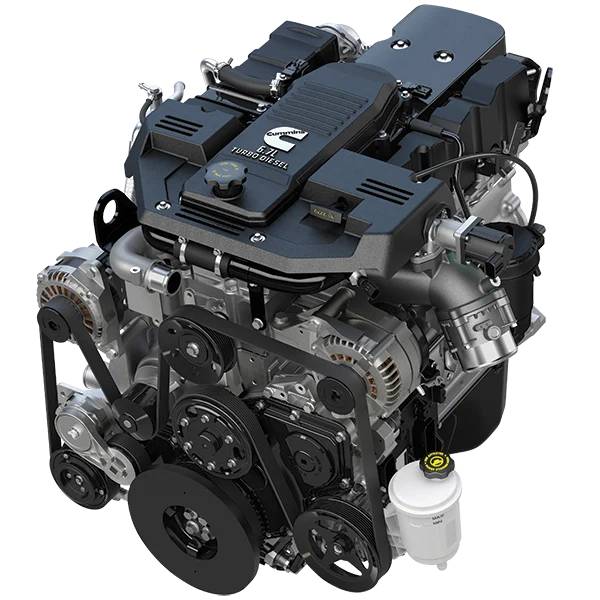
What Are the 6.7 Cummins Engine Specs?
The 6.7 Cummins is a 6.7-liter inline-six turbo-diesel engine with a 107 mm (4.21-inch) bore and 124 mm (4.88-inch) stroke. Its specifications vary by model year and application, particularly for horsepower, torque, compression ratio, and fuel-system configuration. For example, the 2021 pickup version was available with 370–420 horsepower and 850–1,075 lb-ft of torque, while the 2025 pickup version produces 430 horsepower and 1,075 lb-ft.
The following table provides a reference point for the major specifications. Because Cummins has revised the engine over time, horsepower, torque, compression ratio, and several supporting systems should always be checked against the specific model year.
| Specification | 6.7 Cummins Engine |
|---|---|
| Configuration | Inline 6-cylinder diesel |
| Displacement | 6.7 L (408 cu in) |
| Bore | 107 mm (4.21 in) |
| Stroke | 124 mm (4.88 in) |
| Aspiration | Turbocharged and charge-air cooled |
| Fuel system | High-pressure common rail |
| 2021 horsepower | 370–420 hp |
| 2021 torque | 850–1,075 lb-ft |
| 2021 compression ratio | 19:1 Standard Output; 16.2:1 High Output |
| 2021 wet weight | Approx. 1,070–1,071 lb |
| 2025 pickup horsepower | 430 hp |
| 2025 pickup torque | 1,075 lb-ft |
| 2025 pickup compression ratio | 16.0:1 |
| 2025 pickup engine weight | 1,070 lb |
Cummins lists the 2021 Standard Output engine at 370 horsepower and 850 lb-ft, while the High Output version produces 420 horsepower and 1,075 lb-ft. Both versions retain the same 6.7-liter displacement, six-cylinder layout, 107 mm bore, and 124 mm stroke. The major differences therefore extend beyond displacement and basic cylinder geometry to calibration and other engine and drivetrain specifications.
The specifications changed again for the 2025 pickup application. Cummins rates this version at 430 horsepower and 1,075 lb-ft, with a 16.0:1 compression ratio and 1,070-pound engine weight. The 2025 Chassis Cab configuration has different ratings—360 horsepower, 800 lb-ft, and an 18.3:1 compression ratio—which demonstrates why the vehicle application must be identified before assigning a single set of specifications to a 6.7 Cummins.
What Is the 6.7 Cummins Engine Configuration?
The 6.7 Cummins uses an inline-six, four-stroke diesel configuration rather than a V8 layout. Its six cylinders are positioned in a single longitudinal row, and the engine uses turbocharging with charge-air cooling in Ram heavy-duty applications. Cummins also identifies the broader 6.7-liter architecture with a high-pressure common-rail fuel system.
An inline-six arrangement creates a different physical and mechanical architecture from the V8 diesel configurations used by several competing heavy-duty engines. The cylinders share one bank and one cylinder head rather than being divided between two banks. For the 6.7 Cummins, this layout combines a 107 mm cylinder bore with a longer 124 mm piston stroke.
The configuration has remained a defining attribute while supporting components and output ratings have evolved. For example, Cummins identifies both the 2021 Standard Output and High Output versions as six-cylinder, turbocharged and charge-air-cooled engines despite their different horsepower, torque, and compression ratios.
What Is the Displacement of a 6.7 Cummins?
The 6.7 Cummins has a displacement of 6.7 liters, equivalent to approximately 408 cubic inches. Displacement represents the combined volume swept by all six pistons as they travel through their cylinders. Cummins lists the 6.7-liter/408-cubic-inch displacement for its 6.7-liter inline-six architecture.
Engine displacement is determined by cylinder bore, piston stroke, and cylinder count. The 6.7 Cummins combines six cylinders with a 107 mm bore and 124 mm stroke to create its total displacement. These fundamental dimensions remain useful identifiers even when comparing engines with substantially different output ratings.
Displacement should not be used as a direct substitute for horsepower or torque. Two 6.7 Cummins engines can have identical displacement while producing different outputs because engine calibration, airflow, fuel delivery, turbocharging, compression ratio, and supporting hardware also affect performance. The 2021 Standard Output and High Output engines demonstrate this distinction: both displace 6.7 liters, but Cummins rated them at 370 and 420 horsepower respectively.
What Are the Bore and Stroke of a 6.7 Cummins?
The 6.7 Cummins has a 107 mm (4.21-inch) bore and a 124 mm (4.88-inch) stroke. Cummins specifies these dimensions for both the Standard Output and High Output 2021 pickup engines, and the 107 × 124 mm dimensions remain listed for the current 6.7-liter platform.
The bore measures the diameter of each cylinder, while the stroke measures the distance the piston travels between the upper and lower limits of its movement. The 124 mm stroke is 17 mm longer than the 107 mm bore diameter. Combined across six cylinders, these dimensions produce approximately 6.7 liters of displacement.
Bore and stroke are fundamental physical specifications and should be separated from output specifications such as horsepower and torque. Output ratings can change substantially through engine development without requiring a corresponding change in displacement. This is why model-year comparisons should treat bore, stroke, horsepower, torque, and compression ratio as separate attributes rather than assuming that one determines all the others.
What Is the Compression Ratio of a 6.7 Cummins?
The compression ratio of the 6.7 Cummins varies by model year and engine configuration rather than remaining at one value across every version. Cummins lists a 19:1 compression ratio for the 2021 Standard Output engine and 16.2:1 for the 2021 High Output engine. The 2025 pickup engine is listed at 16.0:1, while the 2025 Chassis Cab engine uses an 18.3:1 ratio.
Compression ratio describes the relationship between cylinder volume when the piston is at the bottom of its stroke and cylinder volume when the piston reaches the top. Compression is particularly important in a diesel engine because diesel combustion relies on heat generated by compressing air before fuel is injected.
The variation between 6.7 Cummins versions shows why a compression ratio should always be attached to a specific model year and configuration. For example, stating that every 6.7 Cummins has a 19:1 compression ratio would correctly describe the 2021 Standard Output specification but incorrectly describe the 2021 High Output and 2025 pickup engines. Model year and application therefore provide essential context for interpreting this specification.
How Much Horsepower Does a 6.7 Cummins Have?
The 6.7 Cummins produces approximately 350 to 430 horsepower in factory Ram pickup applications, depending on model year and engine configuration. Output has increased substantially since the 6.7L engine replaced the 5.9L Cummins in Ram Heavy Duty trucks. Recent versions sit at the upper end of this range, including the 2025 pickup specification of 430 horsepower.
Horsepower measures the rate at which an engine performs work, so it represents a different performance attribute from torque. In a heavy-duty diesel engine, peak horsepower contributes to the ability to maintain performance as engine speed and vehicle speed increase, while the engine’s high torque output provides the rotational force required to move heavy loads. The combination makes the 6.7 Cummins suitable for Ram 2500 and Ram 3500 applications where towing and payload performance are major requirements.
A single horsepower number should not be assigned to every 6.7 Cummins. Earlier engines were rated substantially lower than current versions, and Cummins has also offered Standard Output and High Output configurations during several model years. For example, the 2021 Standard Output engine produced 370 hp, while the High Output version produced 420 hp. Both engines displaced 6.7 liters but used different specifications and calibrations to achieve different output levels.
How Has 6.7 Cummins Horsepower Changed by Model Year?
Factory 6.7 Cummins horsepower increased from approximately 350 hp in early Ram applications to 430 hp in the 2025 pickup specification. The increase did not occur in one step. Cummins and Ram revised engine calibration and supporting systems across multiple generations, creating several distinct output levels.
Representative factory ratings show the progression:
| Model Year | Configuration | Horsepower |
|---|---|---|
| 2007.5 | 6.7 Cummins | 350 hp |
| 2010 | 6.7 Cummins | 350 hp |
| 2013 | 6.7 Cummins | Up to 385 hp |
| 2019 | Standard Output | 370 hp |
| 2019 | High Output | 400 hp |
| 2021 | Standard Output | 370 hp |
| 2021 | High Output | 420 hp |
| 2025 | Pickup | 430 hp |
The table demonstrates why model year is an essential qualifier for horsepower. A 2007.5 6.7 Cummins and a 2025 6.7 Cummins share the same basic displacement, but their factory power ratings are separated by roughly 80 horsepower. Hardware revisions, fuel delivery, turbocharger control, combustion calibration, emissions-system development, and drivetrain integration contributed to changes across the engine’s production history.
Horsepower figures should also be interpreted as factory engine ratings rather than wheel horsepower. Power measured at the wheels is lower because energy is lost through the transmission, driveshaft, differential, and other drivetrain components before reaching the tires. Aftermarket tuning can also produce outputs substantially different from the original factory specification, so modified-engine dyno figures should not be mixed with stock 6.7 Cummins specs.
What Is the Difference Between Standard Output and High Output Horsepower?
The High Output 6.7 Cummins produces more factory horsepower than the Standard Output version when both configurations are offered for the same model year. In 2021, for example, Cummins rated the Standard Output engine at 370 hp and the High Output engine at 420 hp, creating a 50-hp difference.
| 2021 Specification | Standard Output | High Output |
|---|---|---|
| Displacement | 6.7 L | 6.7 L |
| Horsepower | 370 hp | 420 hp |
| Torque | 850 lb-ft | 1,075 lb-ft |
| Compression ratio | 19.0:1 | 16.2:1 |
| Configuration | Inline-six | Inline-six |
The difference is therefore not created by increasing displacement. Both versions retain the 6.7-liter inline-six architecture, 107 mm bore, and 124 mm stroke. Instead, the output difference comes from the engine and drivetrain specifications used for each application.
The High Output designation is particularly relevant when researching a used Ram Heavy Duty because two trucks from the same model year can have different engine ratings. Identifying the model year, transmission, truck model, and engine configuration provides a more reliable specification than assuming every 6.7 Cummins from the same period produces identical power.
How Much Torque Does a 6.7 Cummins Produce?
Factory 6.7 Cummins engines used in Ram pickups produce roughly 650 to 1,075 lb-ft of torque depending on model year and configuration. Early 6.7L versions started around 650 lb-ft, while later High Output engines exceeded 1,000 lb-ft. The 2025 pickup engine is rated at 1,075 lb-ft.
Torque represents rotational force and is one of the most important performance attributes of a heavy-duty diesel engine. High torque at relatively low engine speeds allows a truck to accelerate and maintain movement under substantial load without requiring the high rpm characteristic of many gasoline engines. This is one reason torque receives as much attention as horsepower when comparing diesel-powered Ram 2500 and Ram 3500 trucks.
The increase from approximately 650 lb-ft in early applications to more than 1,000 lb-ft in later engines represents a gain of more than 400 lb-ft. However, that additional engine torque does not translate into an identical percentage increase in towing capacity. Maximum towing capacity also depends on the transmission, axle ratio, chassis configuration, Gross Combined Weight Rating, cab and bed configuration, drivetrain, and other vehicle-level specifications.
How Has 6.7 Cummins Torque Changed by Model Year?
The 6.7 Cummins increased from about 650 lb-ft of torque in its early Ram application to a peak factory pickup rating of 1,075 lb-ft in later High Output applications. Several major output revisions occurred between those specifications.
Representative ratings include:
| Model Year | Configuration | Torque |
|---|---|---|
| 2007.5 | 6.7 Cummins | 650 lb-ft |
| 2010 | 6.7 Cummins | 650 lb-ft |
| 2013 | Available configuration | Up to 850 lb-ft |
| 2019 | Standard Output | 850 lb-ft |
| 2019 | High Output | 1,000 lb-ft |
| 2021 | Standard Output | 850 lb-ft |
| 2021 | High Output | 1,075 lb-ft |
| 2025 | Pickup | 1,075 lb-ft |
The 2019 model year marked an important milestone because the High Output 6.7 Cummins reached a four-digit factory torque rating of 1,000 lb-ft. By 2021, the High Output rating had increased to 1,075 lb-ft. This represents approximately 65% more torque than the roughly 650 lb-ft rating associated with the early 6.7L application.
Torque ratings must still be matched to the specific application. Chassis Cab versions, for example, can use different engine calibrations and output ratings from Ram pickup versions even when both vehicles use a 6.7-liter Cummins. The engine name alone therefore does not establish the correct torque specification.
What Is the Difference Between Standard Output and High Output Torque?
The High Output 6.7 Cummins is calibrated for substantially more torque than the Standard Output engine. For the 2021 specifications, Standard Output provides 850 lb-ft while High Output provides 1,075 lb-ft, a difference of 225 lb-ft or approximately 26%.
This difference matters most when the engine operates under heavy load. Torque supplies the twisting force transferred through the transmission and driveline, making it directly relevant to acceleration under load, grade climbing, and heavy-duty towing performance. Higher engine torque gives the powertrain more available rotational force, although the truck’s actual towing rating remains limited by the complete vehicle configuration.
Standard Output and High Output should therefore be treated as separate specifications rather than two names for an otherwise identical power rating. Both engines share the same 6.7-liter displacement and inline-six arrangement, but their horsepower, torque, compression ratio, transmission pairing, and application can differ.
For buyers comparing Ram Heavy Duty trucks, the practical rule is to identify the exact engine configuration before comparing performance. “6.7 Cummins” identifies the engine family, while the model year and Standard Output or High Output designation identify the output specification more precisely.
What Are the Dimensions and Weight of a 6.7 Cummins Engine?
The 6.7 Cummins weighs approximately 1,070 lb in current pickup applications, but complete external dimensions can vary according to engine configuration and the components included in the measurement. Engine weight is therefore more useful when it is paired with a specific model year and application rather than treated as one universal specification for every 6.7 Cummins.
The 6.7L Cummins is physically defined by its inline-six architecture and 107 mm × 124 mm (4.21 × 4.88 in) bore-and-stroke dimensions. Unlike a V8, which divides its cylinders between two banks, the Cummins places all six cylinders in one row. This produces a relatively long and narrow engine package, an important distinction when considering engine-bay packaging or an engine swap.
Cummins lists the 2021 pickup engines at approximately 1,070–1,071 lb wet. The 2025 pickup specification lists an engine weight of approximately 1,070 lb. These figures show that the complete 6.7 Cummins is substantially heavier than a typical gasoline passenger-vehicle engine, which is expected for a heavy-duty diesel designed around high cylinder pressures and sustained load operation.
Engine weight also affects the vehicle as a complete system. The front suspension, frame, cooling system, transmission, and other supporting components must accommodate the diesel powertrain. For this reason, engine weight is particularly relevant when comparing diesel and gasoline configurations or evaluating a custom engine swap.
Exact length, width, and height figures require additional context because published measurements can include different accessories, housings, and installed components. A bare-engine measurement should not be treated as interchangeable with the dimensions of a fully dressed engine. When installation clearance is the purpose of the measurement, dimensions should be verified against the exact engine assembly being installed rather than relying on a generic 6.7 Cummins dimension figure.
What Fuel System Does the 6.7 Cummins Use?
The 6.7 Cummins uses a high-pressure common-rail direct fuel-injection system. The system stores pressurized diesel fuel in a common rail and distributes it electronically to individual injectors, allowing injection timing and fuel quantity to be controlled according to engine operating conditions.
Common-rail injection separates pressure generation from the individual injection event. A high-pressure pump supplies fuel to the rail, the rail maintains pressurized fuel for the injectors, and electronically controlled injectors meter fuel into each cylinder. This arrangement allows the engine-control system to manage injection events more precisely than older mechanically controlled diesel systems.
Precise fuel delivery affects combustion, engine output, noise, emissions, and fuel use. Multiple injection events can be used within a combustion cycle rather than relying on one mechanically timed fuel-delivery event. The engine can therefore adjust fuel delivery according to variables such as engine speed, load, temperature, and requested torque.
The fuel system is also one reason model year matters when discussing 6.7 Cummins specifications. Cummins has revised fuel-system hardware during the engine’s production history. A component identified for one generation should not automatically be assumed to fit or operate identically on every 6.7 Cummins produced since 2007.
What Fuel Injection Components Does the 6.7 Cummins Use?
The main 6.7 Cummins fuel-injection components include a high-pressure fuel pump, common rail, electronically controlled injectors, fuel lines, filtration components, sensors, and electronic engine controls. These components work as one system to supply the quantity of diesel fuel required for each combustion event.
The high-pressure pump creates the pressure required by the injection system. Pressurized fuel then enters the common rail, which acts as a shared reservoir supplying the six injectors. Each injector meters fuel directly into its corresponding cylinder according to commands from the engine-control system.
Sensors and electronic controls provide the information required to regulate this process. Engine speed, operating load, rail pressure, temperature, and other inputs allow the control system to determine injection timing and quantity. This coordination enables the same 6.7-liter displacement to support different horsepower and torque ratings when combined with different hardware and calibrations.
Fuel-system components should always be identified by model year when replacement or troubleshooting is involved. The 6.7 Cummins has undergone fuel-system revisions during its long production run, so identifying an engine only by displacement is insufficient when selecting components such as a high-pressure pump or injector.
What Turbo Does the 6.7 Cummins Use?
The 6.7 Cummins uses a variable-geometry turbocharger in Ram Heavy Duty applications. A variable-geometry turbocharger changes the effective flow area through the turbine housing according to operating conditions, allowing the engine to balance low-speed response with airflow requirements at higher engine loads.
At lower engine speeds, changing the turbocharger’s vane position can increase exhaust-gas velocity through the turbine and help the turbo respond sooner. As engine airflow requirements increase, the vane position changes to accommodate greater exhaust flow. This variable geometry provides a wider useful operating range than a conventional fixed-geometry turbocharger designed around a single turbine-housing geometry.
Turbocharging increases the mass of air entering the cylinders. The engine can then combine the additional oxygen with an appropriate amount of fuel to produce greater power and torque than a naturally aspirated engine of comparable displacement. Charge-air cooling further reduces the temperature of compressed intake air before it enters the engine, increasing air density and supporting controlled combustion under load.
The variable-geometry design can also contribute to exhaust braking. Changing vane position creates additional exhaust restriction when engine braking is requested, helping the powertrain slow the vehicle without relying exclusively on the service brakes. This function is particularly relevant to heavy-duty trucks descending grades while towing.
How Has the 6.7 Cummins Turbo Changed by Model Year?
The 6.7 Cummins has retained variable-geometry turbocharging as a defining feature while turbocharger hardware and control strategies have evolved across different generations. The exact turbo should therefore be identified using the engine’s model year and application rather than assuming one turbocharger specification applies to the entire 6.7L production history.
Early 6.7 Cummins engines introduced electronically controlled variable-geometry turbocharging as part of the engine’s broader emissions and performance package. The adjustable turbine geometry allowed the turbocharger to support boost control, low-rpm response, and exhaust-brake operation within one system.
Later engine revisions changed supporting hardware and calibration as Cummins increased output and adapted the engine to newer emissions and performance requirements. These changes are significant when comparing replacement turbochargers because physical fitment, actuator configuration, electronic control, and operating characteristics can differ between generations.
Turbocharger size alone also does not explain the horsepower and torque differences between 6.7 Cummins versions. Engine output results from the interaction of airflow, boost control, fuel delivery, combustion calibration, compression ratio, cooling, emissions equipment, and drivetrain requirements. The turbocharger should therefore be treated as one component within the complete engine system rather than the sole cause of a particular horsepower rating.
How Much Oil Does a 6.7 Cummins Hold?
A 6.7 Cummins generally holds 12 quarts (11.4 liters) of engine oil with the oil filter on many Ram Heavy Duty applications. Oil capacity should still be verified against the specific model year and owner’s manual because service specifications can change as the engine and vehicle platform are updated.
Oil capacity refers to the amount required to refill the lubrication system during a normal oil-and-filter service. The engine uses this oil to lubricate components such as the crankshaft bearings, connecting-rod bearings, camshaft, valvetrain, pistons, and turbocharger. Oil also assists with heat management and carries contaminants toward the filtration system.
The correct fill quantity matters because both insufficient and excessive oil can create problems. A low oil level reduces the available lubrication reserve and can expose components to inadequate oil supply. Overfilling can cause aeration or other lubrication problems. The dipstick should therefore be used to confirm the final level after an oil change rather than treating the published capacity as a substitute for a level check.
Oil capacity is also different from oil consumption. A 12-quart service capacity describes how much lubricant the system requires during an oil change; it does not mean the engine should consume a measurable portion of that oil during a fixed mileage interval. Oil consumption must be evaluated separately according to operating conditions, mileage, engine condition, and manufacturer guidance.
What Oil Does a 6.7 Cummins Require?
The correct oil for a 6.7 Cummins depends on model year, ambient temperature, and the oil specification required by Cummins or Ram. Owners should select viscosity and performance specifications from the manual for their exact engine rather than assuming that one diesel oil is appropriate for every 6.7 Cummins.
Viscosity determines how the lubricant flows at different temperatures. Multi-grade oils use two viscosity designations, such as 10W-30 or 5W-40, to describe their behavior during cold starts and at normal operating temperature. Lower-temperature operating conditions can require a viscosity that maintains suitable flow during cold starts, while the oil must also retain sufficient viscosity after the engine reaches operating temperature.
Oil specification is equally important because modern diesel lubricants must work with the engine’s emissions equipment as well as its internal components. The 6.7 Cummins uses emissions-control systems that changed during its production history, making the manufacturer’s required oil specification more reliable than choosing a lubricant based only on viscosity.
For routine maintenance, owners should therefore verify 3 items before an oil change: the required oil specification, recommended viscosity for the expected temperature range, and correct refill capacity for the model year. This approach prevents specifications from one generation of the 6.7 Cummins from being incorrectly applied to another.
How Have 6.7 Cummins Engine Specs Changed by Year?
The 6.7 Cummins has retained its 6.7-liter inline-six architecture while horsepower and torque have increased substantially since its introduction in Ram Heavy Duty trucks. Early versions produced about 350 hp and 650 lb-ft, while later pickup versions reached 430 hp and 1,075 lb-ft. The engine therefore demonstrates how output can change considerably even when displacement, cylinder count, bore, and stroke remain fundamentally consistent.
The major specification changes can be summarized by representative model years:
| Model Year | Horsepower | Torque | Key Specification Change |
|---|---|---|---|
| 2007.5 | Approx. 350 hp | Approx. 650 lb-ft | 6.7L replaces 5.9L in Ram Heavy Duty |
| 2010 | Approx. 350 hp | Approx. 650 lb-ft | Early 6.7L configuration continues |
| 2013 | Up to approx. 385 hp | Up to approx. 850 lb-ft | Higher-output configurations become available |
| 2019 SO | 370 hp | 850 lb-ft | New-generation Standard Output configuration |
| 2019 HO | 400 hp | 1,000 lb-ft | High Output reaches four-digit torque |
| 2021 SO | 370 hp | 850 lb-ft | Standard Output configuration |
| 2021 HO | 420 hp | 1,075 lb-ft | Higher horsepower and torque |
| 2025 Pickup | 430 hp | 1,075 lb-ft | Updated pickup specification |
The transition from approximately 650 lb-ft to 1,000 lb-ft represents one of the most significant changes in the engine’s development. The 2019 High Output version crossed the 1,000-lb-ft threshold while retaining the same nominal 6.7-liter displacement. By 2021, High Output torque increased to 1,075 lb-ft and horsepower reached 420 hp.
The 2025 pickup specification changes the relationship again. Horsepower rises to 430 hp while peak torque remains at 1,075 lb-ft. This demonstrates that engine development does not require horsepower and torque to increase at the same rate. Engineers can revise the power curve, calibration, airflow, fuel delivery, and supporting systems according to the intended vehicle application.
The physical fundamentals remain much more consistent than the output ratings. The 6.7 Cummins continues to use an inline-six arrangement with approximately 408 cubic inches of displacement and 107 × 124 mm bore-and-stroke dimensions. These stable attributes identify the basic engine architecture, while horsepower, torque, compression ratio, fuel-system components, emissions equipment, and calibration provide more useful distinctions between generations.
Model year is therefore one of the most important qualifiers when searching for 6.7 Cummins specs. A specification such as “420 horsepower” can accurately describe one High Output version but cannot describe the entire engine family. The most precise format combines model year + application + output configuration + specification, such as “2021 6.7 Cummins High Output — 420 hp and 1,075 lb-ft.”
What Is the Difference Between the 6.7 Cummins Standard Output and High Output Engines?
The main difference between Standard Output and High Output 6.7 Cummins engines is their factory horsepower and torque rating, although compression ratio, calibration, transmission pairing, and supporting components can also differ. The two versions should therefore be treated as separate powertrain configurations rather than assuming High Output is simply a software-adjusted Standard Output engine.
The 2021 model year provides a clear comparison:
| Specification | 2021 Standard Output | 2021 High Output |
|---|---|---|
| Displacement | 6.7 L | 6.7 L |
| Configuration | Inline-six | Inline-six |
| Bore | 107 mm (4.21 in) | 107 mm (4.21 in) |
| Stroke | 124 mm (4.88 in) | 124 mm (4.88 in) |
| Horsepower | 370 hp | 420 hp |
| Torque | 850 lb-ft | 1,075 lb-ft |
| Compression ratio | 19.0:1 | 16.2:1 |
| Aspiration | Turbocharged | Turbocharged |
The 2021 High Output engine produces 50 more horsepower and 225 more lb-ft of torque than the Standard Output engine. This equals an increase of approximately 13.5% in horsepower and 26.5% in peak torque, despite both engines retaining the same displacement, bore, stroke, cylinder count, and basic inline-six architecture.
Compression ratio provides another important distinction. The 2021 Standard Output specification uses a 19.0:1 ratio, while the High Output version uses 16.2:1. This difference demonstrates why the two versions cannot be accurately compared using displacement alone. Combustion specifications and supporting powertrain components must also be considered.
Transmission pairing is another part of the powertrain relationship. Historically, Ram has paired different versions of the 6.7 Cummins with transmissions selected for their respective output and vehicle applications. This matters because the transmission must manage the torque produced by the engine and deliver it through the driveline under heavy loads.
The distinction also affects used-truck research. A listing that states only “6.7 Cummins” does not provide enough information to establish horsepower and torque for model years that offered multiple outputs. Buyers should identify the truck’s model year, Ram model, transmission, and Standard Output or High Output designation before using an advertised engine rating for comparison.
The 2025 pickup simplifies this distinction because the revised 6.7L Cummins pickup powertrain is rated at 430 hp and 1,075 lb-ft rather than following the same previous Standard Output/High Output pickup structure. This reinforces a central rule for interpreting 6.7 Cummins specifications: use the specification associated with the exact model year and application instead of applying one generation’s configuration to the entire engine family.
Which Ram Trucks Use the 6.7 Cummins Engine?
The 6.7 Cummins is primarily used in Ram 2500 and Ram 3500 Heavy Duty trucks, along with selected Ram Chassis Cab applications. The engine entered Dodge Ram Heavy Duty production for the 2007.5 model year as the replacement for the 5.9L Cummins and has remained a major diesel powertrain option through subsequent Ram generations.
Ram 2500 and Ram 3500 pickups represent the most familiar applications, but the engine specification is not identical across every truck that carries the 6.7 Cummins name. Pickup and Chassis Cab applications can use different calibrations, horsepower ratings, torque ratings, compression ratios, and supporting powertrain components. For example, the 2025 pickup version produces 430 hp and 1,075 lb-ft, while the 2025 Chassis Cab version is rated at 360 hp and 800 lb-ft.
These differences reflect the intended duty cycle of each vehicle. A consumer-oriented heavy-duty pickup must balance towing, payload, drivability, emissions requirements, and everyday operation. A Chassis Cab is designed as a platform for commercial bodies and equipment, so its engine calibration can prioritize operating requirements differently. The shared 6.7-liter displacement therefore does not guarantee identical output.
Ram 2500 and Ram 3500 specifications can also differ even when the same engine family is available. Transmission, drivetrain, axle ratio, Gross Vehicle Weight Rating (GVWR), Gross Combined Weight Rating (GCWR), cab configuration, bed length, and rear-axle configuration influence the capabilities of the complete truck.
This distinction is especially important when researching towing specifications. Engine torque is an engine specification, while maximum towing capacity is a vehicle specification. A 6.7 Cummins producing 1,075 lb-ft does not have one universal towing capacity because the engine can be installed in multiple truck configurations with different structural and drivetrain limits.
How Long Does a 6.7 Cummins Engine Last?
A properly maintained 6.7 Cummins can accumulate several hundred thousand miles, but there is no single guaranteed mileage at which every engine will require replacement. Engine lifespan depends on maintenance history, operating load, idle time, emissions-system condition, engine modifications, driving environment, and how the truck has been used throughout its service life.
Mileage alone provides an incomplete measurement for a heavy-duty diesel. Two 6.7 Cummins engines with 200,000 miles can have substantially different wear profiles if one accumulated mostly highway mileage while the other spent thousands of hours idling or repeatedly towing near its vehicle limits. Engine hours, service records, oil-change history, and operating conditions provide additional context when evaluating longevity.
Maintenance directly affects the systems responsible for engine durability. Engine oil protects bearings, cylinder components, valvetrain parts, and the turbocharger, while the fuel filtration system protects high-pressure fuel components and injectors from contamination. The cooling system controls operating temperature, and the air-intake system prevents abrasive contaminants from entering the cylinders. Neglect in any of these areas can shorten service life even when the core engine architecture is capable of high mileage.
Emissions equipment also deserves separate consideration when evaluating long-term ownership. A modern 6.7 Cummins operates as part of a complete powertrain and emissions system rather than as an isolated mechanical engine. Problems involving the diesel particulate filter, exhaust gas recirculation components, selective catalytic reduction system, sensors, or related controls can create ownership costs without necessarily indicating that the engine’s rotating assembly has reached the end of its service life.
Modifications introduce another variable. Additional boost pressure, altered fueling, aggressive tuning, or operation above the original drivetrain limits increases mechanical and thermal loads. A modified engine producing substantially more than its factory horsepower and torque should therefore not be expected to have the same durability profile as an otherwise comparable stock engine operating within its intended duty cycle.
For a used Ram with a 6.7 Cummins, service history is more informative than mileage by itself. Oil and filter records, fuel-system maintenance, cold-start behavior, blow-by, fluid condition, diagnostic codes, turbocharger operation, and evidence of previous modifications provide a more complete assessment of engine condition.
Is the 6.7 Cummins Good for Towing?
Yes. The 6.7 Cummins is well suited to towing because its heavy-duty diesel architecture produces high torque at relatively low engine speeds. Later pickup versions producing more than 1,000 lb-ft provide substantial rotational force for accelerating a loaded truck, maintaining speed under load, and climbing grades.
Torque is particularly valuable when a vehicle must move a large combined mass. The engine sends rotational force through the transmission, driveshaft, differential, and axles before it reaches the wheels. A diesel engine that develops strong torque without requiring high rpm can perform this work while operating within the low- and mid-speed ranges commonly encountered during heavy towing.
The variable-geometry turbocharger adds another towing-related function through exhaust braking. When the driver reduces speed, the turbocharger system can increase exhaust restriction to create engine braking. This helps control vehicle speed on descents and reduces reliance on the service brakes, which is especially useful when a truck is pulling a heavy trailer.
However, the 6.7 Cummins engine’s torque rating does not determine maximum towing capacity by itself. At least 7 vehicle-level factors influence the final rating: truck model, transmission, axle ratio, drivetrain, cab configuration, bed configuration, and GVWR/GCWR. Rear-wheel versus four-wheel drive and single-rear-wheel versus dual-rear-wheel configurations can further change available ratings.
For example, two Ram 3500 trucks equipped with a 6.7 Cummins can have different towing limits because one may use a different axle ratio, cab, drivetrain, or rear-wheel configuration. The engine may produce the same rated horsepower and torque in both trucks, but the complete vehicles are not mechanically identical.
Payload and towing capacity should also be distinguished. Payload measures how much weight the truck itself can carry, while towing capacity describes the permitted trailer weight under the specified configuration. Trailer tongue or pin weight contributes to the load placed on the truck, so a combination that falls below the maximum advertised towing figure can still exceed another vehicle rating.
The correct method is therefore to use 6.7 Cummins horsepower and torque to understand engine performance, then use the specifications for the exact Ram configuration to establish towing capacity. This prevents an engine-level specification such as 1,075 lb-ft from being incorrectly presented as evidence that every truck equipped with that engine can tow the same amount.
What Fuel Economy Does a 6.7 Cummins Get?
A 6.7 Cummins does not have one universal MPG rating because fuel economy changes with truck configuration, model year, vehicle weight, axle ratio, driving conditions, speed, and towing load. Fuel economy should therefore be evaluated for the complete Ram 2500 or Ram 3500 rather than treated as a fixed specification of the engine itself.
Heavy-duty trucks also differ from light-duty vehicles when comparing official fuel-economy data. Many configurations in the heavy-duty class are not represented by the same EPA fuel-economy labels consumers use to compare passenger cars and light-duty trucks. As a result, an MPG figure quoted for one 6.7 Cummins-powered Ram should not automatically be applied to every truck using the engine.
Vehicle configuration creates substantial variation. A Ram 2500 with a lighter configuration can consume a different amount of fuel from a Ram 3500 dually carrying the same engine family. Four-wheel drive, larger tires, additional vehicle weight, different axle ratios, and aerodynamic accessories can further change the amount of fuel required to move the vehicle.
Towing introduces another major variable because the engine must move the combined mass of the truck and trailer while overcoming additional aerodynamic and rolling resistance. Trailer weight is only part of this effect. A tall enclosed trailer can create considerably more aerodynamic drag than a lower-profile trailer at highway speed, even when both trailers have similar weights.
Driving speed also matters because aerodynamic resistance increases rapidly as vehicle speed rises. A truck operating steadily on an unloaded highway can therefore return substantially different fuel economy from the same truck towing at highway speed, making repeated short trips, idling for long periods, or operating in stop-and-go traffic.
Engine modifications further reduce the usefulness of a universal MPG estimate. Changes to tire diameter, suspension height, engine calibration, airflow components, or drivetrain gearing can alter fuel consumption or the accuracy of dashboard calculations. Hand-calculated fuel economy over multiple fill-ups provides a more useful measurement for an individual truck than assuming that another 6.7 Cummins owner’s MPG will apply to it.
For comparison purposes, fuel economy should therefore be matched using model year + Ram model + drivetrain + axle configuration + towing condition. This provides meaningful context and avoids presenting MPG as an inherent specification like the engine’s 6.7-liter displacement or 107 × 124 mm bore and stroke.
Is the 6.7 Cummins a Good Diesel Engine?
The 6.7 Cummins is a strong heavy-duty diesel engine for applications that prioritize high torque, towing capability, and sustained load performance. Its 6.7-liter inline-six architecture, turbocharging, common-rail fuel injection, and high factory torque output make it particularly suited to Ram 2500, Ram 3500, and related heavy-duty applications.
Its first major strength is torque. Early versions produced approximately 650 lb-ft, while later pickup configurations reached 1,075 lb-ft. This increase gives newer versions substantially more rotational force for moving heavy loads while maintaining the low-rpm characteristics expected from a heavy-duty diesel engine.
The second strength is the basic inline-six architecture. The 6.7 Cummins retains six cylinders in one bank with a 107 mm bore and 124 mm stroke, producing approximately 408 cubic inches of displacement. Although horsepower, torque, compression ratio, fuel-system hardware, and emissions equipment have changed through different generations, the 6.7-liter inline-six configuration remains the central mechanical identity of the engine family.
The third strength is the range of configurations developed during its production history. Standard Output, High Output, pickup, and Chassis Cab applications demonstrate that the same basic engine platform can be configured for different operating requirements. A 2021 High Output engine, for example, combines 420 hp with 1,075 lb-ft, while the later 2025 pickup specification increases output to 430 hp while retaining 1,075 lb-ft of peak torque.
The engine also has practical trade-offs. Its approximately 1,070-lb weight contributes substantial mass to the front of the vehicle, while modern fuel-injection, turbocharging, and emissions systems add complexity compared with older mechanically controlled diesel engines. Maintenance history therefore becomes increasingly important as mileage and engine hours accumulate.
The best 6.7 Cummins configuration depends on the intended use rather than the highest horsepower figure alone. A truck used regularly for heavy towing places different demands on its powertrain from one used primarily for unloaded commuting. Transmission, axle ratio, payload capacity, towing rating, drivetrain, and chassis configuration should be evaluated alongside engine horsepower and torque.
For specification research, the most important distinction is model year and application. “6.7 Cummins” describes an engine family spanning multiple generations, not one fixed set of horsepower, torque, compression ratio, fuel-system, and supporting-component specifications. Matching the exact year and configuration provides a more accurate picture of the engine’s performance and capabilities.