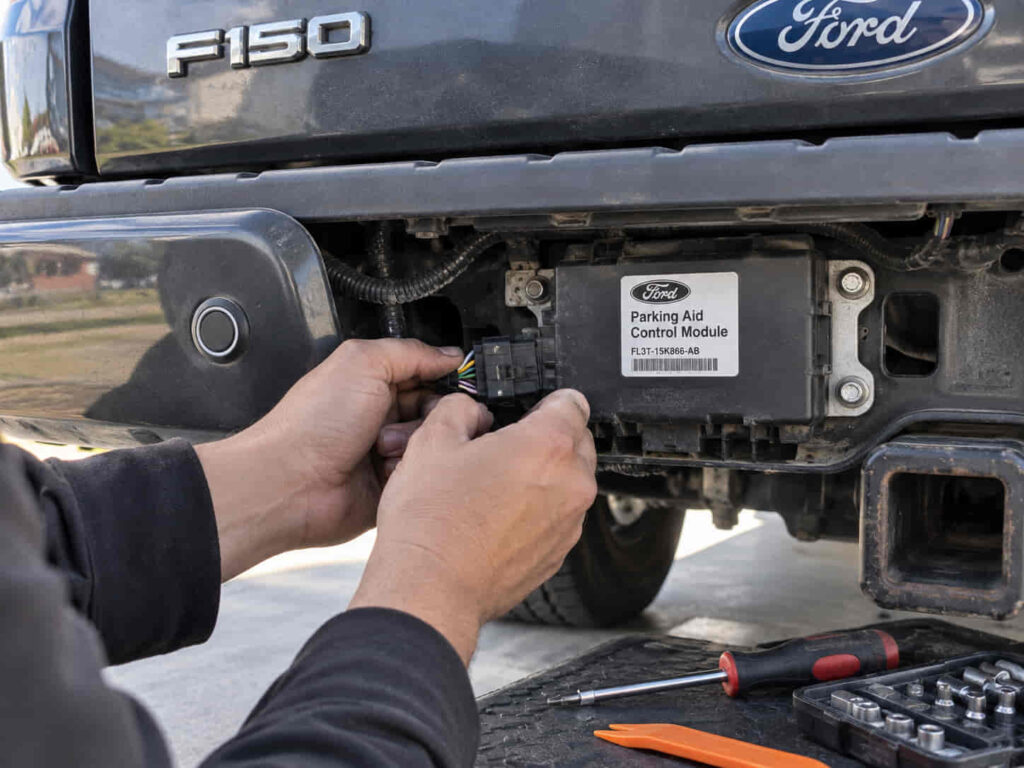
A Ford F150 parking sensor module repair should begin with confirming that the module is actually responsible for the parking aid problem. Parking sensors that stop working, intermittent parking warnings, or a parking aid system that becomes unavailable do not automatically indicate a failed module. Individual sensors, electrical connectors, wiring, power or ground circuits, and other parts of the parking aid system can produce symptoms that overlap with a module fault.
The failure pattern helps narrow the diagnosis. A problem associated with one parking sensor directs attention toward that sensor and its circuit, while multiple sensors or the entire parking aid system failing together can justify investigating shared circuits and the control module. Diagnostic trouble codes, circuit checks, module communication, and application-specific service information can then be used to determine where the fault originates.
Confirming the failure before repair prevents a functional module from being removed or replaced unnecessarily. This guide explains how the Ford F150 parking sensor module works, the symptoms and causes associated with module problems, how to distinguish a module fault from sensor or wiring failures, how the module is diagnosed and repaired, when replacement is appropriate, whether programming or configuration may be required, and what determines repair and replacement costs.
What Does the Parking Sensor Module Do on a Ford F150?
The Ford F150 parking sensor module processes information used by the parking aid system so the vehicle can identify nearby obstacles and provide the appropriate warning to the driver. The module works as part of a larger system rather than detecting obstacles by itself. Parking sensors detect objects within their operating range, while the related wiring, electrical connections, power supply, communication circuits, and control functions allow that information to be processed and turned into a parking aid warning.
This distinction is important when diagnosing a parking sensor problem. A parking sensor and a parking sensor module perform different functions, so failure of one component should not automatically be treated as failure of the other. A defective individual sensor can prevent accurate obstacle detection at that sensor position, while a module or shared circuit problem can affect a broader portion of the parking aid system.
The module also depends on external electrical conditions to operate correctly. It requires the appropriate power, ground, connections, and communication for the specific Ford F150 application. A module that cannot communicate or operate because of an external circuit fault can appear defective even when its internal electronics remain functional. Module diagnosis must therefore include the circuits connected to it rather than treating the control unit as an isolated component.
The exact module arrangement and its relationship with other vehicle control functions can vary by Ford F150 model year and equipment configuration. For this reason, module location, connector identification, wiring terminals, and communication architecture should be verified against service information for the specific truck. A procedure or wiring specification from one F150 application should not automatically be applied to another generation.
Understanding this system relationship establishes the correct repair direction. Parking sensor module repair is appropriate only after diagnosis isolates the fault to the module itself. When the actual problem is an individual parking sensor, connector, wiring circuit, power supply, or another external component, repairing the module will not correct the underlying parking aid fault.
What Are the Symptoms of a Bad Ford F150 Parking Sensor Module?
A bad Ford F150 parking sensor module can cause the parking aid system to become unavailable, multiple parking sensors to stop functioning correctly, intermittent system operation, abnormal warning behavior, or diagnostic faults associated with the parking aid system. These symptoms identify a parking aid problem, but none should be treated as independent proof that the module has internally failed.
The number of affected sensors provides an important diagnostic clue. A problem isolated to one sensor position directs attention toward that sensor, its connector, and its individual circuit before the control module becomes the primary suspect. In contrast, several sensors becoming unavailable together can justify investigating components and circuits shared by those sensors, including the module where the specific system architecture supports that diagnosis.
A parking aid system that becomes completely unavailable also requires broader diagnosis than a single sensor fault. The module depends on power, ground, wiring, electrical connections, and communication with the relevant vehicle systems. Loss of one of these external requirements can prevent normal module operation and create symptoms similar to an internal electronic failure. Confirming module power and communication where applicable is therefore more useful than replacing the module based solely on a parking aid warning.
Intermittent operation provides another useful failure pattern. The parking aid system may work during one drive or operating cycle and fail during another when an electrical connection, wiring fault, or electronic component behaves inconsistently. Intermittent symptoms require the fault to be reproduced and evaluated rather than assuming that temporary restoration of operation means the problem has disappeared.
Abnormal parking warnings can also originate from the sensing side of the system. A sensor that incorrectly detects an obstacle, a sensor affected by its operating environment, or a circuit fault can produce misleading parking aid behavior without an internal module failure. This is why the symptom must be connected to diagnostic evidence before a specific component is condemned.
Diagnostic trouble codes can narrow the fault further, but a stored code should be interpreted according to what the code actually identifies. A sensor circuit fault, communication fault, power-related fault, and internal control-module fault represent different diagnostic paths. Reading a code and immediately replacing the parking sensor module can lead to unnecessary repair if the code actually points toward an external circuit or component.
The strongest module-failure pattern appears when diagnosis moves beyond symptoms and excludes the related external causes. When the appropriate power, ground, communication, sensor circuits, and relevant wiring are verified for the specific F150 application but the module still cannot perform its required function, an internal module fault becomes a substantially stronger diagnostic conclusion. That distinction determines whether the next step should be sensor repair, wiring repair, or Ford F150 parking sensor module repair.
Read more: Chevy Silverado Door Lock Actuator
What Causes a Ford F150 Parking Sensor Module to Fail?
A Ford F150 parking sensor module can fail when an internal electronic fault prevents it from processing or controlling the parking aid system correctly, but external electrical problems can produce nearly identical symptoms. Power or ground faults, damaged wiring, poor electrical connections, communication problems, and faults elsewhere in the parking aid system must therefore be separated from an actual internal module failure before repair begins.
An internal electronic failure affects the module itself. Electronic components and circuit connections inside a control module must receive and process electrical information consistently for the parking aid system to operate correctly. When an internal component or circuit can no longer perform its required function, the module may lose communication, stop processing parking sensor information correctly, or create a repeatable parking aid fault. The exact internal failure cannot be identified reliably from the dashboard symptom alone.
External power and ground problems can make a functional module appear defective. A control module requires the correct electrical supply and ground path before it can operate or communicate normally. If either circuit is interrupted, diagnosis may show an inactive or non-communicating module even though the module itself does not require internal repair. Power and ground verification is therefore part of module diagnosis rather than evidence that the module has already failed.
Wiring and connector faults create a similar problem because the module depends on electrical connections between the sensors and the rest of the parking aid system. An open circuit, poor terminal connection, damaged wiring, or another connection problem can interrupt information that the module needs to process. Repairing the module in this situation would leave the original circuit fault unchanged.
Communication faults must also be interpreted according to the specific F150 system architecture. A module that does not communicate during diagnosis is not automatically a bad module because loss of power, ground, wiring integrity, or network communication can produce the same result. The diagnostic process must establish whether the communication failure originates inside the module or outside it.
The correct failure classification is therefore internal module failure or external system failure. Internal module failure supports parking sensor module repair or replacement. External faults require repair of the affected sensor, connector, wiring, power, ground, or communication circuit. This distinction prevents the parking sensor module from becoming the default replacement part whenever the parking aid system stops working.
How Can You Tell if the Parking Sensor Module or a Sensor Is Bad?
The failure pattern helps distinguish a bad Ford F150 parking sensor module from a bad parking sensor, but electrical testing and diagnostic information are required to confirm the failed component. A fault consistently associated with one sensor position directs diagnosis toward that sensor and its circuit, while a broader system failure can justify investigating shared circuits and the parking sensor module.
An individual parking sensor operates as one input within the parking aid system. When one sensor or its local circuit develops a fault, the diagnostic evidence may remain associated with that sensor position rather than showing a general module failure. The sensor, connector, and associated wiring should therefore be evaluated before replacing or repairing the control module.
A failure involving multiple sensors changes the diagnostic context. Several sensors becoming unavailable at the same time makes several unrelated sensor failures a less useful first assumption and increases the importance of checking shared system components. This includes the relevant power supply, ground, wiring, connections, communication path, and module functions used by the specific F150 application.
Diagnostic trouble codes provide additional separation between these failure categories. A code associated with an individual sensor circuit should lead to diagnosis of that circuit rather than immediate module repair. A communication-related code requires verification of the conditions necessary for module communication. A module-related diagnostic result becomes stronger evidence only after the external circuits relevant to that result have been evaluated.
The response of the system during testing also matters. If a suspected sensor and its circuit fail a model-specific diagnostic procedure while the module continues to communicate and perform its other required functions, the evidence points away from internal module failure. Conversely, a module becomes a stronger suspect when its required external circuits are verified but it repeatedly fails the applicable communication or functional tests.
Parts substitution should not replace diagnosis. Installing a new parking sensor to see whether the problem disappears can occasionally identify a fault, but it does not provide the same diagnostic certainty as verifying the relevant circuit and test results. Replacing the parking sensor module as an experiment creates an even greater risk of unnecessary expense and can introduce additional compatibility or configuration requirements.
The distinction ultimately depends on where the verified fault ends. If diagnosis identifies a defective sensor or its circuit, repair that fault rather than the module. If the sensors and relevant external circuits meet the requirements for the specific F150 application but the module cannot perform its required function, parking sensor module repair or replacement becomes the appropriate diagnostic direction. Model-specific service information remains necessary for exact connector terminals, circuit specifications, test values, and diagnostic procedures.
How Do You Diagnose a Ford F150 Parking Sensor Module?
To diagnose a Ford F150 parking sensor module, confirm the parking aid symptom, identify whether the fault affects one sensor or the broader system, retrieve applicable diagnostic information, inspect the related circuits, and verify module operation before concluding that the module has failed. The purpose of this process is to separate an internal module fault from a sensor, wiring, connector, power, ground, or communication problem that can produce similar symptoms.
Diagnosis should begin with the exact behavior of the parking aid system. Determine whether one sensor position appears to be affected, several sensors have stopped operating, or the complete parking aid function has become unavailable. Reproduce the problem when possible because a consistent failure provides a clearer diagnostic path than a symptom that has only occurred once. The failure pattern establishes which parts of the system require testing first.
The next step is retrieving available diagnostic information with an appropriate scan tool and interpreting any diagnostic trouble codes according to the specific F150 application. A trouble code should be treated as a diagnostic direction rather than automatic confirmation that the component named or associated with the code requires replacement. A sensor-circuit code, communication code, power-related fault, and internal module fault represent different electrical conditions and require different tests.
Individual sensor faults should be isolated before the parking sensor module is condemned. When diagnostic evidence identifies one sensor position, inspect the sensor, its connector, and the relevant wiring according to the applicable service procedure. A defective sensor or interrupted circuit can prevent normal parking aid operation while the control module itself remains functional.
A broader parking aid failure requires greater attention to circuits shared by the system. Module power and ground should be verified where the applicable diagnostic procedure requires these checks. Electrical connectors and accessible wiring should also be inspected for conditions that could interrupt module operation or communication. A module that lacks a required external input cannot be accurately classified as internally defective until the missing input has been addressed.
Communication with the module provides another diagnostic layer. If the scan tool cannot communicate with the applicable control module, determine whether the module has the electrical and network conditions required to communicate before replacing it. Loss of communication caused by an external circuit problem can make a functional module appear dead. Conversely, a module that has the required external conditions but consistently fails an applicable communication or functional test becomes a stronger candidate for internal failure.
The final diagnosis should be based on verified conditions rather than symptom matching. Ford F150 parking sensor module repair becomes appropriate when testing confirms that the module cannot perform its required function even though the relevant external circuits and system conditions meet the specifications for that vehicle application. If testing identifies a sensor, wiring, connector, power, ground, or communication circuit fault instead, that problem should be repaired before the module is considered defective.
Exact test values must come from service information for the specific Ford F150 model year and equipment configuration. Connector pin assignments, circuit design, module architecture, expected voltage, resistance specifications, and diagnostic procedures can differ between applications. Using application-specific information prevents a valid test from one F150 generation from being incorrectly applied to another.
Can a Ford F150 Parking Sensor Module Be Repaired?
A Ford F150 parking sensor module can be repaired when diagnosis confirms an internal module fault and the failed electronic condition can be restored without compromising reliable module operation. Repairability depends on the actual condition of the original unit, so not every parking sensor module fault should be classified as repairable before the module has been diagnosed and evaluated.
Module repair specifically refers to correcting a fault inside the electronic control unit. Replacing a damaged parking sensor, repairing a broken wire, cleaning or repairing an external connector, or restoring a power or ground circuit may restore the parking aid system, but these procedures are external system repairs rather than parking sensor module repair. Establishing this distinction is important because the same parking aid symptom can originate from either side of the module connector.
A repairable internal fault requires more than evidence that the parking aid system does not work. The module first needs to be identified as the failed component through vehicle-level diagnosis. The unit can then be evaluated to determine whether its internal condition supports repair. This prevents electronic work from being performed on a functional module when the actual failure remains elsewhere on the truck.
Repairing the original module can also differ fundamentally from installing another control unit. A module already associated with the vehicle represents the truck’s existing component, whereas a replacement unit must first be verified for correct application and may introduce additional configuration requirements depending on the F150 model year and system design. The specific advantages of retaining the original module should therefore be established for the application rather than assumed universally.
A module should move from the repair path to the replacement path when its internal condition cannot be restored reliably or when an appropriate module repair is not technically viable. Replacement then requires another set of checks, including correct part identification, application compatibility, installation, and any programming or configuration procedure required by that vehicle.
Successful module repair must ultimately be verified by system operation. Reinstalling or reconnecting a repaired unit without confirming that the original parking aid fault has been resolved does not establish a successful repair. The parking aid system should be tested after the module is returned to service, and relevant diagnostic faults should be reevaluated to confirm that the repaired module performs its required function.
The correct decision is therefore based on two separate questions: has diagnosis proved that the Ford F150 parking sensor module itself is faulty, and is that internal fault suitable for reliable repair? Only when both conditions are satisfied does module repair become the appropriate alternative to correcting an external circuit fault or replacing the control unit.
How Is a Ford F150 Parking Sensor Module Repaired?
A Ford F150 parking sensor module is repaired by first confirming an internal module failure, evaluating whether that failure is repairable, correcting the internal electronic fault, testing the repaired unit, and verifying parking aid operation after the module returns to service. Module repair should only begin after vehicle-level diagnosis has excluded parking sensors, wiring, connectors, power, ground, and other external faults that could produce the same parking aid symptoms.
The original module must first be correctly identified because repair procedures depend on the specific electronic unit rather than the Ford F150 name alone. Model year, vehicle equipment, module identification, and part number provide the context required to determine which unit is being repaired. This step also prevents a different parking aid component from being mistaken for the module responsible for the diagnosed function.
The module can then be evaluated for an internal electronic failure. This stage is different from vehicle-level diagnosis. Vehicle diagnosis determines whether the fault originates inside or outside the module, while electronic evaluation determines what has failed within a module already identified as defective. The repair decision should be based on that internal condition rather than assuming every non-functioning control unit can be restored.
An eligible internal fault is repaired at the electronic level and the module must then be tested to determine whether its required functions have been restored. Simply performing an internal repair does not establish that the unit is ready to return to the vehicle. A reliable module repair process requires verification after the electronic work because the original failure must no longer prevent normal module operation.
The repaired module is then returned to the vehicle and the parking aid system is tested again. The original symptom should no longer be present, applicable diagnostic faults should be reevaluated, and the parking aid system should perform correctly under the conditions relevant to the original complaint. If the same fault remains, further diagnosis is required rather than assuming the repair was successful.
This creates a complete repair path of vehicle diagnosis, module confirmation, internal evaluation, electronic repair, module testing, reinstallation, and system verification. Each stage answers a different diagnostic question. Skipping the initial diagnosis risks repairing the wrong component, while skipping final verification leaves the original parking aid problem unresolved from a diagnostic standpoint.
Should You Repair or Replace a Ford F150 Parking Sensor Module?
Repair is appropriate when the original Ford F150 parking sensor module has a confirmed internal fault that can be restored reliably, while replacement is appropriate when the original module cannot be repaired or a dependable repair is not technically viable. The decision should therefore be based on module condition, compatibility requirements, repair cost, replacement cost, and any configuration requirements associated with installing another unit.
Repair keeps the diagnosis centered on the original module. Once that unit has been confirmed as defective and determined to be repairable, correcting its internal fault avoids introducing an unidentified replacement module into the system. This can simplify the repair path in applications where replacement-module compatibility or configuration requires additional consideration, although the exact advantage depends on the specific F150 application.
Replacement changes the component rather than restoring the existing unit. The replacement module must match the required application, which makes part identification an additional step in the repair. A unit that physically connects to the vehicle should not automatically be considered compatible because module application can depend on model year, equipment configuration, part number, and vehicle system requirements.
A used module also should not be evaluated solely by purchase price. The relevant comparison is the total path required to restore the parking aid system. A lower-cost replacement can still involve compatibility verification, installation, diagnosis, and programming or configuration where required. Conversely, repairing an original module is not automatically the less expensive option if its internal condition requires work that is not technically or economically viable.
Reliability is another part of the decision. A repair should only be selected when the identified failure can be corrected and the module can be appropriately tested afterward. Replacement becomes the stronger technical path when damage prevents a dependable repair. Neither option should be chosen simply because “repair is cheaper” or “new is better” without considering the actual module condition and vehicle application.
The correct comparison is therefore repairable original module versus verified compatible replacement module. Diagnosis establishes whether the original unit has failed, internal evaluation determines whether it can be repaired, and application data determines what would be required if replacement becomes necessary.
Does a Ford F150 Parking Sensor Module Need Programming After Replacement?
A replacement Ford F150 parking sensor module may require programming or configuration depending on the model year, module type, and vehicle application, so the requirement must be verified before a replacement unit is installed. One programming rule should not be applied to every Ford F150 because the electronic architecture and module requirements can differ between generations and equipment configurations.
Programming and physical compatibility are separate issues. A replacement module can have the appropriate connector and mounting arrangement without necessarily being ready to perform correctly in the vehicle. Correct part identification must therefore come before any decision about programming or configuration.
This requirement also creates an important distinction between repairing the original module and replacing it. Module repair returns the existing electronic unit to service, whereas replacement introduces another unit whose compatibility and configuration must be evaluated for the vehicle. Whether retaining the original unit avoids a specific programming procedure must still be confirmed for the exact application rather than assumed for every F150.
Used replacement modules require the same caution. Matching the general vehicle model does not establish complete electronic compatibility. Part numbers, supersession information, vehicle equipment, and applicable service procedures should be checked before installation. A module purchased because it came from another Ford F150 can still be unsuitable for the target truck.
Programming requirements should therefore be investigated as part of the replacement decision rather than after the replacement module has already been purchased. The correct sequence is to identify the existing module, verify the compatible replacement, determine the applicable programming or configuration procedure, and then calculate the complete replacement path.
For this reason, module repair and module replacement should not be compared on component price alone. If replacement requires additional programming or configuration for the specific F150, that requirement affects repair complexity, downtime, and total cost. Application-specific service information is required to determine whether those additional procedures apply.
How Much Does Ford F150 Parking Sensor Module Repair Cost?
The cost of Ford F150 parking sensor module repair depends on the diagnostic work required, the internal condition of the module, the repair service performed, and whether removal and reinstallation are included. A single repair price cannot accurately represent every F150 because the total expense changes according to the module, failure type, vehicle configuration, and service process.
Diagnosis is the first part of the total cost because the parking sensor module should be confirmed as the failed component before it is sent for electronic repair. A parking aid problem caused by an individual sensor, wiring fault, damaged connector, missing power or ground, or communication problem does not require internal module repair. Paying for proper diagnosis can therefore prevent the cost of removing and repairing a functional module.
The repair itself represents a separate cost. Once an internal module fault has been confirmed, the unit must be evaluated to determine whether its condition is repairable. The amount of electronic work required depends on the actual internal failure rather than the parking aid symptom observed by the driver. Two F150 trucks displaying similar parking aid problems can therefore require completely different repairs.
Removal and reinstallation can also change the total expense. A module repair service may receive only the removed electronic unit, while a repair facility may handle vehicle diagnosis, module removal, electronic repair or outside repair service, reinstallation, and final system testing. Comparing these services by the advertised module-repair price alone does not represent the complete cost to restore the parking aid system.
Final verification should also be considered part of a complete repair process. After the repaired module returns to service, the original parking aid problem should be checked again and relevant diagnostic faults reevaluated. This confirms whether the module repair corrected the diagnosed failure and whether another system fault remains.
An accurate repair estimate should therefore identify what is included in the quoted service. Diagnosis, module removal, internal electronic repair, return testing, reinstallation, and vehicle-level verification are separate operations even when a repair provider combines them into one service. The exact F150 application and diagnosed module condition are required before a meaningful total repair cost can be established.
How Much Does Ford F150 Parking Sensor Module Replacement Cost?
The cost to replace a Ford F150 parking sensor module consists of the replacement module, diagnostic labor, removal and installation, and any programming or configuration required for the specific vehicle. Replacement can therefore cost more than the module’s purchase price, particularly when additional electronic setup is necessary before the parking aid system operates correctly.
The replacement module is the first cost variable. OEM, new, remanufactured, and used units can be priced differently, but price should only be compared after compatibility has been established. A less expensive module does not reduce repair cost if its part number or application is incompatible with the truck.
Diagnostic labor remains relevant even when replacement is planned. The original module should be confirmed as faulty before another unit is installed. Otherwise, a replacement module can be added to a system that still contains the original sensor, wiring, connector, power, ground, or communication fault.
Installation adds another cost because the original module must be accessed, disconnected, removed, and replaced according to the vehicle-specific procedure. The amount of labor depends on module location and the access requirements for the applicable F150 configuration. A universal installation time should not be applied across all model years without application-specific labor information.
Programming or configuration can further change the total replacement cost when required by the specific vehicle. This expense should be identified before purchasing a replacement module because physical installation alone does not establish that the replacement will operate correctly in every application. The module, vehicle configuration, and applicable service procedure determine whether additional setup is necessary.
Repair and replacement costs should therefore be compared on a complete-service basis. A valid comparison includes diagnosis, the module itself or internal repair, removal and installation, required configuration, and final system verification. Comparing only the price of module repair with the purchase price of a replacement unit leaves out costs that can determine which option is economically practical.
How Do You Find the Correct Parking Sensor Module for a Ford F150?
The correct Ford F150 parking sensor module should be identified from the exact vehicle application and module information rather than from the F150 model name or physical appearance alone. Model year, equipment configuration, existing module identification, part number, and applicable supersession or compatibility information can determine whether a replacement module is suitable.
Model year provides the first level of identification because the F150 has used different electronic architectures and equipment configurations across generations. A module advertised for a Ford F150 should not be assumed to work across every production year. The replacement application must overlap with the exact truck being repaired.
The existing module provides another important reference. Its identification information can be compared with parts data for the target vehicle to determine whether a replacement uses the same applicable part number or a verified superseding number. This is stronger evidence of compatibility than selecting a module because its housing and electrical connectors appear similar.
Vehicle equipment must also be considered where the application differentiates module configurations. Two trucks from the same model year can have different equipment, and electronic control units can depend on the systems installed on the vehicle. VIN-based or application-specific parts information can help narrow the correct component when several module options exist.
A used module requires the same verification. The fact that a control unit was removed from another F150 does not establish that it is compatible with the target vehicle. The donor truck’s application, module identification, part number, and any configuration requirements should be compared with the vehicle receiving the module.
Programming and configuration requirements should be established during the fitment check rather than after installation. A module can be physically compatible while still requiring an application-specific procedure before it functions as intended. Identifying this requirement in advance provides a more accurate estimate of both repair complexity and total replacement cost.
The most reliable selection process therefore moves from exact vehicle application to original module identification, part-number compatibility, and configuration requirements. This approach reduces incorrect replacement orders and prevents a visually similar Ford F150 parking sensor module from being treated as electronically interchangeable without supporting application data.
Why Are My Ford F150 Parking Sensors Not Working?
Ford F150 parking sensors can stop working because of a fault involving an individual sensor, its electrical circuit, wiring or connectors, a shared power or communication problem, or the parking aid control system. A parking sensor problem should therefore be diagnosed according to the number of affected sensors and the behavior of the complete system rather than attributed immediately to the parking sensor module.
A problem isolated to one sensor position provides a different diagnostic pattern from a complete parking aid failure. When one sensor is consistently associated with the fault, that sensor, its connector, and the relevant wiring deserve attention before the module is considered defective. The module interacts with multiple parts of the parking aid system, so one localized problem does not by itself establish an internal module failure.
Multiple sensors becoming unavailable at the same time broaden the diagnostic scope. Shared electrical circuits, power and ground where applicable, communication, and control functions become more relevant because these parts can affect more than one sensor. The module can be included in this diagnostic path, but it should not be replaced until external conditions required for its operation have been verified.
Physical conditions at the sensor can also affect parking aid operation without creating a module failure. A sensor that cannot perform its detection function correctly can produce inaccurate or unavailable obstacle information. The sensor condition and installation should therefore be inspected as part of diagnosis when the symptom points toward a specific sensor position.
Diagnostic trouble codes provide the next level of evidence. Codes should be interpreted according to the circuit or function they identify rather than treated as a direct instruction to replace a component. A sensor-related code, wiring-related condition, communication problem, and internal module fault require different diagnostic responses even when the driver experiences the same basic symptom: the parking aid system does not work correctly.
The correct repair begins by identifying where the verified fault exists. A defective sensor requires sensor-level repair, damaged wiring requires circuit repair, and an internal module fault supports Ford F150 parking sensor module repair or replacement. This separation prevents a general parking sensor complaint from becoming an unnecessary control-module repair.
Can One Bad Parking Sensor Stop the Ford F150 Parking Aid System From Working?
One bad Ford F150 parking sensor can interfere with parking aid operation, but the exact system response depends on the model year, equipment configuration, and type of sensor or circuit fault. A problem associated with one sensor should therefore be diagnosed at that position before a broader system failure is attributed to the parking sensor module.
The parking aid system relies on usable information from its sensors to determine obstacle proximity. A sensor or sensor circuit that does not provide the expected information can affect the system’s ability to perform normally. The resulting behavior should be interpreted using the diagnostic information applicable to the specific truck because different system configurations should not be assumed to respond identically to the same fault.
This relationship also explains why an apparently disabled parking aid system does not prove that its control module has failed. A localized sensor fault can influence broader system operation while the module continues to perform its control and diagnostic functions. Retrieving diagnostic information can help identify whether the fault remains associated with a specific sensor or points toward a shared part of the system.
Replacing the parking sensor module before resolving a confirmed individual sensor fault reverses the correct diagnostic order. The sensor and its circuit should be repaired first when the evidence identifies them as the failure point. Module diagnosis becomes appropriate when the external sensor circuits and other required system conditions have been verified but the control unit still fails its required functions.
Can You Drive a Ford F150 With a Parking Sensor Module Problem?
A Ford F150 can generally still be driven when a parking sensor module problem disables the parking aid function because the parking aid system is separate from the basic task of manually controlling and parking the vehicle. However, the driver should treat the affected parking assistance function as unavailable until the fault has been diagnosed and corrected.
The practical consequence is a loss or reduction of obstacle-detection assistance during parking rather than proof that the truck itself cannot operate. A driver accustomed to parking warnings should not rely on missing, intermittent, or abnormal warnings when the system has a known fault. Direct observation and normal safe parking practices remain necessary.
The scope of the fault should still be established. A parking aid warning can originate from a sensor or external circuit rather than the module itself, and the presence of the warning does not establish the condition of unrelated vehicle systems. Diagnosis should remain limited to the functions and circuits supported by the actual fault evidence.
Repair should therefore focus on restoring dependable parking aid operation rather than assuming a module fault creates a vehicle-wide electronic failure. Once diagnosis identifies the failed component, the appropriate sensor, circuit, or module repair can be performed and the parking aid system verified afterward.
Can You Repair a Ford F150 Parking Sensor Module Yourself?
Internal Ford F150 parking sensor module repair is different from diagnosing the parking aid system and requires electronic fault identification, appropriate repair capability, and post-repair testing of the module. Vehicle-level electrical diagnosis can determine whether the control unit is actually faulty, but that does not automatically make internal electronic repair a suitable DIY procedure.
The first challenge is diagnostic certainty. A module should not be opened or repaired simply because the parking sensors have stopped working. The vehicle-side diagnosis must first exclude relevant sensor, wiring, connector, power, ground, and communication faults. Without this step, internal work can be performed on a module that was functional from the beginning.
The second challenge is identifying the internal fault. Vehicle diagnostic information can establish that a module is not performing its required function, but electronic module repair requires determining what has failed inside that specific unit. Replacing internal components without identifying the failure mechanism does not establish a reliable repair.
The third requirement is verification. A repaired module must be tested after the electronic work and then evaluated again as part of the vehicle’s parking aid system. A module that powers up after repair has not necessarily demonstrated that every function related to the original failure has been restored.
DIY work is therefore more appropriate on the diagnostic side when the person performing it has the required automotive electrical knowledge, test equipment, and application-specific service information. Internal module repair is better treated as a specialized electronic repair when the failure requires component-level diagnosis and testing that cannot be reliably performed with normal vehicle-service tools.
The repair process is complete only when the original parking aid complaint has been resolved. Whether the final solution is a sensor repair, wiring repair, Ford F150 parking sensor module repair, or module replacement should be determined by diagnosis rather than by selecting the most expensive component in the system.
Can a Ford F-150 Pass an Emissions Test With a Monitor Not Ready?
Whether a Ford F-150 can pass an emissions test with one or more readiness monitors Not Ready depends on the inspection rules that apply in the jurisdiction where the vehicle is tested. OBD-II readiness identifies whether supported emissions diagnostic tests have completed, while the inspection program determines how many incomplete monitors, if any, are permitted. A universal pass-or-fail rule should therefore not be applied to every Ford F-150 or every emissions testing location.
Before an inspection, the most useful step is to read the truck’s I/M readiness data with an OBD-II scanner. A supported monitor shown as Ready or Complete has finished its applicable diagnostic routine. A supported monitor shown as Not Ready or Incomplete has not yet completed that test. A monitor shown as Not Supported should be interpreted separately because it does not represent an incomplete diagnostic test for that vehicle.
The check engine light should not be used as the only indication that the F-150 is ready for inspection. A truck can have no illuminated check engine light while one or more supported monitors remain incomplete, particularly after diagnostic trouble codes have been cleared or readiness information has been reset. The absence of a warning light and the completion of OBD-II readiness monitors are related diagnostic conditions, but they are not interchangeable.
When a monitor remains Not Ready, the next action should depend on why it is incomplete. If readiness was recently reset, the vehicle may need additional operation under the conditions required for that monitor to run. If most monitors have completed but the same monitor remains incomplete after appropriate driving, troubleshooting should focus on that monitor’s enable criteria and any vehicle condition that may prevent its diagnostic routine from completing. Repeatedly clearing codes immediately before an inspection can restart this process rather than make the vehicle ready sooner.
Local inspection requirements should then be compared with the F-150’s actual readiness status. Some inspection programs can apply different readiness requirements based on vehicle or regulatory criteria, so the acceptable number of incomplete monitors should be verified for the location where the truck will be tested. This prevents a local emissions rule from being incorrectly presented as a universal OBD-II requirement.
The complete Ford F-150 OBD-II drive-cycle process therefore ends with verification rather than a predetermined mileage target. Appropriate engine and driving conditions give the PCM opportunities to run its emissions self-tests, while an OBD-II scanner shows whether those tests have actually completed. If a supported monitor remains Not Ready, identifying its missing enable conditions or an underlying diagnostic problem is more effective than continuing to drive an arbitrary number of miles.