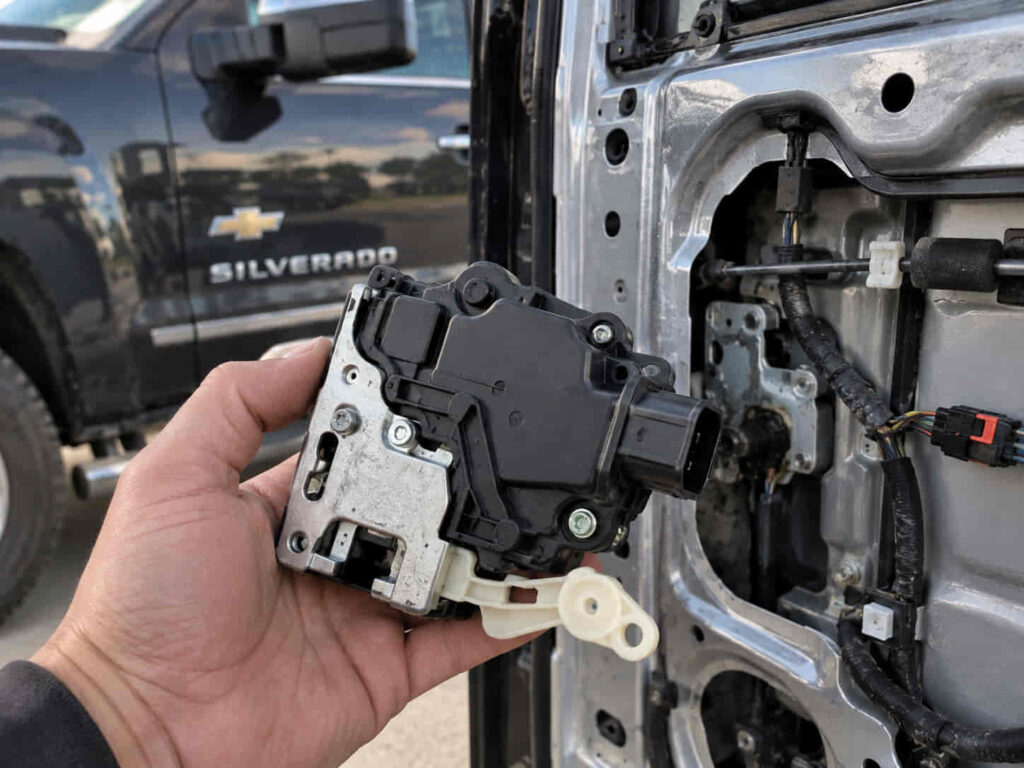
The Chevy Silverado door lock actuator is the electrically operated component that locks or unlocks the door when the power lock system receives a command from the door switch, key fob, or vehicle control system. When the actuator begins to fail, one of the most common results is a single door that will not lock or unlock electrically. The affected lock may also operate intermittently, move slowly, or make clicking or buzzing noises inside the door.
A door that does not respond to the power lock system does not automatically mean the actuator is bad. A blown fuse, damaged wiring, loose electrical connection, faulty door lock switch, mechanical latch problem, or control-system fault can produce similar symptoms. The failure pattern provides an important diagnostic clue: a problem isolated to one door points toward components and wiring associated with that door, while several locks failing together can indicate a shared electrical or control problem.
Diagnosing the problem before replacing parts helps prevent an unnecessary door lock actuator replacement. This guide explains how the Chevy Silverado door lock actuator works, the symptoms and causes of actuator failure, how to distinguish actuator problems from other power door lock faults, how the actuator is tested and replaced, replacement costs, and how to identify the correct actuator for a specific Silverado application.
What Does the Door Lock Actuator Do on a Chevy Silverado?
The door lock actuator converts an electrical lock or unlock command into the mechanical movement needed to change the position of the Chevy Silverado door lock. When the driver presses the power door lock switch or sends a lock command through the key fob, the vehicle’s electrical system sends the corresponding command to the locking mechanism. The actuator then moves the mechanism that places the door latch in its locked or unlocked state.
This relationship explains why an actuator problem can affect electrical locking without necessarily preventing every form of mechanical door operation. The actuator is responsible for producing movement, while the latch assembly is responsible for securing the door in the closed position. These components work together, so a failure inside the latch mechanism can sometimes produce symptoms that resemble a weak or failed actuator.
The door lock actuator is located inside the Silverado door behind the interior door panel, close to the latch mechanism at the rear edge of the door. Access therefore requires working inside the door rather than simply removing the exterior or interior handle. Depending on the Silverado application, the actuator may also be serviced in conjunction with the latch assembly rather than treated as an identical standalone component across every model year and door position.
For this reason, a replacement actuator should be identified according to the exact Silverado application. A part listed for one model year, door position, or latch configuration should not automatically be assumed to fit another Silverado. The vehicle application and the location of the failed lock should be established before a replacement part is ordered.
What Are the Symptoms of a Bad Chevy Silverado Door Lock Actuator?
A bad Chevy Silverado door lock actuator typically causes the affected door to stop locking or unlocking electrically, operate intermittently, move slowly, or make abnormal noises during a lock command. The strongest diagnostic pattern is often a problem limited to one door while the other power locks continue to operate normally. This pattern narrows the fault toward the affected door, although it does not prove that the actuator itself is responsible.
A Silverado door that locks but will not unlock, or unlocks but will not lock, can indicate an actuator or mechanical locking problem. The actuator must produce movement in response to an electrical command, and deterioration within the actuator or resistance within the connected mechanism can prevent normal movement. Diagnosis should still include the electrical circuit because damaged wiring or a poor connection can prevent the actuator from receiving the command required to operate.
Intermittent locking is another important symptom. An actuator approaching failure may work during one lock cycle and fail during another, while an electrical connection or wiring fault can create a similar pattern. The condition should therefore be reproduced several times using the available lock controls. Comparing the affected door with the remaining Silverado doors helps determine whether the failure is isolated or shared across the power door lock system.
Clicking, buzzing, or other abnormal sounds from inside the door can also accompany an actuator or latch problem. A sound indicates that activity is occurring inside the locking mechanism, but it does not by itself confirm which internal component has failed. An actuator may receive a command yet fail to produce enough mechanical movement to operate the lock correctly, while resistance or damage within the latch mechanism can also interfere with movement.
Slow lock movement provides a similar diagnostic clue. A healthy locking mechanism should respond consistently to the electrical command. Noticeably weak or delayed movement suggests that the actuator or associated mechanism is no longer operating normally, particularly when the other doors respond at normal speed. Electrical supply and mechanical resistance still need to be checked before the actuator is condemned.
Manual operation provides additional context. If the door can be locked and unlocked manually but fails when the power lock system is used, the problem is more closely associated with the electrical actuation system. The actuator remains a primary suspect when the fault affects only that door, but the connector, wiring, switch input, and other relevant electrical components must be considered before replacement.
The number of affected doors is especially useful for narrowing the diagnosis. One non-working lock points more strongly toward a door-specific actuator, wiring, connector, or mechanical problem, whereas several locks failing at the same time can indicate a shared power, input, wiring, or control-system fault. This distinction prevents a common diagnostic mistake: replacing an actuator simply because a Silverado door does not respond to the power lock command.
Read more: Honda CRV Fuel Filter
What Causes a Chevy Silverado Door Lock Actuator to Fail?
A Chevy Silverado door lock actuator fails when its electrical or mechanical components can no longer produce the movement required to lock and unlock the door correctly. Internal motor wear, mechanical wear, resistance in the latch mechanism, electrical connection problems, and repeated operating cycles are key failure mechanisms. These conditions can cause complete actuator failure or gradual symptoms such as slow, noisy, or intermittent lock operation.
Internal motor wear can reduce the actuator’s ability to move the locking mechanism. The actuator repeatedly changes electrical energy into mechanical movement each time the power lock system operates. As its internal components deteriorate, the actuator may continue receiving an electrical command but fail to generate consistent movement. This explains why a worn actuator can work intermittently before it stops operating completely.
Mechanical resistance can create a similar problem. The actuator does not operate independently from the door’s locking mechanism; it must move components associated with the latch and lock. Binding, wear, or damage within this mechanism can increase the force required for operation. An actuator that appears weak may therefore be reacting to excessive mechanical resistance rather than suffering from an isolated electrical failure.
Electrical problems can also prevent normal actuator operation without an internal actuator failure. A loose connector, damaged wiring, poor electrical connection, or inadequate power supply can interrupt the command reaching the actuator. The resulting symptom may look identical to a failed actuator because the door does not respond when the lock switch or key fob is used. Checking the circuit before replacement is therefore necessary when the cause has not already been established.
Repeated operating cycles and vehicle age can contribute to deterioration because the actuator and associated lock mechanism move every time the power lock is activated. The failure does not have to occur suddenly. Slow movement, intermittent operation, or changing noises can appear before complete loss of electrical locking. These progressive symptoms provide useful diagnostic information when they consistently occur at one door.
The cause should ultimately be identified as either an internal actuator problem, a mechanical problem that prevents normal movement, or an electrical problem that prevents the actuator from receiving or responding to the required command. Separating these failure categories is more useful than replacing the actuator based only on the observation that a door will not lock.
How Can You Tell if the Door Lock Actuator or Another Silverado Component Is Bad?
The door lock actuator becomes the primary suspect when the problem is isolated to one door, the associated lock mechanism can move correctly, and the actuator receives the required electrical command but does not operate normally. A door that simply fails to lock or unlock is not enough to confirm actuator failure because the fuse or power supply, wiring, electrical connector, door lock switch, mechanical latch, and vehicle control system can create overlapping symptoms.
Start by comparing the affected door with the other Silverado doors. If only one door fails while the remaining power locks respond normally to the same command, a system-wide power problem becomes less likely. Diagnostic attention can then move toward the actuator, connector, wiring, and mechanical components associated with the affected door. If several locks stop responding at the same time, shared electrical or control components require greater attention before individual actuators are replaced.
The way the lock responds to different commands provides another diagnostic distinction. A problem that occurs regardless of whether the lock command originates from the available power lock controls can point toward a fault downstream of those commands. In contrast, a failure associated with only one method of operating the locks can justify checking that input or its related control path before assuming the actuator is defective.
The electrical connector and wiring must also be considered when a single door fails. An actuator cannot operate without the appropriate electrical command. Damaged wiring or a poor connection can leave a functional actuator inactive or cause intermittent operation as the electrical connection changes. This is particularly important when the symptom changes as the door is opened, closed, or moved because that behavior can provide evidence of a wiring or connection problem.
Mechanical operation helps separate an actuator problem from a latch problem. If the locking mechanism binds or cannot move through its required range, replacing the actuator alone may not correct the underlying fault. The actuator depends on the associated mechanism being able to move normally. The latch and lock movement should therefore be evaluated as part of the diagnosis rather than treating every power-lock failure as an isolated motor problem.
A fuse or shared power-supply problem deserves more attention when multiple locks fail together. Because shared electrical faults can affect more than one door, the failure pattern itself becomes evidence. Replacing several actuators would not address a shared loss of power or control. The same principle applies to control-system faults: they should be considered when the pattern of failure extends beyond one isolated door and simpler electrical causes have been evaluated.
The most reliable diagnosis combines the failure pattern, mechanical condition, and electrical test results. If the Silverado door mechanism moves correctly, the relevant electrical command reaches the actuator, and the actuator still fails to lock or unlock the door correctly, actuator or actuator-assembly failure becomes the logical diagnostic conclusion. If the required command never reaches the actuator, the electrical circuit or control path should be diagnosed before the actuator is replaced.
How Do You Test a Chevy Silverado Door Lock Actuator?
To test a Chevy Silverado door lock actuator, first confirm the failure pattern, check the mechanical lock operation, inspect the electrical connection, and verify that the actuator receives the required electrical command when the lock is operated. An actuator that receives the correct command but does not move the locking mechanism normally is a stronger candidate for replacement than an actuator that receives no command at all.
Begin by operating the power locks several times and comparing the affected door with the other doors. Check whether the problem occurs during locking, unlocking, or both operations. A single door that repeatedly fails while the remaining locks respond normally indicates a localized problem. If several doors fail together, investigate shared power or control components before concentrating on one actuator.
Manual operation provides additional diagnostic information. Move the affected lock manually and determine whether the mechanism operates smoothly through its normal range. Binding, excessive resistance, or an abnormal latch condition can prevent the actuator from moving the lock even when the actuator itself is receiving power. The mechanical mechanism should therefore be evaluated before an electrical actuator is condemned.
The next stage is inspecting the actuator circuit. Access to the actuator generally requires removal of the interior door panel and sufficient access to the latch area. Inspect the actuator connector and accessible wiring for loose connections, damaged terminals, corrosion, or visible wire damage. An intermittent connection can cause the same slow or inconsistent operation that is often attributed to a worn actuator.
Electrical testing determines whether the actuator is receiving a lock or unlock command. A suitable electrical measuring tool can be used at the relevant circuit to verify the command while the power lock is operated. The exact connector terminals, wire colors, polarity behavior, and test procedure can vary by Silverado model year and door configuration, so those specifications should be taken from the appropriate wiring diagram or service information rather than assumed to be universal across Silverado generations.
The test result separates actuator failure from an upstream electrical fault. If the required command reaches the actuator and the associated mechanism is free to move, but the actuator remains inactive, weak, intermittent, or unable to complete the lock movement, the actuator or integrated latch-actuator assembly becomes the primary failure point. If the required command is absent, continue diagnosing the wiring, connector, power supply, switch input, or control circuit instead of replacing the actuator.
This diagnostic sequence prevents parts replacement from becoming the test itself. A new actuator will not correct damaged wiring, a missing electrical command, or a mechanically binding latch. Confirming electrical input and mechanical movement before replacement provides a more reliable diagnosis.
How Do You Replace a Chevy Silverado Door Lock Actuator?
To replace a Chevy Silverado door lock actuator, remove the interior door panel, access the actuator and latch area, disconnect the necessary electrical and mechanical connections, remove the failed component, install the compatible replacement, and test the power lock before completing reassembly. The exact removal procedure varies by model year, door position, cab configuration, and whether the application services the actuator separately or as part of a latch assembly.
Start by confirming which door has failed and identifying the correct replacement component for that position. A front driver-side application should not be assumed to use the same component as a front passenger or rear door. Matching the replacement by exact vehicle application and part identification before disassembly reduces the risk of discovering a fitment difference after the original assembly has been removed.
The interior door panel must then be removed carefully enough to access the internal locking components. Door trim can incorporate switches, electrical connectors, handles, cables, retaining clips, and other components depending on the Silverado configuration. These connections should be identified during disassembly so they can be returned to their original positions without damaging trim or wiring.
Once the inside of the door is accessible, locate the actuator in relation to the door latch. Disconnect the appropriate electrical connector and release the mechanical connections required for removal. The actuator and latch interact with the locking and opening mechanisms, so the position of rods, cables, clips, and related connections should be noted before they are detached. Incorrect reconnection can create a door that locks electrically but does not operate correctly from one of its handles or lock controls.
Remove the failed actuator or applicable latch-actuator assembly according to the configuration used on that Silverado. Install the replacement in the same operating position and reconnect the electrical connector and mechanical linkages securely. The mechanism should move without binding, and wiring should be routed so it is not pinched or placed where normal window or door movement can damage it.
Test the replacement before fully reinstalling the door trim. Operate the lock and unlock functions several times and verify that the affected door responds consistently. Confirm that the inside and outside door-opening functions operate correctly and that the latch releases and secures the door as intended. Testing at this stage makes correcting an installation problem easier because the internal components remain accessible.
Complete the repair only after both electrical locking and mechanical door operation have been verified. Reinstall the removed door components, reconnect the relevant switches and electrical connections, and secure the trim panel in its original position. Perform a final lock, unlock, open, and close check after reassembly to confirm that the repair has restored normal door operation.
Replacement difficulty depends on the exact Silverado configuration rather than on the actuator alone. The repair requires access inside the door and correct handling of trim, electrical connectors, and latch-related components. A DIY replacement is therefore most appropriate when the failure has already been diagnosed, the correct replacement part has been identified, and model-specific repair information is available.
How Much Does Chevy Silverado Door Lock Actuator Replacement Cost?
The cost to replace a Chevy Silverado door lock actuator depends on the replacement part, labor required for the specific door, and whether the actuator is serviced separately or with the door latch assembly. There is no single replacement price that accurately applies to every Silverado because model year, door position, part design, labor rate, and the choice between OEM and aftermarket components can change the total repair cost.
The replacement part is the first component of the total cost. An actuator sold as an individual component can have a different price from an integrated latch and actuator assembly. Front and rear doors may also use different components, while driver-side and passenger-side applications can require position-specific parts. Comparing prices without first matching the exact application can therefore produce an inaccurate estimate.
OEM and aftermarket parts create another price difference. An OEM replacement is designed around the original vehicle application and part specification, while aftermarket manufacturers can offer compatible alternatives at different price points. Price alone does not establish whether a component is the correct choice. Fitment, connector configuration, door position, part number, and the specific Silverado application should be verified before comparing replacement options.
Labor cost depends primarily on the amount of disassembly and access required. Replacing the actuator involves working behind the interior door panel and disconnecting electrical and mechanical components associated with the lock and latch. Labor can increase when additional components must be removed for access or when the actuator is integrated into an assembly that requires more extensive removal.
Diagnostic labor can also affect the final repair bill. A door that will not lock does not establish actuator failure by itself, so a repair facility may first test the power lock system, wiring, connector, latch movement, and actuator input. This adds diagnostic cost but can prevent replacement of a functional actuator when the actual fault is elsewhere in the circuit.
A useful Silverado door lock actuator estimate should therefore separate parts, diagnosis, and installation labor rather than presenting one universal number. The most accurate estimate requires the Silverado model year, affected door position, replacement-part configuration, and local labor rate. These variables explain why two Silverado owners with the same basic symptom can receive different replacement estimates.
Which Door Lock Actuator Fits Your Chevy Silverado?
The correct Chevy Silverado door lock actuator is determined by the exact vehicle application and the position of the affected door, not by the Silverado name alone. Model year, Silverado model, cab and door configuration where applicable, front or rear position, driver or passenger side, and the relevant part number can all affect compatibility.
Model year is one of the first identifiers to verify because Silverado door systems have changed across vehicle generations and applications. A component that fits one production range should not be assumed to fit an earlier or later truck simply because both vehicles carry the Silverado name. Product listings that specify a year range should be checked against the exact vehicle rather than treated as universal Silverado compatibility.
Door position is equally important. The front driver door, front passenger door, and rear doors perform the same basic locking function, but this does not mean their actuator or latch assemblies are physically interchangeable. Mounting points, mechanical connections, electrical connectors, lock-cylinder relationships, and latch configurations can differ according to position.
Driver-side and passenger-side parts should also be treated as position-specific unless the replacement manufacturer or verified application data explicitly identifies them as interchangeable. A component can look similar in photographs while using a mirrored housing, different linkage arrangement, or different mounting configuration. Visual similarity is therefore weaker evidence of fitment than an application listing or matching part number.
Part-number verification provides a stronger compatibility check. When the original component can be identified, its part number or superseding replacement information can be compared with the replacement part. A parts catalog can then be used to confirm that the component is listed for the specific Silverado year, configuration, and door position. VIN-based catalog information can provide additional application detail when a model has multiple configurations.
Connector and physical configuration should be checked before installation even when a replacement is listed as compatible. The electrical connector, mounting locations, linkage arrangement, and overall actuator or latch configuration should correspond with the component being removed. A mismatch discovered before installation is easier to correct than one found after the door has been reassembled.
The most reliable fitment process moves from vehicle identification to door position and then to part-number verification. Identify the exact Silverado application first, establish whether the failed component is in the front or rear and on the driver or passenger side, and then verify the replacement through reliable application data. This approach reduces incorrect orders and prevents the assumption that one Chevy Silverado door lock actuator fits every door and model year.
Can You Drive a Chevy Silverado With a Bad Door Lock Actuator?
A Chevy Silverado can generally still be driven when a door lock actuator fails because the actuator controls the locking mechanism rather than the systems responsible for engine operation, steering, braking, or vehicle propulsion. However, the failed actuator can create a security or access problem if the affected door cannot be reliably locked or unlocked.
The practical effect depends on how the actuator has failed. A door that still opens, closes, and latches securely but no longer responds to the power lock command presents a different problem from a door with a binding or damaged latch mechanism. The first condition primarily affects power locking, while the second requires additional attention because the actuator and latch operate as related parts of the door mechanism.
Manual operation should also be checked before continuing to use the truck with a failed power lock. If the affected door can be securely closed and locked manually, the owner may retain basic locking functionality until the actuator is repaired. If the door cannot be secured, opened normally, or reliably latched, the problem extends beyond the inconvenience of a failed power lock and the complete door mechanism should be inspected.
A failed actuator should therefore be evaluated according to its effect on the affected door rather than its effect on vehicle propulsion. The key distinction is whether the problem is limited to electrical locking or also interferes with the latch, handles, or ability to secure the door.
Can You Manually Lock a Chevy Silverado if the Door Lock Actuator Is Bad?
A Chevy Silverado door may still be manually locked when the power door lock actuator is bad, provided the mechanical lock and latch components remain functional. An actuator failure can prevent electrical operation without necessarily eliminating every mechanical method of changing the lock position.
This distinction occurs because power locking and mechanical locking are related but not identical functions. The actuator supplies powered movement to the locking mechanism. If the actuator loses electrical or internal mechanical operation while the remaining lock mechanism can still move, manual operation may continue to work.
Manual locking is also useful as a diagnostic observation. A lock that moves normally by hand but consistently fails to respond to an electrical command directs attention toward the actuator and its electrical circuit. A lock that is difficult or impossible to move manually provides evidence that the latch or associated mechanical components may also be binding or damaged.
Manual operation should not be forced when the mechanism resists movement. Excessive resistance indicates that the problem may not be limited to the actuator, and applying additional force does not identify the underlying failure. The mechanical condition should be inspected before an actuator is replaced when the lock does not move through its expected range.
Why Do Multiple Chevy Silverado Door Locks Stop Working at the Same Time?
Multiple Chevy Silverado door locks failing at the same time point more strongly toward a shared electrical or control problem than several independent actuator failures occurring simultaneously. The power door lock system contains components and electrical paths that can influence more than one door, so the number of affected locks is an important diagnostic clue.
An isolated failure and a system-wide failure should therefore be approached differently. When one door stops operating while the remaining locks work normally, components specific to that door deserve greater attention. These include its actuator, electrical connector, local wiring, and mechanical lock or latch components. When several doors stop responding together, diagnosis should move toward components or circuits shared by those doors.
The failure pattern should also be compared across the available lock commands. If multiple doors fail regardless of how the power lock command is requested, the diagnostic path differs from a situation in which the locks work from one control but not another. This comparison helps establish whether the fault is associated with an input, an individual door circuit, or a broader part of the locking system.
Shared power supply, wiring, connections, and vehicle control functions should therefore be evaluated before replacing multiple door lock actuators. The exact circuit architecture depends on the Silverado model year and configuration, so model-specific wiring information is required for detailed electrical diagnosis. The important diagnostic principle remains consistent: several locks failing together require investigation of their shared system before assuming several actuators failed independently.
Should You Replace a Chevy Silverado Door Lock Actuator Yourself?
A Chevy Silverado door lock actuator can be replaced as a DIY repair when the failure has been correctly diagnosed, the correct replacement component has been identified, and the person performing the repair can safely remove the door trim and reconnect the electrical and mechanical components. The repair becomes less suitable for trial-and-error replacement when the underlying fault has not been confirmed.
Diagnosis is the first requirement because replacement does not correct a missing electrical command, damaged wiring, or a binding latch. Testing should establish whether the actuator or applicable actuator-latch assembly is actually responsible. Replacing the component solely because the power lock does not work can add cost without solving the original problem.
Correct part identification is the second requirement. Silverado applications can differ according to model year and door position, and a replacement should be matched to the affected vehicle rather than selected from appearance alone. Confirming fitment before the door is disassembled reduces the possibility of installing an incompatible actuator or discovering that the replacement configuration differs from the original component.
Access and reassembly are the third consideration. The repair requires work behind the interior door panel and can involve trim retainers, electrical connectors, mechanical linkages, cables, or latch-related components. These parts must return to their correct positions so the door can lock, unlock, open, close, and latch normally after the repair.
DIY replacement is therefore most appropriate when diagnosis, fitment information, appropriate tools, and model-specific repair information are available. Professional diagnosis or repair becomes more appropriate when the electrical fault has not been isolated, the mechanical latch is binding, several door locks have failed together, or the person performing the repair cannot verify the required electrical and mechanical connections.