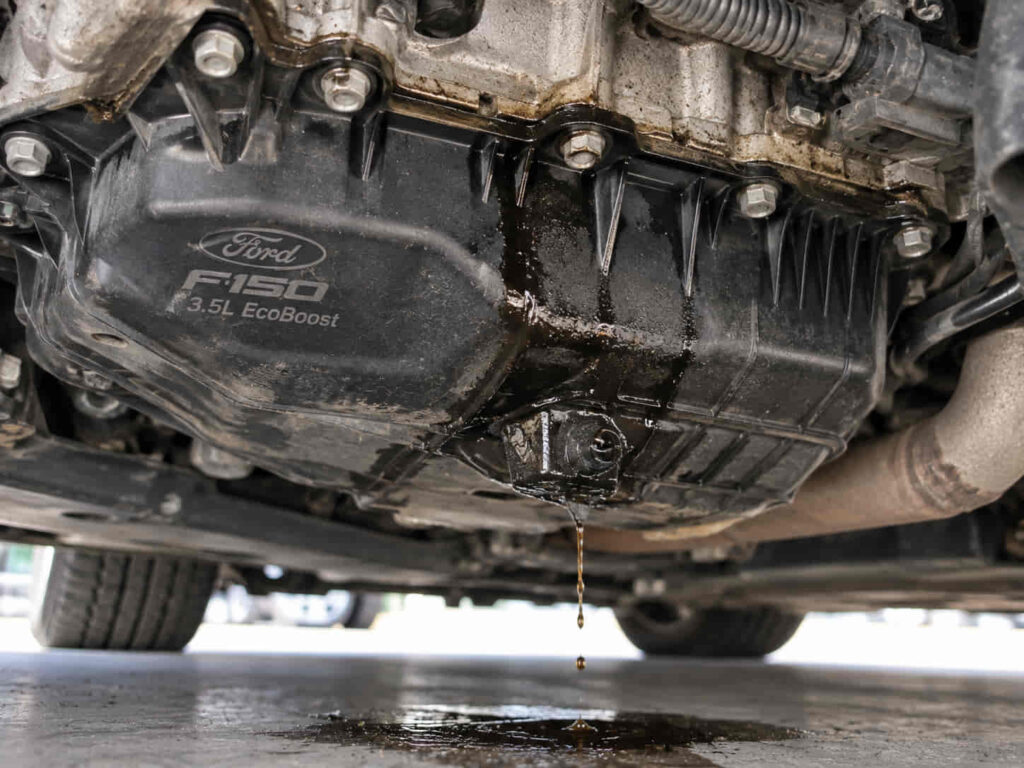
A Ford F150 plastic oil pan leak can come from the oil pan, its sealing area, or another engine oil leak that runs down and collects around the pan. Oil visible on the bottom of the plastic or composite oil pan does not prove that the pan itself has failed. The actual source must be identified before deciding whether the correct repair is resealing an affected area, repairing the drain area, replacing a damaged oil pan, or fixing a leak located higher on the engine.
Correct diagnosis starts by determining where fresh oil first appears. Engine oil can travel across engine surfaces and move downward under gravity, while airflow beneath a moving truck can spread the oil farther from its original source. This can make an oil pan appear to be leaking even when the leak begins somewhere above it. Replacing the pan without confirming the source can therefore result in an unnecessary repair while the original leak remains.
The severity of an F150 oil leak also depends on the rate of oil loss and whether the engine can maintain the correct oil level and lubrication. This guide explains what causes a Ford F150 plastic oil pan leak, how to recognize and confirm the leak source, when the truck should not be driven, how the problem is repaired, when oil pan replacement is justified, and what determines the final repair cost.
What Causes a Ford F150 Plastic Oil Pan to Leak?
A Ford F150 plastic oil pan can leak when the sealing interface no longer contains engine oil correctly, the pan or drain area is damaged, or a previous installation fails to create a reliable seal. Oil found around the pan can also originate elsewhere on the engine and travel downward, so visible oil on the plastic pan should be treated as evidence of an engine oil leak rather than immediate proof that the pan itself has failed.
A sealing problem develops when oil finds a path between surfaces that are intended to remain sealed. The leak may begin as light wetness around part of the sealing area and become more visible as fresh oil accumulates. The condition of the mating surfaces and the procedure used during a previous repair matter because an oil pan must maintain a consistent seal around its interface with the engine. When diagnosis shows fresh oil beginning at that interface, the sealing area becomes a direct repair target.
Physical damage to the plastic or composite oil pan can also create an oil-loss path. The pan sits low on the vehicle and can be exposed to road debris or underbody contact, although the exact level of exposure depends on the truck and its configuration. Damage should be confirmed visually rather than assumed from the material alone. A crack, damaged sealing area, or other structural defect that allows fresh engine oil to escape provides stronger evidence for pan replacement than the simple fact that the F150 uses a plastic oil pan.
The drain area is another location that should be inspected when oil appears near the bottom of the pan. Oil concentrated around this area can indicate a problem associated with the drain interface rather than the perimeter of the oil pan. The diagnostic distinction matters because repairing the wrong area will not stop the leak. Fresh oil should be traced to the point where it first emerges before a repair decision is made.
A previous oil pan repair can contribute to another leak when the underlying sealing problem was not corrected or the installation did not restore the sealing interface properly. Surface condition, component condition, installation procedure, and the specifications applicable to the particular engine all affect the repair. Ford F150 model years and engines should not be treated as mechanically identical, so the correct service procedure needs to match the vehicle being repaired.
The plastic oil pan may not be the source at all when oil begins higher on the engine. Engine oil follows gravity across surfaces, and airflow underneath a moving F150 can spread it rearward or across adjacent components. The lowest or wettest location can therefore contain the most oil without being the point where the leak started. Cleaning the contaminated area and locating the first appearance of fresh oil is more reliable than replacing the component where old oil has accumulated.
What Are the Symptoms of a Ford F150 Plastic Oil Pan Leak?
The main signs associated with a Ford F150 oil pan leak are fresh oil around the pan or sealing area, oil accumulating underneath the truck, and a measurable loss of engine oil over time. A larger leak can eventually affect the engine’s ability to maintain an adequate oil level, making early identification of the source more important than judging the problem only by the size of an oil spot on the ground.
Visible wetness around the oil pan is often the first reason an owner suspects a plastic oil pan leak. Fresh wet oil provides more useful diagnostic information than old grime because accumulated residue can remain long after an earlier leak or spill occurred. The location also matters. Oil beginning at the pan’s sealing interface or a visibly damaged area supports an oil-pan-related diagnosis, while oil trails extending down from above indicate that another source must be investigated.
Oil spots beneath the F150 confirm that fluid is reaching the ground but do not identify where the leak begins. Oil can move across the engine and underbody before dripping from a lower component. The position of a spot relative to the oil pan is therefore insufficient evidence for replacing the pan. The engine and surrounding surfaces should be inspected for the highest point at which fresh oil appears.
A declining engine oil level provides stronger evidence that the leak is producing measurable oil loss. The rate of change is more important than a single observation because an active leak that repeatedly lowers the oil level presents a different lubrication risk from light surface seepage with no readily measurable loss. Checking the level correctly and monitoring it over time helps establish whether the condition is stable or progressing.
A burning-oil smell can occur when leaking oil reaches a sufficiently hot surface, but the odor does not specifically diagnose the plastic oil pan. The smell identifies a reason for further inspection because oil may be traveling from another part of the engine before contacting the hot component. Smoke, rapidly increasing oil loss, or other abnormal engine indications make prompt diagnosis more important.
Oil-pressure warnings require a different level of attention from ordinary external wetness. An oil pressure warning should not be interpreted merely as another symptom confirming an oil pan seal leak because lubrication pressure can be affected by conditions that require separate diagnosis. The safest diagnostic conclusion is that visible oil identifies a leak to investigate, while the origin of fresh oil identifies the component that actually needs repair.
Read more: P0324 Chevy Silverado
How Serious Is a Plastic Oil Pan Leak on a Ford F150?
A Ford F150 plastic oil pan leak becomes serious when the rate of oil loss prevents the engine from maintaining an adequate oil level or creates other signs of a lubrication problem. Light external wetness and rapid oil loss should not be treated as the same condition. The practical severity depends on how quickly oil is escaping, whether the oil level continues to fall, and whether the truck develops an oil warning or other abnormal symptoms.
A small amount of oil around the pan requires diagnosis even when no puddle forms underneath the truck. External wetness can represent an early-stage leak, residual oil from previous service, or oil traveling from another location. Monitoring the engine oil level helps establish whether the condition is producing measurable oil loss, while cleaning and reinspecting the affected area helps determine whether fresh oil continues to appear.
An active leak requires greater attention when oil repeatedly reaches the ground or the engine oil level falls between checks. The lubrication system depends on maintaining an adequate supply of oil, so repeatedly adding oil without identifying the source does not repair the condition. The faster the oil level declines, the less appropriate it becomes to continue operating the truck without diagnosis.
A Ford F150 with minor external oil wetness and a correct, stable oil level presents a different situation from a truck losing oil rapidly. However, there is no universal mileage or driving-time limit that makes a leaking oil pan safe to ignore. Leak rate can change, and the visible amount of oil underneath the truck does not precisely measure how much oil remains in the engine.
Driving should not continue merely on the assumption that an oil leak is minor when an oil-pressure warning appears or the engine develops abnormal lubrication-related symptoms. An oil-pressure warning also should not be diagnosed automatically as a plastic oil pan leak because other faults can affect engine lubrication. The warning changes the urgency of the situation and requires the underlying condition to be identified rather than simply topping up the oil and continuing to drive.
The useful distinction is therefore between the presence of a leak and its effect on engine lubrication. An external oil leak needs repair, while an oil leak associated with significant oil loss or lubrication warnings requires more urgent attention. Checking the oil level and identifying the actual leak source provides more useful information than judging severity from the appearance of the plastic pan alone.
How Do You Confirm the Plastic Oil Pan Is Actually Leaking?
To confirm a Ford F150 plastic oil pan leak, clean the oil-contaminated area and trace fresh oil to the highest or earliest point where it appears instead of assuming the wettest part of the pan is the source. The diagnostic objective is to find where oil exits the engine, not where gravity and airflow eventually cause it to accumulate.
Start with the engine oil level because it establishes whether measurable oil loss is occurring and provides context for the inspection. The contaminated areas around the oil pan and nearby engine surfaces then need to be examined carefully. When old oil and road debris cover several components, the existing residue can obscure the path of a current leak. Cleaning the area makes new oil easier to distinguish from contamination left by an earlier leak, spill, or repair.
Fresh oil appearing directly along the oil pan sealing interface provides evidence that the sealing area requires closer investigation. The inspection should follow the interface rather than focusing only on the lowest edge, because oil can travel along adjoining surfaces before forming a drop. The same principle applies to the drain area. Oil originating there points the diagnosis toward that interface instead of automatically indicating a failure around the perimeter of the pan.
The plastic pan itself should be inspected for physical damage. A confirmed crack or another structural defect that releases fresh oil provides direct evidence that the pan is part of the failure. Surface oil without visible damage does not provide the same evidence because the fluid may have arrived from another location. The distinction matters when deciding between repairing a sealing problem and replacing the pan.
The engine above the oil pan must also be inspected before the pan is condemned. Oil leaking from a higher point can move downward across the engine and collect around the pan. Airflow while driving can alter the path further, making the final drip location different from the original leak point. This explains why diagnosing a leak solely from a puddle position or the wettest component can lead to replacing a part that was never leaking.
When the origin remains difficult to identify after cleaning, the area should be reinspected for fresh leakage under appropriate operating conditions. The first new wet point provides more diagnostic value than old accumulated oil. Any additional leak-detection method should be used according to the applicable repair procedure rather than as a substitute for tracing the actual source.
Model year and engine configuration should be established before moving from inspection to disassembly. Ford F150 engines can differ in oil pan design, component arrangement, accessibility, and service procedure. A diagnosis may establish that oil begins at the pan, but the correct repair still depends on the configuration installed in that particular truck.
The plastic oil pan is confirmed as the leak source only when fresh oil can be traced back to the pan, its sealing interface, or another pan-related failure point. Oil merely coating the pan is not enough. This source-first diagnostic approach prevents an unnecessary oil pan replacement and reduces the chance that the original leak will remain after the repair.
How Do You Fix a Ford F150 Plastic Oil Pan Leak?
To fix a Ford F150 plastic oil pan leak, repair the confirmed source of fresh oil rather than replacing the pan solely because oil has accumulated around it. The correct repair depends on whether the leak originates at the oil pan sealing interface, the drain area, physical damage to the pan, or another engine component located above the pan. Diagnosis therefore determines the repair method.
A leak confirmed at the oil pan sealing interface requires the affected sealing area to be restored according to the service procedure for the specific F150 engine. The objective is to create a continuous, reliable seal between the oil pan and its mating surface. Removing the pan and reinstalling it without correcting the condition responsible for the failed seal can allow the leak to return. The mating surfaces, condition of the pan, sealing method, and installation procedure all need to support a proper seal before the repair is considered complete.
Surface preparation is particularly important when the repair procedure requires the sealing interface to be serviced. Oil, contamination, damaged sealing material, or an unsuitable mating surface can prevent the repaired joint from sealing correctly. The applicable Ford service procedure should determine the preparation method, sealing product when required, application pattern, installation sequence, and curing requirements. These details should not be generalized across every F150 because engine and oil pan designs can differ by model year and powertrain.
A leak originating around the drain area requires a different repair. The technician should determine which part of that interface is allowing oil to escape before replacing the entire pan. Damage to the pan at the drain location changes the repair decision, while a problem confined to another serviceable part of the drain interface may require a more limited repair. The presence of oil around the drain area alone does not establish which component has failed.
Physical damage to the plastic oil pan can justify replacement when the damage creates an oil path or prevents the pan from sealing correctly. A crack that releases fresh oil is fundamentally different from superficial staining or oil that has traveled onto the pan from above. Replacement should therefore follow confirmation of structural damage rather than an assumption that a plastic pan is defective because its exterior is wet.
The repair must move away from the oil pan entirely when fresh oil is traced to a higher engine component. In that situation, resealing or replacing the pan treats the location where oil accumulated instead of the location where the leak began. The actual source should be repaired first, followed by cleaning of the contaminated surfaces and reinspection for fresh oil. This prevents residual oil from being mistaken for a failed repair.
The final step is verification. After the confirmed source has been repaired, the engine oil level should be correct and the previously contaminated area should be clean enough to reveal new leakage. Reinspection after appropriate operation determines whether fresh oil is still escaping. A successful Ford F150 oil leak repair is established by stopping oil at its original source, not simply by making the plastic oil pan appear dry immediately after service.
Does a Leaking Ford F150 Plastic Oil Pan Need to Be Replaced?
Not every leaking Ford F150 plastic oil pan needs to be replaced because the correct repair depends on where the oil originates and whether the pan itself is damaged. Oil pan replacement is justified when diagnosis identifies a pan condition that cannot maintain the required seal, while leaks originating elsewhere should be repaired at their actual source.
A confirmed structural failure provides the clearest reason to replace the pan. If the plastic or composite pan has a crack or another defect that allows engine oil to escape, correcting only the surrounding sealing area will not remove the oil path through the damaged component. Replacement restores the physical barrier responsible for containing oil, provided the new pan is installed according to the applicable procedure.
Replacement can also become necessary when damage prevents the oil pan from forming the required sealing interface with the engine. A sealing problem and a damaged pan are not necessarily the same diagnosis. When the pan remains serviceable and the applicable repair procedure allows the sealing interface to be restored, the repair decision may differ from a case in which the pan itself can no longer seal correctly.
Oil found on an undamaged pan is not a sufficient reason for replacement. A leak beginning higher on the engine can coat the pan, crossmember, underbody, and nearby components before reaching the ground. Installing a new oil pan in this situation leaves the original oil leak untouched. Cleaning the engine and tracing fresh oil to its origin should therefore occur before a replacement pan is ordered.
Previous repair history also needs context. Oil appearing after an oil pan repair does not automatically prove that the replacement pan has failed. The original leak may have been misidentified, another leak may exist, the sealing interface may require further diagnosis, or residual oil may still be draining from contaminated surfaces. Fresh leakage should be located again before repeating the same repair.
The replacement decision should ultimately follow three pieces of evidence: the confirmed origin of fresh oil, the physical condition of the pan, and the service procedure for the specific F150 engine. Replace the plastic oil pan when diagnosis shows that the pan itself cannot contain oil or maintain the required seal; do not replace it merely because it is the lowest oil-covered component on the engine.
How Much Does It Cost to Fix a Ford F150 Plastic Oil Pan Leak?
The cost to fix a Ford F150 plastic oil pan leak depends on the confirmed source of the leak, the engine configuration, the parts required, and the labor needed to access and repair the affected area. A leak that requires correcting a localized sealing or drain-area problem can involve a different repair scope from a damaged plastic oil pan that requires replacement. For this reason, an accurate estimate should follow diagnosis rather than be based on visible oil around the pan alone.
Diagnostic labor is part of the repair cost when the source has not been confirmed. A technician may need to clean accumulated oil, inspect the engine above and around the pan, monitor where fresh oil first appears, and determine whether the sealing interface, drain area, pan itself, or another component is responsible. This diagnostic work can prevent a more expensive mistake in which the plastic oil pan is replaced but the original leak remains.
Labor becomes a major cost variable when the oil pan needs to be removed or replaced. Ford F150 trucks have been produced with different engines and component arrangements, so access to the pan and the required service procedure should not be assumed to be identical across all model years. The amount of disassembly required directly affects labor time even when two trucks show similar external oil leakage.
Parts cost also depends on the diagnosed repair. A confirmed damaged pan can require a replacement oil pan and other materials specified by the applicable service procedure, while a leak originating elsewhere requires parts associated with that source instead. Engine oil and other service materials may also become part of the repair when the procedure requires draining and refilling the lubrication system.
A previous diagnosis can influence the final cost as well. Replacing the oil pan before establishing the source can add the price of a component and labor without eliminating the leak. The truck then still requires diagnosis and a second repair. The least expensive repair is not necessarily the repair with the lowest initial quote; it is the repair that correctly identifies and fixes the oil leak without unnecessary parts replacement.
A precise estimate should therefore identify the F150’s model year, engine, confirmed leak source, required parts, and expected labor before calculating the total. A generic “Ford F150 plastic oil pan leak cost” cannot reliably represent every truck because the same visible symptom can result from different failures and different repair procedures.
Why Can a Ford F150 Still Leak Oil After the Oil Pan Is Repaired?
A Ford F150 can continue to show oil after an oil pan repair when the original leak source was misidentified, the repaired sealing area still leaks, another oil leak exists, or residual oil remains on contaminated engine and underbody surfaces. The return of visible oil should trigger another source inspection rather than an automatic second oil pan replacement.
Misdiagnosis is one explanation when the pan was wet before the original repair but fresh oil was never traced to its starting point. Oil originating higher on the engine can run downward and collect around the pan, making the lowest component appear responsible. Replacing or resealing the pan in this situation changes nothing about the actual leak. Fresh oil will eventually coat the repaired pan again because its source remains above it.
The repaired sealing interface also needs to be considered when fresh oil can be traced directly back to that area. A reliable seal depends on the condition of the mating surfaces and completion of the correct installation procedure for the particular engine. When fresh oil begins at the repaired interface, diagnosis should focus on why that seal is not containing oil instead of assuming that every post-repair leak comes from another component.
More than one engine oil leak can exist at the same time. Repairing a confirmed oil pan leak eliminates that specific oil path but does not automatically correct a separate leak elsewhere on the engine. Cleaning the area after repair is therefore important because it allows new oil to be distinguished from contamination associated with the original problem.
Residual oil can create a false impression that the repair failed. Oil trapped on surrounding components, shields, crossmembers, or other underbody surfaces can continue to drip after the original source has been corrected. The important evidence is whether new oil continues to emerge from an active leak point after contaminated surfaces have been cleaned.
Post-repair diagnosis should therefore follow the same source-first principle used during the initial inspection. Clean the affected area, establish the correct oil level, observe where fresh oil first appears, and compare that location with the component that was previously repaired. A repaired Ford F150 oil pan should only be blamed for a recurring leak when fresh oil can be traced back to the pan or its repaired sealing area.
How Can You Prevent Another Ford F150 Oil Pan Leak?
The best way to prevent another Ford F150 oil pan leak is to correct the original failure completely, install or seal the oil pan according to the procedure for the specific engine, and verify that no fresh oil appears after the repair. Preventing recurrence depends on eliminating the mechanism that caused the leak rather than repeatedly cleaning the pan or adding engine oil when the level drops.
A sealing-related repair needs to restore the complete sealing interface. The condition of the mating surfaces, the pan, and the sealing method all influence whether the repaired joint can contain engine oil. When the applicable procedure requires specific surface preparation, sealing material, installation steps, or curing conditions, those requirements should be followed for the particular F150 engine. Applying a generic procedure to different oil pan designs can create another sealing problem instead of preventing one.
The plastic oil pan should also be inspected for damage before it is reused during a repair. Resealing a component that cannot maintain the required sealing interface does not address the physical reason for the leak. Conversely, replacing an undamaged pan does not prevent recurrence when the actual oil source is another engine component. The repair decision must continue to follow the confirmed source and condition of the component.
The drain area should remain part of routine observation after engine oil service because leakage appearing there needs to be distinguished from a perimeter or sealing-interface leak. Any problem discovered after service should be diagnosed at that location instead of assuming that the entire plastic pan has failed. Correct handling of the applicable drain components and following the vehicle-specific service procedure reduce the risk of creating a new leak during maintenance.
Post-repair inspection provides the clearest evidence that the problem has been resolved. Oil-contaminated surfaces should be cleaned so that new leakage can be identified, and the engine oil level should be checked after the repair according to the appropriate procedure. Reinspect the repaired area for fresh oil after the truck has operated under suitable conditions. A dry sealing area with a stable oil level provides stronger evidence of a successful repair than the absence of an immediate puddle beneath the truck.
General engine maintenance should not be presented as a guaranteed method for preventing a plastic oil pan leak when it does not address the failure mechanism. Preventing recurrence requires three things: an accurate diagnosis of the original oil source, a repair that follows the correct procedure for that F150 engine, and post-repair verification that fresh oil no longer escapes. This source-first approach reduces both repeat leaks and unnecessary oil pan replacement.